WTF Happened in 2023?
notboring.coI've long thought any supposed economic/technological stagnation was illusory, or at least greatly overstated. The third industrial revolution began several decades ago and we're now in the middle of it. I like to stay grounded so I look at basic metrics. Pick almost any raw resource or simple good, and its extraction or production is through the roof, while the energy intensity to obtain it is decreasing.
In fact most trends become quite preposterous, sooner rather than later. (Whole planet turned into ICs by the 22nd century, at this rate.) So all manner of wildness is sure to soon happen. This is certainly not stagnation, whatever it will ultimately mean:
https://upload.wikimedia.org/wikipedia/commons/f/f9/Copper_-...

https://upload.wikimedia.org/wikipedia/commons/4/43/Zinc_wor...

https://upload.wikimedia.org/wikipedia/commons/5/58/Nickel_w...

https://upload.wikimedia.org/wikipedia/commons/9/96/Aluminiu...
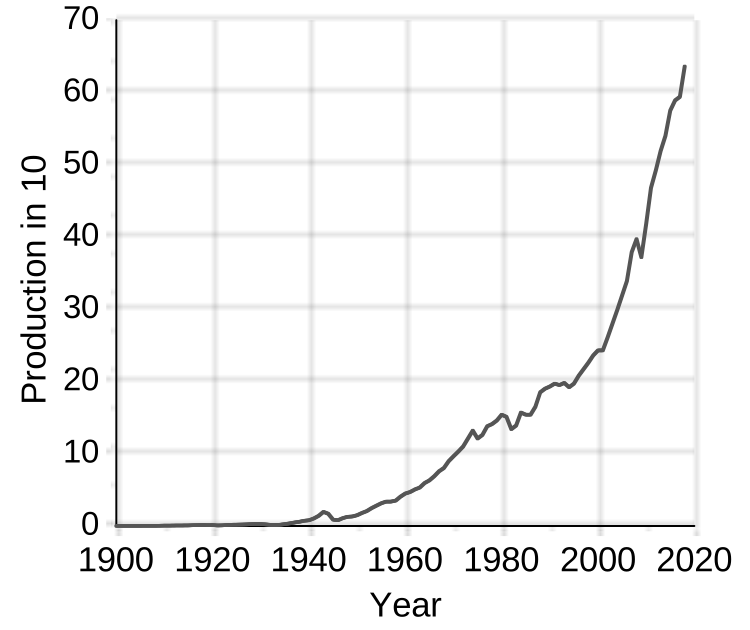
https://upload.wikimedia.org/wikipedia/commons/4/48/Vanadium...

> while the energy intensity to obtain it is decreasing.
Correct. Infinite Growth being the north star here, but it's not sustainable indefinitely.
Expansion into space would help mitigate a lot of things, and the more population pressure, with the accompanying increase in labour, the more likely that expansion is to take place.
https://www.dailymail.co.uk/sciencetech/article-12318767/NAS...
Expanding into space consumes exponentially more energy than doing the same things on Earth.
It's basically just wishful thinking and hand-waving away physics until we actually crack fusion and more or less free near-infinite energy.
Until then, it's just a pipe dream by techno-optimists.
Who wants to go live on Mars, really? Spoiler: you can't survive outdoor, there are no animals there, no trees, no flowers, it's basically a big desert.
Wanna go further? Proxima Centauri (the next star) is really, really far. Actually even a lot further than that. We definitely won't go there, unless we discover completely new physics (but it does not seem rational to count on that). So it's either Mars, or something that looks like Mars (I don't know, Venus maybe?), or living in a spaceship. Which is a bit like living on Mars, but worse.
Let's try to survive on Earth first, shall we? Because right now we (as a species) are failing. And not because of external factors: just because of us.
> Expansion into space would help mitigate a lot of things, and the more population pressure, with the accompanying increase in labour, the more likely that expansion is to take place.
How can expansion into space mitigate pressure on Earth in any meaningful way?
I agree that stagnation was illusory and to me it feels like not only the midst of the third Industrial Revolution, but also the start of the third technological revolution. The first ending in 2000 and the second ending in 2021-2022.
Accelerate.
What? I get that optimism feels nice, but... resources on Earth are limited, and we are starting to feel it (actually for conventional oil, the peak was in 2008, and Europe's economy has been feeling it since then). Extracting metals gets more and more expensive and harder.
Renewables are extremely far from looking like they could remotely replace fossil fuels, and given that building nuclear plants takes decades, it's starting to be short on that end too.
More fossil energy is definitely not good: it's killing us (literally), and it will get worse.
It's really not clear at all, today, that we will be able to replace fossil fuels entirely with renewable energy (meaning that we are likely to face a forced degrowth). And anyway, the more energy we have, the more we behave like humans, and that's killing the Earth's biodiversity (no need to go to Mars: we are changing Earth into something that may look like Mars eventually).
The best thing that could happen in 2023 would be to realize that less is more.
Fissionable resources are plentiful and we've barely started to extract them.
Sure, because our whole society depends on fossil fuels. We are not looking like we are even starting to move away from them, so probably we will have finished screwing up the climate before we run out of fossil fuels. At which point it will be too late for building nuclear plants anyway.
Now say we realize that today (which is very not clear) and start building nuclear plants: still it is absolutely not clear that we can remotely compensate our addiction to fossil fuels. In other words, it may well be that we need more nuclear plants in order to control the forced degrowth that's coming.
> Fissionable resources are plentiful
Actually, and if I understood correctly, most nuclear plants today use uranium 235. Which is limited. New generations use uranium 238 (which is much less limited), but they still need some uranium 235. So even there we need to transition sooner than later. And given how much f** we give about moving away from fossil fuels in order to survive on Earth, I wouldn't bet that we give a lot about transitioning to newer gen nuclear plants.
I think I might be able to embrace optimism after the next presidential race in 2024 (in the US). Once we get past that date, it will either unleash optimism or sink it. Or maybe just keep things ever in debate. But regardless, the next race is going to shift our society, I believe.
It's shameful to see the effect targeted media campaigns have on Republicans with the steep dropoff in support of wind/solar. But at least it's good to see nuclear gain ground on both sides.
> least it's good to see nuclear gain ground on both sides.
Where are you going to store the waste? 200,000 years?
Nuclear is making future generations pay for current consumption
Waste is not so much of a problem. We can handle it.
Don't get me wrong. Nuclear waste is a problem. But it is much, much less of a problem than fossil fuels. As in: fossil fuels are currently killing us (so nuclear waste won't be a problem for many if we continue like this with fossil fuels), and nuclear waste is manageable.
We don't have the luxury of finding something truly "clean" (nope, renewables don't remotely have the potential of nuclear power, which won't remotely replace fossil fuels. And technically they are not truly clean either).
What is making future generations pay is fossil fuel. And it is extremely expensive.
> What is making future generations pay is fossil fuel
That is true, which is why we need to use much less fossil fuels. But nuclear is so much worse.
> nuclear waste is manageable.
That is my point. You are utterly wrong about that
Genuinely interested: are you an expert in nuclear energy? If yes, I would be more than happy to get your view on that. You would be the very first expert I read that believes that "nuclear is so much worse" than fossil fuels, that are currently in a good direction to kill most living thing in the next few decades.
We may not survive the consequences of fossil fuels, in our lifetime. Not sure how nuclear waste can be worse than that.
> Genuinely interested: are you an expert in nuclear energy?
I know a lot about energy policy, through involvement in the policy development process.
Fossil fuels are having a catastrophic effect on the environment and we must stop using them except in the very few cases there is no choice.
The clear path to doing that is renewable energy, which now is cheaper in almost every case. There are no unknown problems to replacing the use of (almost) all fossil fuels, it is a matter of money and resisting those who would burn the world for profit.
At a high level nuclear on the other hand has all the problems fossil fuels have:
* It produces pollutants that will destroy the world. We have very little nuclear power compared to fossil fuel. If we had the same amount, built by the same capitalist group that bought you the 737 max we would have a Fukishima every year. Correctly handled low level nuclear waste is not so bad. But it costs a lot of money to correctly handle, and the handling of it is invisible. It is an invisible unnoticeable poison (at least CO2 has some benefits - if you are a plant) If we had 1,000 times as many reactors low level waste would kill us all in 100 years. Just like the last 200 years of dumping CO2 into the air is doing
* Worse: It produces high level waste. Not much, but enough to be a problem. It is like low level waste invisible and unnoticeable without specialised equipment, or noticing that you are dying some time after you encounter it. It lasts for 200,000 years. It has to be kept away from living matter all that time. Where? How? What sign can you write today that people will be able to read in 200,000 years? At any discount rate you care to think of the storage of the waste is many times more expensive than any benefit that accrues now. Those costs are paid by future generations so we can ignore them. Immoral, but we can.
There are glimmers of technological solutions:
* Fusion - Yea right
* Energy amplifiers. No body has ever built one, but in theory a thorium powered energy amplifier could consume the worst waste and transmute it into safer forms. An energy amplifier would also provide continental scale (to coin a phrase) electricity. Why have they not been built? Perhaps because they are useless in making bombs, and the real attraction of a nuclear industry is making bombs.
> We may not survive the consequences of fossil fuels, in our lifetime. Not sure how nuclear waste can be worse than that.
Fossil fuels are destroying the world as we watch. In the worst case scenario civilisation collapses (much like post Roman Britain).
Nuclear - if pushed to the (il)logical conclusion will destroy the world such that normal human life becomes impossible in many places.
> I know a lot about energy policy, through involvement in the policy development process.
Right. So not an expect in nuclear waste.
> The clear path to doing that is renewable energy, which now is cheaper in almost every case.
But which are built with fossil fuels, and which are cheaper in a world with abundant fossil fuels to make and transport them.
It's not clear at all that renewable energy can replace fossil fuels. Actually, it seems pretty clear that they can't. Even nuclear energy can't. It's just that we need to maintain some low-emission energy (as much as we can, which is not enough to avoid a degrowth).
> Nuclear - if pushed to the (il)logical conclusion will destroy the world such that normal human life becomes impossible in many places.
This is nonsense. How do you extrapolate from some nuclear wastes to "human life is impossible"?
>> Nuclear - if pushed to the (il)logical conclusion will destroy the world such that normal human life becomes impossible in many places.
>This is nonsense. How do you extrapolate from some nuclear wastes to "human life is impossible"?
Move to Chernobyl exclusion zone and live there.
One silly accident, one bomb, and your whole neighbourhood is dealing with nuclear waste.
The nuclear waste of old reactors is miniscule in volume. Pick somewhere, and you're good for ages. The nuclear waste of new reactors is even tinier in scale.
> Nuclear is making future generations pay for current consumption
Yes, a fraction of the payment of any alternative power sources (pollution and climate change for fossil fuels; lost productivity for wind/solar; lost forests for biomass).
> Pick somewhere, and you're good for ages. The nuclear waste of new reactors is even tinier in scale
Where?
It has to geologically stable for a long time.
People 50,000 years from now need to understand your intentions
You cannot do that
The totality of the nuclear waste produced by France in history can fit in a swimming pool, and most of the space is for the containers.
> It has to geologically stable for a long time.
Yep, we know places where natural nuclear waste have been stable for extremely long. Stability is not an issue.
> People 50,000 years from now need to understand your intentions
Sure, maybe some people may suffer from that in 50,000 years (if somehow they go dig there and lost trace of it, I suppose?). But you have to put it in perspective. Even if that killed millions of people (and you would have to look very far to invent a scenario that would be that bad with buried nuclear waste, but let's be very conservative here), that is still much, much better than killing billions in the next few decades with the alternatives.
Nuclear energy is not easy, it has to be taken seriously. But you have to realize that we are not talking about saving a few lives here. We are talking about the survival of most living species in a way that is not too bad for humans.
> The totality of the nuclear waste produced by France in history can fit in a swimming pool, and most of the space is for the containers
and, alarmingly
> we know places where natural nuclear waste have been stable for extremely long. Stability is not an issue.
Just where can you store several swimming pool's worth of extreme poison for 200,000 years? "natural nuclear waste" is an entirely different thing from the several swiming pools worth of material that people seem to want to make every year. There is nowhere that stable.
You have to erect a signpost that can be read and understood, and believed for 200,000 years. That is an order of magnitude longer than we have had writing. How can that be done?
> the several swiming pools worth of material that people seem to want to make every year
I said "in the entire history of France", not last year.
> You have to erect a signpost that can be read and understood, and believed for 200,000 years.
You are worried about people in 200,000 years, where our entire society may collapse in a couple decades. Also you completely ignore that we are screwing the climate in such a way that it may take thousands of years to recover.
Nuclear waste is infinitely better than everything we are doing right now.
Fossil Fuel extraction is still growing.
In the future, I think they'll know exactly what happened in 2023. And it won't be thought of kindly.
I suspect they might not know quite so exactly, due to so many of the records having been lost, but it still won't be thought of kindly.
Optimism and 5 bucks will buy you a coffee.