Franz Kafka was a healthcare claims administrator and insurance underwriter
vienna.earthThis explains a lot; I’ve been thinking for years (ever since being diagnosed with a chronic health condition) about writing an essay likening the American insurance system to Kafka’s _The Trial_. The bureaucracy is absolutely soul-crushing, and has left me in tears on multiple occasions. While nearly no individual person you deal with is at fault or malicious, the whole experience ends up being something I wouldn’t wish on anyone.
Yeah, it is probably helpful to be aware, that quite often the person you are complaining to, knows the flaws of the system way better than you, but is equally powerless to change anything about it.
But sometimes they can do something that helps you, so it often helps to not treat them like they are personally responsible for everything, just because they work there.
Yes, it's important to remember that Kafka didn't invent "Kafkaesque" - it's literally just an artistic description of bureaucracy. So when people talk about Kafkaesque interactions with government or large companies, that adjective is generally redundant.
The Metamorphosis always read (to me) as the dread felt by a society as it unwittingly becomes increasingly bureaucratic and atomized.
I somewhat dislike the line of Kafka commentary that focuses on The Trial and The Castle and then associates their bureaucratic themes with his own life experience working various office jobs.
One, because his writing is about much more than this theme (in which kafkesque is too frequently confused/mixed with Orwellian) but more because it pushes away his short stories and aphorisms, which I think are much, much better than his longer works – and more mystical and mysterious in nature. I'd take A Hunger Artist, In the Penal Colony, or some of the aphorisms from the Zürau book over his more famous works any day.
It's unfortunate that writers tend to be known for a single "brand" which causes off-brand works to be pushed to the side.
This is all a long way of saying that if you associate Kafka entirely with insurance administrators and oppressive bureaucracies and don't find this compelling, check out his shorter works.
100% agree. I think it does so much disservice to his work. But I also don't think The Trial is primarily about bureaucratic themes either. To me it is much more about K not being able to understand the society he inhabits and the rules which govern it, and that can be extended to bureaucracy, but also obviously religion and morality, and just a blanket search for meaning.
I also have read both the original German der Process and the English translation, and I feel that, even though German is my second language, the original has so much more terror and humor than the English version, which largely reads like a bureaucratic text itself. Understanding that Kafka would laugh out loud while reading his texts to his friend, I like to imagine his works to be a kind of interwar Curb Your Enthusiasm, and I love to imagine Josef K as Larry David.
Kafka has a prose style that is relatively easy to read, because he tends to describe concrete things rather than abstractions and does not use many unusual words or idioms, but hard to translate because he exploits the relatively free word order of German to write elegantly structured long sentences that don't seem complex in German but can easily become complex in translation.
I read Der Process in German, but I have also looked at one of the English translations, probably the one by Idris Parry, and I didn't like it much: it seemed rough, old-fashioned and generally hard to read compared with the original, though it's partly a matter of personal taste. Wikipedia mentions six English translation of The Trial but presumably some of them are cheaper and more easily available than others so the probability that we both looked at the same English translation are greater than one in six!
I had not made the connection myself yet but having just finished the german version (the only one I read), I now can't unsee Josef K as Larry David, it fits perfectly. I was very surprised, given it's reputation, how funny the book was.
In the book it is also pointed out more than once that Josef K's trial is not held in the "regular" court. Which to me indicates that the convoluted nature of the trial doesn't necessarily reflect on all bureaucracies, even if it's tempting to interpret it like that.
The other thing is that Josef K seems complicit in this process. At no point is he actively coerced into compliance. The system seems to not even care if he participates. I was constantly mentally screaming at the character, "Why the fuck are you doing this? You have a fucking choice."
So yeah, I think there's a degree of absurdity and irony in the works as well. Less, "look at this hellish version of reality" and more, "look at this dumbfuck going along with this".
That's right! He explicitly says at one point: "denn es ist ja nur ein Verfahren, wenn ich es als solches anerkenne" (for it is only a trial if I recognise it as such). Shortly afterwards he walks out, but the following week he comes to the same place at the same time without even having been summoned. What happens to him then in the roof space is bizarre and somewhat dreamlike but it's the following chapter, with the scene in the "Rumpelkammer" (junk room), that presents Josef K as definitely slipping into madness because he apparently sees and hears things that the "Diener" (clerks) do not see and hear. Josef K seems to have a problem more with society or some inner demon than with any real oppressive bureaucracy.
Perhaps all great writers don't fully understand what they write: a muse dictates to them or they're channelling their subconscious. But I find it particularly easy to imagine Kafka as an extreme case of that phenomenon.
He had plenty of time to finish and publish "The Trial" but he couldn't do it. I wrote above "the following chapter" but the manuscript (which Kafka wanted to be destroyed rather than published) consists of separate unnumbered parts so we don't know for sure what order they should go in.
To me, it's not even that he is complicit, because it's almost entirely his own doing as he actively makes decisions that lead to worse outcomes, refuses to listen to anyone's advice, and generally digs the hole deeper at every opportunity
It makes sense if taken as a parable of life and humans seeking rules to live by, structure, meaning. It often doesn't make sense, is painful and confusing, but we still go with it.
Where does The Metamorphosis fall into this? That is what I initially knew him for.
That's a good question and I think a good illustration of what I was getting at RE: the problems with branding a writer with a single theme. Because I don't think The Metamorphosis could really be described as "kafkesque" in the bewildering bureaucratic sense, and yet it is probably one of his better-known works.
I mean the metamorphosis describes being broken down into nothing over the life of you career. Sounds a lot like bureaucratic sense of kafkesque though maybe i need to revisit this.
I recommend the Stanley Corngold translation.
This was worth the click
A man from the country seeks the law and wishes to gain entry to it through an open doorway, but the doorkeeper tells the man that he cannot go through at the present time. The man asks if he can ever go through, and the doorkeeper says it is possible "but not now". The man waits by the door for years, bribing the doorkeeper with everything he has. The doorkeeper accepts the bribes, but tells the man he only accepts them "so that you do not think you have left anything undone". The man does not attempt to murder or hurt the doorkeeper to gain entry to the law, but waits at the doorway until he is about to die. Right before his death, he asks the doorkeeper why, even though everyone seeks the law, no one else has come in all the years he has been there. The doorkeeper answers, "No one else could ever be admitted here, since this gate was made only for you. I am now going to shut it"Thus the last and always unuttered slogan of modernity: no lives matter.
Ha! Dark, comparatively, I like it.
Of course, this is also wrong. Just as "X lives matter"* is wrong.
I doubt there's any pithy slogan that quite captures the reality of "what matters"**. Best I can do, personally, is point you towards the type of person who might be able to ... coalesce the vapor ... in such a way as to possibly produce a momentarily renewed sense of enlightenment***:
* For any given value of X
** That may seem kind of absurd and stupid, but, I'm serious - there is complexity to the topic in part simply because a given human (and likely beyond) can generate / experience / believe that some "X matters", and we ARE a (miniscule, in multiple ways) part of the universe
*** Left "timestamp" off so setting / framework of scene is more comprehensible, skip to ~33s for "the meat"
My English teachers always taught Kafka largely on the depressing negativity of his writing. Yet he’d hold salons to read his work to friends, and they’d all roar with laughter (Kafka too). Absurdism can also be cathartic humor.
Since (the public image of) Kafka seems incredibly depressing today, I’m very curious to learn more about what they found funny and what works were read.
Wallace Stevens, perhaps America's greatest poet, also had a successful career working in insurance for decades. [1] is a nice short biography. It sounds like he was a committed & involved writer already before that though, and even he took some years off when he started the job and again after his daughter was born. So wherever you are, don't lose hope, but persist.
I didn't know this Vienna website. I scrolled through the author's profile, and it seems very cool - here's another blog from him about nurses - https://vienna.earth/plate/russell/nurse-shaddowing
I was fully expecting this to be an article showing how Kafka-esque the American health insurance system is.
Metamorphosis was always particularly upsetting to read. Someone loses their ability to produce economic value and is portrayed as a literal insect
It reminds me of a cousin of mine who was struggling through some drugs and mental issues, hearing immediate family make a bunch of shitty remarks about him
Kafka is one of those authors that I try not to read because I'd prefer to have a rosier picture of human nature
Not even Kafka got to write full time. Even the famous artists had to work a job and yet we still see posts every day about how greedy the art industries are
Kafka was not a famous writer at all or got rich due to his writing.
And he asked a friend to destroy all of his writings after his death.
He was a work comp claim administrator - in the US, they are some of the worst people on the planet.
This was before doctors became incurably greedy - so a bit early for first party health insurance.
>He was a work comp claim administrator - in the US, they are some of the worst people on the planet.
Whoah now, don't talk about my dad like that! In all seriousness though, my dad said that all the places he worked at over the years generally accepted over 99% of the claims they received.
My dad did develop a visceral hatred for chiropractors over the course of his career though.
Workman’s comp in Canada typically takes over seven years to process and never actually compensated you, it’s always a fraction of what you’d need to even make up for lost income
I have my suspicions but I'm still gonna ask the reason for the chiropractor hate.
In a discussion around worker's comp claims it would be about the chiropractor's who make all their money from worker's comp claims and accident settlements. Every person who walks in that door will need unending treatment at the chiropractor. They walk hand in hand with the ambulance chasing lawyers.
For some people this is their only experience with a lawyer and chiropractor might be when someone walks in, "slips" in their store, and they get sued. The chiropractor is one method the lawyer uses to run up the total. It's always a back pain that can never be fully diagnosed or treated.
Over the years, the chiropractic field as a whole has backed off from curing everything to being split between something in the neighborhood of a massage including joint mobility (which is fine), and the fraud.
Some Chiropractors and their patients are under the impression that actual diseases and injuries can be cured by performing the manual adjustments of the body, which leads to people dying of untreated cancer, or orthopedic injuries being aggravated instead of treated properly. Not to say that there aren’t good Chiropractors who recognize their limits, but they all tend to get painted with the same brush.
For my neighbor when I was growing up, it was diabetes.
Because of the countless times he had to deal with claimants going to the chiropractor and the chiropractor claiming that in order to treat their injury they need to come in three times a week for the next 20 years. I exaggerate but there are plenty of dishonest chiropractors trying to milk everything they can out of worker's comp insurance, even if it is of little to no benefit to the patient.
Chiropractic is a pseudoscience without any provable benefits. At best its placebo, at worst you die from it. It's literally a big scam made by a serial snake oil salesman, that has embedded itself in our health systems.
Chiropractors learned their trade from a ghost
Science research fraudsters could learn a lesson from them in how to get away with it
> This was before doctors became incurably greedy
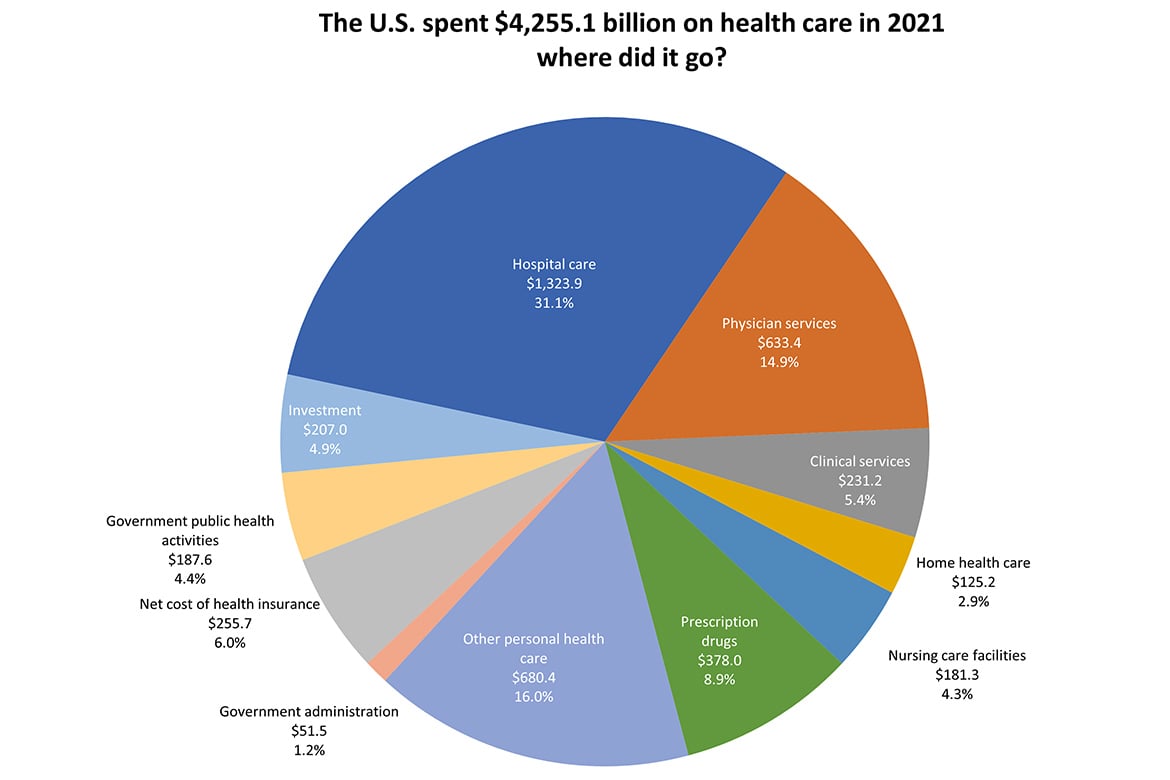
Doctors are not the reason healthcare is expensive.
Any chance the US has of achieving the cost savings of other industrialized nations depends crucially on doctors making a lot less.
https://www.beckersasc.com/benchmarking/how-physician-pay-in...
IIRC about 40 percent of all medical expenses are administrative costs and about 20 percent is drug costs. Improving those could drop healthcare costs by nearly half, without lowering healthcare salaries.
To lower medical salaries, we need to address (a) the AMA acting as a cartel, (b) residency slots being paid for by Medicare and being limited, and (c) crippling student debt problems. As an example, nurse practitioner salaries have dropped as supply has increased.
> Improving those could drop healthcare costs by nearly half
Wouldn't you have to decrease spending on admin and drugs up to 10x which would likely bring US well below the costs in most/all other rich c
I'm not sure how feasible it would be to reduce admin and drug costs by almost 10x?
Edit: to be fair 10x might not that far-fetched as I might have thought, admin costs are massively higher than anywhere else:
https://www.statista.com/statistics/1264127/per-capita-healt...
I'd assume the way they measure it might differ significantly between some countries. Also ~1000 is just 10% of per capita spending in the US.
If we look at drugs:
https://www.statista.com/statistics/266141/pharmaceutical-sp...
The gap is quite a bit smaller. Also in total drugs+admin seem to be about 25% or so?
Total per capita healthcare spend in the US is something like $13k, so yeah, much closer to 25% than 60%.
Also, you have to be careful about how you account for “administrative costs”. Medicare has low “administrative costs” but correspondingly high rates of fraud vs. a typical private insurer who has the incentive to spend more looking for it—administrative costs.
Huh, the numbers I’ve seen are much higher than that. 18% for prescription drugs [1], ~6% for retail drugs [1], and 34% for admin costs depending on how it’s accounted for [2]. A lot of places don’t seem to account for insurance related costs (billing/coding/etc.) in administrative costs, which may be the source of the difference.
[1] https://aspe.hhs.gov/sites/default/files/documents/88c547c97...
[2] https://time.com/5759972/health-care-administrative-costs/?a...
Well, the AMA does constrain the number of doctors in the US so that supply and demand part is on them.
Talk to any doctor about the priorities of the MBA-holding decision-makers at their hospitals.
When each one accuses someone else of gouging us, assume that they're all gouging us.
Doctors are paid the same as software engineers for a job that is like 10x as hard.
MBA hospital administrators have greed as their official main job responsibility.
Research shows that nurses have outcomes comparable to do those of doctors. It's not 10x as hard as SWE, don't buy into that. Plus, thats irrelevant, doctors supply is limited artificially and for no good reasons. The main culprit of high costs are is the insurance companies greed, but doctors are far from being blameless.
On average they seem seem to be paid quite a bit more (at least by 2x?).
> Doctors are paid the same as software engineers
The average physician salary in 2023 is $352K. I wouldn't say that.
Are salaries the only source of income that they derive from the medical industry? My doctor is a part owner of his provider network which also is the insurer.
Don't even start me on diagnostic imaging.
The big DI manufacturers have consulting arms that will help physicians with financing to buy CTs, MRI, PET, that will help them obtain Certificates of Need.
And having a hard time finding it now, but physicians who own a share in a DI lab tend to refer their patients for imaging far more generously than those who don't...
Go and talk to a doctor about the upcoming reimbursement cuts by Medicare - 3.36% this upcoming fiscal year.
Then compare how much Medicare compensates doctors compared to compensation in other countries.
Doctors don't work for hospitals.
Quite many countries limit the supply of doctors with less expensive health schemes.
In the UK the government both limits the supply of doctors and manages a fairly cheap National Health Service. How? It is rationed by queuing and achieves poor medical outcomes.
I don't think any country has a healthcare system privatized to a higher degree than Switzerland? Yet they still manage to spend quite a bit less per capita than the US.
That doesn't prove your point.
Rather than it being greediness by a class of individuals, in my view, it is that capitalism rewards greediness, and sometimes it obligates you to be greedy when you are just an employee or selling a service. People are inserted in a system composed by many layers that incentivize and obligate greediness.