Climate records tumble, leaving Earth in uncharted territory – scientists
bbc.co.ukAnecdotal story time. We have a family villa in Spain about an hour and a half south of Alicante. We just got back from two weeks there like we do every year. The heat and humidity this time was the first time it was too much so that we didn’t enjoy our time there. We’ve had this place 21 years.
Yes it’s Spain and it’s always hot which is why we bought it but this year was something else. The mix of both very high temps (higher than usual for July) and much higher humidity just made it very uncomfortable. We don’t usually need the AC on in July but we had to run it every night this time to be able to sleep.
Even the pool wasn’t refreshing as it was a constant 33C whereas it is usually around 28-30.
On the Wednesday night just gone we also had a heat burst. My first experience with such a thing and wow that was something else. It was like opening an oven door. The blast of scorching hot air in my face was almost suffocating.
Of course there have always been outlier days that have been too damn hot over the past two decades but this time it was the whole two weeks. Not just the odd day. I dread to think that it will be like in August which is when the temps usually hit their highest.
I’m a simple software guy I don’t pretend to know much about the climate but I listen and when thousands of scientists present data that shows average temps going up it makes me worry. If things continue like this some areas just won’t be reasonable to live or visit. They’re just not comfortable. You have to stay indoors as the sun roasts you in minutes and the humidity just makes you feel like crap constantly.
Even our neighbours who live there are talking of moving as it isn’t a nice place to live anymore. You feel trapped indoors with AC and do all you can to avoid going outside.
If these kinds of temperatures do continue to rise as predicted there is going to be a huge relocation of people to more liveable locations which is going to be a whole other problem.
I live in [redacted] where we have hot temperatures in the summer but we have pretty good humidity and it rarely feels “too hot”. I have AC but almost never need to use it unless it climbs to around 40C for a few consecutive days so I am used to pretty hot but I just did not enjoy Spain these past two weeks and was so glad to arrive home last night to 29C.
How much do you think you could get for it on the market? Is that in consideration after your experience this year?
It is certainly something that is more on our mind however I don't know if we will do it anytime soon. Our first change will be to go at different times of the year when it is more comfortable.
We have always avoided August as it's never been a nice time to visit due to the heat as well as being much busier due to the school holidays.
As for it's value I don't know if I am honest. It hasn't been something we've looked into in a very long time so I really have no idea.
I say that because property values in areas like that are likely to be on the decline and it might be a sooner is more kinda thing to pay attention to that
21 years of all that travelling back and forth to a family vacation home... My flight shame would kill me. How did/do you deal with that?
It's a ~12 hour drive. No need to fly.
I have far more shame about how much food I waste or worse how much I used to consume if I am honest. When I look at the environmental impact of the food I eat it dwarfs everything else.
Even if I were to fly every time that would have been 42 two-hour flights over two decades. I wouldn't have shame over that number of flights considering I've worked with people that fly more than that in a couple of months just for meetings.
Apologies for my assumption you would fly there. And yes, I can also always mention worse examples, and those people probably can too. That's one of the cognitive dissonance reduction mechanisms that got us in so much trouble.
No need to apologise, it is a pretty logical thing to assume.
We have flown of course but more often we will drive as we usually break the journey up visiting friends and family in Barcelona and Valencia on the way.
It takes longer to drive obviously but it is a more relaxed journey than flying. Plus as we don't have any time restrictions such as with a hotel booking we can just take our time and if we decide to stay a few more days for whatever reason it doesn't require any changing of flights, etc. Also means we don't need to hire a car for our stay.
But regardless, sorry to hear you might have to decide to let go of the villa because of the intense heat and humidity. It sure sounds like an amazing place.
Our family flies every year for vacation. Notably unlike my friends and other family we don't usually travel much on airlines other than that.
I think the environmental impact of that one flight pales in comparison to the plastic packaging our family consumes on a yearly basis... and we are conscientious of our usage.
Why do you assume flight? There's train from Lyon to Alicante. Drive time is similar. It's a ~12h travel, nothing unheard of for a vacation trip.
Enjoy a high standard of living now that you still can. This ship is going down. Might as well make the most of it instead of trying to carry buckets of water out of the hull, it's futile. Humanity has spoken, this is collectively what we want on average. Is it good? Is it fair? It just is.
> Enjoy living now that you still can.
Here, repaired it for you.
The sad part is, it's not happening because we couldn't do anything but because we didn't do what we could.
Remember the sinking island scene in Erik the Viking?
We should take note that even now we have companies pushing back against any changes to our oil consumption. They're literally intent on destroying our way of life to get a bit more profit.
But our oil consumption essentially is our way of life. Changing it will have enormous effects on modern life. A lot of people are going to see a significant drop in their quality of life as a result. This is why it's so hard to change things in the first place, it's not about the companies, but about average people.
That seems disingenuous when the climate catastrophe is going to have far greater effects on modern life. Too many people are clinging to the dream of continuing to dig out and burn as much oil as possible when it's clear that that behaviour is not sustainable.
Although personal responsibility is never a bad thing, we need to focus on the big companies that have been deliberately hiding climate science for decades - they're the ones doing the lion's share of the polluting and suppressing alternatives.
People don't dream about burning more oil, they dream about the quality of life that this process affords us. Things like uninterrupted power, (uninterrupted) running water, cleaner water, the internet, cheap food, enough food (fertilizers/Haber-Bosch process), accessible transportation, economies of scale etc. While few of these things require fossil fuels, fossil fuels are nevertheless the reason why these things are abundant and accessible.
People dream about living a good life. Our fossil fuel consumption has afforded this to many. That is why it's difficult to change. Companies don't make stuff for fun, they do it because there's consumer demand for it.
The really crazy part is that petroleum supply is not a sustainable resource, so we're extravagantly flaring it off when in reality using it for things like fertilizers or steel production while using nuclear/solar + batteries + HVDC for all other purposes would allow us to maintain or improve standard of living for far longer.
> Companies don't make stuff for fun, they do it because there's consumer demand for it.
Companies have so much power that they can fabricate (or suppress) their own demand by manipulating the political sphere. The situation exists because it's more easily profitable, the alternative takes time/effort, and our market/government incentives only focus on short-term thinking. The same companies that profit prevent changes to such incentives.
This is the best anti-green argumentation I have ever seen. This is what a drop of water thinks about, which never considers itself a part of tsunami.
I hope it isn't only seen as anti-green. A big worry I have concerning climate change is that often I see discussions about climate policy ignore why our consumption is so high. It's not really the billionaires or greedy corporations. It's us. We're the ones consuming the bulk of these resources. And these policies will affect the poorest the most.
On the other hand, I also worry about the impact of climate change. I think as long as things remain within current predictions we will be able to manage, but what if they don't? What if some process ends up accelerating things faster than expected?
> It's us. We're the ones consuming the bulk of these resources
Agree.
> What if some process ends up accelerating things faster than expected?
I think we're already there (for example, in quite few studies 2030 is the new 2050 for 1.5C target). Sea temperatures (esp. in the nothern sea) and ice cover also seems to change faster than predicted (we could have ice free summers in the arctic before 2030, and thawing of greenland is also faster than expected).
Sustainable policies likely affect the poorest the least. Climate change will affect them the most.
The poorest already make a lot of sustainable choices: living in apartments in cities, taking public transportation, consuming less.
It’s possible that if carbon was heavily taxed, and some of the proceeds returned to everybody, that the poorest would actually be better off. Never mind the whole stopping the climate catastrophe threat.
The poorest mostly live in the developing world that's still catching up and has the highest birth rates. Yes, their carbon footprint is low now. But their energy needs will keep going up until they fully develop and the global population peaks (a couple billion more people from now). It's unclear to what extent clean energies will meet their increasing demand, at least before the world can decarbonize, whenever that happens.
It's the clear tension of keeping our way of life now versus being able to keep parts of it in the future.
Clearly, some people care about the now more than the future.
The solution is a carbon tax, which is unpopular with big oil companies but probably also unpopular with many citizens who vote based on gas prices.
We may just have to use solar radiation management instead.
Many European countries already have something like that: excise taxes on gasoline. Gasoline in Europe is almost twice the price of gas in the US, even in countries where people earn half of what Americans do. It's not particularly new either - they've been around for decades now.
This teaches us a valuable lesson though - money from carbon taxes must not go into the government budget. It should instead be distributed to something automatically (eg equal payments to everyone or the poorest). If it becomes part of the budget then governments might try to maximize revenue rather than deal with the problem.
> solar radiation management
Hahahaha. I can see it now: "Exxon Stratospheric Sulfur Shield - using dirty fuels in long-haul flights to create a particulate-based solar shield [0]. Partnering with governments around the globe [1] to protect the earth and boost tourism. Because we care."
[0] https://www.nasa.gov/topics/earth/features/stratospheric-aer...
[1] https://e360.yale.edu/digest/fossil-fuels-received-5-9-trill...
That's not a solution.
80% of our current energy still comes from fossil fuels. The world runs on it. There isn't a simple solution that's economically and politically viable. It takes time to change that without drastically altering people's lifestyles. We saw how untenable that was in the longterm during Covid lockdowns.
This is quite accurate in fact: to use a Dune analogy: oil is the spice. It must flow, or the empire is diminished and might fall apart.
There is an alternative however, and countries like China are pursuing it. Want to look at what life would be like with less petroleum usage per capita? Look to Asia. I'm not some tankie, but I also don't have blinders on.
I doubt the same people who won’t accept a decline in quality of life by reduced oil consumption will be thrilled with the consequences of the alternative.
You mean what's predicted to come tomorrow, and has little to no effect today? Anti-carbon policies however, will have immediate effects felt today, for benefits tomorrow ...
This is our natural tendency, to seek the quick rewards but we are intelligent beings, capable of planning.
The same arguments can be made for future of your own children, retirement plans, planting trees, long term investments, etc. Yet these are not as controversial and we accept them, more or less, as generally good practices.
This natural instinct on its own is not enough to make people forget the coming danger. You need constant advertisement, news cycles, opinion pieces, disinformation campaigns, etc. to make it stick.
I'm happy with remote working.
Energy is why we burn fossil fuels. Energy is an input to everything. So this is about less consumption, or to put it another way: a drop in income. Let's say 10% less income for you, without you getting any compensation for it in any way. Other than reduced global climate impact.
Of course, you'd have to actually destroy that 10%, if you leave it on a bank account the bank would lend it, or the government would use it, which would prevent this from having an impact.
Inflation has done that already.
That doesn't count. That's just a way to redirect money towards loan repayment. For it to work you'd have to use it to pay people to do nothing that otherwise would have done a job. You'll need to destroy economic value without destroying natural resources.
Source?
Sorry, about to go grab a train, so only had time to find a couple of Shell examples:
It's not just fossil fuels.
"The factory of ignorance": Arte tells about these industrialists who manipulate science
https://www.tellerreport.com/life/2021-02-23-%0A---%22the-fa...
Inside big beef’s climate messaging machine: confuse, defend and downplay
https://www.theguardian.com/environment/2023/may/03/beef-ind...
Why Right-Wingers Are So Afraid of Men Eating Vegetables
https://newrepublic.com/article/171781/meat-culture-war-cric...
The meat industry is borrowing tactics from Big Oil to obfuscate the truth about climate change
https://www.salon.com/2022/11/11/the-meat-industry-is-borrow...
Why the media too often ignores the connection between climate change and meat
https://www.vox.com/future-perfect/23778399/media-ignores-cl...
How Big Oil is manipulating the way you think about climate change
https://www.salon.com/2023/05/13/how-big-oil-is-manipulating...
Disinformation and lies are spreading faster than Australia's bushfires
https://www.theguardian.com/australia-news/2020/jan/12/disin...
Rightwing war on ‘woke capitalism’ partly driven by fossil fuel interests and allies
https://www.theguardian.com/us-news/2023/jun/22/rightwing-wa...
Senate Hearing Exposes 'Insidious' Dark Money Network Fueling Climate Crisis
https://www.commondreams.org/news/senate-dark-money-climate
Report: 1,500 Big Oil Lobbyists “Double Agents” for Supposed Climate Champions
https://truthout.org/articles/report-1500-big-oil-lobbyists-...
Chemical industry used big tobacco’s tactics to conceal evidence of PFAS risks
https://www.theguardian.com/environment/2023/jun/07/pfas-3m-...
Analysis: Most research on PFAS harms is unpublicized
Every time this comes up, mostly people talk about driving less, eating less meat, etc. How about we fix stuff instead of throwing it out? In early 2000s my parents bought a washer machine, it still runs, it does run pretty well, then had to repair heating element at least once, but it runs just fine even now. It’s has every cycle you can possibly have. We had to replace our bosch after about 8 years of use. I can’t buy spare parts. Had to replace drain pump twice, not there is a hose that cracked and I just can’t buy a replacement with matching connector. Similar stories for a microwave, fridge, dishwasher, laptops and even vacuum cleaner.
We need to force manufacturers to make things fixable. And mandate certain level of support for spare parts and batteries.
Same with all types of connectors. I wish the US passed the passed the law requiring common charging port, common audio port(audio jack was perfect), etc. Audio jack removal by Apple and subsequently Google is an atrocity.
No one is really interested in doing the work to slow global warming.
- Build nuclear power plants everywhere. Yes even in countries like Iran and North Korea
- Don't subsidize fossil fuel use by any mechanism. Yes dropping the Russian fuel cap.
- Make reducing emissions a priority that means it comes first in consideration. Yes ahead of Uighurs in China, Women in Iran and Afghanistan.
You will not get everything you want.
But if you believe climate change is civilization ending then you need to give up what you don't need.
Just Stop Oil is super obnoxious but if climate change is destroying our planet why is it they still get openly assaulted in the street in a "first world" country? It's because people aren't even willing to be late to the cinema.
Stop cutting trees and turning forests (rain or otherwise) into Savanna's. 'For agriculture'.
~agriculture~
Meat
No agriculture. Broadscale monoculture crops, grown and harvested and distributed with fossil-fuel inputs. Essentially an outdoors factory.
Agriculture which is used to feed the animals. Look at soy in the Amazon, most is used in the meat industry
Probably most, but here (south eu) a lot of forest is being and was cut down for planting shitty fruit trees and other crops (not for animals; for humans & cosmetics) that are no substitute for what was removed.
Just stop having babies.
Just stop othering the problem.
Look in the mirror. Have you been on a plane? Do you use motor transport? Does your home have electricity? The problem is you, not some baby in a country where people consume in a year what an American does in a day.
I didn't specify a country where people should stop having babies. As far as I'm concerned, every one baby Americans have is more ecologically harmful than 5 babies in Africa.
It's not othering the problem. I think that the people who are already here are already doing enough damage, and that it's enormously selfish and pathologically narcissistic to want to add more humans to the world just to pass along your DNA. Of all the things you listed, I will never consume more than one human's worth of those resources. Whereas for every child you have, you are placing a claim on exponentially increasing resources in perpetuity.
> Does your home have electricity?
Dumb arguments like this do more harm to the climate change cause than anything else. It comes across as an unreasonable and uneducated point of view that no one listens to.
Why be passive? Design cars to kill their occupants turn them to compost. Even more green.
This is like if I said "stop buying Bitcoin" and you were like "why not just set all your money on fire?"
No it's not. It's like if you said to stop making Bitcoin miners, and they said to intentionally sabotage existing Bitcoin miners.
Fine point. I was trying to leave mining out of it.
Anyway, an argument towards stopping future use and abuse of a broken system is not equivalent to an argument to destroy existing structures. The former is corrective; the latter is revolutionary. Revolutions are stupid and useless because they always result in a new iteration of the existing problem.
It's already happening: https://youtu.be/A6s8QlIGanA
> Yes ahead of Uighurs in China, Women in Iran and Afghanistan.
When they said these are important matters in TV, did you really believe them? These, among many other issues, are not even in the queue my friend.
Which will occur first, irreversible worldwide climate catastrophe, or the technological singularity? Either way, the 2020s will be the most pivotal decade in human history.
One (or both?) of those things has perhaps already happened.
At which point do you think humanity will start seriously thinking about radical solutions? Such as detonating thermonuclear weapons to throw enough dust above the troposphere to cool the planet down?
I'm thinking we're still really far away. Migration from areas that become uninhabitable is still weak. And it doesn't look like any state that has substantial military/commercial/political power is interested in starting a fuss about it. Germany's Green party, probably the strongest climate centric party in the world, somehow thinks that potential nuclear reactor problems are just as bad as global warming.
> At which point do you think humanity will start seriously thinking about radical solutions?
You mean, like, switching to a vegan diet, using public transport and stop flying? Those seem radical enough for most people in the Northern Hemisphere.
> Such as detonating thermonuclear weapons to throw enough dust above the troposphere to cool the planet down?
Weird world, one in which people can consider drastically changing the composition of the atmosphere, affecting all forms of life over the planet at the same time, instead of purchasing less from Amazon and doing some changes in their diet and holiday plans.
Individual decisions like that are only good for making yourself feel good about doing something, but it’s close to meaningless when it comes to actually solving it.
It’s systemic solutions that are needed. Some of those may include disincentivizing consumption. But it’s also not simple given that in many places there’s serious pushback against that. And also the economic cost. Everything is interwoven.
I wish people stopped pretending that this is just a matter of going vegan.
Systemic solutions are also needed. And switching to public transport or flying less doesn't happen without them, nowhere in my comment did I say that.
My point is about the fact that we already know and have most of the solutions: less consumption, less emissions, less destruction of our environment. Yet, most people with decision power (be it as individuals, as heads of governments or companies) refuse to accept and follow them. Instead, many prefer to propose global-scale, geo-modifications whose results are unknown and potentially more dangerous.
This study[0] and several other studies by UN, Oxford Uni etc disagree with you. The single best thing an individual can do is immensely reduce or completely avoid meat and dairy. Imagine millions and millions of people doing this, behavioural change will trigger system’s change.
It’s something we can do today, just need to decide whether having a burger is more important or not.
> Imagine millions and millions of people doing this
But they won't. Even here on HN, where some smart people roam, touching their meat (like, eating LESS of it, not quitting altogether) will make them into incoherent angry (I guess) men. And that's of course a big step, smaller steps are even not a thing for many people; not flying, no car, hell, here people even refuse to obey the law of not topping up (or filling) their swimming pools even though there is an huge water shortage.
The only way will be if governments decide to step in. Problem there is; a lot of gov people and the people they support or who support them, are giving the wrong examples; big cars, slabs of meat, villas all over the place, bailing out struggling airlines, making sure the energy/oil companies can make more profits, making sure farmers have to obey nothing of these new rules because export products (so they can keep using whatever amount of water, cut ancient trees down just like that, ...) etc. People pick the govs they like, which means they hope either things will get better for themselves (not the world) or remain the same.
Lots of people, also on HN, now follow climate friendly diets. In reality it is the meat eaters, not vegans, who are very loud and vocal about their diet.
But I agree we need much stronger regulation.
Yes true, but we have to keep trying to convince people in our circles. Otherwise we're effed.
I would have hoped that especially this HN crowd would change their mind because it's quite clear and logical that not consuming meat and dairy will mean requiring fewer resources and producing less pollution.
Human habits, preferences, and desires rarely submit to pure logic. Humans are more emotional than rational.
It's not just that. If these products aren't used anymore, we'll substitute them to some other form of consumption.
If you want to have impact as an individual, study engineering/physics or indeed climate change ...
A lot of people just don't care.
> some smart people roam, touching their meat (like, eating LESS of it, not quitting altogether) will make them into incoherent angry (I guess) men
Not so smart then.
> The only way will be if governments decide to step in
That's why more people vegan == more pressure for governments not to ignore the issue.
I everyone in the world adopted a vegan diet CO2 emissions would drop by 13%. Still eating pork, poultry, eggs and fish would reduce it by 8.6%:
That's "CO2e" (CO2 equivalent, measured in global warming potential), not CO2. The time scale isn't specified, despite making a big difference in some cases, so I'll assume it's calculated over 20 years, which seems to be the most common. It's important to distinguish CO2 from CO2e, because a large part of CO2e emissions from animal farming are methane, which is a more potent greenhouse gas than CO2. Methane emissions could be reduced in multiple ways, e.g. we could switch to farming kangaroos, which don't produce methane, or supplement cow feed with seaweed, which was found to dramatically reduce methane production:
https://journals.plos.org/plosone/article?id=10.1371/journal...
We also may stop it altogether, kangaroo included and gain:
- those 4.4% co2e difference, which is quite consequent
- freshwater savings
- land savings (especially forest)
- the ability to feel morally good when looking and thinking about the food we eat
It's not just about CO2 - it's also that the large scale meat & dairy industry requires way more resources, destroys natural habitats and creates a ton of pollution.
From the article you've linked:
"In a hypothetical scenario in which everyone in the world went vegan by 2050, the regrowth of trees and wilderness could sequester around 547 billion tonnes of additional CO2. Each year we emit around 36 billion tonnes of CO2 from fossil fuels, so that’s equal to around 15 years of emissions at our current levels. They also estimate an additional 225 billion tonnes of CO2 could be stored in soils ..."
That's much more impactful than reducing emissions alone. It would store a load of carbon while preserving biodiversity (paramount for healthy ecosystems).
The URL is not working, can you update it?
The study probably explores what would happen if _everyone_ did that. And that’s the issue right there. Everyone casts a wide net, it includes climate deniers, poor people, rich people, hard core dairy aficionados, etc, etc. The single most important thing an individual can do is inducing systemic change in one way or another. Preferably somehow avoiding alienating the bulk of the audience, as that may end up with people in power who actively undermine any efforts towards solving the situation.
I clicked it - It works.
There is also a link to the PDF - try this one: https://www.nature.com/articles/s43016-023-00795-w.pdf.
RE: The single most important thing an individual can do is inducing systemic change in one way or another.
And that was my point. Vote with your wallet and inform others in your circle that reducing / avoiding will have positive impact. This will trigger systemic change.
Is it the only thing we can do, no it's not, but it's something you and I can do right now.
Why stop at meat and dairy. Why not go all the way, select handful of optimal foods and only allow those to be sold or grown. Anyone doing anything else would heavily punished?
After all, if we ban beef. We have accepted that taste has no meaning in life and we can just ban everything not mandatory like spices and herbs.
Do you think that only animal flesh derived foods are tasty?
It's about cutting out food that create the biggest damage to our biosphere, which is the large scale meat & dairy industry.
RE: Why not go all the way, select handful of optimal foods and only allow those to be sold or grown. [...] ban everything not mandatory like spices and herbs.
This is not about banning meat & dairy. And you can't seriously compare meat & dairy to herbs & spices.
I'm eating vegetarian food most of the time, with an exception from time to time. I've tried doing vegan. Vegan food can be tasty or even very tasty. No vegan food is as good as steak or cheese. Another thing is that I have no idea how to eat enough protein, on vegan diet, without feeling terrible.
Respect for trying. Don't feel the pressure having to change all at once. You can gradually reduce.
Cheese is actually not that good for you [0], but yes it's tasty.
Plant based foods provide enough protein for athletes and body builders. [1] [2]
[0] https://www.pcrm.org/good-nutrition/nutrition-information/he...
[1] https://www.pcrm.org/good-nutrition/nutrition-information/pr...
> Plant based foods provide enough protein for athletes and body builders.
I'm sure that anything is possible for highly motivated individuals for whom eating enough protein is one of the main parts of their lifestyle. I just don't know how to translate it to everyday cooking for a family.
Tofu and other soy products are not easily available where I live. I'm not sure if doing extra driving or ordering online from another country would be net positive.
Nuts are protein dense only when you count them by weight (grams protein per gram) but not that great by energy (grams protein per kcal).
I could eat beans and lentils for every meal but that's from where the part about feeling terrible comes.
It sounds like a list of excuses but it is something that is actually, for me, a daily struggle and source of stress.
Our requirements for protein isn't as high as claimed by the majority of the fitness industry or actually meat & dairy industry.
Read the PCRM article about protein I posted further above, it has more info about this. PCRM is a group of doctors and other medical experts.
Where are you based?
If you live in a region where you can't survive without meat or dairy then you've got to do what you have to do to survive.
My comments are mainly geared towards regions where the majority of people consume meat & dairy because of taste pleasure, not because they need it to survive.
> Our requirements for protein isn't as high as claimed by the majority of the fitness industry or actually meat & dairy industry. > Read the PCRM article about protein I posted further above, it has more info about this. PCRM is a group of doctors and other medical experts.
I find most research on the the topic to be of dubious quality. I know that when I have more protein in my diet I feel less hungry for longer and I eat overall less calories. Also I've been working out for couple of years with little to show for it. I worry sometimes that maybe low protein diet is a, or the, reason for that.
> Where are you based?
I live in a smaller, rather conservative city where it's hard to find anything but local cuisine.
> If you live in a region where you can't survive without meat or dairy then you've got to do what you have to do to survive.
I don't need it to survive. And it is something that I want to do. I just don't know how and I'm not able to find any useful resources.
Why have speed limits on the road?
We have accepted that human life is worthless, because cars are allowed to drive fast enough to cause fatal crashes, may as well remove all limits alltogether.
---
Absolutist arguments are absolutely absurd.
Vegan arguments are absolutist. Everyone isn't going to give up meat. I doubt even the majority of people will by 2050. However, it's possible enough people could be convinced to reduce meat consumption to make a difference. It alone won't solve climate change.
Removing subsidies on meat production and flying are the systemic variants of those individual choices. People would be vegan no-flyers in no time.
Or we’d return to the meat/travel consumption patterns of the early 20th century: trans-Atlantic trips being a once-in-a-lifetime thing or once-every-few-years for the well-off, and the Sunday roast/chicken being the highlight meal of the week.
Lol I’m probably a XIXth century time traveler regarding your scale. Not feeling unhappy, comme join me in the past guys!
Sure ... but without a significant portion of people in the population being vegans it's a political suicide to even suggest that.
It has to start in our own kitchens.
it's the same mentality as those who feel bullet-proof safe rooms in schools is a better solution that giving up their guns.
>You mean, like, switching to a vegan diet, using public transport and stop flying? Those seem radical enough for most people in the Northern Hemisphere.
One of these things is not like the other.
Vegan diets — and I support them in principle — do little or nothing to reduce carbon emissions.
Vegan diets just don't deliver enough calories and essential nutrients without (industrial) supplementation, and veganism depends on broadscale monoculture crops with massive fossil-fuel inputs to grow, harvest and distribute, and exist in places largely that used to be healthy ecosystems supporting animal life.
Nice idea, and I'm cool with the overall philosophy and principles of veganism, but yoking it to climate activism, conflating it with strategies to "save the planet" is misguided.
Such a load of bull. I'm sick of people ignoring the science. Educate yourself before writing anything next time. It's clear as day you're wrong. It's the most impactful thing you can as an individual do.
We need to stop fossil fuels asap, stop animal ag (deforestation, pollution, biodiversity loss, etc.), reform agriculture (soils, biodiversity, poisons) and start reforesting/afforesting.
There are tons of studies that show it's the best way to stop the climate crisis.
How Compatible Are Western European Dietary Patterns to Climate Targets? Accounting for Uncertainty of Life Cycle Assessments by Applying a Probabilistic Approach
https://www.mdpi.com/2071-1050/14/21/14449
Global food system emissions could preclude achieving the 1.5° and 2°C climate change targets
https://www.science.org/doi/10.1126/science.aba7357
Biodiversity conservation: The key is reducing meat consumption
https://pubmed.ncbi.nlm.nih.gov/26231772/
Which Diet Has the Least Environmental Impact on Our Planet? A Systematic Review of Vegan, Vegetarian and Omnivorous Diets
https://www.mdpi.com/2071-1050/11/15/4110/htm
The way we eat could lead to habitat loss for 17,000 species by 2050
https://www.vox.com/future-perfect/22287498/meat-wildlife-bi...
Our global food system is the primary driver of biodiversity loss
https://www.unep.org/news-and-stories/press-release/our-glob...
If the world adopted a plant-based diet we would reduce global agricultural land use from 4 to 1 billion hectares. The expansion of land for agriculture is the leading driver of deforestation and biodiversity loss.
https://ourworldindata.org/land-use-diets
Rapid global phaseout of animal agriculture has the potential to stabilize greenhouse gas levels for 30 years and offset 68 percent of CO2 emissions this century
https://journals.plos.org/climate/article?id=10.1371/journal...
Which Diet Has the Least Environmental Impact on Our Planet? A Systematic Review of Vegan, Vegetarian and Omnivorous Diets
https://www.mdpi.com/2071-1050/11/15/4110/htm
Without Changing Diets, Agriculture Alone Could Produce Enough Emissions to Surpass 1.5°C of Global Warming
https://www.wri.org/insights/without-changing-diets-agricult...
Global food system emissions could preclude achieving the 1.5° and 2°C climate change targets
https://www.science.org/doi/10.1126/science.aba7357
Livestock and climate change: what if the key actors in climate change are... cows, pigs, and chickens?
https://www.semanticscholar.org/paper/Livestock-and-climate-...
The carbon opportunity cost of animal-sourced food production on land
https://www.nature.com/articles/s41893-020-00603-4
Study finds forest protection successfully leads to reduced emissions at global scale
https://phys.org/news/2023-06-forest-successfully-emissions-...
> Such a load of bull. I'm sick of people ignoring the science. Educate yourself before writing anything next time
What are chances that everyone globally will just switch to vegan diet to save on CO2 before 2050 or whatever end date? My fair estimate is zero.
It's like wishing people aren't lazy or corrupt or that are more honest. To quote the poet "You don't get what you want".
Animal ag. is the leading culprit of the mess we're in (together with fossil fuels, ofc). The reason nobody at political level talks about it is because they feel it's a political suicide.
If there was a significant portion of the population with changed habits (and numbers of vegans and vegetarians are rising fast in the last few years, so much that it's affecting sales of meat and dairy already), the abolishing of animal ag subsidies will be much more probable.
Then without subsidies the reduction in consumption is automatic - the price would take care of that. 90% (IIRC) of corporate profits in animal ag comes from subsidies.
Otherwise ... to quote the poet ... "You'll get what you don't want".
> If there was a significant portion of the population with changed habits
It’s exceedingly hard to get people to change habits. That’s why people in this thread don’t believe it will be a realistic (timely enough) solution if left up to mere individual decisions and not forced by systemic changes.
I don't believe in systemic changes coming on its own anymore. They will be forced by angry citizens, or not at all.
We've had 50+ years of climate change warnings, and nothing has really happened.
We're still not doing much... For example, the percentage of coal consumption is still around 82%, even after minor advancements in renewable sources.
Nobody at the political level is even talking about the need for a reduction in meat consumption, despite scientists being very vocal about this.
I simply feel that this is something that has to come (could come) from "down below."
> Animal ag. is the leading culprit of the mess we're in
Citations needed. I think cars/trucks are much bigger polluters than cows. Not to mention the ubiquitous industries of plastic, steel and cement.
https://ourworldindata.org/emissions-by-sector
Points that Agriculture is 18.6% of total CO2 emissions. Out of which plants related emissions make like 4%. Granted, part of that is animal feed, but you'll have to replace meat calories with something else.
Check this thread, I've already provided some of the sources.
All those sectors you've mentioned are absolutely problem too. Animal ag is 15-26% of our carbon budget, depending on which source you'll pick. That's already bigger that cement, and almost all of transport.
But animal ag is not just the emissions alone, and not only cows. Just with afforestation potential (land use change of pastures) we'd be able to store our entire 1.5C carbon budget.
This is a short (and incomplete) list of impacts of (animal & industrial) agriculture. It's imho clear from this list that animal ag (which is 75-80% of all ag) is the major culprit.
- Greenhouse gas emissions
- Deforestation (40+% of pastures used to be forests)
- Land degradation
- Water pollution
- Water overconsumption
- Loss of biodiversity
- Antibiotic resistance
- Ocean dead zones
- Inefficient land and resource use
- Ethical concerns regarding animal welfare
- Zoonotic diseases
- Air pollution
- Eutrophication
- Soil erosion
- High energy consumption
- Chemical runoff from pesticides, herbicides and fertilizers
- Destruction of habitats and ecosystems
- Inequality in global food distribution
- Public health risks from foodborne illnesses
- Nutrient pollution
- Strain on waste management systems
- Overfishing (40-70% of plankton gone, sharks 90% gone, fish almost gone)
> I'm sick of people ignoring the science. Educate yourself before writing ...
Oh science again... You totalitarians are always calling for science when lacking arguments to convince people....
Nazism was supposedly based on race science. Communism was entirely scientific. So were COVID lockdowns.
And now climate science. It isn't science it is just weird millenarian religion. Please stop propagating your religious beliefs on HN.
Science isn't about belief or religion; it's about objective inquiry and understanding the world based on evidence.
It's okay to question and be critical, but dismissing scientific consensus without proper examination won't lead us anywhere.
Let's put aside the conspiracy theories and embrace the wonders of knowledge and progress that science offers ;)
Even by environmentalist website estimates, eggs, milk, chicken, and pork are 4x or so more than some crops. Going vegan is just the wrong avenue to target climate change.
That'll take a monumental effort, for a fairly minor impact. "eat less beef" sure.
People leaving the aircon on 24/7. Horribly uninsulated homes, buying and returning hundreds of items.
But ultimately, it's a shift to renewables+storage/nuclear that has to happen.
Pushing for people to go vegan is essentially counter-productive.
https://www.oxfam.org/en/press-releases/carbon-emissions-ric...
Speaking of flying, some billionaires have a second jet scouting ahead for air pockets. Remember Macron slyly taking off his watch under the table as he preached austerity? As much as I am frustrated by the apathy and short-sightedness of people, it's hard to blame them when those could so easily go first instead just consolidate and line their pockets where they can, to prepare for a crash they help make unavoidable that way. With private bunkers and going to Mars and freezing themselves and stuff that is so much derpier, less rational, so much more alienated, than some average person thinking they'd like to see the ocean one more time, so fuck it, they'll book a flight.
These personal decisions make little difference in the grand scheme of things.
"Be the change that you wish to see in the world." - Mahatma Gandhi
This quote emphasizes the idea that if individuals embody and practice positive values and actions, it can lead to a significant impact on the world around them. Similarly, if everyone were to act rightly, it would undoubtedly result in a different and improved world.
> if everyone were to act rightly
Yes, but that's not reality. Hoping for the best whilst not actually making a dent in carbon emissions is not helping the problem at all.
All significant changes in the past came from people loudly demanding change, be it through mass protests, civil rights movements, revolutionary actions, or the collective voice of individuals seeking justice and progress. These impassioned calls for change have driven societies to challenge existing norms, break down oppressive systems, and pave the way for a more equitable and inclusive future.
People have to change themselves first (to break the walls built by others) to want to change the society.
Hope is not hopium. Hope is necessary for any action to take place.
The German Greens are slowly inching towards nuclear, now the original 1980s membership are dying off and the Gazprom funding is running out:
https://www.dw.com/en/german-greens-lay-out-nuclear-power-po...
I don't know what are you talking about. They have literally just pressured the ruling coalition to shut down all remaining nuclear power plants.
Sigh. Oligarch money still flowing, then.
I don't think that explains it. Many Green voters experience some sort of self-hatered, they claim humanity is a disease, etc. In particular many voters do not want nuclear power at all.
They don't want it thanks to decades-long misinformation campaign waged with fossil fuel money.
The Finnish Greens are pro-nuclear, perhaps because they are not beholden to the same sources of funding as their German counterparts (and not to just blame the Greens here: look at your former Chancellor Schroeder).
The Finnish Greens have only been explicitly pro-nuclear, or at least lukewarm toward nuclear as the least bad out of bad solutions, for a few years. This is to a large extent due to a shift of power from the old guard to a STEM-friendly faction inside the party. But less than ten years ago, in 2014, when the then government decided to give a preliminary permission to build another nuclear plant in Finland, the Greens left the coalition govt in protest, as they also did in 2002.
Still no solution for nuclear waste, still depend on external water cooling, security can't handle threads like cyber attacks and airplane crashes.
That generation of power plants isn't really helping and new ones need a lot of time to build and produce lots of CO2 in the process.
> Still no solution for nuclear waste
That’s false. In France we have a project to bury them 500m underground in stable geological formations. And even if this site failed to retain the radioactive (which studies says it will not) that would be a minor issue against climate change.
As for security issues since nuclear power exists (~70 years) we can count deadly accidents in some dozens of victims while the pollution due to burning fuels kills several thousands of people every year.
At this point it’s so ridiculous that you have way more chance to die in a plane crash of anything nuclear.
Also contrary to a belief, a plane crashing in a nuclear powerplant, while creating a certain horrible mess would not be really different than crashing it in any petrochemical plant. For comparison that would be way less dramatic than the AZF of Beyrouth explosions.
>That’s false. In France we have a project to bury them
It's not a solution if it's still a project otherwise nuclear fusion and carbon dioxide capturing would be solutions too.
Here's a practical solution: put it in the second parking lot. The nuclear waste that a nuclear plant generates over its lifetime likely won't even fill up that same plant's parking lot. And some of that waste could also be reused at a later time.
Something else to consider is that the stuff with the highest radioactivity is usually the shortest. At this stage having a robust forever-lasting solution for nuclear waste is not a larger priority.
There are places in the world where you can just find uranium rocks lying on the ground.
> It's not a solution if it's still a project
Fine, take the Finnish repository as an example then.
All true, but right now those risks pale in comparison to the ongoing disasters caused by fossil fuels.
Precisely the point. It's a good test of commitment when someone is asked to give up something (in this case a very small increase of the probability of causing a problem) in return for climate improvements.
Nuclear is only an intermediate solution but many treat like the final one.
It isn't helpful averting one problem to create another one.
If you are wandering the desert, dying of thirst, and you find a bottle of Coke, you should probably drink it and not worry too much about getting diabetes.
What about a bottle with Vibrio cholerae?
Stupid analogy, but yes you'd actually live a bit longer if you drank it.
Sure. But Fossil Fuel vs Nuclear is a false dilemma
The only function nuclear has is to keep the profits flowing for the same companies that have been running all coal plants. It's really just the same people who were opposing renewables because "too expensive" in order to continue running their profitable fossil fuel plants. Now that it's clear that that gravy train is running out they push nuclear, because they would be the only ones being able to deliver (in contrast to both wind and solar which don't require the same massive investments that can only be pulled of by a few small entities). The only problem they have is that the whole "renewables are too expensive" doesn't work anymore because they are actually cheaper, so instead they make up the baseload myth. Which already has a solution, overcapacity and investment into storage. In fact due to the long energy ROI for nuclear power plants, we would actually make things worse in the short term, because we need to use a lot of energy to build the plants. Solar and Wind are both on exponential curves (with no indication of slowing down), so why would we invest in nuclear? Use that money to invest in solar and wind (especially as long as we are still running fossil fuel plants), you get much higher CO2 reduction return on your investment.
> The only function nuclear has is to keep the profits flowing for the same companies that have been running all coal plants.
Mission fucking accomplished. If nuclear simply isn't profitable they'll have to shift to solar+wind+battery eventually.
The "radical" solutions are not just throwing more technology at the problems. That's how we got ourselves into this mess in the first place.
The solution is to stop mindless consumption. We use the same material to wrap and bake food and drink unhealthy drinks as we do to build airplanes. We use plastic for use cases that take place over seconds and minutes and then throw it away. We drive everywhere because of poor urban design. We use plastic to carry food home from stores and restaurants. We fill our homes with plastic, metal, wood, and electronic junk, very little of it actually needed.
Mindless consumption makes the U.S. waste 1/3 of the food produced every year. 96% of that goes directly into landfills. It is literally throwing energy away, energy that we sapped away from the ground and ecosystems. Only 4% of the waste is composted. Full adoption of composting food waste and reducing it in total could bring emissions down by as much as high single digits or low teens percentages.
We also need greater wealth equality, which brings education and health equality as well.
It's almost silly how simple the real solutions are.
I planted milkweed last year, or rather let the milkweed that the previous owner would put mulch over. Surprise, we have monarch caterpillars this year.
There are real consequences to our actions, and if we reverse them, we get real consequences back.
> It's almost silly how simple the real solutions are.
Simple? Real? Let me give you some numbers. Let's use electricity as a proxy for consumption[1].
Average global per capita electricity consumption is currently about 3000 kWh/a. To put that into context, you can drive your environmentally friendly EV (20kWh/100km) roughly 15 000 km (10 000 miles) and use no more electricity at anything during the year.
US electricity consumption is ~12 000 kWh per year. So if you want to not force third world to poverty forever and keep the global consumption at current levels (I'm not yet discussing decreasing global consumption, just keeping it at current levels). US folks would need to cut their consumption by 75% to allow the poorer to get even.
Sorry, but that is neither simple nor real. If we want to see the poor countries to rise to even mediocre living standards, we will face a huge increase in global consumption. You do not need to like this (I do not), but it is a fact. So please, stop whining about the need to reduce our consumption and start supporting initiatives how we can produce lots more energy and stuff sustainably. Because we need to do that.
[1] https://en.wikipedia.org/wiki/List_of_countries_by_electrici...
There's a lot in this comment that I think responds to things I'm not saying and provides some arguments that are not clear cut. I don't see how electricity is a good proxy for consumption and waste. What does electricity usage in the U.S. measure for manufacturers in other countries making everything and the processes used to do that? Also, In the U.S., poverty and consumption and wealth inequality are all increasing. Thus, increasing consumption to pull people out of poverty does not work logically, at least in the U.S.
> If we want to see the poor countries to rise to even mediocre living standards, we will face a huge increase in global consumption.
Why does reducing overall consumption in developed countries and reducing conspicuous and vacuous consumption everywhere hurt developing countries? There are different levels and definitions of consumption and energy consumption is not the only one and not what I meant or described.
> we can produce ... stuff sustainably
Producing things more sustainably was part of my point.
I guess maybe the final point is clearly defining what we mean by consumption. I view consumption that extends beyond providing a moderate way of living, access to healthcare and education, social services, and transportation to be harmful, and it's that excess that I think should be reduced everywhere. There's no reason why developing countries should not be able to learn what a travesty much of the developed world is and adjust what it means to become more developed.
We are a family of four and yearly electricity consumption with working from home was around 6000 kWh. Your numbers for the US consumption are wrong.
1. Did you calculate in your per capita share of commercial/industrial use? 2. Feel free to provide more accurate numbers with a source.
Have you ever heard of poorer countries? Do you think that over the next decades they'll pursue basic life luxuries such as hospitals, brick and concrete houses, steel reinforced cities, asphalt roads, a car per family? It helps to look at world's energy production and consumption breakdowns.
I'm not sure what your point is or what you're responding to.
To the comment above. The point is that fewer widgets is not going to cut it unless you force the poor countries to stay poor.
I assumed people know world's energy consumption breakdown (cement, food, heating, electrical energy, chemical processes, ...), and what does that imply if most of the world catches up to more or less developed levels. If not I recommend starting education there.
I don't think reducing consumption is at odds with increasing the sustainability of energy, and I wouldn't and didn't suggest otherwise anyway. They both should be done.
> If not I recommend starting education there.
If you have some references to educate, then I'm more than willing to read them.
>We use the same material to wrap and bake food and drink unhealthy drinks as we do to build airplanes
It's not the same material. There are thousands of types of very different plastics.
>We drive everywhere because of poor urban design
Reversing allegedly poor urban design is the work of decades.
>> We use the same material to wrap and bake food and drink unhealthy drinks as we do to build airplanes
> It's not the same material. There are thousands of types of very different plastics.
Aluminum.
I agree in principle. The reason we are not doing this is because it would destroy the economy and when that happens basically everything falls apart. We would still have enough food and essentials for everyone but loads of people would be without jobs and others would lose billions of wealth.
A fully green economy might be possible in the far future but the transition seems like it is going to take a century or more.
We should send people like you together with phone sanitizers to search for a new planet.
You'll go first, the scientists will go in a second ship.
I just explained why climate action is not being taken. I am not making any statement on the matter.
And I don't know what phone sanitizers are.
I should not have reacted in the way I did, and for that I'm sorry.
I've tried to debunk your comment, but it would take a long time, so I rewrote it instead.
"We are not doing it so the nature will destroy the economy and when that happens basically everything falls apart. We then won't have enough food and essentials for everyone but loads of people would be without jobs and others would lose their homes, their livelihood or life even.
A fully green economy could be right around the corner, but instead the transition seems like it is going to take a century or more, which is not enough time not to enter societal and environmental collapse, so it seems more like an extinction level event."
> And I don't know what phone sanitizers are.
We're their descendants. Rejoice, you're in for a treat ... I suggest to you ... The Hitchhiker's Guide to the Galaxy. You'll enjoy it (the book, not the movie!).
This is a reddit-level comment.
Accelerated weathering of olivine mineral rocks is the easy, safe way to cool the planet. Mine 'em, crush 'em fine, spread the dust in the ocean.
The numbers say that even if the whole operation was powered by coal, it'd sequester 20 times as much CO2 as it generated. Use natural gas or other electricity generation for some of it, and the ratio improves dramatically.
Costs less than a $trillion a year which is one percent of global GDP.
Edit: it's the easy, safe, cheap thing to do; and we won't do it.
Wouldn’t a nuclear winter make things much worse by blocking sunlight and causing massive famine? That’s probably why
> At which point do you think humanity will start seriously thinking about radical solutions?
Given the push politically for solutions that are going to impact negatively the lives of millions of people "for their own good", I think some are already pushing for "radical solutions".
Luckily, there's pushback this time.
Radical solutions are known but don’t involve risky Matrix-Style geo-engineering: very heavy taxation on CO2 emissions, 3x-4x those taxes for aviation emissions (due to radiative forcing), ban on ICE vehicles, successive ban on heating other than heat pumps, phase out of non renewable energy generation, in particular coal and gas.
Parts of these are being tried by the Greens in Germany (part of govt), but everyone is getting totally histerical, with all sorts of influence groups coming out of their holes and trying to shut down all the efforts.
If those policies were global it would be fair. Doing it only in Germany is just making the Germans poorer.
Germany as one of the richest nations, and one of the largest cumulative polluters, should be a role model here. If everybody needs to do it, somebody needs to start.
The role model nonsense, I never got that. How is that supposed to do anything.
As for the comparative wealth, I already earn 1/3 of what I would in the US, my home is smaller, I don't own a car and I have no A/C. And now I should also be taxed even more, while Americans who already pollute 10x as much keep doing as they please.
Fuck that. That's fucking unfair and I am not willing to do that.
I imagine someone in India or China is saying that right now, comparing themselves with Europeans or Americans. BTW I'm with you, imposing drastic changes in lifestyle upon a single country is just not going to work at all.
I think it is fair to allow poorer countries to catch up.
Crying about supposed unfairness, hows that supposed to do anything.
But it is funny how people who personally make choices that reduce co2 fight against policies that would apply to everyone (well, at least in the same country, given there’s no world government).
Fairness has value in itself. To me it is just as important as climate action.
I am not convinced that making myself poorer as an example would have any impact at all, without the rest of the world playing along. And in any case it is unfair.
I would be for pretty radical action: banning cars, rationing meat/energy/consumption, but it has to be fair. Otherwise I am not willing to do it.
Probably never, the billionaires causing the issues can just create climate controlled bubbles to live in with the best technology for producing their own energy, clean water, and food. As long as they're able to run away from the problems then they'll never stop taking. Not to mention their lifetime won't get that bad on the scheme of things and they'll just love in parts of the world less affected.
How are billionaires causing climate change?
It gives some people comfort to think that complex problems have simple solutions. If it’s just the fault of the billionaires, that’s a small group that can be relatively easily targeted.
The alternative is facing the uncomfortable truth that climate change is the aggregate of small decisions made every day by every human, and there is no single action that will address it.
Climate change is a symptom of overshoot of the carrying capacity our our environment.
The financial system is based on growth, with the majority of money (97% IIRC) being debts we must repay with interest.
This leads to exponential growth, which is unsustainable in a finite environment (thus overshooting the carrying capacity).
https://futureearth.org/wp-content/uploads/2015/01/great_acc...
Billionaires are simply skilled players amassing virtual wealth in someone else's computer by extracting existing resources.
To really solve this, we must change the game, diminish ourselves and eliminate the pressures of exponential growth.
It's not clear why we need to do this when the alternative is decarbonizing using cleaner technologies, then going heavy on carbon capture once that technology matures. Carrying capacity isn't fixed, it changes depending on how we produce food and other goods. Energy isn't fixed either, because we have the sun, which can provide all the energy we need short of a future science fiction scenario where we outgrow the solar system. I don't think that's a real concern right now.
And even in a science fiction scenario where we become a type 2 civilization, it's not clear that's a bad thing assuming we can expand to nearby star systems. Robin Hanson's Grabby Alien solution to the Fermi Paradox suggests this is what civilizations will do, and we might as well grab up as much real estate until we come into contact with the other expanding spheres of alien expansion (granted this is very long term).
> when the alternative is decarbonizing using cleaner technologies
There (might not be) enough fossil fuels left, and EROI is falling fast, so the question is whether we'd able to do this before the energy runs out and our economy will be forcibly reduced by nature.
> carbon capture once that technology matures
I'm worried that's just a technological pipedream. No such technology will probably exist for decades at the scale needed. We'd need millions of such factories. In fact, we already have such "technology", it's called forests ... but we're not doing that either.
> Carrying capacity isn't fixed
No, it's not. We've extended it in the past, but now it seems that it started decline ... and might enter freefall soon. I'd suggest this for more info: https://www.youtube.com/watch?v=qPb_0JZ6-Rc
> energy isn't fixed either
Yes, and it's heating the planet and oceans 100x more than what we're consuming now. 5 atomic bombs every second now, is it? I'm aware that 254x254 km2 of solar panels would be enough for all our energy needs (except storage) ... but we're far from that. Even in the most optimistic scenarios we're targeting 25-30% of renewable energy in 2050 ... not really enough.
> science fiction scenario where we become a type 2 civilization
I'd like us to get there. But we might as well be at the end of the runway, looking at the great filter with our own eyes right now.
They run the companies that we throw our money at.
How do you think they made the money?
Growing trees?
17° this morning in Kiev ;)
World hunger is on the rise.
I'm full, 8 o'clock in Paris.
> leaving earth in uncharted territory
"uncharted" is the keyword here, do you understand what it really means?
Do you know that Earth is more than Kyiv?
It's Kyiv, not Kiev :)
The right has been accused of denialism for decades at this point, but any time solutions they might be in favor of are proposed, the left gives us hysterics about how geo-engineering is too dangerous to contemplate.
This leads me to believe that they're lying about how important it is to them. Supposedly, it is a world-ending scenario... at least when it comes to wrecking economies. But the moment real fixes are discussed it's "oh no, we can't do that". Considering how much they've had hardons for economic meddling for a century and a half at this point, why should I believe that it's anything other than a ploy to do what they've always wanted?
> But the moment real fixes are discussed
Yeah, Nuh.
"detonating thermonuclear weapons to throw enough dust above the troposphere to cool the planet down" isn't a real solution, and we've done this before .. leaving aside the two atomic detonations at the end of WWII and looking just at the 2,000 test detonations since (many larger, much larger, than the H & N explosions) the absolute worst case examples were ground level blasts that lifted material into the sky. [1]
[1] https://en.wikipedia.org/wiki/Castle_Bravo
Better fixes include inflating bubbles between the earth and sun to reduce incoming light .. at least that one is reversable and fine tuneable.
Or, you know, maybe consuming less and winding down a bit on the baby making?
Woa! Be careful! Baby making seems like a holy activity for some people on HN and elsewhere. Any time you suggest not having as many children or not making as babies all around the world, some very intelligent person will put words in your mouth and reinterpret your words in bad ways, to be able to call you a murderer or similar. Part of the problem.
And of course when it comes to making babies almost everyone thinks, that their child or they themselves are special and it is OK to have more than one child for them. Especially comfortable when they already have two or more children, or for some ego reason want more children than proposed. Oh and never dare to mention China and one child policy either in this context, or the consequences for the world, if that policy had not existed.
Demographic implosion is a real thing. Japan's population is already dropping, and it's only just starting to pick up steam, with most western nations only a decade or two behind.
China can't even turn off their "one child policy". It was a switch they could flip, and now can't unflip. How's that going to work out for them?
My children are enthusiastic about becoming parents themselves one day, and I wouldn't be shocked if we get 6 or more grandchildren. Turns out, all you have to do is always behave as if having children is a good thing... which was easy for me, since it is. It seems likely that the future will look alot more like me than it will look like you.
> "detonating thermonuclear weapons to throw enough
Don't need thermonukes. Seed the oceans with iron.
The expert opinions that I've seen so far have indicated that geoengineering at any scale that we're realistically able to produce on a short notice is unlikely to have a sufficient effect on climate change. Essentially it's a pipe dream at best, and a way to create additional (localised) disasters at worst.
If the only proper argument for doing it is that "the left" is against it and "the right" is for it, that seems comparatively weak.
The expert opinions that come from the same people who don't want it to happen? How much are those worth?
That sounds like a critique far more applicable to non-experts arguing that there's no need for any kind of modification to our consumption patterns or energy use, because if "the left" really cared about the environment they'd just set off our nukes or radically change the composition of our oceans instead
It would be pretty strange for experts to recommend doing something that they consider ineffective or harmful.
It would be strange, if this were truly an emergency, for people who believed it to be an emergency of the highest degree...
To whine and screech "that's too dangerous, don't do that" when other people were proposing solutions. These are the same people who are touted as the experts, mind you. This means that when journalists and talking heads and other jackasses say "but the experts don't even think those things will work", they are talking about the same people who claim that there is an emergency in the first place.
They aren't interested in potential solutions. It's just an attempt to wrestle political power away from those who currently have it and implement economy-murdering policy because they're mad poor people eat meat.
Firing thermonuclear bombs doesnt sound like first thing on the list we should try. It feels like it belongs atleast in the middle.
Same people (the rich) have been in power for a long time in much of the world. Its like they need anyones permission to do anything.
Amazing that now the effects of climate denial by the right, the right-winger in the comment tries to deny it.
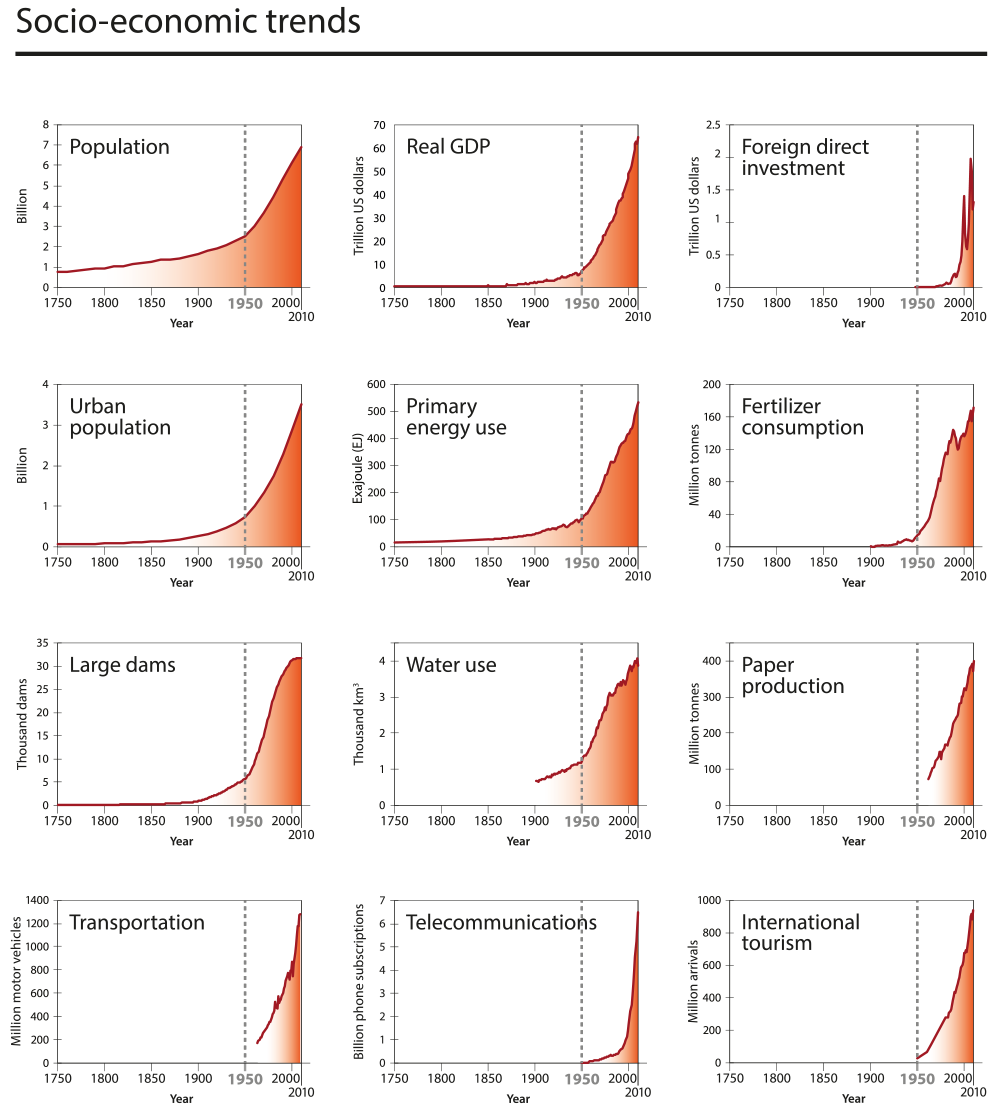
The cascading events that might lead to the end of organized nation-states in many parts of the world due to climate change look like a real possibility now.
What sort of events do you forsee?
I see a lot of dead people and violence.
Loss of glaciers in Himalaya ... 500 mil people on the move
Tropic & wet bulb or 50+C temperatures ... 2 mld. people on the move
Deforestations & droughts ... mass migrations, almost everybody affected
Large scale crop failures (temperatures, droughts, polinators ...) ... famines, wars
Biodiversity loses (it's critical) ... famines, huge loses for future ppl
Thermohaline circulation slow/shutdown ... cooling of northern countries, agricultural loses, extreme events
Loss of ice cover (Arctic, Greenland, Antarctic) ... rising oceans for several meters, major cities underwater
Cascading tipping points ... who knows
I'm starting to believe the sooner the system collapses, the better for the future of humanity.
200 million people trying to get into (or get through) 5 million country
As someone from a such country of 5 million, this crosses my mind almost daily now.
I'm thankful that I'm living in such country with equal nice countries on one side and rather closed one on other. With enough space to probably house this population in future.
Drought and flooding happening in many places in the world destabilizing grain prices.
Agricultural risks consolidating ag into even more megacorps.
Insurance costs making a lot of currently habitable places uninsurable, and after a few natural catastrophes nobody willing to settle in them.
Wet-bulb temperatures making the deaths of a few hundred thousands of people a frequent occurrence in many parts of the world.
Marine die-offs making the source of cheap high-quality protein in many places no longer accessible and lowering nutrition in several human populations.
What events don’t you see happening ? I can’t imagine things just “remaining the same” ?
What can't you imagine remaining the same?
Successful food harvests
It’s not just food security, but also water security. Rainfall patterns are set to change globally, with more frequent and increasingly severe droughts and floods. It doesn’t look good for the world’s biggest economy either
Not sure if you’re trolling ?
I was. When I saw a chain of repeated questions I had to add mine.
I wonder if we should instead embrace the climate change. We know that no one will accept stopping rising standards of living or even lowering them. As such we are not going to emit less in long run.
Can we instead of make some changes on local level that effectively work with the climate change or minimise the impact? Might mean need to abandon some locations, but there has always been population movements.
We need to do both. Climate change isn't a binary thing, the scale is important. We need to plan for things getting worse and work hard to stop them getting much worse than that.
That's a good point.
We are not turning back the systems that will heat the world.
If we approach it as a local challenge, there is a chance we can invent new ways to deal with it.
Maybe instead of this being the end, it could be a beginning of new science and development that counters the negative impacts of change.
Maybe, just maybe, we can get some good out of it.
Do we really want to live and grow our food underground, wear pressurized spacesuits while on the surface, make our air from algae vats, build our villages under big domes?
How many would be able to live like this, how many would die until we would get to this point, and do we really want this?
The problem is the overconsumption and overpollution. That's the only problem.
Nothing good would come from your proposed solution, imho.
> Can we instead of make some changes on local level that effectively work with the climate change or minimise the impact?
We can always get our towns ready to receive the millions of climate refugees we'll be creating.
Towns have no future in a collapse. Too hot, too water/fossil fuel dependent, too unsustainable.
No, it's the other way around.
Towns and cities are actually far more resource efficient than rural and suburban sprawl.
The only inefficient thing in them is highrises. But five-story buildings are incredibly infrastructure-efficient. Walking through a midrise neighborhood puts you past more people per minute, than driving 120 mph through a suburb.
> No, it's the other way around
When everything works as intended. In a collapse everything changes.
Imagine energy grid not working, no tap water, non-existent food supply, money is worthless ... such kind of future.
> Imagine energy grid not working, no tap water, non-existent food supply, money is worthless ... such kind of future.
Unless you're a subsistence peasant, which 99.9% of rural and semi-rural (suruban) people aren't, you're going to have the same exact problems from a lack of all those things.
Yes, it's gonna end up badly for most.