Hungary nuclear plant cuts output because of warm Danube waters
reuters.comNuclear power plants and coal-fired power plants work off the same principle:
Use the heat to boil water to create steam, run the stream through a steam turbine, and condense the steam back to water. This water is continually recycled throughout the system.
The river water is used to condense the steam back to water and then the water is discharged back to the river - warmer than it came in. If the water coming in from the river is too warm then the condensation rate increases until you get to the point it's out of spec. You can't condense the water fast enough. You need to reduce the plant's output, i.e. reduce the heat.
On the other end the discharge water is always warmer than the intake water. As the intake water warms then the discharge water will also warm - all other things being equal. You'll get to the point the discharge water will raise the water temperature to the point where aquatic life is negatively impacted. There are also laws mandating the maximum temperature for the discharge water.
So, you have to reduce output. That's just how these plants work.
That's the nice thing about natural gas plants - the gas turbines are essentially jet engines - they're fueled directly, no steam or cooling required.
This is something rarely talked about in the solar and wind discussion. People love to point out that the wind and the sun provide intermittent power, while ignoring more and more traditional power plants are curtailing output as water temperatures rise or water levels lower (water intake pipes would be exposed).
We don't talk about it, because we want to get _away_ from igniting huge amounts of underground carbon-based material and putting it straight in the atmosphere. We want to move to methods of power generation that do _not_ significantly upset the delicate balance of a livable planet.
Continuing adding more carbon to the atmosphere is only worsening the situation.
There are so many people that only think in extremes - we should go all in on nuclear and there's no other way. They are the ones that ignore limitations that parent mentioned. Their fantasy will not work and strong opposition to renewables is detrimental to our future.
I don't think anybody except lobbyists argue for that. In most projections i saw from pro-nuclear anti-carbon think tank (such as the one i was memebr of during Covid), the nuclear part in the energy mix vary from 30 to 50% (Depending on what the nuclear would be present for: i think in the 50% model, 60% of nuclear should be controllable plants, vs 100% for the 30% model).
Not talking about something doesn't mean it's gone.
Large gas power plants are combined cycle steam plants. Only the smallest ones are simple cycle as you describe. Large gas power stations are as complicated as any other thermal power station.
We have this problem with coal plants in Australia - in Summer often there are unplanned coal unit outages on hot days (due to this kind of thing, among other reliability issues with the aging plants - I don’t think ours use river water but this kind of cooling issue), and it’s always right when the grid is stressed with all the air conditioners running…
And of course the rightwing media starts the chorus of ‘those bloody renewables’ causing problems, even when solar especially is actually helping us ride through some of the coal unreliability!
Look what happened in Texas - major Winter storm hit and it froze the gas generation plants. Of course all the right-wingers could talk about were those "frozen windmills" failing them. Meanwhile in my state, which is considerably further North than Texas, the temperature was even colder yet our windmills were spinning just fine. Of course they "forgot" to mention that. They also "forgot" to mention all the gas generation plants that couldn't operate in subfreezing temperatures. You can better believe when generation is taken offline due to the river water being too warm or the water level being too low they're going to blame solar and wind generation for the outages. It'd be funny if it weren't for the fact that there are idiots who believe what they say.
You can do air cooling with nuclear plants as well, for locations that don't want to or can't use a water supply. Costs more, but totally doable.
> the temperature of the Danube, whose water is used to cool the plant, reached 29.72 degrees Celsius
Still works for cooling, right?
It's not that there's any technical issues; it's that there's ecological issues. Though there's going to be much larger ecological issues if we have to replace it with coal.
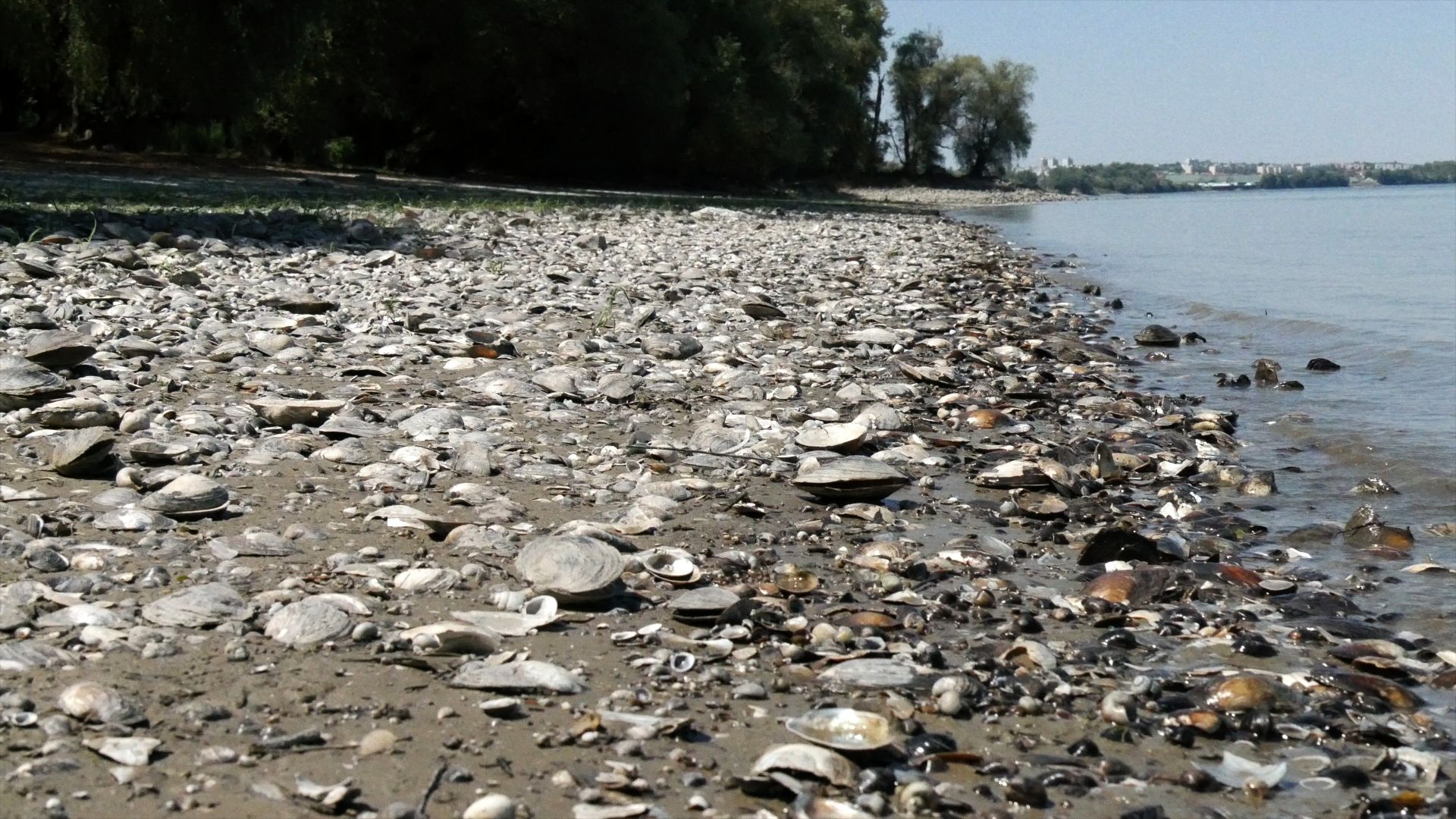
Works for cooling, but kills everything in the water. Besides last time I was there 3 years ago, the temperature was not uniform and there were waves of 34 °C water. Seems like nothing has changed since then:
https://atlatszo.hu/wp-content/uploads/2022/08/kagylokpaks.j...
I get your point, but it's a bit more nuanced. High water temp doesn't just impact the ecosystem, but also the plant's cooling efficiency. Also, those ecological rules aren't just guidelines, they're legally binding. As for coal, absolutely agree - we don't want to go backwards, but this does show how climate change throws a wrench in the works even for clean energy.
Coal power plants have more or less the same cooling problem.
"Nuclear plant does what it is designed to do"
The news here, and thus the interesting and probably unexpected thing to note, is that if we depend on natural sources for water to cool nuclear plants and due to climate change the temperature of waters rise, we need to adjust where we build plants and/or spend extra energy to cool down the water to in turn cool down the plants.
Its not just that water temperature rises but that there is less of it (ie drought) so the constant amount of constantly hot water from the plant gets mixed with less water left in the river increasing its temperature more
Well it's got more to do with not wanting to boil the river ecosystem rather then being unable to cool the plant.
It’s both, higher temperatures also make the cooling less efficient.
Yep. Also this shows that the Danube is not able to cool the power plant, yet the guys are building Paks II...
It's perfectly able to do so, but not at full power without heating up the river so much it would hurt organisms in there.
Even then, it _could_ have been designed to do so - through more flow - but it's just a design parameter that was optimized in a cost/performance trade-off.
Cost performance tradeoffs aren't some minor thing. If you cannot produce energy at a cost effective level, you might as well not produce it at all. The theoretical capabilities of the thing are not relevant if the economics of them don't work.
Well sort of. Reliable base load power (nuclear, coal, gas, hydroelectric) has become essential to modern civilization in a way that transcends economics. If we can't keep the lights on then nothing else matters. Thus, competent governments will find ways to keep those plants running regardless of cost or environmental impacts. Those that don't will end up as failed states like what is happening to South Africa right now.
Maybe, but irrelevant. If the nuclear plant goes up in costs by 10x then you're just going to buy more fossil fuels. Ignoring costs associated with running and changing the nuclear plant that might cause you to run it anyway and just lose a ton of money. The backup answer is always fossil fuels more or less.
It's cost-efficient to operate in profitable scenarios and halt in costly scenarios.
Optimizing profitability concerns the full operating range, not same anecdotal outliers.
All energy-intensive industry operates only when circumstances are favorable. Sometimes it's more profitable to reduce output temporarily, e.g. during high gas-prices, or during weekends when workers are more expensive.
> It's cost-efficient to operate in profitable scenarios and halt in costly scenarios.
That really depends. You have fixed costs to operating a nuclear plant. You can't suddenly operate for a smaller fraction of the time and expect the economics of operating the plant to be the same.
Also, your comment was about the technical design of the plant and how it used flow to cool things, not the decision to turn lower operational output.
Climate change starts hurting one of our best chances of avoiding climate change.
A bit of an exaggeration. It's the middle of summer. It's not like this water source won't cool down again.
Everything is fine. Carry on.
Not what I said.
I think at this point we should stop saying „climate change starts …“. It’s already happening since a while. Climate change does indeed hurts one of our best chances of reducing C02 levels.
Note that warm waters is a typical strawman argument against nuclear power.
These are rare anomalies and there's dry-cooling of nuclear power plants (although it's less efficient and costs more).
These are as rare as the week long events of low wind. Meaning that we must plan for nuclear curtailment just as we must plan for unusual wind weather: with backup generation and with storage.
Trying to brush aside legitimate engineering challenges as "not real" seems far too common among nuclear advocates. Which is my guess that their construction projects fail so often; the engineering and logistics and construction are significant challenges that are not taken seriously enough.
If the nuclear industry took engineering and problem solving as seriously as those in solar and wind, we would probably have a lot more nuclear around, a lot more successful construction projects, and nuclear that was cheap enough to build.
> Note that warm waters is a typical strawman argument against nuclear power.
A strawman is a false opposition argument set up to argue against, so, no, its not. I am not even sure what you are trying to say, but “strawman” isn’t it.
Also, most proposed new reactors a aren’t dry-cooled and the arguments, which include cost, for nuclear don’t assume that higher cost option.
Plus, it's a design parameter in a performance/cost trade-off.
It's _designed_ to not work at full power at this heat, because that was thought to be the ideal trade-off.
Maybe it still is, maybe they underestimated the occurrence of high water temperature incidents, but in any case it's a consciously designed safe state.
Sure, but such mitigation strategies mean even higher costs for nuclear power which is by far its largest problem.
It’s clearly possible to make a great deal of nuclear power safely, just not as cheaply as similarly environmentally friendly alternatives. Electric utilities prefer to spend less on battery backed Solar etc because of all the little details that aren’t obvious until you really study what’s involved.
Can future designs have the operating temp shifted in order to accommodate warmer waters?
You mean the design of the ecology around? No, not in a reasonable timespan ;)
Plus, most reactors were built in the 70s/80s when waterflow of rivers was more plentiful and less warm on average. Ironically, nuclear contributed to none of that.
"Ironically, nuclear contributed to none of that."
Only when you think building them, maintaining them, mining Uran, shipping Uran and shipping and storing the radioactive waste has no CO2 footprint.
Now sure, we still might have been better off, if we would have replaced all the coal plants with nuclear by now. But we did not and now we have to work with what we have.
Rare anomalies currently. Will they continue to be rare anomalies going forward? Also, high heat moments are the times when you likely need more power than ever...
Is it not a chicken and egg? If we don’t build waters get warmer faster from the existing primary sources of power, albeit indirectly
There are scenarios where it could be a chicken and egg. But there's also likely many scenarios where you ought to acknowledge that it's a dumbass place to build a nuclear plant because the water supply it depends on are not reliable and are expected to get worse with no regard to the plant itself. I'm not saying that's the case here. But... I would guess it's likely.
Very curious, where do we have the reliable water supply? Just move existing fleet, or build all new now with what we fail already? And then cool them with the unproblematic salty sea water, boiling the oceans that also start getting temperature problems already? Very confused..
Creating heat to turn into electricity is an outdated 19th century idea at this point.
Now that we’ve mastered the technology to turn ambient energy directly into electricity, traditional nuclear reactors are an overly complex technological dead end.
Though it seems inefficient why don't we see alternative methods take over?
We are seeing alternative methods take over....
Check out the interconnection queue for new generation where there's price competition, and you will see it completely dominated by non-thermal tech.
And the thermal tech that is there, natural gas, is partially combustion turbine driven, and without that combustion turbine component it would likely not be competitive at all. It's likely that within a decade a lot of those new natural gas CCGT assets will be completely stranded and uneconomical.
And as with any high-capital established industry, there are a lot of dinosaurs that will not move until they die off. They will be victims of creative destruction, rather than survive and pivot sooner.
I'm seeing them? (:
These are rare anomalies
Note that partial shutdowns due to excessive heat happen regularly in France, e.g. in 2018, 2019 and 2022. The problem's been around for a while, see e.g. this article [1] from 2009 that also mentions the heatwave of 2003, where regulators had to grant special exemptions to allow discharging 30°C water into waterways, well past the 24°C limit.
[1] https://web.archive.org/web/20110612153407/http://business.t...
> Note that partial shutdowns due to excessive heat happen regularly in France, e.g. in 2018, 2019 and 2022.
And they affect a very small number of plants and energy output. The largest disruption so far has been when French government finally got its head out of its butt and stopped a few plants for long overdue maintenance
Even before the most recent maintenance period, there were problems: In 2019, French regulators had to ask industry to cut consumption by 1.5GW to keep the grid stable as utility frequency was dropping significantly [1]. That issue comes up basically every other winter, but so far, we've avoided catastrophic results.
[1] https://www.cre.fr/actualites/RTE-fait-appel-aux-industriels...
They asked to cut consumption because of nuclear power plants or because insufficient supply of electricity?
Insufficient supply in winter times due to electric heating, mostly. Nuclear power plants are relevant insofar that they (in particular the older generation of power plants) are bad at providing energy on-demand. So while everyone worries about Germany and the issues associated with variable availability of solar and wind power, there are also documented cases where Germany had to fire up its coal plants to meet nuclear posterchild France's electricity demands.
I used to read German online magazine Telepolis regularly. They've got a writer who advocates for renewable energy, hence I used to come across related articles every now and then.
> Nuclear power plants are relevant insofar that they (in particular the older generation of power plants) are bad at providing energy on-demand.
This is, of course, an easily verifiable lie.
During winter nuclear power plants already work at near 100% capacity. They can't give you more than 100%, other sources cannot meet demand, and somehow you blame nuclear.
> This is, of course, an easily verifiable lie.
It's not a lie, you just failed to get the point:
Assume, for the sake of the argument, that you have a power plant that always works at 100% capacity and cannot be shut off. To provide energy security, you would have to budget capacity to account for highest possible demand. But if you do so, you will over-produce electricity most of the time, and there are economic incentives against doing so.
> somehow you blame nuclear
I don't blame nuclear energy production, I blame an over-reliance on nuclear energy production.
Okay, you keep approaching this with a abias, false assumptions and false premises.
This is the last I'm going to say on the matter:
1. "Nuclear power plants ... are bad at providing energy on-demand."
This is a lie. All nuclear plants, at least in Europe, are required to increase and decrease their power output on demand.
"according to the current version of the European Utilities Requirements (EUR) the NPP must at least be capable of daily load cycling operation between 50% and 100 % of its rated power Pr, with a rate of change of electric output of 3-5% of Pr per minute." [1]
Daily. Between 50% and 100% of its rated power.
The lie that nuclear power cannot provide energy on demand is a lie that people keep perpetuating.
2. "for the sake of the argument... a power plant that always works at 100% capacity... I blame an over-reliance on nuclear energy production."
If your power plants always work at 100% capacity, it's a failure of planning, not of the plants.
It's amazing that you brought up Germany in one of the comments. It just goes to show how biases make a person completely blind/oblivious.
Germany has shut down its nuclear power plants. Now it needs to burn ungodly amounts of fossil fuels and import ungodly amounts of electricity every time there's a windless night [2]. Because they decided that renewables are enough, are over-relying on them, and made no plans for when they are not enough.
This is colloquially known as "fuck around and find out". Aka "you can't attribute the failure in general planning to the performance of a single actor".
Yes, France relies on nuclear power. And yet, they have done fuck all: they have neglected maintenance of their nuclear plants for decades, they didn't plan for increased electricity demand etc. Much like Germany with shutting down their plants: they never calculated the actual electricity needs etc.
But people like you keep saying things like "nuclear is bad at providing energy on demand" etc.
[1] https://www.oecd-nea.org/upload/docs/application/pdf/2021-12...
[2] On the week when they celebrated shutting down their last reactor, there was a night when they had 0% solar production, and 0.2% wind production, both of which could be covered by just a single reactor from theos they had shut down.
The largest US nuclear plant is Palo Verde just west of Phoenix were temperature can get crazy hot and nowhere near a body of water. It’s running with waste water of the city. So I’m pretty sure in a country way more humid like France you can have a backup plan, like building larger condenser towers.
Sure. It's not so much a physical limitation, but a failure of policy.
To what extent is it a strawman when it comes to nuclear power generation?
These rare anomalies could happen more often because of climate change and the existence of dry-cooling power plants doesn't help if yout already existing isn't
Never heard of dry-cooling nuclear reactors, how much less efficient, also less safe? Does a prototype even exist? Some reference please.
Will we call the rare anomalies rare until it they are the norm? And then?
nuclear power plants are not environmentally friendly. sure they're carbon friendly and "green" in other ways, but the mining of uranium is horrendously dirty, the long term storage of the waste is dirty as hell and this waterways heating issue is just another problem.
green renewable should be our goals, we're bathed in power every day it just needs to be bottled. nuclear plants have their place, but its few and far between and i would argue less than desirable in general.
A typical large scale nuclear plant produces 3 cubic meters of waste fuel which is (in the US at least) stored onsite in cooling pools. It is not "dirty as hell".
> green renewable should be our goals, we're bathed in power every day it just needs to be bottled.
There is a lot to unpack in this vague statement, but generally speaking, utility-scale power generation from nuclear has the lowest ecological footprint, not just in land area, but all-told. A solar farm is a big, complex, thing with a huge footprint.
the long term storage of the waste is dirty as hell - It's not! France manages to recycle a lot of it's fuel(not sure if all), 90% gets back to reactor, 10% is transformed in solid state via vitrification for long term storage, where only first ~300 yrs are really dangerous bc of the decay speed of these 10% Why others don't do this? Fk knows, fossils lobby I guess+ some other 'reasons' that are not that important. There are similar reprocessing plants in Japan and (maybe) China and one more county
US doesn’t do it because the highly-radioactive byproducts generated by the reactors were at one point the desired end-product. But even so, it’s a miniscule amount — such that things like “having an off-site storage facility” are problems that have been put off for decades (and probably can be for a few more).
In the US the Carter administration stopped spent fuel recycling due to it's fears of nuclear proliferation. Didn't make sense to me at the time and still doesn't.
> green renewable should be our goals
Comfortable life for everyone is my goal.
> we're bathed in power every day it just needs to be bottled
That word "just" proves that you don't know what you are talking about.
It's the same "just" as in we need just more nuclear power plants.
But he is right about the botteling. Storing energy is the most important issue, because we have plenty of energy sources but still depend on production on demand.
The thing is, we can produce nuclear power plants reasonably fast [1]
The problem with storage is that we don't have it. Not now, not for forseeable future. Australia has had some headways into the problems though, and has been midly successful with storage at scale.
[1] And unbearably slow. There are examples of both.
> but the mining of uranium is horrendously dirty,
if you go down enough the chain of anything you find something that is not so friendly. And anyway that is a call to review Uranium mining practices not a condamnation of nuclear tech. In sum nuclear power plants are friendlier that everything we have right now.
> but the mining of uranium is horrendously dirty, the long term storage of the waste is dirty as hell and this waterways heating issue is just another problem.
The production of renewable infrastructure, and mining for the materials required to produce them is also horrendously dirty.
> the long term storage of the waste is dirty as hell
90% of waste can be safely stored on-site, and is short-lived.
The remaining waste is ridiculously minuscule, and can probably fit in a few shipping containers. The main reason it's expensive to store is politics.
> it just needs to be bottled
"just".
what if you just pooled the water until it cooled down naturally under shade before discharging back into the Danube?
Turkey Point plant in SE Florida uses miles and miles of man made switchback canals to cool the discharge before it returns to the plant.
The water, coming from uphill, is already cooler than it would be if it sat still at the current altitude. Streams and springs average the temperature out over months, not simply a few hours.
so is there no way to convert radiation to electricity directly without heating large amounts of water?
some Seebeck thing?
For other Americans, 29 C is 85 F.
and Burmese and Liberian.
Both those use metric primarily in official documents now.