San Francisco may soon get 24/7 driverless cabs. City leaders are fuming
washingtonpost.comIt's entirely possible that this tech isn't yet ready for an expansion, but this article does a shit job of demonstrating that. The alternative is not perfect drivers. The alternative is real human drivers who make all kinds of mistakes every day. I completely believe that these incidents are real, but without comparison to the actual alternative, it's useless information.
My guess is that the self-driving cars are a bit safer against injury/death per mile (we don't have enough data to know either way), but make stupid mistakes that inconvenience emergency services a lot more.
But we don't know how to make human drivers any better, and self-driving cars are steadily improving (even if that's slowing down a little).
> make stupid mistakes that inconvenience emergency services a lot more
Maybe. But human drivers already do this way more than I would expect. I’ve seen emergency vehicles stopped and blocked by human drivers who are either paralyzed with uncertainty of what to do or selfishness (no way of knowing what’s going through their minds).
They're both guesses based on incomplete data. But it sure looks like self-driving cars are still a fair bit worse on the second. The whole "fail safe" thing is great for overall safety but bad for doing something reasonable in these edge situations.
> But it sure looks like self-driving cars are still a fair bit worse on the second.
How so? We hear about the self-driving car incidents because they're required to write up reports whenever something happens (and it also makes for a good news story). That's not the case with human drivers.
We're generating a whole lot more videos and fire department complaints about Cruise vehicles doing bad things at emergency scenes than you'd expect for such a small number of vehicles.
It's also the least structured portion with the least clear rules than any other part of the driving task, so it stands to reason it would be worse.
In 2022 there was about one formal complaint per week. Hopefully, there has been a reduction in 2023.
My solution, would be to have free or low-cost self-driving (to keep the cost down) buses and ban cars including taxis. That should move a lot of people and clear out the streets.
> The alternative is real human drivers who make all kinds of mistakes every day.
From a European perspective I would say that in a city the real alternative is a functioning public transport system. Trams, light rail etc are infinitely safer and far cheaper than any form of car based system.
I think this is just complacency and a bias towards how things are; imagine a world in which biking is safe, pedestrians are safe, and huge amounts of the city don't have to be devoted to parking. That's what 24/7 driverless cars can enable.
Why will self driving cars enable this though? It seems to me that an equally plausible outcome is that we move even further towards cities built solely around the car.
I have never owned a car. As a result, I look at each trip and think about the best way to accomplish it. Usually the optimum in terms of cost is by bicycle, or by bringing my bike with me on a transit connection.
If I'm short on time, going to the airport, or my eyes are dilated from going to the optometrist or something, I'll use Lyft or Uber. This is like a once a month or less occurrence, (as you might guess since dilated eyes are one of my main reasons for using a car... I don't go to the optometrist that often.)
So I'm a world where few people own care, you might expect something like this. The car costs are up front per trip, not sunk as they are when you own the car, so you should see people thinking more rationally about their trip planning.
Driverless cars won't ever road rage / deliberately drive close to bikers to freak them out at least.
Driverless cars can come pick you up, which means you don't care if they park further away from your house, because you don't have to walk that distance.
Also, every parked car is one that isn't being used. So if there is lots of parked cars, that means you would need a lot fewer driverless cabs to replace them.
It would be easier to make a street car free. As driverless cabs dont need parking and can use daily updated maps. There would be very little resistance if a street gets converted to a small park. People would have to walk 5 min further to pick up a cab.
Unless you take all human driven cars off the road, you’re not going to get nearly the efficiency and safety you describe.
I, for one, don’t want to live in a world where my ability to go anywhere is decided by Google and Uber.
Big Tech has way, way too much power already. Please don’t give them any more of it.
> I, for one, don’t want to live in a world where my ability to go anywhere is decided by Google and Uber.
Seems like a red herring. I think it’s safe to assume that you will be able to own your own SDC, and the faster Google gets this tech scaled, the sooner you can affordably purchase one.
Will the SDC not get any updates over the internet? What Google decides to lock me out? Or show me unskippable ads before starting the car?
I don’t think the self driving car cheerleaders have thought this out.
If there's no law to prevent it, "traditional" cars will also soon come with unskippable ads. At least, that's the way how "traditional" TV manufacturers went. And if there is a law against it, Google or VW isn't a meaningful distinction anymore.
Nothing will stop someone from building a SDC that doesn't have the ability to be locked out like that.
The tech to do this is getting easier each year.
We’re down to a duopoly in the smartphone market. For most of us without a desktop/laptop (the bulk of global internet users), our digital lives are essentially controlled by Apple and Google.
Why would this be any different with SDCs? The tech might be getting easier, but current market forces make it far easier for the big players to monopolize the market.
There are a lot of competing car makers. In theory, they should select from multiple competing offerings.
Then again, they haven't always done well with that in supplier selection. You might be right, they might end up largely tying themselves to a few suppliers.
OTOH, the network effects shouldn't be as strong. It isn't hard to imagine FOSS options like OpenPilot continuing to exist.
Selling self-driving cars at cost is not the profit-maximizing strategy here.
With Google (and big tech) squeezing more and more for profits, some here even proclaiming it the new IBM, I don't see this ending with consumers winning.
I think you’re assuming (incorrectly) that Google will have a monopoly on SDC technology. There are already many big players in the space, so the profit maximizing strategy is probably much closer to what the consumer actually wants.
It doesn’t seem to me like there’s a big competitive moat other than $xxb in R&D costs, so if there is unmet consumer demand for self-owned SDC, it’s probably safe to assume someone will cough up the R&D costs.
Would I be purchasing it from Google ? Android Car (tm)?
Google or someone they partner with will likely be an option. Another will be Cruise or whoever they partner with. Or, Tesla.
Not sure that really makes much difference, it will be like buying an android phone. Full of tracking and spyware.
That is what government regulations are for. No one freaks about about Amtrak suddenly deciding who can and can't ride their trains.
MasterCard can and does decide who can or cannot take payments and nobody gives a damn either
Lots of people give a damn, laws surrounding that exacts issue have changed in the past and obviously they can be changed again in the future.
True, but the self-driving cars argument has always been that if all cars on the road are replaced by self-driving cars, you will have no road deaths.
Which pretty much means that in this future, you will have no choice but to use a self-driving car. Which gives disproportionate power to automobile/SDC companies.
If the only motorized way to move from point A to B was Amtrak, I would be worried about the power Amtrak has over my physical movement too.
If you rely on human-operated cars for transport, your ability to go anywhere is already controlled by large institutions.
- You require a car manufacturer like Ford or Toyota to manufacture and sell you a vehicle.
- You require an insurance company to cover your liability.
- The government must issue you a license, which it may take away at any time for not abiding by its traffic laws.
Well, you atleast have some control over the government and can theoretically vote out any policies that would deny you the license to drive a vehicle.
Google is not beholden to any democratic process and can summarily deny my request to go somewhere.
TBH, that's a fallacy. You don't have to get rid of literally every human driver to get vastly better safety for VRUs.
Just reducing it to only the people who choose to drive will make a big difference.
> I, for one, don’t want to live in a world where my ability to go anywhere is decided by Google and Uber.
Great news! If you join the tens of thousands of people who die from driving related deaths every year in the US, you won’t have to.
As a society, you have to make a decision between perfect freedom and perfect tyranny. Its never a clear cut choice and the reality is always somewhere in between.
But surely I can’t be the only one concerned about companies that already own my digital lives now also encroaching upon my physical life?
In this world, we'll still have giant hunks of steel zooming around our cities, creating noise, taking up space and wasting energy to move themselves around (the payload to weight ratio of cars is abysmal).
We need to get rid of cars altogether, with exceptions for emergency services etc.
I'm fiercely anti-car, but I also live in reality. If you find a few tens of trillions of dollars to rebuild every American city to be car free, let us know. I'll buy some books to occupy me during the 2-3 decades on non-stop construction.
What do you suggest people do when the weather isn’t quite as nice?
Where I live, it gets so brutally hot and humid in the summer that people literally collapse and die if they do anything much outdoors.
You're inverting cause and effect.
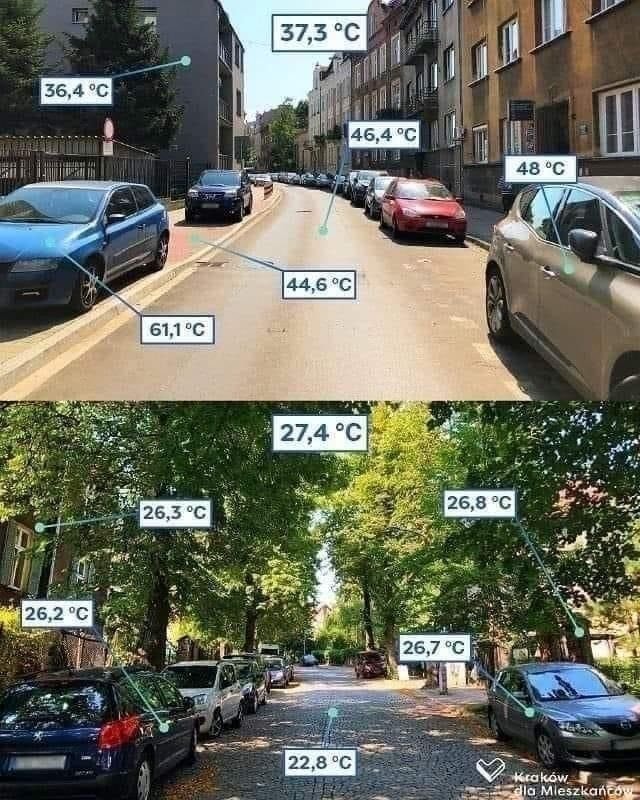
The reason it gets so hot in cities is because it's a concrete wasteland that traps heat because of, guess what, cars.
Here's an experiment to show said effect - same city, same day, very different street layouts: https://doemee.leiden.nl/uploads/55aa69e8-fb15-4ccc-8335-9b6...
San Francisco is not like that though. that's the whole point of the article. They could also take transit.
SF despite being dense and having high transit ridership for a US city is still fairly car oriented. If the endpoints of your trip are not near Muni/BART station it's going to take twice as long on transit. And the hills can make the walking part difficult for people who are elderly, disabled, or need to transport items.
That sounds like a place not suitable for human life.
Well, hundreds of millions of people already live here.
Not for much longer. In the 20 - 30 years, those areas will become uninhabitable.
These self-driving taxis are basically just buses you can call to pick you up on demand. In areas where there's sufficient density, the most cost efficient option would probably be a self driving on demand bus. In principle, I think they can be part of the solution.
The main difficulty is making sure the self driving transit vehicles are safe enough that people feel comfortable taking them instead of individual cars. Even though you are statistically speaking less likely to get shot on Philly public transit than you are to die in a car crash on a Philly highway, many people still choose to drive because there's a shooting on transit every few months or so and other less serious disorder on a more regular basis. I assume the same is also true in other cities like San Francisco or New York.
I'm strongly in favor of walkable cities and public transit but most people are going to choose cars and suburban sprawl if it means not having to deal with rampant crime. So anybody who wants to get rid of cars and car dependent suburbs needs to be in favor of both locking up the criminals (in a manner that respects their rights to due process of course) and addressing the root causes of crime (i.e. poverty, bad schools, drugs, etc.) so we don't end up with another generation of hardened criminals.
Transitioning to bike-centric urban transit takes decades. The best cities in the world have roughly equal bike and car traffic (and a big chunk of transit), but it's taken decades to get there.
Cars moving over the next 15 years to be much safer for pedestrians/cyclists could be a big shortcut on this path.
Seemingly Paris has done a great job over the past 2-3 years.
Paris has done great in climbing up to a bit more than 15% of daily trips by bike.
My point is: even the bicycle capitals of the world (Amsterdam, etc) have equal car and bike trips per day, and it's taken a long time to get there.
IMHO, San Francisco's Telegraph Hill neighborhood with it's 31.5% grade will take longer than Paris to become bike friendly.
There is 36C outside with ca 50% humidity
Do you suggest biking?
That's what 24/7 driverless cars can enable
If the prospect of this happening was somehow grounded in reality, that is.
I took one of these in Phoenix, and realized how easy it would be to rob/kidnap/assault someone in a SDC. If you simply surround the car on all four sides, the car will refuse to move.
All it would take is 4 thugs to surround the vehicle and you would have to give up all your belongings. In the current world, you’d just run one of them over but that’s not an option in SDC’s.
This combined with the fact that the cars are easily identifiable and trackable via the app seems like a disaster waiting to happen. I'm not sure what you could do other than arming vehicles.
There are probably much less risky targets to rob/kidnap than someone who's inside a metal box of cameras that's monitored by remote operators able to dispatch police.
I don’t know what to think about my gut reactions anymore. I guess that’s a good thing, but for instance, when bird type scooters came out and the city wanted to regulate, I thought the city council to be a bunch of luddites expecting a cut somehow. Fast forward 7 years or so and those things litter the sidewalks, people ride them very dangerously and sometimes even block handicap pathways or emergency egress. I felt the same way about them trying to clamp down on those FB/Apple/… employee buses and their use of city streets to pick up and drop off employees. I still thought that one was weird as they got more cars off the roads than anything else.
There are hundreds of these driving around SF 24/7 already, and they're highly visible, so I'm not convinced they actually have issues at a higher rate than humans. Any time something unusual happens with them it's almost guaranteed to make the news. And a few times the initial knee-jerk reaction turns out to be wrong. I wonder if this whole narrative that AVs are ruining SF is going to go away after they actually get approval. I haven't heard of any protest or outrage in Phoenix, where they've had Waymo for a while now.
The SF dilemma:
- can’t own a car because expensive, no parking, will get broken into
- can’t use a bike because roads are dangerous for bikers and bike will get stolen if parked outside
- can’t use uber/lyft because expensive, companies abuse drivers
- can’t use public transport, because it doesn’t cover enough of the city, timetable unpredictable, can be dangerous or unpleasant
- can’t use self-driving cars, because they occasionally interfere with public services, are run by big tech
The thing is you can use all of these for different use cases.
I have a car which I take to anywhere I can park easily (which is a lot of places in the city if you avoid downtown).
I don't own a bike but I know many who do, and just take it inside with them. Roads are dangerous for bikers but not moreso than every other city in the country.
I use uber/lyft only when I know I'm not going to be sober, which isn't that often (once a weekish).
Plenty of people I know use public transit, though only some routes are useful/safe.
Self driving cars are still very early days and I'm sure they'll work out the technical issues. The fact that they're owned by big tech isn't a problem for me and most other people.
For what it's worth I would rather be run over by a stupid person than a stupid machine. At least if I survived I could learn to forgive a person.
They should simply be held to the same standard as any other road user. Whoever is ultimately responsible for these cars should also be responsible for the traffic offenses. Prosecute them. Revoke their drivers license. Impound the vehicles.
Im not against driverless cars, but I am against unbalanced treatment of road users, legal persons and natural alike.
> Revoke their drivers license. Impound the vehicles.
> Im not against driverless cars, but I am against unbalanced treatment of road users, legal persons and natural alike.
OK, well, ... surely we need to have some kind of not-exactly-equal treatment. If I commit 4 traffic offenses in a year, I'll get a suspended license. If Google commits 4 traffic offenses in a year across, say, 5,000 cars and 50,000 vehicle hours, they probably should not have operations suspended.
Why not? It's the same code across all the cars... it's as if you had a clone factory making clones of driver you.
I kind of hope you're joking, but just in case you're not I'll explain.
Because if I make a mistake every 3000 hours of driving, that's a mistake every 5-10 years. I am allowed to continue driving by the law.
If Waymo makes a mistake every 6000 hours of driving, and drives 50,000 hours per year, that's 8 per year. Said system would be twice as safe as me but would pretty much immediately get suspended if it's treated as "one driver."
Under this logic, twins would share the same drivers license. :)
Why? Full-time professional drivers are subject to the same rules as casual drivers. They should program them not to perform traffic offenses.
Because perfection probably isn't attainable. Exceeding human performance by a large margin should be good enough. There is no reason to compare a fleet driving 500,000 hours (or much more) in a year to one person driving 300 hours in a year.
A single professional driver cannot drive hundreds of thousands of hours in a year.
That first paragraph sounds _exactly_ like what I’ve seen human drivers do. All of the incidents in the article are.
Sure, wet should strive for bettering the situation with automated technology, but it’s not like this is worsening the status quo.
It's really hard to believe how much of America a few companies will own. The Internet, advertisement, transport, AI like...can anything stop Google?
Individual motorized transport is a dead end, especially in cities, no matter if it has a driver or not.
It's just inherently energy- and space efficient to haul around a two ton piece of junk per 80kg person. Cities don't have the space, the planet doesn't have the energy to support it. We need to ban cars from cities in the longer term, both human- and AI-driven. For now, we need to take steps to get there. Reduce car lanes, increase bike lanes. Build out public transit.
I am with you on personal automobiles which take up enormous amounts of space on our streets per rider, even when every seat is filled. That doesn't mean individualized urban motor transport is a dead end: there are still E-bikes.
I think that ship sailed in many parts of the US when cities were built around cars.
US cities weren't built around cars, they were bulldozed for them.
https://historydaily.org/america-streets-before-cars
We can undo the damage.
…and hope that climate change makes the weather nice enough for bikes and walking all the year round!
what if a thug stayed in the car an robbed every new rider? What if the homeless camped in the car?
Why couldn’t it drive that person to a police station for the criminal or a suitable place for the homeless person? Certainly they detect when anybody is in the car.
Whilst the city doesn't control the laws here, they control the police. So if the city intends to sabotage self driving cars? They'd lock the car down for illegal parking when arriving at the police station.
Good point, valid concern. It’s assumed you need to pay to enter the vehicle and this is tied to your credit card. Could the system be setup so you are charged until you exit the vehicle and your trip doesn’t end until you do? Cameras or presence sensors could detect when the occupant enters or leaves the vehicle.
The first night these are driving around, a homeless person or a drugged up techbro will turn a car into an expensive autonomous outhouse.
It's called Waymo because there's way mo edge cases than they expected, ayoo
With these driverless cabs, will a person still be behind the wheel ? Or is no one there.
If not, what happens if an accident occurs and the cab keeps on driving due to a software bug ?
No one is behind the wheel. Right now there is no mechanism for a third party such as law enforcement to reliably stop or redirect the vehicle.* Yes, it is possible that an issue could occur and the vehicle will keep driving.*
* you could say the same thing about human motor vehicle operators
https://www.theguardian.com/technology/2023/jun/12/san-franc...
While this one is unique afaik, there are plenty of other odd ball ones.
Driving my kid to/from school in San Francisco, I regularly see completely empty Waymo cars driving around... pretty much every day. There's 1-3 that I see parked on a particular wide and relatively empty side street and I suspect they use that street to wait until they have a destination.
There are multiple failsafes to prevent a “keeps on driving from a software bug”.
There are overseers who are remotely monitoring vehicle telemetry. If there is an accident, the company will know before anyone else and will respond accordingly.
In the extremely unlikely event this happens and the AV doesn’t pull over the footage is saved for a time so the other driver/pedestrian/etc can simply contact the company/police for insurance claims.
There's already driverless cabs with no one behind the wheel running. Just not 24/7.
If some accident or bug occurs, they currently just stop completely until a person comes out
Waymo already operates around the clock. Their application to CPUC will only allow them to charge for the service.
Hopefully they had the foresight to test this.