Buy well, buy once
fellow.venturesI think a lot of times this philosophy is just rich people justifying paying a lot for high status items.
a pair of Crocs is 50 bucks and that's one of the highest quality pairs of shoes you'll buy for the price. you could buy 10 pairs of Crocs for a $500 pair of Alden's so even if the crocs only lasted a year, it would take a decade to recoup the investment on the Alden's.
but the crocs don't have the same status that Alan Edmonds or Alden or Fiorentini does.
Same thing with the G-Shock watch versus a Rolex.
If you really want quality look at what middle class people are doing. Crocs, Kirkland, G-Shock, Corolla etc.
All this stuff is top quality but rich people wouldn't be caught dead in them.
Another thing rich people like to do is repurposing something completely trivial. This dude probably paid as much or close to shipping the shoes than a new wallet would have cost.
This guy gets a feeling of satisfaction that they're making the world a better place by repurposing their shoes. Then they go to their job where they earn a lot of money defending companies who gave a small town cancer or a massive oil spill or wholesale invasion of privacy.
Completely agree. People love to tout the boots theory but the reality is that the people who claim this are often far beyond the point of optimal cost. Mass manufacturing inherently allows for better value to be delivered at greater scale, which tends to occur at the lower end of the price range. Beyond a certain point you're paying for prestige rather than lifespan.
I've had the same wallet for 10 years. It cost me $16 and was made from recycled leather scraps (thanks, Phil's wallets!). I plan to use it at least another 10 years. Will the $115 wallet pushed in this article really last 7x longer than my scrap wallet? I doubt it.
It really depends what you mean by “optimal cost” and “better value”. For example, if you want something that’s handcrafted rather than made in a factory on the other side of the world, you have to pay for the skills and labor that go into that. Depending on what it is, it might not last longer - but could be a better value in other respects than simply cost. Not everything has to be about making widgets for the lowest amount of money possible.
Of course. If you change the requirements the decision space shifts too. With respect to the boots theorem optimal cost is specifically focused on long-term concrete utility per dollar. Fwiw I'd (very loosely) classify the points you're bringing under "prestige".
> Fwiw I'd (very loosely) classify the points you're bringing under "prestige".
If I'd like my clothes made and sourced ethically, or if I want to support a local business that makes leather goods rather than buying mass-produced ones from somewhere else -- I wouldn't say those scenarios are motivated by prestige, but by valuing people and the work they do. It's a bit unfortunate that some things like that are considered a luxury these days.
> It's a bit unfortunate that some things like that are considered a luxury these days.
Those always were a luxury. Before mass production most people just couldn't afford to have things as we do nowadays.
$50/$500 is a 10%/year yield, which is hard come by in any guaranteed investment. The Crocs will likely have no retained value, while the $500 shoes may be worth something after 10 years.
However, that ignores the cost of maintaining a nice pair of shoes (both money and time) as one needs to clean, polish, and resole every so often.
You might want shoes in two or three colors/styles, which would make the Crocs last 2-3x longer, same for the other shoes, but are you really going to want the same expensive shoes in 30 years?
I think the higher end stuff that retains value and requires less maintenance might be a better example, like if someone is good at buying watches they could get a Rolex that appreciates in value and ends up costing them nothing vs a series of cheaper watches. Or compare to a $500 Apple Watch you replace every couple years. I don’t wear watches, though, and I’m not good at buying or selling them.
Really, I think there are some expensive, durable goods that last longer and are cheaper you might think, but still more expensive once you take into account the maintenance and time value of money. But nice stuff is nice to have, and it’s helpful that you don’t have to replace it so often.
Oh completely agree. My beef is with this smug patronizing attitude rich people have like theyre wise for buying expensive things that will last longer and the rest of us peons should learn from these wise sages. When thats not the case at all. You want to learn how to buy quality things look at a middle class family of four wearing big old granny Kirkland panties and driving a Subaru.
Their overhead on purchases is low AND their returns are high.
> The Crocs will likely have no retained value, while the $500 shoes may be worth something after 10 years.
This is the core of the “secret” to wearing high quality shoes at a low cost. Buy good used shoes and get them resoled as necessary. E.g. https://www.reddit.com/r/malefashionadvice/comments/1jhp8o/a...
I did that for a while. Resoling is $150 or more which is more than a normal pair of shoes costs.
A Rolex still requires very expensive maintenance every couple years (hundreds of dollars) just to do basic timekeeping. Absurdly, an Apple Watch upgraded every 4 years is probably cheaper to maintain. A high quality quartz is probably the financially smart option.
This isn’t a totally fair comparison. When people buy shoes, their criteria isn’t normally as low as “covers my feet”. They have a specific style they want, a specific material, and will shop amongst shoes that fit that description. Crocs and dress shoes are not interchangeable to a lot of people.
A better comparison is to look at, for instance, Johnston and Murphy vs. Alden. Then you get a more fair comparison. For instance, one has welted soles and so they can be replaced without changing out the upper. Those soles are leather and provide excellent comfort. One uses full grain leather uppers, one does not. Everyone doesn’t need those, but if you’re someone who is wearing dress shoes to the office every day, it may be worth the benefit. You also don’t have to worry about replacing the shoe every year (though you do have to maintain it).
Agree. Theres alot of factors involved in buying anything.
So we need to stop acting like we have great wisdom for "Paying more for quality" when in reality status and fashion had as much to do with the purchase as well.
No, I think we need to stop contriving obviously skewed examples like Aldens vs Crocs. Boots vs shitty holey rubber sandals isn't a good comparison.
Maybe compare backpack, or suits, or something along those lines.
"obvioudly skewed" how?
Its pretty much the perfect example imo
Aldens vs cheapo 20 dollar amazon boots would be a better comparison. You ain't wearing Crocs with a suit my man.
I wear a suit maybe once every five years though.
Like the rest of my life I could wear either Alden or crocs....and I do.
You pick one extreme edge case.
My criteria is maybe less fancy than other people. Covers my feet + isn’t embarrassing + durable + potential arch support + cheap.
I’ve never found shoes that meet all those criteria. I’ve actually never found any shoes, ever, that were even durable or had usable arch support. So cheap + not embarrassing is pretty much the bar to cross
But I learned recently that crocks have amazing arch support!
What kind of arch support do you need? I've found that superfeet insoles work great for my flat feet. I buy them whenever they're on sale.
They also make my cheap slip on shoes last much longer.
Fair warning. I have not found Crocs to be particularly arch supportive. there may be a specific model though that I'm not aware of that. has added arch support.
Hiking shoes are usually pretty durable and supportive.
For the shoes example, there's also value in reducing waste. 10 pairs of rubber Crocs that you throw out every year create much more waste than 1 pair of 500 dollar leather boots that can be repaired and are much more environmentally friendly when they are eventually disposed of.
100% agree about the Corolla though.
I'm not so sure about this comparison even. There are multiple factors at play that you're just assuming, that the $500 leather boots are going to be worn for 10 years to be equivalent to the crocs, but I'm not sure that's the norm. Excluding those who have the means easily for $500 leather boots, who likely will just buy more of them to rotate (thus creating waste). Surely someone who spends $500 on leather boots is also going to care about their status, and therefore might get them repaired far more often.
These repairs, while likely less wasteful than full-on recycling, have costs attributed to them. It costs to produce the goods required to repair. These goods often aren't super sustainable products either. With these factors in mind, is the comparison equal? Can we absolutely stand by the idea that paying for $500 leather boots will be better for the environment and you for 10 years?
Which is why when making these comparisons we should really get into the nitty gritty details, otherwise we're just handwaving a bunch of things and making assumptions to justify our position. By doing so, we'll be able to make better choices with proper information rather than shifting the burden of environmental impact elsewhere (to a repair shop or shoe makers, etc).
Note, this is not a defense of crocs vs leather boots. The product categories are just throwaway examples.
Right, because reducing waste is what people buying $500 shoes are worried about.
Corolla is a terrible example. It’s not a nice car to actually drive compared to almost any other. In that price range: Subaru and Honda will be as reliable and much better cars.
False. Corollas are one of the best cars ever made.
I had a relatively recent Corolla. I put some leather seat covers and floor liners in it and it was nice.
Waste disposal is usually a flat rate though, so it doesn't really matter how much waste you produce in financial terms.
From the documentary Idiocracy: Idiocracy director Mike Judge revealed that they went with Crocs both because they were cheap and that "no one would ever wear them." To the surprise of Judge and Idiocracy's wardrobe department, by the time the film came out after a delay, Crocs were all over the place.”
In fact you could save more money by wrapping your feet in used burlap sacks. Just need to be creative.
Right because Hollywood is great to look to for advice on how to buy low cost high quality items....
Idiocracy is exceptionally prophetic. And we've still got people seriously evaluating if GPT can be better than your doctor.
"Exceptionally" I think you might be thinking its more prophetic than it actually is.
It's more prophetic than the overwhelming majority of futuristicistic movies. Exceptionally does not equal extremely.
Also see Demolition Man.
you should write a blog post or something about it. I don't find it very prophetic but would like to hear other people's opinions.
Here's an article and discussion. I find the article somewhat lacking, but oh well.
I would say rich people who want to signal status would not get caught with those. But there are plenty of rich folks who want to fly under the radar, your millionaire next door types.
Crocs are not utilitarian (no structure or support for physical activity) and they aren’t appropriate in the wider spectrum a nice pair of shoes are.
I settled on some classic Vans after a deep internet dive signaled that they’re the most popular among homeless people for being durable and comfortable without being too expensive. They look fine, and I have a lot of freedom regarding when to replace them. I’m very happy with the decision actually. As an added benefit, they’re a welcome donation to the homeless if I don’t completely wear them out (which is basically impossible).
$500 sounds about right to me for the leather equivalent of the Vans. By the time you’ve accounted for durability and comfort without sacrificing appearances (and done it such that they can be attractively resoled) you’ll spend around that much.
I don’t have a wardrobe to match leather shoes, but the logic holds here if I did. You don’t have to be rich to daily drive a single pair of nice shoes, and the author’s tone didn’t strike me as snobbish or smug.
It’s just a different attitude. Lots of more expensive clothing gets you added features, better style, and better comfort than Kirkland. Expensive athleisure brands like Lululemon and Alo, for example, have pockets in better places and are more attractive than their Kirkland equivalents. The directly equivalent spending on the two makes for a smaller wardrobe that gets worn more often. If you have a ChatGPT Plus subscription, have a quick discussion with it about fashion. Its training is not among content from the rich but rather the internet at large, and even it will tell you that fewer nicer fashion choices make a better wardrobe than more less expensive pieces.
Every pair of vans I bought fell apart in a year. I think they used to be quality back in the day before they got popular and shipped their manufacturing overseas. I've never seen a homeless person in vans but that's just me.
The Sk8 Hi, or whatever it is, is the only pair of shoes I wear aside from some rain boots. They show little sign of wear after two years. I’ve also had an interesting and and slightly uncomfortable interaction with a homeless person saying “nice old school kicks” and giving me a high five. So my anecdotal data definitely holds up. Perhaps it’s the model. I also have a musician friend who’s been wearing the same pair of the same model for 10 years including a tour.
This even happens with expensive shoe brands. Loakes and Church’s are two such brands of shoes and Danner boots used to be decent too.
Small shoe makers get a good reputation for quality then can’t keep up with demand and sell or partner with huge fashion companies which cut costs and offshore manufacturing while keeping the price high.
Enshitification for shoes I guess.
Would you mind sharing some resources from your deep internet dive (if you still have them at hand) or maybe even just sharing the Vans model? Thanks.
The dive was mostly archived Reddit threads.
https://www.vans.com/en-us/shoes-c00081/sk8-hi-canvas-shoe-p...
The way I would put the Crocs thing is that they are not versatile. Maybe you could live a whole life with a pair of Crocs and a pair of well made leather shoes. But in that situation a minimalism extremist might ask: what are the Crocs for? You can wear the leather shoes around the house but you can't wear the Crocs to a wedding.
But I think your point is generally true, though I'm not convinced it is very responsive to this specific article. I didn't get much preachiness from this article, but maybe it was there, or maybe you are familiar with this person's other writing, I dunno.
My take is that "minimalism" is indeed often a status game as you say, but that it also has good insights for the rest of us who aren't interested in those games, but do feel this sense of having too much junk cluttering up our lives.
I'm far from a "true" minimalist, but reading stuff like this over the years has totally impacted my thinking. When thinking about buying things now, I do think about whether I could spend a little more for something I'll be able to use a lot more. Or even ignoring price differences either way, I just evaluate things from this perspective of durability. And I think that's good.
Pretty on the nose.
I think even more accurate is that quality/longevity and price are almost completely decoupled.
Spending more doesn’t guarantee higher quality it mostly gets you exceptional graphic design and deftly nested packaging that makes you feel good when you open it.
But it’s not like all the cheap stuff is better. A Rolex is an incredible engineering marvel and is in fact very high quality and durable. So are Festool tools, and so on.
But like so is G-shock and a random and difficult to pin down subset of Harbor Freight.
The broader point is that none of this really makes a fucking difference most of the discussion is just people preening about their choices instead of admitting it’s mostly a roll of the dice.
And the old stuff wasn’t “better” it was just different. When I was a kid in the 70’s and 80’s garages were full of shoddy junk from the 50’s and 60’s. That stuff is just all gone right now.
Yeah completely agree that price is decoupled from quality nowadays and it's pretty random.
Price seems to be based a lot more on marketing and brand saturation than quality. And quality brands get bought up all the time and the new company will coast on the brand while outsourcing manufacturing to the lowest bidder.
And you can't trust reviews with affiliate marketing around.
So pretty much the only thing to do to identify quality is to experiment or share info with people you trust.
I've wasted a ton of money on shitty products on the way to identifying quality products.
I'm not even railing against status. I bought a pair of Alan Edmonds specifically for job interviews to signal status but I wear LL Bean shoes and Crocs the rest of the time.
Also, there's other factors besides just durability and status. There's aesthetics, variable utility, ease of replacement, warranty availability, price, etc.
I hate shopping so I think alot about this haha
In the world of fashion perhaps. In the world of tools, absolutely not.
In human society its arguable that fashion is a tool of communication. At least thats how I have to justify it to myself because I hate being forced to participate in it but we all are constantly being judged on how we look.
My reply was strictly in regards to
> Yeah completely agree that price is decoupled from quality nowadays
In the world of physic tools, price and quality are highly coupled.
To your other points, I honestly think fashion is very rewarding and healthy so long as you are focused on making yourself look good to you. And I agree, some fashion conformity is unavoidable. Especially depending upon your career field.
The area in which this drives me the craziest is furniture. I have no idea how to find high quality durable furniture. Price signals definitely aren't it, but I have no idea what signals I can look for, or where to go to find them.
Furniture is INSANE!
Ive never felt like I was in a more skeezy situation than mattress shopping.
In general: pick the heaviest ones.
You have to learn enough about how they are built and then haunt local consignment shops for good finds.
It’s taken my wife and I years to slowly get pieces that will last the rest of our life.
I have two young children, I don't have time to "haunt" anything. But before we had kids we tried this with consignment stores, would spend like a year looking for some simple piece of furniture, and end up with junk anyway.
Design Within Reach, Herman Miller, Room & Board, Blu Dot, ...
Thanks this is really helpful. But how do I know what is or isn't junk at these retailers? None of the ones on this list have a showroom near me. And what goes in the ... ?
> A Rolex is an incredible engineering marvel and is in fact very high quality and durable.
But it's fundamentally worse at being a timepiece than a digital watch synchronized to an NTP time server.
This is a completely different device than a mechanical watch. Nobody cross shops GPS watches with a Rolex. Maybe a grand Seiko.
It's a Rube Goldberg machine.
Not after a nuclear war.
Sure it is. Even a relatively poor quality Quartz watch is higher accuracy than a mechanical watch, without any sort of synchronization. Really good ones are accurate to one second per year. No need for NTP at all.
If you're thinking about EMPs or something: well, I'd consider extremely accurate timekeeping to be the least of your concerns if no electronics work anymore...
Crocs aren't shoes. I understand what you are trying to say. But that was a lousy comparison. Even if you consider Crocs shoes, you typically won't wear them the same place you will wear Aldens.
this is false. people wear Aldens all the time and people wear crocs all the time to all kinds of different functions and events.
But "buying for quality" and "buying for status" are different, and I don't think rich people conflate the two (or the people here). The person buying Louis Vuitton luggage (or whatever rich people buy these days) knows they are buying it for status among their similarly wealthy friends. Although, you also get counter-signaling among "old money" types, where it's seen as déclassé to try too hard; they wouldn't be seen dead with something as vulgar as Louis Vuitton luggage.
However, I don't think this conversation is about them.
The smart middle class family buys the best they can afford given their budget, but the less-smart family buys the cheapest 'Buy well, buy once' encourages the first approach.
Sure a lot of stuff is high status crap (like the LV weekender bag that was torn apart here: https://www.youtube.com/watch?v=EktumN7N5l8).
But your comparisons don't factor in total cost of ownership and usage, and in fact many quality brands you do pay up for quality and better cost of ownership.
I can wear crocs at home. I would look disrespectful wearing them to a funeral. I can wear Alden anywhere though I might be overdressed for many occassions.
Aldens can be resoled and repaired and can last decades, the cost-per-wear can be very low. And many models of Aldens can be sold for a pretty penny (as an example these https://www.ebay.com/itm/394665864763 still go for nearly $300 even after years of wear). So if you bought Aldens new for $500 and wore for a decade and sold for $300 your cost per wear would be lower than that of the crocs. You would also be doing better for the environment by reusing the clothing and requiring less total material for your feet over a lifetime.
This also applies to a very few select watchmakers (and in fact increase in value). A Rolex or Patek Philippe has essentially beat inflation and would be considered a smart investment that made you money even while you wear it. A G-Shock would not offer similar returns.
Actually a lot of quality clothing can be like this. I thrifted a Tom Ford shirt for $40, wore it for a decade to weddings and funerals, and then sold it for $150. Certain makers are heavily discounted on second hand but retain their value. Borrelli shirts are some of the best on the planet. Would I pay retail? No. But you can buy them, wear them, and sell them second hand and pay virtually 0 to wear them over time.
Furniture is one where I've yet to find cheaper furniture paying off. A lot of particleboard furniture is awful. And it's all over Wayfair. The stuff I've had passed down or that I've bought that's lasted decades are all from North Carolina furniture makers. Not all of that stuff is expensive or high status but it is well made.
Expensive things are not always bad. Oftentimes the price is not justified. But it's not exclusive.
This a 1000 times. Those kind of articles are just rich people showing off, seeking attention, they must have indeed a miserably or fake life to even think that other cares about the brand of their shoes or mattresses (except other equally unhappy people. A shoe is a shoe, a mattress is a mattress, a sofa is a sofa. There's more important things in life that those details.
> Corolla etc.
Fun way to think about it (borrowed from James May): A Toyota Corolla is higher quality than a Rolls Royce. Because Toyota makes 10,000,000 vehicles per year. Rolls makes only 6,000. Meaning Toyota is better at making cars just by virtue of having 4 orders of magnitude more practice.
The original formulation of this theory (in Car and Driver iirc) was that it’s harder to make a water pump for a Chevrolet than a Mercedes, because you had to meet a tight cost objective for the Chevrolet.
In practice, it just meant Chevy often cheaped out on the water pump and you got water pump failures after the warranty expired.
This however is balanced by material quality. Rolls Royce can use more expensive alloys and premium leather that do not degrade as quickly and still have plenty of margin.
Corolla designers are highly constrained by cost.
Except that’s not true. So…
RR is made by BMW these days. So it’s almost certain to be awful.
BMWs are also higher quality than Corollas.
They have more features, but they break down a ton more often. By all means, if you want ventilated seats then you can get a higher end BMW, but that's a different metric from quality.
You can get ventilated seats on Hondas and Hyundais. You don’t need to pay high-end BMW money.
No they don’t. BMW is consistently in the top 5 rankings for reliability.
They’re just better cars, made to more exacting standards with higher quality materials and better engineering and features.
> BMW is consistently in the top 5 rankings for reliability.
And Toyota consistently ranks higher.
https://www.drive.com.au/news/most-reliable-and-least-reliab...
Yes so a Corolla is a lower quality car with comparable or slightly higher reliability stats.
Unless you think the word quality is just fully synonymous with reliability (in which case a paper airplane beats an F-18) then my point stands.
I don't know that 72% to 65% is comparable or slightly higher. That seems like a gap to me. And the fact that BMW ranked 10th last year isn't great.
Quality is famously subjective, that's why you'll never see it ranked in a way that everyone can agree on the way you can with reliability which is actually measurable.
But reliability is one of the markers that most people would use to judge quality. And we generally expect aircraft to go where we want them to without catastrophic failure, so I would think that an F18 is more reliable than a paper plane.
The reliability rankings are determined by surveying people and asking them the frequency of repairs.
Assuming my paper airplane never goes into the shop it’s going to outrank the F-18.
Ain’t a better plane though.
Well, again "better" is subjective and you would want to agree on some metrics before deciding.
Say I wanted a low-cost, lightweight, hand-propelled aircraft capable of flying short distances indoors that I could fold up and put in my pocket afterwards? Which would be the "better" plane then?
Better in this case is durability and there's no way of BMW is more durable than a Toyota Corolla and that is objective.
A brick handily beats both.
The other end of this is companies manufacturing products that are questionably eco-friendly and certainly less durable leading to a worse off situation to everyone except them.
An observation I have made of my grandparents, who certainly had a bit of money, is everything they own is high quality and has lasted them years.
My grandfather still has his Hickey Freeman suits and sports coats tailored and repaired by a local menswear shop. Their Dualit toaster still works while I have personally gone through many Cuisinart toasters. Their technics AV components still work with their high quality speakers. Their Sony Trinitron TVs still work. Their pots and pans from their wedding are still in active use. Their Pyrex continues to store leftovers decades on. I am currently using the Minolta film camera and lens that my grandfather bought in the 80s for traveling around the world with.
When I go to their home, I am always in awe of the high quality objects that still function perfectly fine and can all be passed down. When I look at many of the things my parents own and most of the things I own, I see less and less of that. Our clothes are cheaper. Our pans less resilient. Our technology is less repairable.
Buying well certainly leads to a longer lifespan for objects. However, I find that’s becoming tougher and tougher to find these days.
This sounds to me like a combination of survivorship bias and cost preference.
You see the resilient things at your grandparents' house because those are the only things that have survived. All the poor quality things they purchased over the years are gone by now. Also, you and your parents probably favor lower-cost items (as do most people these days) over longevity. This may simply not have been possible in your grandparents' time, pre-globalization. It's still very possible to get high-quality and long-lasting goods (the buyitforlife subreddit is a good starting point), but you're going to pay a lot more for them than most people are willing to in comparison to the "replace it when it breaks" mass-produced-in-China goods.
I personally don't favour cheap over longevity, and I don't really believe most consumer do either.
The problem is that it has become increasingly difficult to discern if something will last.
An expensive product, from what was a trusted brand, can be just as short lived as a cheap one these days. Cost does not always reflect quality.
And brands that build long-lived products struggle as they don't have the repeat customers of products that are good, but contain forced obsolescence features.
It's a hidden cost to consumers that is often hard to figure out without extensive research.
> And brands that build long-lived products struggle as they don't have the repeat customers of products that are good
I know of a company that was a national leader in a certain kind of industrial equipment. Now that the industry isn't expanding in this country, the market is saturated and they can't sell anything because what they sold decades ago was designed for excellence and just won't die. Nearly all business now is occasional servicing of their old equipment.
Well, if their brand is that strong, that itself allows them to start making something else - you know, "from the makers of <stuff_that_just_wouldn't_die>"; won't need much brand building and convincing because people are still eating the pudding containing the proof.
They should be able to increase the margin of their meager sales at the least, with a history like that.
Exactly. Marshall Major headphones I bought some tears ago looked and were priced in a way I thought would guarantee decade of service at least. They fell apart in half a year revealing multiple fundamental design flaws.
I definitely agree with you. I would also add that I believe there’s an element of the period of time in which they had the money to purchase their goods. Many goods had been iterated upon and become the best versions while having been around long enough to make an informed decision on high quality products.
Today, we have been in a period of rapid change as technology advances. My grandparents bought the best of the analog world. Their CRT TVs were the peak of consumer sets. The world switched to LCDs when I was looking to buy a TV, which took a long time to catch up to the height of CRTs (not until OLED in my opinion). Their film cameras took exceptional pictures. Only recently have most consumer DSLRs begun to achieve the same level of quality. Their cars had battle-tested V6 engines while the cars I looked at had newer, unproven inline 4 engines that came with carbon build up issues.
So a mix of survivorship bias and cost preference but also the current state of the market. Fortunately for me, I have been able to purchase a nice PVM to play my old video game consoles on, have made use of my grandfather’s film camera and can develop the film at a local studio, and am able to buy a used car with a proven V6 engine since they are still available in the market. When buying products that will hopefully last, I first look to what my grandparents own as a starting point. Often, purchasing older goods let me take advantage of those points you mentioned.
For a current product on the market that is pretty great, I have been pleased with a Moccamaster coffee maker.
Small and efficient ICE engines are as proved a technology as it gets. If you end up buying a V6 engine now it is not because of how good or reliable the engine is, it is either nostalgia or status symbol. So, please don’t and be more mindful of your emissions.
My very-elderly parents have a house full of stuff, from appliances to towels, that they bought as a young couple on a tight budget. They were always the type to buy the cheapest thing that would do the job. Even that stuff, though, would last practically indefinitely if you didn't abuse it. Except for some cameras, all the old items I can think of there were made in USA. My own view on this is that manufacturers didn't necessarily have more integrity, they just hadn't yet figured out how to make things more cheaply.
My grandparents grew up during the depression. They buy everything on sale, including food. They have olive oil in their cabinets that’s from 2009 (it survived a move.) My grampa, in his own words, loves buying “junk” and “crap” and holding into it forever. They probably spend most of their money on gifts, dining out, cruises, and trading stocks. I love them so much. But I fear the day I have to accept their hand-me-downs. I’ll probably end up with the oil.
>My grandfather still has his Hickey Freeman suits and sports coats tailored and repaired by a local menswear shop.
Do you think people are getting new suits because they are "worn out", or perhaps because they're no longer in style?
>Their technics AV components still work with their high quality speakers.
I'll bet modern engineered speakers will beat those high quality speakers, at a fraction of the price. That's modernity.
> I'll bet modern engineered speakers will beat those high quality speakers, at a fraction of the price.
You'd be surprised how shitty most "modern" speakers are.
Size is still king. Doesn't matter how fast your fancy microcontrollers are. The big-ass cabinets from the 80s and 90s still sound incredible when you put them next to the typical experience you'd find on the shelves of Target or Best Buy.
Correct. The only downside on some of those large speakers is the paper cones can get brittle and break, but when properly repaired they sound great.
Often the woofer on the speaker is larger than a modern 5.1 subwoofer.
The one argument I can see for modern speakers is materials: theoretically we can have better materials science-- better foams and rubbers for the gaskets and such, better insulating batting.
However, it is frustrating that I can't get modern speakers anything like my parents' three-ways with a 12 or 15 inch woofer without finding some esoteric offering.
> However, it is frustrating that I can't get modern speakers anything like my parents' three-ways with a 12 or 15 inch woofer without finding some esoteric offering.
You can get "modern" builds of the very same loudspeakers right now with major brands like Klipsch - https://www.klipsch.com/heritage-premium-audio The AK6 is still considered by many to be the best loudspeaker you can ever own.
Yeah, I'd probably ditch the big stereo system if I were starting over from scratch at this point. But that would be in the interests of downsizing, not because I have any illusions that a soundbar is as good as my surround sound setup with large speakers and a subwoofer.
Eh, speaker tech—outside of miniaturization—seems to be the one area that feels pretty static.
Mainly because the market did large speakers is so much smaller now. Feels like the price/quality trade off is about the same as it was 40 years ago.
The speakers that are “a fraction of the price” now are there, but they’re really terrible Chinese-made junk for the most part.
Our clothes are cheaper...
There's a useful function in limited lifespan - things are much easier to update and upgrade. My tastes have changed a lot over the past 20 years. If my clothes lasted longer I'd have a wardrobe full of things I don't like now and wouldn't wear. If my TV lasted 20 years I'd still have an old, inefficient SD CRT box in the corner, or I'd have passed it on to someone else and maybe they'd have scrapped a functioning item now.
It's less true for basic things like toasters and pots and pans, but I suspect the lower quality is partly due to being cheaper to make and therefore more accessible. If everything is made well and costs more then wealthy people have things that last and poor people don't have things. Cheaper things balances that inequality a little.
> My tastes have changed a lot over the past 20 years. If my TV lasted 20 years I'd still have an old, inefficient SD CRT box in the corner
Societal context is important here.
Did your taste really changed on itself or did the constant marketing pressure changed your taste for clothes and your expectations for what is an acceptable TV ?
I mean : of course, I’m a tech enthusiast : I love big modern OLED screens, I love 4K movies and beautiful video games. I’m truly amazed by what we can do.
But, does all of this makes me truly happier than when I played with my Nintendo 64 on a cheap CRT screen ? I don’t think so. The pleasure I feel playing video games alone and with my friends never changed with technology evolution.
And it’s just an example that can apply to mostly everything. We just change things because we are encouraged to by marketers. Sometimes things are more robust or more efficient and that’s really worth changing, but that’s pretty uncommon.
I really don’t notice much difference between 4k and 1080 or even 720 as long as it’s minimally compressed data. High compression ratios is IMO is a huge driver for 4k because you can hide a multitude of artifacts once individual pixels aren’t as noticeable, but rarely do you compare identical bandwidth streams at 1080 and 4k.
That’s IMO what’s driving a lot of technological advancement. It’s not necessarily about needing progress as it is separating yourself from the profit maximization processes which makes most things worse over time. Tiny companies don’t have inherent advantages when it comes to say food, but they don’t have the expertise to perfectly maximize shelf life while keeping the food reasonably palatable.
That same maximization causes Windows and smart TV’s to include so much advertising because it’s maximizing their profits at the expense of the product. But you don’t see that in new categories like AR headsets.
I have direct experience that supports your point:
There’s a local TV/internet provider who rolled out a new system of TV boxes. They compete with the big giant who had “4K” at the time. This provider sent out a signal that was 720P natively but it looked way better due to the rock-solid bitrate that was planned from the beginning. It was so noticeable that sports on the big giant’s boxes were a smeary blurry mess by comparison. And yet, the majority of bigger-spending customers still got pulled in by the “4k” marketing.
I wish we had standardized on advertising bitrate instead of resolution.
It's not useful that the thing happens to be broken at the point of time where you don't like it anymore anyway. If it wasn't broken and you didn't like it anymore, you could pass it on to someone else.
Poor people go to Goodwill or the Salvation Army store for high-quality, inexpensive items. Or they used to when high-quality items were in greater abundance.
It's not that much more difficult to periodically clean out your wardrobe and donate it compared to throwing it in the trash.
As my father said: We are too poor to buy cheap stuff.
A nice theory, but ultimately from a novel about something completely different than poverty. It feels today like expensive things are also garbage and that paying more for something does little to ensure its longevity.
My father said: We're not rich enough to by cheap things.
I wonder if the original saying has been translated multiple times before getting to English.
We all feel the same. The reason is the https://en.wikipedia.org/wiki/Planned_obsolescence
Strange article. It is about an unrepairable pair of shoes that need to be recycled but its title is "Buy well, buy once". Not really the case, then ?
Then he mentions that he has only 192 "worldly possessions". I'd like to see the actual list, because if it is accurate he mustn't have many forks or boxes of food in his cupboards. So he probably lives in a big city, eats out very often, takes public transportation, and basically relies on external services for things he does not have. Which is a kind of lifestyle that has a lot of externalities and does not really have a minimalist impact on society as a whole, so it feels less appealing to me.
I'm rather in the opposite camp, if I have some fixing to do in my house, rather than call a plumber for example I'll buy the tools, learn by watching youtube videos of experts, and do it myself. Not because of a philosophical view of the world but because I like to learn skills and be self-reliant. My possessions also last a long time because I'm often able to repair them.
> Then he mentions that he has only 192 "worldly possessions". I'd like to see the actual list,
Author didn't even seem to read the LA Times link he linked. I've personally got close to 5000 staples in a drawer. And I'm sure the author has some similar huge amount of an object. He's undoubtedly not counting his shoelaces as separate objects, where it seems likely the authors of the research on items in a household are.
From the LA Times piece:
> The average U.S. household has 300,000 things, from paper clips
emphasis, mine. A box of paper clips is considered multiple items.
That seems like a pretty bad statistic. No source online, possibly just an oft-repeated estimate from "professional organizer Regina Lark". There are only 100 paperclips in a box of paperclips, so that's not a major source of items. This statistic requires 150 items for every square foot in a 2000-square-foot house. Not even things like my laundry basket or spice rack manage that.
> or spice rack
I see you aren't counting the individual granules.
Cue Monty Python; "Every Sperm is Sacred"
> So he probably lives in a big city, eats out very often, takes public transportation, and basically relies on external services for things he does not have. Which is a kind of lifestyle that has a lot of externalities and does not really have a minimalist impact on society as a whole,
Not sure how living in a big city and taking public transit has more negative externalities than the alternatives, care to expand?
He didn't say they are negative, he said they are externalities. I've come to the same conclusion that minimalism is only supportable by other people not being minimalists. That's not necessarily a judgment on whether it is good or bad, but a statement of fact.
Maybe I can clarify, I felt there was an argument that living in a big city and using shared services (e.g. public transit) had a bigger impact than other alternatives. I was wondering what those alternatives that would be.
I also feel it was implied that this impact was negative - or else it wouldn't be an argument against the post - but that's besides the point.
Maxi checking in. I have racks of labelled drawers full of bearings, screws, glues, specialty tapes, oodles of hand tools, power tools, ad infinitum. I'm honestly not super competent or anything (I barely know what I'm doing, in any domain) but I do learn new things all the time and it brings me joy.
I miss the clarity of minimalism, but I can also have a different view on wallets - they're just leather and some stitching and such, and I can change them to be what I need.
Of course it's a very particular type of programmer disease to fixate on having equipment that can compile any possible wallet to solve the problem of having a wallet.
I get a kick out of dumb stuff like fixing the dishwasher latch by bending a new spring rather than getting the $70 replacement part (... probably spending $100 of my labour, good thing my free time is worthless!).
I spend a lot on storage systems and need a lot of discipline around stuff like deciding a place for things before acquiring them. It's a tradeoff I'm OK with.
I relate to this so much.
I love bring the extra screw up from the basement I saved 4 years ago knowing this moment would one day come where I need it. Now is it on the bottom of the red or the blue folgers coffee can.
That said - tools and home improvement objects are allowed in the maximum as long as they fit in the basement workshop, that’s my only rule.
My box of wires in the attic is often the butt of my wife’s jokes, but every once in a while I find that satellite coax connector I’ve been saving, or the scart cable that is the only thing standing between old vhs tapes and nostalgia.
I was using a broccoli rubber band as a wallet for years but they have a tendency to break after a while. Have settled on a metal binder clip and it’s worked much better - less friction in/out of pocket too
I use a broccoli rubber band as a minimalist iPhone 'case'. [1] It makes the back and bottom of the phone grippy, so it's easier to hold. It does slightly block the corners of the screen, but not much. It doesn't provide much protection in case of a drop, obviously. But the added grippiness makes drops much less likely!
I have occasionally bought broccoli that I didn't need just so I could get another rubber band, after my previous one broke. They typically last 2 months or so.
> It doesn't provide much protection in case of a drop, obviously. But the added grippiness makes drops much less likely!
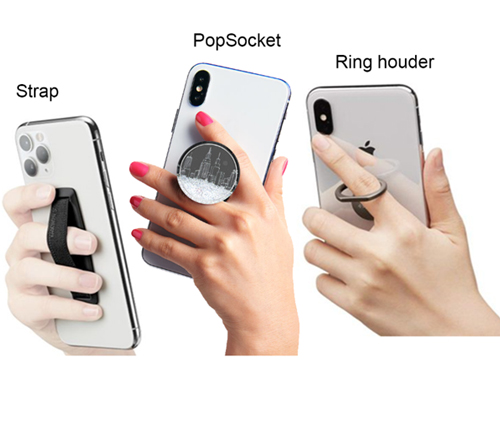
I found popsockets and ring holders a better option in that regard https://image.gsmpunt.nl/blog/image/image_3.png
> popsockets
Oh so this is what those weird phone attachments are called. Thanks!
Be advised that they seemed to have changed their design and tape material. They advertise the lower quality tape as "re-adjustable".
I don't care that as a man in my 50s that I look like a teenage girl with my phone, but I immediately put a Popsocket on any phone that I own. They are wonderful.
How do those interact with the MagSafe charging are on the back of the iPhone?
No idea, I haven't had an iPhone in ages. They have magsafe versions though https://www.popsockets.com/en-us/more/magsafe so I suppose it's compatible ?
Ah, thanks for the link. I think this means they can occupy the MagSafe slot, but if you want to charge via MagSafe then you have to remove them and reattach after.
I don't think I have seen rubber bands that thick in ages. It surprises me they don't use the tiny ones?
Even asparagus will often come in thick rubber bands. Leeks too.
This is my favourite kind of minimalism.
"rather than getting the $70 replacement part"
Appliance repair usually starts at a $100 house-call fee and goes up from there. It is cheaper to buy a new dishwasher than get it repaired.
When I moved into my apartment, the racks in the dishwasher were badly rusted. I told the management.
They replaced the entire dishwasher. They said they couldn't get a replacement rack.
> They replaced the entire dishwasher. They said they couldn't get a replacement rack.
What are the margins on replacement racks?
Someone would have to pay for warehousing, stock tracking, employees for packing/shipping, then add shipping costs. Why would anyone offer them?
This problem is multiplied by the fact that most consumer goods have subtle differences in design between brands and even model lines within the brand. If there were only 2 or 3 different, standardized dishwasher racks for all models, stocking those few would be cost effective.
As someone that owns a number of small-engine powered devices, I'm always amazed at how easy/cheap it is to find parts. Most small engines are either one of a couple Briggs and Stratton models, or a knockoff of same. Even across models, B&S usually did a pretty good job of reusing common parts. When you need a part, you can cross reference various part numbers to find either the OEM part or dozens of cheap Chinese copies.
Small engine devices also often utilize belts so you can replace the whole engine with various different ones and only have to line up and size the proper belt.
We bought a house recently and the racks in the (old) dishwasher are rusted. I thought it would be cheap to replace them. $400 for new top and bottom racks. $425 for a new dishwasher. I am gobsmacked.
You often can get the part, but it’s expensive and with shipping and hassle you might as well but a new dishwasher.
Especially as a landlord, spend $200-400 to replace the racks or buy a new for $500 and pretty much guarantee no calls on that item for five years.
Unless you repair it yourself. I’ve done things like replacing the bearings and a cracked spider arm in our clothes washer. Not only was it cheap to do so, I also learned a lot about how a washer is put together by dismantling one down almost all the way. Same with replacing the heating element in the dryer.
Living in a country that is a smaller market really sucks on this front because I either cannot get the parts, or they cost more to ship here than the cost of the part itself. Last time I got something for my coffee machine that the manufacturer refused to sell it cost $80 to ship it here from a parts warehouse.
The person is talking about buying the part and installing it themselves, not paying someone to come repair it for them.
I enjoyed this article about the minimalist man getting two minimally useful extra wallets.
I used to be interested in minimalism, but I realised that they just obsess over objects in a different way.
I wanted to save money, avoid maintenance and reduce my mental load. I found people who keep spreadsheets of their stuff and debate whether it's okay to own tools or multiple coffee cups.
> I used to be interested in minimalism, but I realised that they just obsess over objects in a different way.
This is really interesting, particularly since you use the word “obsess”. I meet all of the criteria for OCPD (obsessive compulsive personality disorder — NOT the same thing as OCD), except for “unwilling to throw out broken or worthless objects, even if they have no sentimental value”. In fact, I’m quite the opposite because I try to be as minimalist as I can and am constantly throwing away or donating objects that I don’t need or that don’t meet my quality standards.
I always thought it was strange that I don’t match this one specific symptom of OCPD, but then I started thinking some more, and I realized that I do obsess over objects in a way but not by hoarding them. If I want to order nail clippers for example, I have to spend hours online researching the best pair of nail clippers. I am currently wiring my house for networking, and everything has to be of the highest quality using data center components. Even rented a Fluke network tester. Closet needs repairs? Now I’m learning about drywall and level 5 skim coats. It’s a nightmare because I can’t do anything in a way that I consider half-assing it — I feel compelled to either do nothing at all or go into an extreme level of detail with it.
This constantly causes relationship and work problems, but to a lesser degree than I suppose hoarding stuff would.
Hm, I find aspects of myself in this description that seem like they should be troubling.
Nail Clipper: Green Bell G-1008
The frustration of needing to build expertise in things you want to not do shabbily is particularly familiar. Especially with home repair tasks that contractors end up doing but not doing well ... I've learned far more about roofing, flashing techniques, the guidelines for handling, installing, and storing prefinished siding that were nowhere near followed by contractors ... than I would have expected or even truly wanted. It really emphasizes the "ignorance is bliss" mindset which is a hard pill for me to swallow.
In case you haven't already, please consult a professional. Do yourself the favor, you're worth it.
Edit: @asddubs: thanks for taking the time to share your thoughts, though you never know what reality faces the person on the other end of a link, which is why I still try. Sometimes you might be surprised. And thank you for helping get my karma back to an even number, all is well again. Your friendly friend, MD.
I didn't downvote you if that's what you mean. Sorry if my post seemed rude, but I think the other side of the coin is that it can be a little grating to talk about yourself without requesting help or indicating that you're not already getting it and be offered extremely obvious advice, so I think your post just rubbed me wrong a little.
seems like a useless piece of advice to give to someone with that level of awareness about it.
This will probably rub you even wronger, but your defensive response here makes me think the advice was more useful than you think.
Except I'm not the same person the advice was given to
Ah I see. Now I'm just really confused about why you commented. Oh well.
I already gave my reasoning, maybe you could just accept it at face value?
Please talk to a doctor. Looking at the Merck manual, the criteria are 4 or more symptoms. If you have 7 of 8 symptoms, then you may have OCPD.
Thank you for this, it put into words my uneasiness with this practice. Our household definitely has too much stuff and we always seem to be at battle with it but minimalism just feels like a mirror image problem.
> Replacing broken or worn items often feels like a nightmare of upheaval and system change
It seems like if this is where someone's application of minimalism lands them, they have missed the point.
On that note I went from owning one pair of shoes last year to three. It was a great non-minimalist decision. My shoes now take three times longer to wear out, and now I'm always wearing shoes that are more useful or more fashionable for the situation (or both) than what I used to wear.
Whenever I try to do this, I inevitably settle on wearing one of the three 100% of the time. How do you manage it?
Buy identical shoes in different colours.
I go by function. A pair of everyday shoes for regular days, a pair of cross-trainers for gym days, and an expensive pair of boots for days when I get dressed up.
Im finding out that the way I was brought up is not universal. I was always taught that you have to alternate shoes every day to make them last longer, because feet sweat too. That's why expensive dress shoes have shoe trees (not just to hold the shape better).
So two pairs of shoes for the office so they always have a full day to dry out etc. Now with WFH that sort of goes out the window as I don't wear shoes for as long any more.
As soon as I read they store every item they own in a database, that seemed like unhealthy obsessive-compulsive behavior to me. Using technology to shame yourself does not seem like a path toward happiness. I wasn’t sure why I want to take advice from someone that has that level of anxiety around owning things.
> reduce my mental load
That's has become my goal for new purchases. For some items that means getting higher quality that will last longer, for others it's get the cheapest that will work and replace it if it breaks. It does lead to weird purchases like higher quality charger cables, but cheaper a cheap TV.
It sounds kind of woo, but I tried the Konmari method and it really was helpful without being overly prescriptive. It definitely felt good to get rid of a lot of that stuff. Though there are a couple that I'd probably take back if I could do it over.
It's a great technique, but I'd rather focus on reducing purchases instead of getting rid of purchased stuff. The environmental damage is already done, unless it finds a second user.
I like that Konmari can also apply to obligations and how you allocate your time. Thats the premise of a book: the life-changing magic of not giving a f**.
Part of the promise of the book is that going through the process once will change how you shop as you develop your sense for which things you really want to have around.
I think Dieter Rams captured it best with the phrase, "less but better". It's more or less the ethos I try to (and seldom do) achieve.
well, i think it is mostly a form of self-therapy where you project a mental stressor onto something you can touch, see and deal with. then you try to manipulate that stressor and heal your trauma by manipulating that object or set of objects - or maybe an animal, a spouse or your child. of course that won't work.
It was suppose to be like Simple, but not Simpler. But modern minimalism went to an extreme.
That sound pathological, why would you do that to yourself
One also has to admire Whitstable man's marketing genius if he's able to live of his $100 "wallets" (which mostly amount to two badly sewn together pieces of leather). This article feels a bit too on the nose though. But he probably knows his audience.
They're really more like card holders, but I looked up that term and found they've now been rebranded as "minimalist wallets." Hey, even minimalism can be commoditized and sold. All that is solid melts into air after all.
A lot fewer people regularly use business cards and a lot more people rarely use cash or need to carry a lot of cards with them given they can store info on their phone. I carry one made by Saddleback and it's perfect for me.
Therein is the kernel of every hoarder pathology, which is ironic.
“This is too <whatever> to get rid of!”
Wrong. Throw it away and don’t replace it.
or if throwing it away makes you feel bad, give it away.
either it finds its way to somebody who will value it, or somebody will throw it out for you. either way is a win.
Giving it away has now haunted me. Father passed away two years ago and a bunch of computing equipment he bought for me had been donated years before he had passed when it was worth very little. Now in this post covid era all of those things are 'vintage' and super expensive. I have tracked down some of the original equipment through the people I originally gave it to but it has not really been possible to get those things back. Yes I was a mild hoarder aspiring minimalist before but now I have become a full on hoarder. I desperately do extreme organizing in places like my basement to be able to contain so much of the stuff I have. I don't really know how to reconcile this fear of losing something for good.
A fellow hacker at VCF once mentioned to me that this obsession that many geeks have should graduate into letting go of items because down the road you can always buy another one if it scratches your itch again. He made a good point.
I'm going through my own journey with this at the moment, the thing I keep telling myself is that "this item will have a better life somewhere else" and "my house isn't a landfill". It's tough though.
Plus selling stuff is a full-time job really and it's annoying AF if it's not your day job. So I guess the question is - are you going to ever sell it? If not, then it doesn't really matter if it's expensive, it's just taking up space.
I've gotten rid of a lot of stuff I've accumulated over the years--including most computer-related hardware and software I don't use. One thing I find hard is that you know you have stuff that someone would be delighted to get for cheap/free. But it really isn't worth my time to try to make that connection. And a lot of it is niche enough that I doubt I'd find takers at a yard sale out in the country.
Keeping things isn't free, especially at scale. And it's not just about the space, as you've noticed organising and keeping track both of what you have and where to find it is a lot of hassle. Only for 95% of things decreasing in value over time, with no reliable way to identify the 5% worth keeping.
Your income/purchasing power definitely plays a role here too. Hoarding is more worth it if you don't have an efficient way to covert time into money.
I disagree. It’s another pathological behavior. In many of these cases you are taking your problem, something you have no use for, and turning it into someone else's problem. My wife and sister in law are terrible about this. Rather than just getting rid of things they go to a relative to sit around for years or decades, out of sight, before finally making their way to the trash. I absolutely hate it when the sister in law shows up with a new box of “priceless treasures” for us to deal with.
Giving things away definitely is a win. Good Will seems to be a quick solution for this - is it a good place to give things away? Hope the things find a second life.
Mostly single-stitched and with unfinished edges to boot
I'm a bit of a recovering minimalist, though it was never really a choice to become one.
I spent the better part of 15 years living out of a small backpack, travelling ~9 months a year then flying home to work short software contracts and save up for the next trip. As a consequence, I got used to not having very many things. One pair of pants, one pair of shorts, that sort of thing. I think my policy was something like "If I haven't used this thing in the last 3 days, I don't really need it along".
At one point, I revisited my storage locker, filled to the roof with everything I had owned in my 20s, and couldn't really find anything that I wanted to take out of it. "This isn't the shirt I wear", and "I already have enough socks" (meaning four socks: 2 on my feet and another pair for when I wash these.) I ended up just letting the storage company auction it all off.
It was really weird buying a house and starting to fill it with things. I bought a couch and a TV. I got my old guitar back from the friend I'd lent it to 20 years earlier, then eventually bought a second one and a bass to go with it. It's actually kinda nice to have a few possessions.
The attitude is still there though. At one point I had to buy five iPhones in a single day as test machines for a job, and it was all I could do to physically force myself to click the buy button. It was like fighting every natural impulse in my body to overcome my aversion to consumerism.
I guess it has left me in a healthy spot in regard to "stuff ownership."
I find the thought of minimalism interesting, and we don't buy endless crap and try to get rid of things every now and then, but then again, if it's Christmas we've got a few boxes with decorations, if I go camping we've got our tent/mats/fridge/etc, when I go snowboarding I have clothes and my own board. Also I have hobbies that require stuff. And so on. I don't want to give up on these activities and I don't want to make them into a nightmare collecting/arranging everything each time.
And on top of that, now we have a kid ;)
In a way I admire committed minimalists. But I often wonder what their long term lifestyle is like. Surely many of them are single (or they only count the items which are solely theirs). They surely rent at a higher rate than own property. They surely own vehicles at a lower rate. And so on. I just get this picture of a person in an urban area, living alone in a studio apartment, dependent upon everyone else for basically everything.
I’m fond of the conspiracy theory that the rise of minimalism is actually propaganda to placate Millennials who can’t afford the same level of material comfort as their parents and other earlier generations enjoyed.
To me, minimalism seems like a natural reaction to the transient lifestyles that people live now. A generation or two ago, many would grow up and settle down in the same town or county with 4 years of college being the most time that one spent outside their hometown. If you have a permanent home, it's easier to invest in filling it with stuff.
Today I hesitate to buy anything that I can't pack in a suitcase or wouldn't feel comfortable throwing away or donating to Goodwill in ~2 years.
Americans are actually less mobile than they used to be. Young people even more so.
Most of the gung-ho minimalists are upper middle class or rich, they may have only a sofa and coffee table and a lamp in their $6000 a month apartment but those 3 items cost over $10,000.
What if its just Millennials discovering it own their own as a result of their reduced standard of living? The powers that be would want maximum consumption and minimalism goes against that no?
Same probably goes for "vanlife". It is millennials just realizing they cant afford a home ever and so they improvise with what they can resource.
Consumption is not just buying things. And even in buying things, many so-called minimalists still buy a lot, maybe less in tonnage, but GDP-wise they still spend a lot of money.
Of course, there are zen style minimalists. But many seem to be in it for aesthetic.
Vanlife is still very costly if you try to maintain any kinds of creature comforts. I think it is more so millennials seeing the romanticized side of it on social media, and then finding out its actually a lot of work and you are one break down from being literally homeless.
Where have you been? TPTB are desperately trying to make you poorer by banning cars, banning air travel, banning meat, and inflating the fuck out of our money.
Oof, was really hoping for a /s at the end of this one.
Or a conscious choice to live an alternative lifestyle to their parents. Seeing an unattainable future and choosing a separate path.
Same with having children. “I don’t even want kids. They are needy, expensive, and tie you down.”
All true, but having kids was never a choice for you given your financial situation so let’s not pretend you had a say in the matter.
I agree with you but I don't think it's a financial thing but a psychological/maturity thing.
People have kids at all income levels. For every one who claims they can't afford kids - someone is raising a family on that same income.
Yes but one of the most common desires is that you want your children to have a better childhood and life than yourself. Some people don't care or don't explicitly make the choice to get children, they just get them. But some people won't get children if they can't provide an environment that is at least as good as the one their parents provided to them.
People need to learn that material possessions are way less important than emotional environment. For most of us, being better parents is about how we parent. Not what we can afford.
Childcare, education, housing (often tied together) and health care. Those are the big 4 expenses that are killing fertility rates, and only one is somewhat material.
All of them are tied to money, really. If you are rich, then you can afford nannies (or a stay at home parent, this is nowadays a luxury too), housing, and if you are in a district with high property taxes, your public school is well funded. College is also easier if you don't rely on scholarships or on your children to work so that they can support you. Health care also suddenly becomes affordable with money (although in the US for big things it's still inaccessible).
In general, if you get N children, then you either favor one child, or each child gets 1/N of the inheritance. Same goes for money available for sending your kid to college. Meaning, as a rule of thumb, the more children you get, the poorer those children will be from that point of view. Like a single can live well from €2k euro per month in most of Germany, but for a family with 3 children the same sum is very little.
And of course there is the entire dateability aspect, too. People with higher income are seen as more attractive than those with lower income.
That’s true. I meant more so for those that purposeful have children. My brother had two children that were definitely unplanned.
That's what I am referring to as well. Plenty of people at income X intentionally have children while plenty of people at 5X lament not being able to afford them. I think this is true for every X.
I suspect income has a negative correlation with the number of children in general, if anything.
It’s always a choice. People in 3rd world countries are having 5 kids in a mud hut without doctors.
It might not be a choice to have kids, and a new car while also going to the cafe every day. But having kids is always an option.
OTOH, if you're poor, it might be best to save every item in case it becomes useful later, whereas a rich minimalist can afford to give away or sell for cheap everything not needed right now, knowing that replacements can be bought when necessary.
Millennial here and half-baked minimalist here.
At least it’s not true for me. For all my life I’ve been drowned in objects. My parents are still telling that I had so many toys.
Minimalism is a way for becoming aware of the objects around me. Not so much about the pure number of objects.
Since, I started thinking about what should be part of my life and also letting go of things I don’t really need, my savings rate has skyrocketed. Also, many things I own have much higher quality than my parents or grandparents.
I guess minimalism is a counter-movement to super-cheap consumerism.
Precisely. We are constantly bombarded by messages to buy buy buy. Fill that hole in your life with plastic crap that will surely be the thing you were missing that finally makes you happy. And when that doesn't work, well, just buy some more!
The trick they pulled is telling us all that inconvenience is bad and needs to be eliminated, but what I've come to see is that life happens in inconveniences, and consumerism tells us we should trade our life for their junk.
My grandma grew up in the US without even indoor plumbing. She had to use an outhouse. She's still alive today.
The massive carbon emissions campaigning seems to be this. Since generations of young and hard working people are being so heavily exploited that they can't afford things, blast out the message that they are saving the world from being doomed by not having a vehicle, not traveling, not having land, not eating quality food, and most importantly: not having children so that they aren't interrupted in their duties of paying taxes and profits.
It is completely free to convince people they are saving the planet by living less than others.
You can add tiny houses and van life to the list.
Dunno, seems like we might be past peak materialism. Do people really need 2000 ft^2 with a 2 car garage just packed with crap. So much so that they often buy things because they can't find what they own. Even renting storage units on top of a full size house is surprisingly common.
China closets, album collections, file cabinents, many book cases packed, shelves of games/cartriges/cdroms, many different kinds of sports equipment not used for a decade, dead appliances, 3 toolboxes filled with crappy tools, drawers filled with disposable pens, large closets packed with clothes not worn in a decade etc. Every trash day with overflowing garbage cans from all the disposable stuff.
Buying decent shoes, tools, a decent pen, a decent razor, and decent wallet can last decades. Even more disposable things like cars, computers, stereos/electronics can last a decade or more, but often have a somewhat higher cost up front/but cheaper to own per year. In general if it's made in plastic my first conclusion is that it's not worth it. Don't eat out of plastic, drink out of it, don't use a plastic keychain, even cans these days are plastic lined. Don't even touch it if you can avoid it.
Yes this kind of attitude is possible even with wife, kids, and a dog. If it's not been used in the last year considering upcycling, donating, giving it away, or pitching it.
200 sq ft sounds great, just don't fill it with crap.
To be honest it's not like the guy in a suburban home is self-reliant either; it's just easier to kid yourself. But I do agree that a picture-perfect minimalist lifestyle will face some challenge if you live with others, especially kids.
Steve Jobs was known for living in such a way that I don't think was entirely a put on. He did own vehicles but refused to put license plates on them apparently for aesthetic reasons. Ironically, it seems like having a lot of wealth helps with the minimalist thing.
Heh, don't think that fits. I heard he figured out the related california law that you had 1-3 months before you'd get a legal penalty for not putting a new plate on the car. So he worked it out with the car dealer to swap cars every 1-3 months, so he could park whenever he wanted and never get a ticket.
Yeah it's great. You can pack up and leave whenever. Why get tied down?
Yeah that is kind of me. I like it though
This article, and people posting in this thread are saying that they own 100 or 200 things.
I can't believe this at all.
My utility room, which basically just has stuff like cleaning products and rags/cloths etc, has more than 200 items in it. It's all useful, we're talking things like bleach, deodorant, shampoo, handwash, etc.
My house probably has 50 or more pieces of art on the walls and then another 50 pieces of furniture. My computery odds and ends bin easily has more than 200 items in it.
Either you guys are all just-moved-out kids, single and living in a single room, or we're defining "thing" differently. Which is it?
No kidding. If you own 100 items, a made bed is like 10% of your belongings. That's nonsense.
"Either you guys are all just-moved-out kids, single and living in a single room, or we're defining "thing" differently. Which is it?"
It's just a different lifestyle, there are obvious exceptions to it - but I was there once with a house and countless things - most of them I forgot I had and such.
The idea is to do inventory and then catalog and see what you need and don't need. But no, I can say with assurance my life right now is basically two suitcases, by choice - and airbnbs/hotels. 20 lb of clothes/about 80 pieces total.
Misc electronic stuff takes a ton of space, spare usb - chargers, usb cables, etc - having spares for spares.
> This article, and people posting in this thread are saying that they own 100 or 200 things.
> I can't believe this at all.
> Either you guys are all just-moved-out kids, single and living in a single room, or we're defining "thing" differently.
I feel like the assumption in this is that people who are single and living in a single room are not "people", and shouldn't be posting about how much they own? My utility room contains a washer, a dryer, one bottle of Tide, and a paper bag for dryer lint. I'm not posting "people say they have 2000 square feet in their home, I can't believe this. Either you guys live in houses, or we're defining 'feet' differently".
So in your house do you have things like -
antibacterial spray
bleach
cleaning cloths
washing up liquid
floor cleaner
dusters
etc?
They might not be yours, but someone uses these? Maybe the cleaner brings them?
I don't think that people who are flatsharing or whatever are not people. I just think that it's a super narrow slice of life. You might do it from 25-35 maybe and then get a partner and like, not do that any more.
I see what you're saying now: "Is everybody here from the single 15%?!" Meanwhile I've never not been single so being single feels like normal conditions to me and not "that slice of life I barely remember after college".
I have bleach sometimes during flu season and I have hand soap. Probably my cleaning habits are in the bottom 15% too.
Everything else is in their parents' basement.
I think your house must be a bit bigger than most people, based on 50 pieces of art, compared to a minimalist living in a rented 2 bedroom apartment
It sounds like the entire distinction is just renting vs owning to be honest, which makes it all a bit more boring.
My house is a fairly normal sized house, there are millions of it in the UK.
I used to travel for extended times, and I actually counted the items in my backpack. It was about 70 items (if you count a money wad as one item and each sock pair as one item). That's all I needed.
Of course, much more items are accumulating while staying stationary. Easily approaches 1000, and I'm not a hoarder type. If some item has not been used for 1 year, out to the garbage it goes.
To be fair, I don't think it really makes sense to count consumable items like the bleach, deodorant, shampoo, handwash, etc. examples you gave. I wouldn't expect him to count the milk in his fridge or the olive oil in his pantry, either. Point being that just the natural day-to-day use of that stuff uses it up.
But yeah, I agree with the general point.
> I don't think it really makes sense to count consumable items
On the other hand if I count something it is more likely to be consumable item, so I have track of what is missing. Why bother with other stuff? That sounds like opposite of minimalism.
exactly. If you just count cutlery, dishes, pans, cleaning products, chargers, cables, etc... it goes up way too fast.
I have trouble keeping up with the minimalist type lifestyles. I don’t necessarily buy into many of their numbers (in this article we count things… except when we don’t), and I have trouble with the “buy it for life” type groups too.
The latter groups surface goals I like but I find a lot of times they’re just interested in paying more for what are effectively pseudo luxury brands or strange ideas that because it is made of metal it will last longer…. but little in the way of anyone actually using the items much.
It’s frustrating as I like the gist of the ideas but the folks practicing that I find on the internet seem off / miss the target IMO.
Buying plastic and MDF everything because the minimalists are in the pocket of Big Steel.
My gramps will once a while gather a bunch of stuff in the house and throw it out. He always has great fun doing it he loves it lol.
Amen. Not exactly a minimalist thing this, but more about sourcing quality to "buy once": Rotel multi channel sound system (amp and pre amp) from 1997 here, still going strong with one repair five-ten years in, along with Infinity Kappa speakers from the same time - their surrounds replaced once, a decade ago.
Amazing sound, I love how it feels.
Where it loses most is connectivity. Amps use DB25 cables both between each other and for input, so the audio cable I've got hooked up to the HTPC's Xonar Deluxe with RCAs out is a very special one indeed - I'm amazed I found it at all, all those years ago (DB25-RCA). All audio has to go through the HTPC, for that reason, so the Samsung 65" QLED from 6-7 years ago is just a dumb display (not a bad thing!).
For longevity I rarely if ever power the equipment down; it's gotten a bit finicky to start the preamp after a power outage, but for now it's still coming back.
I'll attempt to have it repaired prior to getting a replacement if it ever fails.
Oh and the Win10 HTPC is a decade old at the core too, but I've updated it with a modern case, cooling and storage - works fantastic with a wireless Logitech keyboard.
Speakerbits in Melbourne who did my surrounds (they had all disintegrated) has ceased to exist now, but they did a stellar job - guy said the speakers had appreciated since my purchase, as decent mid range speakers just didn't exist anymore, it was either low end (rubbish) or the extreme high end.
I respect using that stuff for a while (my amp is about 12 years old but I'm upgrading this year).
Stick with what you have if it sounds good to you, but I do feel the need to point out two things: There have been significant improvements in room correction DSP algorithms particularly in the last decade. You don't need to ditch your amp to add these, there are DSP boxes you can put in the preamp stage. These will improve sound quality considerably. Audyssey, Dirac, and Anthem ARC are common names; there are others.
And there are a huge abundance of speakers in the mid range $200-$600 that are absolutely fantastic; it's a pretty wide market segment. There's plenty of old options too, but... it's not hard to find a new set of speakers capable of great sound at a decent price these days. I don't know what exactly Speakerbits was implying, but it's not true now.
Thanks for those tips, great to know! I hadn't thought of maybe upgrading the pre-amp only (one with a room processor built in, for simplicity?), that's actually something that would make sense especially for connectivity also.
I haven't really been following hi-fi products over the last couple of decades, due to wanting to "settle", but it wouldn't surprise me if things have improved since January 2010 (checked the date they were repaired) - or maybe the technician just had a particular affinity for the Kappa 6.2is (4x same plus their centre speaker).
I like the idea of cataloging all my possessions. It seems like a nice way to put that particular necessity of life (owning things) in a box that can be neatly put away when you don't want to think about it and quantify/measure it in a way that lets you manage it (I don't want to own 200 things, etc). It also seems like it would be helpful for legal situations like a manifest for a house fire or a will.
I've done this, and it's very liberating. Basically, all things I own, including consumables, fit inside a small Org file. It's less than 100 items. I went this route because I wanted to emphasize some good habits, and de-emphasize things that I considered less valuable.
The process I went through was basically thinking about my core habits, mapping said habits to some objects, and then thinking about extra objects to support those habits. After that, I slowly started purchasing what I needed. Timing was great, because I sync'd that with moving countries. I spent some effort thinking about quality of individual purchases, and I ended up with a very minimal home, which is also great for maintenance.
Something I am curious about. Does this list would include tools and all the thousands of parts and pieces one accumulates over the year when hobbying around?
It's funny this came up. I ended up writing a small webapp that runs locally and allows me to catalog my tools, parts and other important odds and ends in a SQLite database (and attach datasheets and other information I've picked up along the way). I'm almost certainly the opposite of a minimalist, but going through and actually documenting what I have, where I put it, and sometimes what it was intended for, has been incredibly useful, especially being able to use full text search to quickly look up things.
I relocated and I no longer have any hobbies that involve tools.
For a different lifestyle, this list would be much longer and that is fine.
There is nothing special about having just 100 items.
>There is nothing special about having just 100 items.
Depending on where you are located geographically there may very well be something special.
I live in the PNW and I bet if I counted all my forks, spoons, coffee cups, pots and pans, etc., I'd have more than 100 items right there, to say nothing about my tool chest. Between my home office and my wife's purse I probably have 100 pens and pencils around the house.
To own a grand total of 100 items would be extremely spartan for just about anyone around here.
I meant it's nothing to brag about. I agree that in many situations, it'd be inconvenient to own so few items as it'd leave you unprepared for e.g. emergencies.
But if you are renting a condo downtown, as it was my case, you may want to trim down your possessions as much as possible.
Nonetheless, I think people tend to own too much stuff and this prevents focusing on what actually matters, it's a bit like with bloated software.
>Nonetheless, I think people tend to own too much stuff and this prevents focusing on what actually matters
On this I agree with you wholeheartedly. It's very easy to accumulate cruft that one "might need later". I have a whole toolbox full of that shit. I might actually need a bunch of random capacitors, who knows?
My minimal backpack camping checklist has 25-50 items on it, and that's with counting "first aid kit" as one thing, "tent pegs" as one thing, not counting clothing I'm wearing, "food" as 1 item, etc.
There is no way that an adult has 100 things inside an entire flat they eat, work, leisure, and sleep in. I assume that they mean 100 valuable things that they wouldn't want to just lose.
You never know, some people go to extremes. One fork, one toothbrush, one sleeping bag, one laptop, one credit card, done. Toothbrush doubles as a shower brush and credit card is used to scrape off water instead of a towel.
Lol.
Of course, the shower isn't yours so it doesn't count. Using this, we can get rid of the sleeping bag and just roll up the carpet in the rented flat and sleep in that.
What else can we cut?
Toothpaste. We have soap/shampoo.
No no, dirt works perfectly as a natural scrubbing agent.
I have an inventory.yml. It’s not complete yet but every now and then I extend it. I put everything there and belongs together in a meaningful way. For example, AirPods. I don’t list each one and the case but just AirPods. I also note when I bought it and what it costs.
This is something I like about backpacking / camping. I make a mini-list of everything I bring with me, consider each item, and then know exactly what I have as I set off. Doing it for all my possessions is probably too hard.
You can also catalog when you use something - many things we own are once a month or year items - and some can be replaced with a rental or hiring out.
related useful post about insurance and keeping track of your possessions https://www.reddit.com/r/Tennessee/comments/fdju8r/cookevill...
My Hack: For insurance don't try and catalog everything in a spreadsheet or such; you're prematurely optimizing for a rare event that hopefully will never happen, you'll miss stuff or forget important details and it's impossible to keep it up to date.
Once a year walk through every room in your house with a video camera, openning all drawers and closets and record it all. Drop your 20-plus gigs of high-dev video somewhere (I use AWS glacier for pennies a month) and then IF you ever need to, you can painfully go through it and catalog everything.
I'm not a fan of buying it once. I prefer buying on feedback.
Here's my daily wardrobe:
- an oversized plain black T shirt, - a pair of jeans, - a belt, - black socks, - and a pair of boxer briefs.
I wear these almost every day. Every single one of these items is cheap enough to buy in bulk whenever I want them. So: If I ever walk into my closet and find myself missing any one of these items due to them all being in the laundry, I immediately
1. Take out my phone and 2. Order another pack of them on Amazon.
The beauty of this feedback loop is that I very quickly converge on the point where my buffer matches my flow, where my natural cadence of laundry-doing never leaves me without one of these five essentials. It works regardless of whether I do laundry once a week or once a month, so long as I make sure to do all of it. Worst case scenario, I have a few shirts/pants/boxers/socks/belts that mostly lie around unused, until of course I eventually have to throw out old shirts/pants/boxers/socks/belts because they were used heavily enough to wear down.
> Every single one of these items is cheap enough to buy in bulk whenever I want them.
I apply something like this to most of my purchases. If I am buying a new phone or some computer hardware, I want to be able to fit another replacement for what I'm about to buy into whatever my budget is. The same goes for clothes, tools for the garden like a tiller or a chainsaw or whatever.
And you know what? It's a decent approach: I have a used Ryzen 5 1600 in my computer now (upgraded from Ryzen 3 1200), as well as an RX 570 (and a spare RX 580 for similar price, bought recently as new old stock), because under that reasoning that's all I can afford, yet it's all that I realistically need. Some spare HDDs (those die more than most other hardware) and a mobo and everything in the shelf next to it. If any one of those parts die like they have in the past, I don't have to cry about how expensive replacing everything will be, nor wait for shipping, just spend 30 minutes swapping out parts.
As for longevity of various items: I don't quite buy it. Sure, there are also people with Stihl chainsaws that have lasted them decades, but why would I spend 5-10x more money, when I can get a new Chinese chainsaw for about 100 EUR that will be enough for all of my casual usage needs around the farm? And once it inevitably stops being useful, I can get a completely new one without a worn engine, while still having some spare parts for repairs. I can think of very few items where I'd want the latest or greatest, even my daily driver phone isn't top of the line and only stands out because of IP 68 and being shock proof (up to a degree, dropped it out of my pocket and on concrete while doing pull ups, didn't even crack the screen).
Perhaps the only exception to this is something like services: dental care and other healthcare procedures, no reason to go cheap on either of those, but then again, I live in Europe so that's not a very contested subject for me due to the overall affordability. Still pondering these thoughts in regards to food, but store brand food is generally both affordable and reasonably healthy over here.
Ha, moved from the US to Finland 2 years ago myself, we could be twins down to the phone. The deciding factor for me picking up a ruggedized Nokia XR20 was because I said to myself "all I do on this think is Anki, Spotify and social media, so I might as well get an indestructible one if I have to get a new one at all."
In the US the calculus for cheap tools is "cheap Chinese chainsaw, $120; ER (emergency room) visit, $3750."
> In the US the calculus for cheap tools is "cheap Chinese chainsaw, $120; ER (emergency room) visit, $3750."
The healthcare costs are indeed unfortunate, but personally I can't think of many things that would be so dangerous about chainsaws.
Kickback will happen with every saw, the chain brake should be tested before every run anyways. A 50cc single cylinder engine doesn't feel like it'd be too dangerous to be around, especially with the rest of the chainsaw body around it. Maybe the chain wouldn't be too good and people would tension it too much, or perhaps it could come apart or something. Even then, PPE that you're wearing would generally make you safer. Realistically, at most it won't last you a decade and signs of wear will become apparent a bit earlier.
Regardless, I get your point and thank you for making it!
Agreed. I often lean towards getting cheaper products if they’ll do, but that logic has a hard stop when something is safety-critical.
I like the concept, but this reeks of native advertising.
Agreed, it just comes off as really odd. They don't want random stuff, but now they all of a sudden have two random wallets that they are grateful to have. While they "luckily" have a blog where they can thank the random stranger they sent their old leather to, who happened to take their time to handcraft them new objects out of it. It just seems too coincidental, and I don't believe that would ever happen to someone without advertising potential.
I vacillate on this a lot. On one hand, yes, it's nice to have well-designed items that last decades or a lifetime. And obviously we're awash in disposable goods at great environmental cost. On the other, who hasn't been burned by buying a garment "for life" that no longer fits, no longer appeals to us, or otherwise gets rendered unusable? Or buying a beautiful, premium tool that only sees one or two uses? Or having an item that by all rights should have been disposable last for years of regular use?
For the tool conundrum, I’ve found that the best course of action is to buy the cheapest option (within reason) to start with. If you don’t use it, no sweat, it was cheap. On the other hand, if you use it soo much that it breaks it you outgrow it then you get to buy the best version of that tool. At that point you know what you like and don’t like, as well as what’s worth paying extra for, so you end up with the perfect tool for you.
Yes, this is a commonly recommended strategy. But you do run the risk of being stuck with an unsatisfying but functional tool you feel guilty getting rid of, and even in the best case, who feels good about having bought a lousy tool that breaks?
I tend to go with a bit of a sliding scale based on factors like "how often do I expect to use it?" and "how afraid am I of it injuring me?"
On the other hand, you risk considering a whole tool class as not very useful, when actually it is just that the one you own is crap...
This is a decent strategy and well-trotted in every buy-once thread but I'll offer my advice as someone who has been on this tool purchasing train for a few decades now. If you know the precision you require you can buy the tool you actually need. As an example if you are doing some leveling work over a 20ft by 20ft area you can figure out how well it can be done with an 8ft water level including disaster scenarios where you fuck it up and then you can consider a self-leveling laser and weight up your choices properly. Following the advice to get the cheapest tool will likely lead you into disaster scenarios because you end up with the entirely wrong class of tool.
A better idea might just be to ask a neighbor to borrow their tool. Or subscribe to a tool library which may be near you.
They had me with the title but the content reads like an elder-millennial whose conversational voice got inescapably stuck in memes and referral links.
I loved the faux naïveté. “I can’t believe I’m getting a ~surprise~ package in the mail from the guy who recycles leather just two weeks after I sent him a passel of recycled leather totally out of the goodness of my heart!”
> I even keep a record of all my worldly possessions in a visual catalogue spreadsheet on Airtable. 192 items at my last count.
> I don't count hoodies, t-shirts, socks or usb cables but I really don't own many. I count a pair of shoes in a box as 1 item.
Huh? Either you're counting things or you're not. Saying you own 192 items except for the 800 (?) you're not counting doesn't make a lot of sense. Why are shoes an item but socks aren't?
192 makes no sense to me. I've probably got 192 items in my kitchen alone, just from wanting to be able to cook and serve a meal for 4 people because it's nice to eat with friends. A fork is a worldly possession, after all.
wanting to be able to cook and serve a meal for 4 people because it's nice to eat with friends
Don’t be silly, having three friends is hardly minimalist. Have you ever considered how friends weigh you down? One is more than enough, and frankly even that might be too many.
Yeah and he’d have to list his friends on his airtable bringing him dangerously close to that problematic 200 figure.
This is not a joke for me. The same impulse that says I don't want to maintain a lawn or bed frame makes me count the benefit of a friend against the cost of committing time every few weeks, time I could be using for whatever I want. Some of us feel really burdened by commitments. We feel about each outlay the way a normal person only feels when they get right to their limit and have to cut back.
He’s gotta be ready to walk out in 30 seconds flat when he spots the heat round the corner.
Living is hardly minimalist.
I have two items because I count my house as one and my car as the other.
If you would like to reduce the number of possessions you own by 50% you could park your car in the garage. You're welcome.
Life hacks ^
You also have keys to each so that's at least 4 items, and then your clothes and computer, i'm sure you have soap and toothbrush and toothpaste, and hopefully you have toilet paper and a bed, and having a bed means you likely have a pillow, pillow cover, sheet, blanket, and mattress, etc
I count all those as parts of the above!
(Counting owned items can get entirely silly).
I don't own anything at all, but my wife sure does have a lot of stuff I use often that she never uses, and happen to be in a men's large.
G. Gordon Liddy of Watergate fame once said something on his radio show along the lines of "well, as a convicted felon, I'm not allowed to own firearms. However, Mrs. Liddy has a large collection that she occasionally allows me to use under her supervision."
>192 makes no sense to me. I've probably got 192 items in my kitchen alone, just from wanting to be able to cook and serve a meal for 4 people because it's nice to eat with friends. A fork is a worldly possession, after all.
You're assuming people are the same as you - I follow the same but I live out of suitcases and can travel at a moments notice for the best flights and pick up an airbnb somewhere.
But this is the life I want - literally 95% of my things fit in 2 suit cases, a third is my bike and a bike is a bike thought if you want to get really technical you can count the wheels, the brakes, the brake rotors, the frame, chain, groupset, etc as different but together it's a bike (and a bike bag!) but I do count the clothes/water bottles, etc.
It's also so cool because you can use pivot tables to group items into necessary or not - so if you want to wing just a one backpack 25-40l trip, you know what to grab and also the rolling cost of items associated too - and for more fun, deprecation, purchase cost, etc.
I enjoy it, but thats the spirit, a pair of socks = 1 or do you have 12 socks?
Is the idea that you're renting apartments and counting the pots and pans, toilet brush etc as not being yours because you leave them with the house?
So my bath mat is "mine" because I own the house and had to buy it myself, but yours isn't because it's rented?
Because if we can cut that out then yeah, now I own far fewer things. It seems like a weird distinction to make.
It can be - if you do a STR/Airbnb/Hotel, the pots and pans should come with the place and they're not yours. Many hotels do include the above, especially mid to higher end ones.
If you're renting on a standard long term lease - not short term rental, and it isn't furnished with them, yes they're yours because you bought them.
It's up to you what you want to "count", but toiletries are like petty cash. Pots/Pans can have realistic value, and the rabbit hole for them goes deep from cheap iron, stainless steel, ikea standard purchase, etc.
The idea is to take a break, catalog what you have and go from there. You can catalog 1000+ items and just get rid of ten but then you know "oh just ten items were fluff" vs not knowing or getting rid of 200.
The idea is the exercise.
So if I rent everything, I can live my exact same lifestyle but be called a minimalist?
You don't own it - its furniture, comes with the house - it's the lifestyle itself. While you technically seem correct on it, you're missing the point.
And, really, don't we all rent everything?
Most people buy everything, even their homes, using rented money!
Minimalist is just a self-identified label, so you're welcome to call yourself a minimalist if you feel that it fits.
You don't have to look for some technical workaround to some exact definition here, and pedantically arguing about descriptive terms can get tiring real quick.
Maybe you're not trying to be pedantic and are coming from a place of curiosity, and I do apologize for my tone if that's the case. It is coming off as sounding a little "debate-bro" though.
Well you see I have a mortgage and if I walked away they would take everything within the house thus I don't own anything other than the clothing on my back.
Same with the cars.
I make a distinction between things I have sentimental attachment to, important or expensive to replace vs things that are not.
I wouldn’t count all my dinner plates and cutlery as “possessions” as such, but I’d count my good knives.
Those are "prized possessions". Possession means property. If you own it, and would have to pack it up and take it with you when you moved, it's a possession.
Can't people who live out of chests of drawers and closets also "travel at a moments [sic] notice for the best flights"?
Suitcase, chest, drawers, yes - it's just the thinking and not having "possessions."
The bigger takeaway is learning what keeps you grounded or anchored. Nothing is wrong with that - can be family, can be cars, can be real estate/houses, can be business, etc.
The idea is you inventory your life and see what is the most minimal you need (haha, MVP basically.) and go from there.
You can do it for spending, you can do it for consumption via money, diet - eating/consumption/purchasing,etc.
It's fun, I enjoy keeping an inventory list, knowing what I have where and for larger valued items, e.g. $500+ I can put in last time usage so if I don't need it, I sell it - lower value items giveaway/free.
For me, I've live in the PNW too - and it's quite fun to just have a suitcase/duffel bag, and just camp out in my car or drive somewhere new and do that - or like I said above, hop on a flight and have everything I need for the duration of my stay.
I get it can sound boring or non-exciting to many people, but once you get into it - it really is fascinating. What things do you need for everyday life?
Up in the air had a great segment about it, https://www.youtube.com/watch?v=UsRP9EUrXjo I haven't read the book, but I should - I've been seeing it quite a bit.
Do they count the spreadsheet itself? It does not have physical weight but mental one certainly.
My relationship to stuff is at a weird point. I've watched a bit too many documentaries about impact of overproduction on our world to a level where I tend to over analyze and over scrutinize every purchase, probably to unhealthy levels. I tend to use objects i have to the point they become unusable, trying to get their full worth.
But at the same time, I've realized that buying the best of everything every time is not the best way to go. Sometimes your taste changes but the object still is in a great condition with no other takers. So you're stuck with something you don't like anymore.
A good compromise seems to be buying the cheap version of everything the first time around. That way if you don't use it as much, you haven't spent a lot of money on it. And if you do it use it, the cheap stuff will wear out sooner and you can replace it with better made stuff.
Buy used. You pay less and nothing gets produced.
I have the same obsession as you and this is how I reconcile with it. If I'm not ready to meet someone across town I probably don't need it.
Buying used has become a huge pain. The platforms are absolutely full of scammers and time wasters, the items are either overpriced or immediately purchased by flippers, and they often aren’t very accessible without owning a car.
I prefer to just buy new, where I can have stuff delivered, and then use it until it’s completely worn out or obsolete.
Depnends on the item I suppose - half of my small board game collection (100+ titles) is used games bought from local eBay equivalent. And almost all of them were in perfect condition but half the price.
Same! I paid 5-10€ each and slowly acquired most of the Spiel des Jahres winners.
You can often find near-new Apple products and great tools at a steep discount too.
In Germany (eBay) Kleinanzeigen works rather well. People are still people, but at least the platform is good.
Nice, now please do the same thing about your phone.
Oh you can't? Right because tech is actively trying to make you ditch your old phone. My last phone was great but can't fix the screen and the new model is worse, because they now want you to buy their earphones, and their watch, and soon their goggles.
I used my last smartphone for 6 years, was completely satisfied and would have been using it still if I hadn't finally dropped it fatally into a stream.
This is the Sam Vimes Boots Theory[0].
I think it's a good idea, but not always feasible.
Also, the absolute top-of-the-line may not be reasonable, when a "near-the-top" product would be just as useful.
I own a lot of stuff that doesn't really catch anyone's attention, but cost a fair bit. Examples are Junghans and Oceanus watches (I prefer the Oceanus, which cost half as much as the Junghans, but I now wear neither, as I have an Apple Watch, which costs less than either of them).
[0] https://en.wikipedia.org/wiki/Boots_theory#:~:text=The%20Sam....
There's a Hindi proverb I heard as a kid from adult friends and relatives:
Mehngaa roye ek baar, sastaa roye sattar baar
Meaning, literally:
Expensive, cry once; cheap, cry seventy times.
I'm afraid I'm not the target audience, so I can't say anything about this piece.
But I've seen actual minimalists and they're nothing like an urbanite living in an all-white studio apartment.
They're tightly-knit circles of friends livig in small towns who go way back and therefore can trust each other with their property and, of course, save money in the process because none of them does it just for minimalism's sake.
Bottom line is if you want both minimalism and individualism, you're gonna spend a lot of money on services rendered by strangers.
Try having kids. The amount of crap you will end up with, like it or not, will make you rethink your position in the world, and your house’s storage capabilities.
Reminds me of https://buymeonce.com/ . If this kind of thing interests you, check it out.
From reading the comments it seems that a lot of people are more interested in organizing their stuff than in enjoying their stuff whether they are minimalist or not.
> You are either in your bed or in your shoes, so it pays to invest in both.
Do you wear shoes inside?
I’m in the midst of a life transition and I’ve found that it’s a good opportunity to do some culling. I’m fine with some extravagances (I have probably about 1500 books, of which I’ve cataloged 1,166 on LibraryThing (my transition has paused cataloging activity as my library is mostly living in boxes now and part of the cataloging is shelving everything by Library of Congress call number). On the flip side, I have a very well-defined wardrobe now, with 9 long sleeve shirt, 9 short sleeve shirts, 4 pairs of trousers, 10 pairs of socks and 10 pairs of underwear (I make a point of doing laundry once a week, the more than 7 of everything allows me to occasionally let laundry day slip a little). I have a complete list of all the furniture in the house, which is going to end up being reduced somewhat. I don’t know that I’ll be down to 200 items (excluding books), but I think that once I’ve finished my transition, I will be definitely much more deliberate about what I allow into my home.
A ways ago I started sliding towards DRM free digital books. They take up much less hoarding space.
I like the way a bookshelf looks on a wall. I like that friends can browse and discuss and borrow. I like looking at book titles and thinking about when I bought them or how I felt when I read them.
An e-reader is amazing for travel, but doesn't give you any of the above.
Pretty much that. My bookshelves are not merely a collection of books, but they’re also an expression of myself. Many of the books I have, I can tell you where, when and why I bought them. Even books that I’ve let go for the sake of space still carry that memory with them. Not to mention that many of the books I own are not available as ebooks and likely never will be (a lot of my collection veers towards the esoteric and specialized).
Sure, but you should be intentional about the books you want a paper copy of. "I will read this again regularly", "I want to page through this for reference often", "I want to display my love for this book" are all good reasons to own a physical copy. But if you have 1,500 books, how many fall into that category? Maybe a hundred?
I might have over 100 physical paper books. I know I have well over 100 computer parts and accessories (including cables, adapters, extra hard drives, USB drives, game controllers, webcams, old CPU fans, PCIe cards, etc)
I don’t think I’m making it to less than 500 items total. Maybe not even less than 1K.
I also don’t see anything wrong with that.
> I struggle to understand how or why there are 300,000 items in the average American home
It would be interesting to count everything in our home. The author says they don’t count clothing, but I wonder if the article includes clothing. I probably have 10,000 screws/bolts/nuts/washers/nails/etc. in the bins in my garage. Do I count all those separately? We have thousands of books. The kitchen has lots of dishes, silverware, pots, pans, trays, etc. Do we count all the food items separately? I have a 5 gallon bucket of all purpose flour, a 5 gallon bucket of wheat flour, bags of bread flour, a separate canister of flour on the countertop… do I count all of those separately? I start to think of all the things in the shed, in the garage, in closets, and bedrooms. 300,000 probably isn’t far off.
I’ve noticed some minimalists go to the extremes of limiting items based on numbers. In a way it’s a bit of a luxury.
Many people keep items or leftover stuff (one time use tools or extra glue, etc) because it saves money and time from having to drive to the store or order it online again incase they need it again. Those just incase items build up but they can end up being handy.
As someone that’s moved every year for like 6 yrs in a row, I sell about 95% stuff I don’t use but I still have a lot of things just in case that take up little space in junk drawer, etc. I think focusing on what you like and enjoy is better. Putting a hard round number on items is too much of a mental waste of time
The few hard core minimalists I’ve met are single, get paid well enough to buy whatever they wish… and their parents are all holding their old stuff at home.
All extra luxuries that enable them to live minimalist type lifestyles, but it’s not quite the whole story.
I think its a bit different. When you can buy whatever you want, you realize stuff doesn’t really improve your life.
However, not having to drive to Home Depot every single time you need a screwdriver does. As does having more than one bowl.
That's the spirit. Everything is a single use item if you are rich enough.
You also can discard things easier… knowing they can be had at will later.
I have bought a number of pairs of pliers over the years. Some are quite serviceable but the worst were the adjustable multigrips (also sometimes called water pump pliers). They pinch as they slipped out of the grooves - just horrible. And then I was watching a youtuber describing 10 tools to throw out. One was cheap multigrips, but he showed a wonderful replacement - Knipex Cobras. I bought two of them in different sizes.They are just wonderfully engineered - German of course - they literally can't slip , properly adjustable to maintain parallel jaws, they even demonstrate you standing on the handles under load. I ended up buying their electrical pliers and side cutters as well. All heirloom quality.
I bought a pair of Knipex pliers after reading a similar comment. Turns out I don't need pliers.
I try and live according to a similar principle, albeit less "pretentious", as other people have labeled it. "Buy once, cry once" only works every so often, but I do stand by one thing: don't cheapen out on things that MATTER (for example safety or comfort).
Generally speaking, the cheaper you go, the less a thing will last. In the end, everything is built/manufactured to meet a price target with the exception of things that are overpriced because brands, and it's important to learn to identify this.
In many ways you can't really be a consumer and a producer at the same time, you're mostly more of one than the other.
It's so difficult to toe the line without leaning more one way than the other.
For me I had the biggest abundance and greatest variety of elecronic components to perform repairs and hobbyist work when I had stockpiled kilos of discared circuit boards back when they were almost all still through-hole design.
One man gathers what another man spills.
Part of this too is the cultural infrastructure available to you. I have moved from the USA to Europe, and one thing I found surprising that’s normal here was access to artisans at reasonable prices, sometimes even lower than the mass-consumer price in the USA.
As an example, I needed to take some basketball shoes down a size. If you look up insoles on Amazon, they’re about $20 (which is insane). On the other hand where I live there was a cobbler that did the work for less.
This is the way.
I love repairing stuffs and feel little bit nervous if using something that I know is not repairable or dont understand, how it works.
Of course quality over quantity is more sustainable. Corporations needs to understand this. Trying to be more green or diverse wont help with overproduction of cheap, non quality stuffs. If market offers new stuff cheaper that fixing existing one, something is realy wrong. And I guess we can feel it right now.
Sometimes I buy something cheap and then if I use it enough to break it I end up investing in a decent one. Another perspective on incremental delivery.
You’d think if you pay more you get quality. I paid 280€ for the Microsoft Surface Headset 2 when they came out. After a year and a half, the plastic head band cracked in half. The part of the device that is stressed whenever I put the headset on or take it off was cheap plastic and just broke with regular use. 280€ down the drain because some MBA or stupid designer said hey let’s use cheap plastic.
There is a balance there too though. e.g. I was looking at multimeters. Much googling later I determined that the Fluke brand ones are the best and "last for life" type buy.
Nearly spent 200+ on one 2nd hand via ebay auction. After a while sanity prevailed and I got an amazon brand one for a 1/4. Does the job too and I use it so seldomly (soldering DIY sht) that I'm glad I didn't spend more.
Yeah, I think many "buy it for life" items are generally only sensible if you depend on them either for work, a somewhat regular hobby, or for everyday use.
Sometimes it almost hurts me to buy cheap junk. But then I also realize that this is perfectly adequate for my use cases and even $10 more for another product would not be worth it. (And who says that the other product would really be better?).
Sometimes buying well means buying cheap. I buy cheap DIY tools. They're good enough for me as a hobbyist. But if I were a professional they be a bad buy. For one, with constant use, they'd wear out too quickly. Secondly while I can do accurate cuts on my £100 tablesaw, for example, each cut requires more setting up time, than on a quality saw with an accurate fence.
As someone who rents the main thing I’ve gained from this philosophy is that it’s way better to buy high quality used and resell for close to the same price than to pay cheaper and struggle to get rid of for free.
Not sure how well the durability arguments with new products will hold up over decades like a 60s Braun product may have
I would love to be a minimalist. Unfortunately I have a wife who is the opposite of that and a woodworking hobby.
Hobbies are a great reason to accumulate stuff though. You can’t get good at stuff if you have nothing or need to hire gear all the time.
I find that wallets are easy to buy once. The last wallet I bought was from 2016, made from leather, able to holding quite a few bit of cash and cards while maintaining slimness. I can't foresee needing another wallet until it broke, but it still hasn't broken from daily use since 2016.
phone flip cases are great wallets. + less things to worry about
There's a UK company called "Buy Me Once" https://uk.buymeonce.com/ specialises in this. I've bought some stuff from them and it was always good.
My tiny workshop contains a greater number of hand tools than the number of items this guy owns. I suspect that the person who made the fancy shoes worked in a larger workshop. Not everyone types for a living.
A dear friend of mine always said “if you buy quality you cry only one time!”
I don't think "buy well" is the proper response to "the things you own own you". The warning is about fetishization, not directly about "amount".
Yeah i still drive my 86 plymouth horizon. Gets me to work on 60 bucks for the month.Bloody thing will outlast me if i have anything to say about it.Plus it has a good radio 8)
Although the idea sounds intriguing, it doesn't really make a lot of sense in modern world.
To "buy well", one has to understand every merchandise he is to make a purchase, but who has the capacity to do the research? And how do you do the research?
For example, how do you know that two fridges, one $800 and one $2000, which one will last longer? Modern capitalism distorts price-quality equation so you cannot simply pick the more expensive ones.
It really makes sense to just pick a brand you heard of, take a middle priced model, or what ever fits your need and go with it. And never places too much hope on it. Expect that home appliance will break in 5-7 years.
Our fathers and grandfathers had the luxury of living in a different world. We don't. I guess the only saying that makes sense is: don't buy screwdrivers from dollar shops.
I don't think there are any universal roles. I would use a screwdriver maybe once or twice a year. Dollar shop ones seem fine for that
A great read! Awesome that James can turn a beloved pair of shoes into a wallet you can keep forever
My grandma always says: “We are too poor to buy twice”.
Quite similar to this post which appears on HN often:
Thought the saying was buy it nice or buy it twice
I'd rather risk it once and splurge the second time if that item felt important. I have plenty of cheap tools that last.
"Buy once cry once"
This is the one I always use. Especially popular in the overlanding world which is fitting because everything is so overpriced.
I've also heard "I'm too poor to be cheap."
Honestly it's a fair point. For me it's I don't have enough time to be cheap.
personally I "buy mid-range, and replace when it breaks". Not obsessing over your possessions is freeing.
Unrelated, but anyone know a good desktop program for home inventory? No webapp, no mobile app.
Spoken as someone living alone
Wow. Cohelo quotes on a page about hand made wallets and how to be a savvy capitalist. So many generations' movements colliding here I can't even.
Yeah the only reason "buy well, buy once" needs to be said is because production has been consumed by corner-cutting and planned obsolescence to serve capitalists and keep us on the hamster wheel spending our measly cut on the latest disposable.
fcuk crocs
Things I have bought well and once:
Vitamix 5300 - going strong after 13 years of near daily usage, 4 family blenders from department stores failed/poor quality blending before this
Zojirushi Rice Cooker - also close to 13 years, usage of a few times a week
Breville Burr Grinder - decade or a bit older, frequently used
Sonicare Toothbrush - $150ish or so model, probably 8 years of near twice daily usage. Presume I’ll have to change the battery sooner or later, but fine aside from that.
Being from poverty, I don’t think anybody in my family prior to me had ever spent nearly this much money on singular appliances. Having made the money spent on them on my own in my early teens, I consider it money very well spent - they’ve been with me in the Midwest, to the East Coast, and the West Coast (and through more than a few TSA baggage scans with people maybe wondering why is a young male flying with this kitchen equipment)
Sadly, my Diamond Sonicare toothbrush failed after just over 2 years. I spent several weeks back and forth with Philips. Initially they offered me 10% off buying a new one, which I was not happy with having spent so much on a top of the line model. I asked about the possibility of repair, they forwarded me the details of several local certified Philips repairers who, when I rang, all said they only really repair TVs or large consumer electronics devices and have no idea where to even start with repairing an electric toothbrush.
I contacted Philips again and explained that nobody is able to repair it, they again offered me 10% off a new one (which I'd have to buy through the official web store, which is already more expensive than a retail store) which I declined, they sent me details of a repair shop in a completely different state. I rang that repair shop and explained in detail the entire story, they were empathetic but also said they have no idea how they'd repair a toothbrush or even why Philips would suggest I send it there.
I'd say you got lucky with your Sonicare, and based on the runaround they gave me, poor customer service and poor serviceability, I would not recommend anyone buy an expensive Sonicare unless they're made of money and don't care about the possibility of having to replace it within a few years.
Mi Zojirushi/Micom rice cooker is good, but the battery is essentially not user-replacable. I just set the clock any time I'm going to use the timer; it's a real letdown in something that otherwise has lasted me over a decade.
If you own a screwdriver and a soldering iron, some solder braid and some solder, the battery becomes replaceable!
This is my objection to minimalism (not that you're advocating, but ObOnTopic): Tools and materials are capability, which seems senseless to minimize!
I own all of these things, but after watching repair guides for my specific model, I decided that it was a better choice to have a definitely working rice cooker that needs the clock set when I want to use the timer (I only use the timer maybe once a month). I agree about the repair thing in general though; I own trackballs; the buttons are almost always the first thing to wear out and they are very replaceable with an iron.
I was disappointed to learn Vitamix and Instant Pot aren’t dual voltage compatible. Can’t use them in Europe.
So basically only low wattage stuff is 120 and 220 volts.
You can get both in 220V versions though.
Unfortunately, plastic cards are out these days, replaced by NFC, except in some technologically backward countries like US of America. These wallets also can't carry cash and are too thick and heavy. I use tyvec wallets for cash, they last ~two years but are really thin and weightless.