Methane may not warm the Earth quite as much as previously thought
sciencenews.orgWe just had a conversation the other day about climate change and methane, and some people were saying 20x as strong as CO2, and others were saying and sometimes correcting them to 28.
According to this article the correct answer is 20. That’s still over an order of magnitude difference. It still doesn’t change the priorities much, it means you can leak 40% more methane from a system before it’s worse that coal, but we aren’t usually measuring these sorts of problems in 2 decimal points to begin with.
Methane naturally turns into CO2 in the atmosphere. Even if it did increase warming more than CO2, once methane emissions reach a steady level, reducing methane emissions won't change a thing, compared to CO2 emissions.
This is also similar to meat production emissions. Most of carbon emissions in meat productions are of carbon which was captured from the air as a part of the production cycle, by the plants which feed the cattle.
The narrative is extremely misleading.
> Methane naturally turns into CO2 in the atmosphere
After how long? A half-life of a decade, as I understand it? Not exactly the order of magnitude of luxury time we have to spare.
> Even if it did increase warming more than CO2
"Even if it did" is strange wording for an established fact. Do you write "even if the sky was blue"?
> once methane emissions reach a steady level, reducing methane emissions won't change a thing
It's kind of really, really important how high that "steady level" is and how fast we'd reach it though, no? We're not just worried about life 1,000 years from now. We're worried about life 20 years from now.
> The narrative is extremely misleading.
I find this statement strange after reading your comment.
> It's kind of really, really important how high that "steady level" is and how fast we'd reach it though, no?
(Update: In hindsight I'm not sure you were talking about methane emissions in general or about methane from meat production. Here, I'm focussing on the latter. Meanwhile, fossil methane is of course a huge problem.)
As for the second part of your question: When it comes to meat production, we have already reached the steady state.
As for the first part: Yes. But it is not that high. Let's say the total amount of greenhouse gases in the atmosphere due to cattle (and rice and other types of agriculture) account for a fraction X of the world's yearly emissions. (In Germany, for instance, X = 0.06, i.e. 6%.) Let's assume for simplicity the remaining emissions are exclusively due to fossil fuels and all emissions are the same every year. Let Y be the fraction of agricultural emissions relative to fossil emissions, i.e. Y = X/(1-X). (= 6.4% for Germany)
Then, after N years, the amount of greenhouse gases in the atmosphere due to agriculture, relative to the amount of greenhouse gases in the atmosphere due to fossil fuels (burned during that timeframe) will be Y/N. This is because agricultural greenhouse gases in the atmosphere will stay constant – because we're in a steady state – but greenhouse gases due to fossil fuels will keep on accumulating.
Putting e.g. N=20 yields Y/N = 0.3% (for Germany). N=100 yields 0.06%.
In short, the amount is negligible. Fossil fuels are a real problem when it comes to climate change, agriculture is not.
> When it comes to meat production, we have already reached the steady state.
Well yes but also no, we've reached a steady state. If we reduce meat production we would reach a new, lower steady state which would buy some more time.
> we would reach a new, lower steady state
That's right but your claim that this
> would buy some more time
completely ignores my (admittedly back-of-the-envelope) calculation. Please do point out if there's an error somewhere but until then I will stand by my point: Emissions from meat production – even with meat consumption as high as it is these days – are negligible in the grand scheme of things. We better focus our efforts elsewhere.
Besides, what kind of food would we replace the meat with? That food would also need to be grown, harvested, transported, and so on. In the end, we might not gain much in terms of greenhouse gases.
With the exception of agriculturally marginal land, using land to produce food by way of animals is typically vastly more wasteful than using it to produce human-edible food directly, certainly on a per-calorie basis. There's no shortage of studies demonstrating the potential for genuine reductions in emissions (both CO2 and CH4), and reductions in the need for land-clearing, indeed freeing up land that can reforested etc. if we didn't insist on such (land-) inefficient methods of food production. Even if the emissions-savings benefits were negligible, it's hard to thing of too other many lifestyle changes we could make that have such potential ecological benefits than moderating meat consumption. If done sensibly and thoughtfully it's almost certainly going to benefit your personal health too (and, I'd argue, your tastebuds!). But obviously there's a cultural shift involved that won't happen overnight - restaurants/food retailers in particular often seem afraid to offer any more than one or two token meat-free dishes, despite the fact that if I were to list the 10 most amazing meals I've had in recent years, maybe 1 (2 at most) would contain any meat.
> That food would also need to be grown
Animals for meet are killed before reaching adult age but it still takes longer time then one season of plant growth. They need to eat those in meantime.
Fossil fuels are used to make fertilizer on a massive scale as well as power a lot of equipment used, so agriculture is currently a piece of the fossil fuel problem.
Half life of anything is fine. The problem with emissions is their cumulative effect, something like methane sourced from plants isn't a problem.
Methane from fossil fuels is a problem, however.
> After how long? A half-life of a decade, as I understand it? Not exactly the order of magnitude of luxury time we have to spare
Doesn't matter, if we keep the number of heads of cattle constant, the methane from them in the atmosphere will be constant.
If we keep using the same number of ICE cars otoh, the CO2 from them in the atmosphere will keep increasing. We would have to drop the number of ICE cars to 0 to stop the increase.
If the amount of methane in the atmosphere is constant, the CO2 from that in the atmosphere will keep increasing.
Well unless there‘s a closed loop co2 - soy - animal - co2/methane - co2. Meat production will involve fossil fuels tho.
Not if the methane is produced through carbon from plants, in which case methane will stay constant but CO2 being sucked from the atmosphere would occur at the same rate as methane emission.
It's sourcing food from petroleum that causes the problem.
As the sibling already said: We're in a closed loop. Methane decomposes into CO2, so if you want to maintain a constant level of methane in the atmosphere, energy/mass conservation dictates that this carbon needs to come from somewhere else. Solution: It actually comes from the CO2, via grass growth & the cattle's digestive system. The amount of CO2, averaged over time, therefore cannot increase.
Cows don't eat coal or oil.
they eat oil (fertilizer is an oil byproduct).
That's not the case for grass fed beef.
What is % of grass fed beef? Why is Amazon decreasing?
The narrative is very misleading.
There are two directions to look at it: convincing yourself via a convincing story, or convincing yourself via a convincing calculation.
The story they tell defies basic thermodynamic intuition, and seems to skip over all the parts that would put the narrative in doubt.
The premise is that greenhouse gases absorb black body radiation from the surface.
First of all, greenhouse gas is a bad name, greenhouses warm because of air convection. So the "greenhouse" intuition they try to abuse is misleading.
Secondly, think about this thought experiment: a layer of pure CO2 gas covers the lowest layer of air near the surface. By how much would that get warmer compared to air? The answer is there won't be any difference. That's because the surface and the air near it are at the same temperature, so they emit exactly the same amount of energy. All systems with same temperature are at an equilibrium.
So what can possibly cause warming is only the effect of the difference in temperatures between the CO2 gas and the surface. Which should only be significant in higher altitudes. Which have much less CO2 because it is heavier. And it's also not clear, in this situation, in which direction the weather near the surface will change.
But then you realize there are also effects of increasing methane / CO2 which decrease warming. The most obvious effect is that they have higher heat capacity. Heat capacity goes together with absorption: the absorption is possible only because the molecules have more degrees of freedom to vibrate. So it's usually around the same order of magnitude. And higher heat capacity means faster cooling from convection and it means the air requires more energy to heat up. In fact, you can think of the entire climate change claim as a statement about the entire earth heat capacity.
So I'm entirely unconvinced by the story. But that should've been OK because there are detailed calculations. There are models.
Except these models are dumpster fire. You can download some of them from NASA's website and judge the quality of code for yourself. Old fortran code, all the models copy code from each other, many things which aren't constant physically are constant in the code, functions full of tens of "if else" statements whose physical validity is highly in question.
But those models should've been tested? Except they don't. There's no way to test them. From basic software engineering perspective, it is insane to trust these things to make the kind of trillion dollar decisions they make.
But all models point to climate change! Well they all copy code from each other. But that's not the only problem. They are all thermodynamic simulations which substitute the full state of the system with average states.
In other words, they all, by design, underestimate the entropy of the system. And thermodynamic energy is entropy times temperature, and since they get the energy right (just the sun) you expect them all to get higher temperature. So it is actually expected from all simulations to overestimate warming.
There are also other glaring counter intuitive things about the narrative. Somehow CO2 effects continue to work slowly over decades, and the system doesn't reach an equilibrium with the current levels of CO2 until decades ahead.
This is completely against normal thermodynamic intuition. Meta stable states exist, yes, and there are out of equilibrium systems. But usually the reason for systems not reaching the more stable state, is that their fluctuations are too small. In this case, the fluctuations are much much bigger than the supposed stable state change. We're talking about barely a degree change over decades in systems that fluctuate by several degrees daily. It makes no sense to claim their equilibrium will only be reached in decades while their fluctuation exceeds the difference to equilibrium daily.
> So what can possibly cause warming is only the effect of the difference in temperatures between the CO2 gas and the surface
This is wrong. If you do the math, you actually find that you get warming from CO2 if the atmosphere is colder, the same temp, or hotter than the surface.
When the ground emits a photon there are two possibilities. it either gets absorbed by an atom in the atmosphere or it goes to space. about half of the photons absorbed by the atmosphere get radiated back to the earth (compared to roughly zero percent of the ones that go to space).
Since CO2 is better than air at absorbing infrared radiation, it traps some energy that would otherwise be lost. The situation isn't really any different than wearing a coat. a jacket will warm you even if the jacket is colder than you are because it prevents some heat from leaving the system. this doesn't violate thermodynamics because the jacket itself isn't causing warming, it's just preventing heat loss to a colder source.
The jacket is preventing heat loss via convection. You literally can't prevent heat loss from radiation. By the zeroth law, an object with specific temperature is at thermal equilibrium with photonic heat bath at the same temperature. If you look at the interface between them, whether there's CO2 there or a black body doesn't matter, because you could replace it with photonic heat bath. The comparison to greenhouse (convection) and to jacket (again, thermal convection / conduction) is misleading exactly because it evokes the wrong intuition.
The better comparison is to a black hole. Literally nothing can escape it - not even light - so it is much worse than CO2. Yet it still has a temperature, and it still emits radiation according to its temperature. You cannot absorb more than black body.
The "better than air at absorbing" isn't an arbitrary statement. It comes from extra degrees of freedom in the gas that can absorb the heat. And the difference in absorbing thermal heat between any two systems MUST be a result of their temperature difference, because they must be at equilibrium if they have the same temperature.
If any two systems of the same temperature had a difference in energy emitted by radiation between them, that would violate the second law, and you would create temperature differences between them (heat would flow) and extract work from the temperature difference without needing a colder reservoir.
there doesn't have to be a difference in radiation energy for the second body to shift the equilibrium temperature
This is physics misunderstanding. There's no such thing as "equilibrium temperature" between two systems. The zeroth law of thermodynamics is that all you need to know in order to tell whether two systems are at thermodynamic equilibrium with each other is the temperature. If they have the same temperature, they are at equilibrium, period. You don't need to know anything else.
https://en.wikipedia.org/wiki/Zeroth_law_of_thermodynamics
In this case, a wall which only allows transfer of heat via radiation (say, two simple thin transparent walls that only stop particles with vacuum gaps between them) is a diathermal wall.
These arguments aren't anything new, there's https://en.wikipedia.org/wiki/Kirchhoff%27s_law_of_thermal_r...
Climate arguments with laypeople is usually full of things that go against common sense thermodynamic intuition, and then the funny thing is that when you state the common sense thermodynamic intuition, which doesn't fit the narrative, they object to things which are as basic physics as you can get.
I bet that the confidence in climate change takes a nose dive with understanding of physics. It reaches a stable position somewhere of "well we're doing approximations too so without looking into it, maybe their approximations aren't so bad". If you do go looking into it in detail, you're either too invested to go against it, or you go against it and get cancelled / whatever, and then you're faced with a squad of believers who understand nothing but defend it with absolute confidence, with understanding that sounds more like caloric or phlogiston theory than actual modern physics.
There's a funny social gradient from climate modelers which know exactly how far away from the truth these models are, but still do the best that they can, to their managers, press releases, activists, politicians, where the entire thing looks like a game of broken telephone. And the honest people who say "I'm doing the best I can but I know it's not enough" are probably drowning in the shadow of those with dishonest conviction.
EDIT: to also correct a little simplification, you can prevent heat loss to radiation by reflectivity. But that's not the case with CO2 in the atmosphere, the arguments of greenhouse effect is not about reflectivity. Reflectivity would be the albedo of the surface, which is indeed important. But the atmosphere is completely negligible for reflectivity purposes.
Actually the model for the greenhouse effect is pretty simple, climate models are much more sophisticated than that for example CESM have about 5000 equations as the model takes into account interactions between the biosphere and the atmosphere, clouds and carbon stocks. But greenhouse effects is a really simple you can implement it yourself and verify the results, here's a good start https://en.wikipedia.org/wiki/Idealized_greenhouse_model
> EDIT: to also correct a little simplification, you can prevent heat loss to radiation by reflectivity. But that's not the case with CO2 in the atmosphere
CO2 absorbing some infrared light and transmitting it back to the earth is a form of reflection.
"So what can possibly cause warming is only the effect of the difference in temperatures between the CO2 gas and the surface. Which should only be significant in higher altitudes. Which have much less CO2 because it is heavier."
My understanding is that CO2 being heavier results in it having lower concentration only at very high altitudes, which are irrelevant for CO2-caused warming. At the relevant altitudes, it's well mixed due to winds.
In the basic mechanism as I understand it, what's relevant is the altitude at which a photon emitted by CO2 is likely to escape to space, rather than being reabsorbed by another CO2 molecule. If CO2 concentration is increased, this altitude goes up, to where CO2 concentration is the same as before. At higher altitudes, the temperature is lower, so emission is from a colder gas, which means less energy is emitted. This isn't a stable situation, however, since the amount of energy coming in is the same as before. Equilibrium is restored when the whole atmosphere heats up a bit, so the temperature at the altitude where photons escape to space is the same as before.
Understanding this makes the discussion about positive feedback from water vapour seem more iffy. Warming is supposed to increase H2O in the atmosphere, which is a greenhouse gas, indeed, the one with most effect. But all that matters is the amount of H2O at the altitude where photons are emitted to space. What happens at that altitude seems like a very complex question, so one is really back to trusting the simulations, which as you say don't seem all that trustworthy.
Disclaimer: Not really a physicist.
> So what can possibly cause warming is only the effect of the difference in temperatures between the CO2 gas and the surface.
This shows you have a complete misunderstanding of the basic physics going on.
If you have a source of radiation directly hitting a surface, some of the radiation will warm the surface by being absorbed by the surface material, but some of that radiation will be reflected back into space. When you add air on top of such surface, the air will capture both some of the direct radiation, as well as some of the reflected radiation. That's what causes extra warming of the surface compared to the situation without air. Now, air is a mix of several gases... different gases absorb very different amounts of radiation in the sunlight spectrum... what we're saying when we say methane is much more powerful as a greenhouse gas than CO2, is that methane can absorb much more radiation, which makes it warm up much more than CO2, and that heat stays around until dissipated back into space, which takes quite a long time!
Now that you understand the process at play, I hope it's obvious that your comment above is incredibly wrong on so many levels. IT's ok to be wrong, but I hope you're able to look for what's real and try to understand things better to avoid making such comments that may lead innocent people into a complete misunderstanding of the situation.
> That's what causes extra warming of the surface compared to the situation without air.
While this effect may be real, it's not what people are referring to as the "greenhouse effect". This requires the absorption and re-emission as IR. Methane and CO2 are considered greenhouse gases because they absorb thermal IR, not because they absorb reflected light from the surface.
In addition to the Wikipedia article machina_ex_deus linked, this might be a good intro: http://forecast.uchicago.edu/archer.ch4.greenhouse_gases.pdf. I'm not sure if I buy all of machina_ex_deus's conclusions, but I think his description of the effect is much closer to accurate than yours.
No, you're the one misunderstanding the physics. The reflected radiation is in a different spectrum than greenhouse gas absorption spectrum. The greenhouse effect is supposed to be about the difference in thermal radiation absorption frequencies, not sunlight absorption frequencies. You can read again about greenhouse effect to see that you misunderstood it. CO2 is the same as air in sunlight spectrum, which is the reflected radiation. Both are negligible. The entire argument rests on thermal radiation absorption, not sunlight absorption.
Do you have any background in physics at all? Seems like you don't really understand physics.
Here, wikipedia's entry:
https://en.m.wikipedia.org/wiki/Greenhouse_effect
The warm surface emits thermal radiation in IR, which is what is absorbed by greenhouse gases.
That's not your fault, their explanation is extremely misleading, like I have said.
You seem to be looking for a slightly misleading representation of what the "greenhouse effect" actually means to go on an irrelevant tangent about whether or not CO2 and methane cause global warming. If you ignore the term "greenhouse" and just think about the physical process by which the Earth's temperature changes, you will see that what I said is much more accurate than your silly interjection about what greenhouse means. I am sure you understand that the Earth is not in any sort of thermal equilibrium, but you keep saying that. It's like you just ignore the Sun, which is what drives the whole process, and only consider what would happen if you had a solid and a gas under thermal equilibrium, and then changed the gas, which is completely irrelevant to how atmospheric temperature changes depending on the contents of the atmosphere (and assuming changes in Sun radiation are neglibigle). I really think you're intentionally trying to murk the waters to troll us all.
I'd recommend watching this video if you'd like to know the more nuanced story behind climate change: https://youtu.be/oqu5DjzOBF8 I am not qualified at all to really comment on it but this did open my eyes to how confusing the entire thing is.
I know that video. The thing is, when you get to this point, it should've been pretty clear for any honest scientists that you shouldn't trust the narrative / story, you should do the full calculation, and be honest about how trustworthy the calculation is.
The picture presented is as if the story is already enough (it definitely isn't), and the shortcomings of the calculations are not important, while the truth is that the story was heavily biased, and the calculations are very important. And the calculations really are dumpster fire.
I have to agree, when money and interests like with the situation around climate change are involved its hard to do actual science, it just turns into a fucked up manipulation game.
https://en.wikipedia.org/wiki/Berkeley_Earth was funded by the Charles A. Koch Foundation, which hoped to get a contrarian result backed by real science. The study lead was a climate science skeptic at the time. It reached the same conclusion as everyone else.
Decades earlier, ExxonMobil spent millions to do its own science and came to the same conclusion. https://www.scientificamerican.com/article/exxon-knew-about-...
It's not hard to do the science. It's hard to be truthful about the results when they affect your bottom line.
> Secondly, think about this thought experiment: a layer of pure CO2 gas covers the lowest layer of air near the surface. By how much would that get warmer compared to air? The answer is there won't be any difference. That's because the surface and the air near it are at the same temperature, so they emit exactly the same amount of energy.
You've added an assumption in your question that the entire atmosphere is at the same temperature. This is trivially false; the atmosphere varies greatly in temperature. Some levels of the atmosphere can heat others, and indeed would do so more if those levels are composed of gasses which absorb more energy in the frequencies emitted, like CO2 does in practice.
> the absorption is possible only because the molecules have more degrees of freedom to vibrate.
The gases in the atmosphere are not blackbodies. They absorb different amounts of radiation at different frequencies because of those vibrational modes. If you substitute a gas in the atmosphere that absorbs no infrared with one that absorbs a lot of infrared, the atmosphere overall absorbs more energy and therefore warms.
> Except these models are dumpster fire. You can download some of them from NASA's website and judge the quality of code for yourself. Old fortran code, all the models copy code from each other,
The code quality has absolutely nothing to do with the predictive power of those models. Unless you have found bugs in the code, this is irrelevant.
> many things which aren't constant physically are constant in the code, functions full of tens of "if else" statements whose physical validity is highly in question.
Of course simplifying assumptions have been made. Can you point to an example of a variable made constant that you think is an oversimplification that would change the predictions so drastically as to remove warming from added CO2?
> There are also other glaring counter intuitive things about the narrative. Somehow CO2 effects continue to work slowly over decades, and the system doesn't reach an equilibrium with the current levels of CO2 until decades ahead.
I'm really not sure what you're trying to say here. It seems like you're implying that all thermodynamic changes to a system have to occur instantaneously. We may also not reach equilibrium for a very long time, if (as is very possible!) the warming of the Earth decreases its albedo.
> This is completely against normal thermodynamic intuition. Meta stable states exist, yes, and there are out of equilibrium systems. But usually the reason for systems not reaching the more stable state, is that their fluctuations are too small. In this case, the fluctuations are much much bigger than the supposed stable state change. We're talking about barely a degree change over decades in systems that fluctuate by several degrees daily. It makes no sense to claim their equilibrium will only be reached in decades while their fluctuation exceeds the difference to equilibrium daily.
I'm sorry, but your understanding of thermodynamics is extremely flawed. Metastable states have nothing to do with this. You are also making the basic error of confusing weather with climate here. The temperature increase that is discussed in climate science is an increase in the total energy of the atmosphere. By increasing the ability of the atmosphere to absorb energy, you increase its energy.
You are also arguing against models but have completely failed to address the fact that the atmosphere _is warming_. This is being measured and is no longer a hypothetical.
You skipped the part where I explicitly concluded that the effect comes from the difference in temperatures. I don't ignore it, I first understand the zero order - at uniform temperatures, there is no effect of CO2. Which leads to an understanding that if CO2 does indeed make a difference, it is the result of the temperature differences.
Then the part where I'm not at all certain about which direction the effect should be, is because while CO2 decreases thermal conductivity by radiation, it increases thermal conductivity by convection because the heat capacity is higher for CO2. Which is actually a much better intuition if you want to understand how does water vapor seems to have such negligible effect despite the fact it is a "greenhouse gas" and "absorbs much more heat".
You want me to point out bugs? There are like 20 different climate models. I've seen heat capacity being constant independent of pressure, temperature, CO2, density, etc. Not just heat capacity, but also other "constants". Not in a single place because the code is a mess, they actually have several different modules with different constants, so say the radiation simulation is extremely detailed mess that's completely unreadable, and the cloud simulation just starts all over with their own different constants.
Writing such code is somewhat human task, but reasoning about the magnitude of the mess that is going on there and which directions the errors will go is beyond the capabilities of anyone. It could be possible but not with the way it's currently written.
I'm sorry, but it is your thermodynamic intuition that's completely wrong. Equilibrium to you means "things stop moving". That... not how thermodynamics works at all. The reason that ordinary things look like they are "not moving" in equilibrium in your everyday life is because they do move, but at scales much smaller than you. Do the Brownian motion experiment.
And meta-stable states have everything to do with this, again this is your lack of understanding of physics, not mine. Given a thermodynamic system, there's expansion around the meta stable state or the unstable state over time, where you get the duration to reach equilibrium from the size of the fluctuations. The gist of the expansion is that what delays reaching equilibrium is that the fluctuations are too small.
There's infinite reasons why warming might be happening. Just the direction itself is a single bit of information with no significance whatsoever. It isn't worth my time arguing against a theory whose statistical strength is one bit.
The models don't have any significance beyond this bit or maybe two bits if you try to be generous about their abysmal performance regarding temperatures. They had some success at very high attitudes, but that's not surprising as these high attitudes are just so much simpler to predict and have no bearing on the rest of the model and the actual climate as observed on the ground. They excuse their shortcoming as the "weather", but if your models don't have any feedback from reality and testing around the parts that matter, why should I trust them ?
Have you considered that the Dunning–Kruger effect might be in play here? You're making lots of big claims and insisting everyone who disagrees with you doesn't understand physics. I have a degree in astrophysics and I've worked quite hard to get through thermodynamics courses. I'm quite confident that I do understand the thermodynamics involved here. Your argument seems to boil down to:
- The fact that you don't understand the mechanism through which CO2 would heat the atmosphere, and therefore you think it isn't happening. - You reject every single climate model because of the simplifying assumptions and "bad code". Given that simplifying assumptions are necessary to do modeling and the amount of conspiratorial thinking in your other comments, I suspect that there aren't any assumptions you would agree with. - You admit that warming is happening, but don't consider that to be evidence in favour of the models (even though they fit the data quite well). You claim they fit it poorly, well, let's see that study then!
> You skipped the part where I explicitly concluded that the effect comes from the difference in temperatures. I don't ignore it, I first understand the zero order - at uniform temperatures, there is no effect of CO2. Which leads to an understanding that if CO2 does indeed make a difference, it is the result of the temperature differences.
This is a vacuous statement.
> Then the part where I'm not at all certain about which direction the effect should be, is because while CO2 decreases thermal conductivity by radiation, it increases thermal conductivity by convection because the heat capacity is higher for CO2. Which is actually a much better intuition if you want to understand how does water vapor seems to have such negligible effect despite the fact it is a "greenhouse gas" and "absorbs much more heat".
Your lack of understanding is not a flaw in climate science.
> You want me to point out bugs? There are like 20 different climate models. I've seen heat capacity being constant independent of pressure, temperature, CO2, density, etc. Not just heat capacity, but also other "constants". Not in a single place because the code is a mess, they actually have several different modules with different constants, so say the radiation simulation is extremely detailed mess that's completely unreadable, and the cloud simulation just starts all over with their own different constants.
This is just you repeating what you said before. The code quality is not relevant unless you point out a bug.
> I'm sorry, but it is your thermodynamic intuition that's completely wrong. Equilibrium to you means "things stop moving". That... not how thermodynamics works at all. The reason that ordinary things look like they are "not moving" in equilibrium in your everyday life is because they do move, but at scales much smaller than you. Do the Brownian motion experiment.
I never made any such claim, nor did I imply that. Strawman argument.
> The models don't have any significance beyond this bit or maybe two bits if you try to be generous about their abysmal performance regarding temperatures.
What do you mean by this? Many of the models fit the warming in the recent past quite well. This process is called hindcasting.
Again I understand the mechanism, but I still claim it's not enough to wave your hands and tell the story, calculations matter, and in this case, the quality of calculations is extremely important. You are used to astrophysics where the standard is simply much higher, and you project that onto climate science.
There are no error boundaries or even attempt at giving meaningful estimation of the error in these calculations, in fact, the various models disagree quite wildly in the sense that after accounting for variation between models, you're left with barely a weak directional claim.
There's also a significance difference between predicting global climate, and estimating with accuracy the CO2 forcing. While the global temperature is at least measurable, nobody has any way to test CO2 forcing meaningfully. Which is the entire claim.
The reason for the decision to move trillions of dollars is the prediction about CO2 forcing, but if it is wrong and we're going to rely on "renewable energy" a.k.a. wind and sun when we are currently forecasting they are going to be unreliable, that's suicide. You can even worry about whether it is the correct decision even if the entire uncertainty was geopolitics by the way. In fact, just the unpredictability of China alone is enough to put the entire policy of the west in huge doubt, but that's something else.
> This is just you repeating what you said before. The code quality is not relevant unless you point out a bug.
I literally just pointed out several bugs. These things are not constant, they depend on these parameters, you're going to accumulate huge errors if you don't take them into account, and even worse, you're going to completely miscalculate CO2 forcing if you have entire sections of your code which ignore CO2 forcing (by having "constants" that aren't constants at all but depend on CO2).
And again, you're projecting from a real science (astrophysics) where you can point your telescope anywhere you wish and collect data, which is worth millions of bits, to climate science where the only "data" is very few temperature measurements which need to be averaged to retain a very weak signal. But on the other hand, nobody dies because they got astrophysics wrong (except in "Don't look up" movie)
It's not science. They hardly have any data points fitting their models compared to the size of these models and the variation in their results, and most importantly, they don't have any data on the central claim (CO2 forcing) at all. My argument is basically, nobody can trust the story because stories are misleading, you need a detailed calculation. Not misleading in a conspiratorial way, misleading in that this is numerical question which we humans suck at estimating narratively.
And again, those calculations could and should be much less of a dumpster fire if we're going to trust the future of humanity with them. Another example of "simplifying assumptions" blowing up in the face of the economy was 1987 stock crash where "simplifying assumptions" in modelling option prices blew up in everyone's faces and led to multi year recession. And another "simplifying assumption" in the coronavirus response led by misleading infection models and proceeding ahead out of pure cognitive dissonance. I'm sure the climate modelers are doing the best they can, but the best they can is not enough.
This dishonesty about the certainty of models, which usually results from a broken telephone where the honestly and articulated science claims are transformed into propaganda that misleads even the leaders is a bigger problem than what these models claim to solve.
If this blows in everyone's faces and "moving to renewables" turns out to be a complete disaster, they will be hanging scientists in the streets and I won't blame them. Everyone's maximizing for the "scientists were extremely accurate in their predictions and we listened to them and got it right" scenario and it's because in everyone's mind the probability the scientists are right is like 90% when in reality it's more likely 10%.
I don't want to convince you it's wrong. I want to convince you it's very non-trivial calculation to understand whether the problem is CO2, that framing it as "scientists always knew that and it's basic physics" is extremely misleading about the certainty, and that the narrativistic mindset is extremely dangerous.
Yet the warming continues at exactly the rate we expected since the 1980s, given the rise in co2 we are measuring.
Strange coincidence, or maybe the fact that the code is fortran doesn’t say anything about the accuracy of the math.
I vouched for your comment just to tell you you're probably shadow banned, and I thought you would want to know.
(I didn't do it, it was probably done long time ago by a moderator).
I just feel bad looking at someone who doesn't know he's wasting time writing things nobody will see. Even if he only snarkly disagrees with me.
Also, if you engaged seriously, maybe they wouldn't ban you in the first place. I just don't believe in ignoring people who are wrong, only in correcting them.
You make a good point about animal-based carbon emissions being a closed loop, but I don't think your conclusion that this loop doesn't accelerate the greenhouse effect is correct.
Methane degrades to C02 in 1-1 proportion. So at any time, if more atmospheric carbon is concentrated as methane than as C02 then the greenhouse effect will be stronger at that time (because methane is a stronger GHG). If agriculture removes 1 unit of C02 from the atmosphere (from feedstock) and emits 1 unit of methane (from cow) then total atmospheric carbon is unchanged but the proportion of methane, and therefore the total GHG effect, is increased at that time. Summing over time, and you get an increase in overall heat that has been trapped.
> I don't think your conclusion that this loop doesn't accelerate the greenhouse effect is correct
It's not like mammalian herbivores are a recent invention. If a constant amount of mammalian herbivores in the world would cause a constant acceleration of greenhouse effect then the greenhouse effect would have increased exponentially for millions of years already. That has not been the case.
If you increase the number of mammalian herbivores in the world then the greenhouse effect will increase for about a decade because of increasing levels of methane. After a decade, the methane level (and therefore the greenhouse effect) will have found a new (higher) equilibrium and no longer increase.
It's not new, but the number has hardly stayed constant, since at some point humanity started mass herding.
And, also, we kinda quadrupled the cheptel size in 50 years ? https://ourworldindata.org/meat-production#global-meat-produ...
(To be fair, I was expecting more, and I was again astonished by the relative numbers of cattle vs poultry)
We have increased farming, but the American plains were there once home to vast herds of bison. Basically there’s been 30 million large ungulates there for a very long time.
There are roughly 1.5 billion cows in the world right now.
https://cairncrestfarm.com/blog/how-many-cows-are-there-in-t...
The natural carrying population of bison eating grass is going to be considerably smaller than cows being fed grains produced using artificial fertilizer and major irrigation projects, given antibiotics to grow larger, etc. Part of what makes American beef so carbon intensive is that massive supply chain moving around animals and feed.
Another thing to consider is that American beef cattle are famously rich methane sources due to the artificial diet they’re fed and how early calves are started on corn. Not only are there fewer bison, they would be smaller and eating the food they evolved to eat so each of those animals would be smaller and less gassy.
Yeah... And we hunted that population to... ?
Humans and their livestock make up the vast majority of the mamallian biomass.
> It's not like mammalian herbivores are a recent invention. If a constant amount of mammalian herbivores in the world would cause a constant acceleration of greenhouse effect then the greenhouse effect would have increased exponentially for millions of years already.
Factory style livestock farming is a recent invention. There's no way a similar amount of herbivores existed a million years ago in the wild compared to what we can currently cage and feed corn product to.
You're missing the point. An increase in the number of mammalian herbivores just means an increased point of equilibrium for methane. But there will still be an equilibrium.
In contrast, using fossile sources of carbon (oil etc) will increase the greenhouse effect every year even if the usage is constant.
And you seem to be missing the point that increasing the equilibrium concentration of atmospheric methane is something we very much do not want to do. And that agriculture isn't actually a closed loop.
> then total atmospheric carbon is unchanged but the proportion of methane, and therefore the total GHG effect, is increased at that time. Summing over time, and you get an increase in overall heat that has been trapped
This is not correct. We are already in a steady state. Methane levels due to cattle are already at their maximum (given a fixed amount of cattle).
At any point in time, gras will absorb some CO2 from the atmosphere, cattle will convert some gras / carbon into methane and emit the latter into the atmosphere, and some methane in the atmosphere will decompose into CO2. This is a continuous process, that's happening every second, and if the amount of cattle is kept constant, there is a maximum amount of methane that you can reach in the atmosphere as well as a maximum amount of CO2. After all, the total amount of carbon involved in the process is constant – energy conservation dictates that mass doesn't appear out of nowhere.
In fact, since we've been doing agriculture for a time much longer than the time scale in which grass grows, a cow digests grass or methane decomposes into CO2, this whole closed loop has already settled into a steady state: At any point in time, the amounts of methane and CO2 in the atmosphere due to cattle are constant. The resulting radiative forcing will thus stay constant, too.
Maybe we were talking past each other.
> ...and if the amount of cattle is kept constant...
My point (unclear) is that this is not a constant, but a variable (in the sense that it is a societal choice). Animal agriculture shifts more of the distribution of atmospheric carbon at any time toward methane, which accelerates warming.
> ...this whole closed loop has already settled into a steady state: At any point in time, the amounts of methane and CO2 in the atmosphere due to cattle are constant.
The premise that the amount of animal agriculture is constant is incorrect. It has been increasing year over year for some time as the human population increases. The theoretical concentration of methane has been increasing over that same time. It's also worth noting that industrial animal agriculture is not a closed loop because it currently relies on mined hydrocarbons for feedstock fertilizer and transport.
Thanks for your comment!
> The premise that the amount of animal agriculture is constant is incorrect.
That certainly is true – I just had a look at the exact numbers: Cattle has seen a 15.6% increase between 2000 and 2020[0]. However, even if you double the numbers in my calculation in my other comment[1], you will see that agricultural greenhouse gases in the atmosphere are still basically nothing compared to those caused by fossil emissions.
> because it currently relies on mined hydrocarbons for feedstock fertilizer and transport.
Many types of food require fertilizer for production and logistics. I'm not trying to say that animal agriculture might not be comparatively bad here but we certainly won't get rid of fertilizer- and logistics-related emissions over night by overcoming animal agriculture. In fact, it could be that we'd just replace one emission source with another. So, before prescribing vegan diets for everyone, I'd really like to see some numbers that suggest that such a move would actually change anything.
[0]: https://www.destatis.de/EN/Themes/Countries-Regions/Internat...
> Methane degrades to C02 in 1-1 proportion
Source? I understood that the long-term radiative forcing of methane was lower than CO2, which is incompatible with this claim.
Presumably, each molecule of atmospheric methane (CH4) primarily degrades through oxidation to 1 CO2 and 2x H2O - this is basic chemestry.
Although atmospheric losses to space and capture into oceans and subsequent precipitation into hydrates cannot be excluded as potential atmospheric methane sinks, I expect those to be only marginal at the grand scheme of things.
> Although atmospheric losses to space […], I expect those to be only marginal at the grand scheme of things.
Indeed: https://en.m.wikipedia.org/wiki/Atmospheric_escape#Earth
The source there would be that they both contain only one carbon atom...
The four hydrogen atoms then... oxidize to form water?
Eh, we use plenty of petroleum based fertilizer to grow animal feed, so it is still there.
Plants that feed the cattle are overwhelmingly fertilized using fertilizer derived from petroleum products, so it’s not an accurate picture that the feed plants are carbon capture methods.
All plants we eat are fertilized. We can stop fertilizing and all die.
Yes, but the problem is that meat consumes approximately 25 plant calories to produce 1 meat calorie. It's a reducing function, which means calorie for calorie meat produces 25 times as much greenhouse gas simply from the costs involved in plant production.
This isn't universally true - some meat is grown by grazing "free" plant calories. But it is true for grain fed cattle -- for most US industrial meat production.
The methane production issue is in addition to the plant/meat production inefficiencies.
> Yes, but the problem is that meat consumes approximately 25 plant calories to produce 1 meat calorie.
Why is this a problem? Animals also produce higher quality protein with higher bioavailability, have a better amino acid profile that better suits what humans require, and provide nutrients that people cannot get from plants.
That's on top of the fact that a lot of those plant calories aren't even consumable by humans.
> "Why is this a problem?"
It's a problem because of the aforementioned disproportionate energy consumption.
> "Animals also produce higher quality protein with higher bioavailability"
Hey look, you don't have to pitch me on meat -- I'm basically a carnivore. Personal preferences don't change the underlying engineering dynamics.
> "and provide nutrients that people cannot get from plants."
I love meat and I'll defend it as stridently as anyone, but this just isn't a rational argument. I want meat in my diet, but I do not require it to live. There are many ways to achieve a balanced diet either with other animal products, or without meat altogether.
The really weird thing about diet is that many (most?) of calories a typical American consumes are in excess of a healthy amount and are hurting us rather than helping us. It's a very strange dynamic, because the vast majority of Americans suffer from excess nutrition -- not malnutrition.
These excesses not only hurt our health, they harm the environment. Fat people create far more greenhouse gasses per capita than thin people. I eat meat, but I also eat healthy portions -- which puts me far ahead of most people regardless of their diet in terms of the resulting carbon footprint.
> this just isn't a rational argument.
Taurine, Creatine, Carnosine, and B12 are not found in significant amounts in plants. Heme Iron is much more bioavailable than Plant Iron or Iron supplements. Plant-based diets can also inhibit the absorption of many more nutrients, including Iron and B12. You cannot get the right type of omega-3 fatty acids through a normal plant-based diet, either, you must supplement it with an algae-based supplement.
In fact, a lot of nutrients that are abundant in meat and readily absorbed and processed by our bodies probably needs to be supplemented with a pill to get enough of it on a vegan diet. Choline can be found in plenty of vegetables, but are you actually getting enough of it? Incorporating meat into the diet makes it very easy to get enough of many nutrients that our body needs without having to take a half dozen supplements.
That doesn't even get into how a plant-based diet can negatively affect gut health and the composition of plants can inhibit nutrient activity and absorption. Nor does it get into how these diets can negatively affect children, either through the quality of nutrition derived from their mother's breast milk or from adhering to a plant-based diet in general.
Again, you don't have to convince me. I eat meat too.
I agree, meat calories are higher quality for a variety of reasons -- you don't need to argue this point to me.
My point is that these reasons are not essential reasons. You can survive without Taurine, Creatine, Carnosine because they are all synthesized by the body. Is it preferable to supplement with them in a diet? Yes. Are there more than a billion vegetarians on earth who don't supplement these? Also yes.
We can and should accept both of these facts:
1) Meat is a better calorie source.
2) Meat is less efficient in terms of energy consumption and this is a problem.
You can't disprove #2 by arguing about #1.
Can't you have omega 3 with rapeseed? Also, you make a lot of statements without scientific backup. Afaik balanced pland based diet is healthy
Rapeseed oil has alpha-linolenic acid (ALA) which can be converted into eicosapentaenoic acid (EPA), and docosahexaenoic acid (DHA), but the process to convert ALA to EPA/DHA is an inefficient one where only about 5-10% of what goes in gets converted. Much of the benefits of omega 3 are found in EPA/DHA and not in ALA, though ALA may also be beneficial.
So, kind of? but not really?
> Also, you make a lot of statements without scientific backup.
This isn't hard to look up nor is it particularly controversial.
> Afaik balanced plant based diet is healthy
It can be. It's just way harder to get the nutrients in the right amounts when compared to someone who is eating meat. Meat obviously has its own issues, but it's undeniable that it's an incredible source of protein that has the right composition of amino acids and has higher bioavailability in the nutrients your body needs. No one is going to accidentally eat a healthy and balanced vegan diet, you will almost certainly become deficient in B12 and potentially a lot of other essential vitamins and minerals. You'll also have issues with amino acids. Meats have a more complete profile that is easily used and absorbed by the body. Individual plant proteins may lack specific ones and the amount and quality of them is lower. Plants also can contain many different antinutrients that make it more difficult for your body to absorb nutrients. This is why plant-based protein powders are a higher quality protein source for vegans than just eating plants.
I have no dog in this fight, but will point out that asking for scientific backup and then using a word like "healthy" is kind of hypocritical. "Healthy" at best means nothing, and at worst is just a word to use to frame your agenda.
When people talk about reducing meat for environmental reasons they are usually implicitly referring to red meat. Chickens are great, they consume food waste and produce eggs.
Yes there are some people who think that the best way to save the planet is to drink as much almond milk as possible. But that is not the strongest form of the argument.
The way to "fix" meat consumption is to ensure that the externalities are accounted for in their cost (which currently isn't). In fact, this applies to _everything_, not just red meat.
Meat that has less externalities will surely be cheaper then - such as chicken/poultry, and even fish or insect proteins.
The fact that the paid cost of red meat for a consumer is not reflective of their true cost is the meat of the issue to me.
Does the majority of the calories consumed by the typical American come from meat? Looking at what is prevalent in supermarkets I would say most come from carbohydrates and sugars. Or is there data proving otherwise?
I think you're wildly overestimating the amount of calories consumed by "fat people" if you think it's more impactful than the 20x factor you mentioned for meats vs plants.
Presumably most obese people also eat meat though, and in higher quantities.
Not that much more. A fit person who exercises regularly will probably consume more calories than an overweight person who is mostly sedentary.
Both age and gender are better predictors of caloric consumption than BMI.
> Why is this a problem?
You need to produce much more plants to feed the animal first instead of directly feeding you. So to stay on topic (unlike your "quality") this process uses more fossil fuels.
> You need to produce much more plants to feed the animal first instead of directly feeding you.
Yes, but in the case of grazing, it's plant material we cannot eat. That's called nutrient recycling because it converts what cannot be processed by humans into something that is.
In grain diets, a lot of it is produced specifically to feed livestock. This probably at least in part due to the significant subsidies on corn in the United States. Ending corn subsidies would probably be beneficial to American diet both in it'd raise the price of meats and increase the price on HFCS and other corn product.
With that being said, agricultural byproduct can be fed to livestock which can help close nutrient loops. Things like stalks, leaves, husks. Also milling byproducts like wheat and rice bran. soybean and canola meal from oil production. Peels and pulp that are produced from production of juice and other fruit products can be used.
There's a lot of ways to shore up inefficiencies in producing livestock and other agriculture that can help make it more sustainable than it currently is.
> So to stay on topic (unlike your "quality") this process uses more fossil fuels.
Quality is part of the topic because the quality of nutrients is the utility that meat offers and it's from that we need to make judgements on whether or not it's worth producing.
My argument is obviously yes, the increased cost in terms of carbon footprint is worthwhile because meat is such a great source of nutrients that naturally aligns with the nutritional needs of humans in a way that is difficult to do with a solely plant-based diet. There's also not wholly understood benefits of meat, probably because it's become the new boogeyman, like fat was made out to be in the 20th century.
There are nutrients and amino acids only found in meat. Where do you get the replacement for this, what does that process look like, are they even metabolically equivalent?
> nutrients [...] only found in meat
Nutritional yeast is tasty and naturally has b12, and most cereals/grains are fortified with it.
> amino acids [...] only found in meat
This just isn't true, you can get all amino acids from plant-based sources like soybeans, lentils, and peanuts.
Source: I have been vegan for 5 years and I still have a healthy 6 minute mile, 25 consecutive pullups, V5-V7 range boulder problem climber, etc.
> Nutritional yeast is tasty and naturally has b12, and most cereals/grains are fortified with it.
Taurine, Carnosine, Creatine, and B12 don't exist in significant quantities outside of meat. Nutritional yeast is often supplemented with B12 but the bioavailability of it compared to animal protein is low. You will need to take an actual supplement to get the right amount of B12 your body needs to function optimally.
You'll also probably need to supplement calcium, iron (with kelp-based supplement), omega-3 fatty acids (with algae-based supplement), and Vitamin D because even though many of these are found in plants and even relatively high amounts, their bioavailability is low. Spinach is rich in iron but very little of it can actually be processed by the body.
> This just isn't true, you can get all amino acids from plant-based sources like soybeans, lentils, and peanuts.
The amino acid profile in plant sources do not mirror the needs of human beings. In order to achieve a complete amino acid profile you will need a combination of many protein sources like pea, hemp, soy, brown rice, and quinoa. In order to actually consume it and get what you need you'll likely need to make a mixture of protein powders because you won't consume the right amount just eating plant foods.
One cup of milk supplies 46% of US RDA of B12.
Taurine is found in eggs.
Neither are meat.
Creatine and carnosine are produced by the body from amino acids.
You do realize this is more pedantic than insightful, don't you?
From your comment, a reader would be misled to think that these nutrients cannot be obtained in sufficient quantities outside meat. My post is not meant to be either pedantic or insightful but to correct that misconception.
It is being pedantic, but yes, to be more precise, it's animal products. It doesn't really change the conversation about how these aren't really found in food that vegans can eat (without fortification).
Verdverm's claim was that there are [essential] nutrients that are found only in meat. "Animal products" instead of "meat" is an entirely different claim. I explained how it isn't pedantic but clearing up a misunderstanding, one which you must believe also exists now that you've had to clarify that you weren't supporting verdverm's claim.
B12 absolutely exists in many species of fish, it larger concentrations than in meat.
Fish is meat. But even if it weren't, it's still an animal so it doesn't matter when the discussion is about a vegan who won't eat them, either.
In the stores fish and meat are different aisles.
And the discussion is about carbon footprint, not veganism.
Please don't inject yourself into conversations when you do not fully grasp the context.
> In the stores fish and meat are different aisles.
This does not change the fact that fish is still, in fact, meat.
> And the discussion is about carbon footprint, not veganism.
Broadly, but not in this context.
From the comment upstream:
> This isn't universally true - some meat is grown by grazing "free" plant calories. But it is true for grain fed cattle -- for most US industrial meat production.
It is quite obvious meat is used here in everyday colloquial sense. Especially when elsewhere in the greater thread people contrast meat with poultry.
I was responding to someone who was talking about them being vegan. The conversation was about vegan options, which fish isn't one of them. Please just stop, you didn't even have a real point to make in the first place.
In my store, the fish is right next to the butcher, in the same aisle...
Fishing is the primary source of plastic in the ocean, it has its environmental issues as well. That is before we talk about offshore fish farms, where the fish live in a cage their whole life, get fed subpar inputs, and generally resembles chicken farms. Not to mention that we have over fished the natural ocean to the point that the salmon food chain is in danger of collapse...
Sure mate, my whole store has eukaryotes all mixed up.
https://www.healthline.com/nutrition/7-nutrients-you-cant-ge... is just one example
Most dietary deficiencies take many decades to play out. Vegans require many artificial supplements to fill the gaps. My questions is mainly, are these sufficient or are natural sources better?
I'd recommend checking out this Huberman podcast for a set of protocols for assessing your strength, endurance, and more. https://youtu.be/CyDLbrZK75U
tl;dr if you focus on one type of athletic ability, you are not optimizing correctly. For example, endurance athletes will have issues with bones and balance loss reactions later in life
Human is also animal. Other animals also do not produce B12. They have it either from bacteria or in case of modern farming: supplements.
> Source: I have been vegan for 5 years and I still have a healthy 6 minute mile, 25 consecutive pullups, V5-V7 range boulder problem climber, etc.
Is "I'm athletic right now" really a legitimate argument to "veganism at a large scale could have unintended health consequences"?
Hundreds of millions of Asians are vegetarian or vegan. It's not like these diets were invented yesterday.
If this is your assertion, I'd love to see some data around both the total amount of vegans/vegetarians and studies assessing their overall health.
https://en.wikipedia.org/wiki/Vegetarianism_by_country shows that 19% of Asians are vegetarian, meaning hundreds of millions. Multiple studies show vegetarians live longer, but they are correlational.
Right. I'm not asking about studies about people that may or may not have chose veganism/vegetarianism at a certain point, but about large groups that exist that way for significant periods of time. People that seek out a certain diet are going to show better quality of life than people that don't, regardless if it's veganism or not.
Approximately 40% of India is vegetarian for religious reasons and have been for an extremely long time - several thousand years.
I noticed that while everyone here is discussing vegetarianism, you are discussing veganism -- which is different.
Yep, I've been intentional in including veganism, and I've noticed others are bringing up vegetarianism.
I think the difference is largely uninteresting in this debate. Personally I enjoy eating meat and don't see myself giving it up entirely. I think there is a reasonable middle ground between 'we continue eating like we do now' and 'everybody will be forced at gunpoint into a vegan diet'. We could save enormous amounts of pollution and animal suffering by simply eating less meat. The existence of significant populations who have been living successfully as vegetarians or vegans for thousands of years simply demonstrates that we should not be overly concerned about side effects of reducing (not halting entirely!) our meat intake.
Suppose we (as in "the average first-world citizen") were to collectively half our meat consumption. Either by reducing portion size, or by eating it less often. The benefits would be amazing, and apart from people who make their living selling meat I don't see any real downsides.
Back when I was growing up I was used to eating meat virtually every day for dinner. These days I skip a few days each week, because I learned how to cook different stuff (and these days I have to pay for it myself, instead of my parents...).
There are no amino acids only found in meat. B12 is mostly only found in animal products, but some fungi have it.
As to metabolic equivalency, that is a very good question, studies so far indicate the accessibility of amino acids in plants to the human metabolic pathways varies within our species somewhat widely.
B12 is found in animal products because it's added to their diet. It doesn't come natural them. B12 you get from eating dirt, which we don't like to do.
Are you suggesting we should eat dirt instead of meat to get B12? Ist it even bio-available to us in that format?
B12 is not actually synthesized by animals, it is synthesized by bacteria. Most grain-fed livestock are heavily supplemented as well, with industrially fermented B12. You can just get the same industrially fermented B12 we inject livestock with. You don't have to inject it though.
> There are nutrients and amino acids only found in meat. Where do you get the replacement for this, what does that process look like, are they even metabolically equivalent?
Supplements are an easy solution, but I think what you're missing is that you don't necessarily need the massive amounts of those nutrients that is reflected by the meat industry. We certainly do not need to eat as much meat as the meat lobby wants us to eat. In fact, even by your nutrient argument, we need hardly any meat. In fact, of all the things we eat, the most amount of meat we'd need to eat, if we needed it at all, would be the smallest quantity amoung all those things. And really we don't necessarily need meat at all. Using a nutrient argument to support the eating of meat is a bad argument.
Maybe things have changed but when I was a bit into weightlifting maybe a decade ago, common knowledge back then was that some forms of protein (ie amino acids mix of specific types and ratios) can't be realistically substituted by normally eating humans. I mean unless you want to prepare all your meals with scales.
Its not about theory on paper, but what people actually eat on a given diet and how their body looks long term. Its a fact that ie vegans lack: B12, D3, iron, taurine, creatine, iodine, calcium, zinc and have generally lower mineral bone density. Given that people with alternate lifestyles tend to take much more care into what they eat and focus on eating healthily and are well aware of this shortcoming, that's not a good result.
I mean lets have discussion about morality, sustainability etc. but when it comes to nutrients, science doesn't seem to be in favor of these alternate diets.
I personally wish people grokked that just reducing portions would bring massive improvements for everybody, including the planet. We simply eat too much (and definitely too much meat of any type), and often to full when it should be about avoiding hunger. I see 0 activism there, its harder to sell books, programs and overpriced supplements to desperate people rather than telling them this simple hard truth and having them actually accept it and act accordingly.
> some forms of protein... can't be realistically substituted by normally eating humans.
uh...
> Its a fact that ie vegans lack: B12,
Most vegans consume enough B12 to avoid clinical deficiency by eating foods fortified with B12, including plant milks, some soy products and some breakfast cereals, and B12 supplements
> D3,
The vegan source of vitamin D3 comes from algae, produces the most body-ready form of vitamin D3, cholecalciferol.
> iron,
Plant sources of iron include lentils, chickpeas, beans, tofu, cashew nuts, chia seeds, ground linseed, hemp seeds, pumpkin seeds, kale, dried apricots and figs, raisins, quinoa and fortified breakfast cereal.
> taurine,
Nori, the papery-like seaweed product used in making sushi, has up to 1,300 milligrams of taurine per 100 grams.
> creatine,
Supplements are sufficient.
> iodine,
Sea vegetables such as kelp, nori, kombu, wakame, and arame provide more than enough daily iodine. Common vegan thickeners such as carrageenan and agar-agar contain the mineral, too.
> calcium,
Sources of well-absorbed calcium for vegans include calcium-fortified soy milk and juice, calcium-set tofu, soybeans and soynuts, bok choy, broccoli, collards, Chinese cabbage, kale, mustard greens, and okra.
> zinc
Sources of zinc include beans, chickpeas, lentils, tofu, walnuts, cashew nuts, chia seeds, ground linseed, hemp seeds, pumpkin seeds, wholemeal bread and quinoa.
> and have generally lower mineral bone density.
Vegans avoid lower BMD by consuming plenty of plant-based foods containing calcium and vitamin D.
Eating meat has its own health risks, including a higher risk of ischemic heart disease, pneumonia, diabetes, diverticular disease, colon polyps and colorectal cancer. On average, those who engage in regular consumption of meat (three or more times per week) experience more adverse health consequences compared to those who consume meat less regularly.
But the biggest problem with eating meat is that meat industry is responsible for a large share of global greenhouse gas emissions. It contributes not only to global warming but also causes direct environmental pollution. People who eat a lot of meat can make a significant difference in the climate crisis by reducing or quitting meat consumption altogether. Even substituting other meat for beef would considerably reduce greenhouse gas emission.
In conclusion, meat sucks. I'm not a vegan, but my biggest gripe is meat is shoved down everyone throats. Nearly single restaurant, at least on the east coast, pretty much only serves meat dishes. Becoming a vegan is difficult because meat is literally everywhere, and animal product is in nearly all food products in some form or other, and even a large number of non-food products.
And there is simply too much meat in the US. There is a cow for every 3.5 people. An average cow, including calves and adults, weighs more than 1000lbs and produces nearly 650lbs. of meat. That's roughly 185lbs. of meat for every man, woman and child in the US, which would take a year to consume eating a half a pound of meat every day.
It's too much. There's way, way too much meat, and it is hurting everyone, everywhere. So please, don't be so pro-meat. Eat less of it, much less. You'll live longer and healthier, and your sacrifice will benefit everyone.
So, basically, to avoid eating meat which is what we have been doing for thousands of years, we have to eat all kinds of pharmaceutical products to compensate the deficiencies of a plant based diet.
Are we accounting the costs of the production of these products in the comparison, and do we have conclusive, long term studies that suplements are as good as eating natural products? Apparently, the first suplements only appeared around 70 years ago.
No. Just eat less meat. We eat far more than is needed even according to the (disputed) literature suggesting meat is necessary for a balanced diet.
This doesn’t have to be a binary decision.
Alternatively, we eat as much meat and figure out how to reduce emissions in other ways. Meat production is part of the equation but its focus in these discussions seems largely agenda-based than anything else. It's a convenient scapegoat.
> according to the (disputed) literature suggesting meat is necessary for a balanced diet.
Meat being necessary hinges on veganism being a legitimate replacement. Is veganism legitimate as a full-on replacement? No, it's not. At least not yet. If or when it does become that, then yeah, meat won't be necessary. Right now it's mostly a viable option for relatively healthy adults with a lot of money to spend.
Did you read my comment? It’s seems you are back to dichotomising to “just as much meat” Vs véganisme.
Why not just eat less meat?! No matter how it’s produced, there is a basic physics to this that means it’s always going to use more land than growing plants.
Maybe you're misunderstanding. My point is that maybe meat production in itself isn't something that really needs to be reduced because there's 1) ways to reduce its carbon footprint, 2) it's worth the cost it has on emissions because of its high utility.
I understand your point now although I think both premises are entirely unreasonable. How about we find wsa to reduce emmisions first? There is no evidence of anyone successfully doing at present. On the second point, I think you’d need to substantiate the utility of excess meat first. The evidence seems to go the other way.
> we have to eat all kinds of pharmaceutical products to compensate the deficiencies of a plant based diet.
Vitamin supplements are regulated by the FDA as food. They're not drugs or "pharmaceutical products."
More correctly, they are almost completely unregulated.
> Most vegans consume enough B12 to avoid clinical deficiency by eating foods fortified with B12, including plant milks, some soy products and some breakfast cereals, and B12 supplements
No, they probably won't get enough with just fortified foods. Most vegans will need an actual B12 supplement.
> The vegan source of vitamin D3 comes from algae, produces the most body-ready form of vitamin D3, cholecalciferol.
This is true, except that people don't eat algae, so it's an additional supplement you need to take.
> Plant sources of iron include lentils, chickpeas, beans, tofu, cashew nuts, chia seeds, ground linseed, hemp seeds, pumpkin seeds, kale, dried apricots and figs, raisins, quinoa and fortified breakfast cereal.
All of which have low bioavailability which is why so many vegans have iron anemia. In fact eating mostly fibrous plants and seeds likely inhibits iron uptake.
> Nori, the papery-like seaweed product used in making sushi, has up to 1,300 milligrams of taurine per 100 grams.
It's likely to have less and once again, the issue comes down to bioavailability. It doesn't matter that it's in there if it cannot be processed by the human body.
> Sources of well-absorbed calcium for vegans include calcium-fortified soy milk and juice, calcium-set tofu, soybeans and soynuts, bok choy, broccoli, collards, Chinese cabbage, kale, mustard greens, and okra.
The phytates and oxalates in those inhibits calcium's bioavailability in these foods. You get it from supplements, once again.
> Sea vegetables such as kelp, nori, kombu, wakame, and arame provide more than enough daily iodine. Common vegan thickeners such as carrageenan and agar-agar contain the mineral, too.
You're more likely to meet your iodine needs from iodized salt. You need a reasonably large quantity of seaweed in your diet to actually meet your need for iodine. It's not problematic for some people, but it's just another list of things you need a specific amount of in order to just avoid malnutrition.
> Vegans avoid lower BMD by consuming plenty of plant-based foods containing calcium and vitamin D.
Yes, vegans have to jump through hoops to avoid malnutrition in their diet, which requires careful thought and planning. You do not avoid malnutrition just by eating a vegan diet and you will almost certainly be malnourished if you don't take supplements.
> But the biggest problem with eating meat is that meat industry is responsible for a large share of global greenhouse gas emissions.
It's also responsible for providing a reliable source of high quality protein which better matches what a human body needs. Livestock is nutritionally one of the best sources of food available to human beings. It does contribute a significant portion of greenhouse emissions, but so does agriculture in general. 14% of the 25% that agriculture contributes is livestock. If you completely removed livestock from the equation, emissions share for plant agriculture would increase and you'd be introducing more considerations that could also increase emissions. If I were to guess, it'd still be a net positive for emissions, but not as significant as people like to think.
> In conclusion, meat sucks. I'm not a vegan, but my biggest gripe is meat is shoved down everyone throats.
No, meat is great. It's an almost perfect food for humans. Vegetables, fruits, nuts, and grains are also great. Grains are probably the least great but they are important because they increase food security substantially and also serve as feed for livestock, which have their own benefits.
> Becoming a vegan is difficult because meat is literally everywhere, and animal product is in nearly all food products in some form or other, and even a large number of non-food products.
Vegan options are increasing a lot all over the country, including the East coast. But even if they weren't, eating out has a significantly higher carbon footprint than cooking a meal at home. You can cook for yourself which would decrease your carbon footprint along with your choice to eat vegan.
All you've done is contradicted the statements I've made, which are verifiably true. I'm not sure why you would waste your time. Every statement you've made, every single thing you've just written, is provably false. Eat all the meat you want. You've earned it.
> Every statement you've made, every single thing you've just written, is provably false.
No, they're not.
> Most vegans will need an actual B12 supplement.
It obviously depends on how much of any given fortified B12 food you consume. Hypothetically yes, you could eat enough fortified foods to avoid the need for a pill, but it'd take a lot more intentional eating on the vegan's part. Most vegans should take a B12 supplement because it ensures that they're getting enough B12, while fortified foods have varied amounts of it.
https://www.vegansociety.com/resources/nutrition-and-health/...
> This is true, except that people don't eat algae, so it's an additional supplement you need to take.
I take this back, people do eat nori which is algae. It just doesn't contain vitamin d. Vegan would take a supplement, since vitamin D is not prevalent inside of plants. Another option might be UV-exposed mushrooms, but generally you either need fortified foods or a supplement. Vegan vitamin d supplements are produced from the algae you mentioned.
> All of which have low bioavailability which is why so many vegans have iron anemia. In fact eating mostly fibrous plants and seeds likely inhibits iron uptake.
Plant sources of iron do not contain heme iron, they contain non-heme iron, which is less bioavailable. 25% of heme iron and 17% of nonheme iron get absorbed, which seems insignificant until you realize exactly what that translates to in terms of how much material you need to consume to reach that.
https://www.ncbi.nlm.nih.gov/books/NBK540969/
And on the bioavailability of iron:
https://www.sciencedirect.com/science/article/pii/S000291652...
On nori: https://www.researchgate.net/publication/319322455_The_Tauri...
The only source of 1300 mg claim that i saw was webmd... which is what you copied that sentence from.
> The phytates and oxalates in those inhibits calcium's bioavailability in these foods. You get it from supplements, once again.
Phytates play a larger role than oxalates. It's the same issue as with iron. Phytates bind with calcium which can prevent uptake.
Stop making impassioned statements trying to push an agenda you're unwilling to defend. My argument is defensible. It's quite possible I'm wrong about some of it, but it's certainly not driven by dogma.
What you're missing is vegans have made a big decision and take their diet seriously. The fact of the matter is most vegans do not have a B12 deficiency, nor any of the other unsupported criticisms you've made. I honestly don't know how they can be so disciplined, and my only criticism of them is their often saying "it's easy," because I personally find it impossible to get away from animal product. There have been a lot of studies and surveys, and vegans do it, they avoid meat and animal product, and they're not all anemic and suffering from low BMD, in fact most are perfectly healthy because, again, they're serious about diet and nutrition, and disciplined, and they know what to eat. I guarantee you that most if not all vegans are a good sight healthier than you or I. The evidence is available on the web if you would just search and cease trying to confirm your biases. You're just trying to justify your lifestyle. Don't bother, because no one cares.
> The fact of the matter is most vegans do not have a B12 deficiency
I didn't say they did. I did say they in all likelihood need to supplement their B12. This is well supported by vegans and nutritionists.
> nor any of the other unsupported criticisms you've made.
I have supported my claims, actually. The fact that you disagree with the science is your problem, not mine.
> The evidence is available on the web if you would just search and cease trying to confirm your biases.
Your absolute lack of intellectual curiosity indicates that the one that would benefit from these words is yourself. You haven't actually discredited anything I've said even though this is all pretty well studied stuff. It's also important information for people that you seem to admire so much, to ensure that they are getting the right nutrition. Your argument is basically "I know vegans and they don't have any issues resulting from their diet." It's not an argument and it does a disservice to vegans to talk about it with such dishonesty.
> You're just trying to justify your lifestyle. Don't bother, because no one cares.
No, I'm making a case for meat, which you seem to have a really toxic relationship with on top of you being incredibly ignorant to the actual data.
You seem to be making the wrong assumption that I'm trying to dissuade people from becoming vegan. That's not what I'm doing. I am making an argument that meat is an excellent source of nutrition that has extremely high utility so the increased energy required to produce it is worthwhile.
> No, I'm making a case for meat
Well, that's not really possible. Meat is bad coming and going, objectively speaking. The only thing meat does have going for it is the energy provides, but at the cost of poor health and hurting literarily everyone. If meat producers weren't so greedy, and produced less, a lot less, only what was necessary, a lot of the harm that comes with meat could be mitigated, not the health risks, just the carbon contribution.
btw, any time I am mentioned, me personally, what I know or don't know, or what I am, etc. etc., a fallacious argument is being constructed. Fallacy is unpersuasive, fwiw.
> The only thing meat does have going for it is the energy provides
Meat doesn't simply provide energy, it's a very nutritious food source. Livestock can and should be part of making our agriculture more sustainable.
> but at the cost of poor health and hurting literarily everyone.
Yes, we've established that you think the meat is bad, except you've not actually provided any evidence that it is bad.
> If meat producers weren't so greedy, and produced less, a lot less, only what was necessary, a lot of the harm that comes with meat could be mitigated, not the health risks, just the carbon contribution.
If any industry that contributes to greenhouse emissions produced less of what is causing those greenhouse emissions, that'd be a net good, probably. It's a balancing act between what people need for survival and what's good for the earth itself. Obviously you think that meat should be produced at a small fraction of the rate it's being produced at now, but I think that's got little to do with the environmental impact given how demonstrably dogmatic you've been throughout this conversation.
> btw, any time I am mentioned, me personally, what I know or don't know, or what I am, etc. etc., a fallacious argument is being constructed. Fallacy is unpersuasive, fwiw.
You've literally said that vegans are likely more healthy than I am and that I'm just trying to justify my lifestyle. When confronted with actual facts, you rejected them as bunk science. The cognitive dissonance you're experience is apparent.
You are not persuasive by showing your argument is based on your hate for something
Ah yes, clearly no human has ever survived without eating meat.
Meat production also produces fertilizer.
Fortunately, there are other means of fertilising. Green manures - generally annual legumes - are a good option. The difficulty is that this, and other organic approaches to fertilising and structuring soil, require a proportion of land to be allowed to lie fallow for a while.
In other words, fertilising the soil with fossil fuel derived products is just.. more profitable.
The solution is probably carbon pricing of some kind for fertilisers: the cost of organic farming needs to be roughly the same. Agricultural subsidies are already enormous, so some of them could be directed to food prices directly, to ease the transition for consumers.
This is unrelated to the argument that animal feed from plants is/isn't a sustainable method of carbon capture.
That isn't true. The carrying capacity of the earth would shrink but there would be enough food for at least a billion people.
Carbon in plants comes exclusively from air, not from fertiliser.
This is true, but if you use synthetic fertilizer, even if the fertilizer itself contains no carbon it still uses hydrogen split from methane. The carbon part has already gone into the atmosphere, which plants then pull down. You would need to sequester the carbon released during SMR for synthetic fertilizer to have no effect.
Fertilizer doesn't contribute methane. The carbon of the plants comes almost entirely out of the atmosphere.
The fertilizer contributes nitrogen and other minerals. Eliminating agricultural emissions should involve non fuel nitrogen fixation, not methane reduction.
Where have you been that fertilises grass?
I don’t understand this logic or the wording.
Methane = increase in Co2 Reducing methane = no effect But reducing Co2 yes? Why wouldn’t reducing methane change anything? Following your logic reducing Methane is reducing Co2, no?
The argument is that there is a set quantity of co2/methane in circulation. The meat industry supposedly isn't increasing the amount on a yearly basis.
By that logic the only climate change relevant source of greenhouse gases are ones that introduce new ones into the circle, which is pretty much only burning fossil fuel.
It's a pretty old argument that holds some truth, (the fossil fuels are the biggest issue) but is also been debunked by people much smarter then me
Are you saying that the claim is that meat industry is extracting as much Co2 as they contribute?
Specifically with respect to the methane cow farts, yes. That carbon comes from their plant diet (be it grass in a field or grain in a feeding lot), and the carbon in those plants came from the atmosphere.
This isn't counting the fossil fuels the industry also burns, or the carbon released during the production of fertilizers used when growing that feed. But the carbon in the feed itself all comes from the atmosphere, and therefore the carbon in the methane emitted by cows comes from the atmosphere.
The argument I’ve heard is that with more demand for meat comes more clearing of forested land that’s turned into pasture. So instead of storing atmospheric carbon long term in trees, you take much of the carbon absorbed by the grass and release it right back.
What about when seaweed is added to the feed which reduces methane emmission by 70%?
The numbers that go into these approximations are not reliable and that's the problem with trying to have some exacting figure 20-28 and use that to create policy.
Which is why we can know that it is just about creating policy.
Seaweed in a cows diet either: increases the CO2 the cow emits, increases the mass of carbon the cow shits, or increases the mass of the cow. The carbon has to go somewhere. I don't know where it goes, but regardless of where it goes, there's no doubt about where it came from to begin with. Virtually all the carbon cows eat was pulled out of the atmosphere by plants.
Do you have a point?
I have missed it.
On the one hand yes, on the other hand the immense amount of land set aside to produce cow feed could be used to produce much more human food, and the extra land could be used to plant forests.
Yea but grass doesn't grown on methane
> Methane naturally turns into CO2 in the atmosphere.
Burning fossile fuels and methane also releases lots of water vapor… Big warming.
And you don't think the FAO reports that are most often quoted (Livestock's long shadow, and Tackling climate change through livestock) didn't take the biogenic carbon cycle into account?
Come on.
Could you explain further?
How does:
> reducing methane emissions won't change a thing, compared to CO2 emissions.
Follow from:
> once methane emissions reach a steady level
Methane in atmosphere today is at 2 ppm, carbon dioxide is at 420 ppm. If methane is 20 times more potent, this implies that atmospheric methane is equivalent to 40 extra ppm of carbon dioxide.
If we removed literally all methane from the atmosphere, this would be equivalent to reducing carbon dioxide concentration to 380 ppm. This would bring us back to climate of 2005. By any reasonable measure, climate in 2023 is not significantly different than the climate in 2005 (eg. you’d hardly be able to observe any difference without making a lot of very careful measurements, you wouldn’t “feel” any difference on your own skin).
And that’s if we remove literally all methane. Most of the methane in atmosphere is a result of natural processes, not caused by human activity. Thus, if we stop all methane emissions caused by human activity, we can maybe at best slow down climate change by 10 years. In terms of practical effects as felt by human beings, this is accurately described as “won’t change a thing”. Actually, to be more specific, slowing climate change by 10 years won’t make any difference, but stopping all methane emitting activities would be tremendously negative to human flourishing.
There is a detail missing in your Calculation.
Global Warming Potential of Methane over a 20 year Time period is a bit more than 80 times that of CO2. https://www.epa.gov/ghgemissions/understanding-global-warmin...
So, redrawing your path by your method, if we remove ALL of the Atmospheric Methane today, we would be reducing GHG concentrations by about 160ppm CO2 equivalent, which takes the overall CO2 concentrations to less than that of pre-industrial levels(280ppm), 260ppm.
This negates your conclusion that we would hardly observe ANY difference.
If we remove literally all of the Methane today, we would have solved Global warming from the perspective of concentration of Green House gases and will just have to wait and watch for the Global Temperatures to catch up (meaning they will go down).
> Global Warming Potential of Methane over a 20 year Time period is a bit more than 80 times that of CO2.
Where in the linked document it says that? Because I do not think it’s true.
2nd para beneath the side heading: "Are there alternatives to the 100-year GWP for comparing GHGs?"
GWP calculations has been an active area of research for a long time.
For instance, if you look up the table beneath the VALUES side-heading in https://en.wikipedia.org/wiki/Global_warming_potential, you would notice that from 1995IPCC to the recent one, Scientists are getting more and more closer to ~80 GWP.
> climate in 2023 is not significantly different than the climate in 2005
'Devastating' melt of Greenland, Antarctic ice sheets found https://news.ycombinator.com/item?id=35657570
This was here just yesterday. You may not feel it "on your own skin", but Earth does. And what exactly will happen when we'll lose all ice, we simply do not know. We just know it won't be pretty.
> stopping all methane emitting activities would be tremendously negative to human flourishing
How? I smell bullsh*t.
> How? I smell bullsh*t.
Actually no, I don't think you would because raising/using cattle would not be allowed if we stopped all methane emitting activities. Also your farts can contain methane, so you'd have to hold them in ... forever. If you've ever had to do that during a long meeting, you should know it is negative to human fluorishing.
Giving up hamburgers and farting is not the only thing we'd have to do. I get the feeling you didn't think very hard about GP's comment before arrogantly and ignorantly dismissing them as bullshit. If you honestly think a world where only the wealthy had heated homes and many other products that everybody now takes for granted won't negatively effect human fluorishing, I'd be (truly) interested in hearing why, such as what would either replace those things or why we would no longer need them.
(ChatGPT) There are several human sources of methane, including:
- Livestock farming: Methane is produced during the digestive process of ruminant animals such as cows, sheep, and goats. Therefore, animal agriculture is a significant contributor to methane emissions.
- Energy production: Methane is the primary component of natural gas, which is commonly used for heating and electricity generation. Methane can also be released during the extraction, transportation, and distribution of natural gas.
- Waste management: Methane is produced during the decomposition of organic waste in landfills, wastewater treatment facilities, and manure management systems.
- Fossil fuel production: Methane can be released during the extraction and processing of coal, oil, and gas.
- Biomass burning: Methane can be produced during the incomplete combustion of biomass, such as wood or crop residues.
- Agricultural practices: Methane can be emitted during rice cultivation, as well as through the use of fertilizers and manure in agriculture.
Ok, so let's stop using fossil oils and animal agriculture (let's ignore human farts for a moment).
How could that be detrimental for human flourishing, I ask? Are the burgers essential for humans to flourish? I don't think so.
Yes, eating meat is essential to flourishing of overwhelming majority of humans. Most humans, as they become wealthier, increase their meat consumption. This is very consistent across the world. If you forced humans to stop eating meat, this would make billions of people very unhappy.
Benefits of burning fossil fuels are extremely obvious, so I shouldn’t even need to list these — for one thing, they make the discussion we have now possible in the first place. Many of current uses of fossil fuels can be replaced by other sources of energy, though at higher cost. Higher cost of energy necessarily means we get to spend less on other things, which entails less flourishing in aggregate.
> If you forced humans to stop eating meat, this would make billions of people very unhappy.
Wealthy billions. The poor ones don't eat as much meat and dairy. And it's a good thing ... if they did, we would need not one, but 4-5 Earths to feed everyone.
Eating meat is a culture. A story we tell ourselves. It cost us all of megafauna, half of our forests, it threatens thousands of animal species with extinction, and it should go. It can't go for much longer if we want to have any future.
> Higher cost of energy
Costs are human construct. Money is just a record in someone's database. Goverments can make as much as they want. It means nothing.
> necessarily means we get to spend less on other things
We will learn what has value when we'll eat the system to the ground.
> Wealthy billions. The poor ones don't eat as much meat and dairy. And it's a good thing ... if they did, we would need not one, but 4-5 Earths to feed everyone.
Yes, that’s exactly what I’m saying: less energy consumption pretty much directly translates to less human flourishing. You seem to be arguing that this is a good thing (which I disagree with), but you keep supporting my claim with more evidence, so please, concede this.
> Costs are human construct. Money is just a record in someone's database. Goverments can make as much as they want. It means nothing.
This is not so. If that was the case, poor countries could become rich by their governments printing more money. Zimbabwe tried, they did get more money, but did not get any wealth.
The point here is that money represents something very real and significant, which a claim on value produced in the economy. If you just “change records in someone’s database”, you’ll only have more money chasing the same amount of goods, ie. inflation. If you, however, force people to use different, more expensive sources of energy, the impact is very real: less of stuff in total gets produced, and so the society gets to consume less in aggregate. This means less flourishing.
> don't eat as much meat and dairy
> less energy consumption pretty much directly translates to less human flourishing
You're like the man who floats on the sea on the raft made from coconuts. The more he eats, the more he thinks he flourishes.
Sharks are meanwhile patiently circling around.
> Zimbabwe tried, they did get more money, but did not get any wealth
Not everybody has the guts and means to organize few coups & occupy some countries first, steal their oil and other natural resources, then build mega army and spread it around half a world.
But if they did, then it would work. It's a recipe that works everytime.
Inflation is irrelevant. I've studied economics ... it's hogwash.
> Inflation is irrelevant. I've studied economics ... it's hogwash.
I call the above statement hogwash. Let’s take your proposal to the logical extreme. If inflation is hogwash, then why do we have to tax the citizens? Why not just print the money we need to run the government? Why do we have a national debt if we could just print the money we need to pay it off? We could try your proposal by I don’t think it would end well.
Inability to imagine alternative ways of managing things is all too common, and too complex topic to be addressed in a single comment.
Instead I'll recommend works of David Graeber [0], mainly his treatise Debt and The Dawn. [1][2] I'll throw in his Bullshit Jobs, just because. [3]
[0] https://en.wikipedia.org/wiki/David_Graeber
[1] https://en.wikipedia.org/wiki/Debt:_The_First_5000_Years
[2] https://en.wikipedia.org/wiki/The_Dawn_of_Everything:_A_New_...
> Ok, so let's stop using fossil oils and animal agriculture (let's ignore human farts for a moment).
> How could that be detrimental for human flourishing, I ask? Are the burgers essential for humans to flourish? I don't think so.
Disclaimer: I decided to interpret the comment as disagreeing with me because it seemed like the most plausible interpretation giving the ambiguous potential use of sarcasm, but it's very possible I misinterpreted.
The burgers and the farts were an attempt at humor.
A much more serious consideration (also in my original) is heating our homes. If you have ever been homeless longer than a day or two during cold months in a cold place (I spent 6 months this way), you pretty quickly learn how important modern climate controls are. I don't see how you can "fluorish" when you're freezing your ass off. Good luck getting the sleep you need to perform either physical or mental work, which currently is needed in order to fluorish (unless you think the homeless on the street are fluorishing). If you're lucky your employer will be able to heat their office so you could live there, but not everybody works for someone like that. The wealthy would be able to buy whatever they needed (electric heaters, solar panels, battery storage, the high labor costs of retrofitting all these things, assuming these are even still available after the long chain of dependency is broken) but the vast majority of people would not. Human fluorishing is not just comfort for the wealthy. The average person's life matters. Much of what advances our human condition come from people who aren't born into wealth.
How exactly do you propose to heat the average person's home when all fossil fuels are no longer available? And any derivative products of fossil fuels such as plastics? Keep in mind even bio-plastics made from corn and other products would not be nearly as available since we would lose orders of magnitude of production capacity by no longer being able to use fertilizers, tractors and other machinery, etc.
I guess we should probably establish what "human fluorishing" even means otherwise this discussion is pointless. If your idea of human fluorishing is where a massive perecentage of human labor is doing farm work again like in the 19th century, or going back to feudalism where we all work the Lord's land and pick his crops. My definition is where human quality and standard of life continually increases. We're not perfect right now (especially with life expectancies in the US dropping) but our current situation would look like a future paradise compared to what we'd have without any fossil fuel.
> How exactly do you propose to heat the average person's home when all fossil fuels are no longer available
Atom & renewable sources. 256x256 km of solar panels is enough for whole world.
> And any derivative products of fossil fuels such as plastics
You mean trash (99% of plastics produced)? Stop producing it.
> fertilizers
Use regenerative agriculture. Agriculture can perfectly well function without fossil fuel inputs.
> tractors and other machinery
Electric tractors. Should have been here decades ago.
> your idea of human fluorishing is where a massive perecentage of human labor is doing farm work again like in the 19th century
Maybe we shouldn't insist on 70+ % of workers working bullshit jobs, and let instead few of them work in agriculture instead. Many would like it, if they could support themselves with it.
It's only because of the exploitation of the soil, natural resources and humans, that current agricultural practices prevail. If it would mean that our food production would not be dependent on use of poisons, i think that would be good thing for everybody.
> fluorishing
Humour?
> Atom & renewable sources. 256x256 km of solar panels is enough for whole world.
> Electric tractors. Should have been here decades ago.
Those sound like great ideas. How about we roll them out first, and only stop using fossil fuels once they're able to totally replace them with no downside, instead of giving up heat and tractors indefinitely in the meantime?
So ... business as usual?
We have to decide to stop using the bad stuff first, set the deadlines, or new stuff will never materialize.
Have you noticed how Tesla started electric cars, everybody laughed, and now they're the only way forward?
It will be the same with this ... sooner or later. And the change of focus will bring innovation we can't even imagine now.
> Have you noticed how Tesla started electric cars, everybody laughed, and now they're the only way forward?
But Tesla was super successful even though ICE cars still aren't banned.
But they're being phased out.
Did any ICE phaseouts start to happen prior to Tesla starting to deliver EVs that were just as good, though?
>> Atom & renewable sources. 256x256 km of solar panels is enough for whole world.
>> Electric tractors. Should have been here decades ago.
> Those sound like great ideas. How about we roll them out first,
> and only stop using fossil fuels once they're able to totally
> replace them with no downside
All these things are already here. Nuclear power is nothing new, renewable methods of generating energy are growing fast, and electric tractors are already on the market.
How expensive they are and how fast they are common does not depend only on the market, but also on the policies we have.
There are subsidies and policies in place to protect the status quo. Without demolishing the existing barriers of entry no progres can be made.
If we accept "cheap" energy from coal plans as standard, and wait for new miraculous technology to compete with subsidized coal energy on price, without any support, it simply won't (and didn't) happen.
But say you'll phase out coal plans, and almost miraculously the effort materializes and is redirected to new areas and new solutions are found.
Wait for it to happen on it's own, and only thing you'll get is cancer from the soot and scorched earth.
The Earth doesn't feel anything because it is not sentient. Anthropomorphizing topics causes us to treat them emotionally.
The OP has an excellent point which you didn't address them: most methane in the atmosphere is from natural causes. When the amount due to humans is removed, the effect on heating is not very significant in comparison of our CO2 emissions.
Stated another way, the OP is warning against premature optimization focusing our energy on issues that are an order of magnitude away from the main process.
If this were a conversation about a C loop, we wouldn't be emotional about it and we'd could argue better (for example, methane production also releases green house gases)
If we're seeking to halt climate change, it seems quite reasonable to look at effective measures for that. If decreasing methane emissions from landfill or farming might contribute, it seems odd to write those things off. This is partly due to the way we silo investment in the west: there isn't an organisation that is a single point of coordination and can make the tradeoffs logically. So for better or worse, we should try to make those tradeoffs wherever we can.
To riff off your programming analogy, climate action is like a program that requires a thousand complicated, interdependent functions to be written for it to do its job. Unfortunately in our analogy, virtually none of them ever speak to one another, so the process will be hard, some people will try to bypass other people's contributions - even if they're better - for want of understanding, and the whole thing will be an organic mess.
The difference is, if the program doesn't do what it says, that's kind of fine. If we don't meet or exceed carbon goals, many people around the world are likely to die.
We could slash emissions tomorrow by lowering the speed limit.
We aren't because we don't actually care.
Or not doing business with gross polluters like china that wouldnt be a rounding error like cars.
I think that we'll have to do not one, two or three big changes, but maybe hundreds/thousands of small ones.
"Human activities contribute significantly to the total amount of methane emissions in the atmosphere. According to the Global Methane Budget, human activities account for about 60% of global methane emissions, while natural sources account for the remaining 40%.
To put this into perspective, it is estimated that human activities emit about 330 million metric tons of methane per year, while natural sources emit about 230 million metric tons per year. Human activities that contribute to methane emissions include livestock farming, waste management, and energy production, as well as other activities such as rice cultivation and biomass burning.
While natural sources of methane, such as wetlands and wildfires, are also significant contributors to methane emissions, human activities have increased the amount of methane in the atmosphere by about 150% since pre-industrial times. Therefore, reducing human emissions of methane is crucial for mitigating the impacts of climate change."
- ChatGPT
You wouldn't cite a random bloke on the internet, a person that has reason and consciousness, why are citing a language model that is trained on what the stupidest of blokes have said on the internet?
If we really cared about CO2 emissions we'd lower and strictly enforce interstate speed to 50 mpg. My Golf's milage goes up 30-40% when I drive 55 vs 80 (any slower is dangerous with 70+ traffic). All for an extra six minutes of commute time.
We don't actually care about emissions, not enough to do something meaningful about it. So we buy stupid electric cars and go on about cow farts. It's all posturing and virtue signaling.
Antarctic sea ice extent is currently at the same level it was at this time of year in 1980, actually a little higher. Use Charctic to see for yourself:
https://nsidc.org/arcticseaicenews/charctic-interactive-sea-...
Arctic sea ice extent is currently tracking the 2010-2020 average. Nothing much is happening in terms of Arctic sea ice extent at the moment and that's been true for a while. There has been a steady decline since 1979, which is the earliest year Charctic shows. But data exists for much longer. This is unfortunately standard for climatology, they truncate many data sets starting at this time and then declare records based on that truncated data set. That's not because nobody cared about the poles before the 80s, people definitely did.
Here are some examples. In the 1990 IPCC report, we can see satellite data for the Arctic going back to ~1972 and it shows a huge rise in sea ice extent during that decade ([1], p224, figure 7.20). This data is no longer shown on modern graphs.
This 1985 report [2] is by the US Department of Energy "Office of Basic Sciences Carbon Dioxide Research Division", it covers many topics around the construction of global climate models. Figure 5.2 on page 181 shows data on sea ice extents going back to the 1920s, citing Vinnikov et al. It shows a massive fall in sea ice from the 1920s to about 1955, when it turns around and starts climbing again. This data is corroborated by news reports. In the 1920s there were reports about melting ice caps. These were the dustbowl years and the 20s-30s were very hot. But in the middle of the century that turned around and by the mid 1960s the climate had been cooling for decades. The NYT reported [3] that:
The United States and the Soviet Union are mounting large‐scale investigations to determine why the Arctic climate is becoming more frigid, why parts of the Arctic sea ice have recently become ominously thicker and whether the extent of that ice cover contributes to the onset of ice ages.
Sea ice continued to thicken and by 1975 newspapers were reporting a consensus of experts that the future had a lot more ice in it, claims made credible by the growing Arctic ice conditions [4]:
In the last decade, the Arctic ice and snow cap has expanded 12%, and for the first time this century ships making for Iceland ports have been impeded by drifting sea ice [...] Many climatologists see this as evidence that a significant shift in climate is taking place [....] No scientists are predicting a full-scale Ice Age soon, but some predict that in a few decades there might be little ice ages
So the Arctic and Antarctic have changed quite a bit in the 20th century. They grow, they shrink, and scientists know this but no longer are willing to show these old datasets because the picture they paint is not a very interesting one. It certainly would not convince anyone that climatology is the key to saving the planet from doom.
[1] https://archive.ipcc.ch/ipccreports/far/wg_I/ipcc_far_wg_I_c...
[2] https://www.osti.gov/servlets/purl/5885458
[3] https://www.nytimes.com/1970/07/18/archives/us-and-soviet-pr...
[4] https://chicagotribune.newspapers.com/search/?query=%20new%2...
We have reliable measurements of Arctic snow cover that date back to the late 1960s when satellite observations of the Earth's surface began. The earliest satellite used for snow cover monitoring was the Television Infrared Observation Satellite (TIROS) series, which was launched by the United States in 1960.
In the early 1970s, the National Oceanic and Atmospheric Administration (NOAA) launched the Advanced Very High Resolution Radiometer (AVHRR) sensor, which provided more detailed and accurate measurements of snow cover extent and duration in the Arctic.
The extent of Arctic snow cover has varied considerably from year to year, but in general, there has been a decreasing trend in snow cover extent and duration since the late 1960s. According to data from the National Snow and Ice Data Center (NSIDC), the Arctic snow cover extent has decreased at a rate of approximately 4% per decade since the late 1960s.
In recent years, there have been some variations in snow cover extent, with some years showing slightly more snow cover than others. However, the overall trend has been towards less snow cover and a shorter snow cover season.
The decrease in Arctic snow cover is thought to be due to a combination of factors, including rising temperatures, changes in precipitation patterns, and changes in the Arctic's sea ice cover. The loss of snow cover has significant impacts on the Arctic ecosystem and can contribute to further warming and changes in the region.
[0] ChatGPT
The glaciers all around the world are melting. Polar bears are drowning. While world is 1-1.5C warmer, in polar areas it's 5C and more.
There were many papers claiming that smoking doesn't cause any harm. 97% of scientists agree that climate change/crisis is human made and bad. The scientific consensus is what matters.
As a point of order, chatgpt is not a citable source. It relies on underlying sources and you can ask chatgpt to identify it’s sources for a specific response in a follow up question.
AVHRR started collecting data in the early 1980s, not the early 70s. ChatGPT is hallucinating again. I guess this is the scenario AI ethics people feared - the internet being clogged up by AI generated misinformation. If you want to take part in this debate do you own research and cite actual data.
Polar bears are doing fine, by the way.
https://polarbearscience.com/2023/02/23/published-field-stud...
It seems that AVHRR was launched in 1978 [0], with fairly continuous global coverage since June 1979 [1].
So it was not in early 1970s, it was in the late 1970s, and it was not in early 1980s. You both were pretty close.
> Polar bears are doing fine, by the way.
Good to hear. For now at least. If true.
"In 2004, biologists discovered four drowned polar bears in the Beaufort Sea. Never before observed, biologists attributed the drowning to a combination of retreating ice and rougher seas. As a result of rapid ice melt in 2011, a female polar bear reportedly swam for nine days nonstop across the Beaufort Sea before reaching an ice floe, costing her 22 percent of her weight and her cub. As climate change melts sea ice, the U.S. Geological Survey projects that two thirds of polar bears will disappear by 2050." [2]
[0] https://en.wikipedia.org/wiki/Advanced_very-high-resolution_... [1] https://web.archive.org/web/20210426213549/https://www.usgs.... [2] https://nwf.org/Educational-Resources/Wildlife-Guide/Mammals...
From your wiki link:
"AVHRR data have been collected continuously since 1981"
ChatGPT was off by a decade!
I hope nobody will confuse an anecdote about a handful of bears from 2004 with robust science.
Robust science? You mean NY Times or Chicago Tribune?
No, with the work done by people actually observing and counting polar bear populations.
At any rate, going back to the original non-bear related claims that you're picking a fight with, those outlets were in both cases reporting measurements and claims made by scientists.
Indeed, you could argue that they aren't reliable and the reality was different, but then you'd have to concede that in the past "consensus climate science" has been wrong across the board and thus that this is also a possibility today.
I think in reality the claims made about basic weather stats back then were probably true, or at least as true as they could get at the time. Climatology was too new and too small to have been politicized in the same way it is today. And newspapers had a different ethos around trying to present facts neutrally, they also were less politicized than today. But by all means, argue that the global consensus of scientists (both US and Soviet no less) was wrong.
> But by all means, argue that the global consensus of scientists (both US and Soviet no less) was wrong
What an outstanding comment. You put much more effort in it than the person you replied to really deserved.
Thanks! :) Glad someone appreciated it.
Where did you get the idea that most of the methane is from natural processes ? (Same for people that seem to think that most of anthropogenic ones are from livestock?)
Also some of the "natural" causes are suspect now, since they include things like permafrost thaw, which itself is caused by warming...
For a more rigorous approach (of this naiive modelling), here are the differential equations.
https://cleantechnica.com/2021/02/06/a-differential-equation...
If you release the same amount of methane per year for a couple dozen years, the methane reaches a steady state where it has a constant value, but CO2 continues to rise.
This is because the methane is being converted to CO2 at a relatively quick clip.
The timescale for CO2 is larger-- centuries.
Methane - CH4 - degrades to carbon dioxide in the atmosphere. A quick clip, however, it is not: it can take 20 years, during which that single carbon atom yields 20x the global warming potential as part of a methane molecule than it does as part of a carbon dioxide molecule.
it can take 20 years, during which that single carbon atom yields 20x the global warming potential
Actually, it's more than that. The 20x global warming potential of CH4 is based on a 100-year average, which is the yardstick unit of measurement in the scientific literature. But as you say, methane degrades in 20 years so its average-20x contribution happens within those 20 years:
> The IPCC reports that the global warming potential (GWP) for methane is about 84 in terms of its impact over a 20-year timeframe [..] and 105 times the effect when accounting for aerosol interactions
-- from https://en.wikipedia.org/wiki/Atmospheric_methane?useskin=ti...
The point is, if emissions are steady state for a bit more than 20 years, the amount of CH4 remains constant. It will be removed from the atmosphere at the same rate it is added. It takes centuries or more for CO2 to reach equilibrium.
Indeed, this means most of the warming you get from emitting a molecule of CH4 is after it has decayed to the more stable CO2. Of course, sharp increases in methane are of concern for dynamic effects, from things like permafrost thaw.
It takes 10 years for that to happen. So the effect in the short term is 20 time more greenhouse gas effect. If we stopped producing CH4 now, it'd be 10 years to see the drop back to co2 levels.
Cutting CH4 is useful for fighting climate change, but in a different way than cutting CO2.
In terms of climate change it’s not a 10 years thing and then methane instantly swaps, it’s a second by second thing where a percentage of existing methane is constantly converted. In steady state new methane from say cow farts 1:1 replaces methane from past cow farts being transformed into CO2. The only difference is an atom of CH4 at 16.043 grams per mol weigh less than an atom of CO2 at 44.009 grams per mol. Though many sources of CH4 start by extracting atmospheric CO2, natural gas leaks don’t.
The critical difference is if we cut net CO2 and hold methane steady the atmosphere stops warming, where cutting methane and CO2 would actually cool the atmosphere.
Put another way NEW sources of methane are different because it takes multiple years to reach an equilibrium. In the first years they have a very big impact, but eventually it falls off until eventually a constant source of CO2 may actually have a larger impact.
I'm more worried about untracked CH4 leaks from coal mines and LNG projects. Which dwarf farm emissions. Cow's are just part of the problem. The real threat is the LNG industry.
Methane emissions from oil and gas are enormously variable depending on what kind of upstream production facilities you have. Norway's methane emissions from oil and gas are negligible, and a couple of orders of magnitude better than the worst offenders, which are Russia and the US.
Why the US? Shale gas is based on an enormous number of gas wells with a short lifetime each. It's not economical to provide power and compressed air at each of these shale gas wells, so they use the pressure of the natural gas as the energy source to actuate their valves and pump liquids. That means the gas is vented to the atmosphere. And any liquids storage is in tanks which have no blanketing, so any evaporation and associated gas goes straight to the atmosphere.
US shale gas has incredibly high methane intensity. Not quite as bad as Russia, but worse than the rest of the world, including Saudia Arabia.
LNG plants themselves tend to have fairly low methane emissions. If you go to Qatar or Australia, the other two leading LNG exporters, their CO2 emissions will be high, but due to their upstream facilities they will have a tiny fraction of the methane emissions of US production.
But it's cheaper and easier to just engage in finger-wagging, pledges and vague ESG-inspired aspirations that to pay more for less-GHG-intensive LNG, so nothing will change in the short term.
And then US tight oil is also suspect of being basically a scam : AFAIK this industry has had maybe a couple of quarters in the green, so, like with corn biofuel, the resulting energy is likely to end up negative (not even counting the pollution!) - basically Wall Street using cheap Quantitative Easing money, while leaving someone else will the bill once the music stops pumping ?
We can track methane concentrations from satellites so there really isn’t significant unknown sources.
https://www.esa.int/Applications/Observing_the_Earth/Coperni...
Per the IPCC’s AR5, the GWP20 (“Global Warming Potential, i.e. relative radiative forcing over 20 years) of methane is about 80X that of CO2, while the GWP100 is 26-32, or about 28X.
I have a paper I’m (very slowly) working that argues that these figures may be too low. Our current model of CH4 emissions and natural destruction assume a lifetime of 9-10 years in the atmosphere. The problem is if you do some simple stoichiometry, net emissions are not enough to account for the roughly 4 Gt of excess CH4 in the atmosphere.
I’m hoping my math is wrong.
The calculus on this is going to be hard because methane can’t absorb photons that have already been absorbed by the atmosphere around it.
It’s a bit like calculating if I’ll die of cancer. If you could protect me from everything you might be able to know that I’d die of colon cancer at 75. But here I am breathing weird dust and walking a route that starts on city streets and driving X miles a year and you just don’t know what’s gonna get me.
The geophysicists and others who model this are aware of these issues.
The question I am investigating is an input to such calculations; I am not qualified to estimate the impact.
Methane from organic sources is at a steady state since it oxidizes to CO2 over time. In effect, that means that keeping the same number overall of heads of cattle does not increase global warming dues to methane or CO2 since the methane they produce was fixed from atmospheric CO2. There may be global warming caused by CO2 emissions from cattle farming due to fossil fuel use, particularly feed production, but that's a function of the way that farming is done, not cattle itself. Grass-fed cattle on marginal land that's not otherwise suitable for other food production is not the same thing as industrial cattle farms fed from corn.
It would be if we didn’t have a billion cattle on the planet and climbing. There’s a cow out there for every 7 people or so and if we make more people they’ll make more cows.
Cow methane is on the order of human population, so it matters.
That's not the point. The point is, the methane is constant at number of cows constant. Unlike CO2 from oil.
The issue isn't just natural gas leaking out of the distribution system.
It's also the enormous methane output of the cattle industry. There are thirty million cows in the US alone. Each is producing 150 to 300lb of methane per year.
It is also the fact that both wetlands and melting permafrost emit methane, and both sources seem to be increasing their emissions as the world warms. This is a scary feedback loop, and that’s before we get to things like undersea clathrates.
Such dangerous feedback loops are conjectured but not actually a threat. It can be proven with historical evidence like this paper, which shows that during the Roman times it must have been much hotter than today, like somewhere between 3-7 degrees hotter, based on the discovery of bison fossils in the Alps. This is well beyond the level climatologists claim would cause runaway feedback driven global warming and mass extinction, yet that didn't happen. The historical records don't contain any reference to climate meltdowns around that time, and humanity obviously wasn't wiped out by anything.
http://www.museumgolling.at/wp-content/uploads/2022/09/9_Sch...
These wisent remains from alpine caves are all from sites now in the subalpine to alpine zone. From this it can be concluded that the beech limit but also the forest line during the »wisent time« (6,000 to 1,200 years before today) was much higher and the average summer temperature had to be at least 3 to 6 °C higher than today
Oaks (Quercus) at an altitude of 1,450 metres around 2,000 years ago also indicate a climate approximately 4 to 7 °C warmer than today
There's a lot of evidence pointing in the same direction.
https://www.nature.com/articles/s41598-020-67281-2
This record comparison consistently shows the Roman as the warmest period of the last 2 kyr, about 2 °C warmer than average values for the late centuries for the Sicily and Western Mediterranean regions.
Yet according to scientists, "Temperature rises over 2 degrees could bring catastrophic and potentially irreversible impacts, including pushing three billion people into chronic water scarcity."
https://edition.cnn.com/2023/01/30/world/global-warming-crit...
This sounds like a bunch of irrelevant nonsense. Not sure why you would post it.
Unfortunately, looking at this (pretty new) account's recent posts makes me think you may be arguing in good faith against a climate change troll. It's just a general pattern of Gish-galloping, and relying on the principle that disproving bullshit takes lot more effort than spewing it.
A response like "that looks like nonsense" isn't arguing in good faith, is it. That's not even arguing at all. It's the shallow dismissal of someone who doesn't know how to respond to unexpected evidence of incorrectness.
Absolutely. I'm just more fascinated by the idea that there are still such climate change trolls out there in 2023, and they're wasting time on HN. I thought they'd moved away from straight denial and on to bad-faith arguments against renewables.
You assert a feedback loop that is reached at a certain absolute temperature level, I respond with evidence that it can't exist (otherwise it would have already triggered), and your reply is that you can't even understand the link between these two things?
It's not irrelevant, but there's a lot of extra information that he is leaving out... other variables ? rate of change ?
Not knowingly leaving out. Happy to debate such variables. What's your proposed hypothesis?
How many buffalo were in the US before industrialization? I get 30 to 60 million.
In a circular ecosystem that sustained that population. Any co2e they produced would be offset by natural processes (and in some cases they would store co2). They moved over almost all of the US and a large chunk of Canada in a system that had evolved to accommodate them.
It is not comparable to the current system with domesticated animals at all.
Cattle are no different from any other herbivorous ruminant in terms of methane production, and the wild population is larger than our own herds.
Do you also propose we exterminate every wild deer, elk, moose, buffalo, hippopotamus, elephant, giraffe, etc?
> the wild population is larger than our own herds.
It is not.
Domesticated cows make up approximately 35% of the world's mammal biomass. That's the same as humans. All wild land animals combined - all the ones you mentioned and many more - make up around 2%.
One source: https://ourworldindata.org/wild-mammals-birds-biomass
before modern man, there were 30-60 mil buffaloes in the US, now there are 30 mil cows. It's kinda a net zero
The "Cattle Inventory: United States" chart here claims there are 95 million, down from a peak of 130 million in 1970s.
https://cairncrestfarm.com/blog/how-many-cows-are-there-in-t...
I guess it depends how you count them:
> Other key findings in the report were:
from https://www.nass.usda.gov/Newsroom/2023/01-31-2023.phpOf the 89.3 million head inventory, all cows and heifers that have calved totaled 38.3 million. There are 28.9 million beef cows in the United States as of Jan. 1, 2023, down 4% from last year. The number of milk cows in the United States increased to 9.40 million. U.S. calf crop was estimated at 34.5 million head, down 2% from 2021. All cattle on feed were at 14.2 million head, down 4% from 2022.So the question is: did they estimate the young buffalo calves as well? That seems to be what brings the cow total number from 40 to 90 million.
If you read the actual report that is linked from there, you will find from the table on page 4 that the classes of cattle not listed in the press releases are heifers, steers, bulls, and calves, and that they do sum to ~89 million.
https://downloads.usda.library.cornell.edu/usda-esmis/files/...
so the question is: did the buffalo estimated include the calves+heifers or not?
There are around 1.5 billion cows alive today.
I think you are VASTLY underestimating the amount of pigs cows and chicken.
The domesticated chicken is, for example, by far the most common bird with a population about 15 times larger than the second.
Humans make up between 30-40% of land mammal biomass, wild animals around 4% and domesticated animals make up the rest.
We have altered the ecological balance to an insane extent. Animal husbandry use almost 80% of arable land.
The wild animals are also a part of a circular ecosystem. They are, in contrast to domesticated animals, carbon neutral in most cases.
I am writing this on a slow GPRS connection, so I can't provide you with sources, but they are readily available. Both papers and news coverage. I managed to get into this page, but that is all: https://ourworldindata.org/wild-mammals-birds-biomass
I used to think the wild population would be bigger too, but apparently it is not: https://xkcd.com/1338/. Welcome to the lucky 10K: https://xkcd.com/1053/
How is 20 vs. 28 vs. 40 an order of magnitude change? This phrase is usually reserved for changes in base-10 order: e.g. 2 vs 20 vs 200 are order of magnitude changes.
I think they mean 20 is only an ~ 1order of magnitude more than 1
Between methane and carbon dioxide.
The other big difference is that methane stays only around 12 years in the atmosphere compared to centuries for CO2.
This is so confusing to me. Iirc decades ago the rationale for methane being worse is that it stayed along longer. Now we know better from isotope studies (there's probably atmospheric bacteria breaking it down). The IR absorption spectrum of methane is way way weaker than CO2. (I have taken one myself in advanced pchem lab. This also makes sense b/c CO2 has a higher interatomic dipole moment and c-infinity symmetry so symmetry breaking rovibrational absorb more). So I don't understand how methane has a stronger forcing function, and I can never get a straight answer from anyone.
Like TFA says : it doesn't end up in the same place in the atmosphere ? (A little bit like Ozone is bad to have around us, but extremely important in ~high (?) atmosphere?)
IIRC (but I am way less certain of this) there's also extra issue with methane degrading into not only CO2, but also water, and in a place where they increase the greenhouse effect rather than reducing it ?
P.S.: Also water vapor is an extremely powerful greenhouse gas... but I have no idea which fraction of water ends up in this phase under these conditions, nor how long water lasts there...
P.P.S.: Oh, also, I just remembered : CH4 (+X O2) => CO2 + H2O, is just one of many reactions that happen... IIRC this is also where the ozone layer is and all of these ingredients and products all have an effect. But in the end it's all oversimplified into CO2 has this greenhouse effect, and CH4 that one - by the climatologists ?
(All of this from climatology 101 that I had to take a decade ago, because there was no other option for a remote physics degree...)
My understanding is that the methane decomposes into CO2 and water, so it ends up doing the same damage as CO2 in addition, anyway.
Half life is 12 year. It also rise rapidly in the high troposphere (where the magic happen), so the methane we emit today will have an effect in 2-3 year, whereas the carbon we emit today will have an effect in roughly 20 year. Today's climate is caused by 2003 emissions.
It converts to CO2 if I recall correctly, only 19x of it expires effectively.
Yes. It doesn't change anything to the problem.
But lots of people will say it does (the climate deniers).
Anyone who changes relative priorities for emissions reduction based on new information is a climate denier?
As a person who believes man is effecting the climate, and is very worried about sustainability, but also thinks that there are some climate scientists who are off in their estimates (or can be too myopic at times like any other human) and that there is still much for us to learn and discover, yes I can confirm that if you question anything or approach things with skepticism (even though that's the way science is supposed to be done), you are a "climate denier" or often called "a science denier." It's quite depressing.
I had hoped by now humanity would be moving deeply into rationality, but we're still just as emotion-driven as ever. We come by it honestly since our neurology is tuned to handle most (or maybe all) decisions subconciously and then have our conscious/rational mind justify the decision after the fact, but I do believe that by understanding our biology and implementing systems/approaches to combat it, we could become a highly logical species. There is still some hope on the horizon. Live long and prosper my friend.
I don't think the experts are against skepticism, they are just deeply tired to be stuck at the stage "try to convince" when the proofs are already overwhelming and the apocalyptical consequences are already slowly (but not slowly enough) unfolding before our eyes on this planet.
Methane also has a half-life in the atmosphere of 12 years, rather than centuries for CO2.
CO2 doesn’t have a half-life. It has to be consumed.
It does have a half-life in the atmosphere. I'm not referring to radioactive decay.
"Compared to what" is a common theme with studies. Thanks for pointing out.
This is exactly what the "deniers" have been saying - that the mathematical model is not fleshed out enough, and the data is not present in sufficiently accurate quantity, for the climate models to be accurate.
This research shows that the mechanism of action was misunderstood all this time. What else hasn't been researched enough and has simplistic assumptions baked into the climate models?
That shockingly simplistic models and the barest of data don't actually have predictive power wouldn't surprise people in any other scientific discipline, but it will certainly be cause enough for this subject, to have this comment voted into oblivion....
This sounds like a prelude to a simplistic "the models aren't accurate, so climate change probably isn't really a problem". However the problem with that is that the overwhelming majority of observations and models, many of which are far from simple and use large amounts of data, point to climate change being real, unusually rapid and anthropogenic. Using the argument that these models aren't accurate ignores the fact that even with a large margin of error, the lower bounds of climate change still result in significant negative effects for large numbers of people and ecosystems. Models have for a long time shown that the overall global temperature will rise and observations over the years have proved the models reflect reality. Are all models 100% correct with predictions? No, but the trend the models show is proven, even if there is a margin of error which is typically always acknowledged during modelling.
Questioning the accuracy as a form of dismissal raise the question of what level of accuracy you'd want before accepting the results, and what level of accuracy any countering research should have. Research like this paper also has margins of error, are often single studies or analysis and therefore aren't proven to be accurate themselves. Science evolves all the time, a large amount of the science we experience or rely on day to day cannot be fully modelled with high accuracy but we don't discount reality because the models don't match it.
I think the problem with the attitude of “so what if the models aren’t accurate, we should still undertake giant unpopular sacrifices because I, the expert, says so…”.is that it makes people more and more distrustful of future models that may be more accurate.
We just watched with front row seats what happens when once trusted scientific authorities rely on poor data, poor communications, and poor models. The general populace starts to distrust and reject them. This is the danger of every apocalyptic climate prediction that fails to come to pass. The desire to scare people into action only tends to push people into distrust and indifference.
Significant portion of population will always act against status quo even if the data is accurate to the T. Something about “don’t let perfect be enemy of the good” heavily applies to climate modeling, in my opinion. Worst case scenario, we convert to better sources of power through a ton of investment, and make general populace’s life “cleaner” anyways.
There’s always the Lizardman Constant[1], and on top of that there’s people demanding unreasonable perfection of data, sure. But I think the post you’re replying to has a good point: public opinion of “public health” has taken a significant hit in reaction to the handling of Covid, as more information came out that contradicted earlier messaging (vaccine confers immunity -> vaccine lessens symptoms, most notably). It seems prudent to acknowledge the same could happen with climate change!
1: https://slatestarcodex.com/2013/04/12/noisy-poll-results-and...
The worse case scenario is investment in your your movement towards cleaner energy is constantly hampered by scientists and politicians making near term apocalyptic predictions based on conjecture.
> However the problem with that is that the overwhelming majority of observations and models, many of which are far from simple and use large amounts of data, point to climate change being real, unusually rapid and anthropogenic
I think climate change is a problem (not a crisis) but it's important to note that if a scientist questions climate science, he becomes a pariah. In such an environment, it's hard to know how much confidence we should have in consensus.
> Models have for a long time shown that the overall global temperature will rise and observations over the years have proved the models reflect reality. Are all models 100% correct with predictions? No, but the trend the models show is proven, even if there is a margin of error which is typically always acknowledged during modelling.
My understanding is that we observe some climate trend over N years and then select the best model proposed in the past. This is where the "oil companies knew about climate change!" accusation comes from. But it's much harder to select the model before taking the measurements and climate models have obviously performed much worse at that.
> if a scientist questions climate science, he becomes a pariah
As a climate scientist myself, I can tell you this is untrue and a harmful legend. As climate science is mostly atmospheric physics, biology and chemistry, it's pretty much very easy to disagree with anyone if you have a good argument supported by data. If you have strong scientific arguments, it does not matter even if the whole world is against you. On the contrary, this will likely make you famous and secure your career. Scientists (at least the curios ones) love to be proven wrong.
EDIT: spelling
> If you have strong scientific arguments, it does not matter even if the whole world is against you.
That’s a nice idealistic thing to say.
Academia has shown this to be false again and again.
Most groundbreaking ideas or arguments which go against the current wisdom get buried in the best case, and the proponents scorned and driven out of research in the worst case.
It has been like this since the beginning of organized scientific communities, which is understandable. Scientists are humans with the usual shortcomings like ego and pride.
According to your logic then, science should not have been able to advance at all from the very beginning
The idealistic view of scientists as unbiased arbiters is just not true. Science advances because:
1. Some of the time, scientists behave in an objective manner
2. Theories that are correct have predictive power and are therefore useful (i.e. get results, enable new technologies) and therefore tend to win out
3. "Science advances one funeral at a time" -Max Planck
There’s a cynical notion that science advances one funeral at a time, attributed to Max Planck.
>> As a climate scientist myself, I can tell you this is untrue and a harmful legend
Other climatologists say otherwise:
https://reason.com/2017/01/04/georgia-tech-climatologist-jud...
There's also a long list of people who were listed as IPCC reviewers, who claim they pointed out serious flaws in the research, were ignored, and whose names were then put on the final report anyway.
I hope you do know that reason.com is a right wing think tank funded by David Koch foundation, and thus have serious conflict of interest?
1. The article is simply a summary and repetition of Judith Curry's announcement, and Curry is/was an academic climatologist.
2. Given (1) I don't really care what reason.com is, but at any rate, I think right wing think tanks are far less biased and far more reliable than universities, government agencies and left wing think tanks, so that's not a useful or convincing response. Climatology is flooded with money due to their claims of doom, so they're as biased by money and profit as it is possible to be. My experience was that their opponents are barely funded at all and object due to a belief that things labelled as scientific should actually be so.
> I think climate change is a problem (not a crisis) but it's important to note that if a scientist questions climate science, he becomes a pariah.
People who have never done science really like this idea of the general scientific community being some sort of secret society that agrees to support eachothers ideas.
If you put 5 scientists in a room, you can't get them to agree on >anything<. The idea that disagreement is enough to get you outcast from "science" is complete nonsense.
I know scientists who are climate change skeptics. However, what gets published ("the consensus") isn't the same as "what scientists think".
This isn't only true in science, it's true in virtually all parts of human societies. It's hard to go against the grain and you're naive if you think doing so doesn't blight careers.
Who is preventing the skeptics from posting their arguments anonymously to arxiv for us to see how the arguments hold?
Well for one thing it's a waste of time to work on research that won't advance your career.
Also, I'm not saying "heterodox scientists have secret, bulletproof analyses to disprove climate change," I'm saying that there are significant incentives against publishing climate-crisis-skeptical research. I'm unsure how anyone can disagree with that. Acknowledging it doesn't mean denying climate change is real or accepting that its risks are exaggerated.
If you're a climate sceptic scientist then the oil companies will give you a lot of money to do research.
This is a pretty serious misunderstanding of the claim you're responding to. It's not that scientists in general agree about everything in general. It's that certain hot button issues become politicized in such a way that prevents real scientific skepticism / decent on those subjects in particular.
It sounds like a very basic mistake, though. Now I wonder how well climate research is funded.
It's incredibly well funded, that's part of the problem. Every time they make extreme claims their funding levels go up, because rich people and governments conclude studying the climate is the most important thing that can be done with the money.
The reason your comment is bad isn't you pointing out some "truth". The reason is your comment being misleading. You pretend, the accuracy of climate models was insufficient for any relevant conclusions to be made. That is just nonsense.
The interesting part is people clinging onto anything calling that impending climate catastrophe (or its human cause) into question.
Individual subjective short-term benefits outweighing rationally obvious mid- to long-term consequences is usually considered the domain of teenagers. Or of people living in very uncertain (life-threatening) circumstances, devaluing any future considerations.
Either way, those opinions can't carry weight in such a context, as their reasons share no common domain of validity with global long-term considerations.
You're talking about changing literally trillions of dollars worth of economic activity, per year, now and supposedly for the next 50 or 100 years, across the whole of Western civilization.
The requirement for the math being absolutely "spot-on" in this case is extremely high.
Is it?
If the police isn't sure if someone is driving 190 or 220 miles per hour in a 45 zone, should we just not ticket the person?
Or perhaps a "scientist" has spotted a suspected cancer in your brain but they can't quite pinpoint whether it's a 20x increase from normal size or a 28x increase. Based on the 28 assumption, you'll be in a wheelchair within seven years, but it might also be ten years. It's entirely preventable by doing the surgery but that costs money today plus minor lifestyle changes. Before doing a costly operation and bothering with, say, a daily pill and no alcohol, one could choose to wait while they refine their equipment over the next decades and then measure again before taking serious action. Can't trust dem scientists anyway, maybe it wasn't a problem in the first place.
That's the logic I'm seeing here. A "times worse than CO2" value for one of the elements might have been off by 30% so we should just assume nothing is wrong in the first place and not change our society away from burning carbon. Maybe it's just a coincidence that ~five of the past ten summers are the hottest of all the summers whose temperature we've measured... yeah I agree: maybe. It's a possibility, no matter how remote. But I'd rather not wager with billions of lives impacted by the outcomes that are part obvious (sea level rise) and part the prediction from yet more models. We needed to act yesterday if the models are anywhere near the truth and it's going to get exponentially harder to fix the longer we wait (because reducing emissions year-on-year is a lot easier than cutting+capturing at a moment's notice). If it turns out to be a dud, we can continue to dig up the remaining oil and have a big feast, everyone happy. If not, it's a good thing we acted and we're probably still not going to be able to prevent some level of habitat damage for the species we call human, but at least it won't be as bad as when we wait for more precise information on a problem where the conclusion remains unchanged.
(That's besides the healthy years of life provided by having cleaner air; I don't know how that would compare against e.g. cobalt mining.)
No, the model doesn't need to be "absolutely spot on" for it to be correct about the correlation between industrial activity and sustained global temperature rises.
And that argument works better in reverse anyway: we're talking about a trend implying large parts of the planet becoming uninhabitable for present levels of human population within a relatively short time frame (which will also have an effect on economic activity!). If contrarians really have a good faith belief that this trend is caused by some other factor and will be self correcting, perhaps they could deign to specify their own testable assumptions and make their own model...
> literally trillions of dollars worth of economic activity, per year, now and supposedly for the next 50 or 100 years, across the whole of Western civilization
I'm not sure what sort of model you used to arrive at this vague estimate, but:
Even if you assume AGW science is completely wrong and the effect is zero, humans have to move from fossil fuels to renewables/nuclear in that timeframe anyway, because we have 47 years of oil left. Whether it's 20 years or 80 years, still needs to happen.
Well, Climategate happened. So there is legitimate reason to be skeptical of dire claims. And yes, I’m aware all of those involved in the scandal were cleared of wrongdoing. That’s like the FBI investigating itself and finding nothing wrong.
Anyways, the fundamental assumption of most models—-that humans are behind climate change—-has not been sufficiently evaluated or tested. I find starting with that assumption unscientific.
I don't know whether you're being genuine or just trolling/flame baiting. If you are serious, maybe start by reading what those emails you're referring to actually said.
They're correct. This article goes deep into the emails, what they said, the non-investigation that followed and more:
https://www.rossmckitrick.com/uploads/4/8/0/8/4808045/climat...
Just for kicks, what do you think is the reason for that curve at the end of the hockey stick diagram? Because there's quite a bit of work that's been done there, I don't know what you need more!
From models, basic physics, and observed effects scientist make forecasts about climate change, and they adjust models based on observations.
If scientist make 100 forecasts based on current models they won't all be spot on. It might turn out that say 85 of them turn out to be pretty close, 5 of them turn out to be wrong in that things actually turned out worse than the models forecast, 5 of them turned out better than the models forecast, and 5 of them didn't happen at all.
The "deniers" look at those last 5 or 10 and dismiss the models and all conclusions from them as worthless, ignoring that the models got it mostly right and that the things they got wrong are nowhere near important enough to change the overall result. They at most just change the timeline a little.
Except climate change is happening, and there's no doubt about that because knowing it's happening isn't relying on models, it's relying on thermometers (and to a lesser extent ice cores to confirm that it's human-driven rather than a natural change).
How bad climate change will be, yeah I suppose there is a little fuzzyness there. But given how bad it COULD be (think: complete extinction of humanity, or an end of civilization) we can't really wait around not doing anything while we try to develop a perfect model.
The temperature has changed repeatedly without any evidence of human involvement over those longer time periods we can observe.
And the levels of CO2 etc. have changed as well, during time periods when it could not possibly have been blamed on humans.
I grew up in Canada, in an area with lots of farms... and I remember the high school trips to different geographical features such as moraines which are the residue of glaciers from long ago.
What caused those mile-thick glaciers to melt, given the low levels of human population and the low levels of human technology?
I don't think you understand what you are arguing.
Yes, the average temperature of earth has chaged vastly over its history, giving different levels of habitability.
At this time, we're in a really good spot for habitability, and we are seeing that we are slipping out of it.
There is evidence that some of the temperature change could very well be human made, and thus easy to stop (compared to, say, the emissions of volcanoes).
For some reason you argue that nothing should be done, because nothing was done in past massive climate changes, which resolved in mass extinctions.
Is anything I'm saying wrong?
Climate has changed in big ways without mass extinctions. The medieval warm period, the little ice age, mid-20th-century cooling. Just three examples. The idea the climate has been stable since the dinosaurs isn't supported by the evidence.
I mean have you looked at the charts showing the little ice age and the warm medieval period? The variation of temperature is orders of magnitude different to what we are experiencing now - I don't think that it's very relevant, is it?
While climate hasn't been "stable" as in "hasn't changed", it has remained in a very narrow band of t°, of which we are slipping out of it at a much faster rate than all your examples.
I'd argue it's quite clear we are on the way to an extinction class climate change, are you saying we are not? The hockey stick graph is pretty alarming to me.
Hockey stick graphs are indeed alarming, but also fraudulent, and the IPCC has even accepted that in the past! Look into the history of these graphs, the Mann lawsuit, the work McIntyre did on showing how these graphs were manufactured etc. After it was shown how Mann did it the NAS investigated and hockey sticks vanished from IPCC reports for around 15 years. Then one snuck back in to the latest report but only in the summary! The graph doesn't appear in the actual scientific review part at all! That's the state the IPCC has degraded to: the summaries for policymakers are completely different to the actual content for scientists and introduce new claims unsupported by the cited research. The graph is still wrong and the techniques that lead to them are blatantly fraudulent (lots of cherry picking, truncating, splicing, even tipping raw data upside down to make it go up instead of down, really horrific stuff).
I'm sorry, you're spewing nonsense.
For anyone having read this far: - "the mann lawsuit" is climategate, where some people found a single sentence out of context that sounded off out of years of emails. Mann sued the people that accused him of skewing the facts, and won a defamation suit. - while you write about things around the hockey stick graph, you dance around describing what they show. You can't "manufacture" a global rise in average t° of over 1°C. - I'm not even certain you are a real human being! Why argue all this, when you can just look at the graph?
That's backwards! Michael Mann filed a defamation lawsuit against a skeptic and then lost it nine years later. The court awarded the defendant full costs:
https://climatechangedispatch.com/tim-ball-defeats-michael-m...
Not only did the B.C. Supreme Court grant Ball’s application for dismissal of the nine-year, multi-million dollar lawsuit, it also took the additional step of awarding full legal costs to Ball.
The case was about whether Mann was engaged in knowing scientific fraud when he made his false hockey stick graph. Tim Ball said he did, and Mann sued, but in the end he preferred to lose the case rather than reveal his data and working, which says a lot:
In the pre-trial Discovery Process, the parties must give up key evidence in a reasonable fashion, that proves or disproves the Claim. Dr. Mann lost his case because he abused Discovery by refusing to honor the “concessions” he made to Ball in 2018 to finally show in open court his R2 regression numbers (Mann’s math ‘working out’) for his graph (see ‘update’ at foot of article).
Mann v competitive enterprise institute recognizes that a jury would find their comments as deragatory, false and damaging, and the suit was dropped because Mann delayed the proceedings as he was "busy with other things".
No where was his data found fraudulent - the court recognized that Mr.Ball's statements are derogatory. The delay is a technicality that has nothing to do with science.
The article you linked is very inflamatory and makes this seem much more of a big deal than it is - nowhere do they discuss the court decision itseld, but they bring up more than 3 scientists from the 90's shitting on climate change.
I'd be weary of this news outlet.
Mann filed a lot of lawsuits over this and has lost all of them:
https://www.steynonline.com/11508/youre-once-twice-three-tim...
He didn't spend 9 years fighting a very expensive lawsuit and then, when he finally had a chance to prove that his work wasn't fraudulent in front of a judge, decide he was busy with other things lol! He refused to present the relevant evidence because his goal from the start was an ideologically motivated litigation war, in his own words:
thanks Phil. there is a possibility that I can ruin National Review over this. Going to talk w/ some big time libel lawyers to see if there is the potential for a major lawsuit here that will bring this filthy organization down for good.
But then National Review was removed from the case and so there was no chance for him to achieve his goal via abusive litigation anymore.
Mann is unquestionably a fraud even in the eyes of his colleagues. He deliberately deleted data that disproved his reconstruction because he knew that if he was honest "skeptics would have a field day":
As lead author, Mann decided to omit the Briffa data without the input of his other lead authors.. . . Mann’s own collaborators cautioned him against the deletion. IPCC TAR Coordinating Lead Author Chris Folland wrote to Mann that Briffa’s data “contradicts the multiproxy curve and dilutes the message rather significantly.”. . . Briffa himself urged Mann not to succumb to “pressure to present a nice tidy story” by “ignor[ing]” his post-1960 results. . . . Mann agreed with them on the merits but bemoaned the data’s political impact: “[I]f we show Keith’s series . . . skeptics [will] have a field day.”
All dimissed on technicalities, go read the judgments
"Technicalities" like Mann filing a lawsuit and then never actually doing anything to move it forward? The judge is extremely harsh towards Mann in the Mann v Ball case dismissal, stating in plain language that Mann has engaged in abusive behavior. He also clearly tried to BS the court about the reasons for delay.
That sort of behavior is consistent with abusing the legal system so he could say he was suing for defamation without ever having to actually win - for a decade! Dismissing such a case isn't a technicality. As the judge points out, Ball got witnesses lined up in his defense and Mann delayed so long that Ball's witnesses actually died of old age.
Honestly, I hadn't read the dismissals before. But it's laughable to call this dismissed on technicalities. Mann comes across as an abusive, manipulative and extraordinarily untrustworthy person in all of this. A clearer case of abusive litigation is hard to find.
But you agree that all the judgment also recognize that the jury would've edit: been able to recognize the comments as defamatory, and that, factually, in reality, the cases were - black on white - dissmissed on technicalities instead of from an actual judgment of anything scientific?
The whole point is that you bringing this up has nothing to do with the subject of this conversation.
And that you were blatantly wrong and misguiding in saying that he "lost the case" as the case was not argued
> But you agree that all the judgment also recognize that the jury would’ve recognized the comments as defamatory
The Mann v. Ball judgement [0] does no such thing (as is common for a procedural dismissal of this kind, it doesn’t address the merits at all.) I’m not going to track down the rest when the first one I check shows that you are wrong on the blanket claim, but if you’d like to point to any specific judgement that meets your description, feel free.
[0] http://climatecasechart.com/wp-content/uploads/sites/16/non-...
I'm unable to copy paste somehow, I'm very sorry. http://climatecasechart.com/case/mann-v-competitive-enterpri...
Edit: here it is When looking at the bottom of the climate change litigation database on Mann v Competitive enterprise, if you go read the second to last summary, it states what I was meaning to say. I think I read it a bit quickly - it states that Mann met the burden of proving that a jury could find actual malice...etc. The to me is enough to indicate that the courts were supporting the suits as having some degree of validity. I think I was a little heavy worded in my prior comment.
What I meant to say was that all courts recognized some degree of validity to his claims of derogatory comments, by not dismissing his suits on those grounds, but on technicalities. So the whole thing is simply inconclusive, while the other commenter keeps arguing that it proves Mann is the antichrist.
So this whole tangent feels unnecessary and goal-post moving, as it has nothing to do with science.
> if you go read the second to last summary, it states what I was meaning to say. I think I read it a bit quickly - it states that Mann met the burden of proving that a jury could find actual malice…etc. The to me is enough to indicate that the courts were supporting the suits as having some degree of validity. I think I was a little heavy worded in my prior comment.
Assuming you mean the third to last document in the reverse chronological listing (the second to last is the plaintiff’s amended complaint, not a finding of the court), this is a ruling on a very early motion to dismiss, and what it actually found is that it was too early to determine whether or not there was, as a matter of law, sufficient evidence for a jury to find “actual malice” to the required standard of proof. [0] The first (most recent) document in that list (the one I linked upthread) is on a later motion for summary judgement, and, on the same issue, the court found explicitly against Mann on “actual malice” from CEI, finding that there was not evidence on which a reasonable jury could find that, which is why they dismissed his claim against CEI. That earlier ruling is not the court endorsing any degree of validity of any of Mann's claims, it is simply stating it is too early to address whether or not those claims were material disputes of fact for the jury, much less whether they had validity (which is mostly what the jury decides, though the court can resolve it when it reaches the level where there is no basis for a jury to find one way or the other.)
> What I meant to say was that all courts recognized some degree of validity to his claims of derogatory comments,
That’s simply false; some found that there would be triable issue of fact on falsity, but that’s not recognizing any merit of the claim, and others simply did not address the question at all.
> What I meant to say was that all courts recognized some degree of validity to his claims of derogatory comments, by not dismissing his suits on those grounds, but on technicalities.
Dismissing claims because of failure to provide sufficient evidence to meet required elements of the claim (like “actual malice” against CEI) is not a “technicality” (which is a bad name for procedural misconduct resulting in a dismissal with prejudice, anyway) but a ruling on the merits of the claim.
> So the whole thing is simply inconclusive, while the other commenter keeps arguing that it proves Mann is the antichrist.
I don’t see anyone claiming that Mann is the antichrist. He is a serial abuser of the legal systems of multiple jurisdictions, however, that is clear, and his claims on this issue have either been dismissed on the merits or because of his culpable failure to pursue them.
[0] “At this stage, the evidence before the Court does not amount to a showing of clear and convincing as to ‘actual malice,’ however there is sufficient evidence to find that further discovery may uncover evidence of ‘actual malice.’ It is therefore premature to make a determination as to whether the CEI Defendants did not act with ‘actual malice.’” http://climatecasechart.com/case/mann-v-competitive-enterpri...
Thanks for taking time to write this up, I was sloppy in my reading - as I said, I lost interest in these suits quite quickly. Sorry if I mislead anyone, not my intention.
On the topic of Mann's science itself, I don't find anything in these suits to affect our view of it. Do you?
No, the jury would not have found it defamatory if it were true, which it was.
The cases were dismissed without evaluating the science because of Mann's behavior. The people he sued wanted to just get on with it and debate the science, but Mann literally filed suit and then never turned up to his own legal proceedings. Hence the judge's displeasure.
Apparently Mann tried to make the same argument you made about not losing the case. He lost all the cases. If the judge dismisses your case that is losing. You don't get to file a lawsuit, never turn up and then when the judge tosses you out, claim you won.
You can chat with a lawyer for clarification
> Mann v competitive enterprise institute recognizes that a jury would find their comments as deragatory, false and damaging
No, Mann v. Competitive Enterprise Institute had Mann’s claims against CEI dismissed at summary judgement because Mann’s evidence was insufficient for any reasonable jury to conclude that the required standard (“actual malice”) was met in CEI’s conduct, irrespectice of whether the charges were false or not. [0] (“actual malice” was held to be a triable issue of fact for the jury against an individual defendant in the same case, as was the actual falsity of the charges. I believe the case against the individual defendant was abandoned because CEI was the real target, or just because of Mann’s pattern of abandoning cases because he was “too busy” to prosecute them after filing.)
I wonder if in general you are making the mistake of assuming that motions to dismiss or for summary judgement in which the court is required to assume that the jury would find for Mann in any cases where there is a material issue of fact constitute “recognition” that the jury would find for Mann, which is decidedly not the case.
[0] http://climatecasechart.com/wp-content/uploads/sites/16/case...
Oh and for McIntyre, here is a paper rebutting all his work :https://web.archive.org/web/20130124033049/http://www.cgd.uc...
That paper comes from the same group as the original MM paper (one of the authors studied under Mann even), has some of the same problems and was itself rebutted:
https://climateaudit.org/2006/08/30/wahl-and-ammann-again-1/
WA reported that reconstructions without bristlecones (their Scenario 6) lack “skill” in reconstruction and “climatological meaning”, a finding with which we concur. The NAS Panel says that bristlecones should be avoided in temperature reconstructions. Thus, MBH-type reconstructions (with PC networks) with or without bristlecones are both eliminated. So much for the “refutation” of our criticisms.
Like all the variations you mentionned are less than 0.5° average, while we are already over 1° now. I think it's almost disengenuous to use them to say that the present warming is nothing to be worried of.
No, the changes were much larger than that, but recall from the climategate emails that they spent a lot of time trying to find ways to cover up the data around that. Look into the history of "hockey stick" graphs to see just how far they go. Historical evidence from outside their field shows there must have been changes of many degrees in the relatively recent past, e.g. bison fossils at altitudes indicating 5-6 degrees warmer than today with no runaway feedback loops and obviously, subsequent cooling.
How large were they? With a source please, you say a lot of garbage that I'd like not to have to sift through. Every source I see shows clearly that both your events were much less than 1°.
Bison fossils? What about ree rings and ice core samples? How are bones a possible indiction of anything?
Climate gate had a single sentence that seemed off to someone who has never done statistical analysis, if taken out of contexy.
ClimateGate had numerous emails that in context showed serious malfeasance. They were literally saying they were going to exclude any scientific work that disagreed with them "even if they had to redefine the peer reviewed literature to do so". It certainly wasn't a single sentence. Try reading them yourself and see!
Re: fossils. Example: http://www.museumgolling.at/wp-content/uploads/2022/09/9_Sch...
But there are other lines of evidence that work in similar ways. They are based on the discovery and dating of fossils at altitudes where that form of life can't exist today because it's too cold, and then from that calculate how warm it must have been at the time (much warmer than today, even in the relatively recent past).
Re: tree rings/ice cores. These are called proxy reconstructions and they routinely conflict with each other, meaning they can't really be temperature proxies. Nonetheless, PCs are regularly discarded in a form of industrial scale cherry picking in order to create a hockey stick. An example of the problem is here, where proxies are randomly selected and plotted showing how almost none of them show any kind of hockey stick:
https://climateaudit.org/2021/08/11/the-ipcc-ar6-hockeystick...
I will now stop answering and direct anyone reading to read the papers themselves
Easy to stop? Lol it's down right impossible and all this discussion is colossal waste of time. Humans are never going to coordinate globally to do this.
I'm not wasting a lot of time on this, maybe a couple hours a month in looking at papers? I don't think it's a waste of time.
Humans don't need to coordonate globally to slow down emissions. I'm sure you are aware of what motivated small groups of people can do.
I'm not talking changing laws or protesting, but sabotage and disobedience in general are very efficient and need little coordination.
The deniers are mostly denying that the impact of human activities on climate is real. They are just attacking the models as a convenient scapegoat which is weird because everyone know the models can be criticised but there is undeniable evidence for human emitted CO2 having an impact so it’s mostly a waste of time.
If you really want to criticise the models, demographic hypotheses are far more questionable than anything having to do with methane by the way. Population growth was widely overestimated in the 90s for example and might still be. Plus the impact of an aging population and immigration becoming the main factor of population growth in the USA, Europe and China isn’t really well studied. This is partially voluntary by the way as it quickly leads to unsavoury questions.
World population has grown at exactly the same rate for the last 70 years:
https://ourworldindata.org/world-population-growth
If modellers were caught by surprise by this then they are clueless. But they weren't because population doesn't factor into models. They go straight from projections of CO2 levels, which have also grown at a constant rate:
https://gml.noaa.gov/ccgg/trends/
So it's not clear why you bring up population growth. It's not relevant.
>> there is undeniable evidence for human emitted CO2 having an impact
What is it and how is this impact measured in an undeniable way. It can't be temperatures because they don't track CO2 levels.
> World population has grown at exactly the same rate for the last 70 years
Did you actually look at what you linked?
The main graph is only China and India and already shows a net inflection for China in the past few years. It will keep slowing. Read about population-lag effect.
The second graph nicely confirms that contrary to what you pretend population growth has started slowing globally.
There is no consensus about how much it will slow and when the peak will be reached. IPCCC had to adjust their hypotheses in the past because the lowest credible estimation where falling outside the lowest considered by the first climate model and some specialist argue we should look at even lower prediction. People in developing nations have stopped having large families faster than we thought.
> So it's not clear why you bring up population growth. It's not relevant.
If you don’t see how population size affects consumption, production and in fine pollution, I can’t do much for you.
> What is it and how is this impact measured in an undeniable way. It can't be temperatures because they don't track CO2 levels.
You are clearly arguing in bad faith or are clueless about the research surrounding climate change. In both case, I think it would be a waste of my time arguing further.
Did you bother changing the graph to show world population instead of just looking at the default selection? Here is the link to assist you in this:
https://ourworldindata.org/explorers/population-and-demograp...
It is a straight upwards line.
But as I said, they don't care about population, only CO2 levels, which also go up in a straight line.
It would indeed be a waste of time for you to argue further, because you don't seem able to respond to the points being made. Here is a graph of temperature as measured by satellites. It consists of long flat periods, punctuated by sudden rises. This is not correlated with CO2, which grows smoothly.
https://www.drroyspencer.com/wp-content/uploads/UAH_LT_1979_...
Now, do you care to respond to the data that's being cited?
I was serious when I said you should learn about the population-lag effect. The global population has been steadily declining since 1990 as even a cursory search would have shown you. So that eventual other readers haven’t entirely wasted their time, here is a link to the relevant UN source: https://population.un.org/wpp/Download/Standard/MostUsed/
I’m not going to bother answering the rest of your comment.
The global population has been steadily declining since 1990
I assume you mean global population growth here? The global population isn't expected to decline until 2100 [1], barring cataclysmic disasters.
I did indeed mean growth, sorry.
There is disagreement about when the peak will be reached. As your link shows, the UN puts it in 2086. The Global Burden of Disease Study published an article in the Lancet putting in 2064. The UN projection is solely based on current demographic trends and assumptions regarding life expectancy are quite optimistic. I have seen at least one study put the peak in the 40s while arguing that the rate of decrease in the total fertility rate is underestimated which while not likely is not impossible - historically predictions of variation in the TFR have not been very accurate.
Generally, the impact of potential feed back loops including climate change are understudied. There is a convincing argument to be made than worsening conditions could lead to the peak happening sooner.
At the end of the day, models remain models. They are not exact forecast. It's important to keep in mind when people argue we are doomed based on them.
(not a climate scientist) Also, for the graph showing "peaks" - it seems to me that the "pattern of peaks" is constant through your graph, but the average temperature rises continually through the peaks.
If I were to guess, the peaks are things like volcanoes, currents and such, which are "constant" through time. The rise in CO2 is shown in the graph by the median not being a flat line.
If you have a step function and draw a trend line through it, the trend line will go up, but that doesn't imply a continuous process. CO2 forcing is (asserted to be) a continuous process. More co2 = higher temperature. The attempts to explain why that's observably not the case have become particularly wild in recent years, yet we are constantly told the science is settled and other untrue things.
Co2 is far from the only thing affecting temperature. The graph you're posting is clearly not a step function either. More like some kind of oscillation with an additional linear trend. Maybe the oscillation is el nino, it seems to be roughly periodic to 7 years or so, I don't know.
Edit: the bigger peaks are bang on el nino years, especially the '98 peak
Yep the step function is El Nino. There is also La Nina which can cool things, the AMO and other natural inputs that affect temperature. So it turns into a debate about how much each factors matters, which is the big set of unknowns that have no clear answer. Hence why the science isn't settled.
You're still left trying to explain the gradual linear increase over time. Modelling strongly suggests that this is due to increased carbon.
Modelling assumes it's carbon, that's taken as a premise. The models are built to calculate that the climate is stable if not for industrial activity. If the climate is simulated as non-stable even in pre-industrial times, that's assumed to represent a bug in the model.
Technically speaking, gradual increases and decreases over time don't have to be explained for CO2-doom to be wrong. Invalidating a theory doesn't require replacing it with a different one. But it could be AMO or sunspot activity or many other things that were once considered uncontroversially to have a big impact on the climate.
National Geographic, 1967:
Dr. Hurd C. Willett, Professor of Meteorology at Massachusetts Institute of Technology, suggests the answer. Dr. Willett, one of our staff affiliates this year, has shown us how cyclic changes in the climate closely parallel the cyclic changes in sunspot activity—the manifestations of powerful electrical energy discharges from the sun. We now feel confident that our investigations here back up the solar-climate theory of weather cycles.
If you want to talk about predictive power, let’s look at the first IPCC report from 1990. That had estimates which we now have data to judge them against, and have held up well:
https://arstechnica.com/science/2012/12/ipccs-climate-projec...
Similarly, Dr. James Hansen (director of NASA's Goddard Institute) testified before Congress based on his 1988 study predicting global warming and his numbers were very close to what we saw over the subsequent 3 decades:
https://www.theguardian.com/environment/climate-consensus-97...
This research shows that one variable might be 30-40% smaller but the impact of that is clearly still within the margins on reports from 3 or 4 decades ago, so perhaps consider that the fossil fuel-funded sources telling you that the models are “shockingly simplistic” are not being entirely honest about their motives.
As the Ars article makes it clear, the predicted range of temperature change was extremely wide, 0.35 to 0.7 degrees by now even if you allow for the re-scaling to a shorter time period, yet actual change was at the very lowest point of that uncertainty interval.
That by itself doesn't tell us that they understand the climate though. Remember that previously they were extrapolating a cooling trend into an ice age. Anyone can extrapolate a linear trend forward on a graph into a disaster zone territory, but that doesn't imply real understanding.
It’s not news that scientific consensus becomes more precise over time. The point was simply that scientists have a good track record of making accurate predictions decades out, which is quite the contrast of how deniers have flitted from wrong prediction to wrong prediction. Don’t feel bad for them, however — they get paid a lot better than climate scientists do and are probably old enough to miss out on the worst of it.
It got less precise. Look at the range of ECS estimates. They are now wider than they ever were. It's quite the controversy. Even guys like Hausfather and Schmidt are sounding the red alert over it.
Do you have any examples you could point to? Most of their public comments on the topic of this thread look like this, noting the accuracy of predictions:
https://twitter.com/hausfath/status/1597660277188677632
https://www.science.org/content/article/even-50-year-old-cli...
Based on what little details you gave, I’m assuming you’re referring to the “hot models” paper:
https://www.nature.com/articles/d41586-022-01192-2
If so, the key point is that neither the IPCC nor NASA GISS reports are affected because they weight the models based on their accuracy predicting the past. This looks like the normal scientific process at work: ¼ of models are overly sensitive to CO2, careful validation caught it, and the major reports don’t have that problem because that review process worked. We also know that this is an increasing challenge human efforts do have a significant impact and if emissions go down that’ll be used by critics as proof that earlier predictions were wrong.
From a policy perspective, it’s also worth noting that there’s no credible reason to think warming will halt or reverse. At this point we have roughly half a century of models accurately predicting that we will have a big problem unless we stop polluting and we know the costs of the unavoidable warming are already measured in trillions. Trying to reduce error bars is always good but at this point it’s clear that acting seriously now will save many lives and enormous sums of money compared to letting the fossil fuel companies continue to encourage more rounds of “debate” on whether the problem is real.
>> the key point is that neither the IPCC nor NASA GISS reports are affected
You: scientific consensus got more precise over time.
Me: it got less precise over time and there's no consensus on the right answer for a core variable.
You: if you drop models you "know" are wrong then it's got more precise!
That isn't a rebuttal it's a confirmation. The models have been getting less precise about core variables over time and they don't know why. IPCC try to cover this up to some extent by downweighting models they "know" are wrong, but as the article you cite says, most climatologists don't do this and continue to act as if all models are equally correct even though they're diverging and so that can't be true. Result: not only is there no consensus on ECS but there's not even any consensus on what to do about its divergence. No precision, no consensus.
>> there’s no credible reason to think warming will halt or reverse
Temperature trends have halted or reversed even in just the last few decades so that can't be true, although climatologists like to go back and edit the record to try and remove these embarrassing episodes. See: global cooling becoming global warming, and "the pause" e.g.
https://www.sciencedirect.com/science/article/pii/S167492781...
"Issues related to the pause of global warming in the last decade are reviewed. It is indicated that: (1) The decade of 1999–2008 is still the warmest of the last 30 years, though the global temperature increment is near zero; "
From my perspective, trying multiple things, testing them, and picking the ones which had the best predictive values seems exactly like the scientific process working as intended. ¾ of the models did not have this problem, after all. Remember, science isn’t the process of assuming you’re right but rather testing your ideas harshly and learning from the faults you discover. Given half a century of reliable predictions, I again argue that they have sufficient predictive value even if it makes science deniers uncomfortable to acknowledge their personal contributions have only been towards making the world worst.
Global cooling was never a mainstream position and the people hyping it since the mid-1970s have intentionally been lying to you.
https://arstechnica.com/science/2016/06/that-70s-myth-did-cl...
Similarly, there was not a reversal of warming. Weather data and sources are noisy, and changing sensor artifacts introduce sampling biases, but the trend is clear and numerous follow up papers found that claim to be wishful thinking:
https://www.realclimate.org/index.php/archives/2017/01/there...
After witnessing and taking part in many such debates also around COVID, it's become apparent that a lot of people don't really understand the scientific process. What you've given here is a good example. Recap: study, hypothesize, predict, observe, validate, announce. This is the process meant to be followed by a person or team as part of being a scientist. Ordering matters!
1. You aren't allowed to go around announcing you fully understand the mechanism at play until you have successfully validated your hypothesis via enough correct predictions being generated by it.
2. You aren't allowed to team up with others, make every possible prediction and then when one of them ends up right by chance, claim credit for the entire group. That's the same thing as if a single person made dozens of predictions and then cherry-picked one to claim understanding.
3. You aren't allowed to change the data to fit the theory. You have to derive the theory from the data.
Climatologists and really quite a few other fields don't work this way. Because they make predictions with a 20 year horizon but want fame, glory and funding before then, they make an endless series of predictions that can't be validated until the end of their career, and then immediately skip to the announce stage. They do it over and over. When after a decade or two it becomes clear their predictions were wrong, they point at predictions they made last year - not yet validated - announce them as correct and state that their earlier incorrectness was just science at work. Or they decide it must be evidence of an error with the data and go fishing for reasons to change/ignore it. There's endless examples of this, and Climategate revealed not only them doing it but literally stating to their colleagues they were going to do it because otherwise the skeptics would win, and far from scientists embracing skeptical review they actually turned out to hate it and call it things like "Lord Voldemort".
Re: global cooling. The Ars article wriggles around and omits a lot of relevant evidence, but I find actually the top comment to be the clearest example of how it all goes wrong. It's by a climatologist who worked on modelling during the 70s. He says things like:
- "I found him [Schneider] to be an excellent scientist, but also a political creature, and thus a funding magnet."
i.e. so-called "excellent scientists" were corrupted by a desire for political influence and money, exactly what skeptics argue today
- "various senators wanted to show off these models to prove they were worthy of the huge federal funds to build them."
i.e. the science became a circular process of justifying prior funding grants, exactly what skeptics argue today.
- "the early models were pioneering efforts on overburdened (slow) computers, so oceans were ignored"
i.e. the models were known to be inaccurate but presented to the public anyway, exactly what skeptics argue today.
- "The answer we got was predictable: Meh, can't tell. But the additional funding sure helped."
i.e. politicians weren't told the models were useless and so the money kept flowing, exactly what skeptics argue today.
- "For a while we didn't know for sure. We simply laughed at the simplistic articles that appeared in the press"
And finally, another lie. Why do climatologists lie so fucking much, all the time? This guy claims he worked directly with Stephen Schneider who, apparently, was one of those who "didn't know for sure" and they "simply laughed" at the "simplistic articles". So why did he write a whole book about global cooling?
https://www.amazon.com/Genesis-Strategy-Climate-Global-Survi...
If they were "simply laughing" at the press, why was he giving interviews to the New York Times to tell them all about the threat of global cooling? Why did he tell them that this was a consensus position and why, when apparently they didn't know and the models didn't really work, did none of these people who were being mischaracterized stop laughing for a second and object?
"they [climatologists] are predicting greater fluctuations, and a cooling trend for the northern hemisphere [...] the news for the future is not all good. The climate is going to get unreliable. It is going to get cold. Harvest failures and regional famines will be more frequent"
https://www.nytimes.com/1976/07/18/archives/the-genesis-stra...
But it's a rhetorical question. We know why the press reported these views as the consensus of all climatologists, it's because none of them actually objected to it. They didn't object for the same reason they don't do that today: they love presenting a united front, and threatening that would have endangered their prestige and funding, which they care about much more than truth. Nothing has changed and nor will it until we stop listening to these people.
The fossil fuel industry has also grossly underestimated the amount of methane leaking from wells and fracking sites.
Researchers got some things right, other things wrong. What we have seen historically is that the pessimistic estimates of scientists have matched reality better than the optimistic estimates. Scientists have actually under estimated the effects of climate change.
> What we have seen historically is that the pessimistic estimates of scientists have matched reality better than the optimistic estimates.
I wasn't aware of this, but it also sounds hard to prove so I'd be very interested in such a study having been done. Or do you mean for climate change specifically? (That seems much more manageable to meta-analyse)
Scientists overestimated climate change and frequently still do by their own telling.
https://www.nature.com/articles/d41586-022-01192-2
Climate simulations: recognize the ‘hot model’ problem
Users beware: a subset of the newest generation of models are ‘too hot’ and project climate warming in response to carbon dioxide emissions that might be larger than that supported by other evidence.
In recent studies, the “hot models” have even been shown to be ineffective at reproducing past temperatures, a common method used to test their reliability and accuracy. This has cast further doubt on the model democracy approach, whereby all models are given equal weighting when establishing future warming parameters.
(unpaywalled copy here https://www.masterresource.org/uncategorized/climate-models-...)
The second link is not an unpaywalled copy, it's "climate change isn't real" content that you're portraying as having been posted to Nature. This is not a constructive way to talk about the topic at hand (methane being the equivalent of 20x CO2 instead of 28x, at least if the submission isn't in error).
Here's a public versions of their nature comment written by the same authors. I should have linked to that instead of the original paywalled version but all these versions are making the same argument, presumably with sightly different wording for copyright reasons:
https://www.carbonbrief.org/guest-post-how-climate-scientist...
If you're claiming this material is "climate change isn't real" then look into who the authors are.
The topic at hand is climatologists changing their minds about basic variables despite decades of making predictions with 100% confidence. The fact that their latest models are totally unrealistic, by their own assessment, is further evidence that the science here is seriously flawed and subject to major revision, still.
Alright so the ipcc makes multiple projections, with some being "hot", in the sense that they are worse than their other predictions. I think they made like 6 predictions last report.
This papers is just arguing that the "hot" predictions should be less intense, because they are not very good at reproducing some specific past dataset.
That has nothing to do with a problem with hot models - it's a slight modification to them.
You seem to be arguing in bad faith. Your article even seems to imply that the hot models are fine with predicting present data, just jot the data of the last ice age. Who cares? What has that got to do with anything? No one is only looking at the hot model!
The article says this: many of the models are getting hotter with time in ways that are clearly wrong, but climatologists routinely use them anyway out of some misguided belief in "model democracy" i.e. that all models are equally valuable and correct even when they disagree strongly with each other so should just be averaged together. It's pointed out that this undermines vast amounts of the supposedly settled science.
> That shockingly simplistic models and the barest of data don't actually have predictive power wouldn't surprise people in any other scientific discipline
This is dead wrong. It's a source of wonder in most scientific disciplines that heavily simplified models can have amazingly good predictive power.
> This is exactly what the "deniers" have been saying
Deniers gonna deny. They'll use whatever argument it as hand, including completely nonsensical and contradictory ones, to tarnish, downplay, distort, misrepresent, and fundamentally reject the underlying thing they want to deny.
> . What else hasn't been researched enough and has simplistic assumptions baked into the climate models?
Simplistic assumptions does not necessarily have favorable outcomes, on the contrary, it's more likely that climate change is worse than what we think it is because of our assumptions. Also climate models are insanely complex, usually contain thousands of equations that sum up the research efforts over the last hundred years, it's not some simple model that one guy can implement in an evening as you are basically trying to simulate the whole earth from the scale of plant stomata and molecular diffusion to the entire boundary layer plus the interactions and feedbacks between the different parts of the earth system.
Oh no, from 28x to 20x. It must mean there is no problem at all!
There's not one monolithic group of "deniers".
They're anything but simplistic.
You heard it here, folks! Climate change is a hoax.
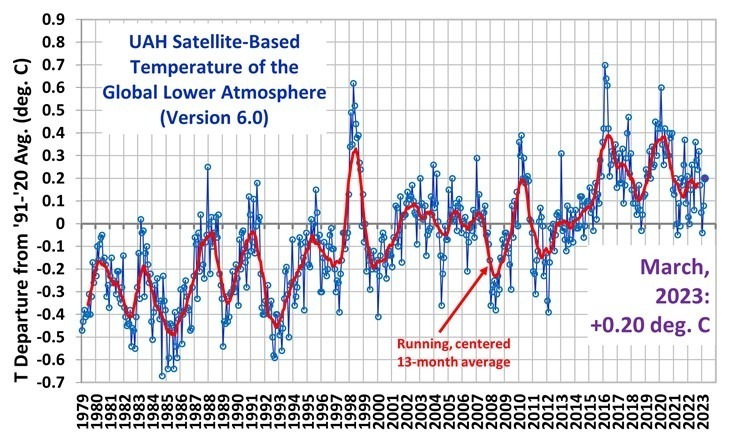
> Scientists fear that as warming triggers thaw of permafrost in the Arctic regions, this could also lead to increased methane emissions
Could?
This is already happening.
Scientists such as Natalia Shakhova have been studying this for years. This is a video of her from 10 years ago.
Summary:
The effect is 30% less than previously thought, and global warming is still really really really important.
So the folks saying 20x may be right.
To be honest, it would be awesome if the title could be change from "Methane may not warm the Earth quite as much as previously thought" to "Methane is 20x worse than CO2 instead of 28x worse".
The heading should just be “Methane 20x worse than CO2”.
There is no need to mention previous thought, most people had no previous thoughts.
I agree with you that would be a better title, for a number of reasons. However I would advocate against changing it.
The title here on HN is the same as the title in the original/linked article. Something I personally live about HN is we don't editorialize by rewriting headlines to reframe things to fit our preferred perception (even when we really believe that perception is correct). This is important for cognitive diversity.
I don't know if it's the "HN is deteriorating" effect finally setting in after a decade, but I do feel like titles either made more sense at the source or were changed to make sense in the past (say, before 2020±1). Now the homepage very often has 10-30% titles that either make no sense or mislead, and you have to click to know what it's about. Might as well just have a list of hashes then and see where you end up. Opening it now: titles like Boustrophedon and XINF (those two words are two submissions' entire titles) aren't useful and should be added to, for example. Similar for this article: it's not editorialising ("expressing one's opinion rather than the facts") to make it reflect what the source is trying to say.
"30% off" ain't a claim to be "harmless". The stuff is still quite insane. Ditching cow and milk is still quite relevant. (Also, corn price for feeding cattles vs famine is still a topic with tension).
I wish the headline said that: "methane not as bad as thought, still very harmful".
Source study:
Nature.com has a dark pattern on the accept cookie workflow. I expected better from them
Scientific publishing is one of the most parasitic industries out there. To be clear the authors of studies that get published at places like nature have very little leverage on this kind of thing -- it is the rent-seeking publishers that are driving it.
I recommend enabling the annoyances filters on uBlock Origin. It removes most of this bs
This stuff is complicated. Specifically you can't do a straight comparison between the greenhouse effects of methane and carbon dioxide. Why? Methane is naturally destroyed in the atmosphere [1]:
> Methane is naturally destroyed by both chemical and biological processes, including reaction with atmospheric hydroxyl [OH] and chlorine, and by methane-consuming bacteria (methanotrophs) in soil and water. This results in a lifetime in the air of 9.1 ± 0.9 years [12]. Thus, we face an important question—given methane is being removed from the air anyway, why trouble to do this artificially? It may be preferable to dedicate the cost and energy involved in methane removal to the task of stopping methane emissions, which would accomplish the same end result of lessening, halting, or reversing the growth of methane-driven climate warming, or, alternatively, simply to ignore methane and dedicate all efforts to CO2 removal. To answer this question, the specific methods of removing methane must be examined.
Climate change deniers are going to have field day with this one.
Denier is such a loaded word, call them skeptic. In this case at least, seems their skepticism was warranted.
Climate deniers are not people who discuss whether methane is 28x or 20x as strong as CO2, but rather people that do not believe in global warming (or our responsibility for it) at all; that's not skepticism, that's blind faith.
Relative to what things looked like 10-20 years ago, is there still a meaningful contingent of climate change deniers? As far as I can tell, most of those people have accepted the reality but disagree on how we should approach it. Even in the most extreme case--looking at Republicans in the US Congress, steeped in fossil propaganda and owing many of their elections to gerrymandering--and using a broad definition of climate change denialism, deniers are (very slightly) in the minority
I personally don't believe CO2 is a driver of climate change. I think the 'science' is junk. I do think pollution is a the number one issue facing humanity, and we're doing nothing about it, because all of our collective energy is being directed at a red herring.
Entire ecosystems are being destroyed by chemical and mining industries, not just ones used for batteries. We've polluted every water source on the planet. Just look at the chemicals they're spraying on crops. We're completely over fishing the oceans. We're paving the best farm land in the world to put up shopping malls.
Climate change, even if it's being caused by people, is so far down the list of concerns I couldn't are less about it.
> I personally don't believe CO2 is a driver of climate change.
You can't just say that and not give a reason (unless "the science is junk" was the reasoning needed for any level-headed person to arrive at the same conclusion as you), at least not if you want to be taken seriously. Bit like saying that the sky being blue is just an optical illusion and it's really purple because the science on why it's blue being bogus and the real-world observations being just a coincidence.
It's so far out there and so casually said that I'm again not sure if this thread is just full of flame bait or legitimate opinions. Do people that believe there is no major conspiracy just not open these threads anymore in comparable numbers to those who believe in a conspiracy? Or do you actually believe the opposite of what you wrote but it's way funnier to cause this waste or time going back and forth over it?
> You can't just say that and not give a reason
They can, because the purpose of the statement is to answer a question I asked about what people believe. There are other drivers of climate change, other seriously impactful greenhouse gases even. In light of their acknowledgment that pollution is humanity's biggest problem, and without more of an understanding of their specific beliefs, it's completely disingenous to compare what they're saying to "the sky is really purple".
On the science-being-junk point, the science on climate change is highly correlative and I don't blame someone for wanting to hold that science to a higher standard. (I understand the arguments why it's ok that the science is less classically scientific, I'm not trying to stake a position here, I don't care, please don't start a flame war with me)
And the rest of their comment is totally reasonable. Ecological collapse __is__ a much more complex and unambiguously serious problem which, depending on your view, is either a bigger risk than climate change or a superset of it. At least with climate change we have silver linings like a possible increase in arable land just as we're hit with a species-threatening rolling food crisis.
I don't care if I'm taken seriously or not. There's nothing I can possibly say or show you to convince you of my position.
At this point we have to consider people who deny that climate change is caused by humans to be climate deniers, since they are advocating for no change in behavior which is the same as people who outright deny that it's happening.
I've heard these arguments: (a) that we don't have the evidence to confirm that climate change is anthropogenic, and (b) that we shouldn't change our behavior. My understanding is (b) is not tied to (a), but rather that most claims of (b) come out of different views on conservation, what "nature" is, what's achievable with technology, and how different approaches to climate change might impact human quality of life.
And (b) is not really that we _shouldn't_ change our behavior, but that the most popular ideas for how we should are varying degrees of infeasible, harmful, or fascistic.
The "right" on this issue is largely misunderstood. Those pushing for a shift to renewables and a lifestyle change in wealthier nations deserve better literature on what their opposition is advocating for and against: https://compactmag.com/article/energy-lysenkoism
What behavior change should people advocate for to not be considered climate deniers? It’s starting to sound more like a temperance movement than a serious attempt to solve a problem.
Yeah, it's like a religion at this point. There are many meaningful debates to be had but people just react very emotionally and dogmatically.
What is the degree of human causation? How much can be imputed to solar cycles at any given moment of time? What % of CO2 is produced by humanity? Is there a possibility of actual catastrophe? Should pollution reduction and cleanup be prioritized over carbon capture/reduction?
There are a shitload of climate deniers.
Maybe you never heard that Bill Gates is going to have “climate lockdowns” after covid, or “control the food supply.” But among half the voting population this is a common belief.
The data disagree: https://www.pewresearch.org/short-reads/2023/04/18/for-earth...
The most extreme voices are always amplified. In one corner we have people raising alarms over hypothetical ecofascism (misdirecting awareness of the real threat of increasing and increasingly-corporatized authoritarianism); in another we have people pushing for carbon capture methods that could create the next global public health crisis (https://www.vesta.earth/approach -> https://www.ncbi.nlm.nih.gov/pmc/articles/PMC8609536/ ); in another we have people who want to build reservoirs with nukes; in another we have people like me who want to see NAWAPA happen despite all the ecological risks and expected archeological + cultural losses. There are plenty of circles like this and none of them are even a plurality
That was my impression as well, but unfortunately this comment is lower on the page than at least a pair of them, so now I'm less sure :/
In the context of scientific skepticism[1], denier or denialism[2] is the correct label.
Not really. It’s 20x instead of 28x is hardly ‘methane is actually ok’.
Science is hard.
I think everyone has "always" known that methane is not a key driver of climate change. Its relatively short atmospheric life and relatively low concentration make it have a modest effect relative to CO2, even if it is more potent.
A 30% reduction serves to further show that the priority needs to be CO2 in general, and everything but the low hanging fruit for methane emissions is a distraction.
Of course, the possibility of runaway effects and short term positive feedback loops from methane release from permafrost, etc, is still a concern. I guess a 30% reduction there is somewhat good news.
If it is loaded in the sense that they will keep their beliefs despite the vast amount of data proving that not only it exists but it is happening, I am fine with that.
20x vs 28x worse than CO2 hardly proves them correct.
I haven't seen those "skeptics" who said "maybe methane has a slightly smaller impact and CO2 a bigger one". Can you point me to sources here?
Otoh their allies, the climate change fatalists, might lose their "what about methane". (in reality they are usually not allies but the same persons, switching between denial and it's too late anyways some times even mid-sentence)
Unlike CO2 the influence of methane on atmospheric warming (in W/m²) has not changed during the last 50 years. I appears there is almost zero impact on climate change by man/woman-made methane. Am I a denier by pointing that out?
As if the exact number matters to them.
What is the point of making this comment? What does it add to the conversation? Are you just looking for commiseration? Do you get some satisfaction if you then find a loony on the socials having their field day?
Many people don't deny the first-order effects. However, the second-order effects are speculative, and there is and should be more skepticism towards them, especially when someone is suggesting authoritarian policies based on them.
Sadly, most of the green movement is just Marxism in new clothes and for them the climate change is an opportunity to push their authoritarian and dystopian policies. They use words such as 'oceans boiling' and 'extinction' as a part of their propaganda which are total and utter lies.
The goal for Marxists is to stop human progress and wealth generation. Implementing their policies would result in a way worse world than a world with climate change.
I'm fine with that because they are becoming less relevant as increasingly extreme weather makes believers of skeptics
This diagram helps clear things up: https://en.wikipedia.org/wiki/Greenhouse_gas#/media/File:Atm...

Methane has multiple peaks of absorption
I am a leftie environmentalist, yet I found this interview quite balanced and informative: https://www.prageru.com/video/why-are-energy-prices-so-frick...
Frankly, we as a global society have FAR more pressing issues than the greenhouse effect, such as:
Collapse of insect and bird populations
Overfishing and plummeting biodiversity as we turn the world into farms and monocultures
Destruction of coral reefs and kelp forests and rainforests
One third of arable land WORLDWIDE is now undergoing desertification
Day zero for many cities as aquifers run dry
Plastic by mass will outnumber fish in the oceans by 2050
Factory farms overuse of antibiotics and superbacteria…
And so on… somehow this “climate change” thing has hijacked the conversation and sucked all the political capital for things like sustainability, switching to non biodegradeable plastics, ending factory farms, etc.
I wonder if global cloud coverage is being tracked and how it is trending. We can then see if methane is having a noticeable effect on cloud coverage over the years. I also imagine, there are other processes that effect cloud coverage.
On what time scale? Also, what about production?
It has a GWP of nearly 100 the first year but falls off rapidly.
If the hypothetical Methane Gun happened, there is immense warming potential that could rapidly melt regional ice sheets.
Climate change is an obvious scam - used by nocoiners to justify the prevention of a freedom-protecting monetary system
Check the IR absorption spectra of water vapor, and be blown away! Far more heating than all other greenhouse gases combined.
It is kind of astonishing to me to witness the discussion in these comments proceeding civilly and with actual regard to the science. In my experience this is vanishingly rare. It's extremely refreshing. At risk of ruining that civility, I'd like to address some aspects of climate scepticism various other comments are touching on.
It is not difficult to see that a reasonable person may ask that if the UN is correct in saying 30% of climate change is due to methane[1] and this paper is correct in saying methane is 30% less effective at warming than we thought, then isn't this whole climate change problem potentially ~9% smaller than we thought? And isn't that actually pretty big? Big enough to potentially have policy implications?
I'm quite sure it's not that simple but nevertheless as a starting point for discovery it's a decent question. It's also a question that will be met with astonishing levels of derision on social media, mainstream media, and in society more generally. Merely asking it will have large international media outlets like the BBC openly describing the questioner as a 'climate sceptic/denier' which, while some may wear it as a badge of honour, actually serves the purpose of shaming them publicly for wrongthink. Social media will of course be far worse in this regard.
We now live in a world where it is popularly considered valid to provide a political (to put it kindly) response to a scientific question. It is, of course, both invalid and indefensible.
I have no ideological aversion to the idea that climate change is real and a serious threat, but the quality of societal discourse on the topic has become so poor and so overtly political that there is absolutely no basis upon which I can accept either of those assertions as _actually scientifically_ true (short of becoming a climate scientist and spending the next however many years personally reviewing all the literature). For me to accept these assertions as fact would be indistinguishable from a declaration of religious faith. It isn't going to happen.
Moreover the conduct of the pro-climate change 'lobby' from the IPCC to the BBC to Just Stop Oil activists has, on the whole, fallen so far short of the standard demanded by the severity of the problem they espouse that I simply don't believe them very much anymore. In my view--and I claim no authority on this matter, this is just how I see it--climate change may well be real and an existential threat, but it may also be a bureaucratic fantasy mistakenly grown from kernels of misunderstood or mistaken truths that has gotten so completely out of control that it's now controlling us. It could also be somewhere in between, or something else entirely: I don't know and I cannot know so long as society keeps excluding valid voices with valid questions.
I suppose I'm a climate sceptic then...but when it comes to deciding between being a sceptic or taking a leap of devotional faith, what choice do I have? Luckily it seems to me the way forward is the same in any case: the pro-climate change people, being the ones comprehensively 'winning' the 'argument' at the moment, need to show a little humility and engage in open debate with the well-meaning sceptics without the ad-hominem attacks, the gaslighting, the censorship, etc. It really is that simple, and the fact it’s so forcefully resisted should, in my view, give us all pause for thought.
[1]: https://www.unep.org/news-and-stories/story/methane-emission...
Just a note, while I was in college some 6-7 years ago, I was told that methane was 19-21x worse than CO2. I don't think the consensus used to be that it was 28x.
The article also clarifies that while it is 28x, it also has a second effect in which it traps heat, so in total it seems to get to 20x.
One safe space for me is the IPCC report summary document itself.
It's generally couched much more cautiously than most of the rhetoric out there.
Its authors seem to really bend over backward to try to accurately characterize the various degrees of acceptance and certainty of the myriad different aspects of the "consensus."
And I've not seen a single good argument from skeptics. Just looking at the hockey stick graph is enough for me to understand the severity of the issue, and I've not seen a good answer to it, let alone most other arguments.
How will this affect internet arguments about going vegan?
The carbon footprint of cows is still horrendous.
Right, that's still true.
> The carbon footprint of cows is still horrendous.
A constant number of cows produce a constant amount of methane which plateaus quickly due to its very small atmospheric half-life.
"Additional methane emission categories such as rice cultivation (RIC), ruminant animal (ANI), North American shale gas extraction (SHA), and tropical wetlands (TRO) have been investigated as potential causes of the resuming methane growth starting from 2007. In agreement with recent studies, we find that a methane increase of 15.4 Tg yr−1 in 2007 and subsequent years, of which __50 % are from RIC (7.68 Tg yr−1), 46 % from SHA (7.15 Tg yr−1), and 4 % from TRO (0.58 Tg yr−1)__, can optimally explain the trend up to 2013." - ["Model simulations of atmospheric methane (1997–2016) and their evaluation using NOAA and AGAGE surface and IAGOS-CARIBIC aircraft observations" (2020)](https://acp.copernicus.org/articles/20/5787/2020/)
"On November 17, 2003 National Oceanic and Atmospheric Administration reported that the concentration of the potent greenhouse gas methane in the atmosphere was leveling off and it appears to have remained at this 1999 level (Figure 1). The Intergovernmental Panel on Climate Change in 2007 acknowledged that methane concentrations have plateaued, with emissions being equivalent to removals. These changes in methane atmospheric dynamics have raised questions about the relative importance of ruminant livestock in global methane accounting and the value of pursuing means of further suppressing methane production from ruminants. At this time there is no relationship between increasing ruminant numbers and changes in atmospheric methane concentrations changes, a break from previously assumed role of ruminants in greenhouse gases (Figure 1)." - ["Belching Ruminants, a minor player in atmospheric methane" (2008)](http://www-naweb.iaea.org/nafa/news/2008-atmospheric-methane...)
«If there was an increase in atmospheric CH4 mixing ratio and the increase was caused by agricultural sources, specifically livestock emissions, the trends in atmospheric CH4 should correspond to dynamics in global livestock populations. *During 1999 to 2006, however, when atmospheric CH4 mixing ratio plateaued, global cattle and buffalo populations* (these species make up 84% of all livestock enteric CH4 emissions; FAOSTAT, 2017) *continued to increase* from 1.46 (1999) to 1.59 (2006) billion head (FAOSTAT, 2017), at a rate of approximately 18.8 million head/yr, *which apparently did not affect atmospheric CH4* over the same period. Since 2006, the rate of increase for the populations of these ruminant species declined to 7.3 million head/yr (FAOSTAT, 2017); we note that FAOSTAT does not specify uncertainty for their estimates, which is likely large for cattle inventories (and emission factors) in developing countries. Thus, it appears that *the global dynamics in large ruminant inventories do not support the suggested farmed livestock origin of the increase in atmospheric CH4* from 2006 to 2015. Potential increases in CH4 emission from non-livestock agricultural sources to the global CH4 budget cannot be excluded. Globally, *the area harvested for paddy rice* (emissions from which are typically 22 to 24% of the emissions from livestock), for example, *had increased 42% from the 1960s to 2015* (FAOSTAT, 2017), although new rice varieties (i.e., water-saving and drought-resistance rice, or WDR; Luo, 2010) require less water and thus emit less CH4 (Sun et al., 2016).»
«As pointed out by Turner et al. (2017), fossil fuel CH4 is not entirely thermogenic in origin (based on its isotopic signature), with *over 20% of the world's natural gas reserves generated by microbial activities (i.e., carrying biogenic isotopic signature)*. Thus, collectively, we can conclude that quantitative attribution of changes in atmospheric CH4 concentrations to CH4 sources based on δ13CH4 data is at least questionable.» - ["Symposium review: Uncertainties in enteric methane inventories, measurement techniques, and prediction models" (2018)](https://www.sciencedirect.com/science/article/pii/S002203021...)
"we find that city-level emissions are 1.4 to 2.6 times larger than reported in commonly used emission inventories and that the landfills contribute 6 to 50% of those emissions" - ["Using satellites to uncover large methane emissions from landfills" (2022)](https://www.science.org/doi/10.1126/sciadv.abn9683)
> A constant number of cows produce a constant amount of methane
Right, which is why arguments about going vegan advocate for having fewer cows, which kind of renders the rest of your argument moot.
Agriculture production as a major driver of the Earth system exceeding planetary boundaries.
https://www.researchgate.net/publication/320356605_Agricultu...
"... the concepts of “planetary boundaries” (PBs) and a “safe operating space for humanity” ... are intended to represent Earth system processes, which, if crossed, could generate unacceptable environmental change potentially endangering human existence
The nine PBs currently recognized are the following:
1. Land-system change;
2. Freshwater use;
3. Biogeochemical flows - nitrogen and phosphorous cycles;
4. Biosphere integrity;
5. Climate change;
6. Ocean acidification;
7. Stratospheric ozone depletion;
8. Atmospheric aerosol loading; and
9. Introduction of novel entities.
Of the nine PBs, five are in the high risk or increasing risk zones, with agriculture the major driver of four of them and a significant driver of the remaining one. It is also a significant driver of many of the PBs still in the safe zone.
Reduced meat and dairy consumption is likely to be crucial."
While methane is often cited as the most harmful aspect of animal agriculture, it's only one of many. Let's not forget about increased usage of fertilizers, pesticides, herbicides, and antibiotics, ocean dead zones, as well as the spread of zoonotic diseases. Additionally, animal agriculture can contribute to soil degradation and erosion, damage the water cycle, and lead to droughts and depleted aquifers.
Furthermore, it's essential to recognize that consuming animal products is no longer a necessity but rather a personal choice. This choice not only results in the loss of lives of gentle animals (as only those were chosen for domestication), but it also damages nature and wildlife.
So probably not much.
Beef and dairy is still horrible for the climate, yet maybe a few percent less than previously thought.
On here?
Nothing will change from the chorus of "well I get all my meat from this local quaint little butcher who knows all the cows by name and they're raised on grassland that cannot sustain arable farming so it's fine, actually", completely ignoring what happens when 8 billion people need to go to that butcher...
> they're raised on grassland that cannot sustain arable farming
Funny, neither can "regular" farmland sustain "arable farming" (or whatever that means). Mainstream food production has a massive input of chemical fertilizers produced from fossil fuels.
It will not affect vegan arguments, it's still true that CH4 is a 20x worse GHG than CO2.
It probably won't, because they're founded on some fairly incorrect assumptions.
The big one is that "if we don't eat cows then all the methane from stuff cows eat won't enter the atmosphere".
And the cows taking all the blame for their flatulence
All the while cows' methane emissions can be greatly reduced, e.g., by oxidizing methane or by using food supplements that reduce enteric fermentation.
One should not forget soil erosion of typical farming, with a big environmental impact. This can be alleviated by letting cows graze on land to stock carbon in the soil (sequestration of soil organic carbon).
So we're not quite as doomed as previously thought?
Yup. In the sense that the unstoppable guillotine blade is descending slightly slower onto our necks. Yay!
We are free to fart outside once more!!
Human farts on AVERAGE contain about 5% methane, and 9.6% CO2 - but depending on your gut biome you may not fart out any methane at all. There's not great data on this (sample size n=16) but the ballpark figure I found was 30-40% of people fart methane.
Something something 198Fart