IPCC climate crisis report delivers ‘final warning on 1.5C’
theguardian.comJust in case it saves one person the effort to research this themselves ... for some reason I find the measurement of climate change in units of temperature a bit problematic (though entirely rational). It tends to suggest the old bugbear of "global warming", which of course gets translated by deniers (& skeptics) into "well it's colder here so that's wrong".
I spent a while digging in to try to get some numbers on a different sense of what's happening. Global average temperature is changing because extra energy is being retained within the boundary of the planet's atmosphere [0]. So how much extra energy is being retained?
A best guess estimate from 2015 would appear to be that
> the earth is getting about 300 terawatt hours of energy per hour due to anthropogenic climate change, and humans use about 16 terawatt hours of energy per hour.
That is, the earth is gaining 18x more energy per hour than we use every hour, thanks to the changes in radiative forcing driven by climate change contributors.
[0] anyone familiar with complex physical systems will understand that when you add energy to such a system, the effects are often hard to predict. It is very likely that the temperature of the system will rise, but you may also see, for example, more movement as well (which is in some sense a related concept to "temperature" but not identical, and it adds uncertainty because it of the extra degrees of freedom).
> anyone familiar with complex physical systems will understand that when you add energy to such a system, the effects are often hard to predict
This is something that is very underappreciated. It's entirely possible that the climate becomes chaotic (in a mathematical sense) and there are sudden, drastic changes that cause economic and social devastation.
It seems inevitable that people will be complacent until it's too late.
On the other hand, this energy can also get converted into complexity. It's not like this hasn't happened before (organisms, trees, animals, cities, etc...). So it's possible with this fast increase in energy, we get the SciFi city we have all been dreaming of.
Of course, it's easier for this energy to dissipate as heat and kill us all.
> It's entirely possible that the climate becomes chaotic
Ya think ? :)
(no insult intended)
It seems inevitable that [conservatives] will be complacent until it's too late.
Let's not white-wash the problem.
Flipping that around, it seems inevitable that [leftists] will insist on mass collective action based on the predictions of unreliable academics, until the moment they realize those predictions were wrong. Again.
Example: the idea that global warming doesn't cause warming is new. 20 years ago climatologists were telling British people with absolute confidence that by now there'd be no more snow. In the 1960s they were telling people there was a new ice age on the way. Both predictions were dead wrong and have now been white-washed out of existence.
Why is it only conservatives who require that if people claim their understanding of the climate is good enough to predict it decades into the future, they actually be able to do that? Why is it only conservatives who recognize that academia's reputation should suffer if they constantly make aggressive predictions, get it wrong and then pretend it never happened?
> Example: the idea that global warming doesn't cause warming is new. 20 years ago climatologists were telling British people with absolute confidence that by now there'd be no more snow.
The idea that global warming causes local climate shifts, increases extremes, and breaks existing patterns in ways that will sometimes not cause local warming and may even cause local cooling has been a major theme of GW discussions at least as old as the 1980s.
The particular local predictions for Britain may be new, but that its hard to make specific local predictions of the effects is also not a new realization, so I doubt very much that climatologists (as opposed to, say, popular media) were predicting anything of the kind you describe with “absolute confidence”.
>> I doubt very much that climatologists (as opposed to, say, popular media) were predicting anything of the kind you describe with “absolute confidence”.
Here's proof but there's far more where it comes from.
Prediction, March 2000: According to Dr David Viner, a senior research scientist at the climatic research unit (CRU) of the University of East Anglia, within a few years winter snowfall will become "a very rare and exciting event". "Children just aren't going to know what snow is," he said.
https://realclimatescience.com/2023/03/the-end-of-snow-8/
Reality, March 2023: Met Office weather: Snow could return as fresh -4C blast to hit UK. A return of wintry weather has not been ruled out despite the country now being in spring
https://www.somersetlive.co.uk/news/uk-world-news/met-office...
Climatologists have a reputation for being always wrong not due to media mis-representation. The media by and large doesn't misrepresent what they're saying. They have that reputation because they keep making stupid predictions with absolute confidence that then don't come true, and they never admit that this has happened even though the archives are full of examples.
What do you think "a few years" means to a climate scientist?
Actually asking, this is not rhetorical.
It means the same as any other person who says it. "A few", as in, maybe 3 to 5 years. That's why he said children won't know what snow is. If they were small children in 2000 then by 2003 snow is gone, they won't remember it.
But yea, sure, if you want to argue that he wasn't speaking English and that "Children just aren't going to know what snow is" didn't happen then go for it, that'll be amusing to read.
As you wish. Enjoy the view as you pass the 12th floor.
I'm not sure what that idiom means, sorry.
The problem looks pretty “white” to me already.
What does that mean?
Here's an experiment for you: take a two bar pendulum and set it at the bottom with no motion.
Now turn up the temperature in your house until it starts moving. You can put it in the oven and crank up the heat if you want
The thing that blew my mind was that they always report this in degrees Celsius.
I'm in America, even despite an engineering degree, I think in Fahrenheit.
1.5C sounds like a small number, until you remember that Fahrenheit is ~2x 1C.
So 1.5 degrees C is ~3 degrees F. Which, to me, just emotionally feels like a bigger number despite being the same empiraclly.
Similarly, it means when the IPCC is saying there might be a 7C change in 100 years, they mean a 15F change. 15F is emotionally terrifying to me. Its the difference between 85 degrees and 100. 7C is an abstract concept to me.
The US is basically the only country in the world that uses the Fahrenheit scale.
This is false. Fahrenheit is commonly used in Canada to this day. Awareness of the scale still exists in the UK as well. Any commonwealth country is likely to have awareness because metrication happened so late in those countries.
As a Canadian I never use Fahrenheit. The only people I know who do are at least 70.
Edit: For weather.
Honest question: what temperature scale is on your oven? My understanding is that it is likely to be Fahrenheit but I don't actually know.
Sorry, I meant in terms of weather. The oven is Fahrenheit (presumably because its product being sold in America too) but I don't have a mapping for that vs weather.
Ah, yeah, that's a fair confusion.
I don't think Canadian ovens feature the Fahrenheit scale because they are sold in the US. The SKUs are likely to be different and changing the display is easy. Consider cars which are similar. I assume Canadian cars feature speedometers in KPH and external thermometers in Celsius. I am curious what units your engine coolant temp uses though!
Canada is a commonwealth country and the commonwealth didn't begin converting to the metric system in earnest until the 1970s. This is over 100 years later than the rest of the world. Canada paused metrication in 1988. Cooking is likely to have been one of the last things to change because it is so common.
Pre-metrication Canada used the Imperial system and the US used the US Customary system. This means the definition of units like the gallon was inconsistent. Units in Canada seem to be influenced more by the commonwealth than they are by their southern neighbor.
Canadian cars use KPH because they’re required to by law. My Canadian Hyundai showed the temperature in F when it was new off the lot and every time I disconnect the battery, and there’s a crazy secret set of button pushes I have to do in a particular order to switch it back to C which I can never find.
A lot of things in Canada are imperial because of the influence of the US. The Ontario building code says when framing a house, wooden studs need to be on 406.4mm centers. That sounds like a really weird number, until you realize it’s actually 16”. It has to be metric, but it also has to evenly divide 4 feet, because drywall here is 4 feet wide so we can import/export from/to the US.
That sounds reasonable but I’m not certain. You could be right, especially with lumber export. Does Mexico have similar mixed units for cross border trade?
Seems more likely to me Canadian sizes are the way they are because of the Imperial system and commonwealth history.
The US never used the Imperial system so even when both countries used gallons they were different sizes.
The metric system is everywhere but the kitchen :)
As a Brit, I concur.
That is unfortunately not correct. I grew up in a commonwealth country, have travelled to many others, and now live in the UK. Not a single person I know in either country has even the faintest idea what Fahrenheit numbers mean for temperature. It is never used in any way in these countries.
It is used for cooking in Canada even today. Here’s a UK weather report from 1987 that uses both Celsius and Fahrenheit: https://youtu.be/NnxjZ-aFkjs. Celsius is the default but there are living people in the UK who recall using the Fahrenheit scale. This is much less common outside the commonwealth.
An example from 1987 isn't particularly a good example.
The BBC's weather reports are all in Celcius: https://www.bbc.com/weather/2643743
It’s a good example of “living memory”. You won’t find an example like this outside the commonwealth.
My friends in Canada talk in degrees Celsius by default. They have a basic understanding of Fahrenheit (more than Americans do of Celsius), but it's not their native temperature scale.
Yes, they use both. Celsius primarily, but still both. Ask them how hot their oven is, or the temperature of the pool.
Canadians don't know what 15f is going to look like though
275, 375, 400, 425, and hot are arbitrary settings to me, not particular temperatures. They're comparable only in that they're ordered. This is not an understanding of the scale, beyond knowing that it's talking about temperature. I definitely could not tell you how 100f relates to a standard room temperature of 18C
Sure. I was just pushing back on the “America doesn’t metric system, lol” cliche.
Awareness is not the same thing as familiarity.
If you give temperatures in Fahrenheit, most people outside the US (and Canada) are going to need to convert that to Celsius.
Yes, most people will. But that’s more than just America being familiar with Fahrenheit and allows for a disproportionately larger population of Fahrenheit-literate people in the commonwealth.
> disproportionately larger population of Fahrenheit-literate people in the commonwealth
Fahrenheit-literacy, at least in Australia, is practically zero for anyone under 60-70 that has lived outside the US.
Even folks who grew up with it. In Australia they have have spent the last 40 years using Celsius for everything. You tell them something in Fahrenheit and they're going to pause, have to think "How do I convert that".
But anyway, the point was that it's not false to say "The US is basically the only country in the world that uses the Fahrenheit scale."
Basically everywhere else DOES use Celsius.
For day to day understanding of weather and climate, using anything other than Celsius is going to confuse or frustrate more people than it's going to help. Regardless of whether they're in or out of the Commonwealth.
That's certainly not true for Australia and New Zealand, numbers in Fahrenheit are basically meaningless for me.
Australia and NZ had much more successful conversions to the metric system than Canada but there are people alive today who would have used the Fahrenheit scale early in their lives. Contrast this with non commonwealth countries who converted to the metric system 100 years earlier than the commonwealth.
UK Metrication: 1978 (partial)
Canadian Metrication: 1976 (partial)
Australian Metrication: 1988
NZ Metrication: 1976
French Metrication: 1858
German Metrication: 1872
Mexican Metrication: 1857
> This is false. Fahrenheit is commonly used in Canada to this day.
At least where I am, Celsius is the unit of choice, even among the older generation.
Even in the kitchen?
You're right, our oven and most recipes are in Fahrenheit. My kettle though is in Celsius :)
Hah, how strange. An exception to the exception. I find all this history very interesting. The US gets a lot of blame for delaying Canadian metrication but looking at the timelines the opposite seems equally plausible.
UK tabloids apparently choose to use Fahrenheit to sensationalize heat waves.
I wish warnings came with clear outlines of mass extinctions, of changes in resources, and most importantly, of cost to property owners in impacted areas.
That last one could finally cause some action because the current economy largely ignored anything else.
But if any of those outlines don't happen when expected or in a different way then people call it all bunk - same reason people discount it now because of previous dire warnings. The boy who cried wolf is the great fable for this, because ultimately there was a wolf.
"16 terawatt-hours of energy per hour" is simply "16 terawatts of power (continuously)". I want to see writers move away from the unit kWh and instead use joules, which is way less confusing and harder to misuse. Also we as a society need to respect the distinct concepts of energy (J) versus power (J/s = W).
In this place I'm citing from, the writer originally used Joules, but was critiqued by some anonymous commenters and switched. They noted:
> Note: Before anyone complains, I’ve deliberately conflated energy and power above, because the difference doesn’t really matter for my main point. Power is work per unit of time, and is measured in watts; Energy is better expressed in joules, calories, or kilowatt hours (kWh). To be technically correct, I should say that the earth is getting about 300 terawatt hours of energy per hour due to anthropogenic climate change, and humans use about 16 terawatt hours of energy per hour. The ratio is still approximately 18.
Out of interest, you can also convert it to calories. 1kWh is about 0.8 million calories. So, we’re force-feeding the earth about 2 x 10¹⁷ (200,000,000,000,000,000) calories every hour. Yikes.
https://www.easterbrook.ca/steve/2012/01/how-much-extra-ener...
Is that a problem of units or education?
Children sometimes confuse the units of speed and distance, but not when they get older.
The analogy I've seen which I like is to that of a boiling pot of water on a stove. As you increase the heat (energy) in the system, the water level fluctuates throughout. You have points where there's a higher water level, but you also have points where there's a lower water level.
Do you have a sense of what the % increase in total energy is? As in what is the denominator for the +300 terawatt hour figure?
Yeah this stat is a bit confusing to me.
Does this imply in preindustrial times the net energy was 0, or is this total energy and there’s some number not mentioned of loss?
My understanding (I'm not a climate scientist) is that yes, net energy was zero over the "right" period of time (i.e. incoming energy from the sun balanced energy lost by radiating to space).
The key technical term (IIUC) is "radiative forcing" https://en.wikipedia.org/wiki/Radiative_forcing
When we do hit whatever +1.5C or +2C, Q will be 0. The amount of energy input to the earth system isn't changing - that's defined by the temperature of the sun, it's the output that is decreasing.
What your energy look describes is dT/dt, how quickly we will reach the new equilibrium.
At the new equilibrium, the temperature is likely still to be the best descriptor of the new normal - we describe most processes and states in terms of temperatures they happen at, because it's and intensive property rather than an extensive one. You don't have to temper this 300 TW number by the mass or surface area of the earth to get a sense of what's happening when you use temperature
What's the energy number at which a glacier will melt? What's the temperature?
∆T is one of the most important numbers in thermodynamics for good reason
> What your energy look describes is dT/dt, how quickly we will reach the new equilibrium.
The rate is important, but so is the final result. A system whose new equilibrium is +10C is as useless to humanity and life and earth whether we reach it in 25 years or 200.
I agree with you that ∆T is more useful for thinking about actual effects (e.g as you noted glacial melt), but my interest in thinking about it in energy terms is (a) I think it highlights the cause more strongly (YMMV) (b) it better accomodates the possibility of the extra energy in the system having effects not so obviously correlated with ∆T
Yeah, those are interesting numbers. Another one I’m curious about is: how much faster are we burning fossil fuels than they are replenished naturally? The only number I found was a low estimate of 750x, and I think that was for oil. I assume “natural” gas is faster?
Given many fossil fuel deposits took millions of years to settle/decompose/compress, I don't think you get a proper X multiplier without an exponent greater than 6.
Yeah the time is interesting but it doesn’t directly imply anything about the flow. I’m curious about that. Ie how much new oil/gas etc is being produced by nature each year.
Found this[1] now, which gives a ballpark of 20-80k barrels/y which can vary quite a bit depending on the guesstimates of undiscovered reserves. Since we produce 80-100M barrels/y, we’re drinking from the basin about 1000x the rate that it replenishes. Or slightly worse, because we’re slurping up the yummy and easily accessible parts, whereas formation occurs everywhere. Still, the 1e6 estimate seems orders of magnitude too high (to my surprise as well).
Again, this is only for crude oil, and there are certainly more factors at play.
1: https://earthscience.stackexchange.com/questions/571/how-muc...
That answer makes a ton of assumptions, including if it is even an ongoing, continuous process with a useful enough replacement rate that can be used to compare on an annual basis. That's the more important reason to bring up timescales: if it takes millions of years to happen, estimates of "annual" production are a fun game, but just as likely to be statistical lies as actual useful on the ground facts.
(Also, as a reply points out, there's thoughts that time periods after the Jurassic epoch, if not some point earlier in the mid-to-late Cretaceous, may be much less "fertile" in petroleum and coal-producing raw elements and that for the most part new "production" by "nature" has been "stopped" and we've long just been mining further and further back in time. Which is to suggest there is no real, meaningful replacement rate at all with which to discuss.)
Given the timescales involved, I know I'm far more inclined towards pessimism that any discussion on replacement rate with respect to human lifetimes, especially on an "annual" basis rather than cumulative across the human epoch, is ignoring the forest for some statistically insignificant trees.
Oh yeah replenishment is beyond miniscule on any human timescales. Best case we use the amount of oil produced from ancient Egypt until now in ~3 days at current rate (see updated back-of-the-napkin estimate in sibling comment). This of course is based on averages and doesn’t factor in differences in “fertility”.
I was just curious about the numbers, mostly because media refuses to share anything more than the most simplistic data. For instance, if we can say that we drank 500k years or natural production in 1y, that is more meaningful (to me).
>80-100M barrels/y,
Per day...
>we’re drinking from the basin about 1000x the rate that it replenishes
Try half a million times faster.
> Per day...
Oh shit. You’re totally right.
> Try half a million times faster.
Yep. At least it’s better to have a number than nothing, even if it’s +-1 OOM. It’s pretty wild to imagine using up 500k years of fuel production in only a single year.
While googling around, found another interesting metric: ratio of proven reserves to production rate, ie how much longer can we sustain given current consumption and no new developments. That number has increased over the decades, and sits around ~50 years for both oil and nat gas and ~100+ years for coal.
https://en.m.wikipedia.org/wiki/Reserves-to-production_ratio
Not specific to fossil fuels, but there is Earth Overshoot Day[0]
> Earth Overshoot Day marks the date when humanity has used all the biological resources that Earth regenerates during the entire year.
Basically a few minutes into January 1st it's earth overshoot on oil and gas replenishment.
90% absorbed by the ocean thanks to a high specific heat it's an even more modest number in degrees
Complex systems usually tend to equilibrium otherwise they would be in constant oscillation (positive feedback theory).
As we look back in ice cores, there is variation, but not constant oscillations witch confirm a self stabilizing system.
A few negative feedback we don’t often hear:
increase of co2 have a huge effect on plant grow especially in hash deserted conditions.
Increase in temperature increase humidity: clouds that have a huge effect on reflecting radiation (much greater than co2) increase precipitation, increase plant growth in deserts.
Not to say that we should continue this experiment, but maybe not panic either and see this as the only problem: war, famine, poverty are much more important and real immediate problems instead of projected possible problems.
> Increase in temperature increase humidity
Water vapor amplifies the effect of other greenhouse gases.
https://climate.nasa.gov/ask-nasa-climate/3143/steamy-relati...
Yes, but also with clouds that prevent radiation from reaching the ground.
Im sure the IPCC authors didn't forget their climate science 101 material.
Moreover, we can tackle multiple problems concurrently, no need to make it appear we can only ever do one thing. And as it so happens, climate change tends to correlate extremely well with war and famine. It certainly appears a climate solution is going to help many other big problems along as well.
> climate change tends to correlate extremely well with war and famine
and migration.
No it doesn't, that's just people trying to tie together two hobby-horses. Nobody is migrating to Europe or America because of climate change, they're migrating because of wealth and war.
If you live in an agricultural area and can't get sufficient water for irrigation anymore, the distinction between climate change, wealth and war is pretty immaterial.
Do you seriously think that if, in say 30 years, substantial chunks of the tropics-to-tropics range of latitude have become too hot/dry for mass agriculture, that people will not be trying to migrate?
I haven't seen anyone claiming that there is currently mass migration due to climate change. But I haven't seen anyone claiming that previous climate change events (anthropogenic or not) were not accompanied by mass migration (even if the absolute numbers of people were smaller due to total population)
You used the present tense in the post I replied to. But as you say, currently it's not true and there is no correlation between climate change and migration, because the climate hasn't actually changed anywhere near enough in any location to cause people to move.
> I haven't seen anyone claiming that previous climate change events (anthropogenic or not) were not accompanied by mass migration
What climate change events were you thinking of? Medieval warm period? I don't think there's any record of anything that we'd call a mass migration, any time in history beyond the past few hundred years. Not unless you count migrations that took place over tens of thousands of years as mass migration.
> the climate hasn't actually changed anywhere near enough in any location to cause people to move.
Where I live (near Santa Fe, NM), human civilization has moved in and out several times over the last, say, 5000 years, always correlated with the arrival of long term drought conditions. The last big movement was during the megadrought of the late 1300's, and apparently involved migrations of between 300 and 1000 miles.
Similar patterns are well known to archaeologists and anthropologists across the planet.
Also "and migration" doesn't have any tense or time context and even the GP's wording ("X tends to correlate with Y") is also largely free of any implied time period.
The Syrian conflict started after 4 or so successive years of crop failures, which have been linked to desertification and climate change.
You don't think that had more to do with ISIS than climate change?
ISIS came after the breakdown of society due to crop failure after crop failure.
Migration started end masse after Russia was invited over to kill every civilian in sight. But that is also after Assad lost the ability to control and feed the population, something he wasn't doing very well anyway, granted, but without climate change related failed harvests its hard to imagine it had spiralled out of control.
Does it? We have fewer and fewer death because of climate (most death of climate is because of cold) We have a proxy war in Ukraine that has nothing to do with climate We have a famine in Sri Lanka that was caused by the green movement
The narrative of climate is the cause of all problems isn’t reasonable anymore.
Robust institutions disagree on whether heat or cold is more significant:
> Extreme heat and extreme cold both kill hundreds of people each year in the U.S., but determining a death toll for each is a process subject to large errors. In fact, two major U.S. government agencies that track heat and cold deaths--NOAA and the CDC--differ sharply in their answer to the question of which is the bigger killer.
https://www.wunderground.com/cat6/Which-Kills-More-People-Ex...
And while it may indeed be that cold is a more significant source of death, these numbers are hardly trivial:
2003 heatwave, Europe: 72,000 2022 heatwave, Europe: 20,000
and for the future:
> In the course of this century, the percentage of the European population dying from cold temperatures will steadily decrease, while the percentage of the population dying from heat will increase. The latter increase will start to exceed the reduction of cold-weather related mortality in the second half of this century, especially in the Mediterranean. As a result, mortality in Europe related to non-optimal temperatures will start to increase by the end of the century in a moderate scenario of climate change, and already by the middle of the century in the high-end scenario of climate change.
Derived from: Martínez-Solanas et al., 2021. Lancet Planetary Health 5: e446–54
There is no serious narrative that claims that climate change is the current cause of all problems. There is no serious narrative that can refute the obvious point that if climate chnage predictions play out, it will add greatly to all existing problems.
Yes we can, but what are those problems, what is the cost involved, what are we willing to sacrifice?
There is many other goals that are largely ignored because "climate" is very very popular.
I like the work of Bjorn Lomborg on that front. When we rank the problems and solution climate is not at the top.
> clouds that have a huge effect on reflecting radiation
My understanding is that clouds are inside that part of the atmosphere in which radiative forcing has decreased. This means that while they may reflect radiation so that it does not reach the ground, they do not stop (all) the energy from being trapped within the atmosphere.
> war, famine, poverty
All actual problems that will result from significant climate change, not distinct from climate change (even though they may exist for other reasons too).
> increase of co2 have a huge effect on plant grow especially in hash deserted conditions.
Which might sound good for crops but of itself can destabilise ecosystems, African savannahs are already becoming scrubbier with brush and shrubs due to more CO2 enrichment for at least ~1 million and possibly several million years. That will definitely have implications for populations of animals adapted for grassland
The comparisons between the AR5 and AR6 are alarming. Now, under no emission scenarios other than low and very low which we are not tracking close to, we reach +2C at or just before 2050. Many reading this thread will see 3 degrees by the time they plan to retire. This comes with drought, undernourishment, and mass migration: https://sciencenorway.no/climate-climate-change/deadly-heat-...
> Many reading this thread will see 3 degrees by the time they plan to retire. This comes with drought, undernourishment, and mass migration
I wonder what it'll feel like looking back at that point. There isn't anything that I alone can do right now to prevent this from happening, it has to be a collective action but still, we've been warned for decades, over and over, we knew what would happen. Will we regret not having mobilized more, joined every protest out there, not having written our representatives more than we did, not having made more sustainable choices than we did? I know the effect of personal choices and actions is marginal but still, I'm sure we'll feel lots and lots of regret.
From Kurzgesagt – In a Nutshell:
Can YOU Fix Climate Change? https://youtu.be/yiw6_JakZFc
and
We WILL Fix Climate Change! https://youtu.be/LxgMdjyw8uw
Make sure that you watch the second one if you watch the first one.
Our descendants will rightfully conclude that we were a generation of comfortable cowards. Truly unforgivable. Yet we understandably don't know what to do as individuals. The scale of the tragedy is almost inconceivable.
Well, you could for comparison's sake look back from now to when these same warnings were issued 5, 10 or 20 years ago
> I wonder what it'll feel like looking back at that point.
It will feel like nothing, because everyone will have conveniently forgotten about these sorts of reports and predictions when the world stubbornly refuses to end. Just like everyone conveniently forgot that in the 50s and 60s scientists were writing to the US President to tell him that the consensus of scientists was that the world was entering a new ice age, and that he should prepare agriculture and industry for the transition.
You wait and see.
Well, I hope you're right.
Take a look at the extinction clock. It'll make you feel better (maybe)
What a fun page. Not sure how honest it is though.
> Possible 'adverse health impacts in Australia from climate change' by 2020. From Climate Commission's 'The Critical Decade: Climate Change and Health' report, quote: "We need to act now. Decisions we make from now to 2020 will determine the severity of climate change health risks that our children and grandchildren will experience. The longer we wait, the more serious the consequences. [...] Figure 8: Possible timeline of some future adverse health impacts in Australia from climate change". Graphic showing: "Extreme weather events: deaths, hospital admissions, mental health disorders", "Dengue fever", and "Gastroenteritis" to increase from 2010 to 2019 cited from an unpublished article by McMichael in 2011.
Many would say the wildfires in 2020 were one of the worst in history and definitely had adverse health impacts I would say, no? Yet the page says it didn't come true.
Many others don't consider that predictions were made waaaaay before we had the means to model the impact of climate change on a grand scale. Others are just silly, who cares what Prince Charles said. Well, I guess denialists made their point once again.
It's honest. You can just click through the stories to see for yourself. Of course you can try to find one you feel is weak, cherry pick it and then try to dismiss all the others, but all those false predictions are still there and won't go away.
W.R.T. the one you picked, the extinctionclock assessment is correct. The claims being made are about "deaths, hospital admissions and mental health disorders, dengue fever and gastroenteritis".
Deaths from extreme weather are down drastically over time. Very unclear why they predicted a rise in mental health disorders from climate change, but nobody outside the most extremist climate change fanatics are trying to claim a link there. Contemporary discussion about mental health problems focus on the effect of social media on teen girls.
Dengue fever in Australia is also trending down (figure 8 here https://www.who.int/docs/default-source/wpro---documents/eme...). I didn't bother checking gastroenteritis.
Finally, wildfires - not mentioned in the actual paragraph you cited. Here is a graph of wildfires in Australia over the last decade.
2019 and 2020 were abnormal years for Australian wildfires. As you can see, 2021 reverted to the mean which is stable. There is no increasing trend in wildfires, just a couple of bad years that the media cherry-picked to try and make you think the world is burning.
You have to be so careful when listening to climatologists, because they love to engage in data truncation and cherry picking to make deceptive claims. This video shows the problem, and I linked you directly to the part about how they do the same with wildfire data in the USA. The full data shows that wildfires have been in steep decline in the 20th century in the USA, but that the data is being truncated when shown to policy makers to make it look like it's increasing:
https://youtu.be/8455KEDitpU?t=146
If global warming caused more wildfires, then wildfires should have increased in the 20th century everywhere susceptible to them when emissions were ramping up so much, but they didn't. Thus the claim is falsified.
I would love to say this comes as a surprise, but it really does not. UN Secretary-General Guterres really foreshadowed that last year, and he did not mince his words. Really unusual for somebody that role, usually it is more of a diplomat-style position.
> Using bogus ‘net-zero’ pledges to cover up massive fossil fuel expansion is reprehensible.
All true, but as a reminder, more energy in a pseudo stable chaotic system means more extremes in both directions: more frequent floods, more frequent extreme snow events, etc., all across the globe.
Do people in capitals not understand or believe this? What do rich people (some of whom control large parts of the media) plan to do exactly? Die? Bunker? I mean seriously.
The problem is to gain political power you have to out compete others for money and votes.
Understanding a problem, and being able to hold on to power while making the hard decisions is a classic unsolved problem in politics.
But it's infinitely harder with very few (two!?!) high centralized litmus-tested groupthink political parties, incentivized to lock up power unilaterally, and marginalize the power of other parties, not skills conducive to governing.
And also infinitely harder with unlimited spending by corporations (who are not citizens, and don't share the interests of citizens), where tiny groups of executives get to leverage all their companies resources toward tilting the political field in their favor, in order to get massive bonuses for feeding insatiable shareholder demand. But without reflecting any of the decency that shareholders might actually have.
It's the moloch beast. The whole system is the problem, but it's near impossible to improve the system's design because it will fight that at every step.
It mindlessly cares about its own survival. Which is how it came to be.
Even if every single person in the system actually wants to do the hard things that will keep the planet in good shape.
What I don't understand is how not even environmentalists seem to believe it given their opposition to nuclear power. If a climate apocalypse were upon us, shouldnt we have been building nuclear power as fast as possible for the past decades? I really don't understand
What are the options, really? Option A is business as usual. Option B is a massive cut in energy consumption.
Option A implies at some point in the future, massive social unrest due to mass migration.
Option B implies massive social unrest today due to a large decline in standard of living. And no, it won’t be the “people in capitals” suffering here.
Option C is option A plus some geoengineering that will likely be undertaken when the situation is desperate enough.
Many Western nations have substantially reduced their emissions already. This did not result in catastrophic reductions in living standards. And these reductions happened before the current exponential cost improvements in renewables really began to cross the “knee”. At the same time there are fossil fuel interests and politicians who are trying to slow down renewables and promote more fossil drilling, even when it’s not economic. (And China is burning massive amounts of coal for reasons that make less economic sense every month.) This stuff is “set the controls for the heart of the sun” levels of suicidal. We won’t survive it.
As for geoengineering, good luck. While I also think this may be necessary, a precondition for spraying stuff into the sky is convincing people that this kind of intervention is necessary. Good luck doing that while enormous financial interests are trying to convince the world that it’s safe to keep digging up and burning fossil fuel deposits. They may not object to geoengineering itself, but they can’t afford to permit the kind of consensus it would require to get geonengineering done, so they will throw resources at fighting that consensus until it’s too late.
Option D is hoping the mass social unrest will cause enough (of the right) people to die off or actively steering towards that. A final solution one might say.
Option D: less people by any means necessary.
This sounds slightly eco-facist. https://en.wikipedia.org/wiki/Ecofascism
They will be well enough. Maybe their mansions and yacht will be slightly smaller and they will need to find some new destination for tourism. But they will have their air conditioned and heated, homes, cars, shopping centres and so on.
Build walls to keep out refugees.
They seem to be buying beachfront property
Die? I think it's die. Look at Biden, Putin, Xi, and Rupert Murdoch they range from old to really fucking old.
> 2050
Luckily that aligns with the singularity timeline. AGI will have a very good carrot for us to agree on its terms.
It wants Ohio
Literally nobody would miss it.
We'd need another state to pick on, though. Probably West Virginia.
It can fix the planet or it gets the hose again.
For anyone interested in what 1.5C represents, I can't recommend enough the Climate Fresk [1] exercise.
It's not just the droughts and floods, the heatwaves, the changes in birds, insects, crop yields, … Include permafrost melting and releasing greenhouse gasses, civil unrest in populated areas that won't be livable anymore, unstable food production, and quite a few other causes and consequences.
It's a feedback loop of many moving parts. Thinking that "we will reach an equilibrium eventually" is probably a naïve take. The next natural equilibrium probably includes a decimated world population.
Positive action is necessary now. If you don't know what action to do, go to [1] and start there.
Overstating impact is detrimental to the cause.
> decimated
1.5C will be bad, but it won’t directly kill 800+ million people in a short timeframe. People simply don’t respond to harm spread across 100 years the way they react to harm concentrated into a few large events.
Of course, 1.5C will not kill 800+ million people.
https://www.ipcc.ch/report/ar6/syr/
1.5C is the (likely to be overshooted) goal. The IPCC report assesses that 2011-2020 is already 1.1C warmer than 1850-1900 (page 7), that the world has been warming by ~0.2C/decade (saw it somewhere), and that current policies (if implemented) will lead to a warming of +3.2C by 2100 (page 23). Page 16 shows various ways in which a +3.2C world will be hostile to humans. For instance most of south and south-east asia, and some of the most populated areas in Western Africa will experience temperatures and humidity levels that are dangerous for human survival >200 days a year. This is now all determined with rather high confidence.
Famine will. Rice fails to germinate at 35°C.
https://link.springer.com/chapter/10.1007/978-3-030-06118-0_...
False, 35C is described as the highest optimal temperature not the maximum in your link. Yields do slowly decline with increased temperature. For specifics, “Germination occurs within the temperature range of 50° to 107°F with an optimum temperature of about 87°F.”
https://www.uaex.uada.edu/publications/pdf/mp192/chapter-2.p...
Further, it’s exactly the kind of reason to chose a new variety over an old one.
Before saying "False" and dropping the mic, you should pull the paper and look at Table 1. High temperature stresses start at 25°C. Above 35°C, photosynthesis drops by 15%, grain size suffers, etc.
"Yields slowly decline" is a mischaracterization of the situation.
Ahh fantastic. Now let's talk about the rest of the flora and fauna that is absolutely essential for crop growth beyond the few staples that get researched.
So is understating the impact.
This take is seriously dangerous.
"1.5C is not so bad, chill people"
When the fact is - we don't know the impact - if we go beyond 1.5.
What we do know (because it's already very much measurable) is that much of the worlds glaciers will melt, causing drought.
What we do know is that eventually the sea levels will rise and drown many extremely valuable coastal areas.
I'd argue we have no idea what will happen when the glaciers melt, given the lack of accurate climate change predictions to date. We have a lot of models that have historically proven very incomplete with no reason to believe they're any more complete now.
The oceans rising is more a problem, but it's not going to end human civilization and will happen slowly enough that adaptation is possible, albeit expensive. "Drowning" is hyperbole.
Uncertainty is just that, uncertainty. It will be positive for some areas and negative for others. Those of us who benefit from the status quo (myself included) can argue it would be unwise to mess up a good thing, but the simple fact is we have no idea. There will be winners as well as losers. It's quite possible that the midwest becomes wet enough that American farmers will become even more productive through double-cropping, for starters. Likewise the Russians look forward to their northern coastline thawing.
The sky isn't falling, it's shifting, and while we probably should minimize the shift as much as practical, we shouldn't plunge ourselves into an economic depression to do it.
> Drowning is hyperbole
English is not my first language.
How would you describe something previously on land becoming submerged by the ocean?
>> How would you describe something previously on land becoming submerged by the ocean?
A tide. Sea level rises are small and highly predictable over time. All claims of dramatic sudden flooding or drowning are based on assumed correctness of models that, as scottLobster points out, have always been wrong (they always overshoot).
Flooding.
Drowning is when a living organism is submerged, flooding is when buildings are submerged.
> Drowning is when a living organism is submerged...
...and dies from it, which is a pretty important aspect to the word. If the organism doesn't die, it's swimming or just submerged.
Drowning is a process. You can escape or be rescued before death.
Doesn't that make it sound like a temporary condition?
It’s a tense thing. The processes is flooding, if it’s already happened then it flooded.
Ie: The Bering Strait land bridge flooded 10,000+ years a gap and it’s still under water. https://en.wikipedia.org/wiki/Beringia
Ultimately sea level rise is a temporary thing. Given enough time the oceans will boil as the sun ages unless something drastic changes.
Thanks, I learnt something new.
Oh my Sweet Summer Child, you really have an unplaced faith in humanity - especially given our track record. "The sky is shifting" - is a hand-wave to the life-changing impacts headed our way and what our collective response to those impacts will be. Look how nuts people are getting over what are mere trivialities in comparison. Wait until there's crop failures threatening our food supply, fresh water supplies being threatened, property damage on the scale never seen in history, the religious blaming the non-religious for all our woes - the list goes on.
That's some "shifting."
>Oh my Sweet Summer Child
Yeah, this person offers nothing but condescension. Immediate downvote.
Just wait until our upcoming reality hits the conspiracy theorists and religious fanatics. Climate change is going to herald in Dark Ages 2.0. I suppose the upside to that is eventually there will be an Enlightenment 2.0 also, and hopefully we'll get there faster than it took the first time.
BTW, Dark Ages 1.0 wasn't even the first time humanity has been through a dark age...
...honestly, it pays to study history to start understanding what's headed our way.
We've been here before.
We’ve arguably had 2 dark ages in western history though they were both localized. Meanwhile people constantly predict imminent disaster.
If there’s anything to learn from history it’s that things might suck but they will probably be relatively ok. Hell the Black Death didn’t doom western civilization and it got really bad.
PS: 500-1500 actually saw a great deal of innovation and improvements to the average persons quality of live compared to the heights of Rome. For a direct competition both total steel production and steel production per person dramatically increased. Socially peasants where dramatically better off than Roman slaves etc.
The black death must have seemed like the end of the world in a fairly literal sense. Rates of change and relative quantities matter when it comes to population growth: losing a billion people over a century probably isn't a big deal, but losing a billion people in 14 years would be the single largest loss of life in human history. And yet it would only be a negation of the growth we saw going from 7 billion to 8 billion, which took 13-14 years.
In relative terms, lower estimates of the fatalities between 1347-1351 are 30% of the population of Europe. So on a global level we would be looking at more than 2 billion dead in 4 years to get a sense of what that must have been like. 100 million dead in the US alone. That's staggering to think about, and it's no wonder that the pandemic left such an indelible mark on Europe.
All of that was child's play when we lose the vast, gigantic tail of biodiversity, which will be completely unrecoverable.
I don't disagree with the existential threat proposed by climate change. I just think that you're being a condescending jerk, which will ultimately only impede progress toward your goals.
You're not going to convince people of your cause by calling them ignorant. Jesus.
"The sky is shifting" is a euphemism to hide the ugly truth of what we face. The OP is lying to themselves. The phrase "Sweet Summer Child" doesn't connote ignorance, it connotes innocence and naïveté.
we don't know the impact
To your point, we know quite a bit, and it's pretty bad.
Will 10% of the world's population perish? Most likely. There's already a population die-off in progress in many areas of the world as the birth rate continues to decline. People don't have to drop dead for the population to die off, they can simply not be born in sufficient numbers to replace the existing population.
As for those who are alive - adversity leads to war. What we should be thinking about is how much disruption is required to foster chaos - especially in a political environment that has become so divisive.
All in all it's easy to imagine a population decline of 10% over 100 years. Chillingly, it's also easy to imagine a lot higher percentage. Over the next 100 years people are going to rediscover that we are, in fact, animals. Animals who will react violently should our existence be threatened. Hopefully we'll also rediscover that we're social animals and that the key to our survival will be working together.
The old saying is it's darkest before the light. I'm afraid of how dark it's going to get. There's thousands of years' worth of junk in humanity's attic we have to sort out before we come through to the other side. People are fooling themselves if they think sorting through all this will be easy and that the price won't be paid in lives lost.
>Will 10% of the world's population perish? Most likely. There's already a population die-off in progress in many areas of the world as the birth rate continues to decline. People don't have to drop dead for the population to die off, they can simply not be born in sufficient numbers to replace the existing population.
There are two very different points being conflated here. What's the time scale for the reduction in population? 10% of the world's population disappearing today is very different from a gradual reduction over the course of decades. 10% of the world's population disappearing over 100 years is almost certainly a good thing at our current population level, when every indication is that sustainability just isn't possible with 8 billion people. At the very least, it'll force us to challenge existing economic models that are all predicated on endless growth.
And I don't see anyone saying that things will be easy. In fact, I think most acknowledge that the opposite is very much true. But a) on an individual level, there's not much you can do when income, consumption, and emissions are all Pareto distributed -- I can no more instigate a bank run on my own than I could affect carbon emissions -- and, b) the species has survived worse population declines than this before, on numerous occasions. The black plague in Europe and the Mongols tearing through Central Asia both come to mind. Tomorrow has never been guaranteed, for anyone.
As an average person who does his best to live sustainably, there's only so much I have the time and energy for. I live semi-rurally within an hour of a major population center and on the edge of a state park, so believe me, I get it. But if it gets bad enough, at some point it really is out of my control. There's only so much I can care when I have bills to pay and a life to live. I'd imagine most people are in a similar position.
Population declines on the other hand are expected because birth rates have been dropping for hundreds of years. This is a good thing you can’t support infinite growth on a finite planet. Suggesting global warming is the cause completely ignores these long term trends.
Peoples quality of life globally has been consistently improving and that’s unlikely to change with global warming. China had one of the worlds largest famines in living memory 1958-1961, it’s simply been the norm for most of human history. https://en.wikipedia.org/wiki/List_of_famines
Not sure where you take your optimism from but the network effects global warming is causing are not to underestimate. There's been plenty of research that we're talking about several threats to modern civilization at once where each of them alone could already be disastrous. And chances are high that there will emerge additional effects along the road we don't even know about.
The argument of "look back, it always got better in average" is ignoring the fact we're dealing with a global chaotic situation in a world that fragile, it is already shaking because of interrupted supply chains due to a pandemic or a secondary bank for techbros going down.
We have no clue what we'll be dealing with in 30 years but what we know, it's definitely not gonna be good.
People have said that frequently for all kinds of things, but in practice civilization is just really shockingly resilient.
Look at say Ukraine it was literally invaded with a war going on last year plus mass migration etc, but it also exported crops last year and are likely to do the same in 2023. Yes they are down significantly from 2021, but it’s not even close to zero.
It’s easy to get into this mindset that everything must work perfectly or the world falls apart but people adapt fairly quickly and in the end global warming is slow. It’s a death of a thousand cuts, but each of them gives a great deal of time to react. Cities aren’t going to flood on day X of year Y, it’s going to take decades of slightly worse storm surges etc. Crops wouldn’t suddenly fail because this year is 0.02C warmer than last the yield will mostly just slowly decline until alternative crops and methods are used etc etc.
Yes, local crop yields vary significantly year to year based on weather but that’s been the case since agriculture was a thing. The difference is we have much better transportation infrastructure and more ability to make substitutions.
Peoples quality of life globally has been consistently improving due to the "green revolution" transpiring during the 1960's, a revolution that's imperiled by GCC.
Peoples lives have been improving long before the green revolution started. Also, global yields aren’t particularly threatened by global warming due to the overwhelming surplus we currently have there’s a huge buffer before problems start.
To be clear yes some declines are likely in some areas for some crops. But 2100 is expected to have a much larger problem with obesity than crop failure.
Very few things give me as much hope as reading this kinda of doom spam. To know the people pushing this are so detached from reality gives me a lot of confidence we'll be all right.
Are we reading the same history books and watching the same global news events? Hope isn't the strategy that's going to get us through this crises.
OK: how will their respond?
Imagine you live in a valley where elderly people die of heat stroke every summer: 100 three years ago, 500 the summer after, 2,000 last summer. Your parents are 70 and 71 and barely made it. You immigrate, with your children, right? To where? The big city with worse heat management?
Repeat with peasants who can’t grow crops without expensive feedstock, or pig farmers whose water supply is dry. Where will they go?
People will want to flock to places that are currently openly considering tall walls and machine guns to prevent immigration — and that’s when thousands are coming at a time.
You think that having several millions every year will not make that situation a lot more tense?
I would love to make a bet with you, and I'd be willing to, but I really don't think I'll get to collect.
Would you actually be willing to bet that world population drops by 800+ million people within 10 years of 1.5C?
800M is 10% of the current population - the OP's point is that if he's right, there's a non-trivial chance that he, and you, may be dead, making the prediction moot.
In terms of EV, it never pays to bet on the apocalypse since you can't collect. Markets can't price in their own demise. (it would actually be quite interesting if they could).
(Also, given how often people make predictions online, how often do you see people saying "mea culpa, I was totally wrong about that one!" It's close to zero. Guessing wrong, even in earnest, about important things, doesn't matter anymore, and doesn't pose even a minor threat to one's reputation. This lack of social/cultural corrective has made our zeitgeist is so remarkably polluted with utterly ignorant, bad faith BS like bets about the apocalypse that it doesn't even register any more. How fascinatingly horrible!)
Depends, can we filter out any deaths caused by the current major landwar between the breadbasket of europe & the "Order #227" gas station?
No need to filter anything. If world population drops by that much I’ll concede the bet, if it doesn’t then they lose.
And underestimating what's actually going to happen, and how difficult it's going to be to reverse, or even put brakes on it is intellectually criminal, but the pro-AGW group hasn't ever cared about that. Why would they, the track record of 'Let industry self-regulate' has worked out great for them in the past.
We're going to blow right past 1.5C, 2C, 2.5C...
Longer term projections on 2.5C look more hopeful.
Globally electricity production has gotten significantly more green, though offset by increased demand. But, new coal power plants for example were down 66% globally in 2020 vs 2016 and existing infrastructure only lasts so long. Project things forward to 2040 and emissions should be noticeably below current levels even with increasing demand simple because of economic forces.
In 2022 10% of all new cars globally were EV’s and that number keeps rising. Combined with an even cleaner grid and things could look quite different in 2040 again even with increasing demand for cars.
Now I don’t want to project those trends over the following 60 years, but lower emissions give even more time to lower them further. 2.5C could easily hit in 2200 rather than 2100, or even be avoided entirely.
Thus we might be able to shift 1.5C by a few years, 2C by decades, and 2.5C by literal centuries.
Coal is only going out of style because we are building out new natgas plants. The greatest trick that has been pulled on us this century is somehow billing gas as a 'green' source of energy.
Electric cars are an expensive distraction from the problem. The sustainable future of transportation is the electric train, the electric trolley, the electric scooter, and the electric bicycle. Personal automobiles, electric or otherwise, were, are, and will continue to be an environmental catastrophe.
And while we can electrify some fraction of personal automobiles by 20whenever, we aren't lifting two fingers on the task of rebuilding our societies to be less car-manic. A few underused bike lanes, a few rental scooters scattered around town, and a light rail extension 10 years from now aren't it.
> The greatest trick that has been pulled on us this century is somehow billing gas as a 'green' source of energy.
Gas has significantly lower emissions than coal. Progress is progress.
Absolutism gets us nowhere, unless your goal is to drive humanity back to the stone age by "switching" to energy production systems that do not currently exist (with the exception of nuclear, which is the only currently practical solution for "green" base load that we stubbornly refuse to consider).
All of those electric transportation doo-dads add significant load to a system that can barely keep up as it is (in the US, anyway).
Just to emphasize the point, in NYC environmental extremists shut down Indian Point, thus converting about a quarter of NYC's power demands from clean energy (nuclear) to fossil fuel. Meanwhile, each of the past few summers the city has come close to rolling blackouts. Good job, folks.
> Absolutism gets us nowhere,
And building out natgas will get us into a situation where we are locked into decades of guaranteed emissions, as all the vested interests in the production and consumption space fight tooth and nail to protect their line of business, and the capex they've dumped into it.
There's no plausible net-carbon zero path this century that's compatible with our current buildout of natgas. Perfect is the enemy of the good, but this isn't even good!
Natural gas is a great pathway to net zero because the fuel is so vastly more explosive than the equipment. People own gas turbines that are literally used for less than a week a year and are simply paid for standby capacity.
Quite literally you’re better off building solar where 1/2 it’s output is wasted over a year than burning natural gas. When you’re building that much solar things are very close to net zero.
Eventually batteries will replace natural gas, but until that happens we need technologies that can fill the gaps in demand and nuclear can’t do it economically.
> nuclear can’t do it economically.
It can, we're just stupid (in the US).
No country on earth can operate nuclear at 20% capacity factor economically. It needs massive subsidies to operate at even 70% capacity factor quite literally everywhere.
*expensive not explosive
Auto corrupt…
Every hour in operation 2GW of natural gas emit the same CO2 as 1GW of coal. In terms of how quickly we hit 2.5C of global warming that makes a big difference on its own.
However, large steam turbines simply take a lot of energy to warm up to operating temperature. This means simply turning coal power plants on and off releases lots of CO2.
This makes a huge difference as we add wind and solar because you can turn natural gas off and on multiple times a day with minimal cost. Which enables you to dramatically scale just how much wind and solar is connected to the grid.
Nobody wants to turn off a wind farm in favor of a coal power plant but it happens. Eventually we want to swap to energy storage, but for now getting off of coal is a huge deal in both directly and because it allows the grid to be more flexible.
> Electric cars are an expensive distraction from the problem.
As long as people live outside of cities they need personal transportation. Electrifying roads is a viable option, but it’s much easier when cars carry a big battery so you get similar results with 1% of the infrastructure.
*Actual efficiency varies somewhat, but it’s still big gap.
> However, large steam turbines simply take a lot of energy to warm up to operating temperature.
Boilers, not turbines. The boilers at a coal plant are gigantic -- 5+ story hunks of metal the size of city buildings. They don't turn on/off on demand. The whole system is complex, of course, but the boilers are giant boxes of fireball that flash-vaporize water using pulverized coal at ~500C and 200+ bar of pressure [1].
My father was a control systems engineer for coal plants (and later, gas) for a major utility. When I was a child, he'd be away for weeks at a time when plants were spun up or down for maintenance.
One of the more memorable events in my life was when I was allowed to take a tour of a big coal plant when it was down for maintenance. Those boilers were terrifying, even when "off". The gates of hell.
[1] https://www.sciencedirect.com/topics/engineering/pulverized-...
I was referring to a nuance that’s easy to overlook. As you say the coal power plant needs to heat up a boiler to operating temperatures before it’s turbine can generate power. Yet, that’s still not enough for maximum efficiency.
Cold pipes and turbine blades steal energy from the steam. Similarly the boiler is less efficient when fed cold water vs hot water from the condenser. Thus the startup process is more involved than just how long it takes to start generating power.
The most efficient coal power plants are actually double-reheat which takes even long to get up to optimal conditions. https://www.sciencedirect.com/science/article/abs/pii/S03605...
Yes, definitely. Not disagreeing with you, just adding color and an anecdote.
The broader point that we can't just turn these things on and off is 100% correct, and one of the (many) things that people don't understand when talking about the power system and emissions.
I don't know the details of wind and solar, but any system that deals with hundreds-to-thousands of megawatts can't just be spun up on a dime. Make a mistake, and things blow up.
Also > Coal is only going out of style because we are building out new natgas plants.
False. Total electricity produced from fossil fuels (coal + natural gas + Oil) is down even ignoring efficiency gains which reduced the amounts needed per kWh.
US per person total Fossil Fuel based electricity production production: 2020: 7,322 kWh, 2019: 7,861 kWh, 2015: 8,499 kWh, 2010: 9,321 kWh, 2005: 9,838 kWh. It’s offset somewhat by increased population but the overall trend is still really clear.
https://en.wikipedia.org/wiki/Electricity_sector_of_the_Unit...
> The greatest trick that has been pulled on us this century is somehow billing gas as a 'green' source of energy.
It kind of is, in that before it was being used all over the place, natural gas would just be vented or flared when it was extracted as bycatch for oil. Burning it instead of venting it is climate positive, and burning it in a power plant instead of onsite is energy with no impact to the climate.
Of course, when you extract it specifically, that's no longer the case.
Natural gas also makes for decent peaker plants which can complement solar and wind until/unless storage fills that need better.
Could not agree more.
Spending enormous amounts of energy to move around 4,000+ lbs of metal, just to go to the restaurant down the street, is insane.
It has been the "mean, bad Capitalist" vs the "nice, social minded Socialist". I tend to go with the Capitalist. Why? Because it has never been good to kill the consumer of the product. In general, this particular principle does NOT hold with Socialists. They (and again, not all) generally do not care.
Was the parent comment edited? I don't understand who you're responding to, nobody here or in the article or report made that claim.
I don't know, but this:
> The next natural equilibrium probably includes a decimated world population.
Is obvious speculation and likely hyperbole.
It doesn't seem hyperbolic to me, and I don't understand the addition of "short timeframe". "next natural equilibrium" implies something like 100 years to me, at least. I am very concerned about climate change even though I understand it's not going to directly kill me in 10 years.
Let's be really clear: it's not going to "directly" kill many people at all in the next ten years.
People will die from things like storms and floods and heat waves and droughts. Maybe more people will die from causes that someone, somewhere attributes to climate, but these are all indirect.
The real, immediate threat of climate is that we'll have to spend huge amounts of money mitigating these things.
The “real, immediate threat of climate” is trillions of dollars changing hands? A massive TAM, with tons of otherwise intelligent people distracted by chatbots and crypto?
Sorry… this is supposed to be a threat? What are you threatening me with, a good time?
I mean, yes? I'd personally rather see money spent on housing and feeding and educating people than building new seawalls. Particularly in places like Bangladesh, which are both poor and low-lying.
The collective delusion of the climate conversation is that first-world countries are going to be the ones who suffer, but that isn't what the risk looks like at all. For example, New York City will be OK, even though mass media loves to show apocalyptic visions of the climate future set in lower Manhattan.
Not hyperbolic. What is NOT factored in by the IPCC is the effect of NOT using "fossil fuels". Agriculture is affected. NOT using fossil fuels simply means no fertilizer. Famine killing 1 billion would be expected. So -- bad if you do, bad if you don't. My "bet" is simple. I simply purchased natural gas stocks. The bet is that the need for fertilizer will beat the "stop fossil fuels". Because, if it doesn't, the money is worthless. If it does, I will be "sitting pretty". If a billion people die "one way or the other", I am going with my comfort, and my childrens comfort.
Please read some of these reports before you say stuff like this. Of course they factor this in, of course it isn't true that you need fossil fuels to make fertilizer, of course the IPCC does not advocate eliminating fertilizer use.
Producing ammonia is one of the primary uses for hydrogen discussed in the reports. There are many companies doing this as we speak (Yara, CF Industries, BP). If it turns out to be too difficult to scale up or become cost effective, then fertilizer production will be one of the last sectors to use fossil fuels. That's ok, because there are so many other sectors that we can decarbonize right now.
I agree with you. But I caution -- shipping lng is not something that Canada does or will do. Canada's stated goal is to TRY to ship hydrogen. Dangerous as that is. Yes, fertilizer production becomes "one of the last sectors to use fossil fuels". I see no other path. Of course, THAT has to be transported. As does the food produced... That entire chain relies on fossil fuels. A simple bet -- I invest in NatGas and pipelines. The IPCC may not advocate fertilizer reduction... Canada does. No LNG to Europe (for now). Canadian farmers are told to cut fertilizer use by 50%... or else. Market and production controls will be put into place.
And, it is NOT CLEAR that the current perturbations are CO2 related: Snow in Miami on Jan 19, 1977 would be an interesting case (in my lifetime, anyway).
As to the IPCC reports AND the local media reaction -- the Toronto Star reports that Canada will have to CUT CO2 emissions in half.
Here are the numbers:
2T per year for each human:
840lbs to 6710lbs (resting to active) exhalation. Which means, not below 0.5T/year/human.
We are at 20T/year/human here in Canada -- but, of course, at 8953 trees/human, with each tree absorbing 48lbs of CO2/year, Canada absorbs 215T/year/human (carbon negative in Canada by 195T/year/human).
Cutting in half? 10T/year pure human, or 205T/year. But, we are on track to "100 by 100" that is, the Federal Govt here wants 100M people in Canada by 2100. With an additional 30M people (putting the immigration growth in line with the climate objectives), the budget for each human is... well under 5T/year. Not just 1/2, 1/4 (by the specified date) How is THAT to be accomplished? What is interesting (if you have been following the numbers here) is that EVEN at the target date, NO MATTER WHAT the Government does, Canada is still "Carbon Negative". Go figure. It isn't even a problem here.
Solar, I guess... Won't be wind here... Oh, we are too far North for Solar to be that effective. Burn trees , just like our ancestors. That goes over really well... My bet is NatGas. Maybe Nuclear.
You don't need to use hydrogen directly. Methanol is made catalytically from hydrogen, can be reformed back into hydrogen fairly easily, and makes a good fuel on its own. The main link in the chain the needs to be replaced is switching hydrogen production from a natural gas feedstock over to a water feedstock.
But yes, the Canadian government's immigration policies sound like madness and directly contradict a stated goal of sustainability.
I'm not going to argue with your investing strategy, if you want to make money investing in gas companies is probably a good idea in the short term. Personally I have priorities other than making money but I'm not going to try to change your life philosophy in an internet comment.
I will say that "it isn't a problem here" is nonsensical. Canada isn't on its own planet. It is a problem on Earth, and you are on Earth.
> won’t directly kill 800+ million people in a short timeframe
I'd rather we not find out.
Plan for the worst, hope for the best.
I'm wondering what those workshops will teach people to do. Most of the advice I hear comes down to three things "Vote green at the polls"(1), "Vote with your wallet"(2) and "encourage others to do the same"(3)
(1) I live in a democracy with ranked choice voting, and I always vote green #1, but the greens are in minority and the main parties are more interested in playing to the masses. sometimes they're in coalition but they don't achieve much.
(2) I'm a relatively well paid person in a relatively wealthy country. I own my own home, and I have rooftop solar installed. But I can't afford an EV that will fit my family, or a heat-pump, so I still have to burn oil or wood to heat the house in winter and burn diesel to bring the kids to school. I die inside a little every time I have to go to a filling station. We live in a rural area with no public transport, so that's not an option either.
(3) I talk people into getting solar panels and switching to EVs, lowering electricity usage, buying second hand, reusing, recycling, every green action thing I can do. I urge people to vote green. Sometimes I feel like I have a little effect here, but I could be fooling myself.
It's disheartening that an environmentally conscious person like myself, with a good steady income and no big debt, still has to burn fossil fuels on a daily basis to keep warm and move around. I feel like I'm part of the problem, not part of the solution.
> I'm wondering what those workshops will teach people to do.
Takes 3 hours of your time to find out.
> ... the changes in ... crop yields...
How would they even predict/model that? Have they modeled all the different plausible crops and agricultural techniques, which regional environmental conditions they're most suited for, and the transitions between them based on regional climate change effects?
It's one thing to model a natural system, but seems quite a bit more complicated to model a system where human technology and decision-making is extremely significant.
Page 16
https://www.ipcc.ch/report/ar6/syr/
> Have they modeled all the different plausible crops and agricultural techniques, which regional environmental conditions they're most suited for, and the transitions between them based on regional climate change effects?
Seems so.
> It's one thing to model a natural system, but seems quite a bit more complicated to model a system where human technology and decision-making is extremely significant.
"Extremely" is a big word. Agricultural yields depend on the weather. A population of 9-10 billion will not be sustained by vertical farms maintained in a synthetic climate.
> Page 16
> https://www.ipcc.ch/report/ar6/syr/
>> Have they modeled all the different plausible crops and agricultural techniques, which regional environmental conditions they're most suited for, and the transitions between them based on regional climate change effects?
> Seems so.
I'm not seeing it. I'm assuming you mean page 16 of the "Summary for Policymakers," but all that has is a unreadable map of "Maize Yield" projections with the disclaimer:
> Projected regional impacts reflect biophysical responses to changing temperature, precipitation, solar radiation, humidity, wind, and CO2 enhancement of growth and water retention in currently cultivated areas. Models assume that irrigated areas are not water-limited. Models do not represent pests, diseases, future agro-technological changes and some extreme climate responses.
So it sounds like they are not accounting for things like changes between crops or changing which areas are cultivated, which could be pretty significant. For instance: their tiny map shows the cultivated area in Canada remaining unchanged, but if you're looking at total world agricultural yield of a future warmer planet, it seems like you would have account for more Canadian land becoming arable and agriculture spreading further north.
> "Extremely" is a big word. Agricultural yields depend on the weather. A population of 9-10 billion will not be sustained by vertical farms maintained in a synthetic climate.
Which is not the way I (or anyone reasonable) would think people would adapt. Instead of the software-engineer techno-fetishist fantasy of "vertical farms", I would think the adaptations would consist of things like:
1. Creating new farms in areas where the climate is currently too cold for productive agriculture,
2. Switching to different crops or different varieties that are hardier against heat and drought or otherwise yield more calories (per whatever limiting factor),
3. Switching to different irrigation techniques that may be more water-efficient,
4. etc.
> So it sounds like they are not accounting for things like changes between crops or changing which areas are cultivated, which could be pretty significant. > it seems like you would have account for more Canadian land becoming arable and agriculture spreading further north.
It's a map. It's litterally showing the changes by areas. And the map does show areas with increased maize yield, such as Southern Africa, but these don't include Canada or Russia. Potentially the full volume will include other crops yields and more details that you are hoping for.
Of course, the world will adapt and change their crops, but it will come at a cost for people who are unable to adapt, such as farmers in underdeveloped countries.
> It's a map.
One that appears to not answer the question I posed, or answer it in the negative (as in, they're not modeling realistic agricultural adaptations).
> It's litterally [sic] showing the changes by areas.
Apparently only "in currently cultivated areas." It's hard to get worked up over the predictions of a model that basically assumes everyone continues to do the exact same stuff while everything else changes, even if that would mean individuals fail to meet their short-term goals.
It wouldn't have been hard to depict the area under cultivation creeping further north (or the area under cultivation receding in other areas).
> Potentially the full volume will include other crops yields and more details that you are hoping for.
Those are not the details I'm looking for. It would be closer to what I'm looking for if they took that data, divided the world into plots, then for each scenario picked the highest yielding crop for that plot, to come up with an overall agricultural productivity estimate. I say that's only closer, because it presumably wouldn't reflect other reasonable and straightforward agricultural adaptations.
I think you are too much focused on global agricultural productivity, which will not be a life-or-death problem for anyone with access to the global market, such as you. Fear not, global warming will not leave you starving.
Global warming and crop yield change will affect, as I said before, farmers in some communities such as central Africa, rural Asia, indigenous populations, who don't import their food from around the world, don't have the means or don't want to do so.
> I think you are too much focused on global agricultural productivity, which will not be a life-or-death problem for anyone with access to the global market
That one thing I was focused on, but there were others that a are other that appear to be missed, for instance take your...
> farmers in some communities such as central Africa, rural Asia, indigenous populations, who don't import their food from around the world
What will be their actual experience? The estimates seem to assume they'll just keep doing the exact same thing they are now, but that's easy to model but unrealistic. It's extremely likely they'll change their crops or techniques to improve yields in the new environment, and I think results derived from model that doesn't account for that are not useful to a layman.
Thank you for raising these points.
The problem is that about a quarter of the world population - 2 billion people - currently make their living through traditional small-scale farming. If it turns out that climate change rapidly expands the viable area for growing quinoa, that's great for Peru and Bolivia and the world food market, but it's not going to help a subsistence farmer in Vietnam who finds their rice fields no longer grow enough to live from.
> but it's not going to help a subsistence farmer in Vietnam who finds their rice fields no longer grow enough to live from.
But what if those farmers switch from rice to some other subsistence crop better adapted to the new conditions?
Because changing the crop a whole country lives of requires enormous changes in the agricultural infrastructure. Years of trial and error and lots of valuable knowledge farmers have about growing the currently common crops would become less valuable.
Point is: It would lead to lower crop yields, at a higher cost.
That's doesn't mean instant death for all humans on the face of the earth. But it's still something we want to avoid.
Acting to prevent climate change is a cost saving measure.
What I always find so hard to believe is that, knowing how well we can predict weather and other complicated systems, climate change science somehow is able to make 1/10 centigrade precision predictions on time horizons of decades and centuries.
If climate models were predicting the temperature of your city on March 21, 2120 then your intuition here would be wise. But that is not at all what these models are predicting. They are predicting global average annual temperatures and other gross, planet-scale statistics.
"Average annual global temperature in a given year" and "temperature in my city tomorrow" are fundamentally very different types of predictions.
Often it is easier to accurately forecast gross dynamics on a long time frame than it is to forecast precise dynamics the exact same process over a short time frame.
You don't even need to understand the math or physics to see why this is intuitively true.
Consider e.g. predicting minutiae about the behavior of a fetus over the next week ("how many fist clenches", "how many kicks") vs. predicting which week the baby will be born -- the latter is substantially easier than the former despite the longer time frame.
Or, more to the point, consider forecasting the position of a particular cloud of molecules in a pot of water being bought to boil vs forecasting the temperature of the water in the pot in 5 minutes. The latter is hilariously trivial -- a small child can be taught how to do this with excellent accuracy. The former is some horrendously difficult phd level fluid mechanics and even then hard/impossible.
In some sense, an educated intuition is exactly the opposite of yours -- it'd be surprising if we were this good at extremely fine-grained weather prediction but couldn't guess the annualized average temperature of the entire system in 50 years. The latter is a much simpler statistic because the timescales and physical scales take a lot of the difficult stochasticity out of the forecasting problem.
The point he is making is the disconnect between models and reality.
Also when are people held accountable for their models being wrong and the output that comes from that.
Climate models has a terrible track record and have failed to materialize over and over again.
We have environmental crises all over the place which we should be focused on. The two are not the same thing and climate activism seems to not care about that at all, ie the issue of EVs and their super non green batteries or the near slave labor in terrible conditions resource extraction.
There is a good reason to be skeptical of the regulations derived from these models when they are wrong all the time.
But the models aren’t wrong. They’re surprisingly accurate. Some media reporting has been alarmist, choosing absolute worst cases and stating them as fact.
But in general, the changes we’ve seen so far are in line with predictions and there’s no reason to be more skeptical than normal of this science.
(As a side note, the resource extraction required to run a petrol engine is also not very green and often connected to human rights abuses. Not to downplay the issues in lithium sourcing, there are horrible conditions that need to be fixed, but the solution is not “oil”.)
No they are not "surprisingly accurate". I have actually made more money in direct bets AGAINST climate models. From 1970 to present. Indeed, the challenge I make to climate doomsayers is simple: make one prediction in the 5 year out timeframe and stick to it. I'll simply take the opposite. So far, I have won... every time. Let me have a look at my trading accounts: cenovus up, pembina up, taiwan semi up, everything else down. And that is the current recession. Now, I am worried about china, so I may trade the tsm. The only "surprise" for me is that alcoa is down. I'll ride that one.
The "no oil" people may be right; that would make me a horrible person. But, make the prediction -- I'll "convert" if it comes true. Science for the win.
Yes, they are in fact, "surprisingly accurate."
https://climate.nasa.gov/news/2943/study-confirms-climate-mo...
> direct bets AGAINST climate models...
None of the things you mention after this sentence have anything to do with climate models.
> cenovus up, pembina up, taiwan semi up
At best, this is equivalent to saying health nuts have been disproven because you made money buying Coca Cola stock.
On a year by year level they've been pretty bad but on a decade by decade basis they've been pretty much spot on. Why wasn't there any increase in the average temperature between 2004 and 2014? Nobody know, but in 2015 global temperature spiked all the way up to where predicted and stayed there. There's been this weird stepwise pattern to the warming but the general trend is in line with predictions.
The general relationship between increased CO2 and warming has been known since the 19th century, though they were off by a factor of two on the slope back then. Modern climate models have a lot of moving and it's not clear they're actually better than the "Assume a spherical^H^H^H^H homogeneous atmosphere" models but the basic physics and general trend line are hard to ignore.
Please back up the claim "climate models has a terrible track record" and qualify the word 'terrible'.
Casting blame is a common denier tactic [1] used despite the models being useful and accurate [2].
The "whataboutisms" you mention are another common tactic. [3] Blaming EV batteries is a red herring; they have much lower lifecycle emissions than gas-based engines. [4]
[1] https://skepticalscience.com/climate-models.htm [2] https://climate.nasa.gov/news/2943/study-confirms-climate-mo... [3] https://www.cambridge.org/core/journals/global-sustainabilit... [4] https://arstechnica.com/cars/2021/07/electric-cars-have-much...
‘We got it right NOW we promise!’
Predictions so far have been terrible compared to what actually happened.
Yes, turns out the predictions were too conservative.
lol if that is true then why even bother? We are doomed.
Do you also find it hard to believe that casino can say your chance of winning roulette is 1/37 (and you're gonna lose money), despite the fact every roll is random? Both are just law of large numbers.
Strange to compare the random results of a spinning wheel three feet wide in an air-conditioned room to a planetwide system, isn't it?
Well in both cases you can ignore a lot of unknown physical details and still reach a valid conclusion. In the case of the climate this is done in terms of energy balance for example. The details are super complicated but you also have historical data that you can use to calibrate and validate your models on.
Not really, they both rely on chance to win
Can you predict the height of the next person that will turn a corner? You likely won’t any less than three inches off.
Can you predict the average height of all the residents of your city? A demographer can given an answer that is a lot more accurate.
Compare with how hard it is to exactly predict if a patient is gonna survive the next day-- while assuming that *anyone* (for now) is gonna be dead in 120 years is a pretty safe bet.
And predictions about life expectancy become easier in aggregate, too.
Why would you be confused about this? Temperature of a function of energy. We're talking about a global average temperature. Energy is being captured and retained. That raises the global average temperature. The specifics don't matter. Predicting the weather on the other hand is very complicated because you're asking what specifically will happen in a specific place. The variables going into that are many and even if measured extremely accurately, it's not good enough because weather is chaotic.
This is reductionist, the specifics of what goes on at the surface do matter, that is the whole point of the climate change debate. How much chemical energy can we dig up and how do the byproducts affect the radiative ability of the planet (ie green house gases).
> How much chemical energy can we dig up and how do the byproducts affect the radiative ability of the planet (ie green house gases).
These are known stable parameters, we have a long recorded history of resource use and the insulative properties of gases in a mixture are tabled.
It's also well known in numerical modelling and physics why a number of systems have easy to predict long term coarse behaviour while also having short term impossible to predict fine grained behaviour, this exactly addresses your question about how can climate (coarse long term) be predicted when weather (short term, fine grained) is difficult.
See the Dzhanibekov Effect and the work of both Smale and Lorentz for insight.
A rotating (about intermediate axis) wing nut has a determined long arc trajectory of its CoG (centre of gravity) .. but an unpredictable short term tumble about its CoG.
for starters, weather and climate and different concepts. it's easier to predict the long term probability distribution of a coin toss than a single event result.
Aggregates (global temp average over a year) are generally more predictable than the underlying datapoints (daily local weather).
Source: am data scientist.
Can we predict weather that well? The 10 day forecasts my phone gives are mostly ok, not great, and often change at the last minute.
That was my point.
Thanks! I wonder if there's a digital game or model version of this. Feedback loops can be pretty entertaining if presented well.
Thanks for sharing that. I signed up for a workshop on Thursday!
I see multiple people in this thread are talking about 3 degrees which is unrealistic. While 1.5 seems unlikely at this point 2 degrees is within reach and IMO the most likely outcome. I would even say anything above 2.5 is unrealistic. This chart[1] can be useful, compare it to last predictions and you'll see the reason of my optimism.
Also note in the beginning of 2010s solar was very expensive, right now it's (almost) the cheapest source of energy[2] and the technological problem at this point is battery.
That begin said our problem for switching to renewables isn't only technological, there are political reasons (e.g. China and coal [3]) and also despite solar being cheap for a certain period of time running old infrastructure (e.g. natural gas power plant) still makes economic sense, at least in the short term. but I expect that predictions like [1] become more optimistic in this decade.
As a final note in the past economic growth = more pollution which is simply not the case any more for most of the countries.
[1]: https://climateactiontracker.org/global/temperatures/ [2]: https://ourworldindata.org/cheap-renewables-growth [3]: https://noahpinion.substack.com/p/china-must-stop-its-coal-i...
When I skimmed the summary report for policymakers (https://report.ipcc.ch/ar6syr/pdf/IPCC_AR6_SYR_SPM.pdf), on page 23 it seems that we are heading towards a 3.2 degrees increase with current measures.
As far as I understand implemented policies refers to policies that are currently taking effect (comparable to policies and actions in climateactointracker prediction, the difference between the numbers is probably due to difference in modeling). Lots of NDCs and targets are to be implemented later and there are economic and political intensives to implement them at least to some degree. That's where 2C comes from.
I agree 2C peak is the most likely current situation.
It always makes me sad how scientists have to put on a brave face and try to tell us there's still time. Sadly, they know the most likely outcome puts us blowing past 3C by the end of the century, and 'carbon capture' isn't going to save us.
If you guys are planning to see the natural world in retirement, don't wait. Better to see it as it is now than what it will become.
It's not a brave face. The science tells us that we're on a better and improving track. It's not without hope. A decade ago we thought we were on track for 6C by the end of the century.
That said, it's still going to be worse than we all want it to be. Like many things, the truth lies in the middle and all we can do is push hard on the margins.
> If you guys are planning to see the natural world in retirement, don't wait. Better to see it as it is now than what it will become.
What exactly are you saying here? That in 30 years, the entire planet will be an arid desert?
No, the entire planet will not become arid desert, don't be silly, but the world will be getting hotter and drier. Coral reefs will bleach. Rain forest will give way to savanna. glaciers will disappear. The world will be irrevocably changed.
Yes, silly me!
I do wish someone would just acknowledge we’ve been getting “final warnings” as well as predictions of catastrophe every few years for decades now. Just recognize that I have to force myself quite hard to take this seriously. I do trust the science! But I trusted the science in 2017 and in 2012 and in 2009 and in 2004 and in 2000 and so on. I am making myself trust the science this time, again, and selfishly I would just like that extra effort validated.
We'll keep getting "final warnings" as we pass "realistic hope of keeping warming under X" and "a sliver of hope for keeping warming under X if a literal miracle occurs" thresholds for different warming levels. The next major report like this will probably have a best-case scenario of more like 2.0C. We're at "a sliver of hope if a literal miracle occurs" for 1.5C (realistic hope of keeping it that low was probably gone a decade ago, and you may have seen that shift reflected in earlier reports) and have passed similar thresholds for 1.0C already.
All I can take from this comment is there are several likelihood thresholds and an array of future Celsius values which can be combined to generate arbitrarily many “final warnings”. Sigh.
We're terribly sorry the reality is a bit more complex and doesn't conform to your mental model of an "if then" statement.
If you read my original comment more closely you’ll see I have no trouble with the complexity of the reality of climate change, and what I am taking issue with is the annoying method of communication of predictions about that reality, communication that resembles nothing so much as systematized crying wolf. I’m not even asking for it to stop, or threatening to spitefully disbelieve in climate change because of it, I’m just asking for it to be served with a spoonful of kindness.
I don’t have anything productive or polite to say about you misinterpreting my comment as climate denial and then mocking me for having a simplistic mental model.
> I don’t have anything productive or polite to say about you misinterpreting my comment as climate denial
It's good to know you've at least returned the favor in misinterpreting my comment in kind.
> what I am taking issue with is the annoying method of communication of predictions about that reality, communication that resembles nothing so much as systematized crying wolf. I’m not even asking for it to stop, or threatening to spitefully disbelieve in climate change because of it, I’m just asking for it to be served with a spoonful of kindness.
And this is extremely petty and ludicrous. Get past the communication methods and look at the core of the problem. If someone can't do that, then I have nothing to offer them but mockery.
This is not directed at you personally (just in case you misinterpret my comment again)
It’s not petty or ludicrous to ask for messaging about climate change to be slightly kinder, or to come with a bit of empathy for how exhausting the messaging is. It is petty and ludicrous to say that if someone is bothered by the messaging then they deserve nothing but mockery.
The issue is that we crossed those previous thresholds and ... the world kept improving?
If you look at sites like Our World in Data then nearly all metrics of human progress have dramatically improved over the past century, while temperatures increased 1°C.
So it isn't clear that another degree increase will lead to catastrophe. The numbers are round and arbitrary. Our increased wealth and technology has improved lives far, far more than the increased temperature has diminished them, and I don't see why that trend won't continue.
I'm with you on this. And I am absolutely the furthest possible thing from a climate skeptic. If anything, it's just a recognition that this kind of communication from official sources is clearly ineffective. The climate crisis is never ever going to be solved by spontaneous collective action or by appeals to collective action. People will continue to do whatever it is they have to do to get their daily or yearly basic needs met.
What we need are people in positions of power that care.
In a democracy, this means that people in aggregate need to care more about climate change consequences in the future than wealth/disposable income right now.
That is simply a hard sell, always has been, and most of us are to blame for the consequences...
Specially hard to sell when those in power don't seem to treat is as existential crisis that will kill them. I do not see them following their own messaging to utmost care.
I think its dishonest to shift all blame on "people in power" when living in a democracy.
It seems pretty clear to me that specifically US policy would have been MUCH more climate focussed if people had voted like 60% Al-Gore in 2000 (who ran 100% on that platform). But that option was basically on the table, people went like "meh, might as well take generic republican junior instead" and then got distracted by counter-jihad for the decade after.
Now most of the damage is already done, and the same things that would've really helped in 2000 are much less useful now because they're late.
And its not like Europeans did much better in the meantime, but they at least have the excuse that their baseline emissions are about half US level already (per capita) and governance is more fractured (by design), too...
What we need are people in positions of power that care.
Okay then - so how do we get those people to materialize?
Absent "appeals to collective action" which you've already determined is never going to work.
> Everyone keeps saying the water is getting hotter! I trust the thermometer I really do! It just doesn't feel like it's getting hotter to me!
- the slow-boiling frog
Your comment seems to imply I am a stealth climate change denier of some kind. That is wrong. If you must put me in some category of ignorance, I suppose you could call me a “climate change alarmist ignorer“.
We have been getting warnings like this for years and for years things have been getting visibly worse.
I don't know how you "have to force myself quite hard to take this seriously" when the environment around us has been degrading faster than scientist have been claiming for years.
Maybe you're confused by how events related to climate catastrophe unfold? It's not like a nuclear bomb where one day everything is fine, then the next every thing is gone. That case is different in two major ways: the break down is instantaneous and a new normal is almost immediately established.
The final warning for climate is about a process that once started can no longer be stopped.
You don't have to "trust the science", you can literally watch it happen as the arctic heads rapidly towards a blue ocean event (see "arctic death spiral"), crop failures have been increasing, California has suffered extreme years of drought followed by this current season of incredible floods, lake mead reaches a lower level than it has since it was filled, Texas is subjected to extreme weather (in both directions) causing year after year failure of the power grid.
These things will continue to happen, will happen more frequently and at greater magnitude for the rest of your life.
If you feel unconvinced it's because you're in a state of denial (which in part of grieving so not terribly surprising or uncommon).
I don’t feel unconvinced - which is a good thing, because if I did, the suggestion that it would be because I’m some psychological stage of grief would probably feel patronizing or dismissive.
“the environment around us has been degrading faster than scientist have been claiming for years.”
But not faster than science reporting has been claiming, since they have pretty reliably been claiming apocalypse in 5-10 years for 60 years now.
Well the real truth is they were right 60 years ago. That was probably our last realistic chance to avoid catastrophe. But we did nothing and as much as doom and gloom might sell newspapers, true despair does not.
Every article since they has made use of increasingly unrealistic solutions to create the illusions that there is more time.
And again, the "apocalypse" is not a single day's event in the case of climate change. Given that fossil fuel usage continues to climb as well as CO2 (and now methane) emissions it's clear we have chosen the worst case path. The only limiting factor is how much hydrocarbons we can suck out of the ground.
We have committed to destruction of our ecosystem and transformation of the biosphere in ways not seen in millions of years on this planet.
You don't need to read the news, you can just look at outside and watch it continue to happen at an escalating rate for the rest of your life.
I'm not sure what your expectations are?
IMO the situation is that mainstream science said categorically since before 1990 that CO2 emissions lead to unpleasant outcomes, and gives periodic updates on how the world in aggregate is mostly doing worse then planned in emissions and adds some detail to the predicted resulting consequences.
What would you expect from science and science reporting instead?
I lived through the 70s with dire warning of overpopulation and pollution killing us all. It's very difficult to predict the future and scientists has failed miserably in this area. An economist will out-predict a scientist any day.
Let’s say if there is a magical wand that can will any policy the user wants to happen — so the magic can’t remove carbon, but it allows the bearer to pursue any mean within humanity technological abilities — what are the actual actions that could be taken to fight climate change? My impression is that even the big polluter like China (as an example) is already on full speed to build more nuclear plant or solar power, and they just can’t do it faster. Can someone realistically elaborate a high level plan on what could be done, or a pointer to such sources?
80% of the global population lives in a developing nation, keen on quick and dirty energy sources and a growing appetite for hyper consumerism and meat consumption.
The West is living in lala land with some of the proposed policy measures.
A popular one is implenting a carbon tax at the border which forces buyer and seller to internalize societal cost.
But this would result in redefined trading blocs, particularly with united developing nations. The other bloc (paying the border carbon tax) will enter a post-growth period due to slow and expensive trade
Invest on renewable energy, until it is several times larger than our consumption; invest on energy storage and renewable chemical inputs; invest on carbon capture.
There's no hidden trick, all of that is completely obvious. Yet, government action could increase the rate of change several times.
Nobody is in full speed, everywhere things are mostly left to the market, and the market created a huge lot of completely artificial bottlenecks. It also is unable to do research and any kind of long-term investments, even when it's clear those are profitable; and it's always completely unwilling to do infrastructure investment.
this inevitably turns into an argument over the definition of "realistic" that then in turn becomes an argument over hope/positivity-vs-doomer that then inevitably turns into an argument over values.
with that caveat out of the way, here are some examples from other people you can mull around as you ponder the scope and scale.
#1 the IPCC themselves. As part of AR6 one of its reports is on mitigation options: https://www.ipcc.ch/report/sixth-assessment-report-working-g...
#2 - Bernie, if elected, wanted to start a 'green new deal' jobs program that would re-direct most of the military budget as well as greatly increase federal spending such that somewhere in the vicinity of 1.5T/year would be spent on the transition. The hope was that in de-escalating our global military presence he could also entice china into a grand bargain that involved them putting more of their military budget into it as well. Again regardless of your opinion on the realisticness of it, its worth recognizing as one of the only people and plans that got the scope and scale correct.
#3 - https://drawdown.org/ Drawdown isn't a policy so much as a menu of options that have been explored, studied, modeled, quantified and ranked.
Simply taxing CO2 emissions and maybe reinvesting some profits (into electrification and renewables) should do just fine.
The problem is people have to pay for these changes. This means potentially:
- General increase in prices/decrease in disposable income
- Danger for competitiveness of domestic industries
- Uncertain second-order effects/additional risk
Just consider electric vehicles-- pushing for no new combustion-car sales starting in 2025 would be political suicide in a lot of democractic nations, simply because people actually value future wellbeing on a planetary scale less than what's in their own pockets right now.
There is absolutely no need to go nuclear for electrical power at this point IMO-- it's not cost competitive, not sustainable and extremely unpopular, too.
Your assessment of nuclear power is completely wrong. Nuclear is the cheapest, most sustainable and widely supported source of clean electricity. Even in Germany more people support nuclear power than oppose it.
What is the source for your beliefs?
I'm assuming you are talking about nuclear fission because fusion is pretty much a pipe dream right now.
A 2020 report (https://www.lazard.com/media/451419/lazards-levelized-cost-o...) by Lazard (investment bank) points out significantly higher levelized cost of energy for nuclear energy compared to renewables.
In additions, most recently built reactors finished neither on time NOR on budget, and most of those were just expansions/additional blocks for existing plants, which is a big "free" decrease in risk/problems already compared to new plants (compare that with renewable costs which are trending down).
Nuclear is also absolutely not sustainable: Mining fuel is a dirty business and reserves are limited.
Nuclear proliferation is another undesirable side effect, and both nuclear waste and decomissioned plants are difficult and expensive to clean up.
Regarding popular support: What is your source for this? Maybe it is talking about delaying decomissioning of existing plants to keep electricity prices lower? I am extremely doubtful that this "support" could be leveraged into securing new places to build plants anyway.
Also consider that specifically the German electricity mix is basically 50% renewables already-- scaling that up seems more doable, faster, cheaper, and ultimately environment friendly than starting to build nuclear plants on a massive scale NOW.
Lazard doesn't account for energy storage and grid expansion so it shouldn't be used to compare intermittent and baseload energy sources. If there's political will NPPs can be and are constructed on time, like in ROK, PRC or 70's France. Your argument about sustainability even more so applies to renewables considering how much more resources have to be mined to build such low density and intermittent energy source. Also, renewables occupy a lot of space that can and should be rewilded. Using nuclear reactors to produce nuclear weapons is not easy (see Iran) and nuclear waste can be stored underground. Decomissioning of NPPs can be done after 80 or 100 years of operation which is a crazy long time given how short the lifespans of wind turbines and solar panels are. Germany electricity mix is 50% renewables yet right now it's emitting 8x more CO2 per kWh than France. I wonder why that's the case? Maybe energy policy should be more about decarbonisation rather than building renewable capacity?
There is no way except property seizure and capital reallocation at a large scale. This wont happen, so we're effectively doomed to suffer the slow violence of the inaction of our owners who themselves will never live to feel the harm they're aiding and abetting.
Can you go into a bit more details? What are the next step after property seizure, and where is the capital deployed?
Mass property seizure and capital reallocation, i.e. a revolution on a global scale, will inevitably lead to the deaths of millions and a setback on living standards for the rest, i.e. degrowth; which will accomplish the objective of fewer carbon emissions.
>will inevitably lead to the deaths of millions
You are being generous. Historically, tens to hundreds of millions would be more likely.
>There is no way except property seizure and capital reallocation at a large scale.
Just like collective farms made Russia and China agricultural power houses.
That is a very good point; nothing has done more to solve starvation or improve the global standard of living then capitalism. If we manage a hard switch to another system the mass deaths from starvation and the collapse of the standard of living should greatly reduce carbon emissions.
But removing carbon is within humanities technological abilities. I mean, just plant enough trees, and it's mostly done. This is not even a matter of technology. Removing sources of pollution, like certain animals we use for food and other things is another simple solution, which demands not technology at all.
This problem is not a matter of technology, it's yet another problem of society and people.
> I mean, just plant enough trees, and it's mostly done. This is not even a matter of technology.
Carbon capture is completely unplausible. Annual US CO2/capita is ~15tons, we simply can't realistically plant enough trees.
Currently there is no way to do anything that would have sufficient effect to compensate current pollution-- we HAVE to reduce it at the source.
But I completely agree that it is mostly just the will that is lacking.
One square meter of forest land, if any fallen trees are sequestered in a way so they never rot, will be enough to offset 1 watt of fossil fuel energy use. It's not enough to offset our current civilization by a long shot.
Well, completely deconstruct the globalized civilization we have today for a start. Everything that requires putting carbon into the atmosphere would need to be judged for whether or not it is truly necessary. And if you really want to exhibit wisdom rather than just intelligence, you'd want to start considering how things are going to work if renewables and nuclear simply just don't scale no matter what innovation you try.
The biggest and simplest is build massive nuclear power plants and run carbon capture with the energy. It solves the issue it's just not very $$ efficient.
To start, yes, I agree with all the rest of the comments. Of course if you look at the action needed to start within the 1.5 degree carbon budget, it's simply impossible. It's kind of like saying how much better humanity would be if there were no wars - a nice thought, but also not going to happen.
I'm curious, though, and I admit I haven't read the report, but what is it about 1.5 degrees that the scientific community sees as so critical. Is that the temp after which positive feedback loops take over and it becomes a "runaway train", so to speak (e.g. less ice results in less albedo and more warming, which causes less ice). I just want to understand why that number was chosen to represent such a critical point.
And since it's obvious we are not going to make that limit, what are the additional consequences of hitting 2 or 3 degrees of warming?
Edit: To the downvoters, please take a look at https://ourworldindata.org/co2-emissions. Global CO2 emissions have simply skyrocketed since 1950. The only year they didn't go up was 2020 - remember that year we had a pandemic that shut down much of the world for months and months on end. And still, despite all the stoppage of activity, there was just a small blip down in CO2 emissions. I don't understand how any sane person can look at this graph and believe that 1.5 is attainable. Remember, we don't just have to flatten this graph, we need to bring it all the way back down to 0. I do think alternative energy technology will eventually get us there, but certainly not in 15 years, all across the world.
1.5 degrees is commonly talked about because almost every country on earth pledged to "pursue efforts to limit the temperature increase to 1.5°C above pre-industrial levels" [0] in the Paris agreement. We won't hit that anymore, but it makes sense for scientists to compare the taken measures with the original goal. Every degree matters and aiming for 1.5 and missing by 0.5 degrees is better than aiming for a "realistic" 2.5 degrees and missing by 0.2 degrees.
[0] https://unfccc.int/process-and-meetings/the-paris-agreement
Thanks very much for your response, I think it makes the most sense - that is, 1.5 degrees isn't some "magic number", but every .1 degree makes things disproportionally worse, and we want to limit the damage as much as possible.
In that case, I think still harping on the 1.5 degree number is a communications mistake. It is obviously impossible at this point (see the edit in my original comment), and so I think focusing it risks encouraging a "well, this is obviously too late, might as well enjoy our bread and circuses while they last" attitude. I think it would be much better if scientists said "Remember when we warned you about that 1.5 degree limit? Well, y'all f'd that up, so now a lot of these dire predictions are going to come true. Oh, and here is a whole host of even more dire predictions that will occur for every .1 degree you miss the limit, so you better try to limit carbon emissions as much as you can to prevent things from becoming more screwed than they are already guaranteed to be."
I just think that any messaging that talks about things eventually being "too late" is bad from a public motivation standpoint.
Well what you are criticizing is mainly a problem of the media. Look at the actual IPCC report [0], there multiple scenarios are outlined, with 1.5 degrees being the most optimistic one, which makes sense. I did not read through it yet, but from a quick glance they do describe the impact of different scenarios, while also presenting measures to reach those, just like you asked for. You sadly can not expect that kind of nuance from the media though, most articles (just like the linked The Guardian article) seem to focus exclusively on the 1.5 degrees scenario.
The point wasn't not only hitting that limit, but not hitting it before some date (end of century originally). The planet will continue warming up as long as we have an excess of greenhouse gases, even if we reach some kind of cooked up "net zero" of emissions.
If we warm faster, feedback loops will have more effect earlier, tipping points may be reached in shorter time, biodiversity will drop a lot, and our ability to react and do something about it will be compromised because we will have more urgent things to do like i.e. figuring out new food sources in scale after agriculture becomes unreliable enough.
It is not if we will hit a mark, but how fast we will leave it behind. There is no possible adaptation to fast enough change, for us and the world we depend on.
Thanks for your answer, but to be clear, I understand all that.
My question is what, specifically, the 1.5 degree budget signifies, and why it seems like there will be such a discontinuous amount of harmful effects if we blow past it. What is the significance of 1.5 vs 1 or 3?
Also, I'm not some sort of "climate skeptic" - I totally understand there will be severe negative consequences for continuing to pump carbon into the atmosphere. I'm just genuinely curious on why scientists landed on the 1.5 number.
Discontinuous effects, yes.
A stable climate functions more like a light switch than a dimmer switch. There is an "off", and once we go there getting back is really hard. It's almost like a one way switch.
As one example of a feedback loop, when polar ice melts, the area effectively turns from white (ice) to black (ocean). This area then absorbs more heat, driving more heating. So that's one feedback loop.
I think the feedback loops are kind of cool to study. Methane emissions in the tundra. Greenland melting causes more melting. Higher temps cause more water vapor that absorbs heat.
That doesn't give you specifics on where the line is. But wanted to give you an idea about the discontinuity, that there is a threshold vs dimmer switch.
P.S. I plugged your question into ChatGPT but the response was vague.
A) We've already passed the expected point of no return for 0.5 (warned about as early as the 1960s as I recall) and 1.0. As of 2023 we have already experienced years at as much as 1.2 degrees (above pre-industrial average).
B) The 1.5 degree budget, as I recall is the "best wish" case of the 2015 Paris agreement.
C) The 2 degree budget is the "worst case" allowable by the 2015 Paris agreement.
D) The Paris agreement was based on previous IPCC reports on some of the expected outcomes at 1.5 degree and 2 degree budgets. The Paris agreement was largely trying to pick the smallest number that still seemed feasible in 2015.
I think it was a compromise between achievability and limiting damage what made it to be accepted decades ago. It was unrealistic to ask to not reach 1.5ºC back then, but the increase should be as low as possible to avoid reaching tipping points and triggering positive feedback loops that could put things beyond our possibility of control.
Things are not binary, we are talking about global average temperatures, not the temperature you reach some day or season in a region. So you have to deal with uncertainty and that with higher global average temperature you will have the smaller version of the loops, even if you didn't reach the budget yet. But when you surpass enough them, then you will have more players that are changing the climate, influencing each other, and things will change faster. And there the decimal resolution may lose its meaning, your range of confidence will be much wider.
I suggest watching a Kevin Anderson lecture, basically, the 1.5C and 2C come from the political world, scientists then create research around that to get published, get their research into IPCC reports, etc. It is a farce and purely a political one. They are obsessed with "good news" and "hope".
The assumptions for how 1.5C is "possible" amount to futurism.
The goalposts keep moving too - once it was a 66% chance of staying under 2C, now it's common to talk about exceeding 2C and lowering the temperature later, which is about as plausible as running a car into reverse while the gas pedal is down.
It's the "final warning" in the sense that the next report is going to be issued in 2030. By that time, 1.5C will be be inevitable. We may not have hit the temperature yet, but only because it takes a few years for the temperature to respond to the greenhouse gases already in the atmosphere.
Which is to say, if we don't change right now, then when the next report comes out, we will already have enough CO2 in the atmosphere to be at 1.5C -- even if we stopped burning fossil fuels absolutely and utterly.
I'm really not sure how much such a warning can accomplish, after decades of having been ignored in the past. I've been treating 1.5C as a fait accompli already.
The problem for me is less about the actual temperature, or even the disasters that will come of it, but what it does to American culture right now. The whole world has failed to solve the problem, but I think America was the lynchpin. We deny that the problem exists, making it much harder for the rest of the world to summon the will to spend money to do it.
But in America, that has cost us our relationship to science. Any HN discussion is sure to be filled with criticisms of the scientists, many of them insisting now that this is all some kind of leftist power trip. That has utterly destroyed not just our ability to use science for any national ends, but an implacable, violent hostility between political groups.
Climate change is only one part of that culture war, but it is a particularly strong example. The climate conspiracy theorists are simply wrong, just plain factually on the face of it. It's not a matter of values, or interpretation, or conflicting scientific models. There's a right and a wrong answer, and if even that turns to bitter hatred, how an we possibly resolve any genuine differences of opinion?
how is America denying the problem exists? even if they were, they're no longer the problem, US emissions have been flat to falling for over two and a half decades now.
Final report, not final warning - that's the guardian's headline spin, the 'warning' comes from a "climate expert at Greenpeace International" in the article.
"The Synthesis Report will be the last of the AR6 products and is scheduled to be released in March 2023 to inform the 2023 Global Stocktake under the United Nations Framework Convention on Climate Change."
Assume we hit 1.5C and "nothing happens" does this help the cause?
While I'm very concerned about how unchecked climate change could impact future crop yields I also worry that having a hard line like this probably won't help convince anyone, and could counter intuitively act as a "I told you so" for climate denialists when the world doesn't fall apart as soon as we hit 1.5C.
A lot of the more convincing arguments I hear from climate denialists (I hate that phase btw) is that past climate models have been highly inaccurate and many claims and concerns have in time been proven overstated. This is somewhat true.
But here we are once again looking down on the masses and effectively saying, "you plebs just don't get it, this is your final warning before you all die".
I think I'd rather the data was presented with less emotion and I think that would be more convincing personally, but at the same time I suspect we're probably going to have to see some dire consequences of climate change before any serious action is taken.
> A lot of the more convincing arguments I hear from climate denialists (I hate that phase btw) is that past climate models have been highly inaccurate and many claims and concerns have in time been proven overstated.
That's such a trite reply. First, we can take it literal. Yes, models have been inaccurate, and this one will be too. The trend is unmistakably there, though. You can check the bloody weather outside to see for yourself. Do you want to bet your life that the estimate is too high this time?
Second, we can take it less literal. They simply mean they don't want to move. They don't take it seriously. They don't care. Nothing in the world short of an immediate disaster in their direct environment is going to change their "opinion". And even then some will claim it's a freak accident.
Don't take these arguments as if they have the same weight. Do you want to bet your life and the lives of the ones you and we love?
I agree with everything you're saying.
I tend to operate with two mental modals because I believe a lot of these divides can be explained by differing educational levels and intellectual abilities.
I think you need to put yourself in the headspace of a 90 IQ dude who has been told his entire adult life that the world is going to end because of climate change. To him the fact that there was snow the other day and the world hasn't yet come to an end is actually a convincing argument that the Earth isn't getting so hot that he needs to be concerned.
Similarly, while this hypothetical person might not be intelligent enough to understand that scientific models are always going to have some level of inaccuracy and there is always some amount of noise in the data, they are intelligent enough to recognise that in the past false claims have been made – and often these claims have been made in a condescending manner.
We've seen similar divides and misunderstandings with Trump, Brexit and the pandemic. We need to find better ways to communicate across social divides – that's what I was appealing to. We have to do a better job at presenting data in a way that's accessible to every while also not being so condescending and overly opinionated that it's off putting to those who remain unconvinced.
Or put another way, a climate denialist isn't going to be convinced by you telling them they're an idiot for not understanding how to analyse the data correctly (even if you're correct). You instead have to recognise the merits of their perspective and try to explain the data in a way that will allow them (hopefully) to come to the correct conclusions.
But like I say, I don't know if this is even possible with climate change. A lot of people I'm referring to here think with their eyes and if they can't see the truth in their own life experiences, and with their own eyes, then they're sceptical of it. Climate change for lots of reasons is unfortunately one of those things that's really difficult to explain to someone who sees snow as evidence of that the Earth isn't getting hotter, but these are the people we ultimately need to convince.
> Do you want to bet your life and the lives of the ones you and we love?
No. That's why I'm saying please stop with the alarmism. It doesn't convince anyone and just causes unhelpful ideological divides.
The problem here is that we just aren’t cut out to understand delayed consequences. The society we build today decided co2 levels tens of years into the future, affecting temperature for yet more years into the future, affecting society for very long time. One effect of this is that consequences may be locked in long before we see them.
Propagandists love to exploit this by saying things like “there’s still time - just look at all the snow”.
Another interesting thing: one of many reasons behind the “hard line” at 1.5 degrees is that this is the level of warming were models and simulations of consequences have reasonable certainty. Beyond that level there are more unknowns and more less certainty.
So 1.5 degrees should be an important target if good models are important. But, it turns out, certainty isn’t what we’re after.
Yeah the headlines end up all sounding similar after awhile.
Another challenge is the report itself is pretty dry and emotionless (for example, every line of the PDF is numbered).
Here's a link to the new Synthesis report referenced in the article: https://www.ipcc.ch/report/ar6/syr/
Here's the "summary for policymakers": https://report.ipcc.ch/ar6syr/pdf/IPCC_AR6_SYR_SPM.pdf
Did they mention their regulations that is attempting to destroy crop yields, ie limit inputs, is the reason crop yields will drop and that the extra carbon in the atmo has been an inconvenient truth it's helped offset that...
The talking down to people, coupled with hyperbolic dialogue has just fatigued everyone on this file.
I think climate activism is total shit and ignores all the environmental damage that goes along with it.
> we're probably going to have to see some dire consequences of climate change before any serious action is taken.
Is it your position that there have been no serious consequences of climate change to date? That's not factual.
> I'd rather the data was presented with less emotion
"Intellectually, progress could be okay. But you're doing it wrong."
I've read studies which conclude that climate change improves crop yields because carbon is an input to photosynthesis -- often the bottleneck. In addition, global warming frees up more arable land. After all, there is far more landmass in the northern hemisphere than at or around the equator. The net result is that some land become intolerable in certain areas and a lot of land becomes newly arable in other areas.
Many of those studies also conclude "more plant, less food", or:
andTemperature is not the only factor the models consider when simulating future crop yields. Higher levels of carbon dioxide in the atmosphere have a positive effect on photosynthesis and water retention, increasing crop yields, though often at a cost to nutrition.
https://climate.nasa.gov/news/3124/global-climate-change-imp...Increases in temperature and carbon dioxide (CO2) can increase some crop yields in some places. But to realize these benefits, nutrient levels, soil moisture, water availability, and other conditions must also be met.https://theconversation.com/climate-change-is-affecting-crop...
https://climatechange.chicago.gov/climate-impacts/climate-im...
Here (W.Australia) we're busy trialing many wheat (and other) varieties for future use but its better to deal with AGW by reducing C02 (and methane and water vapor) in the atmosphere than by soft selling adaption.
Over threshold things are predicted to tip and get uncontrollably worse.
Water availability, soil nutrients, and moisture are variables farmers can control. Atmospheric carbon levels are not, so while that caveat is important to keep in mind from an agricultural science perspective, it will still result in higher yields of quality food.
I'm in a rural area and have been for six decades, I come from a farming family despite having spent a life in STEM.
> Water availability, soil nutrients, and moisture are variables farmers can control.
Are they though (globally)?
Aren't water availibilty patterns changing with long term dams, aquifiers, and reservoirs drying up in the face of increased demand?
And how's the fertilizer market faring in the face of the Russian-Ukraine conflict; is the future of mega tonnes of additional soil nutrients stable?
> higher yields of quality food.
The articles linked above didn't say any such thing about (for example) maize, a staple crop for hundreds of millions of people.
Can you quote something from the report that you feel was overly emotional?
Well I think climate change is objective fact, but this link is wildly emotional.
"Final Warning" "act now or it's too late" sounds like a late-night infomercial selling me something.
If I were running the report I'd try to write it in a manner that is scientific and thus emotionally indifferent to every outcome. Science doesn't care whether any special dies or not (humans or not). If you can't look at climate science with an indifference to the death of the species, you probably can't run statistics neutrally, which gives a lot of room for doubt (fair or not).
If you want to criticize this article that's fine, but you are blaming the IPCC authors for this Guardian reporter's phrasing. If you read the report you'll find it was written in a scientific and objective manner, and as emotionless as possible while using human language. You will probably find it boring to read even the extremely shortened "Summary for Policymakers".
https://report.ipcc.ch/ar6syr/pdf/IPCC_AR6_SYR_SPM.pdf
The associated press release uses stronger language, but it still pretty objective if you accept the emotional axiom that "avoiding death and destruction is good".
https://www.ipcc.ch/report/ar6/syr/downloads/press/IPCC_AR6_...
What the fuck do you even mean with "nothing happens", when the climate has been changing noticeably for the past decade already?
I know right?
We’re seeing crop failure after crop failure. Whole ecosystems are collapsing. Tornados and floods are happening in places they had never happened in.
Europe and the US are going to be impacted way later than everyone else other than the immigration wave they’re going to have to deal with.
It’s a sick joke that the countries with the ability to do something about this are also going to be the last ones severely impacted.
My father is 75, doesn't speak English and has no idea what "climate change" is scientifically. However, as a farmer he has been noticing the change in climate for the past 15 years at least. I am not a farmer, and don't have his experience, but I am aware enough or my surroundings to notice that the climate of my childhood was different. We used to get rain in the summer. We used to get snow in the winter. It's currently winter, one of the driest I can remember. No rain and no snow.
China, USA, India, Russia - those are countries producing most of the CO2. Take those four countries and you have roughly half of the emissions.
Do you really think China will change anything economical at all when Germany or Great Britian cripled themselves to death? Do you think Russia highest priority is the reduction of CO2?
China is currently at around European level in CO2/capita (~8tons CO2/capita/year).
US is SIGNIFICANTLY worse by about a factor of two (~15tons CO2/capita/year).
"The west" has currently pretty much ZERO moral standing when pushing for more drastic anti-CO2 policies in China and especially developing nations like India or Africa. This is not taking "exported" emissions into account and considering cumulative emissions draws an even more dire picture.
"The ball is in China/India/Russias court, not much we can do now" is such blatant hypocrisy it still sickens me every time I encounter it. Please don't spread it.
You cannot solve a puzzle by picking out one piece. You solve a puzzle by looking at all the pieces and not stylising yourself as the moral hero and assuming that everyone else will follow. That is short-sighted thinking.
A per capita figure may play a role in politics in negotiations, but it is not relevant for solving the problem.
It is like accusing a Norwegian living in a fjord of wasting water. For example, it is completely irrelevant how high the per capita consumption of an Icelander is. Or a Greenlander. Because it doesn't solve the problem.
Yes, the US has a higher consumption. But it's just 334 million inhabitants vs 1,440 million in China (which still puts America in the top five, but far behind China).
If you really want to solve the problem then you need to develop a practical solution for China.
But let me ask you a question: Let's imagine that everything is suddenly perfect in your country. The economy has suffered brutally because of all the changes, but you are now the world leader in CO2 per capita consumption. What do you think happens then?
The CO2 footprint of an Icelander is EXACTLY as relevant as the footprint of a Chinese citizen. Just because Iceland, as a whole, has less effect than China as a whole does not absolve it from contributing THEIR part in any form.
Just reconsider your argument: If China is split into 20 independent nation states, then suddenly NONE of those would be "relevant to solving the problem"?
> You solve a puzzle by looking at all the pieces and not stylising yourself as the moral hero and assuming that everyone else will follow.
You, as a nation, can ABSOLUTELY not expect to first not even come close to doing your part and then let others pick up the slack for you, just because "there are ten others and only one of me, whatever I do won't make or break things anyway".
> The economy has suffered brutally because of all the changes, but you are now the world leader in CO2 per capita consumption. What do you think happens then?
This is a complete strawman. You are not going to beat developing nations in CO2/capita. India/Africa is below 2 tons per year right now, there is simply NO WAY that the US or even EU could even come close to competing with that in YEARS. What you can and have to do is approach the lower emissions of developing nations, demonstrating that a wealthy modern society is feasible without excessive CO2 emissions-- then you help developing nations in not exceeding your level.
It is very obvious to me that it's MUCH easier to cut 1 of 15 tons of CO2/year for a wealthy American (=> "buy a hybrid car for wife/kids instead of another SUV"), than it is to save 200kg each for five Indian rice farmers (=> "no heating in winter?").
It seems to me that you are not at all interested in a real solution to the problem. For you, the solution is already clear: everyone has to make their contribution, no matter how big or small.
The interesting thing is that your solution is not problem-driven, but purely ideological. Whether the solution can be implemented practicably, from my point of view doesn't seem to be any interest to you - as long as all subordinate themselves to some kind of strange socialist maxim, in which not the individual counts but only the people (in this case a kind of state union).
Because a problem-oriented approach for a solution would be to look at the number of political systems and what part of the CO2 budget they control. It makes a fundamental difference to implement effects in 20 different systems or in one. Because time matters. And therefore efficiency. So why waste time on Iceland if China plays a much more fundamental role in the issue.
So if China were divided into 20 political systems - states - the situation would be different. But it isn't. Again, it seems to me that you don't care about the structure of the problem as long as everyone follows the given morality plan.
And to answer your question - the first and only interest of an Indian rice farmer is to care about it's family. To fight starvation. And maybe that his or her children may have a better life than being an Indian rice farmer - so they spend their money rather on school education than having a single thought on global warming.
The same is roughly true for China. China's first interest is prosperity for its citizens. You don't stand at the head of such a country without looking at the needs of your own people.
Your whole solution is already going against the very nature of man: to be an egoist driven by instincts.
Do you really believe that the goals will be achieved worldwide? What if someone resists to join in? Do you then want to enforce these goals with weapons?
What I would really like to know is: Do you seriously believe that in the next 5-10 years humanity will overcome its differences and together put its economic interests aside to achieve the goal? And all this without the greatest social riots ever seen?
So do you really see a realistic possibility that the problem is solved in the next 10 years? And what happens if not?
> Your whole solution is already going against the very nature of man: to be an egoist driven by instincts.
And your solution is to push all the effort on others, because there are more of them? You still did not address in the slightest how this could ever work-- how are you going to convince the Chinese people that they need to reduce their emissions from 8 to 5 tons each, while EVERY american citizen emits 15?!
> It makes a fundamental difference to implement effects in 20 different systems or in one. Because time matters. And therefore efficiency.
How so? Every nation is going to implement these on their own anyway, and this can all happen in parallel. The US is not gonna be any faster or slower in electrifying vehicles or cleaning up power generation just because China does the same at the same time...
> What I would really like to know is: Do you seriously believe that in the next 5-10 years humanity will overcome its differences and together put its economic interests aside to achieve the goal? And all this without the greatest social riots ever seen?
This is not black or white, and every investment towards getting rid of fossils is already a step where someone put sustainability above economics. So YES, because this is already happening (to a degree). There is also historical precedent with getting rid of leaded fuel and CFCs, where international cooperation worked out decently.
But I still believe that we're gonna fail the 2°C threshold because we did too little too late.
> And your solution is to push all the effort on others, because there are more of them? You still did not address in the slightest how this could ever work-- how are you going to convince the Chinese people that they need to reduce their emissions from 8 to 5 tons each, while EVERY american citizen emits 15?!
Negotiation only works when it benefits both sides. Also, your statement is not correct - not EVERY American produces 15 because this is a statistical figure. In the US, industry (and the associated lifestyle) is inefficient in terms of CO2 emissions. And of course the government will be reluctant to transform so as not to jeopardise the wellbeing of its citizens and the re-election that comes with it.
The negotiations are exclusively about tangible facts, not about any morally felt superiority. And in doing so, the government always looks after its own advantages first.
> How so? Every nation is going to implement these on their own anyway, and this can all happen in parallel. The US is not gonna be any faster or slower in electrifying vehicles or cleaning up power generation just because China does the same at the same time...
Contracts are something for the public to show everyone that you care. But in fact they are worth nothing as a guarantee. And it is particularly practical if each nation implements this for itself - so you can give it a certain priority, but in Xi's calculation of his own preservation of power, this will certainly not play a major role.
Simple example: The EU has a stability pact. If you break it over a period of several years, you have to expect sanctions. This has been applied several times for some countries (Italy, etc.). Then came Germany. And broke it over several years. But nothing happened. Why? Because Germany is too important as a donor for the EU.
A treaty is only worth something if someone with power can use it as an argument. But someone with power can also not care about the treaty and can break it at will. Later, they simply negotiate a new one.
> But I still believe that we're gonna fail the 2°C threshold because we did too little too late.
The world is constantly changing. Yes, climate is changing. It doesn't matter how much influence humans (a very dominant part of the ecosystem after all) have on it. We are part of the system and of course we influence it.
One could also see this as an opportunity. The melting of the glaciers is just revealing old Roman roads that people used in the past. So we've been at this point before without the apocalypse breaking in.
The problem I see is rather these completely detached ideological discussions. Science now sees itself as a political actor rather than an advisor. "Last warning" sounds like parents who are not happy with their offspring. Thus they undermine their credibility. Why should I trust statistics from a politician? Irrevocable cliff points? That's rubbish. I have been studying the behaviour of complex, non-deterministic, feedback systems for over 20 years. Climate belongs exactly to this class. In none of these systems has it been possible to see "irreversible cliff points". These systems consist partly of structure, partly of chaos. And they are constantly optimising themselves. They change.
So it makes little difference whether a human being or a volcano causes this change. We should rather invest in precautions for the changes than try to control the world climate from above. We should try to give nature space - to coexist.
Instead in Germany, they are cutting down ancient forests to build wind turbines. Nobody is interested in the fact that wind and sun are not reliable energy suppliers. You can't run a country and say to a steel industry: "Hey, tomorrow you can produce again. There should be a strong wind". The first priority is the well-being of the population. Because if you ignore that, very quickly you have a vote out or a revolution on your hands.
So instead of finding a way to coexist with nature, they prefer to discuss CO2 certificates and flat rates for buses and trains. Where are the discussions to clean the oceans? So instead of preparing for this - or creating more space for nature - we pave everything over with solar cells. Nobody cares that in 20 years we will have a huge mountain of toxic waste. But in the same time future generations are always used as an argument. What a mockery.
At the moment, the whole topic is incredibly emotionally heated. As if we were facing an apocalypse. That's nonsense. When I was at school (this was in the late 80s), the impending apocalypse was acid rain and dying forests. My kids would never see a tree because the environment would be so brutally destroyed.
Then came the apocalypse with the baby seals, then the destruction of the oceans, then the insects, now the climate. And I look out and I still see forests (yes, we have less insects and we should work fixing this).
So there are two possibilities: Either we have just so escaped the apocalypse through heroic action - or it was simply exaggerated. Of course, it must have been the former, because you have to pat yourself on the back for something. Admitting to yourself that you may have been on the wrong track is not an option for many.
I'll give you the following prediction from my experience so far: yes, in 30 years it will get a bit warmer (we can finally grow olives in Germany again) but otherwise the world will keep turning. It didn't kill the Romans, it won't kill us either. We humans will have adapted and will still be arguing about climate change 30 years from now. And the following generation will be very disgruntled about the "last generation" - after all, they will have to justify why they are making demands again.
> We’re seeing crop failure after crop failure.
Where? We just saw some of the best grain yields globally.
Is it just my memory playing tricks, or did we not use to talk about crossing the 1C threshold? I guess now that that’s not a possibility anymore, we’re moving to the next, hoping to get some sort of action out of politicians.
I strongly suspect we’re going to cross the 2C threshold in our lifetimes.
The willpower to change things isn’t there, and the effects are too far removed from our decisions. Even the floods and droughts are easy to ignore, telling yourself “it’s not happening here, just some random far away place”.
But I also think that we’ll slowly start reducing our emissions anyway, as electric cars and green energy keep spreading. So we will eventually reach an equilibrium. I just don’t think that that’ll be before the 2C threshold.
Well, .5 C degree increments in average temperature are big enough to be qualitatively different, so that's why we use them. Hitting 1.5 C includes some things things like "All the ice in the arctic melts in the summer which really sucks for local wildlife" but nothing with huge negative effects on humans. 2.0 C includes "Sea level rise wipes some small island nations off the map", though, which made it of particular concern to said island nations during negotiations.
Probably, the climate is a complex system and we've never had a ringside view of CO2 levels rising this rapidly so there's really a large degree of both upside and downside uncertainty in all of this. Probably hitting 2C just means a few refugee crises and no disasters that'll effect most of humanity but we can't be sure.
How about the hot-fresh super charged activist group called (edit) "Climate 350" .. stop those carbon density numbers from climbing before it is TOO LATE
less than two years after it was formed the PPM went past 360, then not long after went past 400 PPM iir.. how can those people feel emotionally after that?
Are you thinking of https://350.org/about/#history.
As far as I can tell, it was already past their "safe" target when formed, they were just setting a target to aim for in the long term.
> it was already past their "safe" target when formed
no, look how bad it is .. the target was close and ahead of them when it founded. Now from media sources and casual inspection, a person cannot even tell that the atmospheric concentration was less than 350 at that time. Awful.
A major addition to this report compared to previous ones was the emphasis on "demand side" mitigations. That means scaling down excess energy use in a way that doesn't compromise people's quality of life.
For example this paper suggests that in the UK a reduction of 52% by 2050 compared with 2020 levels is possible.
Looking at the CO2 concentration per year chart: how long until we've got Spaceballs' "Perri Air" to avoid cognitive impairment? Anyone already experimenting with getting their indoor air closer to the (extrapolating a bit) ~250-280PPM of the pre-industrial atmosphere? This'd be a step farther than people who vent in outdoor air to keep indoor air from creeping even higher due to respiration and such.
Ventilation (or lack of it, due better sealing that prevents continuous ventilation through cracks) will have much more impact than background concentration.
We could have saved the Earth but we were too damned cheap. ~Kurt Vonnegut
Average corp still don't care! 1.5C is just a number. Until we witness cities with populations over 1 million destroyed by climate change, warnings will continue to be (largely) ignored. Yes, it will take that much destruction before we collectively get our shit together and force ourselves to stop burning fossil fuels.
Tragically, they're wasting their time. Experience has shown that such IPCC preaching is like telling the world to stop using Facebook and Google because tech giants spy on users and sell their data.
Everyone knows that and most don't like it but their addiction is too great to make the necessary lifestyle changes to quit.
So, does this apply to China, which is burning more coal than ever?
The UN secretary general, António Guterres, said: “This report is a clarion call to massively fast-track climate efforts by every country and every sector and on every timeframe. Our world needs climate action on all fronts: everything, everywhere, all at once.”
This is not one of those problems that goes away by pointing a finger.
If one set of countries is lowering what they are doing, and another set of countries is increasing what they are doing, is that exactly equal in your eyes?
I think we can talk to the developing countries at the point when their per capita matches the now lower emissions of most developed countries.
Stop arguing on the internet and join the fight: https://climatebase.org
The problem is to a large part one of attack surface, if we don't have anything to talk about we talk about weather because weather effects everything and everyone. Thing is, all our systems are tuned to how the weather is right now, if climate and thus weather changes, problems can potentially pop up just about everywhere. Now we can talk about the systems we know are at a critical location, like coral reefs, but the actual problem is about unknown unknowns: Right now we are taking the bet that the worst problem connected to a changing climate that nobody has thought about is quite bearable, which to me doesn't look like a good bet.
The currently measured temps are nowhere near reality. We're already way past 1.5ºC if we consider aerosols cooling, climate lag, and feedbacks. We've already eaten and really just waiting for the bill. Even if a miracle happened today and we reached zero emissions it wouldn't change that.
But considering that our global emissions are huge and population keeps growing I'd be very surprised if we didn't reach 2ºC in a couple of decades. Even with the efforts of some countries in reducing emissions, our per capita global emissions have been hovering between 4-5t since the 70s and we're probably going the break past 5t in the next years.
https://ourworldindata.org/grapher/co-emissions-per-capita?t...
The only way out of this are very strong negative emissions. That is, reducing emissions and removing carbon from the atmosphere.
> as rising greenhouse gas emissions push the world to the brink of irrevocable damage that only swift and drastic action can avert.
Well like no one knew that :) But the official report I am sure details all the background to prove that statement. It is too bad the people that can do something will not only ignore the report but probably will double down.
Well, some weeks ago The Guardian wrote:
Early forecasts suggest El Niño will return later in 2023, exacerbating extreme weather around the globe and making it “very likely” the world will exceed 1.5C of warming. The hottest year in recorded history, 2016, was driven by a major El Niño.
1.5°C is basically already locked in.
https://www.theguardian.com/environment/2023/jan/16/return-o...
I'm confused as to how a part of the system can cause a change in the whole system. I understand it's changes based upon ocean temperatures, but it's not as though during an El Nino yeah our global temperature goes up and during a La Nina year it goes down, right? I can follow that El Nino will get worse and cause more local extremes across the global, but I don't know how it will cause or exacerbate the 1.5C global heating.
Warming of 1.5C is an average over the entire planet and a warming Pacific Ocean can drive this average beyond the threshold.
Also nowadays an El Nina more or less pauses the warming.
Is an El Nino actually a warmer Pacific ocean, heating the global average? I assumed it was changes in currents that were already there and the heat was already in the water somewhere.
That's right, we're talking surface temperature.
Gotcha. I always missed that bit - I had to dig a fair ways into the documentation before I found "surface" temperature mentioned. Thanks for your patience.
Glad to help understand.
Are there any resources that show the improvement we've already made in those terms? I think that would be helpful. Like, there's got to be an estimate of what our rate was when growth was before we started introducing what we've already been doing. I know there are cynics who want to make the argument that we've done absolutely nothing and that we're still in the base scenario, but I think that doesn't give credit to the advancements we've made due to environmentally-influenced policy changes across the world.
This IPCC report is an annual report and you can directly compare year to year.
So far it seems like the report gets worse every year.
The pessimistic take is that every single advancement in environmental policy has been used to cover increased fossil fuel usage somewhere else. Almost every "carbon credit" trading program has been to pat people on the back for doing "their part" while actually doing very little and masking existing fossil fuel consumption with sleight of hand accounting tricks. Almost every bit of annual power savings by collective action switching to things such as LED light bulbs and EV cars has been (too easily) entirely offset by the vastly increased energy consumption of things like cryptocurrency mining operations and AI computation farms and still far too cheap oil prices. (The world was on track for net coal-fired power plant shutdown and Bitcoin alone is responsible single handedly for restarting up enough coal-fired power plants in the 2020s to offset that expected net gain.)
This report card says we aren't doing anywhere near enough. We aren't meeting our collective promises (we are likely to miss the Paris Agreement best case target and are hoping we still have a path to stick to the Paris Agreement's worst case). Maybe we still aren't yet "doomed", but there's not really a lot of credit to go around for anyone collectively doing the right thing. (Individual action was always something of a red herring given how dwarfed individuals are by large corporations and industries. It's probably not worth handing out gold stars for individuals doing their part, either.)
This is why it's so hard to ask my question, because I feel like this mentality is so oppressive.
You're not literally arguing that LED light bulbs and EV cars somehow enabled cryptocurrency mining operations, are you?
What I'm asking is: for the set of actions we have taken due to environmental policy that have led to reduced emissions, what is the effect of those policies compared to if we hadn't enacted those policies? For instance, if LED light bulbs and EV cars are a result of those policies, then where would be if we hadn't done that, and still had cryptocurrency mining operations?
In other words, how much have we bent the curve? Not compared to previous estimates, but compared to what reality would have been if-not-for?
Because, unless the argument is that these policies have actually had more perverse outcomes than beneficial outcomes, it's literally impossible that we haven't bent the curve. I'd like to see more reporting on how much we have bent the curve, because I think it would supply positive motivation.
It's the Jevons paradox. When halogen and florescent lights were invented, electricity was not saved, but our environments got a lot brighter. That brought a human benefit, but no climate benefit. When LEDs came in the world was already bright enough and at last energy consumption for lighting went down.
Now plane engines get more efficient every year. We pack seats closer together on planes to save fuel too. Does this mean we're using less aviation fuel? No, we're flying more people, more often and using much more fuel. And most of the world has never been on a plane so there's lot of room for the sector to grow further.
What about other high emissions sectors? Meat and concrete? Clearly lots of potential for the world to increase its consumption to European or American levels and create more emissions.
So what's the answer? Taxing emissions to the point that we continue to improve the efficiency of flying and meat, but making it so expensive that consumption doesn't increase- and for the heaviest users decreases. That isn't something that I see happening in a democracy. Especially not one run by the high emissions lifestyle elite. Who in Congress doesn't associate frequently flying with success and fulfilment.
> You're not literally arguing that LED light bulbs and EV cars somehow enabled cryptocurrency mining operations, are you?
I somewhat am. It's far more correlation than direct causation, but the added energy equivalent of an entire second world country such as Iceland doesn't just spring out of nowhere, especially when considering nearly zero-sum fossil fuel utilization. Assuming that fossil fuel mining/drilling/refining didn't massively increase over the same years (and statistically it hasn't, it mostly appears "constant"), much of the energy that things like cryptocurrency mining have used have by simple matter of fact come in part from efficiencies gained elsewhere in the overall energy ecosystem.
It's not entirely a zero sum game of course, because there has been an increase in renewable energy sources (hydro, solar, and wind especially), but it certainly awfully looks like it is still close enough to zero-sum or possibly even (pessimistically) negatively weighted sum, with regards to carbon output, when even given huge increases in renewable energy mixes across the world we didn't see net decreases in things like coal-fired power plants at the scale we should have. We keep collectively finding ways to use roughly all of the available fossil fuel energy extracted each year, despite focuses on renewables and despite efforts at using less energy overall in average households.
Is that a perverse outcome of well-intentioned policies? I'm not entirely sure. Cynically, it certainly feels like it.
Positive motivation would be great to have, you are correct. I don't think we have enough of it in current policies. (We needed carbon caps, not [just] credits/offsets. We needed carbon taxes to internalize to markets externalities they don't actually care to watch. We didn't get those things. We still seem unlikely to get those things.)
The best positive motivation I'm aware of that we're finally seeing "just in time" some of the effects of a greatly healed Ozone layer, which proves the concerns about Ozone depleting chemicals in 80s and 90s had the desired effect and the efforts to eradicate them were not hyperbolic and were definitely necessary (and that climate change would be much, much worse in most of the world had we not made those changes; though Australia and its strict sunscreen regimens can still tell us how much the remaining Ozone damage is a present threat in anthropogenic climate change).
I still sometimes worry that we needed (years ago) an attitude like that towards things like a possible ban on cryptocurrency energy usage if we actually wanted to bend the curve, but in the 2020s the fact that things like fighting for the Ozone succeeded "quietly" almost dastardly make it harder to fight for political will now because "people already did their part and sacrificed for 'nothing' and are exhausted".
It's not just cynics, that's just how it is. Emissions are still growing. https://pbs.twimg.com/media/Frqp9M_X0AsvyMW?format=jpg&name=...
I'm asking something more nuanced than that. Emissions are still growing, but probably not growing as much as if we had done absolutely nothing. What's the difference between those two trend lines?
I'll up my cigarette intake from 1 a day to 2 to make up for this
For a counterpoint, I thought wattsupwiththat's analysis was alright. But I'm not qualified enough to make a definitive judgment. Can somebody better informed tell me if this article is complete bull?
https://wattsupwiththat.com/2023/03/15/climate-crisis-what-c...
Just looking at the press conference slides, some notable stuff in there. "The challeng ... Cut global GHG emissions by nearly half by 2030." I don't know why they bother putting that in there, it is obviously not going to happen. We will be lucky if by 2030 the emissions are below the current level...
"There is a rapidly closing window of opportunity to secure a liveable and sustainable future for all (very high confidence)"
Given how each word is carefully weighted in their report, this sounds a bit scary to me.
AI, Climate Change and war in Ukraine.
It's really getting harder to stay sane and calm.
If we all end up being replaced by AI, I can't see the devastating economic effects being good for the move to renewables.
What's the goal of these warnings? If the right people cared about global warming and pollution, they could implement a simple law, at least in the US and EU: every item sold must be imprinted with a manufacturer id that's responsible for properly disposing this item. Coca-Cola would go bankrupt, but the amount of plastic trash in the ocean will be halved. Most consumer goods will double in price, because disposing a broken washing machine is not a small feat. The unhinged consumerism will end, but with it will end the economy as we know it.
This whole "act now or it will be too late", I think actually damages our chances of dealing with this.
The reason is that there is a good chance we will blow past 1.5, and this will be brought up as evidence that they are just "crying wolf".
My guess is that the "final warning" phrasing is more news media and not actual scientists. If so, the news media is doing a great disservice to humanity.
So what? After my vacation in Dubai I'm going to buy my next SUV with BitCoins.
why are you gonna do that?
Maybe they don’t have children. Thus a lot of “free credits”.
My comment was removed because it doesn’t support the current orthodoxy. (and could make people feel bad about their new climate religion)
I would be great if the censure applied here would put the comments censored on another page with a link to it.
That way people interested could see what is removed and why. Instead of being it silent and hidden.
More and more I feel that HN has become an echo chamber where only one direction is allowed.
TLDR: make censure explicit and visible instead of hidden.
Enable "showdead" in your settings.
Thanks
There is time, but no action.
We could have solved energy in the 50's. We probably deserve to die. Good luck.
TL;DR - Sorry for this long post.
"Scientists have issued a "final warning" on the climate crisis as rising greenhouse gas emissions bring the world to the brink of irreversible damage that can only be averted by swift and drastic action."
OMG.
I just stopped reading after the first paragraph. Welcome to the attention economy where only the biggest fairground screamer gets a hearing. Except that fairground screamers are definitely not part of the achievements of "age of enlightenment".
I remember a few years ago - when it was about the populism of extreme right-wing parties - how the propaganda was described: First a problem is described as a catastrophe, and then the only way to solve it is presented. Any parallels?
Nothing - but absolutely nothing - makes sense in this paragraph. Where is the critical thinking that "science" always prides itself?
It starts with the fact that scientists have issued a final warning on the climate crisis. Sounds somehow like parents who are at their wits' end with their educational measures and don't know what to do next. And what does "final warning" actually mean? Will we be spared that from next year on? Or will there be the "really last warning", the "last last warning" or the "last last warning 2"?
I am sure they will continue with their "warnings" next year. What else are they supposed to do?
So then the world comes to the brink of irrevocable damage? What is that supposed to be? Irreversible damage like the last eruption of Eyjafjallajökull in 2010, the irreversible damage of the Hiroshima bombs, the irreversible damage of the last world war?
The world is continuously changing. Things are destroyed and things are rebuilt. We dig up the earth everywhere we greed for mineral resources. For the next iPhone of the very scientists who warn against it. We changed the surface of the Earth a dozen times but now it's irreversible. Fun fact: If nature gets the chance in 1.000 years nothing will be there anymore because nature irreversible changed everything again. Is this a catastrophe as well?
But it's not even "damage", it's just the "brink of possible damage". So we are heading for a situation that might produce damage - and that we can only prevent by taking drastic measures.
But who tells us that precisely these drastic measures will not also lead to damage?
Yes, the climate is changing. The glaciers are melting and suddenly old Roman roads appear that led over the mountains. Yes, it was warmer 2,000 years ago, too. But probably someone forgot to announce to the people back then that they were living on the brink of a catastrophe or something.
Before anybody asks: Yes, lets clean the oceans. Lets plant trees. Lets adapt to the climate change. Lets invest in robust energy sources which are not dependent on wind or sun for which we have to cut down forests and destroy seas. But don't be that arrogant to think that using a master plan we can control a complex, non-deterministic, loopback-based system on the edge of chaos.
This never happened. And this never will. And those systems are always "irreversible" because that's the nature of it.
It was refreshing to see Greta delete her "were all doomed in five years tweet from 2018" last week. They also took down the signs in Glacier Park that predicted the glaciers would be gone by now near where I live.
Glaciers are disappearing globally.
Should they take down those signs? I would personally prefer for things like that to stay up with contextualization about how scientific understanding has changed and why the prediction was wrong.
The predictions were not wrong. Society changed, people reacted to Greta and others, and that changed the situation, and thus the predictions. The Pandemia and pausing industries on a global scale did their own share. And as sad as it is, the war in Ukraine was finally a massive boost for changes in Europe's energy-infrastructure. People previously thought it would take decades, what now is finished in some years.
The initial predictions at the time were for the situation then, but if the situation changes, the predictions won't become wrong, just outdated.
Haha society changed? In what way? Of the factors you mentioned I'd say that had a negligible impact on climate change if any at all.
https://www.youtube.com/watch?v=zJdqJu-6ZPo
And we can debate semantics, but the prediction failed to accurately predict the future, as is the norm for climate catastrophists. It's all emotional appeal to whip up the masses to vote, same way gun and ammo prices spike whenever a democrat wins the Presidency. I would hope people who actually have the power to help solve the problem are looking at the issue more objectively.
Is that true? And assuming it is, the model was still wrong as an assumption of business as usual is part of that model. But I don't see how any of that could have prevented a glacier from melting by 2023 or the world from being "doomed" by 2018.
The model didn’t _assume_ business as usual. It explained the consequences of business as usual.
I'm being charitable by saying "model". Greta was just making shit up when claiming the world would be doomed in 5 years back in 2018. But models don't explain what will happen in the future, they predict and they bake in a lot of assumptions. Any model that predicted an ice free Glacier National Park by 2023 was simply wrong, and it was doubly wrong to post signage that stated the prediction as fact.
That's of course not what her tweet said. Did you intentionally misread it or just get it through an incorrect grapevine?
Her tweet was, "A top climate scientist is warning that climate change will wipe out all of humanity unless we stop using fossil fuels over the next five years."
Not that far off from, "We're all doomed in five years," because we definitely did not stop using fossil fuels, and in my opinion, wiping out all of humanity would count as doom.
That is miles off from "We're all doomed in five years". Still entirely possible though seems improbable that the last 5 years has baked in enough change to doom "humanity". Can't really tell until the system has reached equilibrium, so you really have to wait several decades to properly be able to evaluate the claim.
You don't die from jumping off a building you die from hitting the ground.
I think we agree that you're doomed once you jump off the building, right? It might take a while to fall, but your future is set in stone...or concrete. There are people who argue that from a climate perspective, we are doomed. So what's the choice now? Be less doomed if we cut emissions? Be extra doomed if we don't? Are there meaningful levels of doomed?
Hrmmm, maybe I did not the best analogy to try and elucidate the difficulty of judging an action till you have reached an equilibrium state. Since it is quite predictable with a pretty concrete outcome under most conditions.
I think there are definitely meaningful levels of "doomed", but that really depends on what you value. If what you value is I can live by the ocean without being beaten to death by huge storms maybe that is a bit more on the doomed scale.
It more is that we are forcing the system to change, we somewhat have a say in how much/how fast/how unpredictable we would like that to be. Also keeping in mind with some systems the more we push the system from equilibrium the less controllable it is.
It kind of depends what does the “over the next five years” refers to. I would assume she meant “if we don’t stop using fossil fuels within the next five years, the humanity will get wiped out in some unspecified time”.
So, what she is saying is that now we are all doomed anyway. So we can as well have fun while we can. So let's just stop this climate change nonsense and party until we all die.
Perhaps your understanding of English isn't native in which case I apologize but no, those two statements are not at all similar.
Is your point that sometimes people get predictions wrong?
Not the GP, but sure, if the people making those wrong predictions are advocating for policy changes that will impoverish so many people.
Climate change is already impoverishing people.
Not as many as cheap energy from fossil fuels are lifting the global poor out of poverty.
Fossil field are expensive relative to most renewable sources as well as nuclear. This was before the recent price manipulation by oil companies, which have grown price disparity.
What happens when all the fossil fuels run out and stop lifting people out of poverty?
How accurate do people have to be in their predictions to advocate for policy change?
If said policy change is a radical departure from status quo that allowed humanity to flourish since the start of the Industrial Revolution, then quite accurate indeed. People can't just bandy about phrases like "abolish fossil fuels" without justifying it with strong evidence.
Most climate advocacy, I find, focuses too much on the doom and gloom of what will happen if we continue down our present path, and not enough on the number of lives that have been and will continue to be enriched by easily and cheaply accessible energy from fossil fuels. I am aware of the downsides and by no means think we should pollute for the sake of polluting, but I remain unconvinced by the current alternatives proposed by the overall climate movement.
Sweet, I didn't realize that that automatically means doom is never going to happen.
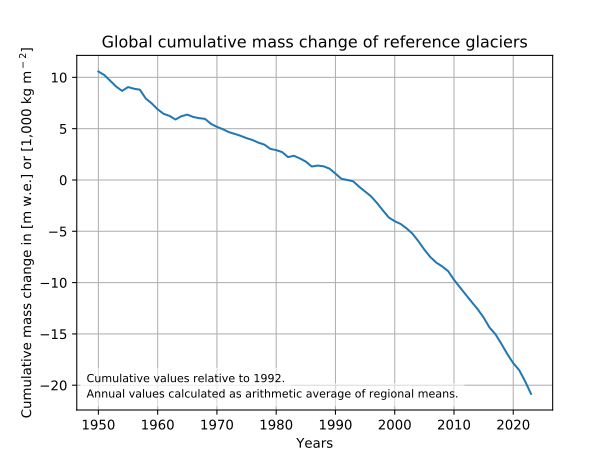
Geoengineering, lets gooooooooooo!
> at the Swiss resort of Interlaken
I hope they all walked up there after taking their sail boats across the ocean.