Show HN: I built an autopilot for the lunar lander game
szhu.github.ioI got pretty good at (and very addicted to) the lunar lander game from a few days ago...
so I decided to make an autopilot for the lander based on what I felt like was the best strategy! Now I can have perfect landings every time without lifting a finger :D
Writing the autopilot code was a lot more fun than I expected! It felt a bit like programming a robot.
Source code: https://github.com/szhu/lunar-lander-autopilot
Original lander HN post: https://news.ycombinator.com/item?id=35032506
That's cool, but it has a very conservative descent profile and would use a ton of fuel. Having played Kerbal I'm used to attempting fuel efficient landings, which means more of a suicide burn approach, but of course this game doesn't keep track of that.
There's something timelessly appealing about lunar lander games. The very first game I ever played on a computer, written in BASIC, was a 'turn based' one dimensional lunar lander game where you input how much thrust you used for each second of the descent, and then it recalculated your altitude, velocity, etc. I learned programming by rewriting it to be a real-time game where you pressed a key to fire the engine.
Which points to a lovely idea - the game becomes writing competitive lander algorithms. Just need a bit of JSFiddle adding...
That'd be very fun indeed!
Maybe not for long, because for a given set of constraints to optimze for, there's probably a solution for which it can be proven to be optimal. At that point there's no more contest.
Obviously next you switch up the game to do things besides lunar landing. Have it be a take off ascent simulator for example. After a few years we can have an entire space mission programmed by gamers...
People have released very sophisticated autopilots for KSP. The game can practically play itself.
Ditto on the timeless appeal.
Watching this auto pilot reminded me of landing Getaceiver on Barsoom in Heinlein’s Number of the Beast, which has a very long passage describing the (fictional) orbital mechanics landing on (a fictional alternate reality version of) Mars.
The first program I ever keyed in was the one dimensional lunar lander simulation on my dad's HP calculator. Must have been 6 or 7 years old (by 9 years old I was doing BASIC on an Apple ][ with floating point card and programming intersections of two pipes to make cutting templates). Even back then I got to the 'suicide burn' approach. Made playing the arcade game pretty easy years later.
I wanted to go for a record of as many flips as possible. So I boosted up to 25,000 feet; started spinning until it was doing about one flip per second; waited a few minutes; then turned on the autopilot to come into a landing.
The autopilot did a perfect job of stopping the rotation and lateral motion, so the lander came down straight as an arrow. Unfortunately, the autopilot didn't even try to decelerate! I crashed into the moon at 0.9 degrees and 770 MPH.
The target velocity is a factor of height, and the autopilot has “160” hardcoded as the ceiling, so going above that means it will never decelerate fast enough.
https://github.com/szhu/lunar-lander-autopilot/blob/master/a...
That's a ceiling for the speed the autopilot is okay with letting the lander descend. There is no ceiling to how much hard it will try to "apply the brakes".
I agree that the target velocity calculation is off though. I was excited that I came up with something reasonably theoretically correct for correcting rotation... and for figuring out when to fire the engines I just gave up and eyeballed it :)
Update: I added a new algorithm, and I think it might be impossible to crash the ship now.
Let me know if you can still reproduce the bug!
Max speed: 148.7 Max height: 3998 Flips: 34
Perfect landing. :)
Yep, it lands safely now!
Lunar lander is a one of the problems in Open AI Gym, where you test AI against standard set of problems: https://www.gymlibrary.dev/environments/box2d/lunar_lander/
Then you have stable baselines which implements popular reinforcement learning algorithms to solve these gym problems: https://stable-baselines3.readthedocs.io/en/master/
Shamless plug: I've built a series of games where you solve puzzles (2048) / toy problems (MDP) like the lunar lander using various AI and ML algorithms.
You can check it out here: https://ai-simulator.com/
Looking at your website I’m curious how exactly you’re building «ChatGPT for mobile games»? Are you using language models to build these AI solvers?
Well to be honest it is just a marketing term I am using to try to get some attention.
In a way what I am building is a "general AI engine" that is capable of taking in an arbitrary game and play it, which is somewhat conceptually similar to how ChatGPT is a general AI that is able to solve a wide range of text-based tasks.
Yes, I would like to see the environment ported to Python, wrapped in gym, and given a good shaped reward, i.e. like reward = prior_height_delta - (height - target_height) - fuel_cost. Run Stable Baselines PPO or DQN on that and it should converge to something close to an optimized MPC controller.
It is already there, just not this particular implementation (or maybe it is?).
You can run PPO or DQN right now on the Open AI Gym implementation using Stable-Baselines3: https://stable-baselines3.readthedocs.io/en/master/
In fact I previously ran it locally and PPO solved the problem within 10 minutes of training with max reward of about 200.
This is a different lunar lander than you are maybe thinking. It looks more like SpaceX's Starship than an Apollo lunar module. I don't think it has been made into a gym env yet but that would be great if it is!
I wish I could play them in the browser instead of with apps.
I didn't make it available on web because it would be hard to monetize it (happy to be corrected if I'm wrong on this).
I'm working as an indie game dev full-time so making money is high on priorities.
Nice auto pilot! Very basic, but works well enough.
In the real world, you would derive physics equations (acceleration -> velocity -> position), add constraints and then solve everything to obtain an optimal trajectory (mostly in term of fuel, but you can add other constraints too, for ex due to radar-ground or Antenna-Earth visibility). I wrote a blog post about Apollo's algorithm: https://blog.nodraak.fr/2020/12/aerospace-sim-2-guidance-law... (Described in the second section ; the first section is about a naive algorithm similar to yours that in the end did not work as well as I wanted).
Also, thanks for the code, I wanted to do the same, but lost motivation when I could not really expose in a satisfying way the internal state out of these JS modules (it's not complicated in the end, but I'm simply not a frontend dev ; and I wanted to avoid forking and monkey patching everything and simply adding some JS code throught the console or something).
While I was playing the game, the idea of traveling in a SpaceX rocket ship didn't seem appealing to me. Now that I have experienced your autopilot feature, I feel MUCH more confident about it.
It’s amazing how a simple algorithm performs so well, the autopilot is able to recover from some pretty extreme situations, and does it gracefully.
Adding some realism to the engine physics (firing delays, minimum firing time, power ramp up, heat limits etc) would likely make it 10x harder.
Especially nondeterminism. Everything you say is still deterministic, so either you're able to land or you're not. With nondeterminism it's more interesting. You have to make tradeoffs between optimizing resources and making success probable.
Thanks for this comment, I hadn't thought to try and sabotage my trajectory prior to engaging autopilot. I thought for sure it was gonna fail, but it managed to set me down gently right at the last moment quite brilliantly.
Nice! I also got hooked on the lander thing, really quick to pick up and good replay value! Your autopilot handles a gentle landing well. If I get the lander going sideways at any appreciable speed, then flip autopilot on, a crash is inevitable :) As a human my solution to that is simply slowing down with lots of thrust, though I still wind up turning the lander into scrap most of the time hah!
It's interesting to think about how the optimal strategy to land the lander would look like.
If the distance to the moon was large, I would expect 4 phases:
1: Turn the lander towards the moon
2: Constant thrust towards the moon
3: Turn the lander away from the moon
4: Constant thrust away from the moon
But if the initial distance is small enough, turning it around might not be worth it or even possible.
So the optimal strategy is probably a somewhat complex function of the initial angle and distance to the moon.
when discussing about optimality, it is worth specifying what are you optimising for.
time optimal landing lends techniques from bang-bang control (e.g. starting with v=0, max thrust towards the target, before flipping around half way and max thrust away from target)
fuel optimal landing (incuding RCS) technique would depend on the available time to turn retrograde (pointy end pointing away from direction of movement). if the duration before the decelerating burn is T1 (so t1 = t0+T1), the smallest possible rcs impulse would be applied so that at t1-T_st the lander is pointing retrograde (retrograde at t1), with T_st being the time needed to cancel the initial rcs impulse. For the deceleration of the lander, fuel optimal landing includes a single burn, constantly retrograde, so that at t_end the lander altitude is 0, and both the vertical and horizontal velocity components are 0.
The time t1 to start that burn depends on the maximum thrust available, the rate of mass change when firing the rocket (not modelled in the game), the initial velocity etc.
in this simple case, model predictive control is not needed, and an LQR (linear quadratic regulator) is sufficient to achieve optimality
source: rocket scientist with control theory background. I remember this example (a bit more realistically modelled) being a project during my studies
In implementing an AI to achieve orbit in a Spacewar-style simulation with gravity, I ended up with a brute-force constraint optimizer that resembles MCP(I've never studied the theory): for each timestep, predict the solutions resulting for each combination of digital thrust inputs(left, right, forward, backwards). Then predict ahead several more steps with additional permutations of input. Then evaluate distance to goal and rank final solution by distance to target orbit and velocity match.
In doing this, it results in a few hundreds to thousands of solutions to test per timestep, which modern CPUs can shrug off easily. Not nearly as elegant as closed-form control theory systems, but easy to tune and give different goals.
replace the brute-force with a linear constraint solver, and you got yourself an MPC !
non-linear constraint solvers are not used because they cannot guarantee a time to solution, hence useless for control applications
almost guaranteed that this problem is already solved by the rocket scientists out there. hopefully someone on HN can point us to the relevant algorithm. this seems like a closed system at least in newtonian physics that should be easily solvable.
chatgpt pointed me to the Gravity Turn altho it refused to give me a formula for it https://en.wikipedia.org/wiki/Gravity_turn#Deorbit_and_entry
This is typically solved using a class of control algorithm called Model Predictive Control which are capable of optimizing for a given cost function (such as using minimal fuel).
Search for "fuel optimal rocket landing algorithm" for good starting points.
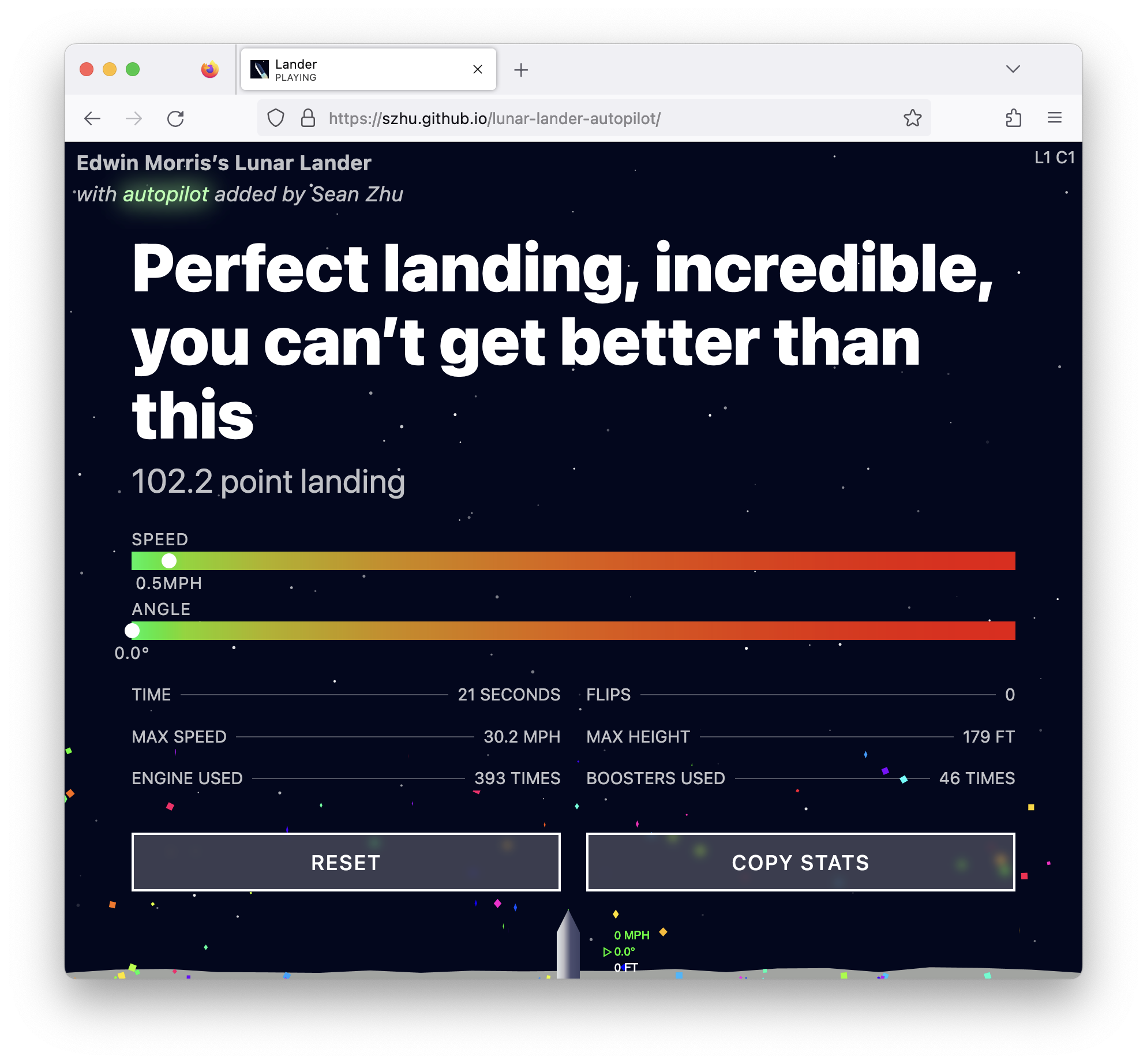
I can confirm that with the improved auto-pilot it is possible to get a 103.6 point landing after performing 1,151 flips (and reaching a max speed of 504 mph and a height of about 38k feet), if you can spare your phone for 38 minutes.
I admire your dedication! Thank you for sacrificing 38 minutes of screen time for a noble cause.
"Oh SNAP! I'm amazing at this!" 101.1 point landing on my second try!
At least, that's what I thought, until I realized I had previously activated the auto-pilot. Best #footgun today (so far!).
So I guess I should say: > Oh SNAP! This auto-pilot is amazing at this!
Thanks!
This is great but I'd like to see an autopilot that can do the hardest crash
Love it! I started playing by disabling autopilot, putting the ship in complicated positions (e.g. spinning uncontrollably) and then turning the autopilot on, it's fun to which conditions it can recover.
Update: I improved the algorithm.
The autopilot now scores a "perfect landing" almost every single time, it lands very noticeably faster, and the code no longer contains a complicated, trial-by-error formula!
I got my first 103+ point landing! (It does this about half the time now)
https://user-images.githubusercontent.com/1570168/224399420-...

A career in KSP is calling for you (Landing on the mun automatically):
https://www.youtube.com/watch?v=TY63i8V1-DA
The most I've used linear algebra since college:
https://github.com/Aperocky/ksp_eng/blob/master/lib/space_li...
This is awesome! The closest I got without the autopilot was 94 or so. The autopilot consistently scores 100+
Woah this is awesome! Someone on Twitter made an autopilot with ML but this seems a lot better.
https://twitter.com/_s_w_a_y_a_m_/status/1633468475611004928...
Really cool! The fact that astronauts handled the landing in the Apollo missions is nerve wracking
Cool, neat code too :) Now do https://race-condition.reaktor.com/! I wanted to pour a few hours into race condition but I got it to complete a lap and never went back.
Best I could score was 102.0 with a combination of manual and autopilot. Neat!
One suggestion: if the lander is within about 10 feet of the ground and is still either swaying back and forth or going really fast laterally, it should thrust upwards to buy more time to correct those things.
oh yeah definitely. Left as an exercise for the reader??
(accepting PRs!)
Actually, I think my new algorithm fixes this -- and without any dedicated "swaying" edge case!
Simple and fun, thanks for sharing! Have you thought of adding a wordle style variation - just a daily puzzle that's a different start orientation + velocity? Just a thought.
Oh that sounds like fun, I would definitely play that. You should suggest it to the developer who made the game!
I'm impressed by the simplicity of the solution, well done.
Thanks! Yeah it's just (1) rotate to follow the trajectory line and (2) slow down once you get close to the bottom.
this is great! The one thing i think to optimize it is to predict how late to start the engine to minimize its usage. The last I got was 730 times used, at 53seconds.
choosing how late you can turn it on and still land is almost a game in itself.
very similar to https://www.gymlibrary.dev/environments/box2d/lunar_lander/
Oh yeah, the author of the game said he made use of a similar tutorial:
http://students.cs.ucl.ac.uk/schoolslab/projects/HT5/
from the readme here: https://github.com/ehmorris/lunar-lander
Would it be possible to put the autopilot in a bookmarklet for the original game?
I really wanted to!
But unfortunately none of the lander's stats are exposed as global variables, so the only way I could make the autopilot was by modifying the existing code. (My commits are actually broken down exactly like this: a commit to expose the necessary variables globally, and another to actually add the autopilot.)
I would also love to be able to play it in the original game though, so I made a PR! I think it would be cool for it to be able to be activated as an easter egg.
I will take a look!
Mobile?
How to you trigger autopilot on mobile?
Click on the red glowing "autopilot" link to turn on on (glowing green)
What about adding a limited fuel supply?
For what it’s worth fuel is in the original arcade game.
“Unlike other arcade games, Lunar Lander does not feature a time limit; instead, the game starts with a set amount of fuel and inserting additional quarters purchases more fuel, allowing indefinite gameplay.“
https://en.m.wikipedia.org/wiki/Lunar_Lander_(1979_video_gam...
And now we've gone full circle
That was my immediate thought.
1.Step: Write code to simulate freefall of an object
2.Step: Write code to negate freefall of an object
uhm... it doesn't seem to work, at least on my workstation (firefox on a debian)
oh no! I'm tried it on Firefox on Mac and it worked fine?
https://user-images.githubusercontent.com/1570168/224370129-...
https://user-images.githubusercontent.com/1570168/224369935-...
Now do it with LQR :D