The Eureka Theory of History Is Wrong
theatlantic.comThere is a Strugatsky brothers short story, in which most of the inhabitants of a planet seem to have suddenly left via some portals, but there are a few who remain, highly armed, violent, and apparently seeking to prevent anyone else from using the portals.
TFA reminds me of this story (which reminded me of the situation sketched by TFA when I had read it, except perhaps for the ratio of leavers to left behinds) but I cannot recall its name?
This story is embedded into their novel "Жук в муравейнике" ("Beetle in the Anthill"), so it does not have a name, never being a separate short story.
I know one familiar-sounding, but different (without violent armed remainers) novel by Clifford Simak: "City".
It’s such a weird collection of ( chronologic ) novels.
One of my favorite book. I read it every 5 years or so.
tfa?
I was also ignorant about this so I googled. It said it means "Thanks for Asking" or "The fucking article". The second meaning sounded correct but I found it weird.
"The fine article" also sounds weird to me.
The featured article.
For usages see https://hn.algolia.com/?query=TFA&sort=byDate&type=comment
Is this acronym really worth it? I always just speak of the article.
HN has a whole series of acronyms for things ranging from "the linked article" to "the nth comment above this" and its super confusing.
I've given up on trying to learn them and just take a stab based on context
Hacker legacy. It comes from "RTFM" (Read The Fucking Manual), said to people on mailing lists who ask questions easily answered by the manual.
The Fine Article (The Eureka Theory of History is Wrong)
The part of the article which explains how the smallpox vaccine was distributed around the world before cold storage and airplanes is just incredible.
  1) Recruit 22 orphaned boys
  2) Inject two of them with the cowpox virus (which is the actual smallpox vaccine)
  3) Put all the boys on a ship leaving Spain for Venezuela
  4) Scrape material from the two boy's pustules (appearing after a couple of days) and inject two more boys with that - the first two boys recover
  5) Continue this daisy-chain approach until reaching Venezuela
  6) Go on with people in Venezuela, arm-to-arm
  7) Continue to Mexico and other places
  8) Go global
What's even funnier is that it's horsepox[0].
At some point it got swapped, maybe a milk maid actually got it off a horse and assumptions were made.
No current smallpox vaccine stock is molecularly likely to come from cowpox as I understand it.
[0] https://genomebiology.biomedcentral.com/articles/10.1186/s13...
Yes, I came across that recently. It may even have been mentioned on HN before - that the original smallpox vaccine is apparently lost.
The article is about how (well akshually) deployment of new ideas has greater impact than the inventions themselves.
Since this is HN, there is a canonical translation of this, something like "Ideas are worth nothing, execution is everything".
Alternatively, combining this with the Great Man Theory of History also being wrong, we should drop the narrative that One Smart Guy will pick up One Great Idea and execute on it and recognize that human history is a story of social networks (no, not those).
The discussion of trust is too binary — people trust institutions or not.
My trust in institutions is limited, but I got vaxxed without hesitation, because it's a specific decision, the kind of decision that has been made many times, where the relevant institutions have a track record and every incentive to get it right.
I sometimes get the impression that people want to sell trust in institutions as an all-or-nothing package. Institution will not discuss when to trust institutions and when not to.
This article is dancing around the issue; making fast progress has been made systemically illegal. Now we have evidence of exactly how damaging the regulatory state is in the the medical world.
1) Turns out those heartless capitalists could be producing vaccines in ~2 years. The tech is there, the regulators aren't ready for the level of risk in the COVID response as a routine thing.
2) Turns out that people aren't going to inject themselves with uncertain technologies, to the point of irrationality. Contrast this to one of the usual response to "we need less medical regulation" which is that people are stupid and will hurt themselves with unproven products. My suspicion is that over the long term this irrational looking swarming behaviour actually turns out to be pretty good at managing risk no matter how crazy the individuals in it are behaving.
The problem in building, construction, technology and mining is pretty consistent. We see the strategies that work in Asia and maybe eventually in Africa - if you let capitalism happen it has powerful enough results at a such speed vs. central planning that it can be rightly called a miracle.
Do you have any evidence to suggest mRNA research was slowed by regulation that was loosened up in the face of COVID? My understanding is 1) it builds on decades of publicly funded research, originating in military programs, and 2) it was being developed nonstop and every prior attempt had serious adverse effects (specifically serious allergic reactions).
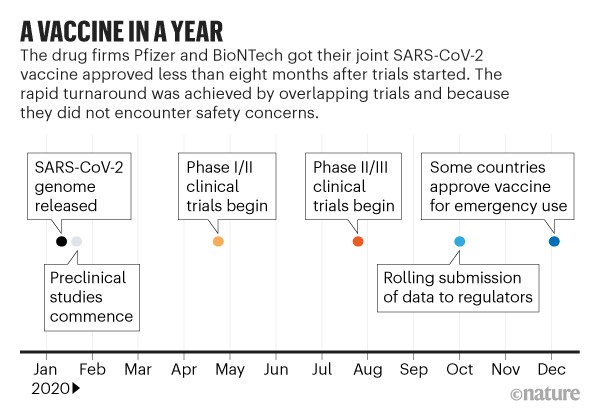
Are we quibbling over definitions? Before Covid it was expected that a new vaccine would take years to develop and go through all regulatory steps.
https://media.nature.com/lw767/magazine-assets/d41586-020-03...
That doesn't have anything to do with mRNA per se, the Uk vaccine AstraZeneca was ready even faster.
It’s not quibbling over definitions but over causes. Vaccine development has always been and will continue to be relatively slow compared to COVID due to lack of commercial incentives.
Insofar as there is any progress made on vaccines in the absence of strong market incentives, it’s due to government funding, not benevolent capitalists choosing to take on decades-long loss-leading blue sky research projects.
The approval happened quickly not because there was some crazy regulatory overhaul but because drug regulation is always a cost-benefit analysis. In this case, the vaccines themselves worked phenomenally well, their risk profile was extremely good, and the costs of doing nothing was extremely high.
It’s not strange for drugs to conclude trials early based on strong early data and strong patient need, just most drugs in most scenarios don’t meet that bar.
Then where are all the other mRNA vaccines? If it is a tech change rather than a regulatory exception there should be a whole bunch of other vaccines coming out by now, they've had long enough.
COVID appeared in March, they had the vaccine in clinical trials by April. The technical aspects aren't a factor here - the time taken to develop a vaccine is basically instant.
Covid vaccines were a repurposing of MERS vaccine research which is also a coronavirus and has a similar spike protein. So, some vaccine companies had a leg up as they were already pursuing MERS vaccines. The problem was that progress was slow because nobody was willing to put large amounts of development money behind a vaccine for a disease with such a small number of cases.
Covid poured accelerant on MERS vaccine research. Suddenly, there was a disease with lots of cases with lots of people willing to sign up for trials. In addition, there was a lot of money sloshing around so companies were willing to take the financial risk to combine Phase II and Phase III trials (to be fair--a Covid vaccine passing a Phase II trial was always going to pass a Phase III trial until we had many different vaccines). And, please do remember, nobody knew if mRNA for Covid was actually going to work.
Other mRNA vaccines are in the pipe. However, they have to go through trials with a lot less funding and a lot less money at the end. Rabies(!) got a Phase I trial--but it's hard to get to Phase II since rabies is so rare. mRNA flu vaccines are in Phase III. mRNA HIV vaccines are in Phase I and may be in Phase II by now.
What you see is that if we drop the equivalent of the Manhattan Project at producing a vaccine, we can pretty much produce a vaccine for a virus in a hurry. However, if we're not willing to drop that kind of cash, progress is slow.
If you want more vaccines, tell some of these multi-jillionaires to quit fucking around with virtual crap like Bitcoin and Twitter and start dropping some non-virtual gigabucks on vaccine companies that are trying to produce real products.
The COVID vaccines were rolled out on the basis that they were more-or-less safe and probably efficacious. A lot of them turned out not to be as safe as anticipated - eg, the blood clotting issue in the Astra-Zeneca virus or the myocarditis issues in the Moderna vaccine that have gotten its use limited in Scandinavian countries [0]. It turns out that the evidence that was collected at speed wasn't actually enough to justify the actions taken.
That was a good standard and an appropriate thing to do. But that standard is lower than what the medical regulators usually accept. As you point out, Phase 3 trials are good to do but it is going to make it a lot harder to get a vaccine to market if people have to take them seriously. Vaccine makers should be allowed to sell vaccines that are merely safe and effective; they shouldn't have to pass a higher standard than that to sell the things with a disclaimer label.
As an aside I'd also question the efficacy results as the vaccines are probably a lot less effective now. It appears the virus has mutated quite substantially. But that hasn't changed the vaccine approval status, raising interesting questions around why efficacy is even a requirement to sell the thing. Why not just a safety study with the requirement that efficacy data will be collected and made available? We need to figure out if something is efficacious, but there will be more money to do that - and better data - if it is allowed to go to market. As we can see from COVID, jabs in arms and money are the two things missing to make vaccine development fast. The normal regulatory framework makes both those things hard to get.
> If you want more vaccines, tell some of these multi-jillionaires to quit fucking around with virtual crap like Bitcoin and Twitter
Didn't most of the wealthy people in Bitcoin make their money in Bitcoin? There weren't a lot of ultra-wealthy people putting serious money behind it as I recall.
[0] https://www.reuters.com/world/europe/finland-pauses-use-mode...
You're completely ignoring just how big of a threat Covid was, which is a part of the risk-to-benefit ratio of a Phase III trial. The same vaccines, with the same P3 results, may well have not been approved for, say, a mild cold virus, but would have also been approved for Alzheimer's.
The reality of drug approvals is that they always take into account proven benefits and risks (including some room for yet-unknown risks) compared to the available alternatives (including other vaccines, other medication, or even not treating the disease at all).
This calculation was not necessarily changed for Covid in some special way. The bug difference with Covid was that governments pumped billions into getting the research done, as did the companies themselves knowning that they will likely be able to literally sell tens of billions of doses of this vaccine if they make it work even a little bit.
Fair enough. This may be where there is nothing more to say. But just in case - why is it necessary to centralise the decision for making risk-to-benefit ratio assessments? Everyone has different risk profiles and may have reasonable disagreements about how dangerous the risks are vs the benefits. We've learned that several widely used vaccines were more damaging than the health authorities realised, but nearly nobody has a problem with them having been rolled out to the masses. This suggests the standards of the health authorities are unreasonably high. When they lowered their standards for COVID there was barely any extra damage done, we're measuring the incidents in single digit cases per million.
A lot of people - dare I say most - have a higher tolerance for risk than the health authorities do. Why is it necessary to hold back progress because of nervous bureaucrats? We could make faster progress by letting people willing to take risks take risks.
The decision is not as centralized as you make it out - various governments and other super-national bodies can and have taken different decisions, based on various assessments and, at least to some extent, the will of their populace (though I'll be the first to point out that representative democracy and technocracy make the effect very indirect).
The argument for not making this decision fully decentralized is that assessing the risk-to-benefit ratio requires a significant level of expertise, both in the subject matter itself (were the studies conducted well? what possible blind spots may they have methodologically? what plausible effects could these blind spots have on public health?), and in the more political/social side (are the doctors running these studies trustworthy? are the results being accurately reported between observation and collation? will this medicine be over-sold to patients in disregard of the studied benefits/risks? what is the cost/benefit estimate for using this in public hospitals?).
Now, it would be possible in principle for the state to provide the current centralized verification services, but then only give consultation-level opinions to the populace, doctors (and/or the public health system). But given the strength of PR and direct-to-consumer marketing, this seems to be extremely risky in terms of people ending up swindled to spend huge amounts for terrible medication sold by unscrupulous corporations (a free-for-all version of the opioid crisis).
> A lot of people - dare I say most - have a higher tolerance for risk than the health authorities do.
You don't get to claim this and also simultaneously make claims about low prevalence myocarditis from Covid vaccines. Sorry, I'm not letting you get away with that rhetoric.
People like to think they have higher risk tolerance--until their bet comes up snake eyes. At that moment, you find out what their risk tolerance really was.
Lots of anti-vaxxers thought that they had high risk tolerance about Covid and vaccines--until they came down with Covid and landed in the hospital. Suddenly, their risk tolerance went out the window and they all wanted lots of heathcare treatment and suddenly were asking for the vaccine (without the understanding that the vaccine was now useless).
> You don't get to claim this and also simultaneously make claims about low prevalence myocarditis from Covid vaccines. Sorry, I'm not letting you get away with that rhetoric.
I took a dose of the AZ vaccine after the blood clotting issue was on the radar. Turns out my risk tolerance for vaccines was relatively high.
> People like to think they have higher risk tolerance--until their bet comes up snake eyes. At that moment, you find out what their risk tolerance really was.
You find out what their response is to being unlucky. If I lost all my money in an investment I'd be fuming and ranting for a few days but that doesn't tell us anything about my risk tolerance.
> Suddenly, their risk tolerance went out the window and they all wanted lots of heathcare treatment
Did you expect them to be hospitalised and refuse medical treatment? Again, you're finding out someone's response to being unlucky, not getting a read on their risk tolerance. I agree that most people are bad at judging personal risk; but people should have a right to make their own mistakes.
I just want to confirm here that you are asserting that COVID-19 appeared in March 2020? Obviously this is not the case or it would be called COVID-20.
Nobody was developing vaccines for it in 2019. I forget when it was sequenced, I suppose that probably happened a little earlier. But it doesn't take much guesstimation to say that vaccine development wouldn't have started in earnest until a little way through 2020.
"ready for the level of risk in the COVID response as a routine thing"
Are patients ready for that level of risk? Are children ready for that level of risk? Outside of emergencies, does anything justify that level of risk?
"We see the strategies that work in Asia and maybe eventually in Africa - if you let capitalism happen it has powerful enough results"
So Asia is capitalist? But other countries are not capitalist? This sentence seems to imply that America is not capitalist but Asia is capitalist. I've seen this kind of writing before. Without a rigorous definition of "capitalism" then this kind of thing quickly becomes "capitalism is all the stuff that I agree with and socialism is all the stuff that I disagree with."
"if you let capitalism happen it has powerful enough results at a such speed vs. central planning that it can be rightly called a miracle"
This suggests that capitalism is the opposite of central planning, but we could clearly design a highly decentralized version of Communism:
https://demodexio.substack.com/p/how-to-build-a-pragmatic-co...
> WHY THE AGE OF AMERICAN PROGRESS ENDED
Actual title? Are they testing out titles.
Things of the genre “everything is going to shit and here’s what to blame” are not worth reading. Exposing “The decline” of whatever the target audience cares about sure is good for attention but it’s just a toxic emotional manipulation and not useful to actually enlighten anyone.
It comes down to things always changing and having a bad attitude about the present and an unreasonable positive attitude about the past is very prevalent.