North Korean ICBM launch detected using GPS
twitter.comRelated: last month's [0] gamma-ray burst also had interesting, measurable effects on the ionosphere,
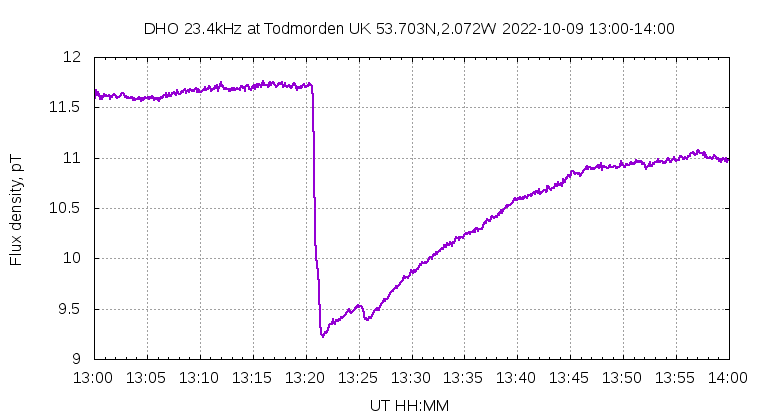
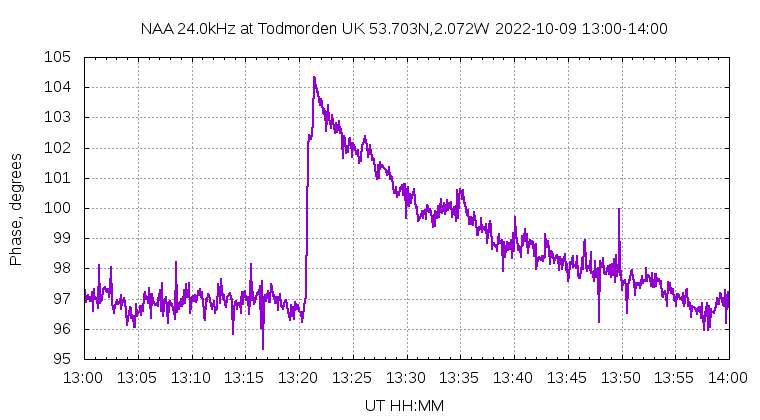
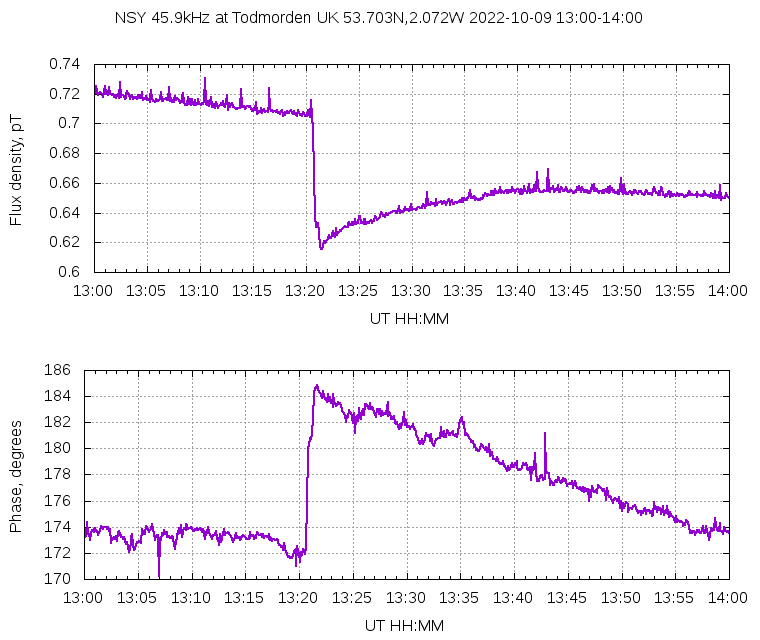
https://gcn.gsfc.nasa.gov/gcn3/32744.gcn3 ("GRB221009A: Detection as sudden ionospheric disturbances (SID)")
https://www.qsl.net/df3lp/grb221009/KLM_grb221009a_magnitude... (from the above link)

http://abelian.org/vlf/grb221009a-DHO.png
http://abelian.org/vlf/grb221009a-NAA.png
http://abelian.org/vlf/grb221009a-NSY.png
[0] https://news.ycombinator.com/item?id=33215572 ("Record-breaking gamma-ray burst possibly most powerful explosion ever recorded")
This was detected with VLF radio, but I wonder if this kind of event also has an effect on GPS signals? The time-of-arrival of astrophysical gamma rays isn't uniform across the earth.
What I wonder about is all of the technologies that go into ICBM's with nuclear weapons. My layman's guess is that there is active support and collaboration of the NK nuclear program from outside. North Korea is a headache for the US and other western powers, one more thing to consume policy bandwidth and military preparedness. This would seem to be in the interests of China and Russia, and perhaps others. I don't worry too much about the threats that periodically emanate from North Korean; if they start to exceed their utility from the perspective of China and Russia, the needed resources to maintain a viable nuclear program can be quickly shut off. I do hope that I will live to see a "1989" moment in which the North Korean regime is overthrown, and relegated to a horrible and sad footnote in human history.
While Russia and China don’t want to see North Korea collapse as existing nuclear powers they don’t especially want to see other countries acquire nuclear weapons.
Active support and collaboration came from Pakistan, Iran and Libya who were all trying to develop nuclear weapons of their own.
https://rusi.org/explore-our-research/publications/commentar...
Google "aq khan pakistan north korea"
https://www.google.com/search?client=firefox-b-d&q=aq+khan+p...
https://en.wikipedia.org/wiki/Abdul_Qadeer_Khan
Yes there was a great deal of outside help with their enrichment and weapons design.
Both nuclear weapons and ballistic missiles are technologies from the 1940's.
They don't need outside help.
Well, these are multiple times more powerful. Not exactly last century's tech. There are other factors too, like the sanctions these countries are under. One might say that some friendships were harnessed over common enemies, but I digress.
Remember that it took about 10 years for North Korea to go from it's first nuclear weapons test (which fizzled) to something that's probably a deliverable nuclear weapon, and they had spent decades before that to get to the first test. Nuclear weapons require great precision but they're not especially complicated devices. Any nation state, even the very poorest, should have no difficulty designing a nuclear weapon. It's the refinement of the design and the acquisition of the materials that is difficult, and even then the challenge is more in doing it clandestinely. Even then, the cost of the manhattan project, which not only developed two different nuclear weapons in 4 years, but also discovered a lot of the basic underlying physics from scratch, all in secret and with 1940s era equipment cost about $23 Billion adjusted for inflation. Similarly, the development contract for first American ICBM cost about $4 Billion in todays dollars. North Korea benefits from decades of scientific and technological advancement since that time, and it doesn't cost much to employ someone when you can throw their family into a camp, but even if we assume that it nevertheless would cost them as much to develop such technologies, over the course of 30 years that still represents a reasonably small fraction of North Korea's GDP. North Korea's long history of failures are pretty clear evidence that they were not given the design and manufacturing capability necessary to produce working nuclear weapons or missile systems. While no doubt there has been communication with other state actors over the decades, the idea that they are receiving active support is not at all supported by evidence, and indeed the embarrassingly long development time implies that either there is a great deal of incompetence in the development effort, active sabotage, or likely both.
I thought the soviets built it in a cave with a bunch of scraps.
Here is the code which generated the linked video: https://github.com/tylerni7/missile-tid
Is it possible someone could explain as if to a small child what data can be collected from GPS which shows this effect. I don't understand.
GPS signals go through the ionosphere on their way from the satelites. The ionosphere causes distortions in the signal. If you want to achieve the best navigational accuracy you need to account for these distortions.
These distortions are not constant. They change from time to time. There are many different ways to account for them. One of the most accurate solution is to keep a GPS receiver on a well known location. Since you know that this receiver haven’t moved you can use the signal measured to estimate the parameters of the ionosphere between that station and the satelite.
Normally these signals are used to correct GPS navigational solutions. You take the closest station to your moving receiver and assume that whatever way the ionosphere was distorting for that station will do the same for your receiver too. This is valuable so there are network of such GPS stations in a lot of places.
Here they use the data collected by these stations differently. Instead of correcting a navigational solution they visualise the measured state of the ionosphere as seen by a bunch of these stations.
Good explanation.
A simple GPS receiver will have a generic mathematical model for the ionosphere and use that as a good guess. More advanced ones can measure the delay directly.
The ionosphere affects different frequencies differently, so the GPS satellites transmits additional signals at different frequencies. By measuring the phase of these signals (L1 and L2), the math can be done to get a better estimation of the delay caused by the ionosphere between each satellite and the receiver. Those are the dots we're seeing on this animation. (GPS also uses the L2 signal to transmit encrypted information that lets military receivers get a better fix than civilian receivers).
more info: https://www.e-education.psu.edu/geog862/node/1715
> One of the most accurate solution is to keep a GPS receiver on a well known location.
I wonder if a network of connected devices with a GPS-disciplined SDR receiver and a regular GPS one could work both as this project does plus as passive radar like the software that was recently taken down. The purpose would be to have much wider coverage along with redundancy and error correction.
Such networks exist and make their data public. I think the equivalent you’re looking for is like LightningMaps, where there is real time reporting of observations instead of having to process recorded data to look back in time?
https://geodesy.noaa.gov/CORS_Map/
https://www.e-education.psu.edu/geog862/node/1830
https://learn.sparkfun.com/tutorials/how-to-build-a-diy-gnss...
I worked on something like this in university. GPS bistatic radar. Two SDR frontends with directional antennas pointed in different directions to do various remote sensing, ranging, and other things.
The GPS network is essentially kept up to date with a few ground stations. The ground station is a source of truth that is used to send correction updates to the constellation periodically which are sent to all receivers.
But what are the moving dots in the animation? Planes, satellites? (seems to move like neither).
GPS being a military technology, I presume those fixed gps stations are only located in US-friendly countries. You wouldn't get that adjustment if you are flying over Russia or China, or any ocean. How much of an error in absolute distance are we talking about here? A few cm or meters or a km?
> But what are the moving dots in the animation? Planes, satellites?
Neither. The stations are in Japan. Imagine a line going from each of those stations to the satellite. Where this line crosses the ionoshpere that spot is what is measured. That is what you have information about. Those spots are the dots.
So you basically see the arc of the Japanese islands projected up towards each satelite which is visible from these stations. When the satelite is low on the horizon this projection seems to move fast, and when it is near the zenit it seems to move slow. This is what you are seeing with the dots.
Their location is calculated here: https://github.com/tylerni7/missile-tid/blob/main/tid/tec.py...
"Given a receiver and a satellite, where does the line between them intersect with the ionosphere?"
And then that is called here: https://github.com/tylerni7/missile-tid/blob/00c5fd25e2ab3c2...
"The locations where the signals associated with this connection penetrate the ionosphere."|
What are the stations/receivers? Is this crowdsourced data?
They have a GPS receiver in a fixed, known location. They measure the received signal and from the variations infer corrections for ionospheric effects. They are part of the GPS network.
The video is data from just a single receiver?
No. These are the receivers from japan’s GEONET.[1]
“Geospatial Information Authority of Japan (GSI) operates GNSS CORSs that cover Japanese archipelago with over 1,300 stations at an average interval of about 20km for crustal deformation monitoring and GNSS surveys in Japan.” [2]
Basically the government of Japan pepered their country with GPS base stations and they let researchers use the data from them. This is just a novel use of that data.
1: https://mobile.twitter.com/tylerni7/status/15934664867144212...
This explanation helps understand the video.
But what are the moving dots in the animation?
I would guess the moving dots are fixed GPS receivers, or more precisely the intersections of lines between fixed GPS receivers and moving GPS satellites with a sphere around Earth representing the ionosphere. If you look at the shape of the moving clusters, some look like Japan.
Section 2.1 in their linked paper (https://agupubs.onlinelibrary.wiley.com/doi/full/10.1029/201...) gives some clues. I think this is what's going on:
GPS receivers work by figuring out how far away they are from a number (>3) of GPS satellites. The receiver knows where the GPS satellites are (since the satellites broadcast their orbit parameters) so if a receiver knows how far it is from several satellites it can work out where it is itself.
Now, as the GPS satellite signals travel through Earth's atmosphere, they can be slowed down by different atmospheric effects. A slower signal will cause the receiver to think it's farther away from a satellite than it really is, so the receiver might estimate that it's position has changed a little bit. However, if you know the receiver's position hasn't change (maybe it's fixed in place to a big rock), then you can attribute the receiver's measured "change in position" to a change in atmosphere characteristics.
In this paper, they seem to have lots of fixed GPS receivers all over the place. By looking at all of them together, they can make a sort of map of the atmosphere characters in a part of the sky that's affected by rocket launches. The authors see these big ripples emanating from a Falcon Heavy launch in the US and this tweet shows those same ripples emanating from a launch site in North Korea.
You can go one better and filter your position data and store the data from the "worst fit" satellite. Which will usually be on the horizon or behind a thunderstorm, but not always, maybe it'll be behind a ICBM...
For made up simplified example, assume you have a moving GPS in an airplane or something, and there's exactly four sats N S W E. All four sats relatively agree you're flying the plane normally in a straight ish line as usual. Suddenly, the data from the S sat gets wildly distorted, but the other three sats remain normal. I suppose the S sat could have malfunctioned but more likely something is in between your plane and the S sat. So your navigation chip tosses the data from the S sat and marks its SNR way down and generally ignores that sat... However, if you were to log that "bad" data from the sat to the south... then compare to someone flying a plane a hundred miles to your south, and their GPS reports data suddenly was trash to their north, then you know something flew between your two planes. Maybe an ICBM, maybe a thunderstorm, maybe a GPS jammer weapon, a lot of "it depends". Sometimes its the data thats tossed out thats the most interesting.
I've been fooling around with something a LOT cruder at home WRT tracking thunderstorms. Its not rocket surgery to know that severe rain attenuation can impair GPS signals. One of the standard NMEA output lines contains each sats SNR, so if I know from my "vast" database that in normal weather satellite #43 at az 45 degrees elevation 45 degrees reports a SNR of made up number -10 plus or minus 2 over the past few years, then if it reports -20 today that would imply either the sat just burned out (unlikely) or there's a rain cloud causing "about 10 dB attenuation" at az 45 degrees elevation 45 degrees relative to my house. The linked project in the article is enormously fancier of course than merely logging SNR fluctuations.
I'm amused at the idea of crowdsourcing a "large amount" of forest hiking data over time to evaluate the health of the tree canopy in forests. Where I live the leaves are all down now so GPS signals should be very strong for hikers in forests.
As the Air Force discovered decades ago, for various EE and trigonometry reasons, bistatic radar works best overhead its kind of the opposite of what you want for an early warning radar so you can see why bistatic radar never went much of anywhere compared to traditional radar for the usual Air Force mission purposes. Although there are interesting modern "IoT" distributed sensor applications, at least if you have unimpeded fast communications systems, etc.
Fun house mirrors are curved and distort your reflection.
Some fun house mirrors are flexible so they can get pushed or pulled which will make you look taller or shorter or fatter or skinnier than you know you are.
By observing the difference between how you appear compared with how you are; you can learn something about how the flexible mirror is being curved.
How this works in the fun house is there is you the mirror and LIGHT.
Both you and the light are well known and easy to predict; light will travel straight(ish) and you will not suddenly become very very short, so the thing that is changing your appearance is the flexible mirror.
In the GPS rocket case, the GPS satellites are the illuminating source corresponding to the light in the room sending out radio (electromagnetic radiation same as light just at longer wavelengths)
The ground station GPS receivers correspond to your eyes (they know what they *should* see).
The earth's ionosphere corresponds to the flexible fun house mirror.
taken together, the same way you could tell if something we can't see behind the mirror flexed it, the author of the post showed they can tell if, when and where an unannounced rocket goes through the ionosphere.
I don't think I could explain it to a small child, given that I don't have a great understanding of it myself. But here's what I could scrape together based on a linked paper[1]:
You use GPS receivers to detect ionospheric disturbances. Ionosphere, coming from the word "ionized", means it consists of charged particles, positive or negative. (Missile) exhaust is mainly neutral molecules, creating a "hole". These ionospheric holes can be detected through the Faraday Effect[2]. By measuring the Faraday rotation of radio signals (like GPS), you can detect these holes. I think this is similar to how polarized light 3d cinema systems work, except it's the radio spectrum instead of light.
[1] https://agupubs.onlinelibrary.wiley.com/doi/full/10.1029/201...
As you walk past a school you yell with your voice, your friend nearby knows what you sound like but he hears you differently because your voice also bounces off the school wall. He adjusts the sound based on what you should sound like, the leftover bit is the shape of the wall.
You can figure out if someone moved a brick (or launched a missile) because your voice changes when it reaches your friend and he needs to apply a new change to get your voice back.
We can see the signal changes the rocket causes to the ionosphere and know that it's happened.
That's one of most impressive examples of essentially "passive radar" I"ve seen!
Isn't the ionosphere already past the burn-out phase of a ballistic missile? I.e. by the time the rocket gets there it is just a glorified harpoon. Or perhaps that doesn't matter as anything of this size travelling at this speed would cause detectable disturbance?
Fun fact: the arecibo radio telescope was funded to study ionosphere disturbances so the US military could explore the possibility of detecting ICBMs passing through the ionosphere. To my knowledge no such system was actually built but apparently it wasn't as ridiculous a proposal as I thought.
I'd like to see the amount of false positives/negatives, rather than just data of one day.
They don’t really seem to have a detector. They have a thing which makes visualisations, and it seems it should be possible to build a detector on top of that, but that doesn’t seem to be done yet.
Oh hey I wrote this!
Yeah, we had a detector with some ML stuff, it worked okay, but the main issue is there isn't much training data.
Overall the false positives are quite low (visually, which is hand wavey, of course). I've not really seen a big event that was not real. I ran it for a while 24/7 and while there are "scintillations" there aren't any circular waves. False negatives are a much bigger issue. Something like an IRBM or SRBM doesn't really show up, and those are much more common.
Fwiw, this uses a bandpass filter to look for the ripples, which filters out a ton of noise. Looking at ionospheric depletion would be good and probably more sensitive, but it requires accurate models of what the ionosphere ought to do. I've tried a few things there with mixed results.
> Oh hey I wrote this!
I’m amazed by your project. Thank you for sharing it with us.
Thanks! It's mostly just been for fun, lots of academic work has already shown the principles of it.
I'm glad folks are looking at it, and enjoying it! If you have questions or anything let me know! :)
You mentioned on twitter[1] that there are realtime data sources which could be used to do the same kind of visualisation/detection.
What would these sources be?
1: https://twitter.com/tylerni7/status/1593466486714421249?s=20...
The main protocol is called NTRIP. Lots of sources make it available (though it might be annoying to stream from ~250 simultaneously, not sure). There's a lot if you search that term though.
I think GEONET (the Japanese data source) might have some NTRIP casters. Also some in Korea and elsewhere. Sometimes you have to pay for access though, so I need to look more.
Thank you very much!
After-effects of WW2 still posing existential threat to us all..
>Missiles make ionospheric disturbances that GPS records. The yellow ripple is the ionospheric disturbance.
Where can I read more about the meta level concept of "isopheric disturbances"? (Because I suspect I'll find this has been done by military intelligence for a long time then rediscovered by so called "arms control" wonks who insist on putting their code into the public domain.)
The second tweet in the linked thread links to the paper which inspired them:
https://agupubs.onlinelibrary.wiley.com/doi/full/10.1029/201...
> who insist on putting their code into the public domain
You say that as if there is something wrong with that.
" /s", spotted on my end.
>You say that as if there is something wrong with that.
So to be clear, you an arms control expert public domaining code that aids totalitarians like Putin and the North Koreans has... "nothing wrong with that"?
Some domain specific knowledge was meant to be esoteric* and there are a variety of better licenses such as CC-non-commercial that allow peaceful uses of the code without allowing it to be used by literally anyone on the planet.
(*Unless you pay the proper fees, of course. But that's not just about money... you have to earn the right to make the purchase.)
I do not feel bad about indirectly aiding them with well-after-the-fact missile trail detection. Why should I? Why should this be difficult to do?
It can be called "military" but it doesn't help with offenses and doesn't really help with defenses either.
>well-after-the-fact missile trail detection.
Sorry, I missed that bit, I thought this could also be used to detect incoming missiles.
I do not want my enemies to be able to detect incoming missiles.
Sorry for posting so angrily.
To do anything about incoming missiles, you'd need extremely low latency tracking, integrated into whatever system you're using anyway. Not sure exactly you'd be worried about even if this was near-real-time.
You could probably use techniques like this to rig an early warning system on enemy territory, but there are of course better options.
Wild! I don't think I've ever seen someone who thinks restricting tech like this is actually a good idea. I thought that was just like, crazy government people who don't understand technology.
I'd hoped we'd moved past printing the entire code of PGP in a hardback book in an OCR font but I guess y'all still out here.
I literally had a bronze bust of JFK on my desk on k street.
I’m not a government type unless I’m calling people my long haired opponent ala Hunter S Thompson running for mayor
> and there are a variety of better licenses such as CC-non-commercial that allow peaceful uses of the code without allowing it to be used by literally anyone on the planet.
I don't have a fully formed opinion on the rest of your comment, however I can definitely point out that software licensing on open source software will not stop a nefarious third party from using it. They're nefarious!
To a practical point though, information asymmetry is powerful in war, but the cat was already out of the bag for this technology as it's in public papers. The code is just an application of information that was already public, they could probably write their own version of the same code based on the papers.
> code that aids totalitarians like Putin and the North Koreans has
This is false. Putin is not afraid of shining a very bright radar into the sky to know when missiles are about to hit them. That is the standard and reliable way to go about this.
Have you heard about the “woodpecker” signal? It was the transmission of a giant over-the-horizon early warning radar system. It is now defunct, has been replaced by more modern systems, but when it was operational you could receive it basically anywhere on Earth. That is the scale sovereigns play on.
Only people who don’t have the backing of a sovereign state need to go about detecting launches in this circumspect method.
> Some domain specific knowledge was meant to be esoteric
Yes. But this is not that.
> there are a variety of better licenses such as CC-non-commercial that allow peaceful uses of the code without allowing it to be used by literally anyone on the planet
Are you kidding me? :) In the top of your comment you worry, wrongly, about Kim and Putin using the given code. And your suggested solution is to release it under a different licence? :) You think they would care about that?
If you follow the thread, there’s a link to https://agupubs.onlinelibrary.wiley.com/doi/full/10.1029/201... which contains this introduction:
======== It is widely recognized that rocket launches can be an anthropogenic source to trigger traveling ionospheric disturbances (TIDs) by generating acoustic-gravity waves (Afraimovich et al., 2002; Arendt, 1971; Bowling et al., 2013; Calais & Minster, 1996; Chou et al., 2018; Ding et al., 2014; Kakinami et al., 2013; Li et al., 1994; Lin et al., 2014; Lin, Chen, et al., 2017; Lin, Shen, et al., 2017; Noble, 1990). The rocket-induced long-distance propagating TIDs associated with shock/ducted gravity waves and internal gravity waves were observed by using Arecibo incoherent scatter radar (Noble, 1990) and ground-based Global Positioning System total electron content (TEC) observations (Calais & Minster, 1996). Lin, Shen, et al. (2017) first reported the rocket-induced shock waves and concentric TIDs (CTIDs) subsequently using Global Positioning System TEC over California-Pacific region. They suggested that the CTIDs are the manifestation of concentric gravity waves that were originated from the mesopause region. ====
The effect seems to be proven quite a while ago. Using GPS receivers to make that widely accessible seems to be new, but I honestly doubt that military intelligence would rely on that - I’m confident they have more direct methods to detect launches such as (radar) satellites.
What does "gravity waves" mean in this context?
Probably this? https://en.wikipedia.org/wiki/Gravity_wave
Not to be confused with https://en.wikipedia.org/wiki/Gravitational_wave
Ham radio is actually where you’ll find a lot on the subject. “Band conditions” are determined by the amount of ionospheric disturbance present. For example, meteors entering the atmosphere produce a disturbance that can reflect radio—there are ham radio techniques that exploit this to communicate.