So long and thanks for all the bits
ncsc.gov.ukWorth the read just for the horrible B-17 bit used as opener. Good hook.
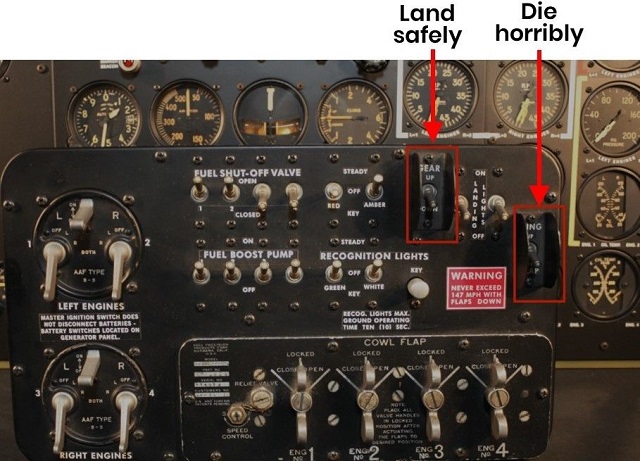
Yeah I'm mentally filing that image [1] away for later use.
[1]: https://www.ncsc.gov.uk/static-assets/images/blog-post/instr...
It reminds me of the accidental Hawaii nuclear missile alert a few years back. AIUI, the button to test the system was in close proximity to the button to send the real thing.
Or much lower stakes but the terrible UI that caused Citibank to accidentally give away $500M[1] (though they got it back on appeal [2]). I am always amazed to see the awful, awful software people put up with to do their jobs.
[1] https://arstechnica.com/tech-policy/2021/02/citibank-just-go...
[2] https://www.reuters.com/markets/us/citigroup-wins-appeal-ove...
that's the most obtuse UI for a money transfer (especially one so large) that I've ever seen.
And THREE PEOPLE all signed off on it!
There were some choices gif/memes to come out of that, though like the top one here:
https://www.popularmechanics.com/technology/infrastructure/a...
omg, that gif is triggering me.
I CANNOT STAND UI's that are interactable before they have completed their layout rendering! Or things like notifications that suddenly push everything down, right when you were about to tap on one of those elements! Why is this still a thing? Any UI element that shifts or appears should have like a user-adjustable half-second delay before it becomes interactable again
Former frontend performance guy here – "Cumulative Layout Shift" is the measure of this jank, and yes, it is the absolute worst.
Conversely, it's hard to overstate how magical sites become when you get that down to 0. Once stuff stops shifting, users are effectively fooled into believing that sites are finished loading. Sites just feel fast, even if things are still happening. It's sadly hard to get there, and very easily worsens.
Yeah I love when I click a thing then a different think appears under it 0.5ms before click registers.
> Why is this still a thing?
HTML/CSS/JS stack makes that the default and coding your way out of that is hard
> Yeah I love when I click a thing then a different think appears under it 0.5ms before click registers.
Its just the worst
Hilariously, I was trying to enable the minimal JS needed to view that page, and UMatrix DID THE EXACT SAME THING, it shifted down a site I wanted to block under my mouse button. :)
For all you dystopian fiction writers:
the end of all humanity, caused by lazy loading JavaScript.
It shouldn't take more than a weekend, and the "Terrifyingly realistic!" reviews will write themselves.
I suspect the real reason it's still a thing is that it makes users more likely to click on ads, which is after all how most of the internet makes its money.
"The best minds of my generation are thinking about how to make people click ads." -- Jeff Hammerbacher
“That’s one heck of a nurse” after hitting the Nuke button which was right next to the “Nurse” button.
Can you guess which music video that’s from?
Land of Confusion
I really like that music video.
+1. The B-17 design flaw analogy is one of the best I’ve seen. The title is great as well, very catchy.
Personally I was more impressed by the director being a dolphin, altho they coud've found better photo of him, he looks a bit fat.
But to be fair It's not that bad when you realize using flaps and gear is time correlated - you slow down, enable flaps, get near the airport, then put the gear down.
There is no "I want to put the gear down in situation when enabling flaps would fuck stuff up too much"
> There is no "I want to put the gear down in situation when enabling flaps would fuck stuff up too much"
Unless, maybe, you just limped your plane in because it’s missing a big chunk of a wing.
One thing the military does is try to make it hard to make a simple mistake and kill a bunch of your own troops.
During the last Iraq invasion I was running around with a fuel tanker which had a pony motor to offload the fuel. It was pretty complicated with a bunch of levers and valves you had to set to get the fuel flowing the right way (and not on the ground) but had a data plate to tell you what to do, easy peasy. One day we were at a bag farm dumping fuel and this staff sergeant wandered up and says I’m doing it wrong. “Data plate” I say and point at the data plate but she started to get all huffy so, whatever, do what she says which was all fine and good until the tanker starts filling up because it is set up backwards. She made some lame excuse for not following the law of the one true god, the data plate, and wandered off to bother someone else.
I mean, the changes are clear improvement, the whole panel is basically "random stuff barely related to eachother" but I feel author is overstating how bad it actually is
I've never seen that example and reading it, I was surely mouth-agape dumbfounded that anyone thought that would be OK to design like that
To my ignorance, didn't know this gentleman before. Nice article, pure substance. Would love to learn more about him.
He also could have used Chernobyl as an example.
Chernobyl was very different, due to the negligence factor. "Hold my vodka and watch THIS" is no way to run a nuclear power plant.
I guess they're arguing that the "fail deadly" design was a design flaw, even if it should never have been encountered in actual operation.
Indeed. See "Why INSAG has still got it wrong" by Anatoly Dyatlov himself. The money quote:
> How and why should the operators have compensated for design errors they did not know about?
Dyatlov is clearly biased here, but he raises excellent questions.
> thanks for all the bits
Am I missing something here? What's the headline supposed to mean? Is it a tongue-in-cheek gesture, since GCHQ routinely hoover up personal data and spy on both their citizenry and foreign countries?
I think it's a reference to "Hitchhiker's Guide to the Galaxy". Knowing Earth was going to be destroyed the dolphins leave, but they leave behind a message which when decoded translates to "so long and thanks for all the fish" (referring to how dolphins had trained humans to give them a fish when they did tricks).
> Knowing Earth was going to be destroyed the dolphins leave, but they leave behind a message
He thinks that the UK is going to implode?
Probably correct even if it is mostly harmless.
> He thinks that the UK is going to implode?
Arguably, it's in the middle of doing so right now...
It's a paraphrase or restatement of the phrase "so long and thanks for all the fish", the title of one of the books in Douglas Adams' Hitchhiker's Guide to the Galaxy series. Changing "fish" to "bits" is interesting, as it could be "just" a reference to life in the modern age and that this individual is leaving a techie oriented job that deals with "bits and bytes". Or it could be a really on the nose "joke" making light of exactly what you say:
"GCHQ routinely hoover up personal data and spy on both their citizenry and foreign countries?"
It's hard to say which it really is.
doesn't bits refer to genitals?
In British vernacular about a quarter of all common words can be used to refer to genitals and/or intimate acts, especially when said out loud with the right intonation.
One time in London I lost my rag with a local colleague and snarled at him "is there nothing you can't make innuendo from?!?" And without missing a beat he simply leered back "in-YOUR-end-o"
It may be more widespread in Britain, but I assure you it's equally possible anywhere. :)
On "Penn & Teller: Bullshit", there was an episode where one of the people they interviewed was a woman who's initially seen carrying a large stack of envelopes, and Penn on voiceover said something like, "We told the previous guy that we wanted to see a woman with really ... big ... envelopes. He's foreign; he didn't understand that, in America, every plural noun means tits." So there may be some regional variation.
In addition to everyone who's given legitimate answers, it's also why they've used a picture of a dolphin and referenced "life, the universe and everything"
It's a Hitchhikers Guide reference, the article has a couple of them.
Its Ian ingratiating himself to the geek readership so they think he's one of them and not, well, a fucking ex government spook ;)
it's from hitchhikers guide to the galaxy. https://en.m.wikipedia.org/wiki/So_Long,_and_Thanks_for_All_...
It's a reference to Hitchhiker's Guide to the Galaxy. "Goodbye and thanks for all the fish" as the dolphins abandon planet earth IIRC.
Four identical answers must be true!
Five!
This is kind of scary:
> one problem (in my opinion) is that it’s too easy to set up free hosting for your cybercrime site. There’s no friction and no risk to dissuade would-be-crims.
Sounds like an Inbound TCP License is next on the UK’s to-do list?
> This sounds like an Inbound TCP License is next on the UK’s list?
Make sure you have a license for those bits.
So maybe a B-17 pilot can explain: From the image, I can't see what the problem is. If you reach for the gear switch to put the gear down, but hit the flap switch instead and put the flaps down... shouldn't that be just fine? Wouldn't you want the flaps down during landing anyway? Shouldn't putting the gear down cause more drag than the flaps, so you're already prepared for any changes there too?
I researched this a bit and based on other sources the issue was accidentally putting the landing gear into the up position when meaning to put the flaps up. Presumably this would happen while coming to a stop on the runway? I have maybe noticed modern airliners do raise their flaps before fully completing braking? Not sure if I'm just making that up. I have barely any flight training but if I recall the main purpose of raising flaps quickly is to lessen the effects of wind from the environment and other aircraft from pushing you around. But the B17 is rather large. I don't know. All speculation.
I'm confused as well. I can't imagine a B-17 landing without flaps. I am a pilot, but never flown a B-17, so take it with a grain of salt...
You'd want both the gear and flaps down on landing, so both switches would be in the down position. If the switches weren't in sync, e.g. you need one switch up and the other down for landing, that would be a problem.
From what I remember from a WW2 training video, you begin the landing 1/3 flaps. If you’re close to stall speed, the drag from unexpected full flaps could be enough to stall the plane.
In the reverse hitting flaps up before gear up is likely to cause problems.
As a pilot, loved the B17 bit.
I am intrigued by the memory safety section. It’s a hot topic these days, right? So here’s an interesting thought experiment.
What if all these areas where we use memory-unsafe technologies were replaced by memory managed technologies like C#, Python, Go, etc. Sure, lots of things would run slower (raw TLS in Python, yay), BUT would there suddenly just be less exploits? Or is this area more of “Law of Conservation of Ugly”?
One of the big reasons that these garbage-collected type languages were not used on critical code was that the timing couldn't be guaranteed. You can't afford a massive L1 garbage collection just at the point you are trying to land a plane or disable a nuclear reactor.
Not sure whether this is still a problem now that computers are way faster but my own experience is that despite the resources available, our apps are slower than ever, even ones that do largely what they did 20 years ago like Word and Visual Studio!
1000%
> What if all these areas where we use memory-unsafe technologies were replaced by memory managed technologies like C#, Python, Go, etc. Sure, lots of things would run slower (raw TLS in Python, yay), BUT would there suddenly just be less exploits?
Yes. We'd see at least a 30% reduction in exploits, and in the overwhelming majority of use cases the slowdown wouldn't be relevant. Software in those areas would also get written a lot quicker.
The trouble is that there's no incentive to do this, at any level. Software would probably crash more (because one of the biggest ways memory-safe languages avoid security issues is by turning silent corruption into visible crashes). No-one cares if you deliver the project in 50% less time than it would otherwise take (you're still missing the schedule), but everyone cares if it's 50% slower on a meaningless microbenchmark. And C bros no longer get to slap each other on the back about what l33t h4x0rs they are. (I suspect, cynically, that one of the reasons Rust is the language that's finally getting to replace C, is that it's that rarest of memory-safe languages that puts an equal amounts of (mostly) pointless difficulty on the programmer).
I want the hardware to protect me perhaps with a key or handle or something. Talking to the hardware: Give me a block of memory that I can append to the end of. Another piece of code: Allow me to access that other block for read only. Each piece of software has some sort of identification. Then the hardware throws an interrupt if a piece of software uses some memory incorrectly.
I was confused by the B17 fact; if you’re at the stage of lowering the gear (flying slowly), pulling the wrong lever and going full flap would do not much? Now if you were taking off and went to raise the gear and lifted the flaps instead, then that's a problem.
On an approach, you are flying dangerously slowly (necessarily). You’re right next to stall speed. You want to go slower slower slower right up to the point you don’t go too slow. You want to reserve that crossing the threshold of too slow until your poised right over the runway with inches between you and it.
When you stall, you start falling at the speed gravity pulls you minus any drag your airframe presents. And if you’re already close to the airfield, you might be only a few hundred feet up, so you’re out of room to put the nose down and throttle up to regain speed necessary to regain lift.
Putting gear down adds a little drag (and a lot of noise), so a minor speed in reduction; going full flaps slows you a lot. You usually pitch the nose down a little more to increase your rate of descent as you go full flaps, so that you keep the speed up to keep the lift up which keeps your plane up. If it’s dark, you’re tired, flying close to stall speed already, go full flap without realizing you just did and don’t keep your eyes glued to the air speed indicator, you’ll stall out and fall from the sky. Trying to recover would catch a lot of disoriented pilots unawares.
Large changes in lift (flaps) must be coordinated with changes in thrust (engines) to keep the aircraft level or slightly descending.
A large reduction in lift (raising flaps) will cause a aircraft to dive. A large increase in lift (lowering flaps) will cause a aircraft to stall -- and fall.
Either of these changes would be recoverable if there were more thrust or more altitude, both of which are intentionally minimized during a landing.
I too was confused.
A bit of searching seems to have revealed that the actual problem was inadvertent gear retraction. Pilots were retracting the gear, either while adjusting flaps on final approach or after landing when they tried to raise the flaps again.
The comments about Heartbleed and OpenSSL suggest (to me) his behind the scenes thinking:
Airplanes don't fall out of the sky because transport safety boards do the analysis and the manufacturers follow their advice - the idea is only one planet crashes per type of mistake.
Well it's hard to get a group of open source developers to follow cleanroom techniques for free. I am guessing that the thinking is to fund the identified OSS groups.
Which is nice...
You don't have to fund every OSS group. But maybe someone should think about funding the right ones.
Obligatory XKCD: https://xkcd.com/2347/
The only issue is who funds them all? UK? US? China? UN? Some body similar to WHO but for cyber?
101010, just for a fun reference I found this interesting mostly unrelated aside to the op and the connection to the book/movie reference from Hitchhiker's Guide, as related to "deepmind" and 42
> All of the Active Cyber Defence services are really treating symptoms, rather than underlying causes. I’m really proud of what we’ve achieved in the ACD programme and we've used it to force some systemic changes. But even that programme is about mitigating harm caused by the problems we see, rather than fixing the problems. We really need to get to the root causes and solutions to some of those really thorny issues.
Yes, absolutely!
For example we build all kinds of crazy things into our CPUs but don't make them safe because this would break compatibility with software design form the 1960s. That's pure insanity given the gigantic costs caused by the to this day unsafe computer architectures. We're talking here about hundreds of billions of dollars, every year. Still nobody wants to change anything.
But than the text goes on:
> For example, one problem (in my opinion) is that it’s too easy to set up free hosting for your cybercrime site. There’s no friction and no risk to dissuade would-be-crims.
Pure nonsense and propaganda!
First of all, there is no "free hosting" for cybercrime. If it would be free the whole following argument about economical initiatives for the hosting providers falls apart.
Also it seems someone wants to change the fundamental nature of the internet: A key principle of the internet is that everybody with access can provide services. So even if hosting providers would be strongly regulated the cybercrime gangs can still host their shit themself. (And because of initiatives some "illegal" unregulated hosting providers would pop up quickly anyway, as it actually the case already).
Fighting the root cause would in this case mean to restructure the internet to a fully state controlled entity. What this guy (indirectly) proposes it pervert! But of course nicely in line with everything the British government stands for…
It has reasons why our governments across the globe pushing for "everything online", payed with "digital currency" (this includes "plastic" and online banking and such, in the future "digital Dollars / Euros / Pounds" etc), and in the last step digital IDs bound to the vital internet access. The result of this is full control—a new age of slavery. (But at least there wouldn't be much cybercrime than; isn't that great? /s)
A much more favorable solution would be safe free hard- and software, so cybercrime would be infeasible by pure technological means (of course nothing can protect people from their own stupidity, but that's a different story, and not unique to the cyberspace). Such a resolution to the root causes means of course less power to the central governments and all power to the people making and using digital things. But I understand that governments aren't in favor of this and dream instead of the full control approach.
The article contains actually much more of the typical intelligence propaganda (or "narrative" how they themself call this kind of propaganda), as others pointed out here already. I would not consider this text anyhow honest.
> They were intended to provide more privacy to users from all sorts of parties, but mainly government and big tech companies. The problem is that DOH makes enterprise cyber security very hard and also damages things like ISP parental controls, and some filtering for child sexual abuse images
Man getting paid to spy on people complains about not being able to spy on people and uses the tried and tested "think of the children!" angle. Classic.
> Apple Private Relay makes law enforcement’s life much harder when looking at who’s visiting certain dodgy websites
Good
> but also potentially reduces the resilience of mobile networks because it messes with the caching strategies in place today and makes diagnosing problems harder.
This is a lie because the vast majority of internet traffic is already encrypted and hence un-cachable. Even if it is true, I don't care, we can trade caching for privacy, we did it with HTTP and the sky didn't fall.
> It also makes it impossible for those networks not to charge for certain data traffic because they can’t see which sites a phone is trying to visit.
Again, good.
Seriously. Fuck this guy and everything he stands for.
Let me just add:
> it messes with the caching strategies in place today and makes diagnosing problems harder.
ISPs will do the most boneheaded things to your traffic if it is not encrypted. There was a time when Comcast liked injecting random HTML into pages. I'm sure this guy has never had to "diagnose problems" resulting from an ISP rewriting HTML on the fly. Nowadays with TLS, ISPs are mostly out of the picture and the surface area for problems is dramatically smaller.
If they know the dodgy websites they want to censor then block the IPs. There's no need to depend on DNS to do this work.
Doesn't work: https://en.wikipedia.org/wiki/Server_Name_Indication
It's an unfortunate reality that the UK Government has taken a strong anti-privacy and particularly anti-DoH stance for ages. They've used every political and technical lever possible to prevent users from having any reasonable level of online privacy within the UK, and one of their favorite things to do is to trot out "non-profits" that focus on child exploitation to talk about anything that gives a user any semblance of privacy helps spread CSAM.
Just more of the same tired refrain from people using motivated reasoning who don't have any care for user privacy or the rights of individuals online.
There are far more Daily Express readers than computer networking technology professionals who vote for whoever the next Home Secretary will be.
Ian Levy, UK National Cyber Security Centre’s departing Technical Director, discusses life, the universe, and everything.
First party thanked is the vendors
I’ve got to give a special mention to everyone in the NCSC and wider GCHQ because they’re just awesome.
precedes that.
I’m an idiot! Thanks for the correction
If it is suspicion/cynicism with senior public sector managers and private vendors, I fully understand :)
Downvotes deserved. I apparently cannot read. Apologies.
what's the issue with that?
I was wrong so... nothing!