Kim Jung Gi has died
latimes.comThere are articles about this in various places (I saw it on the front page of cnn, highlighting just how influential he was), and it does feel a bit like the world has lost a Mozart or a Rembrandt. I'm not sure there has ever been anyone like him, or will be again.
Sad day -- only 47 years old, he had so much that everyone thought was still ahead of him.
I often come back to this video of Kim's process, which is a delight, and now only adds weight to the loss:
https://www.youtube.com/watch?v=DmqFbgKWoao
“When I decide what to draw, I think about what. And then I create another me in my mind. Another me, a.k.a. mini-me, will be travelling through the space of what I want to draw. … Now, I send a bunch of my mini-mes all over the space to find the best suited location for me to draw. Which perspective should I use? Where is the coolest angle or composition with the most impact?”
It reminds me of Nikola Tesla, "Before I put a sketch on paper, the whole idea is worked out mentally. In my mind I change the construction, make improvements, and even operate the device. Without ever having drawn a sketch I can give the measurements of all parts to workmen, and when completed all these parts will fit, just as certainly as though I had made the actual drawings. It is immaterial to me whether I run my machine in my mind or test it in my shop."
Huh. This is the first time I read this quote, but it resonates so well. Does anyone else program this way? I usually sit for a while thinking about the problem, write the program mentally, try out edge cases, sometimes rework the program a few times, then once I feel it's correct I type out all the code, with that phase taking much less time than the "mental work". I'd estimate my usual process is about 90% thought, 10% typing. Anecdotally, from some teams I've worked in, people often find this process quite strange.
I'm the complete opposite. I'll think about the issue a little, but I'll just hack on it until it looks (and performs) right. Lots and lots of trial and error.
I draw the same way. My sketches are tons and tons of lines in the wrong places that somehow end up looking right, because the majority of the lines are near to or in the right places.
This is how I often program as well. I’ve realized that when you do this it’s crucial to have lots of tests to validate the program’s behavior, because it can easily look right and mostly run right without actually being correct.
Though this only works for the implementation side of things in my experience; you still need a good mental model of roughly what you’re aiming for architecturally, I think.
I have coded with a lot of people like this, and I think it is absolutely a fine way to approach things, and can even be good, but one piece of advice I always tell them:
The job has only started when it is working. That doesn't mean you're done! :)
Yes, knowing every detail of what I'm doing would bore me to death. I would rather "not know" and be amazed when the finished product, whether it be a loaf of bread, an application, or a sketch, emerge.
Yeah, I'm the same way. I never sit and think a long time - I prefer to think by doing, to externalize my thoughts so I can move it around, change things, see the thinking process in front of me as code and observable bahevior. Then I just keep shaping it until it becomes what I envisioned at the start. But then, where did that "vision" come from? Thinking over a long time, usually days and weeks, sometimes years.
Same - I can see the beginning and a partial end, but I find most of my ideas and inspiration occur once I get into it, and i can never see the final process to get there - it happens as I go.
It isn't strange, but I've found that writing code as I'm thinking helps me think about the problem.
Also, the domain is so large in programming, it is impossible for me to contextualize the entire set of edge cases. From remembering what exceptions to handle to library interactions, types, etc.. returned from various methods, it is just not really possible to think about even a small system this way (as in a system with 4-5 methods that perform real logic beyond "format this"
But, yeah - definitely large picture before I start to code. "Huh, yeah that calls that... ok.." but once I need to solve a problem "oh, this queue needs to be maintained this way... I need to compare these values against these values, oh, I need a second queue... I need to take this lock... oh this returns this type, which needs to be serialized so I need to figure that out..." - all of that stuff needs to be hashed out in a combination of paper & code. No way I can hold that in my head.
Kinda along those lines. What works best for me is to start with high level comments in plain English after thinking about what I'm trying to achieve for a bit. Then I make a skeleton of all the methods and classes that that will require. Then I'll comment each method (if not trivial) in plain English and only then actually begin development. The development phase seems to go by pretty quickly that way.
And as another plus, that makes my code very readable for others. I leave the comments in.
It depends. If it's an interesting problem I have to work on, but I can't right away, I think about it as I'm going about my day. Driving, cooking dinner, rotting in a meeting. Then by the time I get to finally do it, it's close to a fully-formed solution.
If it's a problem that I have to address right now, it's more like prototyping the first idea that comes to mind and then debugging and refining and being more critical.
Takes way too much RAM for my ADHD brain. If I work like that, solid concepts slip out of my grasp and I have to work them out all over again. Without writing things down, I miss obvious and important problems. Very envious of people who can maintain a large system in their head.
ADHD forces depth first search ("hyper focus") with a time penalty to avoid sinking too much into one effort. It's just a different search algorithm that will explore the problem landscape differently.
I find this the most effective way to do things as well, although at times I lack energy to do it properly, and end up banging away on the keyboard before I’ve properly thought things through (spending more net energy than if I’d done it properly, by the time I’m done).
Reminds me of Rich Hickey’s Hammock Driven Development https://github.com/matthiasn/talk-transcripts/blob/master/Hi...
> UTF-8 was designed, in front of my eyes, on a placemat in a New Jersey diner one night in September or so 1992.
Couple of nights ago I just sat and wrote out a small addition to a personal project.
Must have been less than 150 lines of C, but it was written in one go, compiled without warnings, and ran as expected.
Not even a forgotten comma, or an off-by-one.
I just sat there for five minutes enjoying the feeling of raw rarity.
The quote from Kim Jong Gi reminded me of the quote from Tesla (as well as other notes I've read) because it seems to indicate that they can visualize at extremely high detail and do this at very high speed... while also accurately retaining the information for use later.
Some writers work this way, mostly famously George Simenon, who was possibly the most prolific writer ever.
Corin Tellado's 4000 romance novels[1] would like a word. For reference, Simenon would be between Asimov and Stine on this list, I think.
It's hard not to think that's a team writing secretly under an individual name.
Going off [1] and [2], it seems like she was definitely a lone writer but it also sounds like a lot of them were 75-100 pages - "[in 1962, Bruguera] offered her a contract to deliver a 76-page novel every week. This she did until Bruguera's collapse in 1985" which makes 23 years of 52 novels or about 1200.
[1] https://www.theguardian.com/books/2009/may/04/obituary-corin... [2] https://en.wikipedia.org/wiki/Cor%C3%ADn_Tellado
Well, its a comfy way to make water tight state machines? Is that the question?
I often operate this way, that I design and build and run or use constructions in my mind before I feel comfortable committing to sitting down at the computer and making it, or sketching it. I've been made aware, recently, that some people can't picture things in their mind, rotate them, apply physics to them, etc.
One thing about working this way is it's very frustrating to people who operate by documenting in real time, in something like org or Notion. I am not a note taker and I never really have been. I actually find my thinking gets cloudier when I try to document something I personally find "intuitive".
One example of this clash of styles was recently with a manager where he asked me, directly, how could I know how to design something if I hadn't written out the structure yet? How would I know to build space for a feature if I hadn't documented all the features that were required? I told him the requirements should be known, already, by anyone who was thinking about this problem... that for instance anyone who bothers to even imagine a "Create" action would automatically, symmetrically, imagine a "Delete" action and budget for that. He didn't agree and made me write it out anyway.
Good on your manager. Beliefs of personal infallibility are vastly overrated.
Sure, some things come in pairs. Some requirements are immutable and obvious. That's not the interesting part of a design, and if that's all it lists, then yes, you can probably skip writing a ton of detail. (Although current and future team mates are usually appreciative of knowing how something was designed, instead of just having to read the code - it makes it easier to distinguish mistake from intent)
But the meat of a design is in the trade-offs you made, in the choices that could reasonably go several ways. And no, for any reasonably complex system, you can't hold all of those in your head. And worse, if it's a trade-off, your weights may be wrong - your work is part of a larger effort, and you might miss constraints that seem "outside your area" but play into it.
I've read anecdotes about genius programmers who just sit around playing videogames or watching movies for a bit while they work out the details of complicated problems in their heads and then just finish up and start typing out the right solution in one shot.
Also reminds me of Feynman, who Fixes Radio By Thinking!
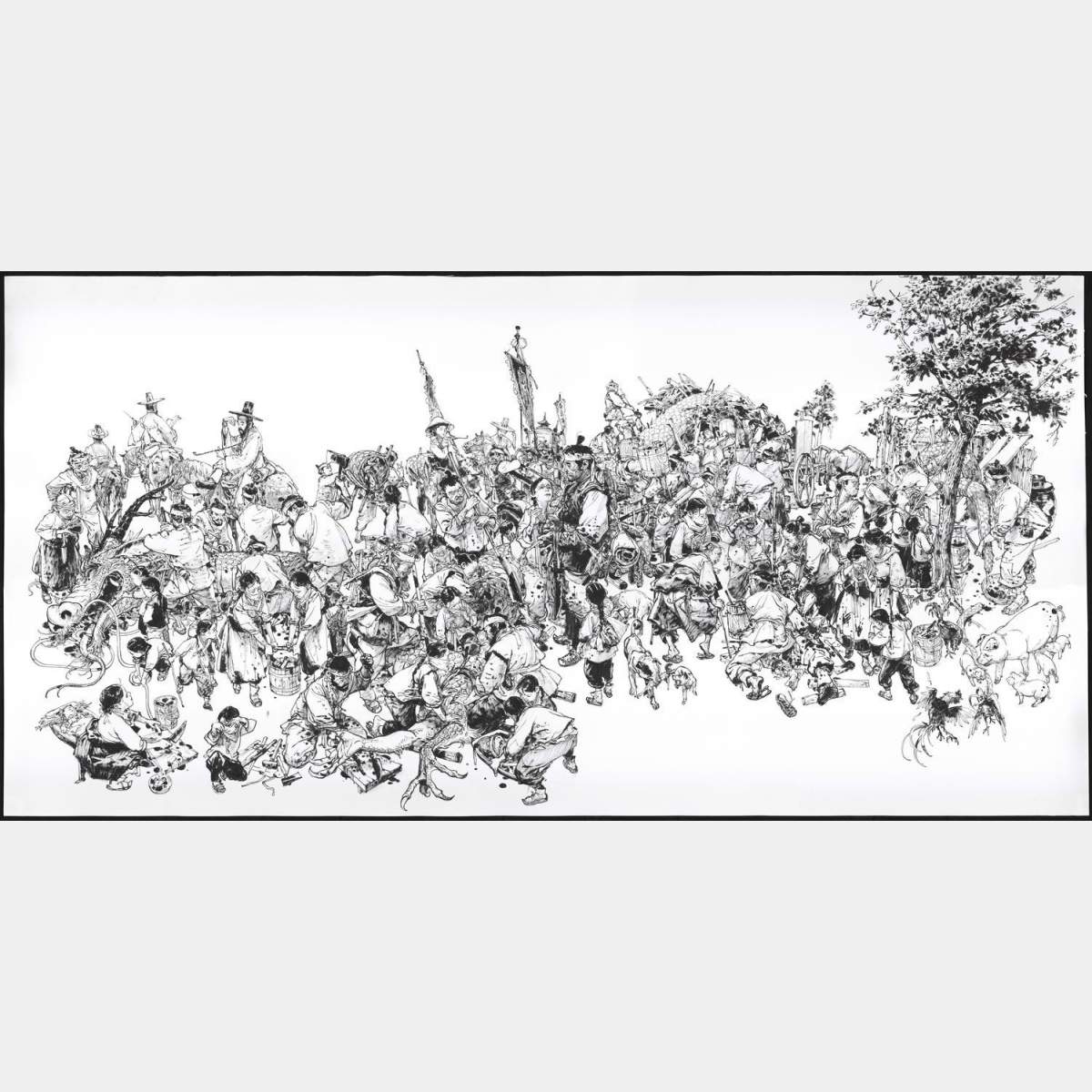
I saw someone on Twitter say that this isn't drawing, it's sculpting with Ink. Insane that he's able to do this.
I found a lot of nuggets of wisdom in this collection of small lectures from his streams: https://youtube.com/playlist?list=PLrg1NICzlqVc_fV37bT7VmySD...
RIP to a tremendously talented man.
This could very much be the definition of genius.
May as well include the link on CNN https://edition.cnn.com/style/article/kim-jung-gi-death-cec/...
Here's a sped-up video showing him in action: https://twitter.com/jesawyer/status/1577731089602265089
Absurd to see that kind of detail emerge like that.
Holy crap, not a single line of sketchwork! Amazing.
Yeah it's unreal. And the result is so well-proportioned and 3-dimensional as well. I wonder how much of it was in his mind before he started, and how much was about figuring out what would fit along the way.
I can't remember the source, but I remember learning that his specialty was 5-point perspective and he could keep most of the drawing visualized in his mind before he even started. But he also improvised a lot and made decisions on the fly.
Unreal is definitely the right word, similar to watching Michael Jordan at his best.
He died of heart issue based on some replies to that tweet?
That guy has a really good sense of proportion.
what’s going with twitter’s mobile video player (on safari). literally no way to just watch the video without it being half obscured with the tweet it’s attached to
He did a live drawing session 3 days ago in Paris and apparently died flying out from Europe.
According to his Facebook:
> It is with great sadness and a heavy heart that we inform you of the sudden passing of Kim Jung Gi. After finishing his last schedule in Europe, Jung Gi went to the airport to fly to New York, where he experienced chest pains and was taken to a nearby hospital for surgery, but sadly passed away. October 3, 2022 After having done so much for us, you can now put down your brushes. Thank you Jung Gi. October 5, 2022 Hun Jin Kim If you wish to send a note or a drawing to his family, please send it to 1975-2022@kimjunggi.net
https://m.facebook.com/story.php?story_fbid=pfbid037QzdzNrwP...
Can someone point to some of his famous works? Frankly it is the first time I’ve heard of him.
I think his drawings are great, though the big kicker is that he draws them without reference and without sketching or erasing.
He is almost like a human printer, drawing one character or object to completion before moving on to the next.
I particularly like his dragon hunter
jpeg: https://www.liberdistri.com/359-thickbox_default/dragon-hunt...
video: https://youtu.be/uNtmdB6N5Qo
Here's the Wikipedia article on him
https://en.wikipedia.org/wiki/Kim_Jung_Gi
A good video was posted here by modernerd, describing his drawin process.
He is all over YouTube and did exhibitions around the world -- I'd check out his drawing show videos.
But are the drawings any good? Feels weird to have to watch a video instead of seeing the finished art.
Presumably his finished work is for sale and display so naturally it's a bit less likely to see it up online in an easy viewing format. Check some of it out here though:
To answer the question though, yes wildly and objectively talented. Part of why you would want to watch a video is to see how he works, his competence is on full display more so than in the finished product perhaps.
That is because the way he draws is part of fascination with his art. The speed of it, that he does not need guidelines for perspective, that he just goes from top of head.
If you are curious whether drawing is to your liking, you can just skip to the end of the video. Or, google his name and filter for images - the filter is in top bar.
The drawings are amazing, but the reason he is so well-known is his process, which you can only see in the videos.
I like some. Not all. I'm afraid I fail to get enthusiastic about knowing how they were done, sorry.
His process is impressive, no sketches or hesitation; he just "prints" whatever was in his mind. The scenes are incredibly detailed, with complex perspectives
He is a master, as he can produce realistic sketches/art, as well as comical adding his own unique flavors to it. He is really a swiss knife. You might not like a type of drawing but he definitely has it all. And his memory, and stream of consciousness sketching is what is superhuman, and they're super detailed massive sprawls of a sketch.
For those that are just jumping in here-- Watch this spectacle (sped up) completely drawn from memory and technique. https://www.youtube.com/watch?v=Bg1j9xwcij8
If there was one thing that I thought all HN users had in common it was the appreciation for a tremendous intellectual gift and better yet, doing no evil with it. I guess you proved me wrong.
well, there are plenty of dumb shits who would say that plenty of his drawings are the mark of the devil...
I know several people that have died or almost died from Widowmaker heart attacks. Seeing a cardiologist and cardio in general is one of those things that a lot of men ignore because they feel healthy but it cannot be stressed enough, once you hit 30/40s, find a good cardiologist especially if you have a history of heart attacks in your family.
Also get your blood work done annually and cholesterol/ lipid panels checked by a qualified physician as that will be the first line of defense to sound the alarm and prevent heart disease from progressing.
I will never forget seeing a family member with their sternum cracked wide-open heart bypass, where they connect your heart to a machine while you are suspended in animation, so they can operate on bypassing your clogged arteries that could have been managed with a healthy lifestyle and drugs.
One thing I've heard is that under 40, people died from trauma (car crash) or suicide. After 40, the body really starts breaking down and people die from anything. Cancer, heart problems, lots of stuff out of the blue much without prior causes like smoking.
I don't have a history of heart attacks, and lot of doctors seem to discount this form of early checking. What do you do when your bloodwork is good?
> What do you do when your bloodwork is good?
Yearly blood panels provide time series data against which it might be easier to spot changes even if all metrics are in the "healthy" zone.
At Kaiser, which usually has its own lab in every facility, yearly blood panels are completely routine. As an HMO Kaiser has every incentive to minimize costs, and they don't make any such practices routine unless and until they've been demonstrated to provide clear benefit across their patient population. (They also regularly run all sorts of trials--they're vertically integrated from the research lab on up.)
Kaisers / HMOs are not that unique in having annual blood work of standard items. I think they have to do it by law at some level, with PPO insurance 'preventive' stuff like that is usually much cheaper or 'free'.
I read a great quote that conveys his talent:
> Like if you saw your favourite band improvise their next #1 hit song from scratch live on stage on their first try. Like an author sitting down and reciting an unwritten novel from start to finish. Absolute unthinkable skill.
https://twitter.com/kimsokol/status/1577748279475027968?s=46...
https://en.wikipedia.org/wiki/Kim_Jung_Gi
Wiki entry for those, like me, unsure who Kim Jung GI is.
Probably better served by the direct site:
--
Edit: ...which still does not contain this critical piece of news. I cannot avoid thinking of that of Martin Perscheid, which on 5 August 2021 had an update "Unfortunately I currently find myself incapacitated, and responding to your queries will take a while". And ended with the same formula of former posts: "Thank you for your attention".
He was a master. Every human being should be aware of the raw talent he possessed and exercised. He was a true prodigy. It isn't wrong for people to compare him to Da Vinci, or Michelangelo as one of the greatest artists of all time. Different era's, etc, but it's just to show he was in a very rarified class of folks. Man, I'm going to really miss his art, and watching him dazzle the canvas live, straight from his mind.
He was everything I loved growing up - robots, samurai, mech all the anime I've watched. He was so talented at multiple genres, could draw architecture or portraits of people with equally refined and masterful skill.
He was the artist's artist, in a world full of artists, where people don't recognize individual artists anymore like back in the day with Da Vinci, Van Gogh, etc. Even though many of the artists in history were only celebrated well after their death. Glad, Kim Jung Gi, got the recognition he deserved while he was at his prime. He still had so much to offer, and I hate that he left the world too soon due to a stupid heart attack. I really want to discuss the solutions that we currently have and what people are working on to combat heart attacks in the future, and to be able to prevent them. It was so sad and devastating to have a loss of such proportions. His talent was immeasurable, but a genius or prodigy is apt. RIP Master Kim.
If inclined, please check out his sketchbooks, they are ~$100, and are worth every penny. 100's of amazing detailed sketches found. Also some are erotic, or NSFW for sure haha, as KJG was a tad crazy.
Also, people should know he was the nicest, most humble person ever. Always up for a photo with a fan or ready to sketch/sign for them. I was lucky to get a photo with him, and as always he is smiling pointing to me as if I'm "The Man" but Master Kim you are, and everyone knows it, and will cherish your art for ad infinitum. Rest easy Master Kim. Thoughts and Prayers for his family, and loved ones.
This is really sad, I used to see his drawings all the time on my Instagram and it was so sudden. He got me into drawing and really thinking about understanding perspective; I'm not good at drawing but man did it help my photography.
Absolute loss. I don't know if it was a heart attack or maybe a pulmonary embolism... he had covid before and I think the long flights might have been taking a toll.
Yes he's had a lot of travel. I met him in Paris last week. He and his entourage flew from Paris to Portugal to Poland and back to Paris all within 7-10 days. He's done several events in Paris the weekend before his death. I suspect he was fatigued and caused a bit of hypertension. I don't know if they were far away from a hospital or how long it took them to get there, or the severity of the heart attack, or if they gave an aspirin to help as a blood thinner(or even if that would help). But, so sad..a genius, lost at 47, I was reeling and so down the last 2 days.
A few years ago I decided I wanted to buy one of his limited prints with some extra money I was to earn. Then I pushed it off for a bit due to a few poor excuses, and eventually forgot about it.
And now his prints are of course ... out of print.
I'm not saying I need a numbered and signed limited print like The Tigers New Clothes [1] but it would be nice with maybe just a regularly, unsigned, unnumbered poster on my wall.
Are there any for sale?
[1] https://www.liberdistri.com/en/accueil/100--the-tiger-s-new-...
His sketchbooks are awesome, and often have a large poster/print in them. I think for sure they will have prints in the future, just not signed of-course any more as much as KJG would love to from up there.
Kim is quite famous in the art world. I remember a livestream where people sent it challenging ideas of things to draw, and he just casually draws them, entirely from memory, no references or googling of any images. Died way too young.
Heart attack at 47, and he looks reasonably fit too in that linked video from 2019 (age 44).
What to do with this information? I don't know. Maybe work on cardio, stop coffee?.
> Maybe work on cardio
Maybe work less? I know four people who died of heart attack. Two of them were in terrible shape (obese, no exercise), while the other two were in very good shape, but were also workoholics in stresful jobs. One of them even got the attack while jogging in the park (he collapsed in a rarely frequented part of the park and was dead before anyone noticed) He was a CEO of a decent-sized company in his early fifties.
you cant talk about the potential causes in here.
It was on the announcement Twitter linked, it said heart attack.
Heart attacks at 47 are rather rare. There is probably some underlying cause but it cannot be discussed here.
hope its not the covid vaccine side effect!
maybe he had genetic predisposition to heart attacks or cardiovascular disease. Maybe the stress on his heart went unchecked for years. Maybe it was a sudden embolism.
Whatever the reason was, we should all be having regular heart health checkups or preventative care that is readily available and to help. I mean, by now we should be having watches or devices that can monitor and read our heart health and vitals 24/7. It's 2022, ridiculous.
Can any expert here help me understand why his heart attack was not reversible by administering tPA to dissolve blood clots?
I'm pleasantly surprised to see his name on HN. He had a table at NYCC this week and people have been leaving him gifts and messages. It's so sad.
https://pbs.twimg.com/media/FeZt8yNWIAE0HEZ?format=jpg&name=...
Edit: Photo Credit to @Leah617
This hit me hard. I just recently got his 2022 sketchbook and it really got me hooked. So sad to see such a talented artist pass so early
Me too, I got into him in 2019, and bought 1 sketchbook last year, and the 22 this year. I had the luxury of meeting him last week in Paris.
not having any art background I was captured by the mesmerizing technique he used to create instant universes, what a loss
I keep coming back to this performance. Always blows me away.
official statement: https://www.instagram.com/p/CjU2fHwuLjw/
I’m glad it appears people were eventually able to talk about The Vax on this thread. The symptoms are real; ask a medical person.
Does he do any planning or prep behind the scenes. I can't tell if this is magic or well rehearse magic. Either way, incredible talent.
None. It's from his imagination to the paper.
Can any expert here help me understand why his heart attack was not reversible by administering tPA to dissolve blood clots?
Oh, no, so sorry to hear it! He was incredible. What a loss. Best wishes to his family and those who loved him.
Amazing! I only just discovered his work. It's sad, yet inspiring to see how many were touched by his art.
Man that is heartbreaking, I hope his mind put on an absolute banger of a lightshow for his road out. RIP
I have one of his early sketchbooks and was taken back on his imagery, ideas and layouts.
Is it confirmed? I just recommended him to a friend yesterday. I can't believe it.
Yes his personal account posted the news in both English and Korean. His friends and the art community have been mourning and cancelling their combined appearances at light box (understandably)
so sad to hear that. he had both talent and hard work. best wishes to his family :(
He was one of the best illustrators of our time. He will be missed.
Absolute master with a brush pen. A great loss for sure.
What a tremendous loss for the world. RIP Mr. Kim :(
Heart attack at just 47 years old. And not because of obesity. Maintaining his unbelieviable skill level must have been pretty stressful for him.
Or he enjoyed it tremendously and it had nothing to do with stress.
You can enjoy things that are bad for you... Polish film director Zanussi said that it was always his goal to have poor health in the old age, because, if he didn't, it'd meant he hadn't push himself hard enough in the pursuit of excellence in his art.
Just because some person said this doesn't make it here suddenly true.
I personally find this anecdote really shitty to be honest. Only a balanced mind and body can sustaine quality over a long time.
Also bad health in old age is super critical for living long and bad. Would never thrive for this like laying in bed having pain every day being dependent
Yeah watched Master Kim a lot. And he always has fun sketching and interacting with people as his job. This wasn't his job, just his passion. Definitely genetic factors, etc, can lead to cardiovascular disease...we don't know every thing to comment. He was getting tired, more from traveling around a lot, as I talked to some of his entourage a week before his passing, don't know how much that affected his heart health.
The biggest surprise to me is that he died of a heart attack in an airport, where presumably AEDs are in ready supply and people are everywhere so it'd be immediately noticed. I really thought the survival rate in such a circumstance, even for catastrophic heart attacks, was pretty good!
I was recently taught in first aid class that the survival rate of an out-of-hospital heart attack is about 10-12%. Heart attacks have a ton of causes, lifestyle is just one of those. Sometimes, things go very wrong without an apparent, explainable cause. Medicine hasn't yet figured out everything that might cause a heart attack.
Even with help on scene, people still die in hospital a few days later because of a mix of underlying causes.
CPR on scene doubles the chances of survival, but they aren't a guarantee someone will survive. The entire point of learning CPR is to maximize the number of people that don't have to die in the event of a heart attack, no matter how minute that fraction.
About 800k people suffer a heart attack in the U.S. yearly accordign to the CDC (this is both in-hospital as well as out-of-hospital).
> I was recently taught in first aid class that the survival rate of an out-of-hospital heart attack is about 10-12%.
In my first aid course we were taught that the speed in which an AED is applied is the main contributing factor. Giving that most workplaces/homes/restaurants ...etc don't actually have an AED you would normally get one when the ambulance arrives.
Someone in the NHS had worked out the graph for distance from ambulance and % survival. He gave us all our % chance survival if our office didn't have and AED based upon the average rate from our work places and that we needed to wait for the ambulance. This was under the assumption that someone would start CPR almost straight after the arrest.
In our office this % without an AED was < 10% something insane like 6% chance survival. With an AED survival is much higher. He gave the figure of 95%+ survival rate for offices that had AED in them.
I brought this up in a company meeting with all staff there and the question was how much is an AED. I had already asked this and it was £750 for an older second hand one and £1100 for a brand new one.
Never bought the flipping AED.
So from what I made out my life was worth < £750 to the CEO.
Imagine if there was a meteor shield the company could buy for £250. If they didn't buy it, is your life worth less than £250 to them?
You have to divide the cost by the likelihood of a life being saved to find the proxy figure for what that's worth. If there's a 1% chance that an AED will save a life during its useful lifespan, that suggests that they're valuing the life at less than £110000 (assuming a company would be inclined to buy new and that there are no required inspections along the lifespan of the AED).
I think the actual likelihood that any individual AED located in a company's workplace will save a life is much less than 1%.
The individual likelihood is not <1%. It's probably more like 10-15% per person. some would be low some much higher. But I wasn't the only employee there there was around 12 employees in that office. There were several who were > 50 years old and in the high risk category which could put them up to 25%.
So given this plus your statement about the £1100 for a brand new one divided by the lifespan which I think is 5-10 years for each £110 per year I would say the value my life < £1000.
The CEO himself was very high risk and had actually been in the hospital recently for a suspected heart attack (a small one that didn't require intervention).
> Imagine if there was a meteor shield the company could buy for £250
The chance of being hit by a meteor is several orders of magnitude smaller than having a heart attack so this comparison is invalid.
A better comparison is being in a car crash and yes if they didn't spend £250 per 5 years to drastically improve my chance of dying in a car crash my life is worthless to them.
The company never listened to me on any of my suggestions so I think they were not listening and just denied my request the same as ever other request of mine they denied. I once asked for a new mouse and they denied that as well some CEOs are just like that.
The likelihood is not "10-15% per person" that, during the operational lifespan of any given AED, that someone would have a heart attack at work, be treated by that specific AED, and have that treatment be life-saving. (That was the point of the meteor comparison.)
The lifespan is 10-15 years depending on the model. Most people were at moderate risk, unfit, drinking alcohol, poor exercise, high stress job ...etc. For moderate risk 10-15% is the stat over a 5 year period. Most where moderate a few, 2 I think, were low and we had a few high and one very high risk given he'd possibly already had a small heart attack.
Also note that you didn't take into consideration that the device is used for all in the office so over the 5 years it's cost must be divided by the number of employees it will cover which in this case was around 12.
Again your Meteor comparison was extremely poor. You are comparing something that is very common, a middle aged person having heart attack, to something extremely uncommon a similar demographic being hit by a meteor. Also to note that you can't say it it £250 to protect from a meteor strike it would likely be extremely expensive to protect an office from that versus the insanely cheap £1100 to almost guarantee that any of us survive a heart attack.
I've eddited to show the actual lifespan of the AED which is 10-15 year
You are overestimating how often heart attacks in the office happen.
Nope ...
How many same-office-colleague-years do you think you’ve had in your career? How many fatal heart attacks in the five across all those? For me, it’s “tens of thousands” and “zero”.
That's rather personal but it is non zero.
It's clear to me you've made up your mind and you feel that spending the money is a waste for something that's so low risk so I don't see any point in continuing this conversation. If you do still work in an office I hope it never happens to you.
I do work occasionally in an office and have personally walked the floor to make sure the AEDs are correctly located on our floor plans and electronic signage and filed facility tickets to get the maps updated. (They were originally not correct.)
I believe in the benefit of AEDs. I also believe the average number of lives saved per AED installed in an office is way, way less than 1.0, and almost surely lower than 0.001 which was the point of this sub-thread.
Insurance would probably pay them out nicely - your death at work is probably worth +1x your annual salary - maybe more.
> Insurance would probably pay them out nicely
I wouldn't have bet any money on that. The dude was unwilling to pay £1100 for a life saving device what makes you think he would buy insurance that would pay upon employee death.
I know for a fact I didn't have any of that cover as my current company does pay death in service and it's like 4 times my yearly salary to my wife. So if he had anything like that he would have said so.
He's was just a cheap fuck. Companies often cheap out of safety gear to make a quick buck happens everywhere all the time.
That’s pretty scary having had one a few years ago I didn’t realise the risks of dying were so high. Is that for a specific case (e.g. heart stopped completely) or for all the stuff that gets lumped in there for example I was still walking around and so on despite the clot forming which probably has a more medical name but colloquially gets called the same thing.
For context when I had mine at 39 I was swimming so swam on for another thirty minutes at a reduced pace, got changed, walked home, lay down for a bit before getting my wife to drive me to the hospital. Ended up with a stent put in. Got lucky I guess from being reasonably fit as there was no visible damage to the heart on an ultrasound.
Can any expert here help me understand why his heart attack was not reversible by administering tPA to dissolve blood clots?
They don't call it a widowmaker [0] for nothing.
[0] https://www.menshealth.com/health/a21346168/widowmaker-heart...
He was certainly very busy, always traveling. This happened (from what I read) as he was leaving a show in Paris for a flight to New York.
Completely pointless speculation.
id be pretty interested to see the number of not that old male dying from heart attack since covid. not pointing the JAB (while it is one of the known side effects) but I think the big one is the confinment, forcing people to stay home, bringing a lack of exercise and mental fatigue would definitly put a toll on the heart. not even talking about the increased absorption of alcohol to fight depression from being isolated and not able to live like before.
We do know that in USA, republican males are dying faster then democrat males.
Also, there is no reason to imply that Kim Jung Gi had increased absorption of alcohol or was depressed last years. Especially since you are just speculating in order to push for political agenda.
what is my political agenda? you are the one talking about republican and democrats. I am merely stating that the past two years have been bad for young (before 50's) people health and the impact of the 2years of confinment, lack of physical activity, unemployment, closing of their business, mental stress hurt a lot of those young people. now add that yes the vaccines seemed to also cause myocarditis specifically in males it is a fact not a political agenda.
Yes and this news should make us all reflect on those habits and try to improve.
who is being forced to stay home at this point?
the past two years have been forcing young people to be confined, become mentally and physically unhealthy so that we can protect the old ones. its not a matter of days. the body builds up stress and organs accelerate their destruction when physical activity or mental health go down
Such talent
Memento mori.
rip
RIP
RIP
probably another covid vaccine death
Update post title to be more descriptive for those who may not know:
Kim Jung Gi, acclaimed comic book artist, has died
Here I was thinking it was Kim Jung Un's child or something. Thank you for the clarification.
I saw the OP comment and assumed it was someone smugly putting aside DPRKs leaders problems and talking about his virtues.
>89 comments
>no mention of Diabetes.
KJG had Type 2 Diabetes for some time now, due to bad nutrition - he mentioned that he would excessively drink coke and eat junk food as he drew, and he drew a lot.
This isn't some widowmaker heart attack stuff that people are pushing here. He was in danger zone for awhile. Watching an interview with him would be monumentally insightful.
@dang why is this comment flagged - it's pretty important people know the underlying mortality cause here?
KJG was diagnosed with T2D years ago.
Citation?
He discusses it in his interview with Proko I believe, saying how he needs to go for a daily walk etc.
For a second I thought it was Kim Jong-Un
If we could change their places it will be fair trade.
Yup, I was about to start spreading the celebration news... then I read the surname :(
Both have the surname Kim.
Oh, then the first name. Thought Kim was the first name.
Given name. "First" and "last" name are ambiguous, since the order (and number of names) differs between cultures (and some people change the order when they go somewhere else).
Gi is the “generational” name. Jung is the first name. Kim, last