Actuarial Life Table
ssa.govOne fun thing to do is to take these death probabilities and throw them into a Leslie matrix [1], along with assumptions for the age-specific birth rates. From there you can simulate the projected population growth (ignoring migration) with no more than a couple of lines of Python/R/whathaveyou.
It's also a great study case for understanding some basic principles of linear algebra: The dominant eigenvalue is the stable population growth rate, and the corresponding eigenvector is the stable age distribution.
Shameless self plug - I'm an Actuary, and as a way to learn React I put together a website that teaches you the basic concepts and math behind these actuarial table.
Is there a site where one can add more data points like BMI, smoking, booze & other drugs, family history of horrible diseases, current medical conditions, etc?
Damn this looks good. Going to check it out in depth.
I know a guy back in college who majored in actuarial science but he's also doing computer science. These 2 subjects have good synergy.
I like the visuals on the "How will I Die?" page. It is interesting to scroll up and down through various ages to see how the causes of death change.
Great job! Your site did a fantastic job of putting this into context for me.
If anyone is interested in more life tables the Society of Actuaries has thousands to download and there is some simple code to read them in Python here:
I graphed the difference in years amongst men and women using good ol' fashioned awk and free graphing software:
It looks like at around age 18 - 30ish, the numbers start catching up, with a sharper reduction in expectancy differences happening around age 35.
From the PRB:
"Men are three times as likely as women to die from injuries (unintentional injuries, suicide, or homicide), and progress against those causes of death has been much slower than against other causes in the last 50 years. There is also evidence that men at all ages are less likely to seek medical care and less likely to comply with medical instructions than are women."
I'm very interested in this workflow of data -> awk -> graph. What graphing software did you use?
Well, I spat out the list of numbers and just googled "graph values" and took the first result, but if you love to stay in command line, you can do something like so...
# awk '{print $7-$4}' chart | gnuplot -p -e 'plot "/dev/stdin"'
Where `chart` is just what I copy and pasted from the site :)
I used a data -> awk -> graph with the NYT covid numbers, which had both state and county granularity. I used gnuplot to graph.
"There is also evidence that men at all ages are less likely to seek medical care and less likely to comply with medical instructions than are women."
Especially on the 0-1 year old group. Toxic masculinity starts in utero.
Men's health is complicated. Yes, there's some "strength in silence" confounding issues in doctor training and patients, but if you pry back the social media buzzwords, you'll see that there's complex economic and societal forces that push men's health downward.
https://www.ncbi.nlm.nih.gov/pmc/articles/PMC1121551/
Also, I think you are trolling, but I'll bite. The expectancy in the 0-1 age group takes into account all life events that will affect the child over time, including what I had quoted. If you look at the probabilities in early life for both sexes, they have similar death probabilities.
> The expectancy in the 0-1 age group takes into account all life events that will affect the child over time
But this is not taken into account in the Death Probability column, is it? Because we also see in that column, consistently better outcomes for women, even for the very youngest age groups
10 and 11 year old boys have very similar rates of death as 10 and 11 year old girls, and it swaps some years ex: 2013.
Click on 2006 for example and men have noticeably lower rates of death in that age range, but 14 year old boys where still twice as likely to die.
Toxic masculinity starts in utero.
I was going to reply but then decided, no, nevermind.
Most people will miss this reference and the rest will feel old. You owe us all apologies.
The internet can be extremely hostile to empirical evidence. I actually just expect to be brigaded whenever I reference things like The Lancet. People are aggressively anti-intellectual.
People don't logon to learn, they're here to be tribal and do social cues
Hoping for a truly open minded forum, like some kind of nirvana
Nevermind was the better album, for sure.
This data, unfortunately, is missing an important confounding variable besides male/female. In the US lifespan his highly correlated with income, and the trend is getting worse. "The gap in life expectancy between the richest 1% and poorest 1% of individuals was 14.6 years (95% CI, 14.4 to 14.8 years) for men and 10.1 years (95% CI, 9.9 to 10.3 years) for women. Second, inequality in life expectancy increased over time. Between 2001 and 2014, life expectancy increased by 2.34 years for men and 2.91 years for women in the top 5% of the income distribution, but increased by only 0.32 years for men and 0.04 years for women in the bottom 5% (P < .001 for the difference for both sexes)." [1]
From the article: "The differences in life expectancy were correlated with health behaviors and local area characteristics."
"Health behaviors (rates of current smoking, obesity [defined as body mass index {calculated as weight in kilograms divided by height in meters squared} ≥30], and exercise during the past month)"
Hard to say in which direction the causation lies.
That’s actually a good point: People who die earlier due to genetics accumulate less wealth in their lifetime, and their children therefore inherit less. With that causality, people are poorer literally because they die earlier, rather than the other way around. ;)
Isn't it the reverse for the vast majorit that live to see retirement?
Wow, as a guy I have a 1/5 chance of not even making it to retirement. (65) 1/3 chance of not living past 75. These are not good odds.
And coin toss of making to 80 (1/2). And if you make it to 90, every year is a round of russian roulette.
Great. I didn't need an existential crisis today :)
I really wonder about the quality of life as I age though. There is such a wide spread in my family. One of my grandfathers died of COVID early in the pandemic - he made it to 83.
I had always considered him too stubborn to die. He survived two congestive heart failures, two bouts with cancer, and a heart attack. He had never taken care of himself (obese all of his life, heavy smoker from teenager to age 50, emphysema (from smoking), etc.). He caught COVID while recovering in a physical rehab from his heart attack and that's what ended up doing him in.
His body was pretty much trashed by age 50 though. His ability to do things was pretty restricted from that point forward. As a child, he couldn't go on roller coasters with us, he had to be really careful with his diet, etc. He spent the last 3 years of his life in bed or wherever he could get on a walker.
Meanwhile, my other three grandparents are enjoying their late 70's and early 80's - they travel, go hiking, play golf, play with the grand children and great-grandchildren, etc.
I wonder how old I'll be when I get to the point where dying doesn't sound any worse than living.
> Meanwhile, my other three grandparents are enjoying their late 70's and early 80's - they travel, go hiking, play golf, play with the grand children and great-grandchildren, etc.
It's okay to slow down, but don't stop moving.
> Great. I didn't need an existential crisis today :)
Don't check what are the odds of you dying this year. You won't like them either.
To be fair, if you are reading this or wrote this, you are far from a "typical" male in this study. The typical includes a lot of low income and/or blue collar workers who cannot or will not take good care of their health and are engaged in high risk activities at work and after work. In all likelihood, the typical HackerNews user alarmed by a subject like "Actuarial Life Table" will have much better odds at living a long life... if only because you are paid tech wages.
This is why I "soft retired" early. People haven't said it to my face, but I get the definite impression many think I'm crazy for "abandoning" work. I'm through hiking the PCT this year, something I never thought I would do until much older.
I'm not really a brave guy, I fear change, but you got to take your chances while you're still alive.
What does soft retire mean? I've always liked the idea of interspersing retirement years with active work, and increasing the relative frequency of retirement years as I get older.
However, I understand the job market might not always be appreciative of gaps in employment.
If you are a contractor it is not that bad. You can also use that time to do a small side project and put it in your CV.
I wonder how those odds change if you narrow down to your occupation/socioeconomic status/location.
I have always wondered what the income volatilities as you age are for the purposes of calculating how much I should be saving. My current strategy is to assume I will be unable to earn income and/or need to spend a lot on healthcare with increasing material odds starting at age 50 (since I might not have access to subsidized health insurance that comes with a job).
The death probability has a turning point from decreasing to increasing around age 10 for both male and female. Wonder why this specific age.
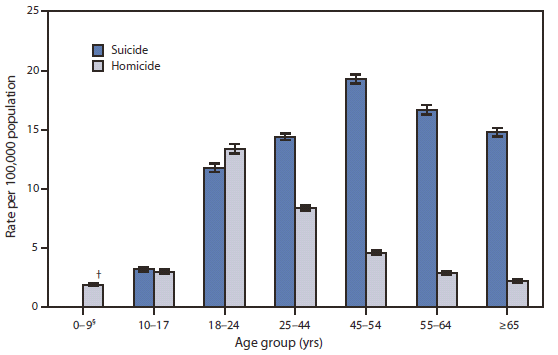
Probably not the only factor, but 10's about the age when suicide becomes more than a very, very remote possibility.
https://www.cdc.gov/mmwr/preview/mmwrhtml/figures/m6128qsf.g...
U.K. data but accidents and cancer exceed intentional self harm for teenagers.
https://stateofchildhealth.rcpch.ac.uk/evidence/mortality/ad...
The overlapping decreasing line curves of mortality due to infant / child mortality cases and increasing line curves of mortality due to external factors, accidents, and illnesses. The lines cross around 10 yrs old.
While that's true, these are small death probabilities. The age 10 death probability is less than 1 in 10,000. It doesn't even reach 1 in 1000 until age 20 for men and age 34 for women. According to this data source[1] there are about 4 million 10-year olds. That works out to less than 400 deaths for the entire US in a year.
What I find interesting is the divergence at age 10 by gender. By the late teens, boys are about 2.5 times more likely to die, in spite of the probability being the same at age 10.
[1] https://www.statista.com/statistics/241488/population-of-the...
I wonder if it's accidental behavior because of not knowing better (children crawling into water or streets etc) combined with accidental behavior because of being teenagers crossing over.
Based on this, by the time you're 30, around 2% of your male high school peers have passed away, but only 1% of your female ones. Puts an interesting perspective on things.
I don't keep in regular contact with people from high school these days, but from what I've heard, I wouldn't be surprised if 1 to 2% of my graduating class has already died from suicide or accidents alone.
I hadn't thought about that but yeah, of the 100-ish people I've known a bit closer in childhood and adolescence, I know two are dead now.
Both were female, though.
This is exactly the table I turned to in April 2020 to put my risk of dying from COVID-19 into perspective. In short, I had much bigger things to worry about over the next 10 years.
Great resource. I use this all the time for military clients near or past retirement eligibility, to estimate the lifetime financial penalty of discharging them before retirement, or of retiring them in a lower grade.
There is something I've never understood about this. Actually, I suspect that it is just plain old wrong.
It looks at what ages people died in the year 2019. If you die at age 80 in 2019, that means you were born in 1939. But if people born in the year 1939 are living to age 80... how do I put this... wouldn't you expect people born in, say, 1989 to live longer? Wouldn't people born 50 years later have longer life expectancies? Especially if you believe the stuff about accelerating rates of technogical growth.
IANAA, but my assumption is that that is why they update the tables every year— we always have young cohorts with incomplete data, so the best we can do is extrapolate from the past. Given a fixed cohort, over time as new tables are generated and the cohort ages, the accuracy will converge to reality. You could then look at past tables retroactively to see the error in the original extrapolations (which could be large due to black swan events).
By choosing someone who died in 2019, you've implicitly chosen from the lucky group of survivors. This is not representative of everyone born in 1939. That is the discrepancy.
If you add the current age to the remaining years of life, the total lifespan is monotonically increasing. This is reflecting the fact you are only looking at the expected age of an increasingly dwindling group of lucky survivors.
Think of life expectancy as the expected age of death if you lived every year of your life in 2019.
I wish I was good enough at math to use these tables to figure out what percentage of the population is within a particular age range in any given year.
In particular, I'm curious to see what years the population of particular generations peaked.
Edit: Actually what I'm really looking to do is to correlate certain marketing demographics with generations. For example, "in what years did Generation X comprise the majority of living people in the 18-34 demographic?" (where Generation X is defined as people born 1961-1981).
There’s not enough data to answer those questions from these tables, the “number of lives” fields are just illustrative.
Why not just go to the Census Bureau for annual tables of populations by age?
obesity and smoking status are more important than sex differences.
Does this mean that until your 113th birthday you can expect to, on average, live to your next birthday?
For that you'd want to look at when the death probability exceeds 50% (108 for men, 109 for women). By 112 there's only a 40% chance you'll live to your next birthday
Actually I realized my original question was ill-specified, "average" being ambiguous. The median woman will live at least one more year as late as 108 but the mean will live at least one more year as late as 113
I would love to see the same data for the last 2 years
Roughly 50% make it to age 80.
Roughly 20% make it to 90.
And around 1% make it to 100.
The road curves steeply at the end!