Asian-Americans fight back against school discrimination
wsj.comIt's discrimination any way you slice it. You can't lower the bar for one person without raising it for another so long as the class sizes remain the same. If elite universities are about providing education (a valid point of critical contention), then systematically barring Asians from entry is the same class of injustice litigated in Brown v. Board of Education. It's not enough to say you can learn calculus just as well at the University of Massachusetts.
"Here we find our first indication of the strength of preferences for underrepresented minority students. African-American students have nearly an 80 percent better chance of being admitted than their white counterparts, while the Hispanic advantage is reflected in almost 50 percent higher odds compared to whites. By contrast, Asian applicants and those from other races face lower odds of admission on the order of 17 or 18 percent—in relation to comparable whites."
https://scholar.princeton.edu/sites/default/files/tje/files/...
Note that most Americans of all races, including Black people, oppose the practice of race conscious admissions: https://www.pewresearch.org/fact-tank/2019/02/25/most-americ....
People of all races also overwhelmingly oppose consideration of race in hiring: https://www.pewresearch.org/social-trends/2019/05/08/america....
In California, Prop 16 failed in every single majority Hispanic county. It’s a minority of mostly white progressives pushing this stuff.
> It’s a minority of mostly white progressives pushing this stuff.
I think if you look a little closer you'll find that many members of that "white" minority are in fact not White (or Hispanic, Black, or Asian.)
You can't do this here. I've banned the account.
Really? Because I don't think so since I mostly see people with a falsely treated savior complex. Harsh judgement, but they also justify racism and if it comes down to it we need to be honest.
This is what affirmative action will look like. If you want to see the context of such an action happening somewhere for long time, take the example of India.
There it is much more explicit and written in the law. For some subjects, the criteria it takes for one cohort to get admission in the top college is the same one in which the other cohort will not even get admission in any college in the top 20. You can see this in undergraduate level admissions the most. I read interesting stats on this long time back, will need to see if I can find them.
However, in case of South Asia/India, the argument is positive discrimination now to correct for negative discrimination in the past. The same argument can't be made in US though against Asians.
I was curious about how the Indians handle this, too, so I read Republic of Caste by Anand Teltumbde. It's a long, rambling, but detailed description of how the reservation system was playing out in India. Broadly, he argues that any initial positive effect has been displaced by caste becoming even more of a wedge issue (each caste feeling disadvantaged unfairly and hyper-vigilant for others' corruption) and castes scrambling for favorable designations (e.g. inventing a new history of victimization or fabricating a genealogy in order to be assigned to a more favorable schedule).
Ironically, Teltumbde advocates for replacing reservations with American-style affirmative action.
Now it is a competition among castes to show that they are the most backward, since they would be considered for reservations then.
and this makes sense as well, I think while in practice the affirmative action in India seems ideal it is far too idealistic and one dimensional. Like just doing it on the basis of race would be in US.
Should an Asian kid coming from a family with financial difficulties be subjected to the same bias as others.
Also, I read a weird thing that in India even religions that don't have a caste system, have castes. It is interesting that Christians, Muslims can have one. It seems like that's one way to reap the benefits of the system.
It is simply a bad mechanism and argument to put injustices of the past on the shoulders of new generations, especially with goals defined in such a blurry manner. On the contrary, the best remedy is to treat people as equals.
That isn't unpractical realism, nothing else is required. Of course some will have a huge head start and culture towards education is a very important factor. But you can shelve the false justice which is just racism with another motivation.
> It is simply a bad mechanism and argument to put injustices of the past on the shoulders of new generations
There's no argument to be had; injustices of the past do land on the shoulders of the present generation. Everyone is born into circumstances they did not create.
There is a reason "The sins of the father shall be visited upon the sons" is a saying.
Now, given that reality, the question becomes "What does a society do about it?" When people believe in equality of opportunity but can see that opportunity is heavily influenced by birth circumstance, how does one address that fact?
The injustices of the present need to be solved still. In America the way schools are funded in many states is such an obvious shorthand for racist school funding there isn't a level playing field.
I would suggest it's more along poverty lines than race lines. If you fix (well improve) the poverty rates it helps all races across the board. I think our emphasis is completely off base, education outcomes track with poverty a lot better than race.
I am fully on point with having more funding in education, it will always be a good investment and doesn't need racial discrimination.
This isn't true. Underfunding is not the issue with underperforming schools in the US. If you want to improve outcomes in inner city schools you need to fix the broken local culture first, but it's sort of chicken and egg.
http://thinkaboutnow.com/2016/03/debunking-the-underfunded-p...
https://www.vox.com/22266219/biden-eduation-school-funding-s....
Compare the homepages of the two. I know which one I trust more.
That was the first link that came up on ddg, but it's laughable to presume that vox isn't just as biased, just in the other direction. Here's a couple more on the subject. I suspect you won't find a left leaning source with this opinion because it would undermine one of the primary ideals behind modern progressive thinking, that all groups of people would magically achieve equity and equal representation across all domains if only presented with the same opportunities.
https://www.commonwealthfoundation.org/
https://www.heritage.org/education/report/the-myth-racial-di...
Wow, thinkaboutnow is quite the website.
Sorry. It is true. I went to schools that could only afford a four day week. Couldn’t even afford the fifth day. This is still happening.
School funding is still an issue.
> to get admission in the top college
Could this indicate that there're many bright people in India, who are mostly self taught, because they belonged to the "wrong" group and so couldn't study at University (or at least not the one they wanted) ?
Whilst, if someone has studied at a top university, it doesn't mean that much?
This is correct to some extant, and not just for getting education. As an example, in many competitive exams conducted by universities etc. to select students, the selection cutoff marks clearly show this pattern of intentional discriminatory admittance.
For someone belonging to "general" category, anyone designated to an upper caste, the cutoffs percentage for selection could be as high as 97-99%. For "reserved" category candidates, those from the lower castes, the cutoff can be as low as 10-20% for the same test. This means someone scoring 95% would not get get an admission offer while someone else scoring 15% would.
This reservation system is also a part of government jobs. I have seen "reserved" teaching positions being filled by candidates who score negative marks in the selection exams. But since no other type of candidate can fill the reserved position, the highest negative score gets the job.
Does this really alleviate the issues borne out of historical oppression of the lower cast, I don't know. Perhaps. Is this overall a good thing for a nation and its people? Again, I have no idea.
> This means someone scoring 95% would not get get an admission offer while someone else scoring 15% would.
Sounds entirely made up. All these exams generally have a minimum clearing criteria at 60-65%
I mean the data is one google search away (granted, if you know some of the official caste related terms)
https://economictimes.indiatimes.com/industry/services/educa...
Also, the example I have provided are from 15 years ago, when I appeared for these exams. I'm not going to bother finding verifiable information from back then but the figures I mentioned are pretty much what I saw.
Then this is probably news to you. Search for Minimum eligibility on these
You and I are referring to completely different scores. It is true that a candidate needs to have scored a minimum percentage of around 50-60% in their high-school/intermediate board exams (so 10th/12th standard) to be allowed to sit in the selection examination.
The cutoffs I'm talking about are dependent on overall performance of all candidates. In the link I have shared this cutoff is 18% (89/480) for reserved category students. There are more details in the article about the cutoff for reserved category students being 60% of that of general category ones. There is further elaboration on how many students have to drop off because of their poor performance. These vacant seats are rarely filled.
You can read the document again. It's the minimum eligibility in the test they're taking not their high school scores.
> the cutoff for reserved category students being 60% of that of general category ones
It is not that off and even if it were, it's not as bad as you initially claimed: 18%. AND media houses are known to sensationalize everything.
In the article the figures of 18% vs 36% are mentioned rather than 15% vs 97%.
Right, it is. Like I said, the figures I've pulled are from what I remember from 15 years back. Unfortunately I'm not able to find any sources with light searhcing.
I'd like to point out that there is a high possibility that there is an upward trend in reservation category cutoffs. And if it is indeed the case then I'd be the happiest.
As for my other claim, please see [1] and [2].
1. https://www.theyouth.in/2018/06/16/candidate-who-scored-minu...
2. https://www.india.com/education/zero-cut-off-maths-phd-inter...
Thanks! I hope they won't start using these ways of hiring people, to find airplane pilots. Negative marks in the exams
AA and other background-accounting factors have some place as an input into the system. You simply can't possibly claim that poor white rural kids in the south or black urban kids in poor neighborhoods (and all similar such situations) have the same chances at success of getting into harvard/yale/MIT as a rich white/asian kid from NYC who went to the best public/private schools (and SAT tutors) money could afford. There has to be some balance in there to account for such things. Until people put something forth as viable AA and quotas are what we have.
"Rich white/asian kid from NYC"
I've seen this sort of characterization a lot here. I can understand it, but it doesn't really reflect reality. I don't know a lot about other areas, but in NYC, most asians are not "wealthy". Far from it, Asians in NYC have a substantially lower median income ($53k household, $25k per capita) than whites ($69k household, $50k per capita ).
More importantly, the asian kids being discriminated against are not from wealthy families. Those that come from well off families tend to have all the extra-curriculars that white kids from wealthier families do. It's the ones from poor families. The ones who have to work after school and weekends to help out... and still study hard. Their parents cannot afford music/dance/arts lessons. The kid can't spend hours a day volunteering. Etc. It's these kids who get shafted when universities seek "well rounded".
Many of the lower income asian kids are from recent immigrant families. Their parents who barely speak english, working low paying jobs. They sacrifice everything to try to give their kids a chance to get ahead. And push their kids crazy hard to do well in school as they see it as their only way up. Imagine the feeling when -- after years of sacrifice and hard work -- after your kid did great in school, got great SAT scores, did everything he's supposed to do... he still gets denied by every good school..
> Those that come from well off families tend to have all the extra-curriculars that white kids from wealthier families do. It's the ones from poor families.
Or even just middle class families. I send my kids to private school with family money WASPs where we have a second winter break in February for ski trips. My kids will know how to navigate a system that puts more emphasis on writing an essay about how her grandfather grew up in a Bangladeshi village than on her SAT scores. But when my parents and I were recent immigrants to the country I certainly didn’t have that kind of cultural capital.
And it’s not just an immigrant thing. My (American) wife was noting that her dad, who grew up objectively poor would never have suggested he suffered adversity growing up, because after all they lived in a “stick built house” (a framed house as opposed to a mobile home).
See "rich" as in not poor. You can't shutdown the primary reasoning of my argument and downshift it to your point. My main point was poverty and location, I really don't even give a fuck about your race. The biggest problem in this country is delineated by who has money and who doesn't. That is the 90% problem, not race.
If your main point was poverty and location, adding race to the description certainly doesn’t help especially with the poor minority vs rich white/Asian angle.
> However, in case of South Asia/India, the argument is positive discrimination now to correct for negative discrimination in the past.
I don't think India makes this "penance for primordial sins" argument.
There's a current high correlation between somebody's caste and somebody's socio-economic status which is reservation is supposed to solve. It has loopholes surely and in some parts of the country, completely useless. But overall it is effective in increasing social mobility and social cohesion.
The argument isn't against Asians, it's in favor of other groups.
I understand. But my argument was, it seems unfair that these Asian kids whose ancestors didn't have anything to do with the race discrimination in US, have to be on the receiving end of the affirmative action.
I know it is not a good example but should we have affirmative action in sporting teams as Asians seem to be underrepresented there.
Should we rather improve the funnels before which are leading to this concentration of Asian kids. This is not even considering the fact if even the desire to follow some subject is equal in every race. If it is not and it should be all things being equal at the start, then we should fix the funnels before.
We're talking about policies that favor some groups against others in a competition for scarce resources (college places, scholarships), so it clearly is going to have a negative effect on the people that are not in the favored groups. And even if the policies weren't so openly discriminatory (eg. SAT scores, quotas), the disparate impact on Asian-Americans would still be obvious.
"scarce resources"
I wish the effort was put into making them less scarce. It's one of the very specific illnesses of American economic culture that we are willing to bite and claw each other over access to things that need not be rare.
There's no shortage of great community colleges, though; the problem is that elite institutions in particular are being made artificially scarce for certain groups of people (Asian-Americans in this case) by government fiat, as well as the fact that prestigious institutions are valued because of their scarcity and exclusivity. If they managed to increase their admissions by a factor of ten, then the value of their degrees in the eyes of society would decrease because amongst other things this would mean that they would have to be less selective about who they accepted.
The number of admissions is limited. If there are two groups, X and Y, and you discriminate in favor of giving more admissions to group X, group Y will have fewer.
So it is ok to favor whites over Asians?
Despite the increased chances of admission, black students make up a modest 5% of the (e.g.) Harvard student body compared to Asian students and white students at 13% and 40% respectively. Ultimately, I can't justify the idea of rejecting students based on race, but when I look at those demographics I just don't see much to get worked up about. From a more cynical angle the problem almost seems like "the total percentage of black people is a few points too high". I understand that there are real people behind these statistics, but this is true no matter which racial bucket you land in.
I'll also add, the paper you linked sort of muddies the waters on your point.
> Based on complete data for three applicant cohorts to three of the most academically selective research universities, we show that admission bonuses for athletes and legacies rival, and sometimes even exceed, the size of preferences for underrepresented minority applicants.
That is to say, there is a lot going on in the admissions process, but it isn't clear to me that much is gained by insisting on a racial perspective. With all that stated, it seems obvious that Asian Americans should fight against discrimination that statistically disadvantages them based on their identity. It's unfortunate that a quality education is a finite pie we have to divvy up into thin slices.
> Ultimately, I can't justify the idea of rejecting students based on race, but when I look at those demographics I just don't see much to get worked up about.
If you look at those particular stats, sure, it doesn't sound particularly objectionable. But if you look at others: https://www.cnn.com/2018/10/15/politics/harvard-affirmative-...
> Under questioning from SFFA lawyer John Hughes, Fitzsimmons detailed some of the recruitment efforts that begin the selection process. Harvard mails recruitment letters to black and Hispanic high schoolers with middle-range SAT scores, Fitzsimmons acknowledged, yet only sends such letters to Asian Americans if they have scored more than 200 points higher.
> According to charts Hughes displayed, Harvard sends such recruiting letters to black, Hispanic, and Native American students with top grades who hit at least 1100 on the combined math and verbal SAT score (the top score is 1600). To receive such letters under similar circumstances, Asian American men must have a combined score of 1380, and Asian American women, a combined score of 1350.
So, an individual Asian student needs to score much higher to have a chance at Harvard, compared to students of other ethnicities. That's very blatantly racial discrimination.
This amounts to, "sorry, we have enough people of your color, so we're gonna make it harder for you to get in." That's wrong. Period.
> So, an individual Asian student needs to score much higher to have a chance at Harvard, compared to students of other ethnicities. That's very blatantly racial discrimination.
> This amounts to, "sorry, we have enough people of your color, so we're gonna make it harder for you to get in." That's wrong. Period.
"The law of unintended consequences" ... what are they going to do if the target demographic (in this case Asians) start their own merit-based and academic-based colleges and universities?
Sure, it's not cheap, but large communities have done much more expensive things in the educational space before, and of course being pure merit-based means that the graduates will (eventually) be more sought after than the standard colleges[1].
Will someone then cry racism then?
[1] Maybe not to the level that Harvard grads are.
If you're saying that we should allow individuals and companies to create their own identity policies free from government oversight, then we should allow individuals and companies to discriminate any way they want. Don't want to hire blacks, gays or Jews? Allowed. To be honest, there is a legitimate argument that this type of discrimination would be better handled through the free market. But I doubt the people who support Asian discrimination in academia would support this.
Is creating a purely merit-based institution really an identity policy though? I see it as an identity-blind policy, unless you define identity to include merit.
The fallacy of meritocracy. You stand on the shoulders of your parents. If you come from a family of crackheads on the bad side of the rail tracks you already lost the race long before 8th grade.
Spending extra time reading to your kids, sending your kids to tutors, paying for summer programs, sweating over neighborhood to move into for their good schools...many of these things are now considered “inter-generational privilege transfer”. But not long ago, they were simply called “good parenting”.
Why even bother doing good parenting when the ideologues in charge want to “fallacy of meritocracy” away any advantages you have given to your kids?
I used to be pretty annoyed by conservatives boasting about "family values". I thought it was just performative virtue signaling. But looking at how the far left views the hard work of parenting as something that ought to be "equalized away" has me thinking maybe the I was wrong.
Indeed we would have to make everyone completely equal. Mao tried to achieve this with the abolishment of the family.
While this is very true, you cannot force all parents to become crackheads, so you will always have different outcomes. We have the same problem with wealth in that regard.
You can only improve education in a way that is offers support for people in difficult homes. Perhaps their difficult childhood will ultimately hinder them from becoming the best. But then perhaps their children will fare better.
This is why we can do things to make up for the fact that society has failed these children.
If you make it so that only “merit” is considered - you’re only gonna get rich kids. (And I see this already through SV - it’s nothing but rich or well educated parents for the children here)
What is the argument against letting children who have had a rough lot in their life get a slight lessening of their handicap when applying for colleges or other life changing scenarios that could pull them out of their rut for future generations?
If you don’t and are unwilling to address the root cause (and we aren’t willing to address that in the US - we don’t even have universal healthcare yet guys) then you’re gonna keep having this shit continue.
The merit-based school such as Styuvesant in NYC and Lowell in SF are both filled with rather poor Asian kids.
The demographic profile of these two schools are substantially lower income than the very expensive cities they reside in.
Edit: Got the names of the schools wrong.
You know that isn't an argument against what I said, right? Like, at all. It completely supports what I said.
> You know that isn't an argument against what I said, right? Like, at all. It completely supports what I said.
It's literally the opposite of what you said, unless you suddenly changed your mind and agree that the merit-based schools are the best option for poor kids.
You said:
> If you make it so that only “merit” is considered - you’re only gonna get rich kids.
He said:
> The merit-based school such as Styuvesant in NYC and Lowell in SF are both filled with rather poor Asian kids.
> The demographic profile of these two schools are substantially lower income than the very expensive cities they reside in.
It couldn't possibly be further from supporting what you said.
Since people here are often ESL. I'll put it this way: "English is a rich language."
Please try to think about how the context of what I said could be interpreted. If you take literally everything at face value - you're truly not thinking critically about anything.
Not sure why you keep arguing against yourself. Many immigrant Asian families have households which are not English-fluent.
Agreed that there is a need of support system. Disagreed on making the denominator racial, religious or cultural. That is particularly evading the root causes in my opinion.
You can't force parents to do anything, but you can structure public policy to include recognition that some people get benefits of circumstance others don't.
As analogy: we won't (and we shouldn't) stop billionaires from making money as fast as they (legally) can, but we can sure as hell tax them proportional to their success at it.
Merit, by definition, is what you deserve. I could see the case for merit-based applications that take into account how far you've come relative to where you started.
what is the fallacy exactly?
The fallacy that you went to that nice university because you're smart and not just lucky.
Do you mean that some people are lucky because they were born smart?
This is the real issue that no one wants to address.
Yeah I’m with you here.
Would it be reasonable to say that hard work should be rewarded? Well…ones propensity for hard work, it turns out, is highly heritable. Either from your genes or from your upbringing. You didn’t choose your parents, nor did you choose your upbringing. So your propensity for hard work is really just unearned privilege.
Same line of reasoning can be applied with future orientation, or smarts. People don’t deserve the fruits of their intellect, because they didn’t do anything to earn it.
I’m not sure if there is a name for this kind of absurdity, but “Achievement Fatalism” is a nice fit.
I can sympathize with people who are sad about the inequalities of biology. The trouble is that the best hope for “a rising tide that lifts all boats” is for the top crust of the IQ of humanity to be applied toward fixing real problems. Distracting smart people with stupid fake victim status games literally makes the rest of humanity poorer.
The smartest people I know simply don't find them distracting. They also don't consider them stupid or fake; they have better things to do than argue whether people deserve equal treatment with dignity and mostly do their best to just treat people with equal dignity.
In fact the Constitution insists on allowing exactly this kind of discrimination in the assembly clause of the first amendment.
The freedom of assembly is specifically the freedom that was curtailed by the Civil Rights Act.
Legally, it should be added... The freedom protected in the first amendment is the freedom of political assembly. The Civil Rights Act has been argued repeatedly in the Supreme Court, and the court has ruled repeatedly that the constitutionally protected freedom of assembly is not curtailed by requiring corporations, incorporated under the rules of the state, to be required to serve everyone in the protected classes.
Amazing that the first part of the first amendment does not only apply to political speech.
The court was wrong and will be wrong again.
I would ask how progressives square two contradictory interpretations of the first amendment but then I realized they don’t really support the freedom of non-progressive speech anymore.
Sorry, that was an error on my part: freedom of association (in the context of providing public accomodation) was curtailed by the Civil Rights Act, not assembly. And your beef isn't with progressives if that's something you're taking issue with; it's with a couple generations of the Supreme Court, which is considered a relatively conservative branch of the government.
(IANAL disclaimer) The freedom of association has been implied by analogy to be protected by the explicitly-enumerated freedom to peaceably assemble in the First Amendment, in some specific cases. But it's a loose protection by analogy; the letter of the First Amendment doesn't even mention a freedom of association. The SCOTUS has not ruled that the freedom of association extends to a freedom to exclude in public accommodation; in layman's terms, the reasoning is "You have the freedom to serve as many people as you want, but that does not imply a freedom to not serve other people if you want to operate under the corporate charter that the government grants."
This overview describes things much better than I can. https://constitution.findlaw.com/amendment1/first-amendment-...
> The court was wrong and will be wrong again.
No doubt, but I don't think you'll find a receptive ear (in the public or in legal circles) to the notion that the Court has been wrong regarding upholding the Civil Rights Act.
> I don't think you'll find a receptive ear
Yes, anyone neutral or right of center knows all about that unreceptive ear.
I'd have to know what arguments you're thinking of in particular to have any opinion on why they don't find a receptive ear.
Without knowing that, broadly speaking: freedom of speech has never implied freedom to have people agree with you. And freedom of the press implies a lack of obligation to publicize information the owner of the press doesn't want to promulgate. It also implies an editorial right to modify published information, ideally with explanation but that explanation is not required (the back-stop on that right being if the public thinks the press's output is trash, they don't have to care what it has to say).
Some positions, you can argue until you're out of breath. If the position is bad, the argument won't win support no matter how much breath is put into it.
I appreciate your willingness to engage in good faith.
The argument is simple: people should be free to include or exclude others in their private business/university/home/club as they see fit, and suffer free market consequences for doing so. This freedom was taken away by the civil rights act and the supreme court.
It turned out, there weren't many market consequences for excluding black people in the American South because they lacked purchasing power (on account of the years of oppression leading to wildly-unequal amounts of resource ownership). There was just suffering and exclusion.
History suggests the market can't solve everything. History also suggests the majority is not always right, which is why the US government is structured as a system of checks and balances and not a simpler-to-implement mobocracy.
Are you arguing that ending Constitutional protections for minorities to freely associate was necessary to preserve the freedom of minorities?
Nobody ended those freedoms categorically. Those freedoms still exist in the context of personal association and most group associations.
But (like any business owner) if a minority business owner wants to incorporate and exchange money with the public for goods and/or services, their rights are curtailed like everybody else's are regarding who they may not refuse service to. For example, a black business owner isn't allowed to kick white people out. They are allowed to kick Klansmen out (as per federal law; states may place additional restrictions).
It is the nature of societies that we give up some rights to protect others. The law is one long, ongoing conversation on what that trade-off looks like. And in the specific case, I'm of the opinion that we tried it the other way (refraining from curtailing the right for a business to refuse service universally) for at least a hundred years and found that it didn't make a good society.
> what are they going to do if the target demographic (in this case Asians) start their own merit-based and academic-based colleges and universities?
I would expect setting up Asian-American universities in which non-Asians need not apply to be highly illegal due to the Civil Rights Act.
> I would expect setting up Asian-American universities in which non-Asians need not apply to be highly illegal due to the Civil Rights Act.
Who said anything about non-Asians? I said "merit-based" and "academic-based".
Is it inconceivable that a university that accepts only on academic performance and focuses only on academic performance will end up disproportionally Asian?
[EDIT: Actually, they can make it so that the "merit" test is not in English, but a selection of Asian languages. That'd very quickly make it into an Asian-only university without specifying Capital-R Race]
Well, if you first racially discriminate against a subset of the public, then propose they can set up their own structures at great expense (which only will become similarly prestigious after decades if not centuries, even if they somehow manage to churn out nobel prize winners and presidents almost immediately), it may be a tall order to also demand they be "racially fair".
At the same time you will push out Asian kids from regular Ivy-League school admission processes, after all "they can go to that Asian school".
If you promote the parallel polis, you will get more segregation, not less. That's the very reason you create a parallel polis.
Such universities already exist, for example Howard University and Albert Einstein. Just not for Asians yet.
> "The law of unintended consequences" ... what are they going to do if the target demographic (in this case Asians) start their own merit-based and academic-based colleges and universities?
You're asking what people would do if those who couldn't get into university address the issue by building a new university, thereby increasing supply?
"Celebrate," I'd assume.
> You're asking what people would do if those who couldn't get into university address the issue by building a new university, thereby increasing supply?
No, I am asking what you would do if the people discriminated against built their own power structures (out of necessity) that, due to merit, was disproportionately made up of members of their community AND produced superior results for their graduates.
Right now many people are basically ranting that Asians are performing too well, leading them to succeed well above other $GROUP.
What do you think those people will say if the discriminated group sets up structures that further reinforce their success in succeeding generations?
Segregation resulting from discriminating against a particular minority to the level that they go ahead and establish their own structures can backfire immensely.
I've seen this (and currently living it firsthand) happen, to the point that the minority group is around 1.5% of the population but holds around 10% of executive and corporate positions[1].
And of course, the 90% majority is baying for blood...
> "Celebrate," I'd assume.
Segregation is never a reason to celebrate.
[1] Last I checked, anyway, which was about a decade ago.
> What do you think those people will say if the discriminated group sets up structures that further reinforce their success in succeeding generations?
"Congratulations on achieving the American Dream."
The NAACP already exists. What you're describing as a nightmare scenario is basically the way this has been done historically in America. It's part of the "rugged individualism" mythology that a group that feels marginalized organizes to take care of itself.
One of the reasons why MIT has the reputation it has, is because MIT admitted lots of smart Jewish students who couldn't get into Harvard... because they were Jewish. (Keeping the Jews out was once largely the point behind Harvard's selective admissions process.)
If, today, Harvard is keeping Asians out, it means more smart, eager Asian students to be recruited by other universities, which just might rise in status for admitting those students.
100%. So many people in this thread are out here acting like going to an Ivy League school is a guaranteed right afforded to those who score well on tests. That’s never been the case. These institutions have been discriminatory from the start and IMO more or less historically exist to provide a path to success for privileged, mediocre, old money scions.
Just saw your nick. Hack the planet!
hack the planet!!!!!
Would they though? I suspect they would want to apply non-merit/academic based policies to the new institutions too.
No, that amounts to "we have way too many people of your color, we're going to invite more people of other colors to apply". Says nothing about making it harder to get in.
The "personal" ratings might:
> Lee said Students for Fair Admissions had misconstrued data, and that race was used only to a student’s advantage in certain circumstances, and never to his or her disadvantage.
which sounds like a weird argument since obviously "advantage" for one in a zero-sum competition is disadvantage for all others, but counters the accusation that Asians in particular are being penalized.
Fair, there's some other articles showing the SAT score spread. It's similar, albeit the delta between highest and lowest ethnicities isn't drastic.
They can still deny you even then. The Asian discrimination was already heavy in the early 00s when I was finishing high school.
A close friend of mine had perfect scores in basically everything and Harvard turned him down on the basis of "we already accepted your older brother and it wouldn't be fair of us to take two of you".
> A close friend of mine had perfect scores in basically everything and Harvard turned him down on the basis of "we already accepted your older brother and it wouldn't be fair of us to take two of you".
I will go out on a limb and say that this is a narrative he shares to avoid embarrassment, and it’s probably not true from the Harvard perspective.
SAT scores and grades are only one part of the admissions evaluation criteria. How did he do in the others? What about his brother?
Something like this might happen if his high school had a certain range of slots for each elite school, and the school counselor decided to against advocating for him to get into Harvard specifically for some reason. That said, it still may have been a polite way of saying that he was not as good as his brother. Furthermore, if he was actually a compelling applicant, I imagine he got into some other elite school.
I really wish more people would learn about and appreciate the different evaluation criteria that elite schools use. These criteria aren’t perfect, but they strike me as being fairly dynamic.
He got into every other elite school. I can't say for certain given the passage of time but he wasn't the type of person to bullshit people no matter how big the issue. He didn't have pride like that.
I see.
If he got into another major school (e.g., Yale or Princeton), the admissions folks or the school counselor may have decided that he was a better fit at one of those.
Good for him for getting into other elite schools.
> So, an individual Asian student needs to score much higher to have a chance at Harvard, compared to students of other ethnicities. That's very blatantly racial discrimination.
A little late to this, but…
1. Your quotes refer to recruiting, not admissions.
2. Even if your conjecture that Asians admitted to elite schools have higher scores on average than other minorities holds water (it probably does), I think this focus on SAT scores and grades sort of misses the point of the admissions processes in many elite schools (including, and perhaps especially, Harvard). Specifically, they are typically looking for people who have been at the top of something or had an impact on something at a regional, national, or international level. Lots of folks (Asians and otherwise) have great grades and SAT scores, but they don’t really stand out in other ways.
> This amounts to, "sorry, we have enough people of your color, so we're gonna make it harder for you to get in."
It’s more like “sorry, you were only above average (not outstanding) in one of the five criteria we evaluate, so we will take a hard pass”.
Note that academics is only one of five factors used in Harvard admissions (iirc). Getting the top rating in academics might be something like winning a prestigious math or science competition, so having “great grades and high SAT scores” doesn’t even merit the top rating in one category. I think many people don’t realize this.
You don’t need top ratings in any single category to get in, but if you don’t have a top rating for any of the evaluation criteria, you need to be above average in several of them.
Harvard mails recruitment letters
Please correct me if I'm wrong..but these are recruitment letters, not acceptance letters, right? A letter asking them to apply to Harvard? My son has been getting a ton of these since he took a PSAT.
> "sorry, we have enough people of your color
This is how US green card applications work too though.
That’s also bad imo.
People shouldn’t be treated better or worse just because their country has more or fewer immigrants.
Isn't that why you also have the diversity lottery?
That's what I'm talking about. Unless you have familial ties, or you are a refugee, exceptional worker or some other special status, it's a diversity-weighted lottery.
>Ultimately, I can't justify the idea of rejecting students based on race, but when I look at those demographics I just don't see much to get worked up about.
Really? I find it very easy. Racial discrimination is wrong. Period. You're pointing to a social discrepancy and saying "eh, maybe racial discrimination is okay because it might make the demographics more equal." I urge you to fully consider what this entails. If we want to live in a multicultural society, we must accept that different groups have different values, preferences, and practises. We choose to allow groups to be different, so we must accept that this means groups end up in different places.
Asian parents in the U.S. exhibit high propensity to encourage that their children study more than all other ethnic groups(https://www.sciencedaily.com/releases/2011/05/110505103345.h...) (data here: https://www.bls.gov/tus/). Unsurprisingly, Asian children grow up to earn more than all other ethnic groups, and display lower levels of crime. In other words, this cultural difference results in an income and wealth disparity.
I am not of Asian descent, and I believe that a child should not be studying their childhood away. Who is right? Should I be making my children study 13 hours every week? Or should the Asian parents have their children study less? After all, if the existence of a disparity alone is morally wrong, one group must bend.
Or can we accept that different groups are different. This is indeed the premise behind multiculturalism. This will result in disparities between groups as a necessary and healthy outcome. Not something to be feared, but something to be celebrated as an expression of free will and cultural autonomy.
> I am not of Asian descent, and I believe that a child should not be studying their childhood away.
Most likely, by raising the bar for college entry in desirable schools, you only make them study more.
I would if I valued my children going to Harvard as highly as Asian parents. But I don't think that I do.
Claims of discrimination in top schools are often based around the incorrect belief that admissions are based mostly on academic qualifications. That hasn't been true for a while now.
I'm not sure where I heard it, but the admissions departments aren't looking for well rounded students, they are looking for a well rounded class.
A lot of that is just code words for racial, ethnic, and minority quotas.
I get that it doesn't make sense to require every admitted at Harvard plays the Violin/Cello. But it's easy to discriminate against a minority--like Asians--with facially neutral quotas that are designed to exclude them. "We've already got too many classical music instrument players" when the admissions dean knows Asians are more likely to play those instruments.
Schools in state's that banned affirmative action still practice it by applying these standards.
Why is racial discrimination acceptable in creating "a well rounded class"?
If racial discrimination is acceptable in this case, why not other cases?
This discrimination is not to protect Black or Hispanic students from being outcompeted by Asians, it is there to protect Whites, just like anti-Jewish discrimination before WW2 when Jews were not considered white.
Bringing Blacks and Hispanics into the conversation is a red herring used by elite universities to defend the indefensible. If you want to see what a truly meritocratic admissions policy would look like, at least in STEM, just see Caltech, where Asians make up 44% of the student body, not the paltry 15% quota the Ivies have consented to grant them.
https://www.registrar.caltech.edu/records/enrollment-statist...
The other thing to consider is that “diversity” somehow fails to consider class. Have you noticed how universities prattle on about racial statistics but getting stats on socio-economic background is like pulling teeth, if you can get data at all?
> it is there to protect Whites
Is it? The estimate at https://cdn.substack.com/image/fetch/f_auto,q_auto:good,fl_p... disagrees, but if you have other data I would be interested.
> at least in STEM
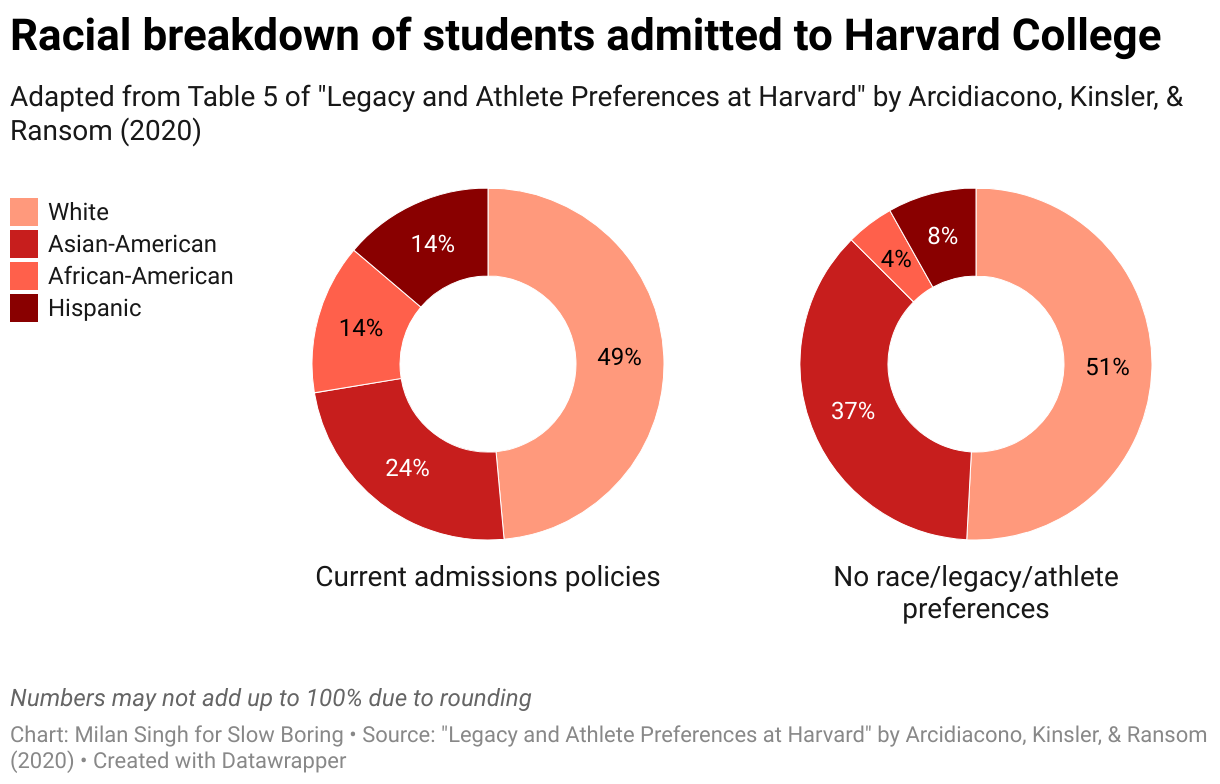
This is an important caveat, by the way. The racial breakdown differs quite a bit by major at many of these schools. I doubt Harvard would be 44% Asian even without the discrimination they engage in (and so do the authors of the study linked above, who put it at 37% Asian admittees if all the racial/atheletic/legacy preferences went away).
> not the paltry 15% quota the Ivies have consented to grant them.
15% when? The data I've seen has Harvard at 15% Asian about 10 years ago. Per the chart above the fraction of Asians in the set of people who get _admitted_ is 24%. Per the numbers at https://www.collegefactual.com/colleges/harvard-university/s... Harvard's _enrolled_ undergrads are 21% Asian. Not sure whether the discrepancy has tso do with systematic differences in how often people accept the offer of admission or whether something else is going on.
> The other thing to consider is that “diversity” somehow fails to consider class.
Yes, fully agreed.
I think universities are judged to some extent on class. There are statistics about how many Pell grant recipients they admit, i believe. But one consequence of that is that if you are just slightly too well-off to get a Pell grant, you have no chance, because admitting you won't boost the university's score.
Exactly, if it becomes truly meritocratic, I feel that there are enough qualified Asian (chinese/indian/other countries) applicants that 100% of the batch would be asian.
And there is nothing wrong with that, if that ever happened
> It's unfortunate that a quality education is a finite pie.
Good that it's not then? With modern technology, one can get started on ultra cheap automated courses (not necessarily just static lectures, can be interactive/VR experience like good computer games), coupled with one on one help from paid and volunteer tutors around the world. Than those who show potential can in due time be given access to expensive research equipment and world renoun professors. All without a need to make a life making or breaking decision based on a single admission process. Let students decide for themselves if and when to conclude that a subject is not for them. Current system amounts to artificial gatekeeping of success.
>>> With modern technology, one can get started on ultra cheap automated courses
You cannot compare a degree from a well known university with cheap/free online courses. The benefits of a degree from a well known university are immeasurable.
Did you mean that one learns more there, or that the well-known name of the university makes it simpler to get a nice job?
This is why I don't understand. The logistics of education are cheaper than ever, almost free. Having a personal mentor is of course far more efficient, but that isn't the reality of modern education anyway.
What elite institutions offer is mainly connections and access directly into the pipeline of companies in a respective field.
There is some benefit to have elite institutions because proximity of highly educated people can spawn a lot of innovation, but a successful education system needs to be broad.
The current system was developed based on almost three thousand years' experience dealing with the finite resource that was education.
And if you think that the resource is no longer finite, then are you going to supply and maintain the hardware and infrastructure to provide everybody with an online computer? Are you going to translate the coursework and exams to their languages? Provide the electricity? Provide the meal in the childrens' bellies so that their mind could be on the classwork?
Black representation is one thing, but it’s almost a red herring. You can make Harvard 10-12% Black without changing the demographics too much.[1] The bigger question for Asians I think is competition with elite whites. A “proportional representation” type system handicaps Asians against whites, for no comprehensible reason. Harvard is 13% Asian, but Caltech is 40%. Why should white students be insulated from that competition?
[1] In my opinion there is no similar justification for preferences in favor of Hispanics. Studies show that Hispanics are similarly situated to previous generations of white immigrants: https://academic.oup.com/qje/article/135/2/711/5687353. Their income disparity is explained by recency and character of immigration, and disappears over time. You see the same phenomenon about Asian groups that comprise primarily refugees. Vietnamese people were as poor as Black people in the 1970s. Today their household income is slightly higher than white people. By contrast, Black and indigenous people face persistent disparities that are not disappearing over time.
> Despite the increased chances of admission, black students make up a modest 5% of the (e.g.) Harvard student body compared to Asian students and white students at 13% and 40% respectively.
The numbers are a little misleading because 25% of the students have their race listed as "non-resident alien", aka no race assigned.
Removing that group and adjusting the other percentages accordingly gives:
* 55% White (61.5% of US population)
* 20.4% Asian (5.4% of US population)
* 12.2% Hispanic (17.6% of US population)
* 7% Black (12.3 % of US population)
* 4.7% Biracial (3.1% of US population)
I was just curious about the numbers and how they stacked up to the national average, and thought others might be as well.
A much cheaper state school in a cornfield can get you a quality education. Harvard and Yale are more about getting invited to the right dinner-parties.
Getting invited to the right dinner parties can be worth orders of magnitudes more than a quality education. I should know, I’ve only ever been invited to the wrong dinner parties!
Was the dinner tasty, at least?
If you wanted to rephrase that: The cornfield-state-school teaches you how to be a better serf. Ivy League teaches you how to become a master.
It's no coincidence that most founders come from ivy-league schools.
I’m assuming you mean startup founders (be sure to genuflect when you say that) but I can all but guarantee that the overwhelming majority of business founders in the US did not attend Ivy League schools.
Though these startup founders are both directly and indirectly funded by the power structures (investment firms, think tanks, the government) maintained by these Ivy League school graduates.
Think how all these startups are getting loads of "trickled-down" money from the Fed's money printer. Look at the list of chairs of the Federal Reserve and most of them are from prestigious Ivy League schools, you get what I mean.
The take that the economic elite are mostly from Ivy League schools feels markedly different than the take that most people who found startups are from Ivy League schools.
Startup founders are more likely to be here than old-money elites are.
But not everybody can go and be slavemasters, so if you're going to pick arbitrarily who can do it, why not use race in the criteria?
Everybody can know how atoms work, and read Cicero, and figure out where on the shore a boat traveling diagonally will land if the wind is picking up at a given rate. Increasing the human knowledge pie in that way is what universities claim to do.
> why not use race in the criteria?
We used to do that, wasn't it called Jim Crow?
Only by those who didn't benefit from the arrangement.
Is a quality education really what is at stake here? Are the faculty teaching undergraduate courses that much superior to those who teach elsewhere? I suspect that if the quality of education is better, it is because of the college-readiness of the students admitted. (So kids, you are the customer, but you are also the product.)
> It's unfortunate that a quality education is a finite pie we have to divvy up into thin slices.
I think this belief is part of the problem. Information is infinitely replicable at zero cost, but we create barriers to its dissemination. If there are kids who are eager and able to learn material, they should have access to that it. And if they have mastered the material, they should be granted recognition of that objective fact. Any other policy means we are deliberately dumbing ourselves down.
On the other hand, perhaps we need to dissect what it is we mean by "education", because while access to information can be unlimited, the number of places at Harvard IS limited. Inasmuch as membership in an exclusive social club is limited, and inasmuch as the Harvard class is an exercise in social engineering, I can see wny one may want some representation for various groups.
In short, knowledge doesn't need to be a finite pie. It only appears to be so because some domains are gate-kept by limited admissions numbers in order to protect the supply of labour in those professions. The tech industry shows that when we don't have professional licensing, talent can find a way regardless of credentialism.
We think universities are trying to solve the trolley problem of whether egalitarianism means letting people rise as high as they can or if it means compensating for all the circumstances of their birth, but they're probably solving the problem of how to admit the student with the highest donation expected value first, then the student with the second highest, then the third...
>or if it means compensating for all the circumstances of their birth
If this is the objective, then we need to start a lot earlier than the point of university admissions. Also, "circumstances of their birth" would need to be broadened to encompass quite a bit more than just race.
>we need to start a lot earlier than the point of university admissions.
Everyone agrees with this, on all sides. That's why we have highschool and grade school for example.
You can, absolutely. A lottery system for admissions.
Not sure if you're joking but it would be a heck of a lot more fair. Just have some sort of objective bar like SAT score, and then do a lottery.
Then you don't have the "did we do enough for XYZ group", the RNG will simplify both decision making and justification. If there's x% of XYZ passing the minimum score, that's how many will be in your class.
And when you find that x% of XYZ passing the minimum score isn’t exactly the same x% of XYZ in the population, what then?
"We didn't make the test. The bar is lower so more of every group passes. Fate decides who gets in, we don't add or remove anything based on legacy or donations etc."
To how many decimal points are you measuring “exactly”?
In the cases cited in the article, I strongly suspect “zero decimal places of percentage” is sufficient to show discrepancies (that discrepancies of full percentage point or more will be present, given the admissions rate for one group changed from 73% to under 50%).
The article calls out the TJ admissions process as discriminatory.
The activists that are regularly called racist against asians proposed exactly this policy. It was called a "merit lottery" and worked by setting a GPA lower bound and then admitting students randomly if they had a GPA of at least that level. This policy was ultimately seen as "too extreme" and non implemented but it saw its fair share of "lefties hate asian success" and proponents were even called "enemies of excellence" by Scott Aaronson.
yes, lowering your admissions bar because you don't like how many asians there are is clearly racist.
But if there were racial disparities in your primary and secondary education systems which lowered the scores of some racial groups, then your supposedly objective "minimum score cutoff" would still be discriminatory.
Yes but then it's society's fault and you can't do anything about it and you have a reasonable explanation.
You can pour money into giving test prep help to disadvantaged groups and keep the headline, which is that fate decides among many who are worthy.
Did Brown vs. Board of Education ever apply to private schools (like Harvard and unlike U Mass)? I’m guessing private schools had some rules applied to them later, but that was way after Brown and probably under different laws not arising from the constitution.
Kind of. When Congress passed the Civil Rights act in the 1960s, the courts became much less aggressive in finding racial equity in the US Constitution, because it simply wasn’t necessary.
Private high schools that had segregation policies ran the risk of having their tax status revoked messed with by the IRS.
Colleges get tons of money from the federal government, which is conditional on not discriminating - and keeping federal government happy.
So private secondary schools still have a fair amount of leeway. Not infinite, but in reality they don’t have to worry about lawsuits like this.
Colleges do.
> It's discrimination any way you slice it. You can't lower the bar for one person without raising it for another so long as the class sizes remain the same.
I'm against affirmative action altogether but the best kind mostly avoids this problem: only consider ethnicity when it helps the application. Consider whites, Asians, Jews, and others as part of the same category.
But then you have to also not discriminate against white students. I'm aware that at super elite schools this discrimination usually helps white people, but in a lot of other situations it doesn't.
IIRC, Ivy League schools actually have a lower proportion of white students compared to the percentage of the total populace that's white.
Of course, if you look at grade schools, it looks like racial minorities are 'overrepresented' compared to the general population, so it's possible there's just fewer young white people.
> I'm aware that at super elite schools this discrimination usually helps white people,
The article calls out the TJ admissions policy, which was explicitly race-blind and did not lower the bar for anybody else.
the bar was lowered for the express purpose of lowering the population of asians at TJ. that is plainly discriminatory and racist - "there are too many of you asian folk here so we're just gonna trash our admissions to get rid of you"
The above post said "lowered the bar for one person..."
The bar in the new system was the same for everybody. It was simply a different method of judging candidates. There was no "these groups get a lower bar because they are black or hispanic."
Notably a group whose admission went up with the policy change was poor asian people.
The purpose of the policy was explicitly to lower the Asian population. It's there in the emails. Now the policy may have failed or ended up back firing but that doesn't make it any less of a racist policy.
I'm a confused by the equity claim to justify discriminatory behavior with what seems like heavy emphasis on race. It seems difficult to achieve equity without transparent, and standardized methods emphasizing a holistic assessment covering visible and invisible, immutable and mutable characteristics--each of which impact individual outcomes.
I understand that tackling overrepresentation and underrepresentation is important; but, when emphasizing race to the degree that these academic institutions are, isn't this leading to representation disparities within the racial categories themselves? The racial categories are a very American centric and limited term, and arguably rooted largely as social constructs that loosely define the ethnic populations they cover. For example, and I don't mean any offense or to call any group out specifically, Koreans are overrepresented compared to Cambodians at the academic institutions listed in the article per their population proportion. This doesn't seem to be captured and accounted for under the current system. The same underlying disparity potentiality applies to whites, Blacks, Hispanics, Native Americans, etc...
The interpretation being, that it's a sort of half-committed approach to equity that isn't really leading to equitable outcomes if that makes sense, and may even be exacerbating ethnic marginalization within the racial categories.
Another question is, if this isn't leading to genuine equity of outcomes and instead passing discriminatory behavior onto smaller, marginalized ethnic groups, what do you do then? Do you revisit implementing an improved meritocracy system, or implement an equity based system with greater accuracy and precision to prevent this?
This doesn't even begin to tackle the issues current racial categorization creates with multiracial people and the essence of "purism."
> ... when emphasizing race to the degree that these academic institutions are ...
There is a fairly classic manoeuvre where the elites feel threatened by the middle class, so they form an alliance with the lower classes to fight them. Eg, a lot of tax & spend policies make it harder to accumulate wealth in the middle class but the very wealthy can shield themselves.
If Asians are not benefiting from being a racial minority, I do wonder if admission policy is focused more on race or more on excluding people who look middle class. I see some mention of Harvard. The point of Harvard is to politely set up the next generation of leaders. Not educate the masses.
Possibly the article offers a view on this, but it is paywalled.
100% this is poltical properganda. Asians are conservative gold-mines in Australia. Somehow our version of the Republicans have convinced them they are on their side, while also playing the jobs saviour for the working class and being anti-asian. its a schitzophrenic relationship underscored public debts subsidising private profits.
The only this article points out correctly is that "Elite" universities, and therefor most modern day research in every field, is tainted by Racist Aristrocratic idealogies. They protect their own kind at the expense of all others.
If you are dreaming of an elite school, you are the problem. You give them power.
It would be more fair to create admission quotas based on family economic status, but I can’t imagine that would ever be put into practice because it would hurt the wealthy too much. The universities wouldn’t like the financial impact either. But if true equality of opportunity were the goal, then that’s how you’d need to do it I think.
It can be gamed.
A long while back at University, I noticed very wealthy students on student income schemes that were only meant to be accessed by students whose parents qualified as low income status. The bar to qualify was quite difficult, if you had one parent employed in a job then it was unlikely you would qualify.
I asked how they could qualify, while almost everyone had to work part time jobs to cover costs.
It turns out their parents paid themselves a very low salary in order to qualify.
I remember nearly the same in Germany. When I was at university governmental student loans were a thing (still are). I didn't qualify, as my single dad earned too much (while having to pay the credit on the house and money was always tight). I worked two jobs next to my university.
Quite a few economics and law students driving new BMWs, Mercedes and the likes received student loans (they only needed to be paid back in part, so quite a good investment to cover living expenses one could say) as their parents mostly lived from dividends with the family income from salaries (from their parent owned companies) were by design very low to reduce tax burden and had the nice side effect for their daughters and sons to qualify for government subsidized student loans.
The system is setup to be gamed by those who have the financial means to do so without actual need to do so. While those with a need but no means need to pay (for those others).
It was quite grotesque. Not few of these kids had higher end cars and more spending money than their professors. While still being subsidized by the state.
Seriously? So for instance I could just pay myself double this year and nothing next year from my personal corporation, and my kid would somehow pass as having a low income parent?
Surely you have to count things like dividends, income in previous years, assets...
Failing that just make it clear that you know when you're tricking the system and fingers will be pointed.
Nope, FASFA doesn’t even look at previous years, you could be poor now and not later as far as they are concerned. We could do a lot more research into each families situation but that’s a lot of time,effort, and probably very expensive.
You could also get married young and hide it.
> You could also get married young and hide it.
What's the significance of that?
I was easily able to get federal money for college even though my parents were doing fine and supporting me. I didn't cheat or lie or even bend the rules, I just had a secret power: I was married. Because of that, my parents' financial status wasn't even entered into the picture. It didn't even come up on any form.
> but I can’t imagine that would ever be put into practice because it would hurt the wealthy too much.
It definitely would hurt their bottom lines, since most of the private elites also provide non-loan financial aid out of their endowments to people who can’t otherwise afford to go. That only works if only a few poorer people make it over the bar.
Public schools should step up more here, as it is their mission.
> That only works if only a few poorer people make it over the bar.
That is not true. The per-capita endowment of Harvard (and other schools of its caliber) is so large that it could afford to entirely eliminate tuition[0]. Currently, approximately 60% of students receive some sort of financial aid, and 20% pay no tuition at all[1]. These figures are similar at other similar schools.
[0] https://www.businessinsider.com/harvard-should-stop-charging...
[1] https://college.harvard.edu/guides/financial-aid-fact-sheet
> The racial categories are a very American centric and limited term, and arguably rooted largely as social constructs that loosely define the ethnic populations they cover. For example, and I don't mean any offense or to call any group out specifically, Koreans are overrepresented compared to Cambodians at the academic institutions listed in the article per their population proportion. This doesn't seem to be captured and accounted for under the current system.
You've really hit the heart of the logical conclusion of intersectionality that those espousing it fight to avoid: individualism. Once you have to start accounting for subgroups of subgroups, you reach the fact that the smallest subgroup to account for is an individual person.
While Asians not being fungible has something to say about individuality (although not much), I don't know what it has to do with "intersectionality." It's very difficult to be Cambodian yet not Asian. Being both Asian and Cambodian is not an "intersection."
It's not about the intersection of the group with the subgroup, but the fact that the group is not a good proxy for the individual. The subgroup is a _better_ proxy, and each further subdivision becomes closer and closer to clearly representing the individual. Ultimately, the person being an individual is the highest fidelity subdivision.
For elite universities in particular, I doubt they care about racial equity for its own sake. Instead, it's a component of their strategic interests, to wit:
1. Admitting children-of-elites for funding and advancement purposes 2. Admitting extremely high-competent students to build an alumni reputation 3. Maintaining a demographics profile that the general population will see as legitimate
Fundamentally, today's racial quotas and preferences are in place for the same reason as why Harvard discriminated against Jewish students in the 1920s and 30s. If they didn't, the university would be seen as an attempt by outside demographic groups to install elites by a significant section of the population.
NYC is going through the same thing and it's really awful. They have danced around a wild mix of policies to encourage meritocracy through testing, school choice across boroughs, charter schools. I am all for equity and inclusion, but achieving it by changing the rules of admission to top schools is the lamest answer. What we need are for schools to be better. Let's stop having so many bad schools that people run away from. Unfortunately, that's the hard problem we don't have an answer for. And the author of this article isn't presenting any decent solutions either.
You have to understand, this is the last dying throes of a liberal fire that has been raging for hundreds of years. Liberalism has achieved great things in the west, including expanding the rights of women, minorities, and LGBT individuals. We are all better off for its achievements. However, the low hanging fruit is taken, and now the same activists that once fought for noble goals are reduced to taking ever more divisive measures in pursuit of an unattainable ideological purity. The hyper focus on race, the election of Trump, the increasingly bizarre language of the modern liberal intelligentsia - these are all symptoms. Expect these crazy racist programs & ideas to intensify in the next 10 years until the whole movement collapses in on itself like a dying star (it may have already started, look at SF school board elections).
You make it seem like the US no longer has an issue when there's an entire class of people who are not being educated, has high crime, and ending in mass incarceration.
I can accept that some people have an issue with current liberal ideas because they think they don't work. If so, what is going to work? Or is the current state inevitable in order to have the high-functioning economy that the US has?
Certainly more Harvard grads isn't the solution. But finding a path to even good high school educations and any college has been elusive to say the least.
> there's an entire class of people who are not being educated, has high crime, and ending in mass incarceration.
Men?
Definitely especially men, specifically poor men in urban and rural places. Obviously the relevant issues are not going to all be solved at Harvard. But the people at Harvard are more likely to be the ones tasked with solving it.
>The people at Harvard are more likely to be the ones tasked with solving it.
That doesn't fill me with confidence.
Plenty of people-groups have endured horrible abuses and have not turned into a criminal underclass. Therefore, other groups are not responsible for any particular group’s criminality.
As to what might work I would consider medicine or genetic augmentation maybe?
> As to what might work I would consider medicine or genetic augmentation maybe?
you're a fucking nazi freak, foh with this Mengele shit
If there was an injection that made you less criminal, are you saying it should not be mandated? I fully agree.
Higher testosterone has been linked to more violent crimes. Would you propose that high testosterone individuals be mandated to receive shots to reduce testosterone?
Nah, we can all just eat a ton of processed food, and we're good.
probably not but there might be a therapy with similar effects and fewer side effects
> You make it seem like the US no longer has an issue when there's an entire class of people who are not being educated, has high crime, and ending in mass incarceration.
It’s the fault of liberalism. It’s also the fault of conservatives pushing disadvantaged minorities into the arms of liberals (often against their own cultural inclinations) but the root cause is liberalism. History of course plays a role, but liberalism is what perpetuates the problem generation after generation.
A stark realization I had after having my own kids is that my democrat-voting immigrant parents were deeply conservative, from child discipline to staying in an unhappy marriage to avoid any disruption to their kids staying “on track.” The biggest advantage immigrants have is that even when they’re democrats they’re not raised with liberal American attitudes.
That's kind of what happens when you teach a group of people that hard work and honesty results in impoverished second class citizenship, generation after generation, until there are few successful role models in a community much less parents who can pass those values on to their kids.
Criminal justice reform has always been an interest of enlightened conservatives and libertarians, not liberals. We all know that Biden talked about "super predators" and pushed tough-on-crime policies which are clearly failing today. The BLM protests have really forced the policymakers' hand, but these protests came from the grassroots not from the liberal elite.
I perhaps should have said progressives and you are correct, although I am under the impression that the tough on crime legislation was broadly popular among conservatives and liberals, and not so much enlightened conservatives, libertarians, or progressives. But the latter groups have always been a minority.
Thank you for contributing something other than pop-sociology to the comments (omg race is a social construct guys).
I hadn’t thought about this this way before - eventually anyone with an inclination to “rage against the machine” will have to really pinpoint that energy and drill down and down until it seems like a parody.
Not saying we’re there now, but an interesting thought exercise.
When the idea is backed by corporate HR departments and academic orthodoxies, it’s no longer raging against the machine. It is the machine.
I've noticed this in young people, in school or fresh out. They've somehow been convinced that they're rebelling against the system by thinking and acting exactly as they've been taught.
Liberals need to start speaking out against the 'progressives' that have commandeered their ideology in the public eye or I emphatically agree with your ending to the movement. My worry is what comes next, the people preying on american liberals aren't going to die with them.
Nit: it's not liberalism, but rather the general progressive/socialist movements. Some of the things being championed are highly illiberal, for example CRT has anti-liberalism as a central tenet.
Is there some manifesto or doc for it?
Not really, but learning about the Frankfurt School during the Weimar Republic is a good foundation: https://en.wikipedia.org/wiki/Frankfurt_School
It’s all so depressingly primitive. Half of me wants to protest that surely we’re more enlightened than this in current year. The other half would settle for everyone else admitting that yes we are definitely still this backwards.
We are chimps with electricity and gunpowder.
I attended TJ, back when it was about 30% Asian. I’ve always felt like the school should do more to get more underrepresented minorities. I’ve found the recent efforts very off-putting however.
It’s based on a modern strain of social justice ideology that adopts some very ugly assumptions about Asians. I’m reminded of Alison Collins in San Francisco, who called Asians “house n—-ers” and said they use “white supremacist thinking to get ahead.” https://missionlocal.org/2021/03/alison-collins-school-board....
Not everybody out and says stuff like this, obviously, but I sense the sentiment lurking under the surface in a lot of modern social justice discourse. In order to fit Asian economic success into their framework of “white supremacy” they end up making some extremely offensive assumptions. For example I’ve seen respectable articles arguing that the “model minority” stereotype arises from white people “allowing” Asian to be successful, to use them as a “wedge” against other minorities. I’ve been told to my face that Asians aren’t “grateful” enough to Black people for the Civil Rights movement and we “owe them.”
You see a form of this in particular the discussion around TJ. For example, opponents of merit-based admissions act like test prep is basically cheating, and elevate its effectiveness to mythic proportions. I prepped for the TJ test and SAT. It consisted of going to some Indian dude’s house for an hour every Saturday for a summer. Not private tutoring—six or eight kids crowded around a small dining room table doing practice problems. If that’s a game changer what does that say about American K-8 math education? And they act like the cost makes it unattainable for anyone else. But it’s a few thousand dollars if that (as low as under $1,000) which is reachable to all but destitute families. My uncle does math tutoring in Canada. His students are all immigrant kids from the high rise subsidized housing complex where he lives with my aunt and cousin. (My cousin lived there until he got his engineering degree and MBA and moved to a nice apartment in Toronto.)
The modern social justice folks blame all economic disparities on white people, and thus don’t even have the intellectual tools to explain what’s happening with Asians except through some distasteful assumptions.
> It consisted of going to some Indian dude’s house for an hour every Saturday for a summer. If that’s a game changer what does that say about American K-8 math education?
Ironically, this is scouting round a theory I have long espoused – the failure of American K-8 math education has nothing to do with teaching, and everything to do with culture.
Sure, going to some Indian dude's house every Saturday for a summer and prepping is not objectively hard in itself. But think of how many cultural factors had to be overcome for that to work out:
- Your family bothered enough to think about sending you there, rather than spending time keeping up with the Joneses for the latest model of garden sprinkler
- Your family quietly put down one thousand(!) dollars towards additional education instead of complaining about the schooling endlessly over $15 bottomless mimosas on Saturday
- You were extremely uncool by the standards of American culture for doing any kind of test prep. On Saturdays at that. The cool kids were off skateboarding or something, right?
- You stuck it out for a whole summer. Who does that? It's cool to blow it off, man. Chill out!
I think the big problem is that most Americans completely ignore these cultural factors, end up having bad outcomes in math, and then often blame it on the "terrible" school system. Asian-Americans just happen to have enough counteracting factors in their own culture that nullify some of these influences that drive away people from math in the United States.
----------------------------------------
Edit: Just to make it clear, the takeaway from my comment is intended to be "We should value STEM fields more in American culture, start paying your classroom teachers $200k", not "Every kid should be forced into test prep". Test prep is terrible and should be replaced by teaching the fundamentals of math and science much better. Maybe that would have caused 'rayiner to work at NASA instead of being a lawyer!
I’ll quibble: paying teachers $200,000 an hour wouldn’t solve the problem. Doing well at math just takes memorization and practice, and Americans just think that’s beneath them.
And test prep is fine. For the most part, it’s teaching you intuition about numbers, vocabulary, and logical reasoning skills. I’d much rather my kid drill SAT questions than study half the stuff in the school curriculum these days.
Criticizing culture is off limits, so here we are...
- Your family bothered enough to think about sending you there, rather than spending time keeping up with the Joneses for the latest model of garden sprinkler
- Your family quietly put down one thousand(!) dollars towards additional education instead of complaining about the schooling endlessly over $15 bottomless mimosas on Saturday
You really think economically disadvantaged families are sitting around sipping mimosas and worrying about garden sprinklers? Wow.
> You really think economically disadvantaged families are sitting around sipping mimosas and worrying about garden sprinklers? Wow.
None of my comments were scoped to economically disadvantaged families – in fact my thesis is explicitly focused on culture, not economic circumstances or the education system. There are plenty of economically advantaged families whose kids are doing poorly at math.
His analogy was sound. When we’re talking about these elite schools, we’re talking about competition within the middle to upper middle class. The median income of every racial group in Fairfax County, for example, is $100,000-150,000. The most underrepresented group at TJ is actually white people, who have the highest median income.
I always wondered if these parents raising test ninjas are doing their kids favors. We have google now. I don't need to know the capital of Ukraine - I can just google it. STEM is great to study, but most of the academics in it after 8th grade are not particularity useful. I still haven't been asked to solve a differential equation at work. I have never been asked what school I went to during an interview (i wished they cared).
Build a raseberry pi robot with a friend, start a club with friends, figure out how to build a fort in a tree, sell lemonade, build a website with friends, find out what you like to do <- I feel like these will be more important job skills compared to memorizing Boyle's law [ a relation concerning the compression and expansion of a gas at constant temperature 1662 ].
You will have decades of sitting, staring at broken SPA apps - smelling someone cook fish in a microwave. You will never get that 3rd grade summer back.
> I still haven't been asked to solve a differential equation at work.
I wish this trope would go somewhere to die. First, university level education is catering to a variety of outcomes. Some people in your class have gone on to use differential equations. If not explicitly, at least in understanding how capacitors and inductors introduce periodicity to the circuit. More importantly, the people that are doing research and advancing new technology do have to use these tools. In my view, at the university level, we want to optimize the absolute ceiling of potential for a thin sliver of the population. That's how we get scientific progress. Imagine if Einstein did not have access to higher level math because it was deemed mostly not useful. The collateral damage here is that some people need to take courses to justify the professor's course.
While I do agree that well-rounded individuals are more important you are missing the fact that the takeaway of STEM courses is not "to memorize Boyle's law". If that is how you approached your studies, then I can understand how you feel the education was a waste. But the more important aspect is learning the process in which one solves a problem. Being exposed to a variety of domains exposes you to slightly different initial conditions and thus shows you a broader range of problem solving methods. Likewise, I can generate an equally silly list like yours of life lessons learned in STEM class from my own public education that are more important than the material: build a Rube-Goldberg machine with a friend, start a study group with friends, figure out how to build a rocket, sell cookies (ok not from a STEM class), build a video game with friends, find out what you like to do.
> I can just google it. STEM is great to study, but most of the academics in it after 8th grade are not particularity useful.
Respectfully, I couldn't disagree more. Understanding the basics of calculus allows one to grok the underlying principles of the universe.
I studied hard science (geology) which included quite a bit of chemistry and physics, which helped me when buying a house (in a location not prone to natural disasters) and remodeling my house (understanding the physics in load-bearing walls and behavior of water in structures).
I also majored in English literature, studying overseas, which trained me to become a much better writer than I otherwise would have been.
Saying "just Google it" shows a very shallow understanding of applied theory which makes one a much better problem-solver, imo.
> We have google now. I don't need to know the capital of Ukraine - I can just google it.
That's not the point. The point is to be able to retain that memory so you can form a unified view of the world and not have to resort to Google all the time. Did you think encyclopedias, dictionaries, and world maps didn't exist before Google?
> I still haven't been asked to solve a differential equation at work.
The skills you used in figuring out which method to apply and the accuracy in not making mistakes during integration, etc. will help you every day.
> Build a raseberry pi robot with a friend, start a club with friends, figure out how to build a fort in a tree, sell lemonade, build a website with friends, find out what you like to do <- I feel like these will be more important job skills compared to memorizing Boyle's law [1662].
...and, it is this sort of reductive thinking that's causing the US to fall behind in STEM. I will leave it to the reader to figure out how Boyle's Law literally applies to rocket science.
> You will have decades of sitting, staring at broken SPA apps - smelling someone cook fish in a microwave. You will never get that 3rd grade summer back.
Again, a false dichotomy. You can have plenty of fun in 3rd grade summer without needing every second of it needing to be some kind of Elysian playground.
I don't think that it is waste. Learning to be test ninja means that you have to learn to concentrate and spend effort at a single task for a period of time over a period of time.
That skill you can later use to do any of the mentioned activities far more efficiently.
At least that is how is see. I thought myself to be a test ninja during high school and I still follow the same basic pattern when doing work related stuff or for hobbies.
Sounds like the first step towards the world described by Issac Asimov in "The Feeling of Power": https://en.wikipedia.org/wiki/The_Feeling_of_Power
Interestingly enough, he apparently had issues understanding how integration by parts worked.
pretty sure the test ninjas build Google
At this point, that could either be advocating in their favor or not so much.
Agreed. And test taking may not be the best criteria to judge people by.
I put in an explicit edit at the bottom of my post now to clarify – I think test prep is terrible to. The important part was cultural factors valuing STEM enough to pay for test prep, not the prep itself.
> I think test prep is terrible to.
Since this is not a mix-up I make very commonly, I obviously meant "...terrible too".
> But it’s a few thousand dollars if that (as low as under $1,000) which is reachable to all but destitute families.
I live in Arlington, so not Fairfax, but in a neighborhood that borders Fairfax (and not really that far away from TJ either). The median household income for our census tract was about a 3rd of the county's average, ~$40k vs ~$120k when I looked into it a few years back. Which is also indicative of the Fairfax areas around me. It's not like America has much in the way of generic social support to make it easier for folks like that to spend a couple thousand on some extra tutoring, plus the cost here is higher because there are so many affluent folks to drive up the price of a tutor. This also isn't a small number of people, it's a really dense area down here relative to other parts of Northern Virginia (including parts with substantially better transit access and more walkable communities).
Northern Virginia has some pretty unique pockets, my zip code is one of the most diverse in the entire country[0], and a bit south of me in Fairfax is the only other one Virginia has in the top 100, but also quite a bit of poverty in those same unique areas. Idk, I just wouldn't paint with such a broad brush, when I know very few folks on my block with kids could just spend a few thousand on extra tutoring.
[0]https://medium.com/@waldoch/measuring-neighborhood-diversity...
I got the impression that he meant $1,000 total, not recurring. Surely most people can scrape together $1,000 over years, if it’s made a priority.
A potential disconnect is the timeframes, I would guess they went to school there decades ago? I have limited direct experience with the tutoring market here, having moved to the area as an adult without kids, but do have a family member and a colleague who did it for some extra cash and the costs I was hearing then (~4-5 years ago) were more like thousands. If I think about folks with kids on my block - again, limited to my direct experience (although within a fairly dense and lower income neighborhood), people are working as movers, maids, day laborers, random car fixing and odd jobs, etc. I wouldn't doubt that the next step up of folks like construction workers or mechanics employed full-time could cover a cheaper tutor, but these costs are simply not negligible. It's not a cheap place to live in to begin with.
There was an article in the mid 2015 timeframe about how the low income Chinese kids in NYC go to this prep center that’s $800 for a summer. Note that for the most part these are group classes, not 1:1, so you’re amortizing the cost over 6-8 kids in a small group.
No, they’re not “negligible.” And frankly I think opponents of standardized testing really overestimate how much test prep even helps. TJ is 70% Asian and only about 25% white, in an area where the median white household income is well north of $100,000/year. If test prep is what causes that disparity, as people suggest, then it’s worth it even if it’s a “substantial” rather than “negligible” expense. Outside the very bottom rung,[1] it’s a matter of financial priorities.
[1] That very bottom rung is quite a small percentage of the population. Keep in mind that only a few percent of the population makes minimum wage, and most of those people don’t have school-aged kids.
A one-time expensive of a couple of thousand or so is not unaffordable on $40k/year. And note also that the median household income of Black households is over $60,000/year in Arlington, and $80,000 for Hispanics. In Fairfax County, it’s close to $100,000/year for both Black and Hispanic households.
I really can’t wrap my head around an argument that amounts to “that person only succeeded on the test because they put in the time and effort to learn the material and their hard work is the primary thing that separated their performance from this other person; if that other person would have tried, they could have done just as well; that’s not a meritocracy!”
It's pretty simple. A lot of kids don't have an opportunity to put in the time and effort. Some of them still do well despite this, and that shows they have great potential if given the opportunity.
Taking life challenges and starting points into account is more of a meritocracy, because you are accounting for the difficulty they had to get to where they are.
For example, say you have two kids with the same high SAT score. One kid has been given every chance to succeed - test prep, rich parents, best schools money can buy. The other kid was raised by a single parent in a poor neighborhood at a bad public school with no test prep or anything like that. They have to work a job to support their family. On paper they have the same score, but the 2nd kid clearly has more merit, in my opinion. They would likely surpass the other kid if given the same privileges they had.
There's always a lot of weird circumlocutions around "merit" and "opportunity."
In NYC, the poverty rate is higher among Asians than among African Americans or Latinos. In what way do the latter groups have "less opportunity"? Is it simply that Asian kids only succeed because they cheat by studying more?
I think that’s a weird stat to try and provide an argument with. There’s been a huge influx of Asian immigrants to nyc in particular and high poverty rates makes sense if you’re grouping all these immigrants in one group because they’re from the same continent (which never made sense to me since even Americans see Indian people to be distinct from Chinese people for example). Thus I don’t think it’s fair to say other groups don’t have less opportunity based on that.
Also with regard to how other groups might have less opportunity, it could be a result of harsher institutional racism towards one group of minorities versus another even given the same socioeconomic circumstances.
Your example lists two outliers, though. Nobody thinks the kid with the 1600 SAT score who gets passed over by the Ivy admissions committee is going to turn to a life of cannabis and government handouts; we're not that racist. That kid is exceptional and will always be considered as an individual. The squirmy mass of kids with average scores are more of a concern.
What do you mean by merit? Meritocracy is not about some kind of moral desert; it's a really, really inconvenient practice we put up with nonetheless (all those tests and credentials are no walk in the park!) because we think that higher-levels of responsibility (which are naturally well compensated) should be given to people with the most appropriate level of skills and competence, which are only developed via strenuous effort. One can say that the 2nd kid deserves to be helped just as much as anyone else in a similar social situation, but as a matter of fact they are surely not more competent.
That makes sense in some situations, but when looking for school applicants, wouldn't you want the student with the most promise?
For entrance exams for Thomas Jefferson Magnet High School, my answer is aligned with yours.
For college admission? My answer is way more aligned with GP's.
At some point theoretical potential must turn into demonstrated competence for it to have value and be rewarded. If that hasn't happened by SAT time, I'm betting against it happening in specifically the next 4 years.
If the concern is about the kid who has to work a job to support a family, then by all means reserve slots for economically disadvantaged kids. But for the most part that’s not who we’re talking about. The median household income among underrepresented minority groups in the TJ attendance area is solidly middle class. Similarly, most of the racial gerrymandering at universities is targeted at underrepresented minorities from middle and upper middle class families, often affluent African immigrants.
To play devil's advocate, these tests are supposed to test aptitude to predict ability to learn--not test what you already know. They are more akin to an IQ test than a bar exam or medical board exams that test your knowledge. If just you want to test their ability to perform in school, why aren't grades the better metric?
It is very likely that increased preparation of the test reduces the tests ability to predict aptitude. If you were testing aptitude for kicking a football, and some players practiced every day and some never kicked a ball before, the test would overrate the players with practice and underrate those who didn't. Send both groups to football kicking practice for 8 hours a day and the test stops being useful.
That said, it is really easy to measure this. And the fact that the proponents of the affirmative action don't prove this factor is significant suggests it probably isn't. All you have to do is see the correlation between asian/white scores and their grades and the correlation between black and hispanic scores and their grades.
I have no experience with Fairfax county school testing, but in law school testing (LSAT), the scores for black and Hispanic students still accurately* predict their law school and bar exam performance. The LSAT isn't biased.
*as accurately as it predicts anyone's performance.
Collages prep has some inertia where students who study and do test prep are significantly more likely to get through freshman year. Things generally flip by senior year where the under-preparing groups who make it that far end up outperforming.
The racially neutral way to look at it is rich white kids going to elite high schools fall behind the middle class white kids academically at elite schools. This effect is somewhat hidden by weighting all classes equally when calculating GPA.
> If just you want to test their ability to perform in school, why aren't grades the better metric?
Because grades are not independently assessed by a third party? No matter what the theory behind it, the SAT is really, really close to an independent test of learned material. And many people would surely argue that having your prerequisites down pat and being fully ready for subsequent learning is at least a major part of what "aptitude" means in practice.
It's really not meant to be an independent test of learned material. It's meant to be an aptitude test.
At the point where you’re entering college, how well you’ve mastered and can apply the basic math that SAT tests basically is your mathematical aptitude in the “suitability or fitness” or “likely to succeed at college math/engineering/science/logic” sense of the word.
It's more that the other person doesn't get the chance to try because nobody is footing the bill for their test prep.
It is self evident that loving, responsible parents with income provide better outcomes for their children's future.
Precisely, and that's the problem we have to solve. We need to remove that influence somehow so everyone has an equal opportunity to succeed.
You can take steps to reduce it, but we don’t (nor should we) have the will to eliminate it.
My kids will have advantages over the median kid in America and my wife and I work hard to ensure that. I don’t have to be specifically seeking to give them a relative advantage, but everything parents do to ensure an absolute improvement in their life outcome represents a relative advantage as well.
We ensure medical care, nutritional food, calm, regular, and loving interactions with adults, social and physical learning through play, clearly prioritize academic achievement, take care to discipline them appropriately, allow them to struggle-then-succeed at many things, expose them to science, cooking, math, computers, electronics, live in a house full of books and Kindles, have a family pet, take trips to local museums and farther off places, expose them to music, a second language, various sports, ensure they feel safe/secure/loved, that they have a quiet, comfortable place to sleep, etc. We’re fortunate to be able to do these things, but it also takes some sacrifice to do them.
If you want to remove those influences entirely, I can’t see doing it without having the state raise the children in standardized conditions. And of course, no one would tolerate that.
I was with you right up to
> But it’s a few thousand dollars if that (as low as under $1,000) which is reachable to all but destitute families.
Selling my blue collar parents on $1,000 to slightly improve my chances of getting into a slightly better school so I could spend even more money? That’s absolutely not happening. I’d have gotten a pat on the back and told there’s no shame in community college.
I think you misjudge how people see that value proposition. There are certainly blue collar parents who see value in a prestigious education, but most maybe rightfully don’t.
That's exactly what he is saying. There is a huge culture underlying. I came form this background and I personally knew tons of east Asian parents would do this(don't much know about south Asian cultures). They would work in the day, come home and work with children's study. Many even attend their children's tuition classes with them. Education value is held pretentiously in east Asian culture, regardless of the income or whether they are in Asia or in North America.
I even knew many parents are guiding the children to take up programming at a very young age. `Bill Gates and Mark Zuckerberg went through this. We should to`.
It is a much better school if your goal is to get your kid into Harvard/MIT/Princeton. Thomas Jefferson is comparable to schools like Phillips Exeter ($38k/year) on Polaris List for the number of kids they send to those schools. https://polarislist.com/
You lost me at 'parents'. I grew up poor as shit in a single parent household. Food stamps. Hand me down clothes.
My mom made damn sure that I went to the best possible schools, did all of the afterschool programs (including the expensive ones like band) and went to summer camp. She had to beg, borrow, save and sacrifice to make sure that happened.
If you grew up in a two parent household you're already significantly ahead of the game by a huge margin.
I've got no interest in playing "who had it worse" but I think two or four or even a hundred apathetic parents put a child at more of a disadvantage than a single parent that actually cares.
My parents had literally zero involvement in my education. I was never helped with homework let alone walked through the college application process. My friend literally paid the $50 application fee for me because I couldn't get it from my parents (thanks Paul).
I can't speak to individual circumstances. I've certainly seen your situation and know that it happens. Just in aggregate though, children of two parent households overwhelmingly have better outcomes. In fact it's the single largest factor determining success in life, statistically. Certainly this can be in spite of, rather than because of your parents.
Also I probably mistakenly gave the impression that my mom cared. No. Her values were more that kids should be out of the house every day from breakfast until dinner. If she had left me to figure that out on my own in New York City I just would have been a kid on the street. As soon as I could get a permit to work and earn my own money was as soon as she stopped giving a shit.
I didn't get a higher education.
Well there is a reason why a quarter of Asian kids who grow up poor end up in the top 20% as adults, versus only 10% of white kids.
this is exactly what's wrong with (poor) Americans. you can go to any east asian country and see how different their mindsets are to yours. they will make damn sure their kids get their best education even if they starve
> And they act like the cost makes it unattainable for anyone else. But it’s a few thousand dollars if that (as low as under $1,000) which is reachable to all but destitute families
This strikes me as extremely out of touch. I would think this cost is unattainable for a large chunk of American families.
If it were true, and the cost was so clearly worth it, then why isn't every kid in America doing test prep?
Different culture: https://www.realclearinvestigations.com/articles/2018/06/21/...
"Do these Asian students have an unfair advantage because their affluent parents can afford to pay for expensive test prep, as Mayor de Blasio has suggested? At Stuyvesant, as critics of the de Blasio plan have pointed out, 46 percent of students qualify for free or subsidized lunches, a common measure of very modest financial circumstances. Many of the Asian families whose children go to Stuyvesant and the other specialized schools are poor. Many of them are immigrants, or the first people in their families to be born in the United States. Many of them live in households where English isn't spoken. They are not children of privilege gaming the system, but newcomers working to realize the American dream.
...
But in addition to pushing their children, China- and Korean-born parents, according to the "tiger mom" theory, sacrifice their own immediate needs to provide their kids with the resources they need to succeed."
Because it’s hard? It requires forcing your kid to do something they probably don’t want to when you’re likely already exhausted from the other demands of staying afloat, especially if you’re a single parent.
But reasonable test prep is very obviously obtainable from a monetary perspective. My own SAT prep was mostly a $20 workbook, and my score improved immensely by the third practice test. Even $1,000 can be achieved if it’s made the top priority besides food/shelter. And my impression is that for many Asians, that’s where the priority sits.
What’s more important to get a kid, a new iPhone or some education?
Americans mostly don’t do after school reinforcement education because it’s not in our culture —unlike Asian cultures where buxibans are pretty much the rule. People will putt around in very old cars which need replacement in order to afford being able to send their kids to after school classes.
We’d rather get new sneakers, iPhones or whatever else peer pressure tells us to do.
Our pop culture reinforces the “be a dope” stereotype as cool and the studious kids as “nerdy”. That’s all you need to know.
That is certainly a factor but I'm not sure it is all we need to know.
Test prep isn't all that effective in raising scores, at least on the SAT. To the extent that it is, a $30 test prep book provides the lion's share of the benefit.
Different family cultures. Some families value education more, plan ahead more, and sacrifice current consumption for their children’s future more than others. Small differences compound over time.
> It consisted of going to some Indian dude’s house for an hour every Saturday for a summer. Not private tutoring—six or eight kids crowded around a small dining room table doing practice problems.
Wow I resemble that remark, down to the part about the Indian dude's house. We didn't have a few thousand dollars to spend though, we just photocopied practice tests and worked on the same test together.
Beyond "not everyone out and saying stuff like this", Collins was practically run out on a rail for it, losing a recall vote in a landslide, in San Francisco. Collins is a pretty good example of the limitations of this way of thinking: the Internet showcases and amplifies the stupid shit people say, but Twitter isn't reality.
> If that’s a game changer what does that say about American K-8 math education?
American k-8 math education is a hot mess and the statistics have borne that out for years. Less than half of 8th graders rank "proficient" in math (https://www.pewresearch.org/fact-tank/2017/02/15/u-s-student...).
> But it’s a few thousand dollars if that (as low as under $1,000) which is reachable to all but destitute families.
And you've hit the nail on the head.
https://www.healthmattersalexandria.org/demographicdata - the median household income for African American families in Alexandria is $55k / year. A thousand a month is 20% of income, only 10% less than is recommended for spending on rent. Private tutoring for African American families is like renting two apartments. For the median Asian-American family in Alexandria, that private tutoring is only about 10% of income. And, as a side note, the fact that the median breaks so differently between two racial demographics points to the interplay between race and class in the United States that has historically made issues like this so challenging to address. Programs designed to minimize class disparity can look like racial programs.
America's historical racial disparity is a hard problem to solve. People know what the outcomes are that they want, but "the pipeline is leaky and full of acid," as the saying goes. I'm not sure the solution is to bootstrap students who would otherwise miss the mark into magnet school by changing the selection criteria to cause the magnet school to more accurately reflect the local demographics around the school... But I understand the impulse to try, because honestly, I don't think anyone knows what will work.
> It’s based on a modern strain of social justice ideology that adopts some very ugly assumptions about Asians.
But the assumptions are based on socio-political history. It's fairly well know that the asian american population is very whitewashed primarily because most asians ( chinese, vietnamese, etc ) were pro-white collaborators who fled china, vietnam, etc after their side lost wars ( chinese civil war, vietnamese war, etc ). These are people who sided with their european/american colonial masters against their own people. And another group are asians historically dominated by white nations ( philipines, japanese, etc ). There have been demographic studies that showed that most asian americans date and marry white. It's so skewed that asian american communities will disappear in a generation or two without asian immigrants.
> I’ve been told to my face that Asians aren’t “grateful” enough to Black people for the Civil Rights movement and we “owe them.”
It was the civil rights movement of the 60s that ended the ban of asian immigration. Without the civil rights movement, there hardly would be any asians in the US. Asians were specifically banned from the US.
https://en.wikipedia.org/wiki/Immigration_Act_of_1924
https://en.wikipedia.org/wiki/Chinese_Exclusion_Act
Oddly enough, asian women were the only gender specifically banned from the US. Looking back it's bizarre, but it happened.
https://en.wikipedia.org/wiki/Page_Act_of_1875
It was only in 1965, as a result of civil rights movement, that the ban was lifted. 99.99% of the asians here today came after 1965.
https://en.wikipedia.org/wiki/Immigration_and_Nationality_Ac...
I'm against affirmative action, against woke culture, etc. But there are kernels of truth on every side. I certainly don't think you owe anyone anything, but there is a reason why other minorities might think you do. This issue also shows that everyone has issues with everyone. And everyone will fight against everyone when the pie gets smaller and smaller.
> But it’s a few thousand dollars if that (as low as under $1,000) which is reachable to all but destitute families.
It seems that more than half the families in the US are "destitute" then (https://www.foxbusiness.com/money/most-americans-cant-afford...) and it's been bad for years (https://abcnews.go.com/US/10-americans-struggle-cover-400-em...)
That addresses sudden expenses that people can cover without resorting to credit, not planned expenses. Two very different things—a lot of folks who couldn’t make a $1,000 unexpected payment for cash flow reasons wouldn’t blink about $1,000 extra in a 5-year car loan where they can plan around the extra expense. Americans are chronically cash poor because their expenses rise to meet their income.
Poor immigrant families in New York where the parents work in Chinese restaurants can afford $995 for test prep because they plan for it in advance.
Exactly, it's all about life choices.
Many Chinese immigrants never go to bars / night clubs, and almost never eat outside, and almost never travels. They save all the money for their kids' education.
Some other ethnic groups, even low-income families frequently spend money on those things. Yes. It's your right to spend the money the way you like. But you don't get to cry for no money for education when you spend money on other unnecessary things.
Essentially, it's culture.
In modern multiculturalism, cultural differences are important for the narrative, but totally unimportant for life outcomes. Why is that?
Because some cultural differences are different than others. And the ones that are especially detrimental won't change unless people of that demographic are exposed to and learn from successful people who engage in beneficial habits that solve the issue.
I don't think most people would change their behaviors even after they are exposed to other cultures.
There is an opposite force to prevent you from engaging in "beneficial habits". In Blacks kids, there is a commonly known term called "acting White". Kids can actually be laughed at for studying hard.
Do you think normalizing the successful behaviors will increase the backlash? I would think it would do the opposite. And I would disagree with anyone that said that becoming highly educated, at least in the modern sense, necessitates giving up one's culture.
When even the first African American President didn’t want to do that, there’s no other person can do that without being called a racist. Sometimes what matters is not being correct, but being politically correct.
That's a myth perpetuated by a (possibly willful) misinterpretation of the survey results[1][2].
If you click on the report in your own link, the survey summary even says as much:
"If faced with an unexpected expense of $400, 61 percent of adults say they would cover it with cash, savings, or a credit card paid off at the next statement—a modest improvement from the prior year. Similar to the prior year, 27 percent would borrow or sell something to pay for the expense, and 12 percent would not be able to cover the expense at all."
In the study, the Fed asks respondents whether they are able to pay all of their bills in full. Only 17% say they can’t pay some bills. The Fed also asks respondents how a $400 emergency expense that they had to pay would affect their ability to pay their other bills. 85% percent report that they would still be able to pay all their bills. Only 14% say that the emergency expense would result in their not being able to pay some bills. The situation is bad for that 14%, but that figure is much closer to what you would expect in a normal distribution, unlike the sensationalist 40% figure that makes the rounds.
Also, these kinds of surveys capture a point in time, and don't reflect changing affluence of an individual over the course of their life. One study[3] of historic income tax returns found that 40% of working Americans spend at least 2 years in the top 10%. A full 62% spend at least 2 years in the top 20%, and over 54% spend at least 3 years there[4].
If this comes as a surprise, one can sanity check this by comparing the median household income (after taxes, transfers, and benefits) in the US with those of other countries; the US is #1[5].
And NB: even for those that are destitute, the US has a huge safety net, where the poorest fifth of American working age households are better off than those in Canada, Denmark, Britain, and Germany because their market income is higher and their taxes are lower, after accounting for all monetary benefits[6]. That's not to say that there isn't room for improvement (people still slip through the cracks), but it's by no means as dire as many make it out to be.
Given all this, it takes a lot of motivated reasoning to be able to argue that "more than half of the families in the US are destitute".
[1] https://www.bloomberg.com/opinion/articles/2019-06-04/the-40...
[2] https://www.cato.org/blog/it-true-40-americans-cant-handle-4...
[3] https://journals.plos.org/plosone/article?id=10.1371%2Fjourn...
[4] https://journals.plos.org/plosone/article/figure?id=10.1371%...
[5] https://en.wikipedia.org/wiki/Disposable_household_and_per_c...
I feel like these affirmative action policies are attacking the wrong aspect of scholastic achievement that doesn't need to be addressed as urgently as other problems in the system. These policies benefit students that are already having some degree of success, but they don't help the students that really need help, the students that have serious trouble with their education like those described in [1]. Those students are basically pushed through via no child left behind and then graduate (or drop out) and immediately fall through the cracks of society into a poverty trap that is very difficult to escape without a real education, skills or opportunity. I think this is the place where the most gains are possible which can then lay the foundation for improving communities that seem perpetually stuck in poverty. In comparison, those getting into a top institution via AA would most likely experience some degree of success even if AA didn't exist.
For those that benefit from AA to get into elite institutions, this can paradoxically end up being harmful as they are often thrown into the deep end where they have to compete with peers that are the brightest in the world since they have had to go through all of the supplementary development necessary to compete with the best of the best to get accepted [2].
[1] https://foxbaltimore.com/news/project-baltimore/city-student... [2] https://www.theatlantic.com/national/archive/2012/10/the-pai...
> In comparison, those getting into a top institution via AA would most likely experience some degree of success even if AA didn't exist.
An extremely disproportionate amount of the benefits of attempts to fix the damage done to black Americans goes to black elites. It's a colonial pattern, where the goal seems to be to generate a tiny clique of representatives who can be treated like diplomats/negotiators for the entire group. The problem is that black Americans are a group only to the extent that they face the same racial treatment by the US, but not through being actually coherent or deeply obligated towards one another. The bulk of black people are supposed to see "representation" and "role models" as some remediation through some trickle-down of inspiration and drive. Black people have plenty of inspiration and drive, what they lack is family wealth; paradoxically, efforts to fix that have concentrated on black people who do have family wealth.
It's annoying but obvious why Asian people would be upset; they're seeing top 0.5% privileged black people getting a benefit from a historical discrimination that has affected them the least (as compared to other black people.) But that's really what meritocracy is: the people who have the most get the most.
It certainly doesn't help that fictional depictions of black people in television and movies tend to depict them as wealthier and more educated than the white people on the same programs, and disproportionately likely to be in management positions. People are bathed in images of black elites (produced by other white people), and when hearing about Ivy League discrimination have to know who that benefits.
Agreed. People in this thread seem to want to throw out the baby with the bathwater just because it is obvious that any kind of equity solution isn't going to be solved by changing the demographics of Harvard grads.
So they should. Anything other than an objective standardized test is just asking for bias.
Australia gets by just fine with standardized testing only, don't see why America can't as well.
If you make the cut then you can qualify for scholarships if you are disadvantaged because of means, etc.
To be fair though Australia is overall more equal in terms of schooling outcomes but to pretend that it's a university/college problem that the rest of the schooling system is fucked is preposterous. By the time someone is at the age to go into university the damage has been done.
Give the spots to those that deserve them because of ability. It's not the job of the school to rebalance society that is the governments problem.
>Australia gets by just fine with standardized testing only, don't see why America can't as well.
Because when the results align along racial boundaries and votes (and therefore power) can be won by 'combating' that 'discrimination' policies follow accordingly.
What? If you think standardized testing is benefiting white/rich Australians you are horrendously mistaken.
Asian Australians disproportionally destroy the affluent white Australian population on standardized tests as they fucking should because they prepare more and work harder.
As a result they have priority access to medicine and law degrees, again, as they fucking should.
If someone is going to work harder for something they simply deserve it, that is all there is to it.
Just because Asian Australians do better on standardized testing does not mean white/rich Australians do not benefit more from it. The population size of each percentile and distribution across percentiles also matter. White identifying students can represent a larger distribution in the top percentile ranges overall [1]. > as they fucking should because they prepare more and work harder.
Working harder does not increase population size or influence necessarily.
> If someone is going to work harder for something they simply deserve it, that is all there is to it.
Not all jobs, responsibilities, careers, political representation, the list goes on.. are based on merit or even hard work. Their is definitely an element of luck and survivorship bias.
Standardized tests are also bias. They are biased toward individuals who are representative of the typical test-taking participant in background, who have more test-specific preparation beyond ability, and toward individuals who are more familiar and skilled with standardized test-taking in general.
Also grouping all Asians together as a group that represents what you may think is ridiculous, the cultural differences between Chinese, Indian, and Vietnamese cultures are very different.
[1] www.brookings.edu/research/race-gaps-in-sat-scores-highligh t-inequality-and-hinder-upward-mobility/
>If someone is going to work harder for something they simply deserve it
What if they only know to work harder for something because of their privilege? Plenty of groups, due to lack of privilege, simply don't believe - because it hasn't applied to their cultures in the past - that hard work yields rewards.
Imagine a slave. What incentive does a slave have to work harder? Why would a person from a culture that's backgrounded in slavery believe in hard work?
The same is true in the US but reality doesn't matter.
> Anything other than an objective standardized test is just asking for bias.
Agree. "De-bias" is actually the same thing as bias. The only way to solve bias is to increase accuracy of measurement, not introduce new error terms with a negative sign.
So, I was involved with admissions in a selective graduate program. Not undergraduate but I saw some of the same issues arise. I have a lot of thoughts about this all.
The end result of a lot of this, my guess, is that schools will drop standardized tests as admission requirements. That's what happened at my institution.
Standardized tests are also biased. They are definitely biased toward individuals who are representative of the typical test-taking participant in background, who have more test-specific preparation beyond ability, and toward individuals who are more familiar and skilled with standardized test-taking in general. The purpose of standardized tests, nominally, is to select on aptitude, ability, or achievement, independent of the test, not to become the thing selected for. People seem to forget this. All the other things -- grades, experiences, and so forth -- are also biased in their own way, but in ways that counter the bias of tests. The reasons for having multiple criteria are so the different forms of bias sort of cancel each other out, or can be evaluated against one another.
Stepping back a bit, I have colleagues at institutions who heavily use standardized tests rotely, and they complain heavily about ending up with students who just want to be told the correct answer, without thinking independently or questioning material. That is, overly obsessed with grades, or missing the fact that established textbook information is often incorrect, or incomplete. This is the fear. Schools want you to be right in the "real world" even if it means getting a lower test score or grade. (Importantly, these colleagues are at institutions with low numbers of Asian applicants to begin with for other reasons, mostly geography.)
Having said that, there's definitely racism afoot. Interestingly to me, people seem to be assuming that this always takes the form of quotas or something, where the racism is in favor of blacks or hispanics, and against Asians. This might be true in many cases, but racism can operate simultaneously against both. I have had colleagues who have argued heavily against black-hispanic applicants because test scores were too low, and then against Asians with good test scores because of interview characteristics. What people might be missing here in this HN thread is that this racism was coming from persons advocating for use of standardized tests. At some level this can happen because typically there are more than enough applicants with high enough test scores, and because there are other reasonably objective criteria that are also legitimately important, so you have to use something other than the test to make decisions.
The net result of this all was to conclude that tests were problematic in both directions, that it underselected some people of disadvantaged backgrounds and overselected other people of other types of backgrounds. Not because of race quotas per se, but because of test bias. There were too many experiences of people with very good real-world qualifications in every other respect, but low test scores, or high test scores and every real-world indication of problems, even among individuals who were all white. The response to racism with regard to test selection was to just drop the test requirement, because in situations with racism, it was being used to exclude underprivileged individuals, and also not helping people who were experiencing other forms of racism. It was basically concluded the test was becoming a distraction and not functioning that well.
I get your points. I really do.
I know that standardized tests aren't devoid of faults.
But, if you want to replace them, you have to replace them with something better.
Just because something has faults, it doesn't mean we abandon it. We find something better, and then replace it.
That is not being true for admissions.
Double-blind standardized tests are not only safe against bias, but also against corruption.
If we were to simply abandon things with fault, we would have to get rid of democracy, marriage, and food, among other things.
This is a sad case of Goodhart's Law playing into reality.
People in power have chosen one metric as a measure of progress of historically oppressed races- enrolment in college degrees.
And that is costing us dearly.
>All the other things -- grades, experiences, and so forth -- are also biased in their own way, but in ways that counter the bias of tests.
I was under the impression that the main variable we were trying to predict in admissions was collegiate academic performance.
High school grades are highly correlated with collegiate academic performance. High school grades + standardized test scores taken together are even more correlated.
This study:
https://50.cresst.org/2020/05/20/cresst-recommendation-for-n...
Found that eliminating standardized tests in admissions actually benefited Asian applicants while hurting Black applicants.
No objective admissions metric will ever be perfect, but grades and standardized test scores are fairly good. I wonder how long until there's a push to eliminate high school grades as an admissions metric.
So you believe standardized tests are unbiased, huh?
It's literally in the name.
All the bias happens well before the tests. Fix the bias at it's root, don't blame standardized testing regimes for exposing the inherent biases in the system.
https://www.nea.org/advocating-for-change/new-from-nea/racis...
https://www.sciencedaily.com/releases/2010/07/100730074308.h...
“ "The belief in the fairness of the tests and the accuracy of the gauges to check them has been so deeply engrained that to challenge them would be akin to questioning the sun as center of the solar system," said Aguinis, a nationally recognized expert who was also a co-author of an amicus brief in the landmark Ricci v. DeStefano Supreme Court case regarding employment testing.”
The amount of bollocks in those two links is hard to quantify.
People who's job it is to complain about how unfair the world is aren't fit to decide how we should measure the effectiveness of education and our students progress. Leave that to educators, just like we can leave the bitching to the "Antiracist Research & Policy Center".
The tests -will- show that disadvantaged children are behind, that is literally the point. Said test results don't mean said child is "lesser" simply that they aren't at the same level as peers that score higher. Fixing that is the job of the schools and the government (in so far as reducing the race/socioeconomic gap outside of the classroom), but they need the tests to understand which each child sits.
Hell if they -didn't- show that minorities are disadvantaged that would be a much more egregious problem and indicate the tests don't in fact test for what we think they do.
Huh? I'm all for calling this what it is: discrimination. But many these are private institutions. They can discriminate however they want. Also as people have been saying for a long time: standardized tests don't necessarily measure what certain educational institutions deem important.
Also for what it's worth, I encountered more cheating Chinese students in my time in college than any other race by far. They even had email lists where they'd circulate around all the test prompts and homework answers. So let's not pretend like grades and test scores are some end-all be-all of academic achievement.
>But many these are private institutions. They can discriminate however they want.
Even private institutions are legally prevented from discriminating on the basis of protected class, such as race. The Supreme Court has agreed to hear a case against Harvard later this year to rule on just this, and there is a good chance the plaintiffs succeed in ending the practise of racial discrimination in college admissions.
I know this is a controversial topic, but the very same is happening when IT companies deliberately hire and promote women to increase diversity. Like race, gender is an immutable characteristic and if you target it to positively discriminate one individual you negatively discriminate the other individual.
HR departments have measures and targets to report on and they will find a way to make their bosses happy.
Two points:
1. For all the logical/social contortions, judgment calls, distorted selection standards, tuning, and subjective assessments involved to create the "desired" class of students (thousands and thousands of hours of applications, reading, discussion by admissions officers, students writing essays that emphasize their overcoming disadvantage)... how much better an outcome or result does this create than simply allowing some objective standard to dictate who gets in, or random selection above a certain bar?
Is there any way to say how much better we do for so much effort? Other countries apply strict bars for admissions -- do they do worse? Why do we think that this produces any much better outcome? Is it just to make us feel better?
2. By what principle are administrators of universities limiting their actions or extent of tuning? Do they apply this believed solution to university admissions just because that is their domain and have it under their control? What makes them think that this is the solution to inequality? And if this is the solution, why are they so meek about it and don't instead completely overemphasize every group that needs more representation?
How do they know when they've achieved the goal? How do they know whether a new goal needs to be set? When "equality" on some dimension is achieved, will that be the end of it? Is there an end to this? Will other groups be not so lucky to get such attention when their turn comes?
Unsatisfactory answers to all these questions make me not support how AA is implemented in the US.
I think this is just a logical conclusion of the US's wider mentality towards higher education. It seems to me that the US considers the main purpose of a high quality college education is to produce good economic and cultural elites. Thus, the focus for these colleges is on identifying and fostering 'good citizens' - those that have the highest potential to be shaped into a well-rounded and ethical stewards of this economic and cultural capital. It follows that these citizens are to be drawn from and reflect the diversity of the US.
I suppose the thing that's odd is that - uh - education and academics feels very secondary in all of this?
For example, for college admissions in my country (the UK), you take national subject-orientated coursework and exams at age 16 and 18 on topics like History or Chemistry, write an essay about the subjects you want to study at university and then maybe have an extra exam or interview that's run by the university. And we're not even a particularly academics-driven culture. I'm sure other commenters can more succinctly describe the US college admissions process, but it really does seem to elevate the importance of (1) extra-curriculars + cultural + social action (2) high school class grade percentiles (3) standardised 'IQ-adjacent' testing and (4) motivations and outlook. What's missing from this list is identifying and developing the next top wave of scholars that might have a narrow but deep interest in an academic field.
The thing is, ordering your student's scores from top to bottom and selecting the Nth best, is going to create a pointlessly competitive system where students strive only to get the best scores and not get actually meaningful education (ex. South Korea, China). Even things like giving more points to extra-curricular activities, volunteers, and good admission essays, are eventually going to be gamed and impose tons of unnecessary stress at the students. (And these additional 'social' metrics can hinder the selection of eccentric intellectuals, since it systematically filters out the ones regarded as "outcasts" and encourage normalcy and complacency among the students).
My proposal is then: the top X% of students based on test scores will probably have roughly similar intellectual skills, and the much more gifted 0.1% of students are not going to be revealed simply through test scores, examinations, or admission essays. So my solution: take the top X% and filter them through a lottery. In that way you can motivate students to achieve a certain baseline minimum while also minimizing the stresses of college admission (although for this to work well you also need to ensure that universities throughout the nation are funded, supported, and operated more equally, so a talented student who failed to get into one of the top-rated schools because of bad luck can still get a decent-enough education, and then transfer to a better school later)
Having a lottery determine your future is scifi dystopia. Why even filter by top X% at this point? Just make everything a lottery.
People should have as much control over their destiny as possible. They should have the opportunity to better themselves through hard work.
> It follows that these citizens are to be drawn from and reflect the diversity of the US.
No, that is a non-sequitur. Being an "economic and cultural elite [...] well rounded and ethical steward" does not mean that the proportion of Asians in higher education must be forcefully decreased. Are Asian-Americans not valid "economic and cultural elite[s]?"
No, the only thing that would logically follow your statement is a rigorous meritocracy that filters to let individuals rise to the top based off of objective measures. Race should not be considered - doing so is plainly racist.
Not the main point but 'Asian' is also way too big - and includes many groups who are as disadvantaged as any other ethnic group in the US. What they really mean is East Asian (Chinese, Koreans, Japanese) and South Asian (mainly Indians) but I am assuming kids from Hmong, Nepali etc ethnicity will also be graded down on this basis. Gross unfair in the overall case, but egregiously so in this specific context
the problem is and always has been that the particular school you attend has too much weight, irrespective of ability or aptitude. if college admissions were high school blind then this wouldn't even matter to begin with. simply being great, regardless of which school you attend would be enough.
re: TJH admissions:
> In 2020, during the summer after George Floyd’s death, the Virginia state government announced that it would be requiring schools to step up their efforts in diversity. Fairfax County Public Schools Superintendent Scott Brabrand’s response was fairly simple. To create a new, broader admissions pool, he proposed eliminating the $100 application fee, the standardized test, and teacher recommendations in favor of a “merit lottery.” The district would be carved into regions, and each region would be given 70 seats in the incoming TJ class. As long as you applied and had the minimum required GPA of 3.5, you would have as good a chance at getting in as any other student from your group.
What exactly is the problem with this?
> As long as you applied and had the minimum required GPA of 3.5,
GPA is not a useful measurement across schools in the US, because the scope of difficulty and curriculum varies widely between states and municipalities. It's also easy to game in schools that offer advanced courses- just don't take them. At my school, the people who had the highest GPA did so by avoiding classes like AP calculus BC.
Any one of these measurements in a vaccum is going to have problems. The GPA without the school and curriculum is like knowing that something is 25% off without knowing the original price.
That being said, the lottery is probably a better method than people give it credit for. It's guaranteed to have the fair distribution over time people want if the lottery is administered fairly.
> GPA is not a useful measurement across schools in the US
Didn't Google do some hiring study and find that grades didn't matter as long as they were above a 3.0 or something? I know there is a lot of noise in grades, but there's probably some threshold.
Here's some source https://web.archive.org/web/20210610101258/http://qz.com/
The actual underlying phenomena is probably that as GPA increase, there is "diminishing returns" to skill. With this in mind, you can improve the lottery by assigning probability of winning relative to ln(x) or 1-1/x, which awards additional hard work, but doesn't give undue credit to the very top performers.
Not exactly sure where the real cutoff might be, that too probably varies with the curriculum, but generally yeah. Either someone gets something or they don't, and if someone gets how to do the work they can be taught and thus will at least do OK learning most other things they care about.
If someone doesn't get how to do the work, but does care, that's probably a medical defect. Hopefully we can treat that someday, if not today. Getting lead out of the pipes and similar efforts would sure help.
If someone doesn't care, that's entirely another matter and we should be more introspective as a society about how to fix it. That's more a political problem than a science problem.
If I remember Google's racial makeup is pretty close to the racial makeup of {x: SAT(x) > 1450}
This is the stated reasoning.
It came out in the court case that the real reasoning was to discriminate on the basis of race without saying they were discriminating on the basis of race, and they weren’t very careful about hiding the fact that the changes were racially motivated in the aftermath of the George Floyd killing. Here’s the opinion: https://pacificlegal.org/wp-content/uploads/2021/03/Coalitio...
The whole opinion is worth reading, but the meat starts from the middle of page 5 onward. Their explicit goal was to change the racial makeup of the school for political purposes, and so the case hinges less upon the changes themselves than the racially motivated reasoning behind them.
If you are interested and would like a far better explanation than I can provide that goes into the opinion, the context around the case and alternatives, consider the latest episode of the Advisory Opinions podcast released on February 28th, 2022[1].
[1]: Link to the episode page here but you are better served searching it in a podcast app like Overcast. https://advisoryopinions.thedispatch.com/p/judge-strikes-dow...
In addition, standardised tests do not have any bias about your past or about your education. Anyone can start from scratch, prepare and ace them. All other forms of admissions, GPA, essays etc have biases of other parties. Essays and recommendation letters especially. Also they are so easy to game.
They should clearly eliminate the test fees and make free prep material available for those who can't afford them. Conduct free preparation classes for anyone to attend etc. A lot can be done to make standardised tests more accessible. That would serve a greater purpose.
The University of California is eliminating them because scores are correlated to race.
Ironically, they used to have a set number of seats for people that had bad grades and aced the standardized tests. Blacks, Hispanics and other economically disadvantaged groups were over represented in that admissions pool. (So eliminating the tests will reduce the number of minority kids. According to the WSJ, they did this in Virginia in an attempt to boost enrollment in those groups. UC claimed that was their goal, but the study that they commissioned specifically to evaluate the policy change said it would reduce minority admissions.)
Doubly-ironically, a while back, California colleges had explicit quotas for Asian kids to keep them from "taking over". They eliminated the quotas and promised to never do it again.
They're still making a big stink about how the student body isn't representative enough. Guess which group is the only overrepresented one in California. (Hint: It's not the Caucasians.)
The structural racism in this state continues to amaze me.
Grade inflation has made GPA pointless at most schools.
that, and then the highschools where they have 30 or 40 'valedictorians' in one graduating class. Now the term 'valedictorian' has also become meaningless as well.
When everyone is a valedictorian, nobody is.
>the highschools where they have 30 or 40 'valedictorians' in one graduating class.
What? The definition of a valedictorian is literally "the student (singular) with the highest academic standing in the graduating class" just as the salutatorian is defined as the student (again, singular) with the second highest standing.
Just like ‘literally’ now means ‘not literally’, folks keep changing things when it suits them.
Some schools literally don’t give less than a B anymore, and that some would make anyone with an ‘A’ valedictorian is a real thing. According to this [https://www.campusexplorer.com/student-resources/what-is-a-v...] article I ran across, Stratford High School near Houston gave 30 students valedictorian in 2010, and I doubt that has gotten much better.
Think of it as ‘scam innovation’ - the first ones to do it get major rewards (for schools it would be acceptance at better institutions for their students), then it spreads as more people figure it out, it hurts the legit folks, then folks start adjusting for it to try to tamp down the scamming.
They have 30 or 40 students saying a farewell speech?
What exactly is the problem with this?
The problem with the TJ case was that the administrators changed the admission criteria with the express purpose of racial rebalancing...and there are e-mails..
> the problem is and always has been that the particular school you attend has too much weight
Could it also be that they want the better education? The names on the buildings aren't the only differences.
The problem is that demand is way too high for magnet / college prep type education. The solution is to designate more schools as such but as with anything the devil is in the details.
> the problem is and always has been that the particular school you attend has too much weight, irrespective of ability or aptitude. if college admissions were high school blind then this wouldn't even matter to begin with. simply being great, regardless of which school you attend would be enough.
Concisely said. Blinding applicants' high schools would reveal the inequality in treatment latent in our educational system.
>Blinding applicants' high schools would reveal the inequality in treatment latent in our educational system.
Which way?
https://www.abc.net.au/news/2017-06-30/bilnd-recruitment-tri...
(Not saying this study is necessarily predictive of "inequality in schools", just that we shouldn't expect it to be a sure thing like you suggest)
It ignores extra-curricular activities, which are one of the best indicators of success in college.
Maybe but more importantly they are the best proxy indicator of money and privilege.
why should a 4.0 student with excellent test scores have "as good a chance" as a 3.5 student with bad test scores?
why not?
When Dartmouth accepted women they increased the class size so they still admit the same number of men. It seems like a good compromise. I'm sure it is not perfect but I think it should be better than holding the class size fixed.
(Note that many school buildings are quite old. A school could replace their smallest buildings with larger ones so as to not need more land. Furthermore, this is something alumni can make happen by stipulating it with their donations; no need to go to court.)
This seems very much related to the equal opportunity vs equal outcome debate. Affirmative action seems to be very much about equal opportunity. What I don't quite understand is why the fixation on race? Why not on family income or any number of other parameters that impacts education, future earning potential etc?
No, affirmative action is literally equal outcome at the expense of equal oportunity.
This is an oversimplification. It started out as: all things being equal, pick the black one. It applied to cases where one was torn between two equal candidates, and the idea was that a nudge toward hiring more blacks would help fix the disparities that arose from years of segregation and racial prejudice. The issue was that the standard for success of this program was racial proportions being equal to that of the general (or local) population.
As years passed and the standard for success was not reached, affirmative action policies became more and more aggressive. This coincided with civil rights legislation that put pressure on companies and institutions to hire more blacks (expanded to include other racial minorities and women). The consequence is the system we have now, where people, if not explicitly using racial quotas, are creating racially oriented jobs (e.g. diversity staff in large companies / universities) or searching for racially loaded standards (e.g. personality scores for Asians in Harvard admissions) in order to engineer an overall impression of meeting racial proportioning criteria.
'Equal outcome' perhaps is the logical conclusion to this process, but I think the way it works in practice and the way it has evolved has little to do with notions of 'opportunity.'
Yeah, you make great points. Equal opportunity should be upheld as a feature in an American styled democracy, whereas equal outcome is the proposed result in communist styled forms of governance. In this case, partitioning a fixed number of seats to a certain group of people based on race, wealth, gender (or any other categorization) such that it matches arbitrary demographic percentages year over year is an explicit adherence to equality of outcome. On the other hand, a strictly meritocratic allocation would represent a step towards equality of opportunity.
Would it be more fair to weight applicants by household income rather than race?
For example, given two equally strong applicants, but one is from upper class and the other lower class, it seems clear that the lower class applicant is stronger, because they were able to achieve similarly with fewer resources.
When I was in high school, one student's parents (one doctor and one lawyer --- very financially well-off) took off work for one year just so they could claim having no income on the FAFSA documentation. She got accepted everywhere, winning across the places she applied over $300,000 in scholarships. The upper-middle class and wealthy can easily game this.
Edit: I should also add that the student and both parents were black. This probably played a large role in the offers.
That is fucking genius. Self identify as '<disadvantaged race>' and then quit your jobs, laughing all the way to the bank as the scholarships roll in.
You could renovate a house or something in the meantime, wrapping up your cash in that endeavor (little money in the bank on paper, except in the 'family home' while simultaneously having no income, offloading it as soon as the scholarships roll in.
Make it require 5 years tax returns.
Even then, 1 year off is a 20% income reduction on paper. 2 years would be 40%. Want to catch people voluntarily taking off work versus being 'legitimately' unemployed? (For example, is a realtor with no income during the housing crisis adequately poor?) Then, every university will have to hire people to do the analyses and make value judgements.
Long term, factoring in wealth creates all sorts of perverse incentives for parents that prioritize their children's education. It means in the present not taking promotions, even negotiating for lower salaries, and being priced out of better neighborhoods with better schools, all out of fear that doing otherwise will hurt their children's futures. And if their children succeed in getting a good education and a high-paying job, it comes at the cost of sacrificing their own children's futures.
Can’t this be taken into account by also considering wealth and assets, rather than by only income?
FAFSA seems to have been updated in recent years to evaluate not only income, but also wealth[1] (minus retirement accounts), including most types of US trusts[2].
[1] https://studentaid.gov/help-center/answers/article/fafsa-que...
[2] https://mcandrewslaw.com/publications-and-presentations/arti...
You'll also get people claiming estrangement from their parents.
It's like one of those AI algorithms that play games, if you don't plug all the holes, the AI figures out how to bunny hop or move all its troops out of range.
This is already done with first-gen college students having advantages in admissions. Income is highly correlated with race, but also confounded by the cost of living (say, cities vs. rural areas). A waiter in San Francisco might make $50k (well above the median US income) but basically be at poverty quality of life while raising a child in the city. Colleges also have access to databases on high school qualities, and so they have an idea of the rigor and depth of high school programs around the world, and thus know if a 3.8 GPA was hard earned or inflated. Basically there is a vast number of factors that adcoms try to control for, but it's not easy.
If you read College Confidential forums, you'll see how adcoms are well aware of all of these considerations and have been struggling to integrate them in an equitable and rational way for their entire careers.
The advantage of race is that it's not easily gamed. Using household income would incentivize families to try and minimize income in the years prior to college admission. Additionally, you'd have to deal with how income relates to cost of living (e.g. 100k in Alabama and coastal California aren't the same).
Race is really easy to game, nobody will actually verify your ethnicity.
Race can and is absolutely gamed all the time. Case in point: Senator Elizabeth Warren.
Just because it can be gamed doesn’t mean it’s not a good metric
Yes, but it’s harder to game. Income is vastly more fluid than racial identity, especially since in this situation it’s more advantageous for your income to go down.
Income and wealth are better predictors of “privilege” than race though.
So one is using a worse indicator.
Using a mix of income and wealth over several years to me is an appropriate indicator and cannot be easily gamed.
The fact that Will Smiths kids get a better chance to get into college than a similar applicant from a first generation immigrant family from Vietnam shows how broken race as an indicator can be.
That’s probably fair, though even rich black people have to deal with discrimination that rich white people don’t.
How is income vastly more fluid than a “racial identity” checkbox on a form? At least it’s sort of possible to verify.
It’s easy to lie and claim to be black, nobody will perform tests on you to verify this. You can be the whitest person in the world and get away with this (so many do).
A lot of financial aid is income based. Is there evidence of families doing this currently?
Anecdotal, but absolutely. I knew several people in undergrad whose parents did things like put assets into trust funds that would have been invisible to the limited means that colleges have at their disposal to audit. One friend specifically told me how his parents transferred ownership of their house to a blind trust they had established under a family member’s name and “rented” it back. This put their total assets well under the total amount to qualify for (a surprising amount of) financial aid. I’ve also heard of parents deferring a portion of their income for the four years their kid was in school, and receiving the deferred income in the years after their kid graduated.
Top schools these days give substantial financial aid to families whose incomes are well into the six figures (and assets into the seven figures), so it makes total sense that families just above the cutoff would use some dirty tricks to qualify.
Getting rid of the legacy admission system would help equality. Legacy admission is for preserving the generational class structure and keeping the disadvantaged down.
If that were true, then the rich kid/middle income kid performance gap would have declined or been eliminated once everybody got access to the internet, because everybody then has an internet connection, school textbooks, and paper.
Did this happen?
Thought provoking, but the cynical side of me says that this is easily gameable.
It’s probably not that gameable because universities already give aid on a need basis.
A real cynical view would say that top universities benefit more from accepting students from rich families than poor.
Need is gameable too
Why only income and not wealth? Many wealthy don't even work, just live off dividends.
It seems ridiculous that we are denying opportunities to people who have worked hard and done well on the objective measures.
Especially when it comes to public schools, the opportunities should be equal. Set objective criteria for acceptance, advanced placement, etc. Then stick to it. We shouldn't be holding opportunities away from someone because if their heritage, or someone else's heritage.
We have a STEM academy in our area that's based on effort and interest. It will only take maybe 7% of the students from the overall student population for those grades. It's based on essays and teacher recommendations. You only need a C average to qualify grade-wise. It seems completely subjective. A coworker was trying to get their kid in and it sounded like a nightmare. If this opportunity isn't based on some objective measure and doesn't constitute an advance placement (C average in the regular track), then make this opportunity available for all who want it! If demand outpaces capacity, then either set objective measures or make it a lottery. Denying some kid an opportunity because you feel like they don't want it as much as some other kid, or you feel they don't work as hard, is BS.
Set objective criteria for acceptance, advanced placement, etc. Then stick to it. We shouldn't be holding opportunities away from someone because if their heritage, or someone else's heritage.
The new criteria were objective, just different. They dropped the admissions test, which was a sort of SAT-lite exam, instead relying more on previous academic achievement.
The impact of this was brining women to near parity in the most recent class. From an economic standpoint, the incoming class is 25% poor vs past classes around 1%. Black students went from 1% to 7%. And Hispanic from 3% to 11%. And bringing Asians from ~70% of the class to 54% of the most recent class (where they make up 20% of the county population).
All this without much impact on the average GPA of the incoming class. My take is the combination of entrance exam and exam fees were hurdles to other students.
It's clear the previous entrance standards weren't working, with Asians and rich students massively over-represented.
"Among other things, standardized testing requirements were eliminated, and subjective admission criteria were added in an effort to deny slots to Asian-Americans and boost enrollment among blacks and Hispanics."
Emphasis mine. They added subjective criteria. That's the problem. Removing standardized tests and relying on GPA or something would be fine.
A holistic review will be done of students whose applications demonstrate enhanced merit; 550 seats will then be offered to the highest-evaluated students. Students will be evaluated on their grade point average (GPA); a student portrait sheet where they will be asked to demonstrate Portrait of a Graduate attributes and 21st century skills; a problem-solving essay; and experience factors, including students who are economically disadvantaged, English language learners, special education students, or students who are currently attending underrepresented middle schools.
https://www.fcps.edu/registration/thomas-jefferson-high-scho...
My interpretation is the test was removed, the test/application fee was removed, and essays and a portfolio were added. I can't find criteria for evaluating the essay or portfolio (or how much they contribute vs GPA), but those are parts of other standardized tests (SAT, etc), so it's not some crazy new idea.
Either way, the policy was race-blind, at least in language. And in practice the prior policy was resulting in massively disproportionate representation from some groups at the expense of others.
Maybe the new policy isn't ideal, but neither was the previous policy. Disallowing progress because it might hurt a group currently profiting off the status quo doesn't seem like an ideal solution either.
"... and experience factors, including students who are economically disadvantaged, English language learners, special education students, or students who are currently attending underrepresented middle schools."
I would think this would be the more problematic part. It's not based on achievement/performance but based on status. It sounds as if they give preference points for people with low income, from underrepresented schools, etc.
"Either way, the policy was race-blind, at least in language."
That can be said about the old policy too, right?
"Disallowing progress..."
Here is the real meat of the debate. How do the parties define progress? Is it progress to add subjective measures that favor some groups? And should be we be striving for equality or equity?
So, equity or equality, and why? What is the definition of progress and how do you measure that in the scope of education?
Yes, the old policy was also race-blind in language, no question about that. But, it had decades of results that were extremely race-biased.
Equality vs equity - I'd prefer we removed the sources of inequity. Do that and equality works itself out (in theory, anyways). The admissions fee removal seems like an easy win - paying for access to a public high school strikes me as extremely inequitable and I can't think of a good reason to require a fee here. The admissions test could be inequitable - the county decided it was, so removed it. The question, in my mind, is what replaces the test? GPA, essay, and portfolio seem reasonable. I'm not sure about language and income policies, but at the same time, fixing those sources of inequity are massively complex and outside the scope of the school board.
I wish I could find the actual policy WRT language/income/school, implementation is key here. And the language used by people on both sides isn't helpful - too much emotion, not enough facts.
"I'd prefer we removed the sources of inequity. Do that and equality works itself out (in theory, anyways). ... I'm not sure about language and income policies, but at the same time, fixing those sources of inequity are massively complex and outside the scope of the school board."
I agree that the main drivers of inequity in education are huge and mostly driven outside the schools. I think the schools need to act mostly on equal treatment and stay out of equity. We can remove things like admission fees (which I also think is wrong for public schools the charge) without adding equity focused subjective measures. After all, the simple fact of having advanced placement or high achievement courses is inequitable (and I don't think there's anything wrong with that).
Why not start by removing the fees and standardized tests, then see how that works before implementing the more controversial subjective and class based changes? This sort of change would retain equality while reducing inequity. That's what I would like to see more of.
"I wish I could find the actual policy WRT language/income/school, implementation is key here."
I agree that we are lacking some details here. It seems the court ruled that the steps were illegal, and that the school doesn't even hide that the changes made were to adjust racial balance. That's pretty damning, but I would like to see the actual contents.
“Emails and text messages between Board members and high-ranking [Fairfax school] officials leave no material dispute that, at least in part, the purpose of the Board’s admissions overhaul was to change the racial makeup to TJ to the detriment of Asian-Americans.”
Why not start by removing the fees and standardized tests, then see how that works before implementing the more controversial subjective and class based changes? This sort of change would retain equality while reducing inequity.
Agree - a less contentious approach to solving the problem would have been better. I would like to see how removing the fee and removing the test altered the composition of incoming classes, without the extra poor-school, ESOL, etc policies.
“Emails and text messages between Board members and high-ranking [Fairfax school] officials leave no material dispute that, at least in part, the purpose of the Board’s admissions overhaul was to change the racial makeup to TJ to the detriment of Asian-Americans.”
Even that language is open to interpretation (lacking the text of the emails). Did somebody explicitly say "we need fewer Asians"? Or was it "the racial balance at TJ nowhere near represents the racial composition of the county"? At the end of the day, for whatever reason, Asians are disproportionately over-represented at TJ and that is a problem (if nothing else, it's a perception problem, but I suspect it's a lot more complicated than that).
I agree, except maybe this part.
"At the end of the day, for whatever reason, Asians are disproportionately over-represented at TJ and that is a problem"
What do you mean? Just because representation varies from the population doesn't automatically mean there's a problem. Just as an example, I remember seeing a paper about why African American college graduates made less than white graduates. The major finding was that African Americans were more likely to choose careers that provide societal benefits, like social workers or teachers. But those jobs tend to be lower paid relative to college level jobs in the private sector. We could investigate if those jobs are adequately paid, but it isn't defacto evidence of system having a problem. It seems these aggregate measures tend to have problems with interpretation, just like the gender wage gap.
My guess would be that Asians are over-represented due mostly to cultural differences pertaining to parental expectations. Even with the recent changes designed to increase diversity and give preference to undeserved students and racial balancing, Asians make up about 50% of the student population. That's still over-represented. That's part of why I think there must be a home-life influence related to culture.
That's just my guess and my anecdotal experience, but some info does hint at support for this. Such as immigration rules implicitly selecting for intelligent/successful people and that the culture in many Asian countries highly values educational achievement. In the US we see almost 50% of Asian Americans have a BS or higher compared to around 28% in the general population. Yet I have not seen any policies explicitly favoring Asian Americans. This suggests to me a likelihood that it's culturally related and not directly a problem. The "problem" would be with other demographics not showing the same cultural emphasis on education.
My guess would be that Asians are over-represented due mostly to cultural differences pertaining to parental expectations.
But that also hints a problem, albeit not one caused by the admissions process. The problem might just be "some parents suck", but I'd hope we can mitigate that impact somehow. Students underachieving (relatively) solely because their parents are mediocre (or worse) isn't ideal.
The solution to this might be enhancing primary school and related enrichment so kids with crap parents can also succeed. But that doesn't mean the admissions process isn't contributing by ignoring other measures of student potential.
Take a look at the book Live not by lies to understand what is coming.
We used to value truth and individual responsibilities and we are moving in the direction of group/class thinking.
Judging people by the ’group’ or race they belong is going to end badly, I wonder if there is examples where this thinking lead to good outcomes.
It is easy to rage against perceived injustice, but maybe this is just a case of "All predictors become bad if they become the target"?
In the end the goal of admission processes is to select a certain type of individual. Since some degree of objectivity is needed they created a system that tried to select the desired people based on objectively measurable factors.
Maybe a subset of the american asian culture is over fitting the used predictors, so that in the end the process is not selecting the correct type of person anymore, and they just don't know how to fix it.
> so that in the end the process is not selecting the correct type of person anymore
Whether it's intentional or not, "correct type of person" really does sound like a dog-whistle. TJ, at least, hasn't defined any additional objective measures for said type of person. They are simply lowering the admissions bar to brute-force a reduction of Asians, without describing what quality Asians are supposedly lacking that makes this necessary. It's modern-day systemic racism, but people don't care because it targets a minority that's historically done well for itself.
Some people get _more_ angry about systemic racism than the old fashioned personal hatred kind.
Both are an issue but they have some different solutions. I would think institutions are ideally set up to reduce the amount of both.
This is a sad case of Goodhart's Law playing into reality.
People in power have chosen one metric as a measure of progress of historically oppressed races- enrolment in college degrees.
And that is costing everyone dearly.
Napoleon Bonaparte roughly once said that elite education was to important to let it available for the mass.
I once mentioned something like Asian groups have a much tougher time and the guy just went "well, then why stay here? just go back to China" then he laughed and walked away.
As far as Thomas Jefferson High School goes, this is a multi-decade issue. The Washingtonian covered it well in 2017 and it’s only gotten more complex since then: https://www.washingtonian.com/2017/04/26/is-the-no-1-high-sc...
If you have an admission process based on a standardized test and everyone named "Smith" decides to game the system by prepping heavily for the test then you will have a lot of students named "Smith" in your school. The answer is not to create a quota for people named "Smith". The answer is to create admission criteria that are not easily gamed.
Is studying hard really "gaming the system"? The rules are clear for everyone: learn the material and you will do well. The solution here seems simple: provide additional study support for people not named Smith. Unfortunately, most of the academic achievement gap is because of what happens in the home, and this is a place where lawmakers have been reluctant to intervene for obvious reasons. Lawmakers cannot force parents to prioritise studying or academic achievement, and while parents from certain demographics continue to show lower involvement and encouragement in their children's academic outcomes (https://www.sciencedaily.com/releases/2011/05/110505103345.h... - data here: https://www.bls.gov/tus/) the gap will persist.
Studying to pass the SAT is gaming the system if ideally we want well-rounded, whole people to be the elite leadership in the future. Not that including extracurriculars doesn't weight admissions towards the children of current elites. But the idea is that multiple metrics cancel out the biases of the individual metrics. And I understand some people are okay with elite education and others think that is itself the problem though.
Well rounded and whole is an odd term. Can you explain that another way? Everyone who becomes sufficiently specialized and proficient in one thing is limited in the breadth of their experiences due to their metaphorical 10,000 hours being spent somewhere else (study).
Since Harvard is undoubtedly where so many future leaders come from (perhaps another entirely different problem), a better description might be leadership qualities.
And according to Harvard, Asians conveniently score lower personality scores.
Learning how such a thing is calculated would be interesting.
People find the truth that standardized testing and school placement is mostly expressive of IQ uncomfortable. IQ is mostly genetic. When this doesn't evenly distribute across people groups people find it problematic. Again, this truth is uncomfortable.
North east Asians in the US at or below the poverty line score better on average on the SAT than African-Americans from households with incomes above 100k. If there was a socioeconomic lever to pull we should pull it. The evidence says there is not.
Look it up.
I don't think we can create true equitable solutions until we get past these myths that everyone is just the right environmental conditions away from high academic achievement.
IQ is neither fixed for a given person over their lifetime nor is it objectively measurable across different populations.
IQ tests are probably the most reliable tests in psychology. IQ is generally stable from the age of 6. Hundreds of studies have demonstrated a 15 point or 1 standard deviation difference between the intelligence test scores of African Americans and White Americans.
This is untrue.
You have to turn the argument on its head: We're not trying to achieve equality of representation of races because it would be racist not to do so (if anything its actually racist to admit entrance based on race). We're trying to achieve equal representation because not having it feeds rasist thinking (its becomes too easy to assume peoples level of education based in their race).
> They don’t like the way unions leveraged a pandemic to put their members’ interests ahead of the children’s.
This seems like a cheap shot. I assume the article is mentioning teacher’s unions, which should logically prioritize the teacher’s interests over children’s. Don’t they exist to advocate for teachers and not students by definition?
Our institutions reflect our public discourse, and right now, discourse is dominated by race. When it comes to school admissions, the elite schools and colleges want to see their students in places of influence and power. It helps attract more talented students, helps grow their influence networks, and attracts donations and other sources of large sums of money.
Ivy league and other top-tier schools dominate placements in industry, the Supreme Court, and public institutions. When race is a factor for consideration (e.g. Biden only considered black women for the Court vacancy), it will be a factor for these schools. If they instead accepted based on standardized test scores and became 50-60 percent Asian, it would mean that most of their students (by virtue of being Asian) would get shut out of positions of influence and power. Those positions would instead be filled by students from other schools.
One must always remember that elite schools exist to grow their own prestige. An honest hard-working student at Harvard Medical School who then opens a small private practice in his hometown, doing good for his community and his family, is, in the eyes of the elite, a waste of an education. These schools want students with talent and ambition who will be well-placed to change the world.
On the other hand, for lower-tier schools, I see little justification (from their perspective, not from a universalist ethical point of view) borderline-quota affirmative action policies.
Set standards, let people meet them, and don't worry about what they look like.
Ideally, yes. But if the group of people who meet your standards does not exactly match the demographics of the general population, you will be held accountable.
Why should there be an expectation of uniformity?
Subgroups of people come from different families and cultures, and at an aggregate level (not necessarily individuals) will have different values. Those values will lead to different talents and interests. Those different talents and interests will lead to meeting and failing different sets of standards.
Wouldn't it be a boring world if things were entirely uniform? Can you really say that different cultures even exist if the differences are so trivial that they don't really make any difference to your life?
Of course, nobody should be locked into a cultural stereotype. If they, individually, meet the standards, they should be treated as anyone else who does.
It's all about incentives.
It's easier for education departments to shoot the messenger (the college admissions board) than admit the K-12 system they're responsible for is hopelessly racist.
Or it is classist. Or is just plain failing.
> Ideally, yes. But if the group of people who meet your standards does not exactly match the demographics of the general population, you will be held accountable.
Like the NFL or NBA?
So in workplace the gender-death the split isn't 50:50. Why aren't we very hard working to make it reality? By either making some work more dangerous or forcing people the gender-split on dangerous work?
Because it is not nearly as big of a problem as an entire racial and social class failing to be educated, having a high crime rate, and resulting in mass incarceration.
It would be nice if the so-called fiscal conservatives cared as much about wasting the money addressing the issue after it is a problem as they do when trying to address it before it is a problem.
Asians are way under represented in sport teams. Who will be held accountable?
They are trying to. Right now their kids supposedly spend all their time working on their GPA and SAT scores.
Colleges admitting Asians with on sport scholarship is very low. By your logic, colleges should take away sport scholarship admission for other groups and grant them to Asians so that 1. fixes the low admission of other groups based on academic performance, and 2. fixes the under representation of Asians in sport teams.
And others aren't. And it shows.
Part of the argument is whether or not those criteria are the best to judge who will be the future leaders. I don't know myself but I think it is a fair argument.
The debate is about what standards to set. The people who do well at standardized tests and GPA think those should be the metrics by which admissions are judged. Harvard has other ideas.
There is nothing a priori wrong with offering different educational treatment based on academic standards.
The problem arises when you try to produce an "empirical" measurement of academic excellence on real human beings (and particularly children): children spend their entire days under the control and potential neglect of others. One day's failure on an empty stomach[1] is another day's success.
[1]: In case it isn't abundantly clear, this is a stand-in for a complex of issues.
The challenge of course is abilities matter for society in a huge number of ways - irrespective of personal circumstances.
We need the best surgeons, engineers, leaders, teachers, etc. - not the best weighted by some sort of ‘difficulty during upbringing’ score.
How many Einsteins are out there that never had the upbringing and resources he did?
You aren't going to fix that by only letting folks with terrible upbringings in important positions. You'd need to start fixing those terrible upbringings, and likely wait a few generations.
Who is saying only one thing should be done? You can see free lunch programs and free daycare but you can also see that is not a panacea by itself.
Results and end capabilities matter. If there is a way to reliably produce better end results and capabilities, we should do them. If there is a way to better (as in more tied to reality) measure for better results and capabilities we should.
I don’t see that being part of the discussion anymore though, and haven’t for awhile unfortunately.
It used to be this discussion was about how to take better advantage society wide of folks who had good capabilities by not artificially restricting the set of folks being considered (and helping those who didn’t have an opportunity to learn/try).
The goal posts keep moving though, and now seem to be ‘damn that, just give them a spot regardless’, which is terribly corrosive society wide.
If someone is legitimately awesome and is in an underserved community, they’ll forever doubt their actual capabilities AND everyone else will too, because they know the system has been rigged at some level to favor them based on attributes other than their capabilities.
It’s why nobility generally rotted out from the core too.
Any method of choosing folks that isn’t based on effectiveness and actual quality will rot the system.
It happens all the time, and most of the shiftiness we deal with in everything from healthcare to roads to politics is because we forgot this.
I'm not hearing any solutions.
Look at some of my earlier posts around the thread.
For a past example - The Romans typically considered it on the order of 100-150 yrs for an area (once conquerered) to ‘stabilize’, be functional , and ‘roman’ largely due to the same problems and effects.
Going in and crushing a country (or a segment of a population, like has been happening for awhile) causes problems that take time to work out, requires lots of work on everyone’s part (including education, jobs, cultural factors, working up the economic ladder), policing/removing folks in various places that are making it worse, and it is individual by individual and family by family.
For past examples just look at immigrants who were Norwegians, Irish, Germans, Catholics, Chinese, Japanese. Depending on the minority group we’re talking about depends on the specifics of the transition and amalgamation, but the trends are roughly similar.
We seem as a nation to be trying to do a urgent rush job and then getting so impatient that it isn’t fixed NOW! we’re just screwing everyone over. We’re more likely to get enough backlash to slide into racial/nationalist fascism than succeed if we continue on this path, and that’s far worse for everyone.
Especially the last decade plus.
And it’s mostly because we seem to have lost track of actual reality here. Until people mix, they have very different cultural norms, interests, and priorities. Some won’t want to mix.
Even if they want to do a specific job because of pay but it’s outside of a ‘normal job’ culturally, there will be friction - from their own culture, and from whatever other culture/subculture is dominant there.
This happens even if everyone is the same color, and relatively homogenous. Having been an EMT, good luck being a straight male nurse for instance. Good luck being a stay at home dad in Japan.
So what you see is the higher achievers and the ones less held to a standard are forerunners, kids start to accept/understand it’s possible, older generation dies out, younger generation who sees more possibilities comes in, rinse repeat. 4-5 generations later, it’s done.
It works because the folks earned it, there was policing and removal of the bad actors (critical), who are shitty, etc.
If someone starts getting roles without being able to do the job as well, it undermines this progress, as it builds resentment across a wider range of the population, quality decreases which impacts everyone (and removes popular support), and the in and out group fighting leads to social fragmentation into hard groups instead of mixing.
If you want to see what that looks like, check out Lebanon.
It’s like a form of toxic equality going on - everyone MUST have the same interests, aptitudes, outcomes, and support the same things - even if they don’t want it, don’t support it, or aren’t interested in making the trade offs to get it.
It’s dumb.
That's one way to do it, but then you just perpetuate the biases inherent in the system.
For example if the standards include "child of an alumni", that's not very fair. If the standards include GPA, that's not very fair to someone who went to a school that doesn't offer AP tests.
And what they look like is important because certain people experience life very differently depending on what they look like.
> For example if the standards include "child of an alumni", that's not very fair. If the standards include GPA, that's not very fair to someone who went to a school that doesn't offer AP tests.
Some of this is pretty on-point. 'child of alumni' is somewhat dumb standard. I guess part of it is looking at standards and ensuring they're based in rational, and logical ideas.
However, if the issue with the standard being good GPA is that it's not fair to someone who went to bad school. The issue isn't the standard, it's the school. A better attempt to increased enrollment is to focus on ensuring better schools are provided to those students.
> And what they look like is important because certain people experience life very differently depending on what they look like.
That's correct. However, it's not clear to me how lowering standards is good? It's simply lowering the quality of students overall. Again, the solution falls to actually improving the level of quality of education for the under-represented groups instead of lowering standards.
In general, this discrimination is the definition of racism. Replace Blacks with White, and replace Asians with Blacks and you can be pretty clear how similar it is to racism of the past.
Quoting a paragraph from the article with slight changes:
> Among other things, standardized testing requirements were eliminated, and subjective admission criteria were added in an effort to deny slots to African-Americans and boost enrollment among white Americans.
If I saw that in a newspaper, I would conclude that's some racist stuff right there. If I remember correctly, most of the world, including America, in general decided a while ago that this Racism thing is not good.
> If the standards include GPA, that's not very fair to someone who went to a school that doesn't offer AP tests.
so make AP classes run/subsidized by the state, rather than trying to assign quotas to college admissions.
"If the standards include GPA, that's not very fair to someone who went to a school that doesn't offer AP tests."
Sure but the schools who choose to not rely on academic merit any more are just bringing everyone else down instead of raising up the few who need it. Seems like a terrible solution.
San Francisco just turned Lowell High, one of the best high schools in the country, from merit based to lottery. This is despite the school being full of minority students who excel academically. Now they're screwed and their spot will go to some kid who was advanced a grade because their old school didn't want to hold them back.
Well done?
That school is over. It will be propped up for a while on its laurels but the prestige will quickly wither and not return. Kind of like a capital group buying a once great brand and destroying everything that made it great while cutting costs. The radical, race-obsessed, racist arm of the modern American left destroys everything it touches.
A colleague i know also argues that people tend to hire/promote people who look like them (subconscious bias that they prefer their own 'kind' / stemming back to tribal era etc)
This is pure, 100% anecdote, but, I remember at my first tech job, there were basically 3 teams working on different aspects of the product. I, a white male, was on a team with 3 other white males. There was another team of around 5 or 6 who were all Chinese. The last team was probably 10-15, all Indian.
All these people were damn good at their jobs, but it was rather interesting how the demographics fell.
Part of this might be nepotism and networking. Maybe we should ban those from recruitment. Can't recommend anyone anymore. Just purely blind system, maybe text or voice changer, so visuals involved...
Orchestras have blind auditions for precisely that reason, and it apparently works. It's not a perfect system, mostly because the classical music world itself has certain barriers built into it that are tough to navigate, but it certainly does have the intended effect.
No idea why this is getting downvoted. Perpetuating biases is a very real issue.
> No idea why this is getting downvoted.
People don't like to admit that minorities get treated differently just because of how they look.
What is the mainstream Progressive justification for discriminating against Asians?
There often isn't a coherent logical explication of the policies and ideas being pushed around racial justice. Or, there is, but it involves many things that can't be said out loud, so the reasoning is obfuscated and distracted from.
The basic idea is that there are lots of positive feedback loops, so initial conditions matter, and people can end up in a spiral up or down. The theory goes that adjusting things along the way can correct for those positive feedback loops.
There are two big problems though:
One is that it tries to correct by using race as a proxy. Middle class black americans and African immigrants get the advantages, poor asians get left out no matter how hard they work, and poor black americans get forgotten.
The second mistake is assuming that the tweaks are effective and don't have unintended consequences.
The rationale also seems strange to me. If we're talking in economic terms, Chinese Americans (taking one subgroup) didn't start out wealthy but rather historically were a poor, marginalized group (etc Chinese exclusion act). So at least in that case initial conditions didn't seem to matter.
Initial conditions don't just include amount of wealth and oppression, but also culture. This is a much more sensitive subject though that most aren't willing to touch publicly.
I think somehow it's based on the idea of "give more opportunities to the weak" which seems more humane.
It's not the policy only in the State. Believe or not, there's a similar policy in China that if a student is ethnic minority then s/he can get extra scores on the university entry exam named GaoKao which is equivalent to SAT. To take advantage of the preferential treatment, there are quite some fake "minority" students who might have some blood of ethnic minorities. The favorable treatment is not limited to GaoKao.
Personally I'm not totally against the policy in general. It's true that weak groups need to be taken care of. But there are many problems:
1.It doesn't reflect the real academic capability for the students who got extra scores. Eventually some of them can not catch up the pace of normal courses.
2.It created another stereo type and bias towards those students. The are considered to be less competent but actually some of them are excellent.
3.There's no social problem like eastern Asia countries that the minorities are very small group. No body complain. In US it's a totally different situation that could cause tension.
> Believe or not, there's a similar policy in China that if a student is ethnic minority then s/he can get extra scores on the university entry exam named GaoKao which is equivalent to SAT.
I was amused, looking up the admission thresholds for 清华, to see that Uyghur applicants get their scores docked by an amount that I assume equals the boost they got for being Uyghur.
No such readjustment seems to be applied for Mongols, Tujia, or etc.
The goal isn't to disadvantage Asians in particular. It's about balancing demographics by giving advantages to under-represented groups, which inherently means giving disadvantages to over-represented groups.
Affirmative action is messy because it's getting in the middle of zero sum games (e.g. college admissions and hiring). But diversity is a significant problem in many parts of American society, and just about every proposed solution is messy, ineffective, or both.
College admissions and hiring are not zero-sum games. It's possible to provide good education and good jobs to everyone, according to their ability.
Elite status is the real zero-sum game, because it's exclusive by definition. Elite universities don't provide substantially better education than those dedicated to educating the masses. They are elite because they offer elite status and opportunities for networking with the future elite.
Then try and make the AA group fundamentally stronger to get better qualifications, rather than lowering the bar for them. Giving "unfair" advantages there will only bring racial tension.
People can bring up "systemic discrimination", but using Affirmative Action as the cudgel to solve this isn't fixing the issue, it's a stopgap that will probably make it worse.
America needs to build more colleges.
Based on current wtf pricing and demand, 2xing the number might do it.
Or fix the demand side.
Right now, megacorps are abusing colleges as a filter to weed out people who can't cope with high stress environments or keep deadlines and, even more egregious, load the cost for a lot of what used to be employer-paid on-the-job training onto the students via student loans. A "bullshit job" should not require a college degree.
In California, if an employment test is passed at different rates by different races or genders, that in itself is considered evidence of illegal discrimination. Employers use a college degree requirement as a proxy for competency that doesn’t get them sued by the state.
How would that "fix" look like? Awareness campaigns? "ban the box"?
Ban companies from requiring college degrees unless they can prove a college degree and the associated skills/knowledge are mandatory to fulfill the job.
This won't fix the problem. The older/well known colleges will still be prestigious and demand for them will not reduce.
It will fix it eventually when those new colleges build up a reputation.
It'll take time but it will fix itself.
Let's not beat around the bush here. It's "messy" because it's racist against Asians.
How do you suggest we increase admissions for under-represented groups?
Why is race the end all be all grouping? Maybe we should group by favorite dinosaur.
I’m (mostly) white. The first 5 years of my life I grew up in a trailer house. My wife is also (mostly) white, and both sides of her family lost everything during the Great Depression. Is there any good reason a rich black kid should have been out ahead of us in admissions, just because of his skin color?
You don't.
That shouldn't ever be a goal.
Unfortunately a lot of people don't realise that the real world isn't, and can't be, that way.
Don’t you want to look at my dice if I don’t get a 6 after 50 rolls? 12? I think it’s reasonable at a certain point
Sure, though your dice might not be weighted the way you thought. Rather, you might want to look at the pipeline. Asian culture is particularly education focused, so is it surprising that Asians are overrepresented in areas heavily associated with education?
"Asian culture" is hardly a monolith. It may not make sense to admit ~0 Filipinos because the quota for Chinese students has been hit.
Oh, definitely. There are exceedingly common trends amongst east-Asians (Chinese/Koreans/Japanese) though, as there's a shared lineage there, both genetic and cultural. Take a look at all three countries, as well as the Chinese diaspora. They definitely share similarities on how they treat education.
But my point is, you get an overrepresentation of "Asians" due to the increased focus. This leads to an increased flow of more qualified candidates due to the greater investment from the "Asian" population. The issue for African American underrepresentation is in my opinion, the pipeline, not the admission.
I think part of the argument is that focus is also too narrow and not a good indication of the best students.
By figuring out why they're under represented and fixing those?
Is it income disparity? Single parent households? Lack of funding for schools in poor communities? Why can't we focus on addressing those and leveling the playing field rather than picking one way to group people (by race in this case) and artificially tipping the scale? Why not by gender, or family income, or height or beauty? Those all have impacts to life outcome too.
You stop blaming their issues on the white boogeyman and instead knuckle down to fix the hard problems that don’t have sexy solutions (e.g. single parent households, poor nutrition, high-crime proximity, lack of access to studying material, etc).
None of those things you listed are a problem for the upper half of minority households by income. For example, the upper-half of blacks have a higher median income than whites (including if you control for age) and no poverty.
And the bottom half, most of those aren't the kind of shitty parents you're suggesting they are, either.
> And the bottom half, most of those aren't the kind of shitty parents you're suggesting they are, either.
Well, the black bastardy rate at last count was 70%. They're not exactly model parents.
https://en.wikipedia.org/wiki/African-American_family_struct...
Outside actual poverty, the kids are still getting fed, going to school, maybe they're one console generation behind two-parent households but even that's not such a big deal now...
Kids from single parent households are something like half as likely to graduate high school and considerably more likely to end up in prison. It's a big deal.
To be fair to SamReidHughes, almost none of that can be attributed to the fact that the household is missing a parent. Kids from single-parent households where the missing parent is missing through coincidence, such as by dying in an accident, perform at the same level as kids from two-parent households.
Yeah, attempts to show causality there have fallen down. And single parents aren't some abstract concept either; they largely aren't neglecting their kids.
And yet no sane parent would want their children to grow up in a single parent household. Studies don't show everything. Anyone with two eyes and ears can see that single parent households are not good for children. Most children that have grown up in a single-parent household can speak to this. If a culture has a high proportion of single-parent households, this needs to be addressed.
Have you tried telling them to step up their game?
Attack the root of the problem by building better schooling in disadvantaged areas so they increase their chance to be accepted?
You realize this article is, in part, talking about admission to a public high school right?
You mean there is no school before that?
Why do groups matter at all? Shouldn't the individual be what we measure? How much is this individual disadvantaged, regardless of their group or set of groups? Adjust for that, rather than arbitrary groupings.
You could try ending legacy admissions or admitting fewer white people.
According to the recalled head of San Francisco's School Board, anyone who succeeds in the current system are using "white supremacist" thinking to get ahead:
"“Don’t Asian Americans know they are on his list as well?” Collins wrote, using asterisks in place of a racial slur. “Do they think they won’t be deported? profiled? beaten? Being a house n(asterisk)(asterisk)(asterisk)(asterisk)r is still being a n(asterisk)(asterisk)(asterisk)(asterisk)r. You’re still considered ‘the help.’”"
https://apnews.com/article/race-and-ethnicity-school-boards-...
Of course the more likely reason is that this is nothing more than a power grab and any data point that suggests minorities can succeed in the current system is an arrow at the heart of their political theories.
There isn't one. The progressive response is generally deflection.
I'm a progressive myself (albeit one that disagrees with the party line on this particular issue), and it's blatantly obvious that progressives that support anti-Asian discrimination like this are well aware of how messed up it is and how bad it looks, so they try to deflect, rather than engage directly.
There is no "mainstream Progressive (sic) justification" for discriminating against Asians, because there is no progressive political platform built on discriminating against Asians.
Many progressives believe in affirmative action, which doesn't say anything about the particulars of the groups that aren't being explicitly included. Nobody at all is interested in exclusion; they are interested in more inclusion.
>Many progressives believe in affirmative action, which doesn't say anything about the particulars of the groups that aren't being explicitly included. Nobody at all is interested in exclusion; they are interested in more inclusion.
Seems like a cop-out to me, especially when dealing with scarce resources (ie. admission slots). The policy of "more inclusion" by giving preferential treatment to one group, ends up excluding everyone else.
edit: reworded "Your policy" to "The policy" to avoid making it about the parent.
> Seems like a cop-out to me, especially when dealing with scarce resources (ie. admission slots). Your policy of "more inclusion" by giving preferential treatment to one group, ends up excluding everyone else.
I never agreed to artificial scarcity in the form of admission slots, and so I'm not interested in defending any particular consequence of that system.
Admission slots are not artificially scarce. You don't have to be a genius to imagine why you can't admit 100 million students into a particular school.
You're still avoiding the question. Is your position "I support inclusion, only when resources are not scarce?"
> You don't have to be a genius to imagine why you can't admit 100 million students into a particular school.
You don't admit 100 million students to an excellent school. You make 1 million excellent schools and admit 100 students to each. There is no reason for there to be a scarcity of excellent education in our wealthy, developed country.
I support actions that make the world a more just place in the Rawlsian sense of the word. Affirmative action makes the world a more just place.
> Affirmative action makes the world a more just place.
No it doesn't -- race-blind admission standards make the world more just, affirmative action make people like you feel as though they make the world more just. Big difference.
There's obviously no evidence to suggest standardized evaluation of academic excellence favor any particular racial genetics. The fact that today in the US, race-blind admission causes over/under representation of certain racial demographics is thus entirely due to social-economical and cultural factors. We can therefore expect that once those factors are equalized, then the results of a standardized race-blind admission process should naturally reflect the racial demographics of the general populace.
Unfortunately, just as those social-economical and cultural factors are the cumulation of damages done by racial oppression over many generations, so too its undoing will take generations to fully accomplish. And yes, that does mean you may likely not live to see that day. But the seemingly easy path of using affirmative action to force an outcome so that you can pretend to live in a just world is entirely the wrong way to tackle this problem, and will only serve to make the world worse for everyone involved.
Okay, sure. In a perfect world we would have enough resources for everything. In the real world, affirmative action policies disadvantage asian people.
> Affirmative action makes the world a more just place.
The question you have been dancing around: why is it just to disadvantage Asians in favor of other minorities? What is the mainstream Progressive justification for discriminating against Asians?
There is none, because there is no mainstream progressive position associated with discriminating against Asians. You can refer back to my original comment for why that is.
Edit: To be clear: what I'm claiming is that the "progressive" position is better associated with improving education overall. It's only through a particularly warped partisan lens does it become this ridiculous squabble over artificially scarce resources.
>There is none, because there is no mainstream progressive position associated with discriminating against Asians.
Right, just as there's no political party/government whose position is runaway inflation. Yet, runaway inflation still happens, usually as a result of some sort of government policy. The fact that no one advocates for it directly is irrelevant. If you advocate for a policy, you're advocating for all of its effects, good or bad.
>There is no reason for there to be a scarcity of excellent education in our wealthy, developed country.
I'm under the impression that at least for undergraduate education, your average StateU is probably on par with the best name brand colleges. Most of the value of going to a selective school is the signaling/branding aspect, not necessarily the education itself (although it still might be above average). When considering that aspect, you really can't have "1 million excellent schools", because if every school is excellent, than no school is.
It is also networking and exposure to a faculty and student body that ideally passes on the very rare, ineffable, and valuable quality where they have the sense that anything is possible and the world can be changed. State schools have less exposure to this. Whether it is actually valuable and transmissible I don't know.
This is not true since it's the faculty and students that make a school "elite". Unless all 100 million students are brilliant and you have enough brilliant faculty to head those schools, you're going to end up with good and bad schools.
> You don't admit 100 million students to an excellent school. You make 1 million excellent schools and admit 100 students to each. There is no reason for there to be a scarcity of excellent education in our wealthy, developed country.
That's the system we have now. But you end up running out of students who are capable of receiving an excellent education.
>I never agreed to artificial scarcity in the form of admission slots, and so I'm not interested in defending any particular consequence of that system.
I don't think there's anything particularly dreamy or fanciful about a more equal educational system.
My understanding is that the US, with its uniquely devolved set of educational authorities and standards is alone in the developed world in terms of the inequality of education offered to its children.
>the US, with its uniquely devolved set of educational authorities and standards is alone in the developed world in terms of the inequality of education offered to its children.
In terms of primary and secondary education, absolutely. In higher education, inequality is common across countries, but higher education has a much smaller average effect on actual life outcomes than childhood education. Yet somehow reforming the school system (and the avaricious correlation between property taxes and outcomes) gets a lot less political oxygen.
I assume you either have little experience with the US school system or other countries school systems.
There is most definitely similar inequality in other countries.
Do they also have a permanent underclass with a high crime rate and result in mass incarceration?
Permanent underclass? Yes.
Mass incarceration? Depending on your definition
Every other country has a similar system. Even the Soviet communists, at the height of their power, had more or less the same system.
Sorry for being unclear, the "cop-out" was a criticism with that position (ie. that we can do stuff because they're "inclusive" but ignore the consequences), not with you specifically.
Yep, this demonstrates (IMO) the actual problem: we want to have our cake (an artificially elite educational system) and eat it too.
I want to an artificially elite high school (one of the best in the country), and I would much rather see everyone and not just the presumed elite treated the way I was.
Proportional representation is inherently fixed sum. If X% of one group is too low and you want to increase it, then increasing that representation must also reduce the representation of other groups. There's no way around this.
The change to subjective admissions criteria that led to a drop from 73% Asians to under 50% at Thomas Jefferson could be said to be more inclusive of the races that saw increased representation. It's also correct to say that it's more exclusive of Asians.
So, racist policy (including or excluding based on race) is okay if you can rationalize it? Racism isn't absolutely bad... it's only that depending on who is doing it?
> Proportional representation is inherently fixed sum. If X% of one group is too low and you want to increase it, then increasing that representation must also reduce the representation of other groups. There's no way around this.
The overall quality of America's educational system is not fixed-sum. We should be creating a dozen more TJs for every one that currently exists.
But that's not what is happening. What's happening is that Thomas Jefferson is now using race as a factor in admissions, resulting in reduced representation of Asians.
To narrow down more surgically on the issue here:
> Many progressives believe in affirmative action, which doesn't say anything about the particulars of the groups that aren't being explicitly included. Nobody at all is interested in exclusion; they are interested in more inclusion.
This is incorrect. Affirmative action is absolutely just as much about exclusion as inclusion. Advantaging one group is the same thing as disadvantaging all other groups. And yes, the mainstream progressive platform is to advantage minorities other than Asians - which is the same thing as disadvantaging Asians.
My company tried to pull this argument when proposing a larger bonus to recruiters for hiring diverse candidates. "Oh it's not disadvantaging any group, it's just being more inclusive towards diverse groups". But it's not. The company phrased is as an extra $250 to ($500 vs $250) to inspire recruiters to be more inclusive towards women and URM. But you could say the normal bonus is $500, but there's a $250 penalty for non-diverse candidates. Advantaging vs disadvantaging, and inclusion vs exclusion. They're all two ends of the same lever.
What you say is as inarguable as 1+1=2. That's why it's fascinating to watch people twist themselves into rhetorical knots to avoid the obvious truth.
The reason for disadvantaging Asians (and Jews) is that it has always been fashionable to do so. This was true long before the Chinese Exclusion Act and, in the US, it seems it may always be true.
There are a couple takes on this. One is that it was genuine discrimination targeted at Jewish people and Asian people then where as now that is not so much the case. The other take is the reason for affirmative action is to address a very real and stubborn problem where we have what seems to be a permanent underclass. Asian and Jewish people do not seem to be having that problem now, at least regarding college admissions.
Oh there is one that's forming, indeed. Asian-Americans are now called "white adjacent": https://www.asian-dawn.com/2020/11/17/school-district-catego...There is no "mainstream Progressive (sic) justification" for discriminating against Asians, because there is no progressive political platform built on discriminating against Asians.Sometimes they're called "white adjacent". Mostly they're just called "white", or "lily-white".
Here's Eugene Volokh writing about it in 1998: https://www2.law.ucla.edu/volokh/asian.htm
I think the preferred practice nowadays for elected officials in more progressive areas is to call Asians "house n****rs."
https://missionlocal.org/2021/03/alison-collins-school-board...
I know Asian Americans who have inquired about AA and are turned away because they aren't the "right kind" of minority.
Reminds me of this: https://profootballtalk.nbcsports.com/2021/05/22/eugene-chun...
Nobody at all is interested in exclusion; they are interested in more inclusion.
If you have limited open positions and you use race to determine who gets them then you are excluding 1 person for every 1 person you are including.
I have a difficult time squaring claims like this with the decade-long national conversation about racial quotas for Asians (which has done almost nothing to eliminate these racial quotas) and the recent SF public school policy changes in which gifted math classes were eliminated because too many Asian people were taking them.
> Nobody at all is interested in exclusion; they are interested in more inclusion.
In a contingency, the inclusion of a group will result in exclusion in other groups.
The doctrine of double effect applies here.
Successful demographics are evil. They must have become successful via exploiting others.
Some people believe that a certain group of people have "undue influence over the media, banking and politics"[1]. What is that group? The answer might surprise you, it's quite versatile!
*obligatory disclaimer that I'm not equating the groups of people or their mistreatment, nor condoning any of their mistreatment.
[1] taken from wikipedia
That they are Honorary Whites.
Nobody believes this, unless that's a particularly tortured way of describing the model minority[1] phenomenon.
"White adjacent" is a real term used non-ironically by (at least some) progressives to describe Asians and some Middle Eastern groups.
I was recently informed that the term BIPOC is for every non white person except south and east and southeast Asians.
That one threw me for a loop.
Perhaps there should just be a word for descendants of people with lower socioeconomic status/power/opportunities.
Whoever told you that is an idiot, and the term biopic is also idiotic.
It basically means EVERYONE except white people - I think that does more harm that good
Perhaps there should just be a word for descendants of people with lower socioeconomic status/power/opportunities.
That'd be getting too close to the actual problem in society, we can't have that!
I've heard "White adjacent" before, including someone using it to describe me. I think that phrase, however you might feel about it, has a substantially different connotation than "Honorary White."
As stupid as the term seems the idea that they don't have the same problems that other minority communities currently have and enjoy the same degree of accomplishment and privilege (as much as I hate to use that word) as white people isn't entirely invalid.
> Nobody believes this
Citation needed for that one.
Reverend Jessie Jackson counts Asians as being White
What weight does Jessie Jackson's opinion hold? Believe it or not, he's often a target of jokes in Black America.
"Bad personality scores", according to Harvard.
It's not about discriminating against Asians, it's about ensuring that they aren't being racist against black and Hispanic students. Without these policies, Harvard would likely have significant less black and Hispanic students.
AFAIK, that's the progressive justification. They think if schools don't have similar demographics to the country as a whole, or the area they are located in, then some form of racism (using the critical theory definition here) is occurring.
They’re too successful as a group and it makes everyone else look bad (near as I can tell)
I think it is "their community is not continuing to suffer the problems of lack of success and achievement that other minorities are."
6 of one, half dozen of another.
Have you ever worked at a place where you were doing (objectively) well, perhaps by introducing new tech, or optimizing existing processes, or even just because you were working your ass off, but your coworkers were angry because they weren’t doing so well and you were causing problems for them?
If so, was that healthy? Did it serve the companies (or long term groups) interests?
"It's not racism if you're being discriminated against but have power"
https://www.bbc.com/news/world-us-canada-52993306
>On 28 May, Ms Mitchum emailed Merriam-Webster to point out that racism is "both prejudice combined with social and institutional power. It is a system of advantage based on skin colour".
No 17 year old college applicant has power.
What would you call treating a 17 year old different based on their skin color? If we can't use the word racism anymore, then I'll call it bigoted.
Except the legacy admits, who are always miraculously exepmt from the increasing "equality" in college applications.
It is indeed racial discrimination, but it isn't institutional racism. There is a very definite difference between the two. Lots of people on many sides of the issue like to conflate the two when it is convenient, and some are just ignorant of the difference.
That's a leading question.
I live in a town that's associated with progressivism, and know a lot of people who would not object to being called progressives. Honestly I haven't heard anybody endorsing discrimination against Asians, much less justifying it.
The truth is unspeakable because it is unpalatable in its full form, but one can attempt to guess that it comes from the idea that, in a vacuum, all races would be represented equally at universities and that any deviation from that presents an outcome resulting from humans artificially inducing changes in the total population applying.
i.e. the idea that if a high number of Asians are making it in despite low prevalence in the total population, then it is because we have created a system that serves them disproportionately (and therefore unfairly).
I haven't encountered any. When confronted with the evidence of anti-Asian discrimination, I see mostly denials that it is happening, with claims that performance on standardized tests is not a measure of competency, and thus that the admittence rate for Asians being disproportionately low relative to their standardized test results is not a sign of unfair discrimination.
claims that performance on standardized tests is not a measure of competency
That's mostly an attempt to get around this:
Average US Asian IQ: 105.
Average US White IQ: 99.
Average US Black IQ: 85-90.
Most comments focus on the black-white gap, but the Asian/non-Asian is substantial.
[1] https://www.brookings.edu/articles/the-black-white-test-scor...
Those average figures hide something pretty interesting. IQ scores are defined against a white norm of 100. They are often broken down into components, with "verbal" and "spatial visualization" components being very common.
By definition, the white average is 100 on these components. Blacks have a lower average, but (compared to the white profile) they look "flat"; their reasoning scores are similar to their verbal scores are similar to their spatial scores. Ashkenazi Jews also look flat, but with elevated averages.
East Asians aren't like that. The average figure represents a verbal score that is depressed relative to whites, but an elevated reasoning score and an extremely elevated spatial score. The difference in profile has been widely noted in popular culture. (For example: https://ifunny.co/picture/asians-because-your-calculus-sure-... .) But it doesn't seem to come up much in IQ discussions.
(Native Americans have a profile similar to East Asians, but with low scores.)
Any good sources on the verbal issue?
This isn't well understood, but starting with a tonal language has a major influence on how speech processing in the brain works.[1]
[1] https://theconversation.com/if-you-speak-mandarin-your-brain...
> Any good sources on the verbal issue?
I can provide some low-effort citations:
-------
The Bell Curve has this to say:
> East Asians living overseas score about the same or slightly lower than whites on verbal IQ and substantially higher on visuospatial IQ. Even in the rare studies that have found overall Japanese or Chinese IQs no higher than white IQs [...], the discrepancy between verbal and visuospatial IQ persists. For Japanese living in asia, a 1987 review of the literature demonstrated without much question that the verbal-visuospatial difference persists even in examinations that have been thoroughly adapted to the Japanese language and, indeed, in tests developed by the Japanese themselves.
> This finding has an echo in the United States, where Asian-American students abound in engineering, in medical schools, and in graduate programs in the sciences, but are scarce in law schools and graduate programs in the humanities and social sciences.
> [Philip] Vernon's overall appraisal was that the mean Asian-American IQ is about 97 on verbal tests and about 110 on visuospatial tests.
-------
Richard Lynn discusses the pattern in Race Differences in Intelligence:
> [Row 16] shows an exaggerated version of the typical East Asian pattern of high reasoning IQ (108), higher spatial IQ (114), and weaker verbal IQ (92).
> Two conclusions can be drawn from the studies summarized in table 10.1.
> The first is that all the East Asian IQs are a little higher than those of Europeans, except for the Chen et al. (1996) studies of general information in Japan and Taiwan, and the Georgas et al. (2003) result for South Korea, all of which give East Asians an IQ of 100. [...] The median IQ of the studies is 105 and should be taken as the best estimate of the IQs of indigenous East Asians.
> Second, eleven of the studies contain measures of verbal and visualization abilities and in ten of these the visualization IQ is greater than the verbal IQ (the study in row 36 [finding a verbal IQ of 121 [!?] and visual of 109 in 454 Japanese children in Nagoya aged 5-7 years] is the exception). The mean and median differences between the two abilities are both 12 IQ points. This difference appears in a variety of tests. The finding of the stronger visualization abilities and weaker verbal abilities is so consistently present and so large that it appears to be a real phenomenon.
-------
I'll editorialize here to note that an average 12-point difference between Asian verbal ability and Asian visuospatial ability dwarfs the average 5-point difference between Asian ability overall and white ability overall. This is a case where the point estimate for IQ has lost significant, valuable information.
They're capable and are therefore oppressive.
The article is behind a paywall :(
Classic discrimination.