Energy and Human Ambitions on a Finite Planet
escholarship.orgThe entire book falls apart because of two facts, both of which are in the book itself!
"Hands down, solar is the only renewable resource capable of matching our current societal energy demand. Not only can it reach 18 TW, it can exceed the mark by orders of magnitude." (Section 13.9)
"We would likely not be discussing a finite planet or limits to growth or climate change if only one million humans inhabited the planet, even living at United States standards. We would perceive no meaningful limit to natural resources and ecosystem services." (Section 3.5) An energy source that is thousands of times more abundant than fossil fuels is basically equivalent to having one one thousandth the population.
While I must acknowledge the truth that converting things to run on electricity will be a large engineering and logistical challenge, and that battery production must be scaled up (as well as converting some loads to run where the sun is shining), both of these challenges pale in comparison to the money part of that first quote: "exceed the mark by orders of magnitude." In other words, even if we could only store electricity at an efficiency of 1%, we'd be fine. (In actuality, we ALREADY store electricity at efficiencies over 80 times that.)
Ecosystem services, availability of raw materials, and many other challenges exist as well. However, all of them are meaningless in the face of "we would perceive no meaningful limit to natural resources." Having an energy source that is thousands to millions of times more abundant than the ones we use today lets us substitute energy for basically all of our needs. (Need clean water? Energy + dirty water = clean water. Need more steel? Dirt + energy = steel. Need to remove CO2 from the atmosphere? You can do it, at only the cost of several times the energy you got putting the CO2 into the atmosphere, which is only a few % of the future energy budget from solar. Think of it this way. In the past, we relied on cutting down forests for heat. Putting the forests back would have seemed like an insurmountable task, because our fuel came from the forests. But now that we run on fossil fuels, which are approximately 100x more abundant than forests, putting the forests back is a matter of politics and land usage discussions, not one of practicality.)
In other words, we are the only ones we have to blame if the future is not MUCH wealthier than the past, both per person and also for our total economy.
I'm not sure I understand your point. Perhaps you disagree with the author on the desirability of a future in which virtually unlimited energy is available to humankind in its current state (see the upshot on nuclear fusion p. 269, for example). His cautious take on our collective ability to manage our energetic needs[0] does not seem unwarranted to me.
Regardless, I think the book remains useful for its intended audiences as a quantitative assessment of available energy sources given our growth path.
[0] "The rookie mistake here is assuming that adults are in charge." (p. 134)
"Virtually unlimited energy" is where the argument completely falls apart. It's a myth we need to stop spreading. As I said elsewhere, we have only a bit over 200 years at our current 2.3% annual growth in energy usage before we start raising the temperature of the Earth purely from a thermodynamic perspective.
Completely blanketing the Earth in solar panels gets us a few hundred years more (thanks to the fact that that solar energy is already hitting the planet whether or not we use it for electricity), but that's assuming we've developed panels with magical levels of efficiency and we're okay with 0% of sunlight reaching the Earth's surface.
Four hundred years of sustained energy growth at current levels is the most that could happen on this planet under comically-implausible circumstances, and when we reduce the absurdity even just a bit (greenhouse gases still exist, we won't blanket the planet in perfectly-efficient solar cells), we optimistically might get two hundred years more before we hit an energy wall that cannot be overcome without a complete overthrow of thermodynamics as we understand it.
Is that still a lot of growth? Sure. But it's about the same window of time as the industrial revolution until now.
Ctrl+f fusion.
> "Fusion is therefore a complicated and not particularly cheap way to generate electricity. Meanwhile, we are not running terribly short on renewable ways to produce electricity: solar; wind; hydroelectric; geother- mal; tidal."
Fusion is the key to long term success for humanity. It paves the way to essentially unlimited cheap burstable power.
In the even longer term plasma fusion offers a way to create the heavier elements that we are running out of here on earth. Forged in a manmade nuclear furnace.
These pesky climate problems can be solved. We just have to mine ideas out of nature now instead of minerals.
If you're trying to think about humanity's long term prospects fusion should be the crown jewel, not an after thought you handwave away. I believe today we spend somewhere on the order of 1% of what we should be spending on fusion research.
In the even longer term plasma fusion offers a way to create the heavier elements that we are running out of here on earth. Forged in a manmade nuclear furnace.
The only heavy element that we actually "use up" to any significant degree is uranium, which is consumed for energy, but if we had cheap fusion energy uranium consumption would plummet. Even if we could make artificial uranium it would be a net-energy-losing process to make artificial uranium with fusion power instead of using fusion power directly.
>The only heavy element that we actually "use up" to any significant degree is uranium
Helium would like a word with you.
The only heavy element. Helium is the second lightest of all elements. I didn't think that the post I responded to meant helium because it said heavy elements (plural) and it referred to the far future, after mastering fusion as an energy source.
> These pesky climate problems can be solved.
The thing is, it's not just climate that's the problem. The "pesky" problem is that we've crossed or are soon crossing most planetary boundaries[1] at the same time.
Fusion doesn't stop and reverse biodiversity loss, chemical pollutants, land-system change, biochemical flows, ocean plastic buildup and ocean acidification.
To stop the ecological collapse, the necessary condition is that the global North drastically reduces material flows and energy consumption. With less energy use, fusion also becomes less critical.
disagree essentially because I believe we'd get into a situation where the problem becomes heat dissipation.
the problem is the human psique, not technological capabilities.
If we find a cheap new way to generate orders of magnitude more energy, we'll use orders of magnitude more energy.
And you're right. We're only a bit over two hundred years away at 2.3% annualized growth in energy use from noticeably raising Earth's surface temperatures just from a thermodynamic perspective. And that's completely ignoring the effects of greenhouse gases.
You and parent project this in some theoretical universe where these effects would be ignored. Why on earth do you think so? With semi-unlimited energy at our palms, we can do serious geoengineering. We can put these furnaces into high orbits, or moon and beam down just raw output energy with lasers. Or whatever, even the sky isn't a proverbial limit.
Unlimited energy doesn't free us from the consequences of thermodynamics. Geoengineering doesn't help us. Where we generate the energy doesn't change anything if it's used here on this planet.
There are literal physical limits here that can't just be handwaved away by space magic. Higher energy use in a finite spherical volume fundamentally results in increased temperatures when your only way of getting rid of that heat is radiation (and not convection or conduction). And we can't just beam that heat away with space magic either thanks to entropy.
Thermodynamics gives us no tools to deal with this problem outside of increasing the spherical volume of Earth (and therefore its surface area).
Fusion isn't magic, more energy doesn't suddenly obviate the burden of practical engineering constraints, we won't be "geoengineering" our way out of climate change for the foreseeable future.
A world where energy consumption increases by a factor of 10,000 is a far fetched fantasy. If we're starting with such premises, should they not be followed?
A world where energy consumption increases by a factor of 10,000 would already be a world where the surface is lava thanks to basic thermodynamics. Earth can only radiate so much heat into space, and its ability to do so will not outpace energy production for much longer.
A world where energy consumption increases fiftyfold is a century and a half away and would be brushing up against the point where we are noticeably increasing the equilibrium temperature of Earth sans any greenhouse gases. Hitting the thermodynamic limits of Earth's ability to radiate heat into space isn't a far-fetched fantasy, it's terrifyingly close.
This is very wrong. Humans produce about 30 TW of heat. The sun imparts 10 trillion times this amount. If we increased our production by 10,000 then we need to put a small umbrella in space to slightly dim the sun the smallest amount to maintain power balance.
Feel free to do the math yourself. You’ll forgive me for trusting in the calculations of UCSD professor of physics Tom Murphy, who’s written about this extensively.
Edit: Also, your numbers are quite simply incorrect. The 70% of sunlight that doesn’t bounce back into space is about 35,000TW, far from the hundreds of trillions of terawatts you claim. At 2.3% energy growth for the next 275 years, we’ll be adding 7,000TW to this number. That is easily enough to noticeably increase Earth’s equilibrium temperature, and far less than this will be necessary to do so given greenhouse gases which reduce our ability to radiate heat into space.
Sorry the 13 trillion number was from the total power output of the sun (10^26 W).
The Earth receives 340 W / m^2 on average (not accounting for albedo) [1]. The surface area of the Earth is 510 trillion m^2. Humans release 160,000 TWh / year (18.5 TW) [2]. That means the input power from the sun is 9350x what humans release into the atmosphere. If wind and solar play a larger role in the energy mix then the picture looks even better. I can't see how humans could increase power consumption by multiple orders of magnitude without solving so many other (more difficult) problems. Even if we did, playing games with albedo and/or orbital sunshades are on the table with the comparatively meager means we have today. Any future society using that much power surely could address these issues with ease.
Also, expecting constant growth for the next 275 years isn't really a good projection of current trends. We're already seeing negative 2nd derivatives in energy production and population. There is nowhere left to expand in to. The world has become very small very fast.
1. https://earthobservatory.nasa.gov/features/EnergyBalance/pag...
> If wind and solar play a larger role in the energy mix
The whole point of this debate was that fusion will not unleash a new era of unlimited cheap energy. My argument is that not only will it not, it can not. Will we have more energy available to us than before? Certainly. But all it will do is push us closer to fundamental thermodynamic limits of the Earth's ability to radiate excess heat into space.
Replacing 18.5TW of current power generation with 185TW (10x!) of fusion capacity will already start putting us frighteningly close to those limits. 10x on top of what we have today sounds like a lot, but nearly 90% of the global population today lives in poverty. Bringing them up to a developed-world standard of living will likely eat up well over 100% of that additional budget. Can we augment that with solar? Certainly! But this is hardly "unlimited" energy. A 10-fold increase in energy output will buy us maybe 150 more years of growth.
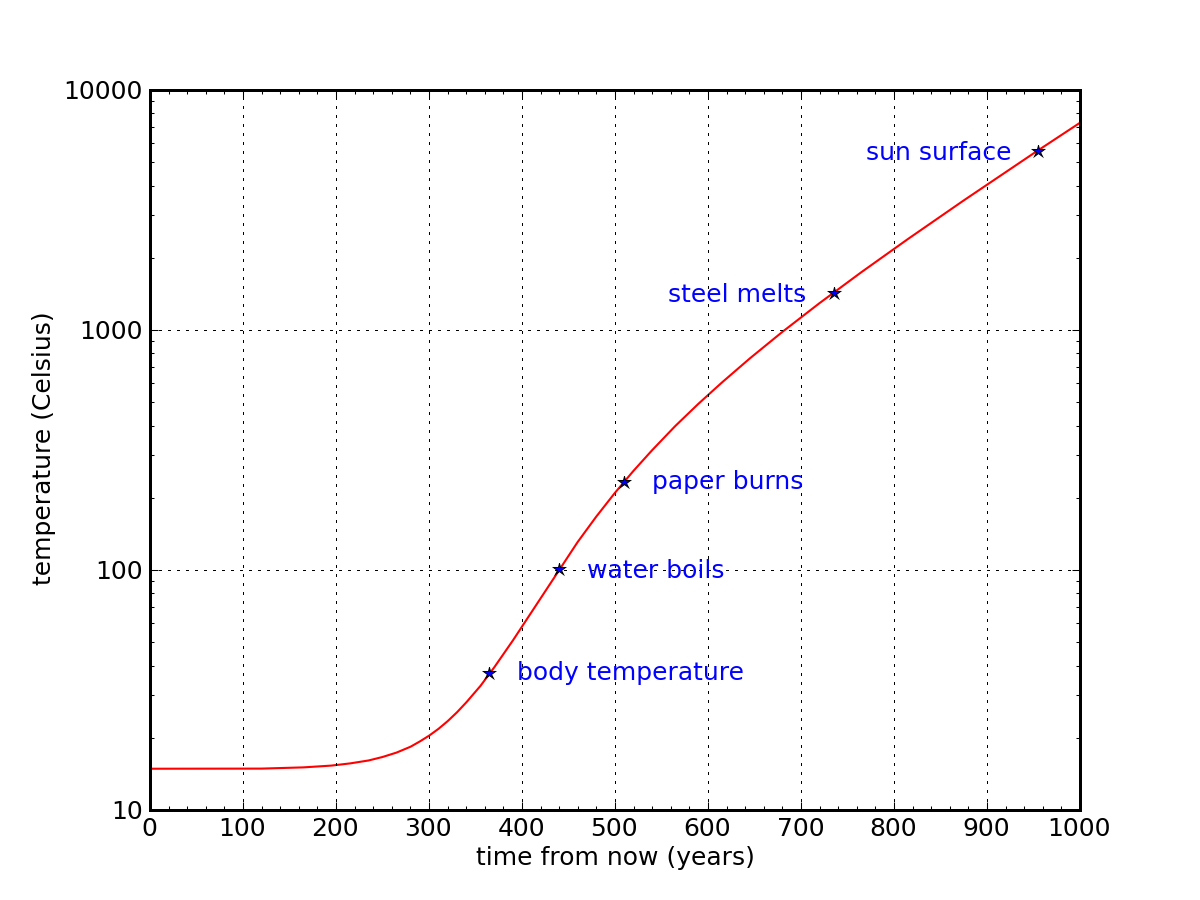
You may not be happy with it it, but this is the graph of Earth's equilibrium temperature given a consistent 2.3% annual increase in (non-solar) power generation:
https://dothemath.ucsd.edu/wp-content/uploads/2011/07/tmp.pn...
I encourage you to run the numbers yourself. They are correct. And this is treating the Earth as a perfect blackbody which it is not. These numbers are worse when you consider greenhouse gases, even if we manage to somehow go back to pre-industrial levels of carbon in our atmosphere.
That is an overwhelmingly good problem to have. We would have truly mastered the planet for that to be a concern. As it stands, keeping society above water for the next hundred years seems like the grand challenge to accomplish. Do not assume victory is given. Nothing is a given. We are always on the edge.
I agree. I don't think humanity is happier given more resources, above a certain relatively small amount. But humanity's desires are limitless. If we are able to invent a free energy machine we'll just use it so much that it causes new problems.
It's still sort of a gamble.
"Salvaging a decent future requires keen awareness, quantitative assessment, deliberate preventive action, and—above all—recognition that prevailing assumptions about human identity and destiny have been cruelly misshapen by the profoundly unsustainable trajectory of the last 150 years."
Brilliantly said. I believe a lot of resistance to the idea that our way of life is unsustainable stem from grief that the future that we were "promised" by the last century of media and marketing isn't coming. The first step towards adapting to the imminent collapse of the high-consumption lifestyle due to energy and resource limitations is to process this grief.
The way you’re phrasing that gives me a certain impression of your beliefs about what is and isn’t sustainable that may not be warranted, so I should ask explicitly:
What do you think a sustainable way of life looks like? In terms of both global population size and typical life experiences.
To me a sustainable lifestyle would be one where if every person alive today's annual consumption was at the same level humanity’s demand for ecological resources and services could be regenerated over the course of that year- effectively balanced. I'm a fan of Earth Overshoot Day and their approach to this problem so I am using their definition: https://www.overshootday.org/about-earth-overshoot-day/. A sustainable way of life therefore looks like the average life of someone in Bangladesh, Sri Lanka, Nepal etc. I'm not holding up the average lives of people in these places as ideal (and I'm not considering anything other than consumption) but instead realistic about what level we can consume at with our current level of technology. Within that consumption envelope we need to figure out how to improve healthcare and education outcomes.
That's why I expect we're headed for tragedy- we can't and won't collapse everyone's consumption to that level. The people who consume the least will be the most hurt by the ecological consequences of what we in the high-consumption regions of the world do.
Do you not even consider the possibility and usefulness of advancing technologies for the production of energy and resources more robustly AND efficiently so that all of humanity can live at a very high level of social and economic development? These notions aren't fantasy, and in many ways the technical capacity to realize them already exists. The push is what's largely missing still.
I'm not saying that this applies to your arguments, but what I notice among many people and groups claiming to be concerned with our impact on the environment is more of a fetishism towards doom and pushing forward a notion of personal sacrifice for billions of people, while actively making any excuse for decrying numerous suggestions for technologies and social advancements that could possibly let us make the world cleaner while also being able to live better on a much broader scale.
That kind of thinking teeters on the verge of pseudo-religious, ideological instead of being something reasoned and practical.
That’s what I was expecting.
Bad news, I’m afraid: If you keep the population and technology constant, the maximum sustainable consumption per person is lower than basic metabolic needs. Either the tech or the headcount needs to change, and nobody is going to let it be their head that gets dis-counted.
The main reason for this isn’t energy (current tech includes really cheap PV we just have not yet gotten around to building but could and likely will), it’s phosphorus. Phosphorus is mined for use in fertilisers, it isn’t renewed, the run-off flows into oceans.
Only thing we know of that might help is more tech, and the tech seems like it needs high-consumption societies to get proper funding.
Naturally, if you can get good research going without that, that’s a massive win for everyone, not just in this aspect.
It's already unsustainable enough that people are decrying how urban planning policies are destroying the tax base and social fabric of society.
I think you’ve misunderstood the concern by several orders of magnitude here — mere tax bases and so on are about as far from the fundamental functioning of the ecosystem as “living in a dumpster under a bridge” is from “needing to borrow the use of your neighbour’s bathroom when you have a plumber in to fix your own”.
Here's a fun little exercise: Open up a spreadsheet.
Label the first column C for capital. This starts at 1.
Label the second column T for total resources extracted. This starts at 0.
Label the third column r for resources extracted this step.
Label the fourth column E for extraction efficiency.
Label the 5th column m for maintenance. Make it proportional to capital.
Now, for each step:
E is some positive function of T with a negative slope. It doesn't have to have a finite area under the curve (you don't have to assume total resources to be finite, in other words). You just have to assume that the next unit of resources to be extracted requires a bit more effort than the last one. Use E = .1*exp(-.01*T) or something like that.
r = C*E
m = C*k where k is any positive number between 1 and 0- .01 is a good constant to use.
C += r*q - m where q is again some constant, say .2
T += r
Now observe the behavior of the system. Plot the value of C over time. For the above constants you'll want to include about 3000 steps.
(Edit: forgot the maintenance term)
I didn't have a spreadsheet handy:
from math import exp k = .01 q = .2 C = 1 T = 0 E = lambda T: 0.1 * exp(-0.01 * T) for step in range(3000): r = C * E(T) m = C * k C += r * q - m T += r print('%5i %g' % (step, C))Because human economics in the realm of energy and or resource extraction are easily predicted by simple equations in a spreadsheet.
So much so that this trivial exercise imparts real wisdom and is definitely not mental masturbation.
Unfair - I didn't say that all human economics are easily predicted by a spreadsheet. It's an exercise. A starting point for discussion. As in: to start with, point out the assumption that is wrong. Rather than just insult me.
> Unfair
Kinda I suppose. But the whole spreadsheet 'try this' trope is already unnecessarily hostile. You could put everything that spreadsheet exercise demonstrates into words.
And that's my main argument too. This equation/exercise is so simple as to be useless.
Human systems are multi-variate to the degree that a simple equation -- in this case showing that reliance on extractables is bad because their availability exponentially increases at the same time humans exponentially rely upon them more -- does not mean much of anything in the larger picture.
This equation sidesteps human ingenuity, free market adjustments that will be made, predicted population decline in developed countries, and if the equation did apply, where on the timeline of the curve would we be.
And those are just some of the criticisms of viewing the world through such a simple myopic lens.
I'll give you a hint: Each one of those equations has an assumption embedded in it. The first and last one seem pretty solid. The middle two, though- The second assumption is that maintenance on capital is some constant proportion of total capital. That might be true, but also might not be, especially if you consider knowledge to be a form of capital. Maybe maintenance should scale with the log of capital, or something like that. But even then, I'm pretty sure that unless maintenance goes to zero, this doesn't affect the general shape of the curve.
The third assumption, that capital increases as a constant proportion of resources extracted, is even more questionable. I think it's fair to say that we are able to do more with less now than we could in the past. You might say that that is a function of the existing capital too. So what happens if you try something like C += r*q*(1 + .01*C)? Do you still get a peak?
And of course, there's the assumption that the next bit of resources you extract is a little harder than the last bit. Statistically this has been true for some time now, but you could imagine this rule reversing, at least temporarily, if we gained access to some new resource, say, asteroid mining.
So there's plenty in the model to attack, if you take the time to really consider it.
Well, I majored in physics, so to me the cow is always a sphere.. but you know, all models of reality are imperfect, no matter how complicated. And it’s true that I have no idea where on the curve we might be. I would certainly not use this model to make specific predictions- that would be silly. It’s more the general behavior of the system I’m interested in. But you can definitely make refinements. For example, if you add renewables then you still get a peak, but it doesn’t go all the way to zero afterwards.
I do realize too that my model makes assumptions- which have not been demonstrated to be true. So, that’s where I would attack it. Which assumptions are false?
I've got a lot of other homework... Could you provide a filled out worksheet or describe the behavior?
The basic M.O. here is not new: (1) Present the basic math of exponential growth to show that exponential growth cannot continue indefinitely; (2) claim that sustaining our present lifestyle would require exponential growth to continue indefinitely; (3) conclude that our present lifestyle cannot be sustained.
The issue, of course, is in step 2.
https://en.wikipedia.org/wiki/The_Limits_to_Growth
Figured this out decades ago.
what's the issue with step 2? Our present lifestyle does seem to require constant growth, and if this is not the case it would be nice for someone to explain how we can keep getting more out of the system without contributing more to the system.
> Our present lifestyle does seem to require constant growth
No, it doesn't. The obvious cause of the huge economic growth over the past 150 years, which is what the author focuses on, is population growth. World population is expected to level off in this century.
The author also assumes, incorrectly, that GDP--money spent on goods and services--is the right measure of overall wealth. It's not. The author even discusses "decoupling", the fact that many types of wealth require little or no physical resources to produce, but fails to realize that the long term outcome of this will not be to raise monetary GDP more and more, but to make monetary GDP less and less of an accurate measure of wealth production.
Finally, the author misunderstands basic economics when he says (p. 25): "A limited life-essential resource will always carry a moderately high value." This is a common misconception. An obvious counterexample is air: air is a limited resource (Earth's atmosphere contains only a finite quantity of it), it is life-essential, but it is free. Why? Because it costs nothing to produce. And if the cost of production of other life-essential resources, like food, were reduced, those things would also become cheaper. (In fact, that has already happened to a large extent in the developed world: over the past 150 years, the fraction of people involved in food production has dropped from about 19 in 20 to about 1 in 20. The main reason food is not much cheaper as a result of this is political: governments artificially manipulate the markets for food, for example by paying farmers not to grow certain crops. This is fixable without any increase at all in our expenditure of physical resources.)
> No, it doesn't. The obvious cause of the huge economic growth over the past 150 years, which is what the author focuses on, is population growth. World population is expected to level off in this century.
world population is leveling off because we're approaching many of these limits to growth and that's affecting the enabling factors for continued population growth.
> The author also assumes, incorrectly, that GDP--money spent on goods and services--is the right measure of overall wealth. It's not. The author even discusses "decoupling", the fact that many types of wealth require little or no physical resources to produce, but fails to realize that the long term outcome of this will not be to raise monetary GDP more and more, but to make monetary GDP less and less of an accurate measure of wealth production.
I agree with this.
> "A limited life-essential resource will always carry a moderately high value." This is a common misconception. An obvious counterexample is air: air is a limited resource (Earth's atmosphere contains only a finite quantity of it), it is life-essential, but it is free. Why? Because it costs nothing to produce.
you conflate value and price here. obviously atmosphere is not currently metered. That doesn't mean we don't place a high value on clean air.
> And if the cost of production of other life-essential resources, like food, were reduced, those things would also become cheaper.
> you conflate value and price here
I'm not doing that. I'm pointing out that the author of this paper is doing that. He is assuming that everything of value is captured in the GDP, i.e., in money spent. But as you acknowledge, this is false, and that invalidates his argument.
> https://en.wikipedia.org/wiki/Jevons_paradox
The Jevons paradox does not say things don't become cheaper when their cost of production is reduced. So it is not an argument against the statement of mine that you were responding to here.
Also, if we are talking about life-essential resources like food (or air), which was what I was talking about in the comment you responded to here, the Jevons paradox is of limited applicability if it applies at all, because demand for such resources is constrained. Even if food were free, people would not eat an unlimited amount of it, any more than they now breathe an unlimited amount of air because air is free. The most important factor driving an increase in total consumption of such resources is population increase, so if population levels off, the resources consumed for these life-essential things will be naturally limited no matter how cheap they become.
> world population is leveling off because we’re approaching many of these limits to growth
Is it? My understanding is that as economies become richer, healthcare improves, infant mortality decreases and parents reduce their birth rates because they need less children to “hedge their bets”.
Why does our current lifestyle require constant growth, could we not just stop at our current energy consumption level?
lots of reasons but population growth and our dependence on technology are two of the major ones.
I was about to add ignoring population growth to my comment because developed countries are generally close to replacement-level fertility rate and I don't think having more children is part of or current lifestyle.
Also lifting everyone to the living standard of highly developed countries will require significant amounts of resources and significantly increase energy consumption, this however is also more like a one-time expense and I would therefore ignore it, too.
How does dependence on technology demand growth? Because resource extraction becomes less efficient as we deplete available sources?
> I was about to add ignoring population growth to my comment because developed countries are generally close to replacement-level fertility rate and I don't think having more children is part of or current lifestyle.
actually they are generally below replacement level, which (if not augmented by immigration) would itself lead to a collapse as people leave the workforce and there are fewer laborers to replace them. But people think we manage this labor shortage with technology, which leads us back to the requirements for more energy and capital development to maintain the same lifestyle.
> Also lifting everyone to the living standard of highly developed countries will require significant amounts of resources and significantly increase energy consumption, this however is also more like a one-time expense and I would therefore ignore it, too.
why do 'highly developed' countries need vastly greater resources to maintain this living standard if its a one-time expense? the greater standard of living your referring to requires continually expanding quantities of inputs in terms of energy and labor, aka 'economic growth'.
> How does dependence on technology demand growth?
its more related to the specific technologies we've chosen to build our society upon, but this technologies generally depend on these improvements to sustain themselves. For example, electric cars require batteries which require raw materials to be mined, recycling batteries requires chemical industry that is predicated on all sorts of inputs, themselves coming from nonrenewable sources.
actually they are generally below replacement level, which (if not augmented by immigration) would itself lead to a collapse as people leave the workforce and there are fewer laborers to replace them.
Which is extra good as this offsets other parts of the world. I would also guess that it is probably easier to provide incentives for people to have more children once this becomes necessary than trying to prevent them from having too many children, but that is not much more than a gut feeling.
But people think we manage this labor shortage with technology, which leads us back to the requirements for more energy and capital development to maintain the same lifestyle.
If we permanently fall below replacement-level fertility, we will just die out and no amount of investment will fix this. The only solution is to match replacement-level fertility which will provide a stable population and workforce and hence require a stable amount of economic activity to achieve a stable lifestyle. The obvious caveat is of course that the economic activity must not deplete any non-renewable resources.
why do 'highly developed' countries need vastly greater resources to maintain this living standard if its a one-time expense? the greater standard of living your referring to requires continually expanding quantities of inputs in terms of energy and labor, aka 'economic growth'.
The one-time expense is to lift someone from say 2,000 kWh/a to 40,000 kWh/a which requires adding the difference in production capacity. After that this person will of course consume 40,000 kWh every year and we will have to produce those 40,000 kWh every year, but I don't think that constitutes economic growth. Economic output is quantified as absolute output over some period of time, not as cumulative absolute output.
For example, electric cars require batteries which require raw materials to be mined, recycling batteries requires chemical industry that is predicated on all sorts of inputs, themselves coming from nonrenewable sources.
I still don't see how this requires continued growth if we assume constant output.
Author even acknowledges it on page 27, but thinks this time Malthus must be right.
This is filled with a lot of hand waving bad math, which distracts from some reasonable points.
rule of 70tells us that the time it will take a system or collection to double in size is 70 divided by thepercentage growth rate. The time units depend on how the time over which percentage growthis expressed—like 2%per dayor 2%per year, for instance. The rule works most accurately forsmaller growth rates, under 10%.
Actually showing 1.10^7 = 1.949 vs 1.01^70 = 2.007, so you can approximate by dividing percentage by 70 between 1% and 10% is fine. Stating it as true in the text then adding a note well no not actually latter on is problematic.
Sorry if I’m missing something, but… what’s the problem with that quote? That’s a widely-used heuristic that helps to estimate doubling times without using a calculator (see [the Wikipedia entry](https://en.m.wikipedia.org/wiki/Rule_of_72).
He does walk the reader through a lot of “back of the napkin” math, in order to help the reader get an intuitive sense of the models he’s using. But my impression overall is that he backs those hand-wavey calculations up with more serious calculations throughout the book.
The issue is he then uses the approximations to do with math without calling them approximations. 1.10^7 is reasonably close to 2, but 1.1^21 is 7.4 which is a fair distance from 8.
He goes so far as asks someone to do the approximation across several hundred years of compounding. And sure it get’s a big number but one no even close to accurate.
You do realize the rule of 70 is used to approximate continuous compounding not periodic compounding right?
There are a bunch of them though compounding normally uses the rule of 69 / 69.3, or rule 72. https://en.wikipedia.org/wiki/Rule_of_72
The rule of 70 isn't "hand waving bad math".. perhaps you just don't understand its derivation?
I feel like the author may have posted this to HN before, at least I remember a similar, book length take on this topic.
> 18.4 Fermi Paradox Explained?
I’m currently leaning in this direction myself. Not necessarily just this, but “big filter ahead” (or lots of small filters). Perhaps it will be this, perhaps it will be a Jonestown massacre but with entire O’Neill cylinders instead of individual people, leading to a Kardashev II scale Kessler syndrome.
I like the last chapter, which shows some strategies for reducing energy use.