The Great Resignation? More Like the Great Renegotiation
npr.orgAt least two things happened here:
- The pandemic gave most people an unusually-long period of time at home to help them realize all the things they could have been doing (e.g. spending more time with family, not being stuck in a commute), if only their work had not been sucking up all their time and energy.
- Income vs. expenses changed to the point where people couldn’t hope to pay off their debts even if they worked. Work has not been paying anywhere near enough. At that point, what is there to lose: if you will be swamped and in debt with work, and you will also be swamped and in debt without work, at least the 2nd option means finally not having to put up with the crap from many workplaces.
Also, it has just become clearer and clearer where all the lies were told. Society did not treat “essential” workers that way at all. There was all kinds of prioritization of bottom line over employee health, especially early on. We all assumed that governments could/would do a lot more to help. Heap on all the unfilled promises for promotions, raises, etc. and many workers just have no reason at all to give a crap anymore.
> We all assumed that governments could/would do a lot more to help.
They did. The US gave out trillions in aid, more than any other country except Japan (by GDP). If you were unemployed this was at least $2400/month and more if you had children - the end result is that poverty and child hunger went down in 2020 and 2021, not up like you seem to think, and everyone went shopping so hard while they were home it brought inflation back.
The reason people don't seem to know this is that journalists weren't unemployed and so have spent the last year tweeting "the government only gave us $1400 because they want us to die".
It's the strangest disconnect right now between the actual health of the average person's bank account, and the sentiment that everything is terrible.
Like GP is talking about insurmountable debt, but the stats show people actually paid down debt/saved money during the pandemic.
I can't disagree that doomsday journalism has a played a role here.
If the USA is anything like Canada, and I don't know if it is, then there there was a "missing middle" in terms of pandemic support.
Here in Canada, if you qualified for CERB, or had social spending (or other luxury spending) cut back, then you're among those who were likely to have saved more or paid down existing debt. For those who did not qualify for CERB, and did not have much pre-existing social/luxury spending, then the pandemic likely hurt them financially. And now with inflation...
Like most safety net items, there is a missing middle that makes too much to qualify for support but needs that support to make ends meet. I was close for most of the pandemic as the household earned just enough to miss most basic support options beyond the food bank but not enough to do more than subsist, which is incredibly depressing. Then all costs are going up so a steeper hill to climb this year barring a raise or new job. My work has great benefits/etc, and before the reorg more opportunity, so it's hard to jump.
Okay now compare the average person's bank account with the average rise in cost of housing.
Cost of housing numbers includes imputed rent, which is money you pay to yourself, and so makes you richer. (if you're a homeowner)
IIRC a lot of new people became homeowners in 2020 or relocated somewhere cheaper, which is a positive sign. If rent is going up, that should be fixed by building more housing, which the admin is working on.
It's a positive sign for whom? The economy? Or those struggling to purchase those homes in the first place?
> The reason people don't seem to know this is that journalists weren't unemployed and so have spent the last year tweeting "the government only gave us $1400 because they want us to die".
This drove me crazy when I saw folks I know on social media expressing the same sentiment. People that I know for a fact did not lose their jobs, actually drove and ate out less (saving thousands)…or some griping and complaining that they did not qualify for the payout due to their income.
Unemployment benefits ended long ago, but working people have continued to suffer. People who were forced to quarantine and miss work due to government mandates don't get unemployment. Unemployment is no replacement for the millions of people who saw their children's schools shuttered for a year (or two!!) and were forced to quit their jobs and stay home to take care of their children. Food, energy, rent, health insurance - all the things people need to survive - are up massively year over year, far higher than the meager wage increases seen by some workers.
The government gave out trillions. Trillions that ended up in the pockets of the country's wealthiest people, who saw their net wealth double or triple during the pandemic and corporate profits soar while working people fell further under water. Its absolutely astounding how out of touch people who look at macro numbers supplied by the FED and the White House and think that everything is swell. Everything isn't swell. There's a reason that 72% of Americans think the country is heading in the wrong direction. American household debt is at an all time high. Millions of Americans face imminent homelessness as eviction moratoriums are lifted. Its incredibly tone deaf to sing the praises of the economy when its as bad or worse than its been for many or most working people in the country in a century.
https://www.theguardian.com/business/2022/jan/17/world-10-ri...
https://www.ibtimes.com/american-household-debt-rises-all-ti...
https://www.nbcnews.com/politics/meet-the-press/downhill-div...
https://buffalonews.com/news/local/deluge-of-eviction-cases-...
> People who were forced to quarantine and miss work due to government mandates don't get unemployment.
Yes they did. PUA made them qualify too. Or if they didn't lose their job, there was PPP and child tax credits.
> Trillions that ended up in the pockets of the country's wealthiest people, who saw their net wealth double or triple during the pandemic and corporate profits soar while working people fell further under water.
No, this didn't actually happen. It looks like their wealth went up if you measure starting from March 2020 when there was a stock market collapse, sure, but poor people's wealth went up and their income has gone up significantly with pay raises since.
>It looks like their wealth went up if you measure starting from March 2020 when there was a stock market collapse, sure, but poor people's wealth went up and their income has gone up significantly with pay raises since.
Poor people don't have "wealth". Most lived paycheck to paycheck before the pandemic hit and they lost their jobs and were forced to stay home and take care of their children. The ones lucky enough to keep their jobs didn't have their salaries increase nearly as much as inflation, which massively eroded their ability to afford even food and other basic necessities. As cited above, the world's richest people doubled and tripled their net worth during this period. Millions of working people face eviction and homelessness, today, after the recent expiration of eviction moratoriums. Its simply a willful denial of reality to reject these easily checked facts.
> Most lived paycheck to paycheck before the pandemic hit and they lost their jobs and were forced to stay home and take care of their children.
Where they got more than $2400/mo in stimulus, and CTC continued until this year. It's certainly bad that expired, but there's time to renew it.
> The ones lucky enough to keep their jobs didn't have their salaries increase nearly as much as inflation, which massively eroded their ability to afford even food and other basic necessities.
No they didn't, poor people's pay raises were better than inflation. It's the middle class who are down - but that number is largely because consumption shifted from services to goods (since people stopped being able to travel/don't want to go to restaurants). If you decompose it, it still looks like the largest increases are transitory.
> Millions of working people face eviction and homelessness, today, after the recent expiration of eviction moratoriums.
They expired three times in the last 3 years. Each time there were news articles saying it would be a huge problem, and each time it wasn't (thankfully). That's because we managed it quietly at smaller scales.
https://www.bloomberg.com/news/articles/2020-08-18/u-s-evict...
https://www.penncapital-star.com/commentary/that-tidal-wave-...
Current numbers are up a bit, but not explosively so: https://evictionlab.org/eviction-tracking/
Don’t forget the hundreds of thousands of deaths.
The large number of people retiring.
Childcare. I know many families where the lower earning parent has quit their job to parent full time because of how outrageously expensive daycare is.
Long COVID. Many people aren’t capable of the work they did before they got COVID and may not ever be capable again.
I could go on posting factors to consider but these four should never be omitted when discussing the “labor shortage”.
Yes. In most discussions I see about the resignation people on both sides seem to forget that those numbers of infections or deaths were actual people who had jobs but now can't work. And many of these were essential workers who made very little.
There has been a massive psychological shift too. Everyone suddenly realized life is short and you need to take action before it is too late. Starting a business has risk and there is fear associated. All that goes out the window when you realize you have nothing to lose.
Realising you have nothing to lose is liberating & a strong motivator to discover and spend time on the things that matter in your life. Between taxes, healthcare and inflation there’s nothing left at the end of the ride anyway. So why would you conform to the norms? Why play the game? Especially when it’s becoming abundantly clear that our society won’t be able to tackle the much larger problems looming ahead when we can’t even handle a minor inconvenience like a pandemic. So yeah, sure, I don’t blame anyone for “checking out” of the rat race.
What nobody is addressing is that it got a lot more expensive to live. People are trying to keep up with inflation.
Because everyone was given free money which they spent on things, driving prices up.
Is increased buying power the actual cause of inflation? Or is it disruption in China? Or is it executives choosing to take profits because they can (for some particular reason)?
What evidence could be used to distinguish between the various possibilities? I don't actually know, and I'm curious.
One such metric would be Chinese export volumes, in ships and containers. Apparently container ports are clogged in USA.
Im sure its a multitude of factors but it is definitely the increase spending due to government intervention. Aggregate demand is several years above trend.
Money supply has not been shown to increase inflation in recent decades. Supply chain issues have.
Would love to read more about this because my understanding is that the increase in M2 money supply is a big part of the current inflation (very simplified - it's way more complex when looking at money velocity and supply chains in general).
Exactly. It's obvious how printing money out of thin air induces inflation.
Current inflation is mostly supply-side driven. Having said that, M2's biggest jump in its history was in early 2020 (see https://fred.stlouisfed.org/series/M2SL). Its slope before and after is more or less the same. However, I don't think inflation will lag it by more than a year.
My rent went up $300 a month...is that supply-side driven?
The last year proves this wrong.
Also a huge third thing:
* Large portions of the middle class and professional class got temporary, permanent, or indefinite semi-permanent Work From Home privileges, leading lots of people who'd been renting small apartments in the cities to buzz off for a larger house out in the burbs. This leads to a lot of consumption of household goods.
Here in the UK at least, those middle and professional classes also saved lots of money due to reduced expenses -- no holidays, no socialising, no commuting etc.
https://www.bankofengland.co.uk/bank-overground/2020/how-has...
I'm sure many high-earners finally got the "FU money" savings required to risk resigning without having new job lined up.
Close to a million people have died in the US. That is a pretty important point in the labour market, quite aside from the brutal human cost.
The people demanding "let 'er rip" got what they wanted - mass death to avoid personal inconvenience - and it turns out that they're getting an economic cost anyway.
75% of those deaths were over the age of 65, past retirement age. So we're talking -250k from a working pool of 150m (-0.17%). It seems to me that the pandemic impact on the other 99.83% of the workforce is what's probably moving the needle on any recent employment trends.
> Close to a million people have died in the US. That is a pretty important point in the labour market
This doesn't make sense given the average age of people who died from Covid is well over working age.
Per https://www.forbes.com/sites/juliejason/2021/11/14/still-wor... there are ~10 million people working in the US that are over 65.
Also long covid which can render people unable to work or issues like taking care of people who are sick or immunocompromised people who used to work outside but can't now.
Why is the central bank inflation target typically 2%?
Well if you target 0% and any actual result below 0% happens, that's deflation which is a disaster for economies.
If inflation is say 10%. Maximum employment is near certainly impossible. Debt will be expensive and the economy crawls to a halt. Who wants to pay 10% interest on their student debt?
So where in between do you have a good price stability? It tends to be around 2%. It allows for error in measurement, it provides safe cushion.
The USA is at 7% inflation. This means the central bank is not doing their job. They by mandate should have drastically increased interest rates. Inflation almost certainly is out of control now. Looking at central bank balance sheets that are very far from balance, and looking at money supply M2. There's a solid 40% inflation coming. Lets say it sticks to 7%, this inflation will last probably 4 years.
When inflation is so high and interest rates are not. The people winning are those in debt. Which is the government and youngins. However, it also means you cant save money. You must spend money as soon as possible. Tourism is dead for many years.
Flipside, what does this also do? It pressures salaries. You are making 7% less this year but you're making 115% less the next year. So anyone in demand will be in demand and be able to buck the inflation curve.
The people most hurt by high inflation are those who just retired. They no longer can demand more $ for their productivity. Their 'safe' investments are way below inflation. They don't realize yet they cant afford to be retired.
Since you seem quite interested in learning economic fundamentals, I highly recommend you check out the Moody's Talks Inside Economics podcast [0].
One topic they have discussed with fair regularity lately is the current inflation rate. They point out that you can tease out what factors contribute to that 7% inflation number, and once you subtract out 2-3 specific components, components that – with some inductive reasoning – we have good reason to believe are transitory in nature, the inflation number that applies to the broad majority of fundamentals is actually closer to the fed's 2% target.
I'm not an expert in this area and I don't grok the economics on a deep enough level to be able to reproduce their argument in situ here, but their case that the fed's strategy of holding steady is in fact the most responsible thing to do to achieve that 2% target.
[0] https://about.moodys.io/podcast-series/moodys-talks-inside-e...
>Since you seem quite interested in learning economic fundamentals, I highly recommend you check out the Moody's Talks Inside Economics podcast [0].
Sweet thanks or the recommendation!
>One topic they have discussed with fair regularity lately is the current inflation rate. They point out that you can tease out what factors contribute to that 7% inflation number, and once you subtract out 2-3 specific components, components that – with some inductive reasoning – we have good reason to believe are transitory in nature, the inflation number that applies to the broad majority of fundamentals is actually closer to the fed's 2% target.
That's kind of the complicated thing about these metrics. CPI is often criticized because they already ignore beyond important factors. Like Housing isnt included in CPI? That sure makes CPI a much lower value measurement.
Then people continue to cut out of CPI and oh look we're at 2%? No, we're not. The actual 7% is already too low, the actual number is most likely higher.
>I'm not an expert in this area and I don't grok the economics on a deep enough level to be able to reproduce their argument in situ here, but their case that the fed's strategy of holding steady is in fact the most responsible thing to do to achieve that 2% target.
The Fed in the USA is politically handcuffed and they understand what's happening. There's a geopolitical approach going on, there's a boomer retirement going on, pandemic. lots of factors.
> They by mandate should have drastically increased interest rates.
I disagree, we are having inflation because of supply bottlenecks, not because of demand. Raising interest rates would only make it harder for companies to get finances to ensure supply chains meet demand.
That's if you even believe raising interest rates stops inflation. The correlation between interest rates and inflation over the last 40 years is pretty nil.
> I disagree, we are having inflation because of supply bottlenecks, not because of demand.
I've seen this multiple times but what's the underlying evidence for either side. If demand goes up and the supply can't increase to follow, it'll look like a supply issue but ultimately caused by demand. What's ultimately the difference?
Is the idea that if the supply chain is scaled for X then moving from X-2 -> X is easier then X -> X+2?
It's systems + networks analysis.
Factories, ports, and transportation were limited or shuttered completely. Warehousing and storefronts saw the same.
Impairing these network nodes, all at relatively the same time and in great numbers, had gigantic consequences.
And if the supply network is severely damaged, it ultimately means supply will go down.
true, but is demand actually higher than pre-pandemic or is it just returning to previous levels (where broken/damaged supply chain issues are now showing up)?> it'll look like a supply issue but ultimately caused by demandexactly, what data would someone look at to decide which came first; the supply crunch or the demand increase. and does the distinction even matter?
>I disagree, we are having inflation because of supply bottlenecks, not because of demand. Raising interest rates would only make it harder for companies to get finances to ensure supply chains meet demand.
Certainly an interesting take. Not unlike this read from somewhat recent. So you're in good company with your position.
https://research.stlouisfed.org/publications/economic-synops...
Mind you, basically everyone and their mother has announced new semiconductor fabs. Intel in Ohio recently for example.
I am curious if these are confounding factors. Maybe they will all play against each other. In terms of the 40% inflation locked in. This has nothing to do with supply chain at all. This is private debt to GDP being 235% in the USA. This is the central bank balance sheet being 8 trillion $ in the negative. This is the money supply being 7 trillion in the negative. Pretty standard Quantity Theory of Money
Supply chain isn't a factor yet, this is ~40% inflation locked in. Now if you consider supply chain struggles. It only exacerbates and makes the situation worse.
>That's if you even believe raising interest rates stops inflation. The correlation between interest rates and inflation over the last 40 years is pretty nil.
The correlation has been weaker because they are using these other options to affect macroeconomics. The central banks are beyond bankrupt, but there is no bankruptcy system for them. So instead of fixing the debt situation, you run inflation high and technically you reduce your debt at the expense of those who are holding currency. Primarily retirees are those who are harmed.
Supply bottlenecks is certainly one way to describe a horrific pandemic response, widespread corporate mismanagement, and the fed printer propping up zombie corps.
I keep hearing that people in debt win when inflation goes up but the problem is you only win if you have assets that already appreciate in value or access to large amounts of capital to purchase assets that are inflation resistant. Simple example Tim is a manager at Lowe's Tim makes $66,000, each year. Tim spends most of that money on the necessities of life, a car payment a house payment if he is lucky, a rent if he is not, Tim spends some on groceries and basic living things to support his family. Inflation goes up 10%, Tim's boss fights for Tim and works hard and Tim gets a 7% raise which is unheard of because usually raises are capped at 5% so Tim is very happy. In the meantime his purchasing power has actually decreased.
Contrast this with Larry, Larry is very rich, Larry owns stocks in multiple companies, Larry also owns many assets and has enough capital to move it into other places to protect it against inflation. Inflation goes up 10% Larry's stocks, real estate and other ventures go up 12% because people are trying to find places to park their cash to avoid losing it to inflation.
In the end Larry ends up with substantially more money because he could take advantage of the inflation, and also because of his wealth had access to credit to take advantage of the low interest rates, meanwhile Tim has blown out his savings because his car's transmission gave out and he didn't have the money to buy a new one, and now is riding at the edge of his income because everything went up in price but Tim didn't want to end up enslaved to credit card debt just to continue living and the banks won't give you loans for "hey I need to buy groceries", so he got screwed by it all in the meantime the money and purchasing power Tim lost went to Larry.
So someone help me understand where my understanding is wrong, because yes I agree in a world of airless friction-less vacuums inhabited by spherical cows the inflation is good for debtors but in the world of the real it doesn't seem that way.
Its mostly just "economics 101" stuff; how it plays out in reality is different, and your analysis isn't wrong.
Inflation is good for debtors if wage keeps pace with inflation. That's it.
Taken to the extreme: Imagine I make $100k in 2030. I take out a 1 year loan for $10k @ 5% (10% my income). Inflation is at 50%, but my wages keep up. 2031: I make $150k. I pay back the loan: $10.5k (7% my income). The loan is worth less as a percentage of my income, because of inflation and wages keeping up.
Generally speaking, wages do keep rough pace with broad CPI inflation, if the inflation is slow, predicted, and a product of monetary policy. The issue in today's climate is multifold, but: first, there are critical sectors of consumer goods which are substantially out-inflating even the elevated CPI averages (housing/rent & microchips are the biggest). Second, most CPI-calculated goods are inflating not due to monetary policy, but due to supply-shock, which is harder to mitigate with wage increases because, well, in short, companies can't make money to give workers raises if they can't sell stuff.
No economics is "economics 101" stuff. Economics 101 is a gross over simplification to get students accustomed to basic concepts. There's a reason economics is called the dismal science.
You've got a system where everything is connected to everything else. There is no way you're going know if it's good for you or not. I have a house with a mortgage so inflation is good. If I can keep my job and demand higher wages. But if inflation is high it will put pressure on the fed to bring it down raising interest rates. Higher interest rates mean buyers won't quality for as high of a mortgage and the price of my house goes down. Unless they can also get higher wages to offset inflation. But then the county notices that their coming up short on tax revenue because of inflation and reassess my taxes. But I need a new roof and that just got more expensive. But my 401k is doing great etc, etc.
All of these things are in balance and you have no idea which ones are elastic and which ones aren't. It's like trying to balance a 10,000 leg stool. You can maybe make some gross generalities and even then you're often going to be wrong depending on where you own your home, what businesses are location close to there. What you have your 401k invested in.
Look up the average house price in your area in 2000. Now imagine you were 20 years into a 30 year mortgage. That's a pretty nice house payment, eh? Realistically, it would be even lower because you would have been a fool not to refinance as interest rates plummeted.
This is one way that people with debt "win" due to inflation.
Yeah, rich people benefit more. But that's always been the case. In a deflationary situation, rich people can take dividends from their investments, rather than selling at a discount. While that might be less than they'd normally get, it's much nicer than how wage workers have to work in fear of losing their jobs and having their income go to $0.
You’re mixing several plot lines. Let’s use an extreme example. You owe $100 and make $1 per day with daily living expenses of $1. Tomorrow the government screws up and the $1 bill is replaced by a $1,000,000 dollar bill. Even if you still break even, your $100 debt is now a complete non issue.
It’s not even a cup of coffee, whereas before it was a significant burden. This is true even if your real wages go down, though that’s a problem in its own.
the good for debtors argument fails to realize its only good for your realized debt. its very bad for all future debt ie: young people, poor, people who want to start businesses
Retirees got a 6% Social Security raise this year.
You seem excessively focused on numbers. If you want economic doom and gloom, it's going to be because of what's actually happening, ie there's a pandemic. It's not going to be because a top line number is 7% when it's suffering from composition effects.
Personally, I think everything's going to be OK.
>"Well if you target 0% and any actual result below 0% happens, that's deflation which is a disaster for economies."
It's not actually clear that deflation causes economic problems for the commonly cited reason (decrease in consumer spending). I think you're right about most of what you say concerning inflation.
https://www.investopedia.com/articles/markets/111715/can-def...
The bigger issue isn't just a decrease in consumer spending; it's a decrease in investment (public markets, private equity, consumer loans, etc). If a bank can just sit on their dollars, and see a guaranteed rate of return potentially higher than a risk-adjusted rate of return after investment, that will happen more often. It trades a reduction in the long-term health of the real economy for an increase in the short-term health of the currency, but over a long enough period of time all currencies are a projection of the health of their real economy.
The Swiss example is a poor one, given the makeup of their economy is nothing like most of the rest of the world, with its bias toward the finance sector. The finance sector would love deflation; they can take no risk and win, or they can take risks (issue consumer loans) and also increase their probability of winning.
All that being said: there's a "correlation not causation" issue in that, the US originally set its "inflation as a target" policy back in the late-60s/early-70s. Ever since then, it doesn't matter what metric you look at, they've all gone sour [1]. Theoretically, causatively, some inflation is good for consumers; but correlatively, its difficult to ignore it as a potential cause for why everything sucks. It's moreso a matter of figuring out... why.
> The finance sector would love deflation
In theory. In reality, customers have a really hard time making loan payments and their collateral no longer covers their debt. I'd say more financial firms have gone bust in a deflationary environment than an inflationary environment.
The economic profession developed some serious deflation PTSD from the great depression. I always heard deflation was bad. Nobody ever seemed to have a great case for why based on good historical data.
This is a chart of the US annual inflation rate. Note that consistent inflation only occurs after ~1930. https://commons.wikimedia.org/wiki/File:US_Historical_Inflat...
This is a log-scale chart of US GDP per capita adjusted for inflation and international price differences. https://ourworldindata.org/grapher/gdp-per-capita-maddison-2...
Do you see a discernible change in growth trend since the shift to consistent positive inflation? I don't.
To be clear, I'm not saying this is even close to conclusive evidence, I just feel like its a compelling enough side-by-side to warrant further questioning.
> The USA is at 7% inflation. This means the central bank is not doing their job.
Is it absolutely clear at this point that monetary policy is to blame? It seems to me that supply-chain issues could still be a major factor.
The country did spend trillions on COVID relief. I don't think that that qualifies as "monetary policy", but it is something Congress did to keep the economy going.
I think it's hard to say this didn't contribute to the demand side of the equation, since a lot of that COVID relief was put into the pockets of upper middle class small business owners. I personally know of several that are spending their six-figure paycheck protection "bonus" on some of the things that are in short supply right now (i.e., houses, cars, remodeling).
In hindsight, these loans should have never been forgiven.
Afaik spending is referred to as “fiscal policy”. It’s hard to saw what “should” or “shouldn’t be” without being aligned on some objective measurement of outcome. After all, for a given policy change there will typically be winners and losers.
If I remember correctly, QE was doubled between end of 2020 and 2021. How many proportion of inflation is contributed by QE?
Is -0.1% deflation really that disastrous for economies? Is it really worse than 10% inflation?
I've never experienced it, so can't speak too authoritatively, but it kind of feels like accepted wisdom in the economic academia: so it isn't questioned - but a lot of economics is propaganda for the powerful, IMO - would minor deflation really hurt the common man significantly? Or would it mostly just punish the rich and powerful who are extremely leveraged?
> Who wants to pay 10% interest on their student debt?
Private student debt lenders already can and do charge in excess of 10% (which seems borderline criminal to me)
Yes, it is. I'm no economist but the problem is deflation isn't stable, it tends to run away. It's like standing on a big pile of TNT and saying, "This match isn't really that big of a deal is it?"
In a super simplified example, you have a dollar that's going to be worth more than a dollar tomorrow (the definition of deflation). So maybe you'll wait to buy that shovel till tomorrow. But now less gets done today so tomorrow the money supply is the same but there are fewer things to buy, making your money even more valuable. Then you think, "Shit, things are really looking good for this dollar. If I just hold on to it, it's more valuable then what I was going to do with that shovel" so now you're never going to buy that shovel and pay that person to dig that ditch. So they're just sitting around without a shovel and you're not going to pay someone to just sit around. They'd be perfectly happy to dig that ditch if only they had a shovel, so you lay the person off. Now we have even less productivity and your dollar is looking really good. Next thing you know you realize that every time you shut things down your dollar is looking even better and better. You used to have to work hard for your money but now you're getting rich for not doing something. If you really want to get rich you realize having money is where it's at so you sell off all the shovels you already have for scrap metal, fire all the workers, and sit on the cash.
It's completely perverse. You aren't just paying people to not do anything, you're paying them to destroy productive things. Things that would be good for everyone but while it might be good for everyone in aggregate it's even better for you do do nothing while on a whole most people suffer. So you're sitting in your mansion, doing nothing, amassing a fortune while workers watch as ditches that need to get dug, don't, you're melting down all the shovels, they're unemployed and starving. What do you think the next step is? It's not pretty.
>Is -0.1% deflation really that disastrous for economies? Is it really worse than 10% inflation?
Yes, it has to do with how people react. Japan has been fighting it for awhile now.
http://honesteconomics.com/history/japan-and-deflation/
Japan has many problems. Their immense debt basically requires them to have a total tax burden of ~95%. That is to say, you work for the government for the entire year and you dont even get anything for it. They are just paying the interest payments on their debt and dont get services from their government.
Then you have the real factor that as boomers leave the workforce. There isnt enough people to replace them.
The only thing that seems to be keeping Japan afloat is their government owned slaves. Their judicial system still has forced labour and also a 99% conviction rate. Get accused of a crime and you're going to be producing goods for japanese companies. There's also the "technical intern training" which basically enslaves non-citizens and traps them in these jobs for life. The numbers are extremely suspect as well. The number of goods produced and recorded by big entities like their automotive industry or electronics like Sony couldn't possibly have been produced by the these government slaves. Makes you wonder where the forced labour camps are that aren't making it into the numbers.
>I've never experienced it, so can't speak too authoritatively, but it kind of feels like accepted wisdom in the economic academia: so it isn't questioned - but a lot of economics is propaganda for the powerful, IMO - would minor deflation really hurt the common man significantly? Or would it mostly just punish the rich and powerful who are extremely leveraged?
This derives from the fractional banking system. Basically a bank will lend out $20 for every $1 it has. That is to say if they have a 20:1 ratio. The central bank manages this ratio.
The idea is that in a deflationary environment, you kind of break the fractional reality. Interest rates would be bottom or negative. So you are giving money away AND deflating which means the people you give money to can just hold the free money and make money? Who wouldn't jump at such a wonderful thing?
You can see this happening. Germany's 10 year bond right now is -0.065%. So you buy that bond and the person lending you money has to give you 0.065% per year? for 10 years? LOL? Japan is positive at 0.14% but has been awfully negative lately. Obviously Japan/Germany are worse off because they were the losers of WW2. The boomers retiring harms them the most.
To avoid deflation, they are giving away free debt. Why? Debt is money. For every $ that exists, it's just debt. That's the fractional banking system.
Oh and here's the real kicker. https://medium.com/navigating-life/we-just-went-from-fractio...
The USA on March 26, 2020 eliminated the fractional banking ratio. They can lend out $1000 per $1 if they so please. What a disaster.
the central bank was sold to the public to prevent recessions and bank runs. they haven't done the former, and the latter is very easy to do now that the reserve rate is at 0%. however countries without central banks post 2000 (afghanistan, iraq, libya, north korea, etc) have not fared well against the petrodollar cartel's war machine.
Where does 115% come from?

> The Great Renegotiation is also a byproduct of inflation. Workers are seeking better pay to keep up with the rising cost of living.
Keeping in mind small business is collectively the largest employer and contributor to US output... let's remember the coming rate hikes will greatly reduce available cash to small businesses that operate with credit lines, credit card debt or via home equity lines. That is a LOT of US businesses. Now add to this increased input costs due to inflation. Now add increased tax rates. You can also expect lending requirements will tighten.
So, it's worth considering the odds of worker prosperity (vs) the odds of a wave of business failures and associated unemployment/underemployment in many (but by no means all) sectors.
Personally, I think the Fed & Treasury will continue fiscal stimulus and capitulate hard in the face of a deep recession. More of the same can kicking, and we'll see what seems like prosperity. In reality, it's a delay of an inevitable downturn unless some magical productivity innovation or goods/services advance emerges to rescue the US economy.
>In reality, it's a delay of an inevitable downturn unless some magical productivity innovation or goods/services advance emerges to rescue the US economy.
That sounds kind of like a plan. Delay until something random happens.
Unfortunately, War is not that random nor is it magic.
Nor is it good for the economy (see: Korea, Vietnam, Iraq, Afganistan, Iraq...).
that depends on which metrics you care about.
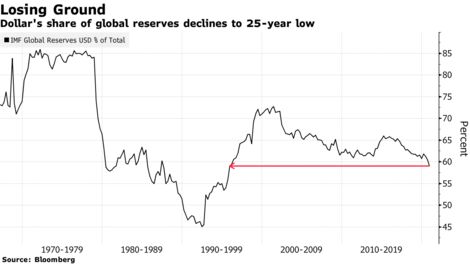
for instance, this chart, of USD as global foreign reserve %
You can clearly see the demand induce correlated with vietnam, gulf war, 9/11 invasion
https://assets.bwbx.io/images/users/iqjWHBFdfxIU/iun0_jAGaJM...
Aren't small businesses best positioned to adapt to these changes?
It's not like they're sitting on piles of cash or other investments that are losing value. If costs go up they'll have to raise prices, just as the prices for what they're buying went up due to rising costs further upstream.
I figured the pandemic cleared out most of the small businesses that would have failed within five years anyway (half do). I wouldn't assume the small businesses left would have as much trouble with inflation as larger ones that operate at greater scales with tighter margins.
Death by a thousand paper cuts. As an example, the local breakfast shop. The owner claimed he couldn't find cheap employees anymore, they all left to sit at home on unemployment (his words, not mine). He also bemoaned the additional time for sanitizing everything. I saw his quality of food go down, and he didn't transition back to using real utensils (this is a major downside for me, thin plastic cutlery stinks).
Further, they didn't adapt digitally to the take-out heavy model. The prices went up across the board, too. You get a worse meal for 10% more than you used to get a good meal.
A multivariate model of all the inputs would show that many variables matter. They're losing demand, they're paying more for inputs, they're not able to get employees, rough spiral to be in.
> [employees] left to sit at home on unemployment... didn't adapt digitally to the take-out heavy model
The restaurant world, in particular, seems to have heavily bifurcated between owner-as-entitled-extractor and owner-as-management. I'm not surprised to hear that someone who failed the transition to take-out is also blaming labor for his business's hard times.
Not to say that there wasn't some determinism in terms of location, target market, and target demographic. But good judgement, simple business management skills, and just generally being able to roll with punches made a huge difference in terms of survival rate.
I would argue they are not positioned well at all. Generally small businesses have limited inventory and limited cash on hand. So they have to now buy their inputs at an increased price while attempting to raise prices to sell outputs to customers that are cutting back due to their own reduced purchasing power. They then lose employees to businesses that are able to offer raises to their employees. They are also generally more limited in their access to capital than the larger companies.
> I figured the pandemic cleared out most of the small businesses that would have failed within five years anyway
PPP and SBA loans kept these companies alive. The bill hasn't come due yet. This is what people don't understand.
I think most of those funds got sucked up by the legally savvy before most small businesses got a piece.
There are a LOT of stories online of companies taking the money and posting fake job ads where they never hire people while laying off a significant portion of their workforce. I think there are a lot of games being paid to get PPP forgiveness by companies that don't deserve it.
Aren't PPP loans fully forgivable if you met certain requirements? There shouldn't be any bill for most businesses.
No, the point is the PPP money kept uncompetitive businesses alive that should have failed. The bill that hasn't come due: their failures.
So not a literal bill, got it
If you used them for payroll, they were free money.
The problem is on the demand side. If consumers spend less (due to higher cost of borrowing), this makes it difficult for smaller businesses to survive or raise prices (while bigger businesses have access to cheap loans/can reduce workforce etc.).
>unless some magical productivity innovation or goods/services advance emerges
But there has been the development and deployment of a major productivity innovation over the last two years. It's called Zoom. Or WebEx/Teams/Meet/etc. And while it doesn't work for everybody, the fact that tens of millions of people suddenly have experience working and running their business remotely means that if it does work for someone, their efficiency goes up.
I think about stagnating innovation, and think that Zoom/Webex focus tends to keep things in the status quo.
I’ve just got a feeling that there will be some hidden cost to innovation at large companies (less chance encounters) and a hit to culture (building a good remote culture is really hard) over time. These are not easily quantified, and I’m not sure the costs outweigh the benefits of a remote work force (health and safety, candidate pool, retention, flexibility, etc.).
But it may be a trend in 5-10 years where companies with an in-person focus start eroding market share of remote-first established companies.
I think this is kinda wishful thinking, tbh.
The labor market was pretty tight before the pandemic and has just become even tighter. Americans are less supportive of permissive immigration policies, birth rates are falling precipitously which means there is no end in sight. So companies which figure out how to do remote right (rather than accept is as a temporary adjustments) will have the edge as they can access a broader labor market (entire NA plus EU, maybe others if they can figure out time zones and outsourcing).
if you switch to Zoom, you don’t need a building. this is an intense and dramatic change to the overhead of a business.
your employees might not need a car any more, either. the number one depreciating “asset” in the average person’s life becomes optional.
this innovation’s been around in tech for decades, and people have started billion-dollar companies this way. (for example, GitHub was profitable for years before it set up its first physical office.) but it’s not just tech now; it’s finally going mainstream.
this is a very big deal.
> It's called Zoom
Does zoom increase or decrease productivity relative to email and phone calls? I suspect it decreases productivity.
It should really be compared to in person meetings
I kinda feel like we’re headed for stagflation at this point. I don’t even think we can stimulus our way to temporary reprieve.
The Fed cannot raise interest rates so high that the federal government becomes unable to afford the interest on the debt. I can't predict exactly what is going to happen, but serious shenanigans are a certainty.
on a positive note though the IRS now requires that all deposits of $600 or more are reported by the banks ensuring that people like servers and small business owners pay their proper share of taxes. So that should help the government pay the debt. We cant have the poor continuing to not pay their taxes and the rich are too expensive to audit. /s Or at least that's the message I am taking from the current administration that appeared to campaign on the opposite message but what do I know?
Edit: I should have made the /s more prominent. This is sarcasm.
> So that should help the government pay the debt.
Hahahaha. Hilarious that anyone thinks that debt will be paid down significantly, let alone in full. Pro tip: US debt is here to stay and will get worse long before it gets better - if ever.
why should the rich have to pay for everyone else?
if its the poor that are getting handouts from the govt they should be the ones that have to pay it back.
(so goes the logic)
The entire present day financial system is fragile as it is built on illformed principles that we've known for thousands of years were a terrible idea.
"Now add increased tax rates." Aren't tax rates on businesses currently lower than they were during the last period of high inflation in the US?
like a war...
> But there are growing fears of a wage-price spiral in which workers, seeing rising prices, demand higher pay — and companies, having to pay their workers more, start charging higher prices. These higher prices lead workers to demand even higher pay, leading companies to charge higher prices, and so on. It's the inflationary cycle of nightmares.
Can someone explain to me how this works? I'd assume wages to prices are a bit asymmetric. E.g., McD's sells 100 burgers per employee per hour at $2 each. It raises wages from $10 to $15/hour. To keep margin, it now needs to charge $2.05 - which is an increase, sure, but asymmetric: a 50% increase in wages implies a 2.5% increase in prices.
Assuming that occurs everywhere - why do workers need to now demand still-higher pay?
also they have to account for the ever increasing bonuses to the c-suite. See Chipotle.
"While Chipotle attributes raising menu prices to the growing price of labor, some analysts point to high CEO compensation as another factor. In 2020 CEO Brian Niccol took home $38 million, $1.24 million of which was his base salary. The rest was made up of other incentives and an annual bonus."
https://www.businessinsider.com/chipotle-is-raising-prices-b....
As a thought exercise, what is that comp averaged by the number of Chipotle salads made? In 2010, they sold ~750k per day, or ~273.75M.
So that CEO bonus costs ~$0.13 per salad sold.
I'm not sure of the rest of the comp required for the C-Suite, but that seems like a lot. I doubt the CEO's value is irreplaceable.
[0] https://www.laweekly.com/fast-food-using-slow-food-talking-w...
>So that CEO bonus costs ~$0.13 per salad sold. [...] but that seems like a lot. I doubt the CEO's value is irreplaceable.
The flaw in this analysis is that you think chipotle only sells salads. They obviously don't. At least based off my experience most people order burritos/bowls, not salads.
Here's my analysis: per wikipedia, chipotle has revenue of $5.586 billion in 2019. If we divide CEO's salary by that, we arrive at 0.68 cents per dollar of revenue. According to wikipedia, chipotle doesn't franchise, so we can assume that's all food revenue. Assuming a salad that costs $10, that's 6.8 cents of CEO comp per salad sold.
To be fair, the source said 750k people fed daily, and I made a slip and wrote salads since that is what I usually get.
The calculation is then:
Compensation / (daily consumers * days) = average cost added per person fed (and, if once per day, per item sold).
This allows us to ignore the price per item or total revenue, which might be misleading.
How much is that per food item (the example you were responding to was $.05/item)?
no idea but I would wager that McDonalds sells a ton more burgers than Chipotle does burritos.
Funny addition to this is that the NY times just published an article on this topic with this funny anecdote:
"On a chilly Tuesday afternoon this month, James Marsh stopped by a Chipotle near his suburban Chicago home to grab something to eat.
It had been a while since Mr. Marsh had been to Chipotle — he estimated he goes five times a year — and he stopped cold when he saw the prices.
“I had been getting my usual, a steak burrito, which had been maybe in the mid-$8 range,” said Mr. Marsh, who trades stock options at his home in Hinsdale, Ill. “Now it was more than $9.”
He walked out."
https://www.nytimes.com/2022/01/21/business/fast-food-prices...
You're assuming McDonald's has a much higher profit margin than it actually does - it's a restaurant chain, not a software company. In other words, the wages for the guy making the burger isn't the only input to cost. E.g., if the beef in that $2 burger used to cost $0.50, it might cost $0.75 now, partly as a response to the need for the farmer to pay himself more. There's also the people working at the meat processing plant, everything that went into the bun, the transportation costs, marketing costs, etc.
Also, I am only going to pay so much for a McDonald's sandwich before I decide the cost to quality ratio is too high, and either make it myself or go to a restaurant that has a better cost to quality ratio.
I find the making it myself option to be much better due to the increased volatility of quality. Sure, I might spend 2 hours cooking and cleaning, but I know the quality will be good 100% of the time, whereas spending $25 per person may or may not get me a decent meal because the restaurant does not have steady employee and/or is cutting corners on quality ingredients to make up for other cost increases.
I think this would hurt the middle restaurants more than McDonalds though. McDonald's has it all streamlined so they can manage costs and still delivery consistency at a low price, but the restaurants in the middle that are okay, but not top tier no longer make sense.
> I find the making it myself option to be much better due to the increased volatility of quality.
I am not a good cook, but I did learn to cook the things I like to eat out specifically because of this consideration. In the beginning, it was a more difficult decision, but now I wouldn't for the world trade my certain home cooked dishes for restaurant ones.
> Can someone explain to me how this works?
It doesn't work.
Labor is a tiny fraction of the total cost of most products. We could double wages at the low end ($30 minimum wage) and not affect inflation significantly.
Source? In particular for restaurants and other businesses that rely on service jobs, I've typically read the opposite.
I said "products". Service industries with razor-thin margins like restaurants are more affected by labor costs, sure.
To be fair, service industries are the most likely to pay low wages
I'd say that a service industry that can't pay workers (primary producers of the service, that can't be replaced) a "living wage" is exploitative and should probably be reworked or disbanded.
Do we want to be cooked for and served by folks who can't make ends meet? Do we want our kids taught by folks who can't afford to buy a home?
Would still love to see a source if you have one!
I'd love to, but my search fu has failed me this morning. (All I could find were corporate blogspam and investopedia definitions and such.)
To be perfectly frank with you, I was just talking out my behind above. I view economists as the modern equivalent of court astrologers, and having no respect for their "science", I feel no need to honor it or refer to its conclusions. I believe that econ papers say whatever the person paying for them wants to hear, so I personally don't see any point in referring to them.
Sorry for trolling.
Presumably if the meat packers also raise wages to keep up with inflation, they will have to charge McDonald’s higher prices for patties. Similarly for lettuce growers, beverage bottlers, etc. All these would put small amounts of pressure on the price of a burger. If the ultimate price ends up going from 2$ to 3$, suddenly the 10$ to 15$ wage hike doesn’t mean anything (except for people who didn’t get the wage hike in the first place).
Have you been to fast food recently? It feels like prices have tripled over the past decade, outpacing reported inflation numbers significantly.
In Seattle:
A mcdonalds medium fry is $4.12.
A taco bell bean burrito is $3.11
A burger king whopper meal is $12.39
Tripled sounds like a lot, so I trawled through some old pictures of the BK menu. I think the NJ price from 2011 is probably the closest to Seattle (price varies by location), so the whopper meal price is ~1.66x. Inflation is ~1.27x
Inflation: https://fred.stlouisfed.org/series/CPIAUCSL
----
Seattle (2022) Burger: $6.59; meal S: $9.79; M: $10.78; L: $11.28; https://www.bk.com/menu/picker-picker_5520
Utah (2018) Burger: $4.29; meal S: $6.19; M: $6.78; L: $7.18; https://www.slcmenu.com/2018/03/26/burger-king-menu-prices-i...
California (2018) Burger: $5.??; meal S: $7.??; https://foursquare.com/v/burger-king/4c48d1376594be9ae8533e2...
Seattle (2017) Burger: $5.29; meal S: $7.29; M: ???; L: $7.98; https://www.yelp.com/biz_photos/burger-king-seattle-7?select...
Maryland (2017) Burger: $4.??; meal S: $6.??; M: ???; L: $7.???; https://www.tripadvisor.com/LocationPhotoDirectLink-g41094-d...
Chicago (2012) Burger: ???; meal S: $5.??; M: ???; L: $6.??; https://foursquare.com/v/burger-king/4acfd01af964a52034d620e...
NYC (2012) Burger: $4.??; meal S: $6.??; M: ????; L: $7.??; https://foursquare.com/v/burger-king/4d4df8edea2760fc7833642...
Newark NJ (2011) Burger: ???; meal S: $5.89; M: $6.39; L: $6.79; https://foursquare.com/v/burger-king/4b86b7a8f964a5205d9831e...
Georgia (2010) Burger: ???; meal S: $4.49; M: $4.89; L: $5.29; http://milledgevillegeorgia.blogspot.com/2010/05/burger-king...
Virginia (2009) Burger: ???; meal S: $4.49; M: $4.89; L: $5.29; https://www.flickr.com/photos/ryanrules/3430593700
Ah, so it's necessarily a compounding effect across the supply chain, then? E.g. assuming 2.5% price increases: energy costs are 1.025x as expensive > fertilizer is now (1.025^2)x as expensive > crops are (1.025^3)x > beef is ^4 > patties ^5 > so now McDs pays 1.025^5 = 13% more on beef, pushing prices up >13% of their avg previous beef cost. The argument is that it could easily get above 50% given cycles in the economy.
Ok, makes sense - thanks
I think it's a bit of both.
It's not only about the money. Many people are realising just now that they don't get paid enough to take all the crap they get from work.
Anecdotally, I know a handful of engineers who quit their jobs because of this. They were making good money, just not good enough for the number of sleepless nights and stressful days they were going through.
what are they doing now though? Eventually, the student loan repayment delay expires, the covid unemployment goes away, any eviction moratoriums expire, and on top of it everything is more expensive than it was. I hope people who are leaving their jobs for less stressful or more accommodating jobs are increasing their income levels as well. There's going to be a big bill due when all the covid relief measures and savings evaporate.
> what are they doing now though?
They are working in the same field, just different companies.
> I hope people who are leaving their jobs for less stressful or more accommodating jobs are increasing their income levels as well.
Again, sometimes wages are not worth the loss in health.
I understand about wages not worth the loss in health but the bill comes regardless. I guess what you're saying is they were so far above day to day expenses (even adjusted for no pandemic relief and the current inflation) that a the decrease in pay will still put them in the black.
I'm at the point where I would sacrifice $$$ for a better work-life balance. Unfortunately my boss just gave me a raise (boo-hoo, right?) so that he could do less work and I could do more.
My goal this year is to fuck off and live in another country for 4-6 weeks, as vacation and/or as remote work. Then extend that to 2-3 months next year and ~6 months thereafter.
I'm pushing 50 and aware that I've only got so many "good" years left.
I am part of this resignation wave, and quit (retired?) last spring with no intention of going back to work. I managed to do this in my 30s, but I do feel slight FOMO of people with high paying tech jobs.
Part of me says, am I missing out on my highest earnings years? I'd like to sit on a beach but with a family, most of my days are getting groceries, doing dishes, folding clothes and driving kids around. It's not glamorous but it feels better than work life.
Exactly, I asked my manager for raise to match market rate. I received meh in response. It was great motivator to start job search. I don't blame her though. It is just how it is, ignore employees while chasing birds in bush lol
Especially in large companies HR dgaf until attrition rates hit a certain percent. Then all of a sudden we're bumping bonuses and ticking up the annual step raise a couple points. It is exhausting.
I like this framing. This is 10+ years of pay and quality of life increases for many, all coming at once. Or, at least, the improvement is just now restarting.
Folks should renegotiate. Good on them.
> "Yet, despite all the quitting and renegotiating, the real wage for the average American worker — meaning the true value of their paycheck after taking into account inflation — fell by 2.4% in 2021."
Because most are still not moving. If a worker won't leave under these conditions, there is no reason to ever give them a raise as you don't need it to retain them.
Should it be the worker's duty to constantly be searching for better opportunities and interviewing for new jobs while working - or the employer's duty to provide reasonable CoL raises so employees aren't driven away from the company?
I don't think either side owes the other anything. But that goes both ways and it can mean losing half your staff in a year for a business and training workers who have no loyalty to your business.
Everyone should be operating in their own best interest. If it's in the company's best interest to raise your pay to keep you on, they will. If it's in your best interest to leave, you should.
Some of my favorite career advice is to seek out a minimum of one interview per year. This lets you see what skills are in demand, what salaries are being offered, and practice your interviewing skills. It's a great way to educate yourself and improve long term career growth.
"Should" being the key word here. Companies are no more rational than its individual humans, which is why they are often irrationally stingy to the point of massive costs.
Stingy, self-destructive employer sounds like the employer's problem, not the employee's problem.
The only "duty" your employer has is to extract as much value out of you for as cheap as possible. If you expect anything different then you are going to be taken for a ride.
An employer at a for-profit company is responsible for maximizing the company's profits, but that doesn't mean it has a duty to extract as much value out of an employee for as cheap as possible.
Such an adversarial relationship with employees causes them to leave, or at least avoid initiative or innovative solutions that are mutually beneficial to the employer and employee.
The recent Thedacare (a non profit organization) debacle in Wisconsin shows this is not limited to for profit companies.
https://en.wikipedia.org/wiki/ThedaCare_Regional_Medical_Cen...
Yes, and yes.
"The Great Resignation" feels a bit like a phrase that folks have grasped on to and just attach the narrative they want to believe to it.
Constant articles and such with very little data. Very frustrating as a reader.
The idea that amid a pandemic and such that there are a variety of reasons seems backed up by the data, although I admit that's what I'm inclined to believe / seen.
> Constant articles and such with very little data. Very frustrating as a reader.
Actual resignations are up slightly, but the idea that employees are quitting in droves is exaggerated. It’s higher than normal turnover, but the stories are written in ways to suggest that companies everywhere are gutted by employees leaving in bulk. I feel like “great resignation” was deliberately chosen to mislead people into thinking people are just walking out of their jobs, which conjures images of a minor revolution.
Of course, that doesn’t make sense because the employees are being hired at other companies. It’s likely that the worst of the worst companies are seeing a significant net loss of employees, but for most it just means turnover is up a tick.
The problem is compounded because the “great resignation” is a narrative that people really, really want to believe. Every time I brought up the actual data on HN, it’s met with anecdotes about somebody whose friend of friend’s company lost all of their employees or something. These anecdotes seem to be the fuel keeping the narrative going far beyond what the data supports.
Anecdotally in my business I saw effectively no churn in employment through most of the pandemic. Hiring new people was also nearly impossible. Then, towards the end of last year a significant number of workers quit. Finding new people to replace them also was surprisingly easy.
I suspect a lot of people were afraid to move on to new opportunities for a while due to the uncertainty of the pandemic. Once enough confidence was restored, the job hopping we'd expect to play out over the course of a couple of years all happened in a few months.
I can certainly see this as a contributing factor.
My own experience is that during the first year of the pandemic I was just cooling my heels in a stable position. Later, the prime factor for me moving on was the whole return to office narrative. I've embraced fully remote and now demand it.
As such, I found a new job in Q4 and moved on, for a 25% pay increase as well.
I went the opposite direction; I was at a cool hipster startup, but since I decided to re-pursue academia part time, I switched to a stable megacorp [1] so I would have a consistent bit of funding for the degree for the next 4-6 years. Roughly the same base pay, but way better stock package.
I feel like for me, the boredom of COVID made online education about 10x more appealing, and with the articles about WGU popping up, I decided to finally finish my bachelors.
[1] I made sure they were ok with me doing a half-time PhD before I joined.
Completely off topic from the main thread but would you be comfortable sharing how you found and/or convinced an advisor to take you on for a part-time PhD?
Completely comfortable.
I spent a not-insignificant amount of time emailing professors (roughly two professors per state) across the US asking if they had part-time PhDs. Most didn't respond to me, the ones that did gave me a polite "no".
I then look up "online part time PhDs" and found basically two places that offer a doctorate online, which was Purdue and University of York (England). I inquired about Purdue, and it seemed more managerial than technical, which I wasn't interested in.
I find a program that seems interesting at University of York and ask them if they have any openings for a remote part time PhD. They responded back with basically "well not if you want funding." I then replied with "What if I fund myself?" Two professors working together decided to give me a shot, so they asked me to write a research proposal, which I did. I guess it was good enough, because when I emailed them back, instead of saying "thanks but no thanks", they gave me tips on how to refine it. After a few months of back-and-forth working on the proposal (and finishing my undergrad), we got the proposal into a state we were happy with.
After that, I just applied on their online portal and managed to get an intake interview. The intake interview was basically "<x> is involved with this PhD. Are you OK with that?" or "What if you encounter <y>?" I guess I did well enough because I got an offer the next week. I start in April.
----
Sorry for the life story, but I figured you might be able to be able to save yourself a few steps.
Thank you, this is very helpful.
Not parent, but part-time PhDs aren't entirely uncommon (at least in the UK, where I am) and I'm currently supervising one.
There are two major difficulties and one major advantage over the full-time version. The advantage is that you can work, so students aren't dependent on external funding or an ever-shortening runway of their own funds. This isn't a small thing. On the other side, though, it doubles the length of an already lengthy process (do people really want to be spending 7-10 years of all of their spare time unpaid and lonely?) and increases the chance the the candidate will drop out (in that they keep an alternative on-hand, rather than burning their employment bridges to do it full-time). Given how hard the PhD process can be, simply saying 'sod that' is always a temptation.
Anyway, it'll depend on the supervisor and the university. Some have policies against it, others are happy to consider.
Yup. I was working in recruiting during the early part of the pandemic, and it felt stupid reaching out to people. Even if you hated your job were you going to leave and take the chance on a new company? Who knows what could go wrong and next thing you know you don't have healthcare or unemployment during a global pandemic.
But I bet everyone who hated their job before, and then suffered through who knows what god awful shit during the pandemic, starting looking as soon as they felt it was more safe.
This is exactly it. The so-called "great resignation" is just pent-up delayed demand for normal job switching that didn't happen during the pandemic.
It's framed this way as click-bait. Of course people click on stories about quitting work because they dream of doing that themselves.
It also feeds into a narrative that everybody is doing fine, and the ones who aren't are just lazy and don't want to work.
>I suspect a lot of people were afraid to move on to new opportunities for a while due to the uncertainty of the pandemic. Once enough confidence was restored, the job hopping we'd expect to play out over the course of a couple of years all happened in a few months.
yep that's me. I wanted to quit over a year ago but I kept putting it off due to pandemic circumstances.
but now that everyone sees omicron is a wet fart and things are going back to normal, I put in my notice yesterday.
Anecdotally from talking to a lot of people who are hiring, people who accept the going rates for work are having no problem hiring. People who are shocked at what workers can ask for right now and try to resist the change are having very little success hiring, whether it's software engineers or subcontractors or lab assistants.
With service workers, resistance to paying what it takes has a compounding effect, because being short-staffed forces people to pick up the slack for missing coworkers, and they end up burning out and quitting, or leaving for another job where the wages are better and the stress is lower.
Demand for better pay and conditions has been bubbling for a long time, the Fight for Fifteen has been going on since $15/hr was a livable wage and then the mass layoffs of 2020 radicalized workers. And business owners are pissed.
Bernie Sanders ran 2 presidential campaigns and got a lot of airtime for worker power. And layoffs screw people over for short-term gain and then incur more costs when staffing up again. It is an embarrassing place to be in so businesses jump on the narrative of a great resignation.
Anecdotally, the 2020 pandemic response by employers has had an huge impact on employee attitudes and loyalty. I work in healthcare and my employer made the very poor choice to do layoffs and furloughs in the summer of 2020 due to depressed demand before COVID surged in our area. This soured the relationship with staff just as we were about to get hit hard that fall and we've struggled to keep up ever since.
Behaviors often vary at different scales. At a macroscopic level you're correct, this movement is exaggerated based on the coverage to overall economic significance (most of its all inflation driven), but at, let's say, a mesoscopic scale, there are businesses feeling these very real effects. It's in specific industries and certain types of employers, I suspect largely abusive employers, where turnover is increasing significantly. And in such environments, these trends are happening the way the media is portraying it. I've seen it and I too have friends with anecdata who have experienced it. This is abnormal as prior to the pandemic such turnover and rejection was fairly rare at a given business, it usually happened on the business's terms during restructuring, rarely on the employee side outside of say unionized strikes.
Taking this view that nothing is going on at a macroscopic scale is like standing in the Himalayas and shouting "but the Earth is really smooth, almost spherical." While at a macroscopic scale you'd be very correct (technically oblate spheriod), the mountains and valleys localized around you are very real challenges you need to navigate. That's important if you never travel outside the Himilayas, maybe not if you're circumnavigating the Earth (just, avoid it, you know). Not everywhere is Kansas and if you ignore very real localized phenomena that may be unavoidable, you're going to have problems navigating if your specific scale can't compensate for it.
I think "The Great Resignation" is an excuse bad bosses use to explain why they can't retain employees. There has definitely been an attitude shift and a re-prioritization over the past couple years that I think has resulted in people being much less likely to stay at bad jobs. But like you said, they are going to other companies, and the companies that offer good jobs in a good environment are not experiencing the same rate of turnover.
> Actual resignations are up slightly, but the idea that employees are quitting in droves is exaggerated.
Official numbers are up ~50% between Nov 2020 and Nov 2021. IMO official numbers dramatically increased as vaccine mandates occurred and under reported.
https://www.bls.gov/news.release/jolts.t04.htm
Nov 2020 -> Nov 2021; percent change by region:
Northeast 1.8% -> 2.5%
South 2.8% -> 3.5%
Midwest 2.3% -> 3.1%
West 2.0% -> 2.8%
>IMO official numbers dramatically increased
By dramatically increased you mean went from 1.8% during a pandemic when people were afraid to move around to 2.5% as things eased, well in line with historical levels.
I think the OP is much more accurate with the statement "the idea that employees are quitting in droves is exaggerated".
In fact, if you look back more than the year you picked, you'll see there was a huge drop, and the current blip is most likely those people feeling some relief from the pandemic. The rates are no where near out of line historically.
Here's historical data graphed for all 4 regions you listed.
https://fred.stlouisfed.org/series/JTS00MWQUR
https://fred.stlouisfed.org/series/JTS00SOQUR
This is all semantics around what qualifies as a "great" resignation, but don't those charts show people quitting at the highest rate in at least 20 years?
Yes, right after not quitting and giving the biggest dip in 20 years. So this is likely the backlog.
And it's not a very big amount. If the rate lasts a long time let me know. Most likely, as should be clear from the graphs, there is very little out of the ordinary happening.
I'd add that, although I haven't really been to restaurants in the past couple of months, things were very clearly not normal in the fall. Limited seating even outside, closed for multiple days a week even though there was clearly demand, etc.
The table appears to be “quite levels” which are not the same as “we aren’t employing you” levels.
I suspect both are up higher than they were in 2019.
News articles written about it are full of provocative statements like "Workers are quitting in droves". "Employers are desperate for staff".
Most of the examples they cite are restaurants.
the stories are written in ways to suggest that companies everywhere are gutted by employees leaving in bulk. I feel like “great resignation” was deliberately chosen to mislead people into thinking people are just walking out of their jobs
Yes, I think this is driven by corporate friendly mainstream media to mostly drum up for support for more corporate welfare while simultaneously painting Americans as lazy and undeserving of welfare themselves.
There's a lot going on:
- Boomers, a huge part of the workforce, are beginning to retire, and they aren't coming back
- The US is near full employment [0]. As such, workers have more power. They can "resign" and go somewhere else relatively easily, or they don't have to take poor jobs
- If a business closes right now due to lack of workers, the owner might make the claim that Americans are just lazy & don't want to work, and corporate friendly media might push that idea. However, remember, we're at a time when we're approaching full employment. The business likely wasn't attractive to workers. So is it really the (lack of) workers' fault? Or was the business just poorly run? It's hard to admit that, and easy to blame others. It's OK for businesses to fail, though. Most do.
I think it's really a matter of perspective. If you're used to having a lot of workers (some of whom don't have the luxury of looking for a good job and need to take any job they can get, just to qualify for stuff like food assistance) fighting each other for the same job, so you're able to pay them less, this is a bad situation. If you're a worker who now has many employers vying for your talents, it's a good situation, but you rarely see that story being told in the corporate media.
0 - https://www.axios.com/jerome-powell-full-employment-27be7355...
"Yes, I think this is driven by corporate friendly mainstream media to mostly drum up for support for more corporate welfare while simultaneously painting Americans as lazy and undeserving of welfare themselves."
I think you are overindexing on the corporate-media outlet connection and ignoring how simple it is for a journalist to write a trend piece from personal anecdotes. All it takes is three friends of a journalist to resign before said journalist feels like this is a 'nationwide trend'.
I believe in the great resignation within the leisure/restaurant industry. Waiters and chefs live mostly off tips, and the COVID limitations have deprived them from those earnings.
Exactly this, demand contracted, millions were laid off. Without more foot traffic, there aren't sufficient tips to keep people in those jobs especially after being burned during the mass layoffs in 2020.
Indeed. The Economist had a great article about this in their Dec 2011 edition. The article is behind a paywall, but the gist of it is that two effects explain the uptick in people changing jobs: (1) surges of job demand in new sectors boosted or entirely created by the pandemic (2) people who postponed job changes in 2020 (which hopefully will be considered as the worse year of the pandemic), effectively creating a backlog of job changes that got processed in 2021-2022. The economy just changed much faster in a few years.
Link to the article for the subscribers: https://www.economist.com/finance-and-economics/evidence-for...
Dec 2021*
- 2011 changes the entire meaning of your post.
2021, definitely :) Apologies for the typo.
December 2021 edition?
I am concerned that people have enough money for bills. How will they send their kids to college. What happens if there is a serious medical condition and they don’t have medical insurance. What happens when their savings run out after many months of remaining unemployed. I got laid off once and it was horrible being unemployed.
I think a few industries are having an outsized effect on the stats, starting with hospitals.
>Of course, that doesn’t make sense because the employees are being hired at other companies.
I don't think this is a valid assumption. I know a lot of people shifting from dual income families to one parent staying at home with the kids. Even more wanting to go from full time to part time positions.
The local regional/ trauma 2 hospital had (admittedly) lost more than 50% of nurses in a year, (unofficially) replaced fewer than half of those, and that was before any of the vaccine mandates were announced or deadlines set.
Vaccine politics have silenced them since then, but work shifts that were already understaffed at the start of covid with 1 MD, 2-3 mid-levels, and 6-8 nurses are still regularly making due with as little as 1 MD and 2 nurses.
Obviously nurses are a special case given... the state of things over the past 2 years. But those numbers are just absurd, even as an outlier.
I think assuming any sort of (near) net-zero shift in staffing is going to be wrong, be it within a particular office, business, profession, industry, or geographic area.
Here's my thought: most employees are quite risk averse, and businesses have been able to take advantage of that in order to negotiate better for wages (better=lower wages). The pandemic essentially forced people into being more comfortable in taking higher risks. It turns out that marginal increases in risk taking translate into wage gains.
You are correct, but much like banking and other industries, as information becomes more discoverable, negotiations tend to balance more towards... Equitable?
I have three contracts that drive the bulk of my revenue right now. I have a few different titles, but for simplicity, let's say Sr DevOps. As a matter of course, my oldest clients have my loyalty, but my highest bidder has my attention - work needs to be done on a Saturday night? For my oldest client, I'll do it. Conflicting deadlines come in? I'll try and take the hit (work extra hours), but the priority? The highest payer with the least micro managerial leadership.
You pay me for my experience, or you pay me to attend your meeting while someone else pays me for my experience to actually do something. It's ok, I'll wait, I charge by the hour either way, and if your meeting is useless enough, I can charge you both!
I just changed jobs. For me it was my job pool increasing by 10x or 20x due to the normalization of remote work. It's also much easier to interview when you're WFH all the time.
I'm inclined to agree that some folks who stayed home (by choice or not) found that ... it wasn't that bad and doing so to find something else probably seems easier than it was before.
My wife is possibly taking a leave to care for her father ... she's thinking a lot about if she wants to go back. If she wasn't taking a leave that first step / time might not be there to decide to do something else.
> I'm inclined to agree that some folks who stayed home (by choice or not) found that ... it wasn't that bad and doing so to find something else probably seems easier than it was before.
There's this, but let's not forget that the S&P 500 is up about 40% relative to its pre-pandemic peak, so retirement accounts have been growing really fast. Staying home suddenly became an option for many.
There were already concerns about boomer retirements. Add a pandemic most dangerous to older people, lack of concern for worker safety, and massive increases in retirement accounts, and you have a lot of people that can and do stay home.
Also, generally, the pandemic probably led to a lot of people on something of a glidepath towards retirement to think about pushing things up some number of years.
The stock market is an excellent point. Feels like there is lots of under-indexing (no pun intended) for the sentiment associated with 40% passive growth in one's retirement account since the start of the pandemic.
I think you're correct, but I would add that inflation (not sure if you meant to imply that was part of the pandemic) has forced people to take higher risks as well.
While in the past an employee may have tolerated below market wages in exchange for the stability (safety) provided by staying still, inflation and its effects have forced their hand. Food, gas, childcare, housing, transportation, etc... have all increased to the point that they've had to make bolder decisions. And that includes looking for better jobs (wages, benefits, work/life balance).
You are doing that right here (narrative with little data). Even the NPR article says "the labor force participation rate remains significantly smaller than before the pandemic and it's still hard for employers to fill open jobs". There is data to back this up and it's not just a narrative.
> There is data to back this up and it's not just a narrative.
The narrative is directionally correct. The issue is that the media (including NPR) has done everything they can think of to exaggerate it as much as possible. Once you look at the actual numbers it’s not the sea change we’ve been hearing about everywhere.
The data is being omitted because the omission leaves more room for imaginations to run with the headlines.
>Once you look at the actual numbers it’s not the sea change we’ve been hearing about everywhere.
Ehh, that's debatable and much harder to prove either way.
For years before the pandemic there have been complaints from every industry about companies trimming down teams/workforces to the smallest possible size. People were doing the jobs of 2 or 3 people were a common issue that was brought up, if anyone was sick the employer demanded you come to work anyway. And that's when things were good. Now add a large portion of employees being sick at any one time and suddenly the work machine is being driven over capacity and much like an overloaded TCP/IP network, congestion collapse occurs. Even a small change in the most productive employees moving jobs could lead to large disruptions inside of a business.
Anecdotally this is something I witnessed. We had pretty low rates of employee attrition during the pandemic, but the employees that did leave were some of the most influential.
> The data is being omitted...
Looking at just the NPR article. The data is NOT "being omitted". As far as I can tell they've backed up all of their assertions in the article and are not exaggerating anything and the claims made seem reasonable.
If you want "pure data" there's plenty of sources out there, albeit with little-to-none in the way of interpretation. Those of us who aren't experts in labor economics actually need a bit of context and interpretation.
The article seems to point to data that provides a variety of reasons.
Having said that I'm also not writing a news article so I think the standard for not having data is a bit different. I don't expect any random person on HN to source everything ... like I would a news article.
I think the MIT study painted an interesting picture (https://sloanreview.mit.edu/article/toxic-culture-is-driving...).
It has the issues of small sample size and cherry-picking (i.e. the researchers tranched companies by industry and had a model of "toxic culture" that could be disagreed with if one cared to make the case), but the overall turn-head-and-squint takeaway is the pandemic forced a lot of workers to ask the question "Am I willing to risk death for the assholes I work with?" and for a lot of employees, the answer was "no." Places where the answer was not "no" had higher retention (both across industries and within industries).
What they do after that is an open question... Some choose another company, some choose another non-career avenue if it is available to them. But the point is the pandemic forced a perspective shift that hadn't happened before.
>Constant articles and such with very little data. Very frustrating as a reader.
Very personal opinion ahead (and not tailored to this specific topic): that's most journalism for you. They're not here to "inform the citizen" as a noble mission. Most of the things the press publishes are greatly exaggerated and dramatic to evoke different emotions to the reader which are closely tied to an agenda. The fix is IMHO easy: stop consuming such media once you find such disparities instead of reading again and again about the same and other topics, because they'll most likely lie/exaggerate in everything else and at the end, you'll be happier and better informed by not filling your memory with bs.
Edit: typo with->which
I don't think that this is a particularly controversial opinion now. A decade ago, maybe. Half a century ago, certainly. But now, in 2022, I think that you could probably find even objective evidence that the median quality of journalism has significantly declined and moved from objective facts to cherry-picking emotionally-laden stories to push a narrative.
Some news companies have even started to explicitly adopt "advocacy over reporting" models, where they don't aim to be journalists in the original source of the word, but paid propaganda subscriptions.
(yeah, yeah, there are economic incentives to do so - but there are also economic incentives to make shoddy, low-quality products and cheat your customers in other realms, and yet it's still wrong)
> Some news companies have even started to explicitly adopt "advocacy over reporting" models, where they don't aim to be journalists in the original source of the word, but paid propaganda subscriptions.
This is a positive development. The problem is when motives are concealed, as in "objective" journalism.
Is it reasonable to assume that if a publishing or media company is owned by a parent company, and that parent company has financial stakes in other industries, the parent company might pressure or incentivize a specific headline narrative to benefit their other financial stakes?
Yes, also I think it caught on because it sounds like people are standing up to bosses and corporations and escaping the rat race. Good for them! Good for the resigners!
Of course, as the NPR article points out, people are really just scrambling to find higher-paying jobs, because of rising costs for goods and services.
The phrase “great resignation” also implies that people are just quitting, when in reality they’re changing jobs. The unemployment rate is lower than it’s been in a decade (except a month or two here and there), people who are resigning are getting new jobs.
Here are the 6 unemployment figures, as reported by BLS... https://www.bls.gov/news.release/empsit.t15.htm
U-3 is the figure most commonly reported. U-4,5,6 start to add in various groups of under-employed or discouraged workers. All of those figures are approaching pre-COVID levels and approaching the lows we saw in 2000. We also see U-6 closer to U-3 now than at many points in previous years (as the economy crashes, U-6 tends to get further away from U-3 as workers are forced into part-time or underemployment situations).
The unemployment rate was lower in 2016, 2017, 2018, 2019. It went up when the pandemic kicked in. Here is one (of many) sources I found with a single google search. https://www.statista.com/statistics/193290/unemployment-rate...
The seasonally adjusted U-3 fell below 3.9% in May of 2018 for the first time since October of 2000[0]. I might’ve been a bit glib about “a few months”, it was closer to two years, but the general sentiment that the unemployment rate is extremely low right now still stands. It’s far lower than the entire period of October 2000 to May of 2018, which coincidentally covers the vast majority of my working life.
There are still some issues around childcare that need to be worked out, which is probably the biggest source of the gap between U-3 and U-6 right now. But this is still one of the hottest labor markets in most of our lives.
4.5% in December, which puts it on-par with 2017 and lower than 2016. U-6, which is probably a better measure of actual slack in the labor market, is lower than any time in recent history except q3/4 2019.
The unemployment rate, by definition, wouldn't capture people who are quitting the labor force entirely.
U-6, which covers people who have been temporarily discouraged from working but want to come back is 7.3%.
If anything is keeping people out of the work force, it’s childcare issues, not anti-work.
7.3% is near historic lows on U6, but that doesn't capture childcare (like you mentioned) or retirements (at least as big of an "issue" as childcare).
Anti-work only actually comes into play in boomers who retired during the pandemic! Everyone else is effectively working if they can.
This is just a pure labor shortage - driven by demographic shifts that were years in the making and just now accelerated and by childcare shortages that are nearly fully state-driven
I wonder if it's the “great resignation” because so many millions of layoffs were pulled forward into early 2020 that the resignations stand out against a slowed down rate of firings.
Text version without “Cookie Consent and Choices”: https://text.npr.org/1075115539/
The social contact has been rewritten multiple times in the favour of elites during crises.
The people are rebelling against the reality of the new social contract.
You wouldn't know it if you only followed mainstream media. I think the corruption of media has been the downfall of our society.
I rarely see any mention of how just so many people dying + becoming disabled impacts the job market. Historically big drops in available labor lead to improved labor negotiation (e.g. working conditions, wages). The "great resignation" is only one facet.
COVID probably hasn't had a major impact in that respect there are a total of 859,354 deaths in the entire country which is only 0.2% of the population, but of the working population it is even smaller than that as almost half of that is in individuals who are 75 or older and unlikely to be participating in the workforce dropping us to less than 0.14% of people being effected, or slightly more than 1 in 1000 people.
Source: https://www.statista.com/statistics/1191568/reported-deaths-...
That's incredibly helpful, thanks! I assumed the deaths were skewed somewhat to elderly but not to such an extreme. I wonder how this impacts calculations of e.g. social security payments and wealth transfers in the US.
Thanks for replying with that... there's no mass piles of bodies in the streets impacting the workforce.
Worked great during the (surviving) workers during the bubonic plague. https://history.wustl.edu/news/how-black-death-made-life-bet...
Worked well if you liked counting money. But if you liked spending it...
"Thus the undisputed rise in nominal or money wages following the Black Death was literally ‘swamped’ by the post-Plague inflation, so that real wages fell." https://ideas.repec.org/p/tor/tecipa/munro-04-04.html
My brother resigned from his job and got another one in 6 months and doubled his income.
Non-cookiewalled: https://text.npr.org/1075115539
(Wow, it’s like free karma to post these.)
I think too its a result of 30 years where employers have had the upper hand in the job market (except perhaps 1999, 2008). Wages have stagnated during these decades, it seems finally maybe wages can catch up.
Wages are going to have to go up. House prices aren't going to come down, rent isn't going to come down, used car prices may come down but not to levels in the before times and only if new car prices don't skyrocket, food won't come down.
It's getting very expensive to meet the ends. Wages will have to go up. When ppl think things aren't fair, they revolt.
> Wages are going to have to go up. House prices aren't going to come down, rent isn't going to come down
House prices and rent go up to soak up as much wages as possible. An increase in wages for everyone helps nobody. Bidding on houses is a zero-sum game where we all bid against each other for the amount we can each just afford in interest repayments. Rent has congruent dynamics.
So.. inflation?
No. Because housing and healthcare costs have been outpacing inflation for years. It’s only in the past year that inflation has been on the table discussion wise, while the average home doubled in value since 2012.
At the bottom, wages haven't kept up with inflation. They haven't even kept up with the cost of rent.
Most of us here on HN are engineers and our salaries have grown much faster than inflation.
Sure, if you can afford to absorb the extra costs, then that is certainly a simple way to think about it. If you can't, it has the potential to be catastrophic. Wages being stagnant for so long, there are more ppl edging towards the latter.
Hell no wages aren't catching up, even getting a 50% increase in salary (with considerable effort on my part i might add) i realize that most expenses have gone up 20-40%. Rent was 1400, now its 1850. Renters insurance was about $130, just yesterday i paid $230. Houses that were selling for 500k near my house have gone to 800-900k. Even after working my ass off to get a higher paying job, i feel no richer than i did when i had my last job, i can't even imagine what people who haven't gotten raises are feeling.
Not a Moore fan, but I think this is his most underrated movie [0]. It became free to watch on Youtube a couple years ago. Maybe it'll pick some more traction now.
loving the region locked irony
I recently found a job I would never have got before the COVID.
Of course I was not really competent enough to deal with all that technical debt so I agreed to stop.
Free money for me.
I still have not had recent inflation change my budget my any noticeable amount. I simply do not see if in my every day life, or on my budget spreadsheet. I have to wonder how much of this is media obsession and how much is truly impacting household budgets.
Shouldn't this be a part of a healthy functioning economy?
Shouldn't labor be free to move where demand is? Demand represented by fairer compensation.
I have a hard time believing these people are permanently quitting work. Rather think of it from the point of a business trying to attract new customers.
I can see the inflation affecting me in my purchases and it's not breaking me. Restaurants are charging more and it's making me re-evaluate how important dining out is if it means trapping people in a low wage job they hate.
Do I really wish for someone not to move up the ladder into a better position just so I can choose from some 50 restaurants in my area? Would my life still not support the indulgence of being able to eat out with say 25 restaurants instead of 50? And with a heftier bill but less frequently going out to eat?
I think America is finally exercising some of the benefits of capitalism for the lower class and not just for the elite.
Anecdotal - myself and most of my peers (software, EE) have moved onto new jobs during the pandemic for gargantuan raises. I don't know anyone in a white collar field who quit and is just chilling now. Old friends who work retail also quit for other retail jobs with slightly better pay, more hours, etc. It brings me joy to see the average person finally realizing their worth and leveraging a little bit of personal risk for better compensation.
I would argue that there is actually a lot more recession and unemployment happening, and that the numbers provided are not an accurate representation of what is actually happening due to market manipulation and the government and fed artificially pumping the markets... hence the inflation and market instability.
Anecdotally I know several people who retired in the last couple of years. One who had been working past their planned retirement date but had been coasting on inertia and a few who moved their timeline up to retire a little early. (Though some of them still seem to do part-time consulting.) Apparently there are also fewer immigrant workers due to immigration changes during the Trump administration and the pandemic.[1]
It’s not surprising that a shrinking labor force (relative to demand) causes ripple effects. As good positions open up it triggers a musical chairs cascade as everyone else trades up for better jobs. When the music stops it seems pretty obvious that the lowest-paid and/or worst jobs are the ones that will be empty.
[1] https://www.npr.org/2021/12/22/1063104262/immigrant-workers-...
I am reading Davos Man, and all of this is how it's "supposed" to work.
"Yet, despite all the quitting and renegotiating, the real wage for the average American worker — meaning the true value of their paycheck after taking into account inflation — fell by 2.4% in 2021."
All while the world's elites have doubled or tripled their fortunes. Great Robbery would be a more apt name than Great Resignation.
My understanding is that the bottom of the wage scale have seen the biggest gains, in real terms (https://fortune.com/2021/12/10/inflation-wages-low-income-wo...). Its the middle and upper middle class that are being made (a little) poorer by inflation. A fine trade-off imo. And given the asymmetry of the risks policy makers faced (great depression vs higher than average inflation), they wisely went with the risk of inflation.
And its not clear that US federal spending is causing the inflation. Month-on-month, the trajectory has been remarkably similar between US, UK and EU.
https://econbrowser.com/archives/2022/01/inflation-us-vs-eur...
Update: I think some people's views of this are skewed by the prices in the places they live. It's worth while doing the comparison of what can be bought for about 1.4 million, in Roanoke:
https://www.zillow.com/homedetails/15-Cardinal-Rd-SE-Roanoke...
and in Los Angeles:
https://www.zillow.com/homedetails/2495-Butler-Ave-Los-Angel...
Wage gains are not being treated the same as investment gains. It's not like Bezos is taking home an hourly rate. Everybody at the real top is doing quite, quite well.
That's why the concentration of wealth into a very few hands at the top marches on, not because of "wages".
Your touching on a much more complicated subject about reporting.
If someone one owns a billion dollars of stock foobar, and foobar grows 10x, then that person is now worth 10B and "made" 9B. However they have not sold anything so while they can be reported as making 9B, they are none of it was directly cash and not taxed; at least not yet.
However, while Bezos "only" has a salary/bonus of 1.5 million a year, it is very common for executives to have total comp packages in the 10s to hundreds of millions a year. These can easily be converted into hourly rate equivalents because there is only so many hours you can work a year.
The billionaire stock owner in your example's economic power has increased by 10x regardless though. They can borrow against that money and those funds aren't taxed - so they can effectively spend it without taxation.
They can cycle debt to avoid ever having to sell a single share for their entire life, at rates more favorable than any middle class person has access to.
We can fix our tax code with legislation to address this loophole, our politicians just don't have the will to do this currently (largely because many of them amass fortunes through stocks and insider tips, IMO).
I think there's kind of a tacit understanding with business owners and legislators that if you collect taxes, you're good. Bezos and Musk might not pay taxes personally, but they oversee operations that result in payments of sales taxes, payroll taxes, employee income taxes, property taxes, etc, in vast amounts.
The historical critiques of class warfare have some good points, because there's obviously a privileged class here that's doing really well on the backs of labor, and this privileged class can afford to buy (and let's face it, it's really bribe) itself ever more privileges for a very tiny share of their wealth.
Wealth != income. What you're advocating isn't changing a loophole, it's developing an entirely new tax (wealth tax) to supplant the old (income tax). It helps to be explicit.
The loophole is that you can get $1M deposited into your bank account, but because it's technically a loan it isn't considered income. This doesn't require a wealth tax, (and getting ex. a home loan shouldn't be taxed as income), but being able to utilize wealth to get a pile of cash that is not taxed is effectively untaxed income IMO.
A wealth tax could address this, but perhaps there are other legislative options, like (partial?) realization of capital gains when used as loan collateral in the income tax code, or something like that. I'd prefer that latter, as it seems more direct.
But I don't know the specific best way to address this, I'm no a tax expert. But, I think its pretty clear that this scheme is an abuse of the system and should be remedied in some way.
This type of loan is really just a form of margin -- the same thing you can get at most stock brokerages (e.g. Schwab, TD Ameritrade, Interactive Brokers, etc). It seems almost impossible to distinguish the purpose of the loans -- e.g. I know people who use these loans to fund primary residence purchases because they lack income for FHA mortgages.
In fact, unless you have a cash-only account, you likely use margin every time you buy & sell a stock. Technically, stock transactions don't settle for 2-3 days. When your brokerage fronts you the shares to immediately buy, sell, or transfer funds, it's all margin under the hood. It gets even more complex once you get into options, swaps, and other esoteric financial instruments.
TLDR: It's simple in principle, but very complex in practice. Further complicating IRS rules is unlikely to win the whack-a-mole competition -- especially when IRS auditors under-target the ultra wealthy to begin with.
I assume they borrow against the after-tax value of the stock, because it will be taxed before being paid back(?) I don't know if that is significant, but I figure it's worth noting.
No that’s not how it works. Infact, you can get a margin loan at 0.75% interest from ibkr if you hold more than 50k usd of stock for half of its value.
Of course, if that value drops you’ll get margin called for more collateral
Half of its value is less than after-tax value, which is at least the initial investment + 63% of the gains.
Maybe I didn’t phrase it right for you,
Unaccredited investors (us, commoners) have access to margin loans for up to 50% value of account.
Accredited investors have access to portfolio margin which can be up to 90% of mark to market value.
That’s nothing to say of any custom financial instruments that banks might come up with to save bezos any taxes. Think swaps.
The thing is, when most of your money is in illiquid assets (stock, in this case, or houses, etc.) you can reliably get an extremely low interest rate loan against those assets. What does that mean? Let's say you have 10B equity in a company, and you want to buy a used 747 Jumbo Jet--a steal, at $500,000. You only have about $100k liquid cash on you at the moment. No problem! Go to a banker, take an extremely inexpensive loan out against your 10B (think less than 1% interest), and buy your jet. Because it's not income, it's not taxed. But yes, these people do actually have access to that much purchasing power, it's not just abstract numbers.
AMZN is down 10+% over the last year so not sure about that one.
His ex-wife is shovelling money to charities faster than anyone before and still made more than she gave out.
He's got elite financial engineers at his disposal, it's highly doubtful his fortune has declined in lockstep with the AMZN share price.
There are the rich and then there are the really rich, and then there are the unbelievably rich. I'll happily call a family earning 500k/y on two salaries in a small town where a million dollar home is literally a mansion on a hill "rich". Because they are. They just aren't as rich as the Trumps or Bezoss of the world.
What do you intend to connote by saying someone is "rich," though? What does it signify?
If the definition of "rich" is "independently wealthy," that family certainly doesn't meet it. They still have to work for a living.
If it means you never have to worry about where the next meal is coming from or losing the roof over your head, sure, a lot of people are "rich." And maybe this is better than 90% of humanity does, but it's still not a reasonable first world standard for being "rich" IMHO.
> They still have to work for a living.
No they don't. They could live in a median dwelling with a median income indefinitely on the interest of what they've saved over the past few years.
If you're saying that they have to work for the living that they're accustomed to, so does Musk.
Their modes of thought, their concerns and worries, their expectations, their assumptions of what is possible, their habits, their identities, all different.
She said: 'I am loosing every time!'
He answered: 'No, you are often winning, but when you lose you lose way too high.'
(-;
What does not calling them rich signify?
It hit me when I saw a 3MM home in Tampa vs 3MM in Bay Area. I think many’s definition of money is skewed from living in hcol cities.
One of my favorite quotes on the topic:
"Shaq is rich. The white man that signs his check, is wealthy." [Chris Rock]
The other thing I never hear discussed is that this round of inflation isn't expected to be permanent, or even particularly long-lasting. So a wage increase in January which is (temporarily) eaten up by January's inflation means....an actual wage increase in May which then goes on for years and years.
I think you're making a mathematical error here.
If inflation goes to zero, that does not mean prices have fallen to where they were before. It merely means prices stop increasing further.
So a temporary bout of inflation equal in magnitude to a one-time but persistent wage increase, _do_ cancel out.
Maybe I should swap in the word "price increases" for inflation.
Gas prices are high now, but nobody expects them to stay at this level indefinitely. (And nobody expects the price of gas to stop increasing without then also dropping back down.) Supply-chain related price increases aren't permanent, and go in the other direction when the supply chain improves.
And the larger point is it's a positive development if workers really are able to renegotiate their compensation -- and that isn't entirely negated by slightly higher prices in January.
Except that producers aren't going to lower prices, because the "expectation" is that other producers won't for any non-commodity good (consolidation is GREAT for the consumer), so we're stuck with it in a lot of cases.
The idea that "printing money leads to inflation" is startlingly overblown as the most impactful source of what causes it. It certainly can; but its explicative popularity is mostly the result of it being really easy to explain to children ("if you have two candy bars, wouldn't you feel that each bar is worth less?")
Or, more accurately: if everyone has more money, wouldn't demand for goods & services go up? And per the law of supply & demand, if demand goes up, prices should go up. And, per how inflation is calculated (CPI), if prices go up, inflation is on the rise. That's a lot of steps to get from "printing money" to "the value of the US dollar decreases".
It certainly can cause, and is a component of today's, inflation. But there are three confounding factors:
First: We're in an unprecedented economic climate, yet we still apply many of the laws of economics written during the Gold Rush. Today, its reasonable to assume that many people have a "demand maximum"; outside of a few high value commodities (houses and cars being the two biggest), there's only so many CPI-included goods & services which can see significantly increased consumer demand given a larger money supply. Food doesn't really see increased demand. Housing and Living supplies don't. Maybe you splurge on a PS5 (if you can find one, see (3)) or a bigger TV.
Houses & Cars, being the two biggest areas people will splurge, and related to that, Rent, are seeing massive price inflation. Which leads to:
Second: All else being equal, the average consumer sitting near a "demand maximum" socioeconomic point should mean that they're sitting on more money in a bank account. But, most aren't. The fundamental reasoning for this is complex, but it boils down to: most of the money being printed by the Fed isn't entering consumer pockets. On the contrary, most Fed policies have hurt consumers more than helped; because of rising real estate prices, which are in no-small-part due to low interest rates, housing & rent prices have skyrocketed, which mostly hurts consumers. QE over the past decade has lined American company balance sheets to unprecedented values, but that money hasn't trickled down to front-line workers in any meaningful sense; all it really serves to do is inflate stock prices, which destabilizes the stock market and makes for fun Forbes headlines about the richest Americans getting even richer (on paper).
Third: Biggest: Supply chain shock. CPI is calculated based on the price of consumer goods. Supply & Demand overwhelm the pricing decisions of most consumer goods. Some products are experiencing demand shock; but nearly everything is experiencing supply shock right now. Blame COVID. Blame China & Russia. Blame capitalism's tendency toward hyper-optimization creating a brittle supply chain.
Overall point being: Many correctly associate the word "inflation" to mean "weakening of the US dollar", but then incorrectly extrapolate it to mean "weakening of the US dollar relative to other currencies". The reality is exactly what's written on the box: its weakening relative to what you'd buy with it. And if its happening to most currencies (as it is, today); its not a currency issue, it's a supply/price issue. I'd argue not only is it not clear that Fed spending is causing inflation; its most probable that it isn't, and Fed spending over the past two years has been a positive, invisible force against higher inflation.
Wage gains aren't actually that good. A lot of people are going to be surprised they moved up in tax bracket while their standard of living went down.
What is the relevance of tax brackets? Earning more nominally while standard of living going down is the same as earning less in real terms.
“Moving up” in a tax bracket never means earning less in nominal or in real terms. It just means you get less in your pocket of the extra you earned, not of the total you earned.
I feel like all the stupid comedy shows, especially in the 80s and 90s, making those episodes about getting a raise and earning less money, did a lot of damage to people's understanding of how taxes ACTUALLY work, and continues to ripple to this day, leading to comments like the one you are replying to.
While there's nothing to fear from taxes, there is the completely separate issue of the benefits cliff [0]. When you just barely make enough to no longer qualify for SNAP or childcare and you lose 100% of those benefits instead of it phasing out based on your pay. This benefit is often worth more than a normal raise, so while you you don't take home less in your paycheck, you do have fewer resources overall. Phasing out benefits instead of making them all or nothing is a simple way to address this.
0 - theguardian.com/money/2014/jul/20/benefits-cliff-minimum-wage-increase-backfire-poverty
Other benefits is certainly a valid point, from food stamps to scholarships to all kinds of things. And when people talk about those I totally sympathize because my family dealt with those issues of "too much for those scholarships but not enough to be able to afford over a certain tier of school." And when people talk about those things I agree entirely.
If inflation is 5% and you get a 5% raise, you're level in real terms, right? No, because that 5% is taxed at your higher tax rate, which is (usually) higher than your average tax rate. This is called bracket creep.
Only if 5% causes you to change tax brackets. 5% of $300k is a lot more than 5% of $100k or $50k/yr, but only if you were already at the very edge of a tax bracket will 5% cause you to change bracket. Eg the 22% bracket is from $40-$86k for single filers in 2021. Only if you were making $81k or more will 5% tip you over. For everyone else earning 40-81k, that 5% doesn't cause a bracket change.
To add to this, especially for non-Americans or Americans unfamiliar with the tax system, the very notion of "change tax brackets" is a misnomer.
If you make $41k, you still pay 10% on your first ~$10k, 12% on the next ~$30k, and 22% only on that last $1k.
So yes, you could be in a situation where you had been at the top of a bracket, and your incremental wages from the raise are taxed at the next bracket's rate. But it doesn't trigger any kind of situation where your entire salary is now charged at the higher rate.
Yes, of course, a 5% raise does not compensate for 5% inflation. But that's just because taxes exist, not because you are entering a higher bracket per se.
IMO, the whole pervasive narrative around tax brackets being something to fear is a fear-uncertainty-and-doubt move by those seeking to vilify the tax system. It's worked surprisingly well to those ends.
No, because 100% of that 5% is taxed at the highest bracket but a percentage of your old salary is taxed at your old bracket.
To simplify 100k split 50k @20%, 50k @ 40% is less than (105k split 50k @20%, 55k @40%) / 1.05
The fist is worth 50 * 0.8 + 50 * 0.6 = 70k, the second is worth (50 * 0.8 + 55 * 0.6)/ 1.05 = 69.52k.
but you're still earning more than if you haven't gotten that 5% raise.
I think his point is that while a 5% raise and 5% inflation should be a wash, since you now pay slightly more taxes than before your pay after taxes is slightly less value than before.
It's still very misleading to say "wage gains aren't good" though - the problem is not that you got a 5% raise, it's that inflation is 5% so you need a slightly-higher-than-inflation raise to keep up. If you didn't get a 5% raise you'd just be even worse off.
It’s too far to say that “”wage gains aren’t good”, but he makes a good point about wage increase, inflation, and tax brackets I hadn’t thought of before
I think it's a bit overblown personally, the percentage of tax you pay is not going to increase a notable amount even with 5% inflation and a 5% raise. The brackets also get adjusted every year, to account for his point.
Presumably the tax brackets are linked to inflation too
Pretty sure they're not.
US tax brackets seem to be
https://www.irs.gov/newsroom/irs-provides-tax-inflation-adju...
1% inflation seems about right for the 2020->2021 tax year. Most indicators are lagging so if inflation started taking off during 2021 it wouldn't show up right away.
That shows nothing about the amount of the adjustment. Looking up last year's and running a few calculations, it appears to have been adjusted 1%! That's not adjusting for inflation. Not sure what it's adjusting for, but not inflation.
Headline literally says
IRS provides tax inflation adjustments
And links to https://www.irs.gov/pub/irs-drop/rp-20-45.pdf
"This revenue procedure sets forth inflation-adjusted items for 2021 for various provisions of the Internal Revenue Code of 1986 (Code)"
It's states adjusting for inflation for the tax year beginning March 2021. The document came out in October 2020 when inflation was 1.2%, I'm not sure when they adjust it and you may disagree with the measure of inflation
The year before was November 2019
https://www.irs.gov/pub/irs-drop/rp-19-44.pdf
Here's the one for 2021/2 (Nov 29th 2021)
https://www.irs.gov/irb/2021-48_IRB
Married Individuals Filing Joint Returns, lowest and highest bands:
Thresholds for tax year 2021/2 goes from 19750 to 19900 (0.7%) at one end, and from 622050 to 628300 at the other (1%)
Thresholds for tax year 2022/3 goes from 19900 to 20550 (3.27%) at one end, and from 628300 to 647850 at the other (3.11%)
And you’ll still be surprised that even though you’re in a higher tax bracket, your standard of living actually went down.
That's not how the progressive tax system in America works.
It is when inflation is high, which is exactly what we are talking about.
Because they haven’t adjusted the amounts for the tax brackets with inflation. So it’s a double whammy. Your money is worth less, even though you got more of it. And now Uncle Sam is taking more of it.
I cannot figure out why the US writes laws in terms of nominal value while maintaining an inflationary currency. The majority of lawmakers agree that a law should be x with respect to the current value of USD, why don't they also agree it should be x+inflation for a future value of USD? Maybe with a circuit breaker for hyperinflation. They don't have to rely on third party inflation numbers, because the Fed is a government agency.
Do some lawmakers only support a law because it will have a lower (min. wage) or higher (tax) real monetary significance in the future?
Probably, even if it is only accidentally. The Congressional Budget Office produces long-term estimates on things, and I'm guessing they aren't ignoring inflation. So, for example, a proposed law has $X ramification, according to the CBO, over the course of 10 years where X is an acceptable amount. If you were to adjust to make the law account for inflation, X would change, potentially into something not acceptable.
I think two of the biggest falsehoods many people seem to believe about finances is that one, you don't want to move up in tax brackets because then you will suddenly be making less money. And two, that somehow businesses and business owners can just "write off" expenses so that those expenses don't actually cost them any money.
There are a few edge cases where these can be technically true but they are rare and limited in scope and magnitude.
I think you are misreading the comment at the root of this whole thread. They aren't saying "if you go up a tax bracket, ALL of your income goes down because you pay more taxes!" but instead saying "you might make more money but despite that, you will not be able to buy more things." I don't think tax brackets have anything to do with this besides being tied to how much you make.
>you might make more money but despite that, you will not be able to buy more things.
I'm not sure how else to read that. If you make more money, you can buy more things. Even if you go up a tax bracket. If you make twice as much money and that moves you up a tax bracket, you won't be able to buy twice as many things, but you can still by more things than you could when you made half as much. Maybe 1.8 times more things.
That’s not how taxes work
https://www.investopedia.com/ask/answers/071114/can-moving-h...
I think they mean if you are 1% away from a new tax bracket and get a 5% raise, 4% of that is at the higher tax bracket. So while you still make more money you make less than you would have if the entire 5% were in the lower bracket.
As others have already noted, that's not how tax brackets work. The real problem might be government programs like Medicaid - it's hard to tell if eligibility requirements are inflation-indexed, and since it seems to be determined at the state level, I'm almost certain it won't be in every state. So it's possible that increased wages, while it still increases post-tax income, actually reduces net disposable income after taking Medicaid, CHIP, etc. into account.
Tax laws are confusing, alot of people think that since they made more they are in a new tax bracket and every dollar they made is subject to the new higher tax bracket rate. This is incorrect, every dollar made at and above that high tax bracket is subject to that higher tax rate, every dollar made below is subject to the previous tax bracket.(and this is after 401k and other tax writeoffs).
Clarity here, this is how it is, where you live I presume.
Other places do have more horrid, retroactive taxation.
But that said, tax rates are typically based upon cutoffs. So the more you make, the more tax you pay.
So this means that if you get a raise to meet inflation, you could see your raise more heavily taxed, if it is above the next tax bracket.
Eventually, with enough inflation, and no changes to tax regs, you could see the very poor, taxed like the well to do, a few years before.
There are also some tax benefits, which have income cutoffs, and also programs which have income cutoffs.
With inflation at historic lows for 25 years, there is little institutional knowledge about how fast >10% inflation can erase buying power, and at the same time big raises mean nothing..
totally sorry, yes you are right, I forgot to mention I live in the US and that is how tax laws here are set up. And as a caveat I am assuming all income is salary.
Being highly paid in salary you are subject to very high taxation where someone who receives most of their income in stock and sells after holding for a year would have dramatically less taxes on the same amount of money received. Its why these CEO's making $1 a year(and having stock grants in the 100's of millions) are a slap in the face to the working engineer who incurs substantially higher taxes as a percentage than the CEO making 100x his salary.
"meaning the true value of their paycheck after taking into account inflation — fell by 2.4% in 2021."
This has been going on for like 30-40 years. It's sad, but nothing new. I got about a 4.5% value cut this year.
> I got about a 4.5% value cut this year.
I have not done the math, but I would not be surprised to see this is true for me. Certainly feels like it.
I do not hate my current job, and I loathe interviewing, but I feel like I will need to jump soon just so I can push the reset button and get my compensation to keep up with inflation lately.
I got a ~50% raise last year by changing jobs and switching to 1099. This year I did not get a raise, contract just renewed as is. So I got a 50% raise to start the year and after inflation took a 10% cut at the end of the year. I like the job but I think I have maxed the salary there so going to have to find a new one at the end of this year. Pretty unfortunate but I can't eat a pay cut every year. I have a feeling most software engineers are in a similar situation where the market is good, why take a cut or only 3% raise during out of control inflation when we can jump and get a 20% raise.
10% cut? Wasn't inflation about 6.2%?
It’s always weird applying inflation to an individual.
Some things changing hit some people more than others. For example, high fuel prices would hit those very dependant on fuel.
They might be referring to inflation in their specific area or in their specific budget. I don’t think you can apply average national or global inflation rates to an individual in a specific location.
That's why I'm asking how it was 10%
Inflation was 7%. Most of my diet is meat which is up ~20%. Also if you want to do some home improvement like put in a pool, that's up 20 - 25%.
Interesting. I wouldn't have thought that would comprise enough of one's budget to have such a big effect. Thanks
It is possible I am off by a percentage point or so, my estimate is not scientific :)
Official inflation numbers are super dishonest in my opinion.
I 100% agree with this. I go to the grocery store on average twice a week. My bill was generally $100. Now my bill is ~$180. I know this is anecdotal and I buy a lot of meat which is definitely up but it seems like everything has come close to doubling.
Fuel prices are high. Housing is high. Food is high. Car prices are high. Education expenses are high. Healthcare expenses are high. Literally everything we spend most of our money on is outrageously expensive.
giantg2 is relentlessly pessimistic and negative about their job and job prospects. They say much the same things in every thread about employment.
I suck at life, but my comments are pertinent to the topics and vary by the specifics of the article/thread.
I would be interested to see the difference between those who did switch and those who didn't.
It could easily be 20% raises for those moving and 1% for those who are not.
It seems like companies are really having a hard time understanding that people are not going to just take financial hits out of loyalty to a company anymore. Companies still appear to be of the mindset that they can give small cost of living increases and people will stick around for years in hopes of getting promoted. With inflation at 9%, getting a 20% raise after 2 years with a promotion essentially just sets you back at your starting salary with more work and responsibility. Why would anyone stick around for that? Plus there are only so many positions available to be promoted into, statistically the odds are not good for most. Coupled with the fact that companies are very open that they have zero loyalty to any employee below c-suite, its not really surprising people are only keeping jobs for a couple years before being forced to look somewhere else.
> Why would anyone stick around for that?
Lots of reasons.
First of all, job hunting takes time and effort. If you're rusty at interviewing and need some practice, then even more so. People that have kids or other responsibilities outside of work have even less of both available. On top of that you have to face rejection, which for many people is emotionally difficult.
Secondly, even if everything goes well, it's still a substantial risk. The new job might seem great at first, then turn out to be a nightmare a couple of months in. The old job might not be ideal, but you're used to it, and know you can live with it -- it's the devil you know. Same way that couples often stay in unsatisfying relationships for years, because it seems better than risking ending up alone.
I have kids and need a raise each year to afford to buy them the things they need while still having a hope of retiring one day.
"The new job might seem great at first, then turn out to be a nightmare a couple of months in"
This is pretty much most of my jobs. The current one is probably the nicest I have had in a long time but I still need a raise as the thought of working until 65 just to be old and then die fills me with existential dread.
I received a 1% raise at my current job. My coworkers who worked evenings and weekends received a "100% positive adjustment of their raise" (2%).
After a few rounds of this, developers basically join a company with a plan to leave as soon as they become reasonably productive.
A 1% raise seems insulting imo.
I got nothing for a couple of years in a row, then less than 1% the next; the HR guys said this is because there is a very low turnover, so there is no need to pay better. Companies to what they can, as much as they can.
It is
It's a clear signal, the company values you less than when it hired you. When leaving a company like that I find it best to frame it in a way that they were unhappy with you. "Hey look I know you are trying to spare my feelings, but that is 6 percent less than inflation, clearly you want me out of here but didn't have the courage to lay me off. Thanks for the heads up, I've found another role."
It really seems like you are most valued the day you are hired, with your value declining by the day.
The whole concept of value in terms of business transactions seems weird to me. It is ill defined and unactionable.
Either you agree to buy or sell at a certain price, or not. “Value” plays no role in the determination of prices.
Whether you agree to buy or sell at a certain price is entirely dependent on whether such price is higher or lower than the value of the trade, in your own subjective assessment.
There are other meanings of the word "value" in business transactions, but that is probably the most common and fundamental one.
>Whether you agree to buy or sell at a certain price is entirely dependent on whether such price is higher or lower than the value of the trade, in your own subjective assessment.
The subjective assessment of the "value of the trade" is then a function of the subject's alternatives, which is usually how much someone else will pay or accept from them.
I find the term utility to be more beneficial than value, due to it being less likely to be confused. As a boss, I would say I value all the employees equally, in human terms. But the employees provide different amounts of utility/$. Although I can see how people use value and utility interchangeably.
> The subjective assessment of the "value of the trade" is then a function of the subject's alternatives, which is usually how much someone else will pay or accept from them.
I agree that it is a function of the alternatives, but the operative alternative here is not trading. The best way to assess value is that which you lose by taking something away, like taking a player out of a team or a customer out of your book of business
Well, what the business will pay for you declines the longer you stay.
Every choice in life is a gamble. Many or most businesses are betting that their labor vendors (employees) will accept less and less. Based on the statistics of the past 5 decades, this seems to have been a good bet.
So in order for us to keep our value, we'd better switch as often as possible, I guess. As long as companies aren't giving reasonable raises, at least.
Isn't that basically how tech careers work? We switch as often as vesting or the willingness of better companies to take us allows.
That is how price discovery in any market works. The more often buyers and sellers engage in transparent transactions, the more knowledge market participants have of supply and demand curve movements.
Note that for buying and selling labor, price is not only the amount of currency being exchanged, but will also include things like work schedules, work environments, break time, location, etc. I prefer to think of it as $x per a certain amount of quality of life at work.
That's how it feels to me.
I started at a company in mid January, and they did annual reviews in June/July. After review, I 'merited' a 4% raise. But... because I'd only been there since January, they prorated the 4% raise to 2%. I never quite understood their logic, but also didn't stay through the end of the year.
EDIT: this was... 2004/2005 era.
IMHO quite generous by them, in my former companies you skipped the raise talk if you joined less than 9 months ago. Makes sense, because you just negotiated your salary on entry.
> Makes sense, because you just negotiated your salary on entry.
Not really, as in this field that is about halfway through your tenure. Market has certainly shifted a lot in 9 months past.
18 month tenure seems short, even for IT employees. Better off just staffing with contractors if that's truly expected.
Devs seem to last two years, but they make the decision to leave well before that, so you need to get a retention offer in before they start the job search.
Any data on that?
Only anecdotal, but that seems to be how long people last. There are no devs that I knew at either of my past two jobs that remain. Virtually all friends report similar experiences.
Inventing arbitrary formulae to calculate your wage is merely a dishonest negotiation tactic. Govt companies do it all the time, don't read too much into it. Also, it's perfectly fine to renegotiate your wage once you're off your probation period, as once you're in, you have a better idea of your worth to the company. Just don't do it too often.
1.5% raise receiver here. Yes I'm insulted.
Is keeping your salary at pace with inflation a good argument? My raises have typically been 0-3% YoY but inflation in 2021 was 6.8%.
There's a saying “never let a good crisis go to waste” and I suspect many elites are taking that saying to heart.
On the surface they are complaining but I suspect many are using this as an opportunity to make changes that they've wanted to make for a long time but couldn't for various reasons. Mainly because elites tend to play game of thrones in their respective organizations and it wasn't politically favorable to make certain changes before covid.
>All while the world's elites have doubled or tripled their fortunes
Who and how?
It's not an US specific issue. Central banks all over the world have been pumping money ("printing") into the financial market during the pandemic. This has lead to massive bonuses, large income increases at the top of companies, while buying up their own stock. Some countries (like the US) have also made tax giveaways.
Not that these things don't happen regardless but artificially inflated capital (AKA debt) perpetuates the issue.
Maybe we should realize that increasing debt via banks and financial products is not good in of itself. Especially when we contrast it with investing in technology and workers.
It's no small secret that the world's billionaires saw >50% increase in wealth during the pandemic.
https://www.reuters.com/business/pandemic-boosts-super-rich-...
This is very misleading. They took a massive cut in early 2020, so a lot of that is just recovery.
I don't understand this degree of wealth apologism.
If you had just read the article or looked at the report, you'd see that the time frame involved includes the March 2020 crash, which in fact did not cause a massive cut for billionaires, who maintained 2.0% of the worlds wealth throughout.
I checked total return price of VTI (which basically reflects the performance of the entire US stock market), and it's up 43.5% from the peak of 2020 (some time in February) to the date of the article. The article seems to be measuring household wealth rather than stocks, so it's plausible that the difference in measurement is off, but "> 50%" and 43.5% is close enough that it's not "extremely misleading".
Yep. And in the last week, the rich have lost more money than anybody else.
It’s all a function of two things: 1. what percentage of your wealth is where, (ie home, stock market, checking account) and 2. Even if you and a rich man are both 80% in the stock market, he’ll come out in absolute terms having made more money.
Is that fair? I think so. Both made the same percentage. And if it drops, he’ll lose more absolute money, too.
[Citation needed]
I think the trick is to be the CEO of Amazon when bricks-and-mortar retailers are shuttered by a pandemic. Or to be the CEO of Tesla when their share price rises 500% for some reason.
The words "all" and "doubled" are an exaggeration, though.
unironically; them, us.
While I hope that this redistribution of wealth can be reverted, reversed or something else, I don't think this is robbery.
My concern with this is primarily because people in Germany (not that many) believe that the pandemic is controlled by big pharma, big tech and by the 'elite' (great reset) and I think it's just much simpler described somehow else than the control of rich people.
"All while the world's elites have doubled or tripled their fortunes. Great Robbery would be a more apt name than Great Resignation."
I don't get it. Why does what they do have anything to do with what you or I do? Why does anyone begrudge someone else for being lucky, harder-working, in the right place at the right time, better looking, fitter, smarter, better at business, better at making connections, faster at learning, or anything else that helps them acquire more wealth? Was it at your expense? I've certainly been passed for hiring because someone found a better candidate. I've receive smaller raises than a co-worker probably because they did more impactful work. I'm sure I've missed opportunities due to office politics.
I guess this is where we should all whip out the "U mad bro?" meme.
>Was it at your expense?
Yes, I think the point of complaints of the richest becoming richer is that they are doing so on the backs of the poor. They are underpaying employees and otherwise taking advantage of the lower classes to extract efficiency from them. If at the end of the year, I'm poorer because wages didn't even keep pace with inflation but my employer is 2-3x richer, something is wrong.
In a healthy econonomy, the idea would be that the employer pays you for services rendered and we both come out ahead and with some sort of balance.
Which, in a truly competitive free market, that should be the case. Amazon shouldn't be able to pay peanuts and work employees like dogs (or drones). Because in a free market, a competitor would show up and pay more and treat employees with more respect. But the moat is too wide and deep for many of these companies.
Heck, even if someone did make a serious play for Amazon's online retail and fulfillment, they would simply use their AWS earnings or even borrowing power due to their market cap to fund their retail side and underprice you out of the market. (Something that they have done several times before).
At a certain point, you start to see the elites continue to amass incomprehensible quantities of wealth while making their employees piss in bottles and drive into tornadoes. It’s a completely different gap than competing for a job or a raise with another candidate or coworker. I believe this is what is meant by “The Great Robbery”.
Because it's not luck. It's exploitation.
Come on. Most of the people in first world countries were forced to stay at home and depend on the services that these "elites" provided. How exactly is it unfair that they make more profit from wider reach? A large portion of Americans who received COVID cheques burned it on toys and leisure instead of saving and their money went upwards. How is that unfair?
> Approximately 159 million economic impact payments, totaling more than $376 billion, have gone out to eligible recipients in the last month — and the majority of that money continues to be spent on groceries, rent and other monthly bills, according to a new survey released Wednesday. [1]
The vast majority of the stimulus money was spent on bills, not frivolity.
[1] https://www.nbcnews.com/business/business-news/how-are-stimu...
Also is even painful to me to think about frivolities and how people spend money when seeing things like this.
“Lamborghini had its most profitable year ever during the coronavirus pandemic”[1]
Each of this cars may be something like 5 years of average salary in US.
[1] https://europe.autonews.com/automakers/lamborghini-had-its-m...
Surely the much smaller individual sums spent on something like Xbox consoles is far greater in the aggregate than a few Lambos?
As soon as you get into rating the worthiness of a spend it becomes a bit puritanical.
The ironic thing is that I mostly agree with you, but judging others ‘wasted’ spend is too slippery a slope to go down.
Yup, I agree with you too and to me the slippery part is to talk about ratios.
Definitely absolute values have a meaning to me, otherwise would not make sense to talk about billionaires and non billionaires and a better classification would be starving and non starving people.
Interestingly according to the above article, Lamborghini had $1.93B in revenue on 7430 cars, while it appears XBox had total hardware revenue of $2.29B in 2020. A handful of Lambos does seem to be worth thousands of consoles!
Perhaps people have realized that the PPP program was basically a gift to business? And that the majority of the COVID checks were spent by consumers on normal expenses?
Beware simple narratives. They almost always lie.
> spectacles like the immense popularity of the "Anti-Work" thread on Reddit — have gone as far as to suggest this record-breaking trend is a movement of young, able-bodied Americans rejecting work altogether.
I don't think this is the point of "anti work". The point is (to me) that people should be treated equitably at work and that work shouldn't be the center of our lives
What's up with all the language games lately?
"Defund the police". No no, we don't actually mean defund the police...
"Anti work". No no, we don't actually mean we're anti work...
In both of these cases "we" is a group of thousands of people with varying opinions. There are absolutely plenty of people who very much believe in defunding the police and ending work. As both movements have grown more popular we've naturally seen more people who agree with the general spirit of the movement but hold more moderate views.
The apologetics are always entertaining.
"True, the subreddit is called /r/antiwork. And yes, their motto (right at the top of their page) is "Antiwork: Unemployment for all, not just the rich!". But is it fair to call them "Anti-work"? Have you considered their moderate membership?"
it's called recuperation. these are different sets of people.
"defund" is the progressive recuperation of abolition, and "nobody actually means defund" is the liberal recuperation of that.
the process is playing out again with anti-work.
it's hard for the radical origins to refuse the attention and alliance, even if it undercuts and defuses them in the end. at least the overton window moves a bit.
I'll definitely agree that that motto and indeed the name of the sub itself are not at all representative of the current state of the sub. It didn't start out that way, but over time as it grew it attracted people who just enjoyed the "shit on your boss" aspect of it without understanding the original message.
This website is named Hacker News, yet there is an abundance of content that is neither for nor about hackers, nor news.
"Vaguely Tech-related Information for Programmers" wasn't a catchy enough name.
Turns out "Disgruntled Laborers Mad about Bad Bosses and Toxic Work Environments" is likewise too lengthy.
If someone doesn’t want to defund the police then I don’t see how they can “agree with the general spirit” unless they want to defund the police. It’s in the name. You can equivocate about anything else but not that. Same for anti-work.
I suppose you identified the potential problem here: people inferring that “defund the police” doesn’t actually mean “defund the police” and ascribing softer, feel-good intentions which aren’t there.
I guess my point is more that I don't think it's actually that common for people to say they want to defund the police but not mean it.
I was thinking more of a case like this: If someone is already outraged about police brutality and they see that a "defund the police" rally is happening, there's a greater chance they'll go as it offers them an opportunity to express their general dissatisfaction with the police regardless of whether they agree 100% with the specific ideology of the organizer. When the headline the next day reads "10000 Attend Defund the Police Rally", this leads to the perception that 10000 people believe in defunding the police when the actual number is much smaller
I prefer “stop pouring insane amounts of money into police funding and tasking the police force with fixing issues completely unfixable by a police force and instead redirect some of the ridiculously inflated police funds to appropriate solutions.”
But it’s a bit long.
"reform the police" is rather short. Not sufficient?
This is Reddit...this is the Internet...what percentage of these "people" are actually individual humans writing their own beliefs?
To be fair /r/antiwork USED to be actually be about not working and discussions on how that might be accomplished(ex UBI or government works programs). But as it got more popular it quickly turned into what it is today, which is mostly fake screenshots of people telling their bosses off.
I was a long time reader of antiwork because of the former, and ended up leaving because of the latter. These days it’s absolutely reeking with stupendously bad takes about employment law and workers rights that in most cases aren’t actual laws and aren’t actual issues of “workers rights” just “shitty communication between functioning adults”.
But that’s a story as common as blue skies and chirping birds: once your favorite sub-Reddit gets big enough…it starts to stink.
once anything gets big, it starts to stink. Call me an elitist, but the average person has wretched taste.
"A person is smart, people are dumb, dangerous, panicky animals"
- An alien invasion movie
Not gonna say I subscribe in text, but in merit...I mean...
My take on /r/antiwork is that people not working is the end goal, which is the hope for a true futuristic utopia right? Obviously we can't reach that yet, so people compromise by wanting better working conditions in the meantime.
Kind of like how the people in the soviet union were working towards a true communist utopia?
Soviet Union was a brutal dictatorship with an elite class operating under the guise of communism. Same goes for any notions of it being socialist. Under no circumstance was the means of production owned by the workers in the USSR. Also most folks pushing for socialism are pushing for Social Democracy.
It's a sophist play on emotions. I don't think there's actual malice behind it, though. More that people struggle to assert themselves and provide direct, well-reasoned arguments. So, exaggerating or throwing meaning away altogether is an easy alternative. It is also particularly useful in obscuring a lack of any sort of coherent plan or proposed action(s) when one is angry/frustrated/etc.
To some extent I also believe it's natural to try to elicit an emotional response from the other "side," because then you can focus on attacking their words, tone, character, etc instead of engaging in reasoned discourse and debate. You get a bit of an automatic advantage if your opponent is already in an emotionally charged state. From what I've seen, the phrases you mention are pretty good at that too.
All of this ends up doing more harm than good most, if not all, of the time.
It is a time tested political tool to capture power by redefining the narrative. It's very effective as is the other strategy of manufacturing crises like the teaching of critical race theory in K-12 school or having to wear masks in schools.
I actually support masks in schools. There's solid scientific evidence backing it as a mechanism to help limit the spread of COVID. Until all ages are able to be vaccinated, it seems like a prudent course of action.
It's unfortunate that people are trying to turn such things into political statements.
> limit the spread of COVID
I think it can be claimed that it limits the rate of spread, not total spread/infections.
What does "total" mean here? Is this some kind of "on a long enough timeline, everyone's dead" reasoning?
Limiting rate of spread is the same thing as reducing how many infections there are at any given time. Or, the total over a bounded time frame. I don't think "well there will still be about the same total number of infections by 2025 with or without masking" is a useful observation.
Think logically about what you just wrote... Masks can and do in fact limit the total spread/infections.
> I think it can be claimed that it limits the rate of spread, not total spread/infections.
Sure. We're probably all getting this thing at some point. But, that's why I said "until all ages are able to be vaccinated."
I really wish the US and other countries would take the Singapore route and require the unvaccinated assholes clogging up our medical system (and exhausting our highly trained/educated/caring physicians and nurses) to pay their own healthcare costs incurred due to COVID.
Having the unvaccinated directly realize some cost for their own ignorance seems highly appropriate here. Although I suppose at least some of them are paying the ultimate price with their life, which is also very unfortunate.
That’s been a thing forever. See also: “states’ rights”, “small government”, “personal responsibility”, none of which actually mean what they say on the label.
The difference here is that the slogans you listed are usually euphemisms for something more insidious. Anti-work and defund the police are the exact opposite—deliberately inflammatory slogans that exaggerate (if not outright contradict) their underlying movements.
The former just seem like good politics: "states' rights" allowed slave owners to court people who were worried about "big government" while conveniently ignoring the grave injustice that's actually occurring. The latter seems like good twitter politics; it'll get good engagement for being so inflammatory, but at the end of the day, most people don't actually agree.
It's catchy, it attracts attention, and it makes people learn what the movement is about.
It's one thing to say "defund the police", and it's another to say "penalize police brutality, take police funds and use them to fund social workers trained to disarm situations without using violence, etc."
> makes people learn what the movement is about.
I don't know about that. More like it muddies the waters and leads to miscommunication and polarization
“Reform the force”
It’s not hard to come up with a catchy tagline that doesn’t completely misrepresent the movement. Thing is, the movement is about defunding police. They’re not shy about that: https://defundthepolice.org/
I do not understand why this is regarded as so radical, once I actual sat down and thought it through.
They never do anything about property crime, even for middle class white people out in middle class 'burbs.
The one time we had a shooting anywhere nearby it was really weird and looked a whole lot like a (small-time—the dude was clearly not a seasoned pro, as he wandered into the wrong house first, telling the occupants they weren't who he was after before leaving) organized crime hit, and AFAIK they never solved it even with several witnesses, it happening in broad daylight, and both victims surviving, plus the guy apparently traveling a good long way on foot to and from the scene, and that was years ago, so they're 0/1 on scary violent crime in my area. I can't imagine they'd do better in a more typical case, unless it's one of those incredibly obvious "the boyfriend did it" situations that any idiot could solve in two minute flat. Traffic enforcement should probably be someone else's job anyway, not the police. Imagine how many fewer police officers we could have if they didn't spend 75% of their time sitting on the side of the road with a radar gun, and how much cheaper people who only did that would be—I think we only maintain the status quo because police benefit from fines & seizures, so they don't want to lose that, and as an excuse to fish for other (mostly victimless) crimes or "crimes" (like having too much money in the passenger seat).
I don't really care one way or the other, but if folks in less-nice parts of town want to try getting rid of them, seems OK to me. If it goes very wrong, I expect they'll get experience practically all the downside, so if they think it's a good idea, cool, let's try it. They're mostly dead weight from my perspective anyway—I don't get why actually defunding them, at least to try it out and see what happens, is such a big deal. They're incredibly ineffective and unhelpful, at best. Starting from scratch and seeing what we actually need to pay for doesn't seem like a crazy idea.
Right, it's about defunding the police, but it doesn't mean "defund the police and change absolutely nothing else," just like most other movements. You can't put a movement's entire mission into its name.
Yep, misleading buzzwords used as rhetorical devices. Their use reveals intent not to further understanding, but to create discord. The media loves it, op-eds can keep attacking strawmen and people basically talk past each other.
"cultural appropriation" - no no, we mean cultural appropriation but from minorities (it's amusing that the popular definitions you see of cultural appropriation have cultural appropriation in it).
"white fragility" - no no, we don't mean white people are fragile but that some are uncomfortable talking about race issues
If you have to explain what your shitty buzzword means every time, then it's not designed to convey your bait-and-switch definition.
Yeah wtf, Hacker News shows me next to nothing about cutting/chopping things down with repeated blows.
Isn't that what comment sections are? /s ;)
As far as I can tell /r/antiwork originally meant just that. Then it evolved into what it is today.
The most inflammatory expression wins out via natural selection, because the others are less repeated and retweeted.
Anyway, "Anti work" may as well be parsed as "Anti The-Kind-Of-Bullshit-Work-We've-Been-Doing". A totally reasonable interpretation.
Tag lines have been short and catchy for as long as humans have been shouting them or trying to put them on signage. Has there ever been a time when a group of protesters flew under the banner of a long nuanced argument instead?
Lately? Catchy slogans have always been a thing.
There have been language games since the dawn of time. Our very human speech evolved to allow us to discuss other humans, to gossip, to chat, to play social games like conversation, debate, acting, humor, rapping. Language has been and always will be full of games.
Intentional psi ops designed to create overreactions on both sides. Narratives in this country have to be fabricated for that effect before they are accepted.
A single voice may have freedom of speech, but the accepted narrative is controlled and much louder.
It's what fuels culture wars and allows them to overshadow more pertinent issues. Media understands the power of irresponsible, incendiary language as bludgeons.
It's a pretty old game actually. Ever heard of "Starve the beast"?[1]
The sub was originally anarchists who literally believe in not working - read the linked posts in the sidebar. It was taken over by socialists but the name stuck.
Anarchists taken over by socialists, hah. A tale as old as time.
Anarchists are, in general, a subset of socialists. You have wacky things like anarcho-capitalists, but it's difficult to take them seriously. There are some rigorous ancaps who truly believe that somehow the state is not needed to protect absentee ownership of property and that this arrangement will be a net benefit to humanity, but many of them simply think the government is the only thing stopping them from owning a zeppelin and wearing a top hat.
Anything with an anarcho prefix can't be taken seriously.
The simple answer is there are no games, there are just liberals taking slogans from more radical places and toning them down or flipflopping to be more palatable. It's more an effect of the general confusions of the internet, and people not being sure what they want, but knowing that things are wrong.
The crowd around here, of course, always constantly jumps on this as if it is all one big inconsistent argument from a specific group. Selectively forgetting in these moments what the internet is like in general. It's funny, just look at the peer replies here, people are so excited to point out the patent inconsistency, the naive radicals who don't know what they want; obviously because people who would even have something close to those thoughts must be confused and irrational.
> The simple answer is there is no games, there are just liberals taking slogans from more radical places and toning them down or flipflopping to be more palatable. It's more an effect of the general confusions of the internet, and people not being sure what they want, but knowing that things are wrong.
To some degree it's click bait, and people getting used to it.
Like "anti work" being the click bait version of "anti how work is currently handled".
If you go to r/AntiWork on Reddit and read their sidebar, it's fairly easy to understand what the point is:
> A subreddit for those who want to end work, are curious about ending work, want to get the most out of a work-free life, want more information on anti-work ideas and want personal help with their own jobs/work-related struggles.
That's what's in the sidebar, but a quick browsing of the posts in there suggests a more socialist bent to me.
Yeah, as it got more popular during the pandemic it was quickly co-opted into more of a pro-workers rights subreddit, and nowadays it's mostly people posting clearly fake screenshots of themselves telling their bosses off over text for to farm karma.
That subreddit changed its rules recently; now screenshots of text-message conversations are only allowed on Sundays.
So, you're actually bumping up against a long-running split in left-wing politics between left-libertarian Anarchists and left-authoritarian Socialists.
The Socialist argument is that profit motives are fundamentally exploitative of workers, and that ownership over the means of production should be in the hands of people who work there. The reason why capitalism is bad is because it enables a privileged few to not work, by making other people do their jobs for them. This is why most Socialist law considers "social parasitism" to be a crime: work is a virtue.
The Anarchist argument is that work itself is the exploitation and that we should strive to reduce it wherever possible. The reason why capitalism[0] is bad is because it creates bullshit jobs that don't need to exist, not just that the workers aren't getting paid enough to do those bullshit jobs.
A good way to remember this is that Socialists gave us labor unions, while Anarchists gave us the 9-to-5 work day.
What seems to have happened is that /r/antiwork started off as strictly left-libertarian, and then gradually expanded to the sort of vague Internet Leftist consensus that we see today. This is a particular brand of left-populism that likes to use the word "socialism" a lot, despite promoting policies more akin to social democrats. There's an annoying quirk of populism (either side) in which they get drunk off justice porn and extremism and don't actually form a coherent political platform. It's one thing to say "I hate capitalism", and another thing to actually propose a workable reform or replacement. Reddit is particularly bad at this as the karma system encourages "content consumption" - i.e. the production of low-effort memes because that's what people upvote immediately. In a way, gaming Reddit itself is it's own bullshit job.
[0] I should point out that Anarchists do not restrict their criticism to merely capitalism but all forms of coercive power, up to and including Socialism as I have defined it here, as well as the Communism that the Soviet Union implemented. "Work is a virtue" is something shared across capitalism and Socialism alike.
I mean the Venn diagram of people who say they want to “end work” and the people whose worldview aligns perfectly with socialism is essentially a circle. That’s not new.
That's somewhat disingenuous. There are socialists who wish for full automation so you can just go fishing all day, and there are those who value work itself but simply want a different relationship both at their place of work and systemically in general.
The subreddit was founded by anarcho-socialists and is run with that philosophy in mind, it's no big secret.
Most of the posts on that subreddit seem like fake stories, there's no proof required to post. Most of the top posts every month sound almost the same, titles like "My boss said i couldn't leave" for click-bait with a screenshot of what sometimes just looks like a word doc.
Perhaps true. But just these last few days we have corporations actually getting temporary restraining orders to prevent people from going to work for another company and requiring the other company to "make available" to them those people who had quit their job and serve out their notice.
Thankfully that TRO was dissolved, but nonetheless.
Yeah, all the stories there are fake, as they follow the same formula / similar-ish screenshots. And antiwork is always on the front page of reddit, so its attracting more low quality , karma grabbing posters
I haven't been there much, but the posts I've personally observed there are mostly LARPing/fantasy stories. They exist to titillate. They are about as real as the stories posted in the erotic subs.
Obviously there's a market for that sort of thing, so I guess that says something. I just wouldn't use people's fantasies to deduce something about their actual behavior - I think almost everyone at one point fantasizes about not needing their job.
This is roughly the equivalent of a reporter quoting a tweet as “people are saying”. Anti work is angry about work conditions, there doesn’t seem to be any evidence that they’re all quitting to lounge about. In fact, there are tons of stories there about people quitting bad jobs to get better jobs.
So would you say that they aren't actually... anti work?
It’s complicated. They’re clearly frustrated with the pay and working conditions typical with work these days. But I’ve seen no evidence of people going on the dole or retiring there. By and far the most common commentary there is people advising each other of their legal rights around how bosses treat them.
Like most of Reddit, the style and rhetorical flourishes are over the top. But the substance being posted does not seem to match what a surface analysis would imply.
Matches what the antiwork subreddit defines itself as in it's sidebar
Yes. Admittedly on the one hand what I see a lot is people embracing victimhood, relieving themselves or responsibility and self empowerment. That's the only aspect of anti-work that I don't like. Otherwise I think their message is very fair and very clear: raise wages to keep up with inflation, and treat workers humanely so people stop dropping dead of heart attacks on the job.
It feels like newfound indignity and the realization is that most of us are actually victims - capitalist exploitation of the working class is codified into the societies we live in, it just took people taking a break from the grind, a step back to see what they were subjected to, to realize what the exploitation is and what it feels like.
Its not popular on HN but most of the libertarian tenants that belay picking yourself up by your bootstraps are not applicable to a supermajority of labor. There is no change of attitude within the framing of the economic system as it exists that individual actors take on a collective scale to suddenly stop being exploited systemically.
> raise wages to keep up with inflation, and treat workers humanely so people stop dropping dead of heart attacks on the job.
...so continue working aka the exact opposite of what anti-work seems to imply. Gotcha.
Another term got co-opted for political purposes, wonderful. Nonsense that once again originates in the US, which will inevitably land on our shores in no time.
From the posts I have read in /r/antiwork I would not like to employ any of the posters, I would not want to be a coworker to any of them either. I'm not convinced that the world needs to have everyone working, but if it comes down to a shortage of food, healthcare or consumable goods, the workers should be fed before the slackers.
>but if it comes down to a shortage of food, healthcare or consumable goods, the workers should be fed before the slackers.
Some of the people in /r/antiwork see these shortages as artificial or caused by a society that funnels labor toward profit instead of toward need, but to your other point, there are a lot of people on that reddit who are incredibly naive or just have a chip on their shoulder.
> shortages as artificial
from a objective POV many but not all are mostly artificial, but not because of someone planing it or anything like that, but because of emergent behavior of our economical system and the complexity of supply chains.
Sadly all of this is very hard to change.
Especially with our world currently heading into a not so grate direction in nearly every sector and most countries...
No, the original point of the sub was always to end the current style of "work" – the idea that people need to be sitting in an office or breaking their bodies for 40+ hours a week doing something meaningless and uninteresting just to earn the privilege of living. Threads used to be about UBI, automation, unions, anti-capitalism, pursuing passions.
Then over the last year it has turned into a wall of (mostly fake) "my boss is bad" stories.
This is honestly my gripe with r/antiwork. It could be (and sometimes is) a hub for a mature conversation towards unionizing and regaining meaningful industry in the US, but it choses to be the place for edgy workers from all ages to declare themselves "marxists". As if they thrived on the ever-diminishing amount of gasps that word incites. Like a bunch of teenagers trying to out-edge everyone else. Hard to read.
It's reddit. The chances of mature conversation are close to zero precisely because it's largely populated by edgy teenagers.
edit: There are many smaller communities on reddit that do have mature conversation and content, they're just vastly outnumbered by the edgy teen clickbait content we see on the front page.
I'm convinced that subreddit will eventually get banned. Some members are radicalized and I see calls for violence very frequently.
It seems uncharitable to assume people are analyzing society through a Marxist lens for "gasps". I personally believe that Marxism is a useful tool for understanding the interplay between the powerful elites in our society and the state. I also have a degree in political science (in addition to my CS grad degree), so I feel confident in saying that I'm not an edgy teen and that I have the academic background to apply Marxist analysis to contemporary issues.
> I don't think this is the point of "anti work".
You should tell this to them. I've spent a lot of time in the sub (left recently though) and many of the people there seem to think we have the technology and means for a fully automated economy and are simply choosing not to switch over.
They truly believe if we had some form of pseudo-anarchist revolution, they would never have to spend another day doing anything but fun, rewarding activities.
According to the faq and the mods, the point is "anti-labor under Capitalism". You have a core user base of basically commies, but a larger chunk of participants just voicing grievances about labor conditions. This is by intention, they're hoping to rub off on people.
No, you are wrong. It is exactly what it says, these redditors do not want to work, at all. Not for good pay, not for shitty pay. Just zero work. It becomes obvious once you read through several threads. They believe life shouldn’t be wasted slaving away for a paycheck so you can pay bills until you die.
The subreddit is mostly about people languishing the fact they cannot escape this cycle and day dreaming about how to get out, or sharing horrible work experiences with others for sympathy.
Just think of ant colonies and how productive they are for so few working workers...
It feels fundamentally wrong that my employer cares at all about where I live when determining my 100% remote salary.
Can anyone offer me rational arguments for why they shouldn’t just pay people based on what they offer the job rather than where they choose to live?
Because it makes me salty to be paid half of what a colleague does because I’m in rural Canada and not San Francisco.
> why they shouldn’t just pay people based on what they offer the job rather than where they choose to live?
Your salary is determined by what a competitor would offer you. Nothing else, forget about your output, adding value, increasing profits, your cost of living, or whatever.
When you are in SF and most importantly, are willing to physically into the office, then there can be only so many available workers. This means high competition from companies for workers.
When you are remote, there may be many more available workers, so less competition from companies.
Naturally, companies / managers try to bend the negotiation in their favor by trying to convince you that your cost of living is lower (happened to me). My advice is to shut this argument down immediately, be willing to get up and leave (for one of the many other real companies willing to hire you).
IMHO it's OK to get a different salary when not in a big city, after all, both sides play the negotiation game. You get access to a bigger pool of companies too, you just have to share it with more workers (probably). On a society-level it's absurd that a SF dweller gets a million dollar mortgage subsidy, and you in rural Canada get (let's say) a 100k mortgage only - for the same productive output. All while crying about city/countryside inequality.
The simple answer is because they can and people still accept the positions.
Why would they pay you twice as much when you accepted half?
Yup.
Because I didn’t have all the information such as what others were being paid. I only knew that they were offering double what my current employer was offering to keep me.
So at that moment, all parties involved made rational decisions. Now that more information has come to light, you're fighting for what you feel is equal compensation. Sounds like the "system" working.
> Because it makes me salty to be paid half of what a colleague does because I’m in rural Canada and not San Francisco.
Sure but you're paid multiples of someone in Mexico. Can you explain that?
Their example is bad because they used a different country, if you want US wages live in the US.
But within the US it's pretty ridiculous.
Not all of how you spend your pay is scaled by your cost of living for example...
My employer can't predict where I want to retire, yet by scaling my entire pay by cost of living where I currently am they'd be limiting how much I can save.
You can live in a high cost of living area and decide you're ok with living with roommates and ramen noodles. That results in the same living expenditure as someone in a low cost of living area with significantly more room to save.
> if you want US wages live in the US. But within the US it's pretty ridiculous
What are "US wages"?
A police officer in SF or NYC makes substantially more than a police officer in Oklahoma City or Topeka.
Even the US has large regional variations in wages, standards of living, and economic productivity.
> Even the US has large regional variations in wages, standards of living, and economic productivity
... and you think Canada doesn't?
They have HCOL cities too, yet on average people in Canadian HCOL cities make less than their US counterparts.
US wages. Plural. Wages in the US in across multiple locales vs wages in Canada across comparable locales.
I think it comes down to an ability for a company to recruit. They can't recruit someone in SF with a salary based on rural Canada's cost of living. The justification is that it's in the company's best interest to reduce costs as much as it's in yours to get top dollar.
A somewhat parallel example is whenever someone tries getting a car repaired or plumbing work done. They may all charge their own flat rate for labor but they almost always exorbitantly overcharge for parts. Why? Because if everyone else does it, they can too. It's money on the table they would be missing out on otherwise. It's an infuriating situation (I was charged $30 for 2 $4 gaskets on my repair yesterday) but it's a pattern that's been quite commonplace.
A better question is, why do they continue to pay the colleague in SF, when they can get another rural Canadian for half the price?
Or Indian, Eastern-European or African? Why not actually lower the prices to the global level? Wouldn't that be fair for everyone?
If a company can actually get what they need, both short and long term, for much cheaper in the international market, then it should.
Buyer beware, though.
I would like to renegotiate reality.
The Great Whining is another way I’ve seen it described
Business owners will continue to be oblivious to this and hope it blows over even as their expenses increase due to the sheer amount of employees who will find better opportunities elsewhere.
The “great resignation” was always suspect.
Think about it - who would take care of all those people in the western world. I could see it happening in Asian cultures, but in the west? Nah. It’s not in us.
I mean seriously, did we ever check ourselves to think that people would just stay home?
Sure a certain percentage will — and that’s actually a good thing, especially families where both mom and dad worked. Since the cost of child care the and the benefit of caring for your own child is so great.
But with most government subsidies ending, I see a lot of parents getting pretty antsy with grown kids at home.
Let’s get real, people are going to have to get off their tukuses that they have been sitting on over the last few years and head back to some kind of work.
It’s good if they choose something more satisfying, but most people will not have that luxury and the world does not owe us anything.
So back to work you lazy bums!!
> So back to work you lazy bums!!
IMO most people want to work and be productive, but they don't want to be exploited.
I wonder how that compares to ant colonies where we know this isn't the case.
> Sure a certain percentage will
10-15% of the workers quitting is enough! If 2 of my 13 employees quit at the same time, I will have to start working 65-80 hours a week.
Or maybe reprioritize what work needs to be done? Losing two employees in quick succession for whatever reason doesn't seem like a rare event at a company.
Nowhere near 10-15% of people are quitting to stay home.
They are quitting to change jobs…
I'm aware, that's why I said what I said and not what you seem to think I said.
Read that wrong. Carry on!