Can helium be mixed with hydrogen to form a non-explosive mix? (2003)
madsci.orgInteresting! Living in Friedrichshafen (Germany) the birthplace of the Zeppelin, I'm wondering if this would be a valid option, because the Zeppelin NT that is used here in the summer uses only Helium AFAIK. The Zeppelin NT has an emergency drain that would essentially mean releasing 7.400 m³ worth of helium. I will definitely ask a family member that works at Zeppelin what he thinks of this research!
Awesome! Could you do us HN readers a favor and tell us here what he says?
So I had a brief conversation with Arthur Brauchle (Head of electrics and avionics)and we talked about some problems with the idea:
- Laws: You are currently not allowed to use anything besides pure helium
- Osmosis: Natural separation would occur, so you would need to make sure to mix helium and hydrogen constantly.
- Cleaning: They have to constantly monitoring the humidity of the helium and have to remove it with a specialized machine on a humid day. This would not work with a mixed gas (with the current design).
- (Speculation) Do not mix it in the first place: Create a sealed off hydrogen balloon in a helium balloon. This would have other problem like different expansion based on temperature. The devil is in the details here...
Thus began the squeakiest death cries of all caught in the horror.
Hydrogen Embrittlement[1] is not discussed in the link, an effect where hydrogen diffuses into metals and causes them to become brittle and crack. Many aerospace materials are especially vulnerable: high strength steels, nickel and titanium alloys, etc. Fueling a disposable balloon or rocket with hydrogen is one thing, but a vehicle that can safely be refilled with hydrogen over and over for decades is quite another. (Recall how the rust red Space Shuttle External Tank was not recycled like the white SRBs were and was the only large expendable component each launch.)
Real economies are made by saving even 8.5% of the cost of an airship's gas. That's real money. Plus, that hydrogen won't escape the vessel over time, so that's a percentage you don't have to keep refilling.
Helium diffusion is a good point though. If you’re right at the edge of non-flammability and you lose some helium over time…
Its about your customer's perceptions of risk. Key line: "Are the cost savings by using a 8.5% mixture of hydrogen worth all the trouble and effort it will take to convince your customers that the mixture is safe, as opposed to avoiding the safety questions altogether by using 100% helium?"
Why would the hydrogen not escape?
Diatomic hydrogen is bigger than helium, less prone to diffusing through a membrane.
Leading to an increasing percentage of hydrogen that will exceed the danger threshold. Helium level will need to be monitored and replenished.
You have to monitor and replenish no matter what.
That's part of why the comment said "a percentage" you don't have to refill.
Have you worked with hydrogen? Being less prone to leaving than He is an extremely low bar and very far away from the claim that it doesn’t ever diffuse through anything.
Diffusion works both ways, too. Oxygen outside of the membrane will also slowly diffuse into the hydrogen and helium mix, further complicating any attmpts to remain non-combustible.
Sure. And none of this prevents hydrogen from escaping.
That’s true, but it isn’t a claim I made.
No, but the post I replied to, and apparently you felt the urge to reply to my comment. But I now understand that you did not intend to contribute to the discussion, thanks for the clarification!
The comment you replied to was mine though…
I didn’t realize you were daniel-cussen - but it looks like you’re merely overwhelmed by how a forum works. That’s fine, but maybe dial down the smugness.
Click on your comment:
https://news.ycombinator.com/item?id=29096388
Then click parent. Go ahead, I’ll wait.
Smugness indeed.
One day you'll understand how a thread works! Don't give up hope!
I’m guessing you didn’t click like I suggested.
That's true, I hope you're not waiting anymore.
If you want to understand this thread, I suggest you start at the start.
Hint 1: I gave you the name of the person I answered to.
Hint 2: No matter how often you repeat it, it wasn't you.
Hint 3: Maybe it helps if you draw a flow chart of the different statements in the conversation!
But, see, don't worry. Because you jumped into a conversation between the post I replied to and myself, I assumed you had to add something to that conversation. I realize that I was mistaken and you just swooped in to offload some unrelated fun fact. My bad, won't happen again!
The comment you replied to was mine. It was this one: https://news.ycombinator.com/item?id=29094670
Yes, there was a higher level comment from someone else. But it wasn’t the one you replied to.
What can I say. Maybe drawing that flow chart really would be helpful for you. It's a valuable skill, being able to follow a thread or a conversation, and trying to understand the back and forth between statements and arguments may come in handy some other time.
ok.gif
It got me wondering if the increase lift capacity would be added factor, but quick calculation shows that it would only gain an extra ~1% of lift. So it would really just be a cost question: https://en.wikipedia.org/wiki/Lifting_gas
Totally unrelated, but a fascinating tidbit from that wikipedia link:
> Venus has a CO2 atmosphere. Because CO2 is about 50% denser than Earth air, ordinary Earth air could be a lifting gas on Venus. This has led to proposals for a human habitat that would float in the atmosphere of Venus at an altitude where both the pressure and the temperature are Earth-like.
Not just on Venus; Buckminister Fuller proposed to build floating cities on earth:
How much would a mile-wide geodesic sphere cost to build?
That’s an interesting What If? question!
One cost-reduction approach would be that the beams could be mass-produced for efficiencies of scale. The top panels could be simply plastic sheeting.
You could make it out of UHMWPE, the best current strength to weight material available. It's a plastic with density slightly under 1 kg/L. And it's UV resistant. Joining the parts is the real problem though. You could make it out of continuous thread in single piece with 3d knitting to avoid glue or fasteners. But all kinds of problems would arise. Also repairability would be bad. So probably you would use some sections and glue.
This seems like the perfect premise for a scifi novel. I wonder why we don't see it more.
Charles Stross has used it in a couple of novels: 'Saturn's Children' and 'Accelerando.'
I tried to convince a group that:
1. Hot air balloons get their lift from hot air; and,
2. Dirigibles can get their lift from hydrogen; thus,
3. Hot hydrogen dirigible?
Blah blah blah ... exploding dirigibles ... blah blah blah. The lifting efficiency is outrageous.
Even if you used weightless atoms to fill your balloon, the lift is only the weight of the air it displaces. So you don't really get much better since hydrogen already weighs so little.
Air is about 30 grams per mole and hydrogen is two grams per mole. So going entirely weightless you could go from 28 grams of lift per mole to 30 grams of lift per mole, a 7% increase.
But 100% more firing a flamethrower into your hydrogen filled envelope while looking your customers in the eye.
Just crazy enough to work. Hydrogen doesn't autoignite till 500 degrees celsius, while your average hot air balloon only heats gas to 100 degrees.
You'd want to be damn sure about the reliability of your thermocontroller though.
I think the fuels, and components to heat without flame, might reduce the benefit a lot.
I have often wondered about super strong materials, a sphere with vacuum inside.
I've often wondered if a double envelope would be worthwhile. Use a thin outer envelope containing He, and an inner lifting envelope with H. The outer envelope would contain any H that leaked through the inner membrane.
Unfortunately, Hydrogen doesn't lift as much compared to Helium as we might expect, since it occurs as H2 molecules rather than isolated atoms.
Until I got to the last line I assumed this was about safer transmission of hydrogen, not lift gas. Of course it would be uneconomic for pipelines to have 91.5% inert carrier gas but I wonder if you could use an inert refrigerant gas to make "non-flammable hydrogen mix" within piping that runs to consumers through non-zone-rated or even residential areas, and then refrigerate the gas at point of use, to leave a pure hydrogen stream? The refrigerant would just go around in a mostly-closed loop.
Incidentally, using 8.5% hydrogen as lift gas will make a gnat's fart of difference; the lift force is proportional to the difference in density between air and lift gas - both helium and hydrogen are way less dense than air.
>Incidentally, using 8.5% hydrogen as lift gas will make a gnat's fart of difference; the lift force is proportional to the difference in density between air and lift gas - both helium and hydrogen are way less dense than air.
My understanding is that the intention is not to create a mixture with better lift, but which is cheaper - helium being significantly more expensive than hydrogen due to supply issues.
What few sources I can find online for elemental prices suggest helium is anywhere from 2x to 10x more expensive than hydrogen, by weight. Even an 8% substitution would be economically significant at those prices - although, as the submission says, you may lose those margins through the bad reputation of hydrogen as a lifting gas.
But if you lower the temperature, the hydrogen increases in density.
I haven't read the article, but I presume that the use of hydrogen is a non-starter. No-one wants a flaming fireball raining down on them.
> I haven't read the article,
lol. tl;dr (apropos in this case): "So, 8.5% hydrogen in helium appears to be non-flammable, whereas anything above 8.7% is flammable. Eight percent hydrogen really doesn't provide much in the way of cost savings. You probably ought to consider another question concerning your airship business. Are the cost savings by using a 8.5% mixture of hydrogen worth all the trouble and effort it will take to convince your customers that the mixture is safe, as opposed to avoiding the safety questions altogether by using 100% helium?" [implied: probably not]
> but I presume that the use of hydrogen is a non-starter. No-one wants a flaming fireball raining down on them.
it'll probably work just fine on coastal or oceanic automated shipping routes. And oceanic routes would slightly mitigate the risk of someone catastrophically holepunching one with a Class IV laser.
Key line: "Are the cost savings by using a 8.5% mixture of hydrogen worth all the trouble and effort it will take to convince your customers that the mixture is safe, as opposed to avoiding the safety questions altogether by using 100% helium?"
I understand the author poses this as a rhetorical question, but obviously the answer is more complicated than “just use 100% helium”. It’s much more likely that someone has already done the cost and risk analysis and determined that 8.5% hydrogen is worth the trouble.
Sorry it’s not the answer [the author] is looking for.
I guess that might depend on the cost of Helium.
Stoichiometric mixture is only loosely connected to flamability.
You can have a stoichiometric mixture that will not be flammable because both reagents would be in right proportions but very diluted in the inert gas.
And a mixture that is very non-stoichiometric can still be very flammable, no problem. The extra gas most of the time performs the same role as inert gas -- dilutes the reagents and takes away energy from the reaction. There are exceptions, though, where you can have different results depending on the mix (for example your burning producing CO rather than CO2 because of abundance of carbon relative to oxygen in the mix).
This article popped up on HN a few months ago advocating 100% hydrogen airships for 'crew-less' cargo shipping
https://www.thecgo.org/benchmark/bring-back-hydrogen-lifting...
Can a micro satellite be launched from a hydrogen filled balloon?
NASA has calculations of hydrogen balloons up to 90km, carrying a 10kg object. [0]
Wind at that altitude can be as much as ~50 m/s, and occasionally even travel from west to east (important for orbital launching). [1] http://www.ccpo.odu.edu/SEES/ozone/class/Chap_2/2_4.htm
Low Earth orbit requires at minimum ~6.5km/s, so launching from the equator into the right stratospheric wind could allow a 10kg launch into orbit from a balloon if it can accelerate from Earth's natural rotation plus the wind speed, totaling around 500m/s, to 6500m/s. [2]
Traditional small rockets seem to have a lower limit in the 100s of kg total mass. Using a solid microrocket(s) [3], you might be able to get a payload into orbit between 10-500 grams. I know MIT was working on this as well as micro-jet engines... [4]
[0] https://www.grc.nasa.gov/WWW/K-12/Numbers/Math/Mathematical_...
[1] http://www.ccpo.odu.edu/SEES/ozone/class/Chap_2/2_4.htm
[2] https://en.wikipedia.org/wiki/Orbital_speed
[3] https://www-bsac.eecs.berkeley.edu/projects/microrockets/mas...
[4] https://www.semanticscholar.org/paper/Performance-of-a-High-...
Rocket launches from high altitude baloons have been done:
https://en.m.wikipedia.org/wiki/Rockoon
If you mainly care about altitude as with a sounding rocket, it can help quite a bit.
Also some launche loop designs have parts of the structure supported by inflatable members.
And there are even plans for a rather exotic airship design that could be flown to orbit with the help of solar powered electric engines:
So like, a rocket the size of a lamppost launching from a balloon the size of a tractor-trailer to deliver a payload the size of a softball?
Neat!
This is the winning strategy. There is no need for crew on cargo craft.
But they are still flying bombs, even without crew.
Except, they are not flying bombs. Notably, the only people killed when the Hindenberg blew were on board. And, fewer than half of them. The flames in the film were the (very flammable!) gas bag itself and the kerosene fuel. The escaping gas went up and away.
A modern craft would not be made of readily flammable material.
Your comments are filled with misinformation:
The gas-bag and paint theory is debunked: https://www.airships.net/hindenburg-paint/
The "nobody died from the hydrogen" line is debunked: https://www.airships.net/hindenburg/disaster/myths/#advocate...
That the craft is made out of flammable material is debunked: https://www.airships.net/hindenburg/disaster/myths/#flammabl...
> The "nobody died from the hydrogen" line is debunked
I don't see that claim in the comments you're replying to.
So are airplanes? And other things, like literal bombs and missiles?
Yes, 9/11 proved that.
Flying bombs that are being controlled remotely. And we know there’s no possible way that a hacking or ransomware group could exploit that channel and fly it into a couple of towers, right? Inconceivable!!
Fly-by-wire control of passenger airplanes hitting the World Trade Center was the plot of the 2001 series The Lone Gunmen[1]. Yes, that was 6 months before 9/11.
[1] https://en.wikipedia.org/wiki/The_Lone_Gunmen_(TV_series)#Si...
A gas bag that bumped into a building would bounce off. Or rip and the hydrogen shoot up to the sky.
So, no, not especially conceivable. Or plausible.
What's to stop the hackers from running the halt and catch fire instruction?
+1 for obscure references
Lest we forget drone strikes.
Anyone thought about using aerogel infused by pure hydrogen, wrapped in plastic? In case the wrap is breached it should make mixing with air slow, preventing explosion. (I am aware that aerogel is absurdly expensive in needed quantity. Just a thought experiment.)
Aerogel is too heavy. The resulting infusion will achieve neutral buoyancy at best.
How could hydrogen be a feasible approach to lifting any amount of cargo if aerogel of all things is too heavy? I just find it hard to believe that even the volume of aerogel required to support enough hydrogen to lift a useful amount of cargo would approach even a tiny fraction of the weight of the cargo itself, but perhaps I'm not imagining things correctly.
Airship Hindenburg had 200,000 cubic meters of lift gas[1].
Air masses 1.2 Kg per cubic meter, so 240,000Kg of air in that volume normally.
Helium masses 0.18Kg per cubic meter[2], so replacing that volume with Helium gets it down to 36,000Kg.
Hydrogen masses 0.08Kg per cubic meter[2], so replacing that volume with Hydrogen gets it down to 16,000Kg.
Huge balloons containing almost-nothing, as soon as you replace the inside with something it gets heavier. Aerogel is 1Kg per cubic meter without the air in it, says Wikipedia. So adding AeroGel to Hydrogen it would be 216,000Kg in that volume displacing 240,000Kg of air. Hardly buoyant at all.
Wikipedia has something called AeroGraphene mentioned[4] which is down to 160g per cubic meter. If that could be scaled up to the same volume with vacuum in it, it would be 32,000Kg and filled with the mass of Hydrogen, 48,000Kg, but that's still less buyoant overall than using Helium lift gas. Hydrogen isn't really "a feasible approach to lifting any amount of cargo", if it was then airships would be everywhere. The rest of the structure of the ship was heavy in the Zeppelin days, leaving little extra lift for people or things. Out of a Whitehouse sized vehicle it could lift low hundreds of tons. Maybe better today with carbon fibre and lightweight engines and such.
[1] https://www.airships.net/hindenburg/size-speed/
[2] https://www.aqua-calc.com/calculate/volume-to-weight
This. Also, even if aerogel tech improves drastically, there is another, more insidious problem.
Small-molecule gases diffuse through solid matter (search for "helium leak iphone" if you haven't read that fascinating story), so hydrogen will be slowly leaking out of aerogel, much like it does leak from a normal balloon.
Air diffuse back inside at a much, much slower rate - with net effect that pressure inside drops. This will crush/crumple aerogel, with no easy "top it off" option available for normal balloons.
But we just need a thick but lightweight shell, which is hard to puncture, not a whole volume made with aerogel.
You are aware that aerogel is porpous?
Indeed. Popular materials for this "envelope" are nylon fabric or mylar =)
Never heard about 10cm thick mylar or nylon fabric envelope.
Wow, great explanation! Kind of disappointing since it sounds like an awesome solution, but now this makes sense to me.
It would still have some compressible strength, right ? While not really being crushed under its own weight by default.
So couldn't you build, say a giant pyramid reaching out into the stratosphere using hydrogwn infused aerogel ? :)
You could build a giant space pyramid out of anything in principle, according to Isaac Arthur on YouTube[1]. The limiting factor quickly becomes the size of "giant" needed for most materials and the limited size of Earth to have a wide enough base. Maybe being Hydrogen-infused would mean less pressure on the lower levels and able to build it higher.
Really though, doesn't AeroGel work by being mostly nothing? The more gas and less substance it has, at some point you may as well use a cloth balloon and only have the surface area size, no?
[1] In this video on Space Elevators - https://www.youtube.com/watch?v=dc8_AuzeYKE
Yeah, in principle you could make the whole thing inflatable as well, with some compartmentalization here and there to avoid catastrophic single point failure.
You have to be careful with the calculation here: The airship must also include the weight of the structure, and aerographene could potentially need much less structure than giant gas balloons.
I don't know how strong AeroGraphene might be, but is it a reasonable approximation to say that these are like a sponge and the way they get less dense is to have more larger voids and less solid matter; that is, the lighter they are, the weaker they are?
AeroGel.org says: "Aerogels can usually hold a gently applied load of up to 2,000 times their weight and sometimes more. But since aerogels are so low in density, it doesn’t take much force to achieve a pressure concentration equivalent to 2,000 times the material’s weight at a given point. The amount of pressure required to crush most aerogels with your fingers is about what it would take to crush a piece of Cap’n Crunch® cereal." - https://www.aerogel.org/?p=3 (it goes on to say Aerogels differ in strength, but most can be made stronger by making them denser and heavier).
I have seen a suggestion, probably in a HN submission, that remaking classic Zeppelin design but replacing the duralumin structure, metal tensioning wires, coated cloth outer shell, and animal guts lift bags with modern carbon fibre, kevlar, and foils could knock 80-90% off their mass. What is all the structure in a Zeppelin doing, why can't they be shaped like hot-air balloons?
Usually when you lift cargo, the volume of the cargo is tiny compared to the volume of the lifting gas. Picture a huge blimp with a tiny gondola underneath.
With an aerogel infusion, the volume of the aerogel is the same as the volume of the lifting gas. Picture a huge blimp lifting a huge-blimp-sized lump of something underneath. Even aerogel, light as it is, adds up.
In other words - it's barely useful, and the only reason it works is because of the square-cube law: the weight of the envelope goes up as the square of the dimension, while the lifting power goes up as the cube. If you want to fill the volume with something, you lose the scaling advantage.
The fact that an aerogel-filled blimp might still conceivably be neutrally buoyant is actually testament to how incredibly light aerogel is. If you filled the Hindenburg with water, it would be more than half the weight of the Empire State Building.
> The fact that an aerogel-filled blimp might still conceivably be neutrally buoyant is actually testament to how incredibly light aerogel is.
True!
I've always had a soft spot for aerogel. I discovered it as a kid back around 2000 when Disneyland had this NASA/JPL Mars rover exhibit and they had a piece of aerogel on display. When I got home I researched it and was really impressed by all its properties. My mom got me some broken pieces of it off eBay (at the time this was way cheaper than buying an intact slab). My parents were pretty cool in nurturing my nerdiness. hah
The more I think about it, the more it seems like aerogel in a hydrogen balloon isn't the best idea for other reasons. If any moisture makes its way into the balloon, I bet it wouldn't take long for the density to suddenly drop catastrophically.
The basic principle at work is the square-cube law. The mass of an airship enclosure grows 2-dimensionally while the volume and lifting power grow 3-dimensionally. If you use any 3-d structure to support the airship you will have problems.
Or you could skip the aerogel entirely and use a hard, incompressible shell and pull a partial vacuum inside. Of course we don't currently have any materials both strong and light enough to do that. Neal Stephenson proposed such vehicles made from thin shells of diamond in The Diamond Age.
Right and when one shell breaks, the shrapnel breaks the other ones and everything around:)
Well, they'd implode (the gas inside is at a partial vacuum) so most of the shrapnel would travel inward. But yeah, diamonds are hard but not tough. It's possible that a kid with a BB gun could shatter such a craft with one shot.
But they'd certainly look cool.
Let us ignore the Helium shortage.
Although it's a resource we should avoid using as much as possible, since it's difficult to renew, the crisis is somewhat averted.
https://phys.org/news/2021-10-helium-south-africa-gold.html
https://us.eitidc.com/new-helium-reserve-discovered/
It seems the situation isn't nearly as bad as was purported back when the helium crisis was the hot new story.
ITS NON-FLAMMABLE HELIUM https://www.youtube.com/watch?v=KsjQZ2eXTxE
That MSDS sheet saying 8.5% is, I assume, for pressurized hydrogen. I wonder if the non-pressurized lifting gas (roughly atmospheric pressure) would allow higher concentration with it still considered inert?
This is making me curious about hot air balloons combined with hydrogen/helium. I don’t know whether the heat would affect the balloon lift in a meaningful way, but would be nice to have control.
Cool, here is a kind of balloon that combines hot air and helium.
It has been one before. https://en.wikipedia.org/wiki/Rozi%C3%A8re_balloon
Hydrogen is non-explosive. If you prevent oxygen from mixing in, then it's also not going to rapidly deflagrate.
It's not random detonation that is the problem, the issue is containment failures, or anything that causes one. A collision, or stress fracture for example will allow oxygen into the tank. In an atmosphere with enough oxygen in it like ours, that's always a risk.
Oxygen leaking in is not an explosion risk. As noted, it takes 25% O / 75% H before it can ignite. Above 75% H it cannot.
With positive airflow around possible leaks, sufficient H2 to sustain a flame can be prevented. In a collision, gas released goes up and out of trouble.
As noted, the lower explosive limit for hydrogen in air is 4%. Significantly lower with pure oxygen. https://www.safeopedia.com/definition/2205/explosive-flammab...
The problem is that hydrogen is a very small molecule and readily escapes containment. It can even travel along grain boundaries through solid metal.
Exactly, the lower limit, when hydrogen has escaped into the air, not when air has leaked into the contained hydrogen. The article makes clear that above 75% H2, ignition is impossible (but only if you read it).
"Traveling along grain boundaries" can only leak trace amounts. With, as I said, positive airflow, trace leaks can be constantly diluted below the concentration where ignition is possible.
> In a collision, gas released goes up and out of trouble
Except for the cases when there's an open flame nearby or sufficient heat, as is the case in a non-insignificant number of collisions. What if a hydrogen engine collides with a standard petrol engine? Or if the gas becomes exposed to hot surfaces during the oxygen mixing? The gas expansion is also a major cause of explosion. You essentially pull oxygen into the fuel, and rapid fuel-air mixing is a known cause of detonation.
What leads you to think that anything would "pull oxygen into the fuel"? H2 under pressure moves outward, and in a containment breach tends to, instead, increase the H2 fraction above the 75% that can sustain a flame until most of the gas has escaped and leapt skyward. H2 explosions are a concern in enclosed, unventilated spaces.
> H2 explosions are a concern in enclosed, unventilated spaces
Well, ignoring one of the largest hydrogen explosions in History which occurred in the open air under the exact circumstances you say are impossible: https://en.wikipedia.org/wiki/Hindenburg_disaster. You mention earlier that this is not the hydrogen, and instead just the fabric. That's been debunked repeatedly: https://www.airships.net/hindenburg/disaster/myths/#hydrogen...
You also mention nobody died in the fire as a result of the hydrogen, which is also debunked: https://www.airships.net/hindenburg/disaster/myths/#hydrogen
"This is probably the most absurd myth about the Hindenburg disaster, yet it is frequently promoted by hydrogen fuel advocates."
In addition, hydrogen tanks are not just sitting there in a vacuum. In order for the hydrogen to "leap skyward", you have to have it, again like I said earlier, not come in contact with anything that will induce combustion. Also, you need a perfectly open environment. Your point about the mixture being above 75% just shows a somewhat naïve understanding of the physical chemistry at play here. All it takes is for an area near the fuel supply to hit the right fuel-air mixture ratio, which leads to combustion, as in common elementary school science experiments (the hydrogen 'pop' demo). This event leads to a pulling in of the air and fuel around it, sustaining the exposition.
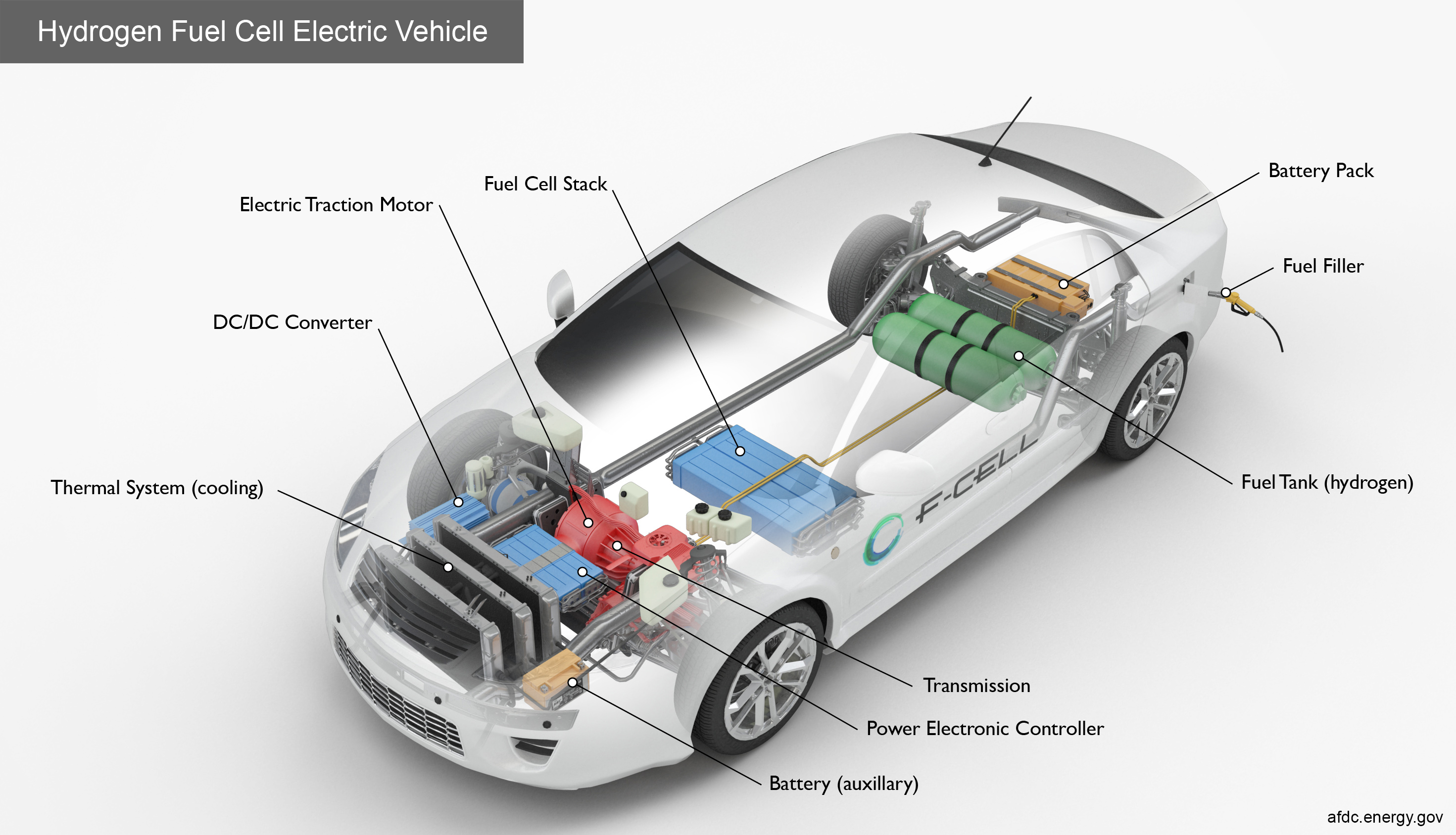
Hydrogen cars have the tanks contained within a sealed environment towards the rear of the car: https://afdc.energy.gov/files/vehicles/hydrogen-high-res.jpg
You are contradicting statements I did not make.
The Hindenberg disaster, in fact, involved no exploding hydrogen. It was a big fire. Fire can be very destructive. There is no need to invent imaginary explosions to explain destruction from fire.
It is a fact that fewer than half who were aboard died. Those who did die obviously could have been burned, and, despite your absurd and repeated accusation, I never claimed otherwise. Nobody who was not aboard died.
Burning hydrogen moves upward the same as non-burning hydrogen. Gas in contact with flame does not magically become non-buoyant.
We are not, in fact, discussing "hydrogen cars", so whatever "sealed environment" you picture in them is wholly irrelevant.
You didn't make the points here, you made them elsewhere.
> Burning hydrogen moves upward the same as non-burning hydrogen. Gas in contact with flame does not magically become non-buoyant.
Correct, it burns. Like it did in the Hindenburg. I have no idea what your point is.
> We are not, in fact, discussing "hydrogen cars", so whatever "sealed environment" you picture in them is wholly irrelevant.
This is a counter-argument for your previous points that leaks are irrelevant. My point is simple: No, they're not. You're trying to side-step this point by saying "well, I'm not talking about that" when you did right here:
> H2 under pressure moves outward, and in a containment breach tends to, instead, increase the H2 fraction above the 75% that can sustain a flame until most of the gas has escaped and leapt skyward.
Which is complete nonsense if you look into what's around a containment system. Which is my point -- containment is never not in a confined environment. You talk about some positive airflow system, sure, that's fine. What if the failure affects that? Well now you have to consider the risks all over again.
> involved no exploding hydrogen
This is a pedantic nitpick. In day to day usage, people say explosion to mean "rapid, uncontrolled fire". That does not negate my point -- that was one of the largest hydrogen fires in history.
You sound like you have tunnel vision on the advantages of hydrogen for industrial uses. There's a reason we don't use it. It's dangerous, and engineering solutions to mitigate the danger are prone to failure. If you want more: https://www.airships.net/hydrogen-airship-accidents/
Talking about "pedantic nitpicking" does not favor your argument. Inventing claims from whole-cloth to debunk does not favor your argument.
The world uses literally millions of tons of hydrogen every year, industrially. That the only event of any note that you can get any traction with was over 80 years ago should give you a clue. Noisy scaremongering does not improve anybody's life. Give it a rest.
You've given me a good laugh here. It's clear to pretty much anyone what I mean about industrial uses, so you're just responding to what you mistake as pedantry with pedantry. Anyway, I won't spend any more time here. Have fun, you've picked a strange hill to die on.
You're the one getting the issues backwards (oxygen leaking in vs. hydrogen leaking out, explosion vs. fire). Someone helpfully correcting you is not being pedantic or dying on a hill.
You're the wrong one, sorry.
Edit: Oh, you the same person as that other comment. You're completely imagining the claim that hydrogen didn't kill anyone! I'm not surprised you feel such a sense of superiority if you're that confused about what's actually being claimed here.
Not fooling any of us.
Had my house once fill up with natural gas for many weeks. Much to the surprise of the gas company it did not explode. Of course everyone has severe long term effects from that.
Still apparently hydrogen fires in daylight are basically invisible (the produce mostly infrared radiation). NASA engineers used to walk with a broom in front of them so as not to accidentally walk into a thousand+ degree invisible fire when testing hydrogen equipment.
Sounds great ... on Mars.
Atmospheric air isn’t just oxygen
So perhaps a decent enough oxygen barrier, say mylar, combined with something like iron oxide to absorb any oxygen contamination, might provide a decent safety profile? Interesting to think about.
Seems my smart ass comment is blowing up...
The original question was wrong, airships have never used this mixture.
You will get a ~8% reduction of cost, but you get other large costs like dealing with hydrogen onsite and dealing with contaminated helium. How does that re-compress? How do you make sure your mixture stays at the right percentage.
What is the purpose here?
Venting helium is expensive, but venting hydrogen is not. You can't do this with a mix but you could vent hydrogen if it's in separate internal bags. That's a possible use, but again you'd need to look at total costs.
Read up properly here for this mixing idea, but there seems little purpose -
Flammability limits of hydrogen-diluent mixtures in air https://prism.ucalgary.ca/bitstream/handle/11023/164/ucalgar... (2012)
"Hydrogen-helium mixtures fail to propagate a flame at 92% helium in the fuel mixture under atmospheric pressure (Calgary, 89k Pa) and ambient temperature. Therefore, only a small percentage of the helium in dirigibles can be safely offset with hydrogen. This is in agreement with previously reported data.
The lean flammability limits of hydrogen binary mixtures with argon, carbon dioxide, and nitrogen diluents in air for upward flame propagation appear to be very close to the limits predicted using the adiabatic flame temperature concept"
Charge the hull, ionize the gas, minimize loss by forcefield. Needs current carrying hull though. Graphene?
I did t read the article. Are hydrogen and helium miscible or do they separate out. I definitely think they would because of the difference in density.