A house 3D printed from raw earth
itsnicethat.comLots of unfair negativity here. I think this is wonderful. HN is full of random hacked-up tech that will never solve the worlds problems but nonetheless give a glimpse at what alternatives could look like. Experiments. This is what this is, and in my opinion it's stunning and I would move into one in an instant.
I disagree. It's common to see news headlines about things claiming to solve important humanitarian problems; they get shared on facebook, talked about over dinner tables, and online communities. They often ommit the downsides and alternatives, which in many cases (I speculate it applies here) make the product non-viable. For example: indoor farming, water-from-air schemes, solar-panels-in-surprising-places etc.
The HN community is more likely to provide a check on these claims - I think that's valuable. You'll find the acerbity is triggered by exaggerated claims, humanitarian claims, and lack-of-discussion of downsides. The TECLA page is filled with lines like this: "TECLA, a 3D printed global habitat for sustainable living". It sounds manipulative, makes me not trust them, and based on past experience, pattern-matches to most of their claims being false or exaggerated.
I agree (with your disagreement) ... "3D printed house" is one of those things that come up at dinner tables regularly.
"Hey you are into 3d printing, right? Have you heard about the new technology that allows us to print houses?!?"
Yes I have ... no it won't change the world ... yes this has been done for years now.
What I am more interested in is that robot arm on a truck that "automatically" lays bricks with mortar (substitute) inbetween.
The negativity is no more unwarranted than positivity. Each depends on what problem a person values. In terms of housing the unhoused this doesn’t do anything. In terms of aesthetic possibilities for people with money it provides another option where a wide array of options already exist.
In HN terms, this is a “rewritten in Haskell.” It demonstrates someone understands a bit about 3D printing. It demonstrates some ideological purity. It doesn’t demonstrate a better solution to existing problems.
The complexity of the logistical chain precludes wide spread application where housing is a basic need. You don’t just need the printer machine. You need a fleet of other machines to keep it full of ink. Shovels won’t do.
In the 1950’s, my mentor the late David Crane, FAIA was a young man. He enthusiastically designed precast concrete shelters for post disaster housing. Running the economics at the end of it, its viability was mostly limited to lower Manhattan.
People have been solving housing for millennia. Stick lumber and reinforced concrete are real breakthroughs by virtue of their commoditization.
This is wrapped up in secret sauce. Beautiful as with the myriad other beautiful ways to build.
Most choices are not between bread and cake. They are bread or nothing.
Something tells me the same things were said about early automobiles:
* People have been solving transportation for millenia
* Horses and trains are real breakthroughs
* The complexity of logistical chain (gas, mechanics, paved roads) precludes widespread application where transportation is a basic need
* You need a fleet of other machines to keep it full of fuel. Oats won't do.
* It does not demonstrate a better solution to existing problems
What is the thing that tells you?
It's called "Google".
Here's the first hit for "early criticism of automobiles":
https://www.saturdayeveningpost.com/2017/01/get-horse-americ...
I am leaving it as an exercise to the reader to verify the extent to which your concerns mirror those of people 100 years ago.
I think the difference is that “concrete/lumber housing” to “3d printed housing” is not like “horses and carriages” to “cars.” Not saying it couldn’t be, but I think the point is that this experiment, although very interesting and cool, does not come close to demonstrating an analogous transformation (yet.)
Arguably, neither did the automobiles when they first appeared.
Nearly 30 years passed from the introduction of Benz's Motorcar (first automobile) to conveyor-belt assembled Ford's Model T (first mass-produced automobile).
It took about the same time from The Mother Of All Demos till the Internet became widespread.
So, let's check back in 30 years
The article does not contain the quotations you listed.
"In terms of housing the unhoused this doesn’t do anything"
"It doesn’t demonstrate a better solution to existing problems."
"They are bread or nothing."
And this guy starts off his reply with "The negativity is no more unwarranted than positivity."
Why do I always see these kind of comments on the top?
Does HN scrutinize everything based on the "practicality of things"? This article is multiple galaxy away from making such a claim. Why do people respond like the next million dollar housing solution is being advertised here?
I’m entirely onboard with aesthetics based positivity. There’s nothing wrong thinking Twinkies are the best things since sliced bread.
And that’s perfectly valid insofar as nutritional content is not a consideration. Insofar as a person has plenty of access to fresh fruit and vegetables.
Not everyone is so far up Madlow’s pyramid. Their needs are also legitimate. My comment is a response to the scolding of people who consider them in their judgment of the project’s merit.
> In terms of housing the unhoused this doesn’t do anything. In terms of aesthetic possibilities for people with money it provides another option where a wide array of options already exist.
Hey, that's me! I want one! I'm here to know if plumbing is included and if the exterior can look better, but I love this style on the inside. Its a mixture of Pierre Cardin's bubble palace and another aesthetic I've seen where the rockface of a mountain makes up the backwall of a contemporary home! I love it!
This seems like a cheaper way to do that, and I love the hue lights.
Its obvious that there is some metal and other materials that did not come from the earth at that site, and that therefore it cannot have zero waste as the company claims
but who cares, this guy (me) that can easily exchange earned resources for shelter does not care! I like the pictures and read it can be done in 200 hours. Uh, hello!
The part that can be done in 200 hours can be done with conventional methods in 200 hours.
Framing the superstructure of a building is always the fastest part. Site preparation beforehand and installing services and finishes afterwards are what takes most of the time.
Keep in mind that 200 hours is the time on site. It doesn't include lead time. If there are ten projects ahead of yours, you're 2000 hours out and because there is a dependency on a particular machine, you just have to wait. While you are waiting for your 200 hours, there will be weather delays on the other projects. Other owners will be like you and decide to add an extra room while the machine is there. Framing crews are largely fungible. Proprietary machines and materials are not.
So now it is finally your turn. Any other trades that need to be onsite haven't been sitting around waiting. They are off on other projects with their own schedules, delays, change orders and problems. Sure you scheduled them for 2200 hours out, but that turned out to be 3200 hours and the plumber will be free at the 3700 hour mark and the electrician at t=4000 hours. Because that's the way construction actually works.
It's why everyone has heard horror stories. It's why 200 hours sounds too good to be true. I mean how long will it take you to find a piece of land with suitable soil? How much time will it take to figure out where to put your strip mine on the property?
Also keep in mind that 200 hours is five forty hour work weeks (and 2000 hours a work year). That 3d printer has to be fed by someone and that someone won’t be working round the clock.
HN worries about the hard problems because they're real challenges that need to be solved before any improvements reach the wider market.
Nonsense. HN worries (enjoys, rather) problems that appeal to them. Linux running on a pen. A new programming framework demonstrates an abstract point. Etc.
What HN is doing here is internalizing cliches, responding to hyperbole/tropes they (we) assume is in the article. Also, the artsy-philosphical terms used by architects pisses off nerds. "Humane Architecture" and whatnot.
This is HN being silly, not HN being smart. We do both here.
Meanwhile, how is transporting materials vs equipment a Hard Problem?
Yes HN is great for championing useless projects, all the while crapping on the ideas that turn out to be huge; Dropbox, Gitlab, Coinbase etc.
Oh well, it is entertaining!
Yes, true. Picking winners is a hard game though... so I have sympathy for that part.
The part that bothers me is crapping on other fields for things we would tolerate, even respect in our own. If a tech company was messing with 3d printing experimentally, released some esoteric and impractical new database alternative or somesuch... We might criticise, but this reaction to experimental architecture is extreme.
I think a lot of it is the artsy language used by architects. It triggers HNers. Meanwhile, we appreciate abstract takes by pg, Stallman, or whatnot.
Consider: "Free software is software that respects your freedom and the social solidarity of your community" - Stallman. This is OK to us, even though it probably sounds like meaningless ideological rambling to the uninitiated.
Meanwhile: "The aesthetics of this house are the result of a technical and material effort, it was not an aesthetic approach only. It is an honest form, a sincere form.” is intolerable to many the HN community. The base assumption is that the emperor has no clothes and regicide is the only solution.
I see your point (although I am allergic to Architect-speak myself!)
I am too, instinctively... though I consciously try to push through it.
OTOH, I think architect-speak is the actual glue between art philosophy and wider movements. Why is "postmodernism" (or modernism, etc.) an epistemology, political ideology, artistic sense and architectural school? They don't seem obviously related Why did Ayn Rand write about an architect to demonstrate her thoughts?
Logical or not, these "movements" are connected somehow and they to ebb and flow together.
There are a lot of lessons here for tech nerds. You could easily describe "agile vs waterfall" in modernist vs postmodernist terms. Apple & Google's product aesthetic does reflect typically modernist ideas... form from function or whatnot.
A couple of years ago I went deep into talking to literal flat earthers (friends, whom I love). I learned (and still processing) a lot. Anti-intellectualism plays a fundamental role, but the key parts are a level or two deeper to that. You need to realize that psychologists, political "think tankers," dieticians or economists actually do present themselves as equally authoritative to physicists. They're wrong all the time, and many of their loudest talking points turn out to be fads in retrospect. EG Monetarism seems to be dying ATM, despite having been unchallengeable for 40 years. That happens in physics too, but relativity didn't make Newtonian mechanics seem like pseudoscience in retrospect. To a MOP though, there isn't an obviously discernible difference between Newtonian mechanics and the food pyramid. Both are intellectualism, claiming the authority of science. All they see is suits, academic titles, and positions of authority who get to be the authority.
Anyway... because architect/artists speak can be bullshit, is often very clumsy, and we can't discern BS from insight, we assume it's all bullshit or a way to get away with bullshit. Often, its our own ignorance.
I credit PG with bridging these worlds for me.
Doom running on an HP printer is interesting because it is clever and because being clever was reason enough to do it.
This isn’t clever. It is a string of tech buzzwords washed with green buzzwords. Or to put it another way nobody really cares how their house is built. The PHP of construction materials and methods is just as good for just about everyone because what mostly matters is location.
The advantage of materials is the ability to stockpile. Their higher degree of asynchronisity. It is possible to maintain an inventory of prefabricated components.
An on-site machine has vast temporal dependencies. And the most common word in construction might be “delayed”...at least it can feel that way at times.
And no place is more full of surprises than what is underground.
The contrarian dynamic strikes again!
https://hn.algolia.com/?dateRange=all&page=0&prefix=true&sor...
There are better ways to build affordable housing already.
You make a factory that builds prefabricated panels then deliver them onsite. With prefab, you don’t need to transport an expensive piece of equipment to remote parts of the world and have onsite experts there to supervise and repair it. You don’t have to deal with tear down and setup of the equipment at every site and installers have predictable channels to install any power/ water infrastructure.
I suspect the reason this is popular is more because they are aesthetically pleasing and use new/ special technology than anything else.
There’s something cool in the idea of a community all building their own dwellings - even if it meant hiring a fancy machine to do the hard work while they all chipped to prep the ground the plumbing, fed the machine clay or whatever.
It’s not something you could measure on a spreadsheet but it’d be immensely cool to be a part of that, maybe even somewhere remote where you don’t really want to bring much more than absolutely necessary.
True, though you still need to transport all those panels to the site and assemble them - one interesting aspect here is that the materials are (mostly) present. That doesn't make for much savings of emissions for a single house, but if you built ten at once... I also wonder if you couldn't carve out a basement/cellar and use the dirt displaced to build the house over it, that'd provide storage.
>There are better ways to build affordable housing already.
Who'd think that a proof-of-concept doesn't yet compete with existing solutions?
>I suspect the reason this is popular is more because they are aesthetically pleasing
We are talking about places people can live in. Aesthetics matter.
The ability to produce something aesthetically pleasing on the cheap and at scale matters.
There is a reason Soviet architecture is the butt of so many jokes. They were rapidly building post-war, with the idea that those buildings will be replaced in two decades.
Many of those buildings are still there.
Consider what the Soviets replaced in terms of housing. The people who moved in weren’t giving up a dacha life.
Same holds for US housing projects. People came from cold water tenaments, share cropper shacks with an outhouse out back, and migrant farm labor camps.
They represent a huge improvement in shelter despite their lack of appeal to people of means
My point wasn't that it sucked; my point was that the architecture of ex-USSR countries is still dominated by that style even when the countries moved on.
So there's value in affordable housing with long-term aesthetics. It affects generations of people beyond those whose lives are immediately improved.
The first computers filled up an entire room and look where we are now...
This is a proof of concept and surely it will be refined to make more efficient construction processes.
> The first computers filled up an entire room and look where we are now...
So, in how many decades do you project that a house will cost $300, and will provide shelter for half-a-million people?
Why compare to computing, which is a discipline that's less to a century old, when you can compare to any other millenia-old-industry, some of which have seen revolutionary improvements, some of which have seen minor incremental improvements, and some of which have seen serious cost and/or quality regressions over that period of time?
This is besides the point, to the extent that it's not just wrong.
The goal here is obviously to build an experimental building, and isn't even explicitly related to affordable housing. Meanwhile, this building method produces a different building to the one you suggest. It's an irrelevant comparison for that reason alone, but there are lots. What if the factory is far away? The fact that transport needs are totally different is actually useful.
Also, what's with this static mindset? Don't you think there are no new building methods to be had?
Personally, I'm quite interested in these printed structures. They're not ready for major use yet, maybe they won't ever be. Practicability will (or won't) be proven when large projects are attempted. You need small projects first.
TLDR, of course they could have just parked an RV there. That's not the point.
From what I understand, prefab homes are only economical in remote areas, like if you want to give off the grid. If you just want a new regular house in the suburbs, traditional construction is going to be cheaper. To be clear, I'm talking about the US. China is successful with prefab, but they also have millions of people moving away from the countryside every year, so economies of scale work in their favor.
Lots of people in the US live in trailers and mobile homes. Cars too.
Not only are there better ways to build affordable housing, there are better ways to do exactly what the article is describing.
A buddhist monastery in my area managed to build beautiful structures using bricks made from local raw earth. No fancy giant 3D printers necessary.
Do you have have links for monastery? I have so many questions... how big is it? what does it look like? I love the idea of earth as a building material, and I'd love to see what the state of the art is now. Do we, as a species, possess the skill to build a Guastavino vault as good as a century ago in New York? Or something as pleasing Cuba's National Art Schools?
3d printing a building might be a cursed problem. If it doesn't scale past single-family dwellings, it's useless. Mo sprawl, mo problems. How could this tech scale up to the size of an apartment building? If you have a big crane, prefab panels are certainly cheaper and faster. Maybe if you built in the style of Agadez Mosque, with the scaffold incorporated into the structure, the robots could climb as they build. That seems to rule out toothpaste extrusion as a technique since the cure time would be a bottleneck. (Let's rule out energy intense curing agents.)
A bricklaying robot... supplied with bricks via the scaffold in the structure.... could the engineering to do that possibly be cost effective against skilled humans? Or the big crane? We haven't even considered aesthetics.
Cursed. Problem.
You are both right and wrong. Yes, experiments are good. Never will I disagree with that. However, it's the manner these experiments, proof of concepts and prototypes are presented.
If you go onto the various engineering and construction subreddits, along with subscribe to various construction trade magazines, these "experiments" pop up all the time. "New" methods. "New" materials. They're "new" if you've never seen them before. However, there's a good chance a real scientific approach to this was done half to a full decade earlier and abandoned for a good reason, which is never mentioned. Unrealistic, fanciful designs are great ways to hide the flaws and look cool because of uniqueness. Too many of these projects detract from more practical methods all in the name of, "We're out to save the world, throw money at us and question nothing!" Basically, think Theranos. Detracting from real, practical, truly well-meaning but unsexy projects is where I get angry.
There are 3D concrete printers out there. There's an Aussie one that escapes me that's just about commercially viable if it isn't already. There are plenty others, but the Aussie one was in the lead last I knew. Another company does an arm that can pick/place brick/blocks. While a bit slow, in like a 36 some odd hour non-stop cycle, it can build a regular, practical, normal, everyday, conventional 2 bed-room house. There are other solutions that are proven. Past experimentation. Past testing. Past prototyping. In production. Ready to go... except attention and investment is given to art projects. Which then hurts the image further for REAL projects because investors will immediately categorize them with these doomed to fail art projects. Remember, construction folks don't really care about form, it's all about function. Cost-effective, practical construction methodology for cost-effective, practical buildings that meet up to local building codes and requirements. Not art projects.
As a separate example of the silliness I'm describing: There's a really fun "innovative material" made from mycelium (fungus) that pops up as "brand new" every quarter. The main substrate does change every now and then, but generally it's a sawdust brick with a fungus allowed to spread into it and form chitin. This new magical brick is biodegradable and uses waste material... except no one likes to mention that they can only maintain ~40 PSI of compression while a standard cement block is rated for a minimum of 3,000 PSI. That's why it's always used in very artsy-fartsy designs to hide the limitations. Oh, and the one thing a building shouldn't be is "biodegradable". Also known as engineered-failure in about a 2 year timespan. We haven't even gotten to viability in windy, swampy, monsoon, seismic, freezing, high freeze/thaw cycles or any other special building conditions.
I so incredibly hate these art projects with a fiery passion because normies imagine, "This will help the poors". No, it won't.
So yes, in the end, negativity is warranted. It's a nice line of logic and experimentation... but earthen homes are a niche and 200 hours isn't that impressive (8+ days). A handful of people can build an impact earth home of the same size in a week by hand with no machinery. Just hand tools. This is on the scope of a cannon against a mosquito level of practicality.
Oh hell, you’ve got Chris Alexander’s shotcrete spayed on chicken wire all the way back in the 1960’s...it’s the methodology of A Pattern Language and the book has pictures.
The difference is that Alexander’s method was rooted in self-sufficiency. Do-it-yourself without an architect or contractor.
You might be more familiar with Mapei, the company that developed the material, TECLA. They are tight lipped about the actual ingredients and chemistry, but it seems to rely on soil that naturally contains cement or lime. The structure also requires a spray applied coating to ensure waterproofness.
https://www.engineeringforchange.org/news/finally-credible-p...
Just a nit-pick, but the spray applicants generally render earthen buildings moisture resistant, not waterproof.
You generally use the old tried and true methods to handle moisture, water and rain. "Good hat. Good boots." Well coordinating landscaping. And appropriate interior ventilation in critical areas.
Yes and no. Having worked in building construction, both classes of coatings would have relevant applications. I was going to complain that Mapei has not released any technical details, but it appears they have: https://www.mapei.com/it/en/news-and-events/event-detail/201...
However, that their "water-repellent" provides "waterproofing" does not clear things up.
The actual products that make it work:
Mapesoil 10.[1] "High-performance, fibre-reinforced powdered stabilising agent for sports sub-base contruction surfaces".The amount of Mapesoil 10 required is 3%-5% of the dirt weight. Comes in 500kg bags, on pallets.
Dynamon SR4 [2] "Superplasticizer based on acrylic polymer for concrete with long slump retention". About 1%-2% of the mix. That gets the material through the 3D printer without clogging.
Planicrete [3] "Synthetic-rubber latex to improve the adhesion of cement mixes". About 2% of the mix. That helps each layer adhere to the previous layers, the usual problem with 3D printing.
These are all standard additives for concrete.
There's also a waterproofing agent sprayed on afterwards.
The same materials would probably work with concrete forms. Plus, then you could do tamping. The trouble with most of these 3D building systems is that there's no tamping or ramming to solidify the material. It's just squirted on like toothpaste. So problems with voids and leakage are to be expected.
All this requires the right dirt. Probably something with a high clay content. Too much sand or too much topsoil and it probably won't become hard enough.
As with rammed earth construction [4] this may not hold up in wet climates.
[1] https://cdnmedia.mapei.com/docs/librariesprovider2/products-...
[2] https://cdnmedia.mapei.com/docs/librariesprovider2/products-...
[3] https://cdnmedia.mapei.com/docs/librariesprovider2/products-...
[4] https://www.firstinarchitecture.co.uk/rammed-earth-construct...
The 3D building printer people still don't have a good way to do compaction. Something like the Lil' Bubba curb machine.[1] It's a simple little device for making concrete curbs. You put in concrete, and it compacts and rams it into the curb it is making, pushing itself along. Something like that is needed at the output end of the 3D printing arm.
I used to wonder about something like Lil Bubba bringing in and compressing dirt to make agriculture borders/fences/windbreaks about 3-4' high. Imagine a grape harvester that straddles rows, bringing in dirt like a zipper. Of course, wouldn't be useful in all cases or maybe any, but running post and wire fencing for hundreds of kilometres in the outback must be brutal.
When you see rock walls around fields, it's often partly to dispose of unwanted rocks in the fields. “This is an awesome amount of manual labor, but it is trivial when compared to the much larger effort of getting stones to the edges of the fields in the first place.”[1]
An extreme case is western Ireland. Tiny plots surrounded by far too many stone walls. Pretty, but too rocky for sustenance farming. Cromwell ordered the Catholics to go "to hell or to Connacht".
[1] https://www.earthmagazine.org/article/history-science-and-po...
>The trouble with most of these 3D building systems is that there's no tamping
I would call that a feature. Building forms is basically building the entire building out of wood (or metal), then building it again out of concrete. Single family homes or multi-unit low rises don't require low void high compressive strength. They need speed. Residential prefab never caught on in North America. Maybe this will. If it is cheap.
That's why I have a lot of respect for Insulating Concrete Forms. You build it out of polystyrene insulation, then fill the voids between the two sides of the form with high-compressive-strength concrete. No need to tear down the form, no need for an extra step insulating the thing after you've built it.
That all said, it is somewhat more expensive than traditional construction. Better insulated, more energy efficient, and more resilient to fire and flood.
Residential prefab never caught on in North America.
True. Neither did concrete construction for residences. Edison tried it. He had a set of concrete forms that latched together. Then you poured concrete, waited, and remove the forms. It was never popular, but there are still a few left in use.
I live in a cinderblock house reinforced with concrete and rebar. It was built around 1950 by a commercial building contractor, as his personal residence. The interior is quite nice, but the exterior looks industrial.
Why didn't residential concrete ever take off in NA? I was talking with a builder in the Netherlands and he the stick and drywall used in the US is only for temporary buildings there. Also, all the concrete and masonry residences I see in the US have cracks everywhere.
Thank you for finding this wonderful information.
In adobe construction, too-high clay content can be as big a problem as too low. All clays are somewhat expansive, and the most plastic clays like bentonite are also the most expansive. If your adobe is too expansive it cracks when it dries and contracts. Including enough sand makes it less expansive and less plastic when it gets moist, and including enough straw† allows it to resist cracking.
When you need to build in adobe, you analyze the local soil first. If there's topsoil, you dig through it to get to the clay, sand, and silt that you need. If there's too much clay or silt, you can defecate some sand in a settling tank and pour the mud off the top. If there's not enough clay, you do the same thing but it's the mud you use instead of the sand at the bottom. If your clays are too expansive, or you have way too much silt, you may need to dig somewhere else, or grout your adobe with lime or ashes like they're doing, which shades into building with cement, as you say.
We have thousands of years of craft lore about how to get this to work, plus modern science. It's true that, like rammed earth, adobe works best in dry climates, but its range extends into wetter climates than you might think, especially in the wattle-and-daub form where you supplement the straw with wood.
The big problem with adobe nowadays is not that it doesn't hold up or that you can't make the soils work; it's that it's a hell of a lot of work because your walls are two meters thick, and they're nearly as dense as concrete, and it's slow, because you need to cure the bricks for months before you start construction. A double-wide trailer is just a lot more house for the money.
The potential advantage to 3-D printing your adobe or concrete instead of tamping it into forms, plastering it on layer by layer, or stacking it up in bricks is that you can deploy the material where you think it'll be the most advantageous. The ruffled outside surface will channel rainfall into the grooves where more of it can flow down the wall before it soaks in. Those big spaces you see inside the walls might help with insulation, they will slow leaching of water that can produce moisture or efflorescence indoors, they might let you cure the adobe in place in the wall instead of in a pile of bricks beforehand, and they remove most of the weight of the wall without reducing its buckling resistance. The dome-vault shape allows you to reduce your roof expenses greatly. And maybe squeezing toothpaste out of a CNC crane will be less work than a team of sweaty guys tossing 20-kg bricks up ladders all day.
Still, though, those gorgeous soaring vaults make me very nervous. An adobe wall collapsing on top of your kids would not be very fucking funny at all.
______
† I guess straw is a "high-performance fibre-reinforced stabilizing agent". The amount used is typically around 1%, so maybe straw is higher-performance than Mapesoil, or maybe they're just arching the walls more than you would normally dare to do with adobe.
maybe they're just arching the walls more than you would normally dare to do with adobe.
I suspect that's a pure compression structure. It's a dome with an oculus, like the Pantheon. It probably took finite element analysis to design an asymmetrical dome. The asymmetry is just showing off.
A pure compression structure is a pool of liquid. If you add some shear strength, so the structure can withstand compression and shear but no tension, you can additionally build a heap of sand or a pyramid with no internal voids. To build a vertical wall, much less an arch or vault or nonuniformly-drying adobe†, your material needs to withstand some tension—a property you only really come to appreciate after attempting to build or plaster with adobe containing too little clay or too little straw‡, then watching the structure crumble as it dries.
It's common to analyze masonry structures as "pure compression structures", but that's a useful simplification permitted by considering the bricks to be atomic units. The tensile stress trying to peel the bottom surface off a brick arch is small, but it's real, and if not resisted by the tensile strength of the brick, the arch collapses from the inside out, like the sand arches that sometimes form above an aperture in a moving-sand-picture desk toy. Fired-clay bricks have enough tensile strength that we don't have to think about this, but adobe is just at the limit where safe and reliable building is possible with enough care. For this reason, traditional adobe walls are very strictly vertical, but their surfaces are not; they are significantly thinner at the top than at the base.
(I'm not an architect or structural engineer, but I spent much of my childhood in adobe structures, I've taken a few adobe-construction classes, and in the process I've built a few adobe structures that are still standing.)
______
† Nonuniformly-drying adobe is not a particular type of adobe. It's the nature of the drying process that, during drying, the surface of the brick or wall is dryer than the core—it's precisely that moisture gradient that causes moisture to diffuse out of the core, thus allowing the core to dry. But that same moisture gradient sets up a tensile stress in the surface, which you can diminish but not eliminate by adjusting the adobe mix. Even portland-cement concrete does this, though to a smaller extent.
‡ Straw or other high-performance, fibre-reinforced stabilising agents, of course.
When you add up all the additives, it's about the same as the percentage of cement in concrete. This isn't "raw earth".
In all of these demos, they never show you the resulting bathroom, shower, or kitchen.
It's always "here's a shell we made". I'd like to see the finished house, with fixtures in place and working.
Modern bathroom pods are very easy to install and come in pre-configured sizes. They're literally just plug and play.
After that, the only challenge is making sure you have plumbing connections at the bathroom and kitchen sites. But modern pex plumbing makes that pretty easy. You're just running flexible rubber tubes from the multiplexer. In this sort of design, I'd imagine you can just pre-print the holes for the tubes, or punch through where needed.
Modern houses are very easy to install and come in preconfigured shapes. They ship flat packed components and drop them on site for low skilled workers to build. They include things like bathrooms and kitchens as part of the build.
Pex does nothing for sewer water however.
Not sure that fitting a bathroom or kitchen is the difficult part of the concept, though.
It reminds me a little of an old Grand Designs episode. [0] Different, in that (AFAICT) the 3D-printed house isn't designed to have high thermal mass (the 'earthship' concept) but it gives an idea how a fully-functional house can be crafted from a lot of earth and work quite well.
[0] https://www.granddesignsmagazine.com/grand-designs-houses/97...
When you mentioned Grand Designs, I was expecting a link to the FACIT [0] house! I suppose that's CNC or cutting/routing based though...
I have to say, it's an interesting design. I have my reservations about portions of it though. Insulation of recycled newspaper makes me very uncomfortable with the idea of what happens if it catches fire. That said, it's just one small aspect of the whole I'm uneasy with so far (but I haven't watched it all).
they show you the kitchen and a shot of the bathroom sink in these pictures, actually. it's just so minimalist that it's not that obvious. not quite to my taste but that's in part because they just want to show off the building itself.
really, though, you can finish them like any other house; there's nothing special about the kitchen, bathroom, or walls that precludes it.
aside from the striping, i imagine there's not that much different about building internal structures into a house like this than there is into more traditional rammed earth housing.
What about plumbing and water resistance to humidity in the bathroom?
The problem is the same irrespective of how the house is built. You need holes for pipes and holes for an extractor fan. The bonus here is that 3D printed surfaces mean you don’t need to drill out material to make the holes.
While am generally a 3d printing skeptic I feel it's not quite a fair take. The bulk of a house (and its major cost component) is the structure. So this could be useful even if it can't print you the bathroom and the fridge.
How well it going to work in practice is another matter (and here's where am skeptical).
The bulk of a house (and its major cost component) is the structure
Using current pre-fab techniques a half dozen builders can raise the core structure of a single family house in a few days. A friend of mine is in the process of building a house and raising the core structure was the fastest and easiest part of the whole process. I don't see this being either cheaper or faster.
The bulk of the cost in many cases is things independent of the actual house, like purchasing the land, doing the ground work and the foundations and pulling in water and sewage.
That's misleading when comparing this.
There's a typical expectation of manufactured parts or prepared wood for a wood frame building. (It's not instantaneous to season wood for house building, and it's longer than this structure drying)
I have looked into building a house a few month ago, the wait time for the structural lumber components to be manufactured to the spec - 3 months. "Raising the barn" part is hardly the long part.
Houses can also be “stick built” from lumber on site. The trusses will usually be manufactured so that they are all identical but they are generally quick barring any backlog of work.
Well lumbar is expensive too now.
True. The question is if that is just a temporary thing or the new normal. I suspect prices will be back to 'normal' in a year
There was a deep dive about this in Bloomberg Odd Lots podcast. Although some of the price increase was due to the industry predicting lower demand and getting rid of inventory. Another, more fundamental factor is the actual scarcity of lumber due to lower harvesting quotas set by Canadian govt. These quotas are unlikely to go up any time soon.
They aren’t going to maintain a 3x increase in price though. If they do we’re going to see a lot of new sawmills starting up.
Absolutely not true. This is often referred to as the 'envelope' in construction and its not the majority of the cost of overall construction (or wasnt before the current outrageous lumber prices)
> The bulk of a house (and its major cost component) is the structure
That's blatantly false, the structure is the easy part.
The structure also has to accommodate those features. They’re not wholly independent.
With pex plumbing and high velocity HVAC, you only need to run small, flexible tubes through the framing. It should be relatively easy to print small, flexible holes for tubing. Agree that traditional ductwork and copper pipping would be hard to accommodate.
Drainage is the hard part. The pipes are larger and require you to cooperate with gravity.
Sewage is absolutely NOT a problem for a single story houses. No large sewage pipes are installed in the walls of all single story houses.
Sometimes they are. My house is single story and has sewage pipes in the walls. Regardless of whether that is a requirement, the pipes have to go through some part of the structure to get to the outside, regardless of whether that's a wall, floor, foundation, etc.
It’s possible but only done for convenience where it makes sense to, not a requirement for new construction since you just put the pipes in before the pad gets poured.
Your toilet pipes are inside a wall? That’s pretty strange, toilet drain pipe is usually 3” dia. Are there 90 degree bends? I don’t understand how or why you’d put a toilet drain pipe in a wall when the drain pipe is in the middle of a bathroom floor, not in a wall.
Are you sure you aren’t thinking of sink drains?
Yes but GP said large pipes, e.g. for a toilet or the main pipe that connects to the municipal sewer. In a single-story house these would be under the floor. Pipes in the walls of a single-story house would be sink drains or vent pipes, and are narrower.
There are a few shots showing the floorplan and utilities.
This illustrates the bath and kitchen areas. Looks as if there's a cooktop but no oven. The bath includes a sink, shower, and WC.
https://www.yankodesign.com/images/design_news/2021/02/a-3d-...
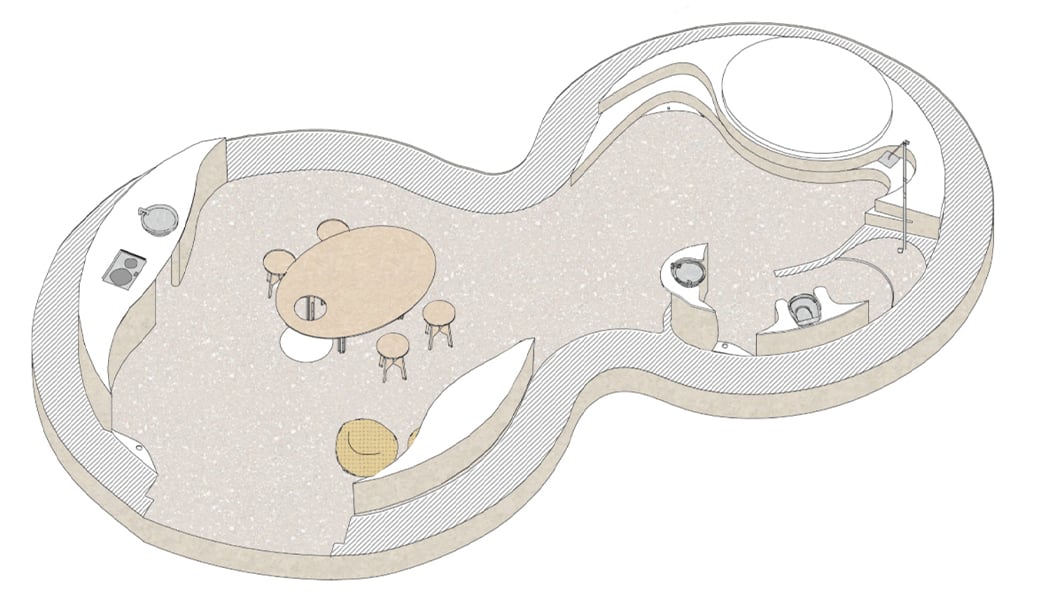
I hope 3D printing homes will take off now that lumber prices are so ridiculous. The sudden cost increases in other materials will now hopefully give 3d printing space to achieve economies of scale.
Imagine homes that are printed with a 20 year life expectancy. Especially in America where I don't know many families that remain in the same house for 20 years. We could start going to the Japanese model of razing the house as an expected part of the land purchase. This has the added benefit of making it significantly easier to keep houses up to modern code.
I really don't like America's throwaway culture. Leastwise for homes. It is wasteful and short-sighted. We should be thinking of how to maintain and preserve the existing homes we do have. There are thousands of homes in the US that are over 200 years old. What jewels they are. I don't mean to be rude, but I really hope your idea does not catch on, especially after seeing half of my childhood town's cornfields get torn up for cookie-cutter subdivisions over the past few decades. Homes are no longer built by the people that will live in them. They're built by development corporations. Just imagine that development corporation, what was cranking out identical clones for the past decade now literally printing them out from a robot factory, and all of them going to fall down in 20 years. Mmm, that yummy profit, though. There's tornados here, by the way.
I mean, this is the same technology used to make....... bricks.
We used to make homes out of bricks, and we could do that again, now that lumber is expensive.
> We used to make homes out of bricks, and we could do that again
Not in areas with earthquake building codes.
1. That’s not strictly true. Masonry construction isn’t impossible in earthquake regions, but it can’t be very tall and has to be reinforced. The details depend on the jurisdiction and building code. As an example consider the vast number of cinderblock commercial and light industrial buildings (mostly 1-2 story) throughout California.
2. Earthquake prone areas are a minority of the surface area of the earth. Suppose just the non-earthquake prone areas shifted significantly toward local masonry as a building material, that should still greatly reduce supply pressure for lumber.
Are you suggesting that this whole building be set on fire? Because unfired bricks are crap.
Something like that could actually work. Bricks were often assembled into the kiln that would fire them. If you could figure out a way to efficiently bake these structures they would be incredibly durable and would require no additives since you would want to use all clay.
more adobe than brick, then
The interesting question would be to know if the mix of raw earth + additives necessary for 3D printing, can be reused for a new construction after 20 years.
The raw earth used for traditional building techniques like rammed earth, can be re-used just by adding some water after razing the earth walls, as long as no cement/lime additive was initially used. This is also the Achilles heel of these traditional techniques: moisture will destroy the structure of a rammed earth wall when not appropriately protected with a large roof + above the ground foundation to avoid capillary rise.
We don't need a new construction methodology to fix a materials problem. A specialized construction methodology makes the problem worse, because they often require very specific materials.
My 3D printer is compatible with ~5 very specific types of plastic. Traditional construction can be done with plastics, metals, masonry, wood, composites, and many others.
I didn't imply that 3d printing should fix the materials problem, I simply hope that the materials problem gives 3d printed housing enough room financially to achieve economies of scale to bring the prices down for those situations where 3d printed houses are specifically relevant.
Consider as one example low income areas that are filled with housing built in the 40's and 50's which can now be razed and replaced without inadvertently causing gentrification.
Unless those houses are irretrievably dilapidated and neglected, why raze them? Seems more sustainable to re-use something that's already there.
Agree that some areas like Detroit that have houses that have been abandonded, scavanged, vandalized, and left open to the elements for years are in most cases not salvagable.
It would certainly fill a niche if they can create a system that only requires 2 guys and a truck to deliver and set up. Even better if they don’t have to be on site while it’s printing so they can do multiple jobs at once.
This is pretty much the idea behind prefab/modular construction, isn't it?
I think that's the first time I've heard of someone considering the Japanese home ownership model aspirational. Isn't that also where the 100 year mortgage idea started?
I'd rather see that we built really solid houses that are fundamentally designed for ease of renovation, rather than routinely raze and rebuild from scratch. Code improves over time but not on a timescale that makes 20-year rebuilds sensible.
Unfortunately a lot of the rebuilds happens because of dramatic code changes. Houses built just 5 years ago will often be illegal to build again. Only way to bring it up to code is total remodel or worse tear down.
Your post is not how things work, already built homes are grandfathered in. There are still houses with knob and tube wiring, balloon framed houses, all sorts of things that aren’t allowed any more by building code.
If a Toll Brothers/(any builder) has generic plan house blueprints that need to be updated to include the new code changes, they pay an architect to change the drawings to include the new code requirements, and then continue building that design of house.
This is an extremely exaggerated take. Again, the building codes do not upgrade on that fast of a time scale and even if a house is technically not up to code, they are grandfathered in based on the time they were built. A house that was built 10, 20, even 30 years ago, is still totally fine to live in, even if not up to the most current codes.
Is anyone trying to make homes out of plastic lumber? Like the material from the Trex decks and Polywood tables. My understand is that those are 100% recycled materials, solid, and a decent alternative to wood.
A friend has a deck made of Trex (or some similar brand) and it's disintegrating. Needs to be completely rebuilt. The stuff doesn't hold up outdoors. Might be OK for structural framing that is kept dry under a roof and inside walls, if it compares to similar sized wood lumber in terms of strength in both shear and compression.
It seems strange that there is so much focus on 3D printing structures. Any close look at where the costs go in home construction can easily verify that foundations and services (power, water, sewage) are where the majority of the costs are. It always makes sense to pinch pennies, but starting with one of the smallest line items limits potential improvement. What we really need are ongoing improvements to modular service installations.
This is also a complex cultural problem here as well because even though there are obvious ways of making even comparisons such as time and money spent before receiving a use permit the culture of construction likes to focus on a single innovation while leaving the rest out. There is a modular apartment building near me that took only hours to assemble from the component modules. However, doing that took many months of site preparation and module delivery and after the several hours construction it has still been months to get finishing done, construct sidewalks, and the rest. Without some general agreement about how to measure construction costs and time it is easy to present innovations that are either minor improvements or actually steps backward.
It seems like installing electrical and plumbing could be a lot easier if a 3D printed building was constructed with all the necessary channels for utilities already there in the walls, and all you have to do is feed wires and pipes through the routes and connect everything. Similarly, finish work is simpler if you don't have to put sheet rock up, and can just use the existing wall texture.
I think the bigger advantage to 3D printed architecture, though, is that you can make drastic changes to the design of a building without having to consider whether a contractor with the necessary skills is available to do the work or spend any effort trying to communicate the design to another human. For example, if I'm an architect and my client wants their living room to look like a gothic cathedral, I could design their living room to look like a gothic cathedral without having to worry about whether I can find a builder who knows how to construct a vaulted arch ceiling. I'd just have to make sure it's within the capabilities of the construction machine and conforms to structural requirements. That opens up a lot of possibilities, especially when it comes to organic shapes, curves, and non-right-angles.
Something like this already exists; you can construct a house from concrete elements with premade channels/cavities for the wires and pipes. However, they need to be finished up, I think with drywall usually.
I'm not aware this method has any real cost savings though compared to wood frame construction.
Do you mean insulated concrete form houses, or something where whole wall sections come in a single prefabricated piece?
My impression is that ICF tends to cost about the same as stick frame construction, but I'm not an expert in these things.
if I'm an architect and my client wants their living room to look like a gothic cathedral
If you were an architect with those kinds of clients you would have a list of potential builders with track records of successfully completing similar work. It’s among the kinds of expertise architects have.
And you would look at this with the jaded cynicism that an architect’s experience inevitably produces...for you will have seen simple concrete pumps break down...seen concrete mixed with extra slump to make it easier to work...and endless product presentations that sounded too good to be true.
And most importantly you would know that right angles are almost always the right answer...
> If you were an architect with those kinds of clients you would have a list of potential builders with track records of successfully completing similar work.
My point is that you don't have to have this knowledge, and you don't have to hire expert craftspeople and pay them expert wages if you can have a machine do the difficult work.
> And most importantly you would know that right angles are almost always the right answer...
Not necessarily. Box-shaped rooms work nicely, but the most important thing is to not have acute angles between walls. (IIRC Christopher Alexander goes into this in A Pattern Language in defense of right-angle walls, but for some reason neglects to consider rooms with more than 4 sides as an option.) Greater than 90 degrees is fine as long as it doesn't present a problem for the intended use (i.e. client expects furniture to fit at right angles). Also, if you're printing a whole house you can design benches, shelves, desks, and so forth into the design. Or maybe contract out to some service that will make the furniture based on a 3D model.
A big part of why walls are straight and meet at right angles is that building materials are generally straight and expect to be joined at right angles. Anything else turns into a complicated geometry problem that takes a lot longer to build. With a 3D printer, though, that's not a limitation. It doesn't matter how simple or complicated a design is, it takes about the same amount of time to print and uses about the same amount of material. The main constraints then just become what's strongest, nicest-looking, and most functional. Most people will probably prefer box-shaped rooms, but the point is that they'll have options if a box-shaped room isn't optimal.
One could imagine if house-design software becomes sufficiently advanced, you could dispense with the architect as well. Someone who wants a house could just log onto a website, identify the site where the house is to be built, and specify a bunch of constraints and preferences, and then the backend software generates a bunch of house plans. The customer choses the one they like and pay the money, then a building permit is applied for and a printing machine and work crew show up on site and assemble a house that's unique and exactly suited to its site.
“Not using an architect” can have benefits. Among them not having to deal with an architect. However, improved aesthetics is often not among them. Same for functionality.
The advantage of an architect is that you won’t get what you think you want.
In the comment you're replying to, I was thinking of the "architect" being basically replaced by a software package that designs the whole house based on the required criteria. Any aesthetic judgments are encoded in the software's heuristics, and the range of available styles are basically part of the brand of the company responsible for this house-designing-and-building service.
Allowing people to directly design their own house using CAD software is also an option. I think on average it would turn out okay most of the time. People have a pretty good incentive to design the spaces they live in well for they way they intend to use them.
This is as misguided as every iteration of no-code through programming history. All such tools promised to allow people without coding knowledge to create software. The result is the tools are used by disgruntled programmers who are now faced with a tool that is not friendly to other tools like version control. It has happened several times before and it is happening again now.
You can not automate problem solving until someone creates GAI. Thinking that all a programmer does is write code or all an architect does is draw walls is an insult to each profession. The primary attribution of both is to decipher what the client actually wants from limited descriptions and to problem solve.
There's a subplot of that in Kirk Vonnegut's novel Timequake...though it involves a parking garage in the style of Thomas Jefferson.
Huh, I started that book once and never finished it. Maybe I should.
What you propose is a recipe for cookie-cutter buildings. But we already have those with no software and no effort needed.
Yup. Foundation, services, and interiors are your big line items. The shell tends to be both cheap and very quick to build with common materials.
Leaning on the culture part, I am sure we would find some great cost savings by improving human waste removed. Contaminating drinkable water is such a bad use for this and sewage is a huge part of the services part mentioned.
I’m very fearful of the incentives that come with making infrastructure easier and cheaper to install. We already have issues around sprawl, which is a gigantic waste of resources. Making it easier for people to extend their last miles puts an undue strain on the system and the environment.
Maybe centering such infrastructure around self containment would prevent some of that but in itself seems wasteful (everyone needs their own water pump, sewage system and electrical generation management equipment?)
Excellent idea as a proof of concept, and even beautiful in design. However one cannot help but wonder how structurally sound these materials are. Stress tests are needed to determine how well this would hold up over years of exposure to the elements before being produced en masse. For a sustainable alternative, homes made from repurposed shipping containers are a cost-effective solution for housing. They are made of weather-resistant Steel which, while not rust-proof, will not rot. A single unit can be kitted out and furnished for as little as $25,000, and yields 300+ square feet of space, comparable to a smaller studio apartment. Check out the YouTube Channel "Containing Luxury" which illustrates the sustainability of Container Homes and demonstrates them as a solution to several housing issues: https://www.youtube.com/watch?v=t_sclvzg9dM
I don't understand why people think shipping containers are a good idea for housing. They were never designed for this and will always be compromised when you come to put windows, doors, insulation and services in them.
I guess because a shipping container is rectangular and that a house can be rectangular.
This wasn't a bad series: https://www.youtube.com/watch?v=QA5fh29rhLs
Put me in the 'shipping containers make shitty houses' camp.
I love that they wood frame the interiors for insulation and walls.
Could have just built a wood frame house. Quicker, faster and more roomy.
$80 / square foot is, like, cheap, but I'm not sure I would really call it amazingly cheap.
Right, they're so bad. Structurally unsound once you start putting windows in. They need insulation which either significantly intrudes on your interior space or you put it on the outside and you then need to do basically a traditional exterior and lose any supposed benefit of the metal enclosure.
Could you elaborate on what you mean by "compromised"? Sure, they can no longer be stacked 7 units high, but I am skeptical that cutting out a handful of windows and a door is going to make a container structurally unsound for the purposes of container homes.
Cut out a whole side wall? That's a very different story.
"Shipping container housing" is the "nuclear energy" of housing solutions.
Can you elaborate? Not everyone would see this as a bad thing. Many would argue that nuclear energy, while not perfect, is a logical next step that, solves quite effectively for the problem of demand.
Often container homes go above and beyond in their retrofits, and it would have been more effective to just build it conventionally. Both from a cost perspective and as a final result. If someone is happy with a simple container home, it really wouldn't be hard to build a similar box more conventionally.
I suspect the real issue at hand is that you're usually not allowed to build such a house, which is where the "tiny home on wheels" trend came about. Ignoring the part where an entire group of people seem to have forgotten that caravans exist, the "on wheels" part lets you build out-of-code homes and put them places you wouldn't be allowed to otherwise.
It really depends on a lot of factors though. What draws someone to a container home, is it the re-use and recycling? Is it the do-it-yourself nature of the project? If so, that's wicked, but I think we can probably work out ways to achieve those two things while also getting better and cheaper houses as the end result, if regulations would let you actually deploy such a house.
> Ignoring the part where an entire group of people seem to have forgotten that caravans exist
I don't think they forgot that they exist, just that they serve a significantly different niche.
A caravan (or travel trailer) is designed to be moved easily and regularly. Ideally with the smallest vehicle possible. This means they are built incredibly lightly, with at least a passing concern for aerodynamics.
Tiny houses aren't really designed to be moved often. They have generally have much more sturdily built and larger internal fixtures. They aren't particularly great on the road, often people hire a company to move them when they need to. But they are designed to be lived in full time.
"It will fix all thing things!"
Maybe?
(Shipping container housing sometimes invokes the same enthusiams which could seen at times in the 1950s for nuclear.)
?
Building a house was never a problem and the huge costs are mostly artificial. The biggest problem is regulation and that you need to have a lot of money to convince local authority to grant a permission to build. It is out of reach for a regular citizen. You can't even build a mud hut without a blessing of a civil servant, and they hate when regular people want to build something as they don't have means to grease their hands.
That's partially true.
But, if you build a house and it collapses on top of you, who's responsible? Who pays for your medical expenses?
Even worse, if the house collapses and it falls on top of your guests, who's responsible? Who pays for everyone's medical expenses?
That's just one random example, there are many ways a house can fail.
Unless you live in parts of Tennessee or Idaho where codes are not enforced.
Would this survive a rain storm or would it turn to mud? I couldn’t tell from the article.
> The collaboration between MC A and WASP has been supported by Mapei, a worldwide producer of construction materials, which has studied the clay materials and identified the key components within the raw earth mixture to create the final highly optimised printable product.
https://www.3dwasp.com/en/3d-printed-house-tecla/
I think its safe to assume that the raw clay has been processed into a material more suitable for masonry.
It says that it's been optimized to be printable, not for longevity or other characteristics needed in construction. What are the tradeoffs?
I would imagine if this house isn’t strong then future designs would be. Bricks and coffee mugs are also made out of clay so it’s not like we don’t already have a long history of experience working with the substance to create durable materials.
Yes, but bricks and coffee mugs are kiln fired, so this 3d printer would need to somehow accomplish that baking process or add something to the mix that would cause it to harden without being fired.
I don’t think either scenario is beyond the realm of possibility.
The link below has more information about this project. Apparently they added a coating to help with water resistance and a stabilizing agent to help with strength.
That sounds like cheating if the whole goal was not to have to bring in any materials.
It would pretty quickly erode away. I think that's why they've built it in a desert. Don't have to worry about rain if there is no rain!
It's in Ravenna, that's not a desert.
The material used probably involves some form of binder, rammed earth is also an option but it doesn't look like rammed earth from the photos.
Rain can be torrential in the desert.
Stunning Aesthetics and sustainability characteristics. Unsure whether it is a contender of factory-built prefab homes when it comes to affordability & speed.
30 story building build in 15 days - prefabricated skyscraper: https://www.youtube.com/watch?v=ajlUVSiUvWg
To really solve the housing crisis we'll need to use this device to print some affordable land first.
There is plenty of land, just not in desirable locations. But if you could build infrastructure easily and with speed, maybe those locations can be transformed too.
Up until last 40 years ago people didn't want to live on the ocean. Now they can't get enough. US has a huge swaths of land empty, especially in the Pacific Northwest.
>Up until last 40 years ago people didn't want to live on the ocean. Now they can't get enough. US has a huge swaths of land empty, especially in the Pacific Northwest.
Can you expand on this please? What do you mean by 'people didn't want to live on the ocean' and also, what do you mean by 'vast swaths of empty land in the PNW'. Are you talking east of the cascades? I don't think there is a whole lot of land there with an oceanic climate?
> What do you mean by 'people didn't want to live on the ocean'
I remember Arnold Schwarzenegger being confused why "nobody" wanted to live in Santa Monica or Venice Beach to a point that the government was subsidizing it to attract people.
For instance north of San Diego there are old apartment buildings on the water that have only window facing the ocean in their bathroom.
Historically ocean was considered as a hassle. You have to deal with the salty air that breaks down many material quite swiftly.
In Turkey, fathers would give the prime land to their sons (pastures) and the crap land to their daughters (ocean fronts). How the world changed.
> what do you mean by 'vast swaths of empty land in the PNW' If you go anywhere outside of the majors settlements there are major swaths of empty land which is fairly cheap, but there is no infrastructure there and people don't want to be the city founders anymore.
> Historically ocean was considered as a hassle. You have to deal with the salty air that breaks down many material quite swiftly.
Not only that, but you don't have to go very far from the ocean for the saltiness of the air to diminish, so there's not much sacrifice if you value being at the ocean.
There's also a social element to it. Historically, most of the people living by an ocean were those traditionally employed in traditionally ocean-related industries, like fishing, canning, and shipping.
These are traditionally associated with a grimier and more impoverished state of existence, because in most industrial cities, that's how oceanfronts were (or still are).
I think this is even better explanation.
The entire west coast of Washington state is pretty well uninhabited, as well as anything West of Port Angeles to Neah Bay.
It also needs to magically make cities less desirable places to live.
Cities are "ideally" cheaper to live in because things are closer together and there's more economies of scale. American cities aren't expensive because they're too popular, it's because everyone wants to be the last person to live there and we let them NIMBY their own children out of it.
My first thought was "Yeah, but I bet it's not really printed, just transported printed prefabs to the site". Nope, it's actually printed on-site!
Second thought is that the interior looks very Star Trek / Star Wars like.
Some confirmation of the non-leakiness of the walls would be good, but otherwise looks extremely promising as a concept.
Cool idea, the lack of discussion of longevity seems pretty glaring. While we would all love to not cause any stress on the environment, we also have to live though heavy rains, snow, and wind. Maybe this structure is designed for dry environment and can with stand a couple of rains a year. >>The architect studied how a building’s shape could impact its efficiency, in relation to its climate and latitude. hopefully someone also studied materials the house is made of, because that seems pretty important. Dirt is a very good insulator of both heat and sound, so maybe they could build something like this a put some sort of shell around it, like siding on current houses, to protect it from weather.
Disposable housing is common in some cultures who value new construction. Having a house naturally erode is better than what happens in Japan for example:
[...] the value of the average Japanese house depreciates to zero in 22 years. (It is calculated separately from the land, which is more likely to hold its value.) Most are knocked down and rebuilt. Sales of new homes far outstrip those of used ones, which usually change hands in the expectation that they will be demolished and replaced. In America and Europe second-hand houses accounted for 90% of sales and new-builds for 10% in 2017. In Japan the proportions are the other way around. — The Economist
It probably needs some kind of render on the outside, lime plaster or something similar.
There are old Wattle and Daub[1] houses near me that haven't been washed away by the UK weather.
> Dirt is a very good insulator of both heat and sound
Sound yes, heat not so much. While it can store heat due to it's thermal mass, it will release it quickly due to a low R-value, depending on moisture content the R-value could be below 1 per inch. Cellulose has around 3.5 per inch.
Without adding additional insulation to restrict thermal transfer, you need to build very thick walls. In sunny desert climates where days are hot and nights are cold, you can build your wall in a way that allows it to go through the heat exchange synced with the 24hr sun cycle, and then it's very efficient. Thinner cob walls need to be wrapped with insulation to slow down heat transfer.
From the looks of the video and pictures, they are going with pretty thick walls, and lots of air pockets. The dirt itself might not be the best insulator, but I think the whole wall would do well.
Theres no reason why existing materials couldn't be use to handle that issue. WRBs, siding, stucco, etc.
You could say the same thing for houses now, which are built out of wood...
Wow. This feels like a big deal. Like, 3D printed homes could noticeably change our world in the next 10-30 years. That hadn't really clicked for me until seeing this. Pretty amazing work.
From a housing aspect, the actual project is a nice, architecturally interesting piece of art. But conceptually it could be a remarkable milestone. Has this project any relation to similar off-earth construction research? Could the methods here be extended to lunar regolith or martian soil? What development is still needed before this can become fully autonomous and able to build many structures before requiring service or additional additives?
Unfortunately, it's susceptible to a big bad wolf attack.
How well do structures like these perform in earthquakes? I can imagine that they might outperform some masonry but be inferior to modern stick-built?
Actually this might be the first house fully 3D printed by IIT Students in India https://timesofindia.indiatimes.com/city/chennai/iit-madras-...
The "from raw earth" part is what makes the parent a first. The house in your link is "India's first".
Both houses look very cool to me!
This brought to mind opensourceecology.org, which was going some work with compressed earth brick buildings. They were getting a lot of attention five or so years ago. Good to see they’re still working towards their goal and are in good company.
I thought this was going to be about... bricks. Houses are traditionally made from earth.
Not in the US. Americans prefer living in cardboard boxes. I mean, timber frame and drywall palaces.
You mean affordable structures made out of renewables and built to the latest safety and efficiency standards?
I always feel like this sentiment sounds like nostalgia some express about the "sturdy" cars of the 60's. Sure, you can hit them with a hammer without a dent, but the engineering is crap.
> You mean affordable structures made out of renewables
Yeah, last I heard ceramic brick is a super artificial material that doesn't degrade at all over time. It's also very toxic :-p
The modern car's engineering of modern car might be astonishing, but at this point there is so much disposable parts that I question their environmental friendliness...
Like what? Modern maintenance intervals are way longer than in the past, and vehicles today are way more reliable and last longer in general.
Reliance on non-repairable electronics everywhere, fully sealed mechanical parts, etc. Efficiency comes at the cost of more moving parts, more sensors, higher pressure, tighter tolerances, which all introduces more failure points harder to debug/replace. Not to mention lighter thinner non-cost prohibitive materials are easier to damage.
As a rule of thumb, I will only buy pre-2008 vehicles, things only went from bad to worst after that era.
And despite the additional complexity, reliability has improved. I have an old carbureted vehicle, and while it might be simple, the environmental shortcomings it has well outweigh any o2 sensor that might need replaced at 200k miles.
The pictures reminds me of my uncle. He was a VP in charge of the companies real estate holdings. What he said about dealing with architects.
'That's nice but I was thinking of something... square. I'm into right angles'
You can take soil and mix it with a little sand and cement and compress it into a brick. It’s called earth blocks. It’s interesting to consider how cheaply one could build structures if they are mostly dirt.
I don't quite understand what they mean by the term “humane” architecture.
I see that is has low carbon footprint, is made of local materials. But is that what they are defining as "humane" architecture?
I suppose one might consider the aspect that with ciment a lot of sand is used, which is a bane on the rivers (in Africa) causing terrible devastation... beyond that just the back breaking work of building a home ...seems much more "humane" if done by these methods...
I see that WASP stands for World's Advanced Saving project, but I did have a bit of a chuckle thinking if they wanted to call it VESPA, but that was taken already.
Very cool looking structure.
That's a nice tech. I'd rather have yr basic optimal hemieggoid tho. Too Rococo.
That looks like good substrate for some kind of fat polymer coating.
Needs windows.
How does it stand up to the wet?
This is superb. Obviously it's just a tech demo, but I'm optimistic for 3D printed houses in general in the near future. Exciting stuff!
Domes are ubiquitous throughout sci-fi. Why don't we have a competition to, say print domes or homes autonomously in antarctica or sahara?
Because domes are a terrible shape for humans. You can't hang pictures on the walls - the curve makes weird things happen. Likewise your furniture can't be against the wall it must be out to account for the curve.
Domes look cool, so of course fiction is full of them. They are not impossible to build so a few people have built them. They are not a good shape though, so they won't catch on.
Right. They're impractical and a poor use of space. Also, it constrains how much of the space is walkable without bumping your head into the wall/ceiling. It's like living in an attic.
I like the idea. Have these been put through stress tests? i.e. Wind tunnels, simulated forest fire, floods, earthquake, cold / hot weather, powder actuated projectiles and how do they compare to traditional wooden framed or steel framed homes? What is the thermal insulation rating? I would expect thermals to be pretty good. I've seen similar designs using aircrete [1] and those are fire-resistant. How strong is this compared to aircrete?
The thermal resistance of raw earth is not good, similar to that of concrete. Thermal conductivity is around 10 W/m.K. To be compared to 0.1 W/m.K for a typical building insulating material.
But raw earth is porous and will store moisture, hence behaves like a two-phase material. Water in the earth may vaporize or condensate in the pores, which helps in regulating indoor moisture levels, and explains the high thermal storage capacity of the material. Since earth is cheap, it's also possible to build thick walls and get a high thermal storage capacity in the building envelope. Sun heat will be re-radiated a few hours later at night during winter, and some the cool of the evening nights will be available indoor during summer days. Because of this high thermal capacity, raw earth buildings are good at this so-called thermal phase shift. But raw earth is still a poor insulating material.
Thankyou for that really detailed explanation. That reaffirms for me that I will most likely stick with aircrete and concrete/shotcrete when it comes time to build a few hobby structures I had in mind.
Out of curiosity, could you suggest what material would be best for storing heat from the sun? I am going to build a greenhouse that will face the south and have a wall on the north side to absorb heat. I have seen some people use clay with a black metal wall and some use black barrels of water. I want to be able to extract some heat from it using pipes. Any thoughts on what might be even better?
If you want to store solar heat, you cannot beat water @4000J/kg.K. Black barrels of water is probably the best solution, yet a very simple solution. I've checked the thermal capacity tables, only ammonia would do a slightly better job than water !
I also toy with the idea of building a greenhouse myself, that's why I have done some research. If you want to harness the thermal capacity of earth for a greenhouse, I know of two tricks:
- Excavate one or two meters of soil to build a “pit” greenhouse. You will get earth walls connected to an immense thermal storage capacity. This is the so called Walipini greenhouse concept https://en.wikipedia.org/wiki/Walipini
- The diurnal and seasonal temperature oscillations dampen quickly with depth in the ground. Below some meters of soil, the temperature will be stable at the average annual temperature at your location (Ta). If you can dig a trench to lay underground pipes to create a ground/air heat exchange connected to your greenhouse, you will get a free source of air heated at (Ta) in winter or cooled down to the same (Ta) in summer. Fans to force air circulation will help.
I too have been looking into a sunken greenhouse and using geothermal venting and long pipes to bring the port temperature closer to earth, somewhere near 50 degrees F. Much easier to heat or cool that than the outside air.
Thanks for the tips on the water. That has the benefit of having emergency access to water if I need it. Also much easier to build than a clay wall.
I assume it has the same longevity as things built out of mudbricks...
So, it's going to have to switch to a subscription model eventually to continue to exist?
In my country, some poor people (unfortunately) live in mud houses. They periodically add a new layer of mud, as the old layers get eroded away.
I imagine, this could be done by a robot for this 3D structure.
Of course, this depends on house not collapsing under heavy rain.
or critters digging through walls and into your house
Creative Ground.
gotem
Looks like LUKE SKYWALKER was born here.
Is beautiful!
It seems to be a mixture of clay, salt, rice fibers and lime.
So I guess the lime prevents erosion.
Mineralization. Effectively turns the aggregate into a kind of concrete. I would put a significant bet down that the energy cost of the lime is not accounted for in their 6kwh calculation.
I have seen 3D printed homes before... raw earth is a lot misleading though
It looks like sea urchins.
Remembers the Terrafoam of Mannah short story. Hope it is not a sign…
Every one of these obnoxious mud huts I’ve ever seen are single story, on like 10 acres of land, in a car-dependent rural area. More people living like this would worsen every current issue we face with environmental sustainability.
Good luck trying to get permits to build anything the slightest bit unconventional in any populated area. I looked at building a geodesic dome, and was going to end up in the boonies and likely still paying off the inspector to pull permits. You could get it done in town and it would have to be over-built, completely ruining the whole efficiency angle of the dome to begin with, and taking months or years to work through the process.
Yeah basically this. Trying to build an eco-structure or even a mostly earthen home in the US you are basically relegated to a sparsely populated counties or taking your chances squatting on Federal land.
This was quite eye-opening to me once I had to actually attempt to find some land to build on.
For good reason - most of these things don't have good engineering behind them. Standard stick frame construction has good insulation values (dirt/clay/mud/cement does not), holds up to weather, earthquakes, and has reasonable fire protection (it burns but in known amounts). This is all backed up by a lot of engineering data that doesn't exist for most alternatives, they might be better, but nobody has actually run all the angles to be sure.
I don't disagree with you actually. I believe that building codes generally keep us safer and create a better standard of house. Most people don't want to become test subjects for an experimental technology.
My point is just that the current building codes necessitate experimenting away from more developed areas in order to innovate and that this should not be held against examples of construction innovation.
After having had to search for land I would say that I feel that building codes are perhaps not overly restrictive, but too ubiquitous. Most experimentation and innovation can only happen on small patches of remote scrubland with poor soil, deep ground water, and limited access to the internet.
It would be nice if some of these projects could take place 15 minutes out of a mid-sized town rather than 40 minutes to an hour. I can see the value in enforcement within a city's limits, but we could get faster building innovation if counties and states were laxer with building codes on their unincorporated land.
> Trying to build an eco-structure
This doesn't even qualify as "eco-structure". R-value is pretty terrible.
Have you tried? I'm pretty sure if you get it engineered w/structural calcuations and it passes residential building code, I see no reason why they'd reject it.
Dammit. I just started looking into building a dome house.
Did you call it off completely?
Yes. I talked to a builder, he thought he was going to have to do R22 insulation across the entire thing because it’s not clear whether it is a wall or ceiling. Ridiculous because the engineering for domes has been around for 70 years. Most lenders won’t help you. Appraisal for resale is problematic.
I concluded it is best done as a DIY project in a location where you know the inspector, or know he won’t care, with cash. Here are some of the stories I was going from:
I think the lender thing makes sense. Lenders are all about risk mitigation, and unfortunately at this time there are just too many risks around a geodesic dome as a house. Lots of folks think that building a house is a potential approach to finding a place to live, but the reality is that doing so is playing house finding on extra hard mode.
It's hard enough to get a loan to build a house, let alone an unconventional one.
So you're complaining that these first demonstrations of a novel technology are not comparable to technologies developed over decades or even centuries? There is an expression for this: "the last of the old outperforms the first of the new". Most of us don't seem to have too much trouble applying that concept to programming and hardware related developments, so why is this different?
In what sense is a mud hut a novel technology?
Your argument is the equivalent of asking in what sense a wheel is novel technology while comparing a car to a horse drawn carriage.
It's not about the mud hut. It's about how the mud hut was made.
I am aware that novel techniques for building mud huts are created all the time, and none of those new techniques address the fundamental issue with all of them — this building technique is only suited to single-story buildings on large tracts of land. 3D printing the mud hut doesn’t meaningfully alter that constraint.
The “environmental sustainability” gains you get from using on-site materials would be totally erased by the fact that if you actually built houses like this at scale and expected people to live in them, we would have to massively increase the land area occupied by humans, which is the exact opposite direction we need to go in.
Show me where this technology can knock down the cost of adding infill housing or building vertically in locations where land and construction are expensive (that is, where people actually want to live), and it’ll be worth paying attention to. Otherwise it’s just a dumb, expensive distraction.
I live in a rural area where the population is declining rapidly. There's plenty of land available for cheap, but actually building a house still very expensive. I think a cheaply built, single story structure on a large tract of land could work very well here, and could possibly help to sustain the local population and quality of life.
I agree we should be building denser to meet demand for housing in cities. But not everyone needs to live in a city.
If I literally say "the mud huts aren't the point" and you reply by talking about "novel techniques for building mud huts", then I don't think you're honestly engaging with my argument.
The technique is limited to mud huts for now. It's a demonstration of what it is capable of for now. With more research it could become more useful later on. Seeing that is not rocket science.
If you like this, look up "superadobe".
Looks, like they where real careful to not include any technical detail that would explain, how they manage to get that buildings stable and rain proof... Probably bullshit.
I want a dirt house
Unfortunately, it's susceptible to the big bad wolf.
The interesting thing with all these alternative construction methods is that they end up having much larger costs in one way or another. I'm a huge fan of "alternative living" (lived in a boat I built myself for years) but even I can't convince myself to build a home with one of these alternative methods (shipping container, 3D printing, compressed earth block, adobe, wattle and daub, concrete block, etc.) First there's the permitting process. Then there's the construction costs. Then there's the safety aspect (many of these homes are a disaster with earthquakes/fire/water issues.)
An underappreciated thing is how easy having straight walls makes construction. Having lived in a boat with curved walls, I would never consider a land home with curved walls. The beauty of the curve does NOT make it worth it, unless you plan to hire someone at great expense to do all the work for you. Yes, it's that bad, your 4 day cabinet project will become 4 weeks in no time. Instead of being able to simply plop in premade components (windows, benches, cabinets, beds, etc etc) you'll now need to custom build absolutely everything. Even the parts that seem simple are not. Laying flooring in a square room is simple enough. In a small curved room, you'll have to cut a ton of pieces with a strange curve. Then you have to lay them to meet up with the curved walls. It's a nightmare. You're also negating part of the eco-friendly aspect, by the way, when you have to discard huge amounts of curvy pieces of material (trust me, you'll cut large pieces wrong more than a few times.) That's one reason why I find this 3D printing clay project quite cool - you can simply 3D print benches, cabinets, walls etc to nestle right up to the curve.
I'd be very curious to hear from anyone here who tried to save money while building a home, but I would suspect that the answer is to go small and minimize labor. Even minimizing labor, you're going to need permits, a foundation, electrical, HVAC, a roof, etc, so it's not going to be nearly as cheap as you think.
If anyone is interested in a good cost breakdown of house construction costs, I like this one: https://www.nahbclassic.org/generic.aspx?sectionID=734&gener...
You'll notice that the sum total of framing + exterior finishes (framing, exterior wall finishes, roof, windows and doors, etc) come out to around 30% of the construction cost of a new home, or around 18.5% of the total cost of a new home. So this machine can save you at maximum 30% of the construction cost. The rest is pretty much fixed: landscaping+deck+driveway = 6.8%, interior finishing = 25.4%, plumbing/electrical/HVAC = 15%, foundation = 12%, permits/sewer/fees = 6%.
Which gets to my last point: the issue with technologies like these is that people compare their best-case projections for one part of the system to the total costs of the existing solution (traditional stick built construction) in the same way people make arguments for Gadgetbahn type projects. You see that the average new single family home costs $485k and suddenly a $50k shipping container home looks really appealing. But that's ignoring two things - one, the costs that are not included in that $50k, and two, that you're comparing a projection to reality. Compare apples to apples, and you'll realize that a stick-built kit for several hundred square feet can be had for $29k: https://allwoodoutlet.com/LARGE-CABIN-KITS/Allwood-Avalon-54...
construction workers about to be automated out
Does it have plumbing? Wiring? Or did they 3D print a shelter.
> needed no materials to be transported to the site Has glass doors...
To be sure, this is really cool—breakthrough even. But the headlines are just factually inaccurate.
Yet another example of the over-hype of “3D Printing”. Yes it’s neat that they collected some local dirt, mixed it with some non-locally sourced water and binder, and poured it into an extruder run on some kind of non locally sourced energy, then sprayed it with some protective coating - it baffles me that people see this as a possible mainstream building technique. Running electrical, plumbing, air conditioning etc through this structure is doable but much harder, as the expectations of these niceties have evolved with modern construction and need easy access and hiding with things like dry wall.
This almost reads as an onion article with the headline “brilliant scientists figure out how to overcomplicate the construction of mud huts similar to our earliest human ancestors”.
Automating anything opens up new doors.
Continuing to develop this tech could make it useful for setting up buildings in hostile environments. Initially deserts and the arctic/antarctic.
But eventually using unattended robots to construct structures on the Moon and Mars.
I think the relevant Onion article is this classic from 1998: "New $5,000 Multimedia Computer System Downloads Real-Time TV Programs, Displays Them On Monitor" https://www.theonion.com/new-5-000-multimedia-computer-syste...
20 years later analog TV is long dead. TVs are now computers.
This probably won't add up to much in the next 20 years. But it's early tech and there are exciting long term possibilities.
> Continuing to develop this tech could make it useful for setting up buildings in hostile environments.
To add to this: If you've ever been to these embedments after the fact, they can leave behind a lot of waste/trash. Namely, concrete (pads, walls, etc). Much of which cannot be easily re-used and breaking it down is expensive/hard.
You use 80% locally sourced materials, if the base just gets left, and starts to breaks down, all you wind up with is mostly original dirt from the area instead of toxic concrete dust.
PS - Although Hesco barrier[0] has also made very positive inroads here, replacing concrete with mostly local dirt, chicken wire, and fabric. But it cannot be used for dwellings, only perimeter wall.
Agree for Mars - this tech will translate well into other areas of need in hostile environments - like agriculture, mining, large scale manufacturing etc.
Also looks great for making WWII-style bunkers, machine-gun emplacements, etc.
You run utilities the same way as with masonry, either conduit outside the wall later, or flex conduit placed into the wall as you build it. I've done the latter in earth ship construction (meter thick walls built with dirt basically) and it was as simple as it gets.
As far as practicality, I'd be more interested in the long term stability of the material. But you likely can do the same thing we did with my friends earth ship style domes, which was to coat them in fabric and then spray a few mm thick layer of cement all over it.
Here's the result. As you can see this is something that would appeal to quite a few people. Pre COVID he had no problem booking airbnb guests for this every night for months out.
https://www.instagram.com/p/CCWtTEQDJ1_/
https://www.instagram.com/p/CCJnAB7DUfK/ (click through to second pic)
I wouldn't be so quick to be dismissive of this general concept. Particularly in Mediterranean areas where wood framing materials are more expensive, this may a perfectly reasonable approach.
While that’s true, and this is no instanthouse.exe, these are all proof of concept projects. Things like longevity or other challenges might not even be the focus. So while this is no holy grail, it’s a stepping stone towards certain building solutions or local solutions (think quick emergency shelters, or off world for instance, to name a few)
I think it’s a great idea to build mud huts on another planet where labor is scarce, machine energy is under different constraints, and certain resources are “unlimited”.
But this approach for building a house on Earth to house humans seems way off the bell curve of potential to scale.
You do realize that millions of people live in houses made of soil, right?
And if you consider that brick houses have bricks made of clay, that's even more...
> Running electrical, plumbing, air conditioning etc through this structure is doable but much harder,
You realize there are lots of brick houses out there and those things aren't run through the brick walls either right?
2x4 dimensional lumber framing is used inside and those are run through the studs.
Yes true, but brick and other base material like it is very strong and support fixtures to attach ducting, pipes, cables - I’m not sure you can drill brackets into this mud and safely secure an AC duct or conduit.
I live in a brick house in Europe, and my plumbing and wire do run in the walls.
I just cut the wall, run my wires inside and cover with plaster.
Your plumbing and wires are actually embedded into the brick walls? Not just a hole through the brick, but they are actually completely within the brick walls themselves?
Yea but good luck running interior 2x4 furring walls for MEPs (Mechanical, electrical, plumbing) on curved wall structures like this. Would be an absolute carpentry nightmare.
It would also be a nightmare on a curved brick wall, or curved cement structure. The point of the shown technology was the experiment and the potential of it, not the specifics of this single architectural design.
curved wood features and structures are not uncommon, using materials like bamboo and engineered wood. it’s not easy and requires specialized skills, but it’s not a nightmare. and flexible wood structures tend to be more resilient on a per-mass basis.
This is a POC and an art project.
Stop with this arrogance, because I can bet that your POC are nowhere near as good looking.
> Running electrical, plumbing, air conditioning etc through this structure is doable but much harder
Have you seen architecture in like, any warm part of the world, especially Italy? Masonry/concrete techniques dominate.
If anything, this is far easier to integrate with utilities, since it can be incorporated into the 3D design.
It also seems easier to drill through than traditional masonry/concrete.
This technique is even more labor-saving than filling formwork with local materials, because formwork is very labor intensive, and you can't readily incorporate unusual utilities, windows, shapes, etc.
Trashing the first iteration of this kind is easy. Seeing where it could be in ten years is more difficult and more rewarding.
Exactly. God knows how many concepts I've seen for mixing local soils with magic powder and (typically) forming up walls. I do like that these guys could make rather free-form structures, but building an envelope is straightforward and runs into the issues of actually using the thing (seismic&water issues, installation of utilities, insulation, HVAC, longevity, insurance).
It's pretty hard to beat traditional methods and anything new typically has to be measurably quite a lot better.
If a person wanted to drive down costs, I'd probably tend more towards larger prefab components.
Maybe it's not so different from software in these areas.
I'd like to see how these compare with other earth-based construction methods (still used in many parts of the world, including developed countries [1]). My guess is that the voids improve the insulation, but reduce the compressive and shearing strength, but this may be mitigated by the round shape and the internal "triangular" structure.
In any case, it's an interesting experiment that should provide good data and observations toward a more "complete" house prototype.
[1] https://www.lemoniteur.fr/photo/le-pise-ressort-de-terre-a-l...
You bring up a good point. I have yet to see anyone construct some of these structures on a shake table and report the resultant data. I wouldn't look for unreasonably good performance, but I wonder how it would perform against, for instance, modern rammed earth structures?
If any engineers out there have links to tests or studies please do post them.
Some day we will 3d print pipes and wire!!!
And this technique really wouldn’t work well in impoverished places where people need shelter. It works well when there’s a lot of local technology but not a lot of labor, precisely the opposite working conditions in much of Africa.