A tactical guide to kickstarting a community
orbit.loveLovely post that matches many of my experiences (admittedly with communities not directly related to a product). A few notes of my own:
> At the start, having just two channels was fantastic. First, it reduced the community ghost town effect by concentrating all activity into those two places.
I'm surprised to hear people keep re-learning this lesson. Back when web forums were popular, this was basically the one big mistake I kept seeing people make. Way too much compartmentalization.
> After [being shown a project in private] a few times, I proposed a new channel: [...] We didn’t try to force the community’s hand.
I think this could and should be generalized into "Avoid surprises". Communities generally do not react well to change with no announcement. Even if you know that a measure is strictly necessary (e.g. because your platform provider changed its terms of service in an impactful way), first give a heads up before you make a change. It goes a long way for public opinion. It's tempting not to, especially as time goes on and you feel like you have people's trust, but it's essential to ask first wherever possible.
> I think this could and should be generalized into "Avoid surprises"
Great way of putting it. When we were considering moving our community from Slack to Discord[1], we actually did a Request for Comment[2] laying-out our rationale, and asked for comments on the doc. I think this went a long way towards building trust and buy-in around big community decisions.
1. https://orbit.love/blog/how-to-migrate-a-community-from-slac...
2. https://docs.google.com/document/d/1PFHhZyyYmiIHNufYpS6fX7gU...
> I'm surprised to hear people keep re-learning this lesson. Back when web forums were popular, this was basically the one big mistake I kept seeing people make. Way too much compartmentalization.
Ahh yes, the “General” section of phpBB. To be fair though a whole generation as come online since then, that never had an opportunity to learn for themselves yet. The internet itself moving away from small niche sites/forums to subreddits/groups/categories under big monoliths.
Same thing happens with Discords I'm in. They just add more and more channels and it becomes a chore to scroll and navigate to the one I want (just my opinion) let alone the reduced engagement in each channel (anecdotal evidence)
The article doesn’t seem to mention how they got their very first community members. I’ll go out on a limb and guess that they got their first 10-100 users through posts like this on social media
Thanks for mentioning this. Truth is I don't exactly remember. I'd say the first 10–20 were friends and former colleagues. Definitely people we directly reached out to and invited to the Slack.
There was also early interest around a framework we created called the Orbit Model[1], which at that point existed primarily in blogpost form.
Before starting Orbit, we did consulting[3] in the developer relations/developer marketing space for about a year, and had met a lot folks who were thinking about the challenges we sought to address, so that group of clients and prospects definitely provided the seeds for the early community.
But yeah, to your point: content can be a great way to attract like-minded folks to an early community. We certainly saw that with the combination of our blog + the Orbit Model.
[1] https://github.com/orbit-love/orbit-model [2] https://orbit.love/blog/why-orbit-is-better-than-funnel-for-... [3] https://developermode.com/
Author of the post here. Happy to answer any questions!
I run a tech community on discord and I'm having a really hard time keeping it alive and well. We've been active for about 5 years and it's hard to keep a tight group of regulars around. Most people seem to come and go, a lot of them only interested in getting their issue solved. People who are interested in being part of a community, chatting with other people etc, don't seem to find what they're looking for and end up leaving. I have about a full renewal of the regulars every year or so where the old regulars become inactive and new people emerge but I can't seem to build a cohesive core of people and build a community culture around them beside the moderators. Have you managed this? How do you deal with retention and culture?
Thanks for sharing this. Without having any more context, here are some thoughts to consider:
- are there rituals that your community observes together?
- are there milestones community members can achieve that signify their progress or tenure?
- are you regularly acknowledging and celebrating folks who are contributing and adding a lot of value?
- have you tried casual events to connect members to one another?
- what is the unifying sense of identity that could/should bind everyone together? Can you lean into that?
Thanks for article, really helpful read.
When slack was created how many users joined on the first day, what was total number of users in ~3 month ?
First day? Maybe 5 people we harangued into joining?
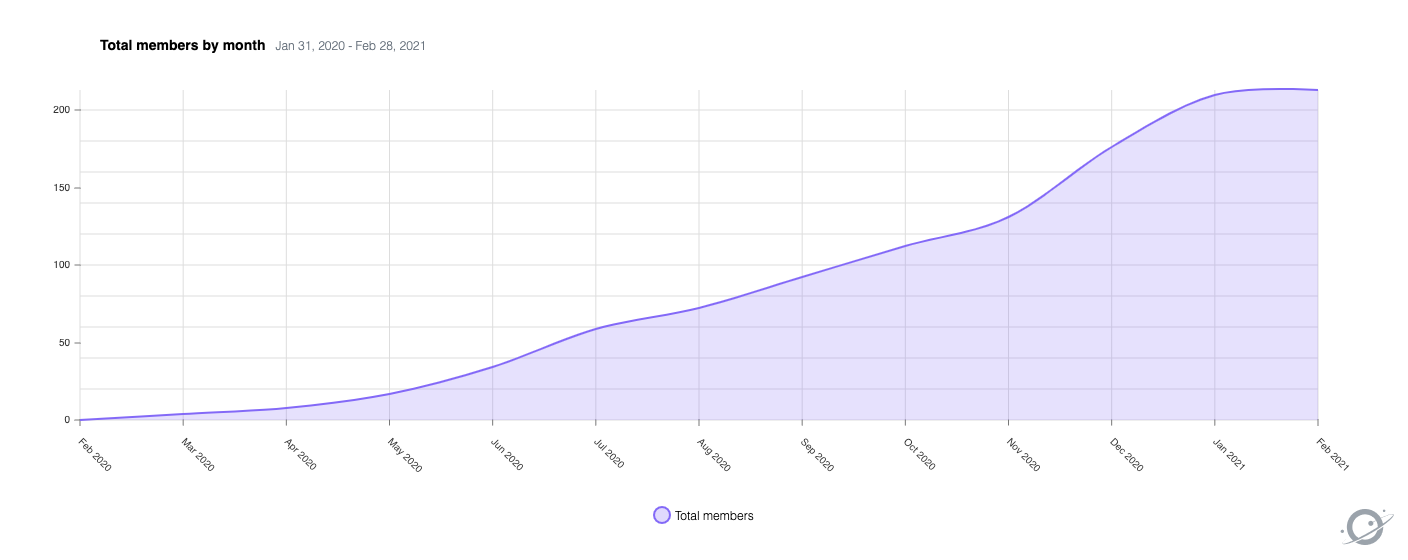
As for the first three months, it depends on when we start counting (I'd say May represented the first month we actually started working on community deliberately), but had 59 by end of July.
You can see the growth curve here: https://res.cloudinary.com/dzello/image/upload/v1615409348/s...
This is exactly what I was looking for as reference point, thank you!
Nice article! You mention doing more events earlier, is there anything else you’d do differently?
Thanks! We definitely could've started with events sooner, IMO. The simple practice of getting folks together to meet and talk shop contributed to the sense of momentum overall and the interpersonal connections in particular.
I should note that all the events we've done to date have been small, and focused on our existing community. I think such focus made sense for us in year one, since we were building the community and the product at the same time. In other words, we didn't have the capacity to produce a broadly-focused event.
That said, the intimate vibe in the early days goes a long way toward engendering a sense of ownership and belonging among community members. I honestly think it's more meaningful to do smaller insider events more frequently in the early days, versus casting a brand net and potentially diluting the group’s nascent identity and culture norms.
Now that we're scaling up, I anticipate increasing the reach of our events as well. But that’s okay, as we have the team to support it on one hand, and on the other, the culture of the community is already well-defined.
Good luck!
To some extent, this is a chicken and egg problem -- how to get enough people to join so that other people will join -- and one way they solved it kind of falls under "backwards compatibility." They started on Slack in part because their audience was already on Slack all day, every day.
Second, they started with just two channels. Not only did this concentrate traffic, it reduced cognitive load on new members trying to figure out where to say a thing and worrying if they were in the right channel.
One good way to outright kill conversations is to have lots of low traffic channels and then fuss at people for discussing a thing "in the wrong channel" because that's where conversation happened to break out and insisting they move their discussion "to the appropriate channel" when there is no actual compelling reason for it. (There can be compelling reasons to ask people to do things a particular way, such as privacy, information security or age segregation protecting young people from explicit content. But those rarely are the reason this gets asked.)
before we created the channel, folks would share their creations with me directly via DM. That was amazing, but this approach didn’t help others in the community, since the conversation was 1:1 in private.
After that happened a few times, I proposed a new channel:
This makes me wonder what preceded that.
Why were people sending him direct messages? Were they only sending them to him or were other team members getting similar messages? If they were only direct messaging him, why is that? What was he doing that fostered that?
In my experience, creating a sense of psychological safety is key to facilitating many-to-many conversations.
One great way to do that is to help members feel like they know who’s on the other side of those usernames in Slack, and that those people are generally nice.
A thing you have more control over: Setting the example of how to effectively interact in a way that fosters safety for everyone.
This was likely done without realizing it. If you know how to have a successful career, you likely know how to relate to the public. If you are writing a guide to kickstarting a community, you likely know a lot about relating to the public effectively.
That involves a lot of baked in assumptions and best practices that you may no longer consciously think too much about. The community then looks to you to set the example for how to do this dance.
Ahead of the call, we sent registrants a $25 gift card to a food delivery app as a way to share the celebration with the community — a virtual “snacks on us,” if you will.
This is brilliant because it connects the real world and virtual world so effectively. You have a real world impact on people you connect with online and a lot of people seem to think this isn't true. A lot of people seem to think the two things are more separate than they are.
This is a brilliant example of how you can send digital goods -- gift cards -- with real world impact -- ordering food to be delivered. Though even just talking with people online is a real experience with real world impact.
+1. what a great team.
How do you think about big community with loose connections between nodes vs small community with strong ties? What are the pros and cons?
I am having flashbacks to my BBSes and usenet groups.
So fun to relive this, what a journey! :D
I stopped reading at “ some of the best minds in DevRel” Jesus fucking Christ, not everything is a “DevOps” wording clone.
Edit: Finished the article, good insights. However can we stop the Dev_ and _Ops BS? Please and thank you.
The term "developer relations" goes back to the mid-90s at least. I find it hard to believe that nobody shortened it to "DevRel" in the 15 years before the term "DevOps" came to be.
You finding it hard to believe is irrelevant. Nobody was calling stuff Dev_ before DevOps
it’s better to not talk in absolutes, we all share experiences (data points). Be kind.
You’re right! Thank you for the correction.