Rare 'half-male, half-female' cardinal photographed in Pennsylvania
bbc.com"At first Mr Hill wondered if the bird was leucistic - a term that means the specimen would have a loss of pigmentation in its feathers, but would not be half-female, half-male.
But after seeing mobile phone pictures, he suspected it had what is called bilateral gynandromorphism, which is when a bird would have both a functioning ovary and a functioning single testis."
So, uh, it would have been interesting if they had mentioned WHY the ornithologist thought it was gynandromorphic rather than leucistic? I'm not an ornithologist but it seems like a pigment mutation is a simpler explanation...
Yep. Unless you check the gonads and the DNA on both sides, any explanation will be uncertain.
I note that birds use the WZ sex system, which is like the opposite of the mammalian XY sex system. Males are ZZ. Selective silencing of genes on the Z chromosome for dosage compensation could cause spacial variation across the body. We see something like this in the XY sex system with Barr bodies, leading to coloration differences such as those of the calico cat.
It's also possible to have a plain old male-male chimera, or a plain old mutation, with the cells in one part failing to produce the proper color.
Leucistic cardinals don't just look like female cardinals. https://lostpineslife.com/leucistic-northern-cardinal-winter...
I suspect it had to do with sex-associated traits were split down the middle. I'm only an amateur, but I can see that the right side has a male's long tail feathers while the left side does not. I imagine there are other details that would be apparent to an expert.
Came here to say something similar. It seems fairly obvious (to an amateur like me, I guess) that the lack of color on one side would simply be from a pigmentation issue. But the description of the event by the photographer as a "once-in-a-lifetime, one-in-a-million encounter" makes it seem like there's a very clear reason he narrowed out pigmentation.
There were two giant northern cardinals "playing" (who knows) in my front yard yesterday morning. This was right after the snow started melting, so their bright red coloring really stood out.
Maybe it's me getting old, but it's nice to see things like that every now and then.
Having grown up in an area without cardinals, I'm delighted to now live somewhere that has a few of them about in winter. There's a mated pair that keep pretty close together around our house, and they're a delight to watch together.
I grew up in Silicon Valley and had never seen a cardinal in the wild until a couple years ago. Currently in the Midwest and see them in my yard and I love them. My home office has a bay window and there is a bush that backs up to part of it, so I can look into the bush. The cardinals love to go in it and I can watch them from my desk. It really is a delight.
I also love goldfinches. I had a bird feeder that only they can eat from and had so much fun watching them. Plus it made it so I can instantly recognize their calls.
And the tufted titmouse is the cutest regular I see.
I always assumed that they lived in Silicon Valley because the sports teams from Stanford are called "Cardinal". But I just looked it up and they're named after the colour, not the bird.
Having some activity in your back yard is definitely worth it, and there's so many people that don't have that because they (have to) live somewhere that's densely urbanized.
I had a very bland back yard (green ivies as walls, some other evergreen ground covering), but my girlfriend moved in two years ago and she's a gardener. We've got a diversity of plants now, the soil is alive again, and there's a popular bird feeder, regularly refilled, hanging on the shed now. We sometimes get a dozen birds flitting about there, who then get interrupted by a pair of magpies.
But, this whole neighbourhood I live in (very middle class, I'm at the outer edge) has been designed to allow for nature, with lots of semi-wild green spaces dotted around and lots of waterways.
We truly are blessed to live in a world with such wonders.
I think it's lovely how accessible high quality photographic equipment has become. Naturalism is much easier when it's not just the "professionals" who have access to high-quality telephoto equipment. These clear, detailed photographs were taken in a rush!
Technology is so good that even entry level cameras have sensors that put professional camera sensors from fifteen years ago to shame. It's easy to feel like we are drowning in lazy photography, but the same technology makes things like this possible.
It’s much easier than in the film days. Great equipment can still give great results. I met this guy on a walk on the north shore of Massachusetts. with a 600mm lens. Much better reach than mine.
https://www.flickr.com/photos/bryanbatley/
As opposed to my setting up a GoPro on my moms feeder. Which is fun but not quite the same (she has a normal male cardinal)
Some fantastic pictures there. 50905348768 is stunning.
For one moment I thought this was about photography of naturism, which is a totally different thing.
So, in what other species can "bilateral gynandromorphism" occur? I'm not having much success googling this.
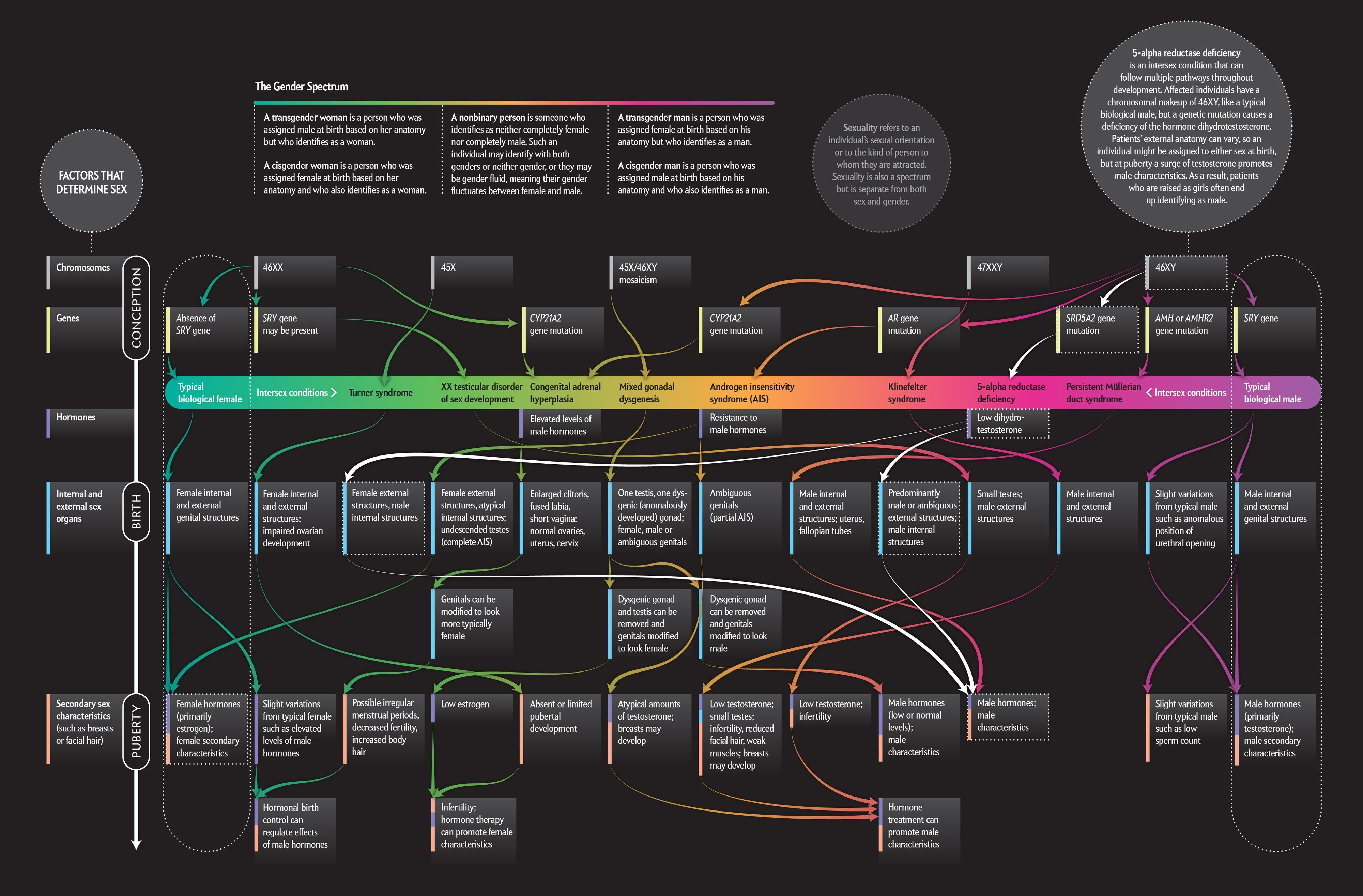
Also, is this just a specific type of genetic mosaicism? I've heard of humans with mosaic DNA (sometimes showing up as patches of alternative skin/hair coloration, etc.); but for some reason I've never heard of humans with mosaic DNA of two different chromosomal sexes.
I believe humans actually, I just stumbled upon this infographic today : https://static.scientificamerican.com/sciam/cache/file/164FE...
I don't have any sources for that but I have an anecdotal story.
While I was volunteering in a support group for transgender people, I once spoke to a woman who had a lot of complex issues with her hormone replacement therapy.
She was on a mix of medication that I had never seen before and I got worried that her health provider was prescribing an incorrect treatment.
This got me to ask questions I would never ask usually out of worry.
She told me that the reason that her medication was not the usual treatment is that she had a condition in which different parts of her bodies had different chromosomes. She told the exact name of the condition at the time but I did not write it down. I do remember the word "chimerism" being said during this conversation.
From experience, stories about weird conditions said by trans people are almost always true. She seemed very sincere about her struggles.
AFAIK gynandromorphism doesn't happen in mammals because sexual development is more centralized. Half of your body could have cells of a different sex but it wouldn't matter because organs responsible for sexual development will still effectively turn out one way. In other species each side of the body will develop quite differently because different cells is all it takes.
Tons of different human mosaics have been observed but it usually doesn't cause anything interesting.
Having different hair would imply chimerism - having two different sets of DNA. With mosaicism you start from one set of DNA but it may not duplicate the usual way.
Most if not all species with biological sex presentation. Binary sex characteristics are an abstraction and extend beyond a specific set of chromosomes (which also present more non-binary configurations). Most humans and other sexed animals bunch up on one side or the other but it’s still a convenience rather than an either/or fact.
You might find more luck with the term “intersex” or in more historical sources, hermaphroditism.
From the wiki for mosaic DNA:
> In rare cases, intersex conditions can be caused by mosaicism where some cells in the body have XX and others XY chromosomes (46, XX/XY).[12][13] In the fruit fly Drosophila melanogaster, where a fly possessing two X chromosomes is a female and a fly possessing a single X chromosome is a sterile male, a loss of an X chromosome early in embryonic development can result in sexual mosaics, or gynandromorphs.
> An example of this is one of the milder forms of Klinefelter syndrome, called 46,XY/47,XXY mosaic wherein some of the patient's cells contain XY chromosomes, and some contain XXY chromosomes.
So yes. Looks like it occurs in humans enough to be a big area of study for intersex understanding. There’s a lot of research on sex in this area, but it’s hard to dig through. (And a recommendation for the game “House of Fata Morgana” if you’d like a fictional telling of this history).
>You might find more luck with the term “intersex” or in more historical sources, hermaphroditism.
Not exactly. Intersex only refers to hermaphroditism in humans, mainly for political reasons. In all other species, its still called hermaphroditism.
Intersex includes conditions hermaphroditism doesn't.
Do you have more info?
Usually hermaphroditism means an organism can produce male or female gametes. For humans it meant they had ovarian and testicular tissue.
> Not much is known about the unusual phenomenon, but this sexual split has been reported among birds, reptiles, butterflies and crustaceans.
From an article linked in another comment: https://www.nytimes.com/2019/02/09/science/cardinal-sex-gend...
Try lobsters.
I thought this was a Catholic cardinal when I first read it and I was like o_O
Just woke up, saw this title, rubbed my eyes to make sure I wasn't seeing things—and then realized what type of cardinal this was!
I'm glad I'm not the only one!
Came here to say this.
too funny
The Pope has some 'splainin to do.
I snorted. :)
Another one?
I'm originally from that part of the country, and I swear my mom sends me a story like this every couple of years.
https://www.nytimes.com/2019/02/09/science/cardinal-sex-gend...
I think the authors description of this being one-in-a-million must be pretty accurate then!
Well, we all know that one-in-a-million chances crop up nine times out of ten.
The article says it might be the same one.
A different cardinal with the same condition, but with more distinct coloring.
Half white, half colored https://www.wtxl.com/news/local-news/water-cooler/northern-c...
really interesting!
Could it be the same cardinal at a different time of year?
I'm not sure whether or not they are migratory.
The colours are reversed, so not likely.
The avian Vivec[0]/Ardhanarishvara[1]
Props for choosing the better of the two Elder Scrolls wikis.
Hard not to wonder if the endocrine disrupting chemicals we haven't banned but are changing sexes of many species, likely including ourselves, contributed.
It's unlikely, since this resulted from an abnormality in early development, before the specimen developed an endoctrinal system.
N.b. that bisexual chmærism happens all the time, but tends to go unnoticed so long as both gonads belong to the same sex, which is typically the case, as they are organs located close together.
What triggers this is that both gonads belong to different strata of the chimæra, and that thus one develops into male gonads, and the other into female gonads.
One's entire body can belong to a female stratum in the chimæra, but so long as only the tissue that forms the gonads belongs to a male stratum, they will develop into testes, and influence the entire female stratum to also develop masculine characteristics, as male and female cells are not differently receptive to sex hormones.
This is not an endocrine disruption but a genetic condition.
unfortunately, endocrine disruptors causes genetic conditions that mutate through offspring of future generations [1]...
[1] https://www.axios.com/falling-sperm-count-endocrine-disrupti...
Why don't you read at least the abstracts of links you post? None of the links says that. One of the links mentions epigenetic changes which can propagate, that's something quite different from mutating genetics.
endocrine disrupting chemicals cannot change sex.
It's ironic how the most insightful comments on this site get the most downvotes. As if endocrine disrupting chemicals in the enivronment are not a possible contributing factor, and the eventual downfall and extinction of most if not all species. [1]
[1] https://www.axios.com/falling-sperm-count-endocrine-disrupti...
1. be wary of all citations to a _meta_ analysis; 2. be wary of dated results that are being republished without further research; 3. be very wary of publishers with an agenda beyond the fourth estate.
1. check 2. 13-page report published in 2017 without follow up turned into a book released yesterday 3. axios "Between the Lines" (https://www.axios.com/about/) just because i like and/or agree with axios does not let them off the hook on #3
The body of evidence about the effects of endocrine disruptors/gender bending chemicals on the destruction of species is many decades in the making. Axios is just one of many to publish such stories:
[1] https://www.ncbi.nlm.nih.gov/pmc/articles/PMC2726844/
[2] https://www.epa.gov/chemical-research/research-endocrine-dis...
[3] https://www.nature.com/articles/s41574-019-0273-8
[4] https://www.thelancet.com/journals/landia/article/PIIS2213-8...
[5] https://academic.oup.com/mend/article/30/8/833/2747295
[6] https://www.newscientist.com/article/dn7440-gender-bending-c...
[7] https://www.newscientist.com/article/mg18625023-300-infant-m...
[8] https://www.newscientist.com/article/dn1298-gender-bending-c...
[9] https://www.nature.com/articles/s41598-018-24505-w
Another 739 studies: [10] https://www.ncbi.nlm.nih.gov/pmc/articles/PMC2726844/citedby...
I'm way more wary of people who post a lot, have been on the site for nearly a decade, and get everything they post voted down and flagged on a consistent basis.
yeah if anything I'm saying doesn't make any sense to you or it's wrong then it makes sense to downvote it, right? but when people provide evidence to prove otherwise, not sure why the down votes happen. One thing I do see about this site is that it is quite ironic that the majority of downvoted comments actually are the most insightful, and maybe that's because people just cannot handle the truth. you be the judge. Down vote me some more, it seems to make everyone feel better when they do that.
touche, i bit.
Anyone during childhood have to study a particular state? I was given Pennsylvania in grade school. Basically a poster everyone does about state birds, flowers.
All I remember about this poster which I had forgotten about until now is the state bird, cardinal. I think it is also the only red bird of this size?
The state bird of Pennsylvania is the Ruffed Grouse. The Cardinal is the state bird of a different Commonwealth: Virginia.
The cardinal is the most common state bird, representing 7 states
Someone needs to run high res pics of this through one of the bird recognition phone apps
Merlin has no trouble with it, unsurprisingly.
Could such a creature reproduce with itself and pass the trait onto its offspring, thereby unevolving sexual reproduction?
My cat that I adopted is a hermaphrodite. I am wondering myself how rare it is, or where I might learn more.
First thought: The red mascot of Angry Birds.
Exactly, I wonder if it was their inspiration
diverse birds
He/she
Darn chemtrails changing cardinals (sarcasm)
Good to see some levity in some of these threads.
Reading this title made me feel like I was in the Alba universe.
(Alba is a heart-warming, pro-nature and fun Apple arcade game.)