Smart spaces will fine petrol car owners illegally parking in electric bays
thetimes.co.ukNot sure what's so surprising/interesting about this (I don't have a subscription to read the full article). This nugget in the introduction seems to summarize the tech behind this --
> Sensors installed in electric bays can be used to detect the presence of a vehicle and whether it is being used to recharge the car battery.
It's surprising because car drivers are used to the fact that rules are not or rarely enforced.
Just think about it: Technically it would be no big problem to enforce speed limits widely. The technology for speeding cameras isn't exceptionally complex, you could mass-produce them and deploy them basically in every street. I'm not aware of any country doing that.
Absolutely correct about the technology. Qatar is doing that.
I lived in Qatar for 7 years, drove a car. All speed cameras are not visible. Some are marked with sign boards, but many are hidden permanently on a lamp post, or in a palm tree, or in anything. There are even mobile cameras, which an operator puts on a heavy tripod, & goes away, & camera takes photos of offenders & send back to data centre. Cameras are on highways, on streets, on intersections. Every traffic signal has built in camera. Fines go up progressively with each offense & over the limit. Owner of car gets a mobile notification as soon as his car speeds in front of camera. All fines are payable fully at yearly registration. If paid in some x days, there is a discount.On Holy Month of Ramadan also sometimes there is a discount.
The biggest is, there is no need of a man standing behind camera. Two photos taken apart a second or such are the proof. Owner can only contest it if he has gps recordings. Speed limit is speed limit. No +5 or +10.
But then, fine amount stings only if they are enough. For an expat like me, a fine of $200 is a lot. For a local Qatari 20ish year boy, thats nothing. Some of my photography club members had fines in tunes of $2500 a year, & totally normal.
> Owner of car gets a mobile notification as soon as his car speeds in front of camera.
So they have another camera about 20 seconds up the road to catch them reading SMS while driving?
Lol no, most of the times, either Employer/Companies, Rental/Lease Companies, or Fathers are the owners. The users/drivers are employees, or family members.
>> The technology for speeding cameras
Speed cameras are not the go-to tech. Nearly every car on the road has a GPS, either organic to the vehicle or inside the driver's phone. If we wanted to actually enforce speed limits it would be a trivial matter to have google forward the relevant information.
This was done by a few rental car companies many moons ago (circa 2001). Speeding laws don't know how to account for such data. Should someone speeding continuously over many miles be fined more or less than someone who speeds twice, each time only for a short distance? Traffic laws are premised on the systems by which people are caught (cops, traffic cameras etc). They are not adapted to the perfect knowledge that modern tech can provide.
https://www.drivers.com/article/428/
Of course, if we really care, it would be trivial to limit all cars to a particular speed while on public roads. Japanese motorcycles are already limited by industry agreement, iirc 300kph (see the Hyabusa fiasco). Merc/BMW cars are limited to 250kph. Those limit could be lowered via a simple software patch.
> If we wanted to actually enforce speed limits it would be a trivial matter to have google forward the relevant information.
So then you get a speeding fine for being a passenger?
Wouldn't people just turn off their phones?
> Of course, if we really care, it would be trivial to limit all cars to a particular mas speed while on public roads.
This is useless because most "speeding" would be within the limit for the country, e.g. there are places in the US with a speed limit of 85 MPH, whereas most of the problem is really people driving 70 in a 45.
And trying to enforce the actual speed limit on the specific road would be fragile and dangerous because if your vehicle detects the limit wrong it could force you to drive 30+MPH below the flow of traffic and cause an accident.
>> if your vehicle detects the limit wrong
Welcome to one of the most basic and most difficult problems for AI-driven vehicles: What is the speed limit? Temporary limits, work zones, school/park zones based on sunlight, weather, children/workers present or not, emergency vehicles beside road or not ... it is complex but also something every driver manages every time they get behind the wheel. While it is possible to drive dangerously slowly, far more people are being killed by driving too quickly than too slowly. The default is generally, if unsure, err on the side of slower.
It's interesting to compare this with the subcomments in https://news.ycombinator.com/item?id=25545467 with some interesting interpretations like
> It is unsafe to drive the speed limit if everyone is going 10-15mph over the posted limit.
> it is complex but also something every driver manages every time they get behind the wheel.
It's also something that humans are still better at judging than machines, because they have general intelligence. They can tell that a speed limit sign for a service road visible from the highway is not the speed limit for the highway. They can guess what a sign covered in rust or sludge might have said based on the road conditions or the speed of other traffic or personal knowledge of the area.
And when the machine gets it wrong more often, you don't want it to be overriding the human driver by force.
In the UK at least, it's relatively simple. If it's a red circle with a number in it, that's the speed limit - anything else is advisory. In my experience, cars with built in sign readers do an exceptional job of working out the current limit (more reliable than me, certainly!).
It should be trivial to convert every sign to have wireless transponder. Optical guessing sounds awful for wrong angles, wind damage, snow coverage, lighting issue.
Maybe correlate it with central database for sanity. Preferably daily updated git.
So no temporary work zones in the uk? What is the rule if the sign isnt there/visible? Do you then get to race through an obvious construction zone?
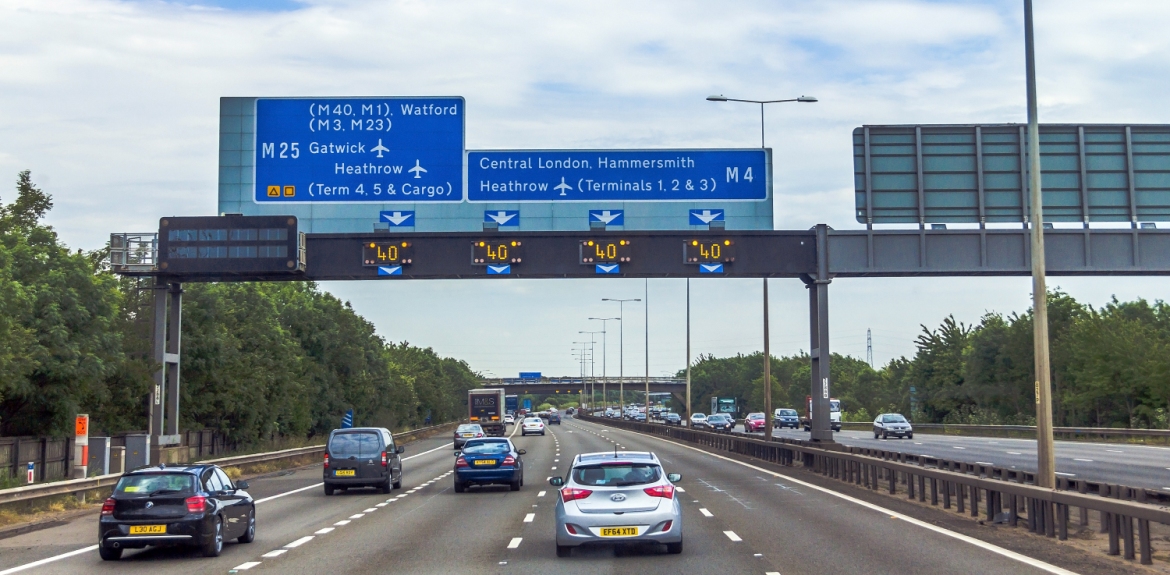
They tie an opaque bag over any incorrect signs, and erect temporary signs (of the same standard, international design) with the new limit. If it's a motorway or similar road, the electronic emergency signs will also show the reduced speed limit [1]. On a motorway, they're often on a gantry, i.e. completely impossible to miss.
I think I read somewhere that it's someone's job to make regular checks that the temporary signs (and covers) are still correct -- they are an important part of the worker safety requirement for the construction crew.
When a speed limit changes, the rule is for the sign to be shown on both sides of the road. There are then repeating signs for the current limit at some regular interval.
The UK is dense enough that having expensive electronic signs on all motorways isn't an unreasonable cost; I understand that's not practical in the USA or Australia.
[1a] https://i2-prod.birminghammail.co.uk/news/midlands-news/arti...
[1b] https://www.ageas.co.uk/globalassets/solved/30072018_road-sa... (possibly this style is no longer used, I drive very rarely in the UK so I'm not sure.)
If there's no sign to indicate that the speed limit is changed, how are you supposed to know what the speed limit is?
I've had speeding tickets forgiven in Australia because the sign simply wasn't visible enough due to overgrown trees and a 2 lane off ramp separating the sign from the road it applied to, let alone the sign missing altogether.
If you are surrounded by people in orange vests, or traffic cones directing you to a detour, you are in a construction zone and better not be doing highway speeds. The fact that the sign wasnt visible, or even wasnt present, will not help. This comes up in AI cars all the time. The camera is blocked from seeing the sign beside the road, perhaps by a truck in the right lane. Or maybe the temporary folding sign is blown over. You still have to recognize a construction zone. A bad sign might get you out of a basic speeding ticket, maybe, but it wont protect you from a dangerous driving ticket, or going to jail after running over a construction worker. And a great many juridictions mandate vastly reduced speeds when cops/ambulances/firetrucks/towtrucks are beside the road, meaning you have to recognize such situations regardless of posted signs.
Well, sure. But in the context of enforcing a limit on a human - by either reporting a breach or actively preventing the car from exceeding the speed limit - and not the car driving itself, I don't see any of that being an issue.
That brings back memories of Pokemon Go issuing bans after flights because you must be location spoofing to have travelled that quickly.
On some level, a device owned and controlled by the consumer and asserting a particular travel speed seems like the wrong place to put that kind of enforcement.
>it would be a trivial matter to have google forward the relevant information.
oof... Glad Google doesn't have that info about me.
Got bluetooth on your phone? Some cities are using bluetooth IDs to measure traffic flow, a phone or car's bluetooth ID as it passed sensors and calculating the speed based on the time taken to cover the distance. This isn't used for speed enforcement, they don't match the IDs to individuals/cars, but it certainly could be.
https://www.econolite.com/products/software/bluetoad/
"Advanced Traffic Management Systems Bluetooth Detection. TrafficCast proven algorithms for filtering and processing data inputs to compute real-time travel times and speeds."
Most Tire Pressure Monitoring systems also broadcast a unique ID that can be used to derive traffic patterns.
An interesting method that is widely used in Australia is “average speed cameras”. They set up 2 sets of cameras on a long highway and then time how long it took you to get from one camera to the next. It’s an excellent idea because you can’t just slow down for the camera and then speed up again.
A friend told me of a similar system which I think was in Malaysia, but some vendors setup food stalls at the side of the road before the exit cameras where people would stop and get a meal to extend their drive time.
Average speed cameras seem unbelievably dangerous to me. I haven't ever driven somewhere with them, but I suspect all I'd be thinking about was the speed limit, resulting in very dangerous driving. With all my focus on making to correct average I'd fail to properly track other drivers and potential hazards.
I'm much happier with a flow of traffic enforcement. Ticket those who speed excessively beyond what traffic is generally flowing and let the posted limit be more of a guideline.
If you're trying to game the detection system to minimize travel time then average speed cameras could encourage pathological behavior (which would hopefully also be caught by careless/reckless driving laws). They're dead-simple and not subject to cosine error and sensitive closed-source calibration techniques though. Even accounting for clock skew and clock drift, if an average speed camera says you were going x+2ϵ mph then it's safe to say you were going at least x+ϵ mph for at least some small interval and some very small value of ϵ.
There are no traffic lights for the ones I've seen here, so you can just set your cruise control. I would be doing this anyway on a long drive, which again is the only place I've seen these
California actually explicitly bans police setting up these kinds of speed traps
I‘ve seen them in the Netherlands as well. These are pretty great as they completely discourage any form of cheating that is dangerous (i.e. sudden braking), but incentivize smooth flowing traffic.
See red light cameras. You recieve a ticket through the mail and you get pictures and a video of the violation. There is a lot of people against it and some governments have legistation against the use of it.
I thought that was mainly because red light cameras often lead to an increase in collisions because a driver is more likely to stop unsafely if they are worried about the light changing
Which is, in turn, caused by the unsafe shortening of the yellow light commonly used in combination with red light cameras in order to maximize ticket revenue. Because with an adequately timed yellow light, few people actually run the red light and the cameras become an expensive money pit that can't pay for themselves.
In India, on some newer signals in last 5-6 years, I have seen that when Red is on, & is going to go to Green, the Red will start blinking in last 5 or so seconds. Then Green will be ON.
When Green is ON, & is going to switch off, it will start blinking & then off, & then yellow will start blinking. Its ok to drive through blinking green or yellow if safe. But common training os drive through blinking Green, but if you see blinking Yellow, then stop.
Plus, some of the lights have counter. It shows how many seconds are remaining for the lit color. An experiment led the Bombay Municipality to install Noise Sensors are one busy traffic light with counter. Every time there is a Red Light, & counter is less than 10, normally people start getting impatient & start honking to force the front ones to move. But on this light, if the noise is above certain decibel while Red, the counter resets.
IIRC there was also the argument that since an officer hadn't seen the crime committed it did not hold or something.
I recall hearing about legal cases which made the city I was in disable and then remove them because they became useless after the rulings.
We'd probably need a few other societal changes to make automatic enforcement of the posted speed limit manageable. As an example, if you're on a 50mph road in the USA and assume that your speedometer is calibrated within legal tolerances (and no further) then you'd have to set your cruise control to at most 43mph to ensure that you'd never speed (5mph speedometer error at that speed plus 2mph in speed variability from bumps/hills/etc), you could actually be averaging as low as 39mph in practice, and somebody else behind you with a speedometer off the other direction could think you're going as slowly as 35mph (on average, slower from time to time). I can say from experience that doing so is an easy way to be flipped off, sworn at, passed on the shoulder or a sidewalk, and have police called to your location (occasionally driving the speed limit plus 0-10mph results in similar levels of aggression), even though you can potentially be ticketed for going even a mile per hour faster (most police forces allow a lot more slop in your speed for precisely that kind of reason, but there are definitely a few who don't give a shit because they know you don't want to drive all the way back to the middle of nowhere to fight it) and even though driving that slowly is totally legal in most places.
None of that is insurmountable of course, and the easiest fix seems like just having the automated system only ticket you at some threshold above the limit while grandfathering in tighter speedometer tolerances. Aggression from driving the speed limit would probably decrease rapidly as tickets started arriving in the mail.
> Technically it would be no big problem to enforce speed limits widely
More than you suggest.
> The technology for speeding cameras isn't exceptionally complex
But speed cameras are just one piece of enforcement. With those and automatic license plate reading you get a piece of evidence that a car violated the limit at a particular time and place, but even if the law is that a set limit is a hard limit (which is not the case in much of the US, where posted limits are often prima facie but not dispositive limits), that's not all you need for enforcement. You also need legal process to weigh potential counterevidence, to deal with contested identity of actual drivers, etc. This isn't technically complex, but it adds a lot of overhead, which is why even places which legally allow this mechanism deploy it selectively, not comprehensively.
The same holds for a lot of other rules, from public transportation tickets over legal fireworks and drinking age to softer drugs and taxes. Society as a whole seems to be generally fine with smaller infractions and I consider this a good thing, tbh. I would be perfectly fine with a similar scheme for traffic laws.
The thing with speeding cameras is that they could easily be adjusted to allow for 20% (say at most 20kph) margin (which would be perfectly fine for me even on the German Autobahn), but drivers would learn that fact and adjust perfectly to just 1kph below that limit. This would then enrage puritans that would DEMAND that these MURDERES be PUNISHED. Sadly for some reason traffic law is an area of zero tolerance for some.
Unsafe driving is a real cause of a substantial amount of death, and unlike most causes of death it is not over represented in the elderly, giving it a massively outsized impact in terms of reduction in expected years of life. Motor vehicle collisions are reliably the leading cause of death of teenagers and young adults in many parts of the world. People are bad at appraising events that are rare with high negative impact, so most people, who have never experienced the consequences of unsafe (or drunk) driving consider it a minor issue.
Unsafe driving is not characterized by speeding a slight margin over the limit on good roads (see German Autobahn for statistics, these are among the safest roads on the planet). Similarly, I am pretty certain that driving 40 in a 30 zone (when 30 is safely possible) is not the cause of most, if any, deaths. Causes are varied, but generally the situations where one or two meters of road would make a difference are obviously rare.
So to emphasize my point: Permanent and ubiquitous speed control is the wet dream of many people, but it's a proxy. These people have a problem with cars. And there are many places where that is absolutely justified (dense inner cities for example, or streets in front of schools).
The increase in stopping distance from 30km/h to 40km/h is significant, more than 1-2 metres, and much of it is thinking/reacting time, i.e. still travelling at 40km/h. People are much more likely to survive an accident at a lower speed.
"The results from one of these studies is presented in figure 1, which shows a fatality risk of 1.5% at 20 mph [32km/h] versus 8% at 30 mph [48km/h]." [1] (in typically British fashion, the actual data is in km/h, but this general-public version of the document is presented with miles.)
The difference is even greater at the next gap (30mph→40mph, or 48km/h→64km/h). That was the subject of a road safety video a few years ago: [2]
[1] https://www.rospa.com/rospaweb/docs/advice-services/road-saf...
Your source speaks of impact speed.
To achieve a difference in impact speed of 16kph, you would either have to go much faster, say 60 to 70kph before the accident or not brake at all.
There are of course situations where a driver cannot brake at all, but there the speed limit should be 10kph or less (and then going, say, 12, would again be more or the same).
On a road where 30kph is considered safe, 40kph is only slightly less safe.
I live in a city where 48 people were killed by cars last year. I am not fine with that.
Don't get me wrong, you shouldn't. But how many of these deaths would have been prevented by a 20% less speed?
That's a rather distasteful argument to make and reminds me of Covid deniers blaming underlying medical conditions for deaths.
Kinetic energy is m*v^2, so yes 20% makes quite a difference.
Also, what's the point of a speed limit of x if 1.2x (or x+19) is tolerated. There is no good reason for a margin.
Oh, come on. First of all, speed limits are chosen conservative for various conditions. Second, cars are usually better than expected. And finally, every rule has margins (see my examples above). There is no reason to consider speed limits special.
Maybe not in the US, but in both France and China, to name two countries I've been to, speed cameras were obvious on the highways and actually sent out fines.
There's a difference between having a speeding camera every now and then on the highway or consistently enforcing speeding limits.
I don't have a statistic on this, but my gut feeling would be most speeding happens in residential areas with low speed limit, and enforcement in many places is basically nonexistent.
In my experience, speeding is prolific and not tied to speed limit. I’ve read it’s actually tied to visual or physical cues the driver perceives as making speeding riskier or safer. Narrower lanes or walls are associated with slower speeds.
So it will fine an electric car that parks in the bay if it isn't charging? These are not really parking spots anymore. They are "charging bays". That's cool. Just remember not to park your electric car there with a full battery. I guess if your battery is full, by the time you drive around a while looking for another spot it will be low enough that you will be allowed to use the bay.
The few times I've tried to charge an EV at a public non-tesla charging point, it has been a real hassle. The multitude of protocols mean that sometimes it just doesn't work. I'd be very not happy if that meant I would then have to find another spot.
Perhaps there is a market for a defeat device, a plug that simulates an electric car, like those HDMI/VGA simulators used to trick motherboards into thinking they are attached to a screen. It probably wouldn't need much of a resistor to simulate minimal charging rates.
They're not parking spots.
Don't park next to a gas pump if you're not putting gas in the car, even if it has an internal combustion engine.
People treat gas pumps as parking spots all the time. It's even more frustrating when you are driving a diesel and the only diesel pump at the station is blocked by a gas car and the owner has wandered off to get a coffee or use the restroom, all while multiple gas pumps sit empty.
I suppose a long-term solution is just to have more charge ports. Or to have charge stations with longer cords so they can service more parking spots.
I mean, charge stations are basically just 110 or 220 volt AC electrical outlets with a fancy plug. There isn't any fundamental reason they have to be an expensive, scarce resource. The more difficult scarce resource is the underlying electrical infrastructure. But if a commercial site only has so much power available, it seems better to just have a cap on the number of chargers that can be active at once to stay within the amperage limits of the site rather than to artificially constrain the number of charge stations. Then if someone is using a "charging spot" but isn't actually charging, it's not a problem; they aren't blocking anyone else from charging.
That's a long-term solution, though. For now we just don't have enough charging stations in most places to be able to not care if someone is using one when they shouldn't be.
Well, fast chargers not so much. There you're looking at 50+ kW with liquid-cooled cables. But yes, urban and destination charging stations don't need any fancy infrastructure.
Most petrol/gasoline stations make the majority of their money selling other products, particularly in non urban locations. Milk, newspapers, magazines etc. This business model makes refuelling stations a viable business since the margins on fuel costs are so slim.
One of the challenges with the crude political attempts to force EV usage (carrot/subsidies, Stick/fines) is the lack of coherent planning behind it. What happens when/if there are huge numbers of EV's?
It's a similar issue with public transport. My sister, a keen cyclist in London, now has two knee replacements and can't really cycle anymore. Public transport is a huge challenge (stairs etc) and driving in London is made ever harder with more and more bicycle lanes, concrete blocks dumped on roads and massive charges for attempting to use her car.
None of this is thought through. I'd really like to see some sort of vision democratically presented for comment by citizens before these autocratic decrees and changes are introduced, we seem to have more and more ill considered plans that are not joined up imposed on us, making life harder and harder...
>> What happens when/if there are huge numbers of EV's?
The strange thing is that there is a model for this already. I live in a rather cold part of Canada. My apartment block has AC outlets for each parking spot. So too does my work, and all local hotels. These are meant to power block heaters, something that doesn't really exist in the UK, but in recent years some people have been using them to charge their EV/hybrids. The charging rates are very low but the ubiquity of the outlets make them relevant. Having very small/cheap charging points on literally every parking spot might be the better approach than a few dedicated high capacity "charge bays". These outlets are dirt cheap to install. No IP issues, no electronics, no networks. Just an outlet and a circuit breaker.
(These are also all free to use. Administering a payment system for each outlet would cost more than the power.)
This is the solution. Power doesn't have to be free, but it should be everywhere.
It's like all the EV charging networks try to replicate gas stations. It's stupid. Nobody wants to take their car to a charging station, pay by the minute, and park their car somewhere else when it's full.
People just want to park their cars wherever, and plug them in when they know they'll stay there for some time, and just pay per kWh, and they definitely don't want to go park their car somewhere else when it's full.
The nice thing about electric is that you could theoretically charge cars pretty much anywhere, outlets would be cheap to install almost anywhere! And cars are parked somewhere 90% of the day anyway. So you don't need fast charging.
I feel like the guys trying to build infrastructure for EVs in most cities are fucking stupid.
You don't need to build 20 fast charging stations. For the same money you could probably install 2000 standard outlets, controlled with a relay and a phone app for payment.
That's something that would actually drive EV adoption.
Right now the only people who buy EVs are people who have a house where they can install an outlet for charging. People who live in appartments are stuck with ICE cars...
Are your outlets continuous?
I’ve heard of ones that cycle through different chunks of the lot, so half (or a third or 2/3) are powered at a time.
Some cycle on and off but the ones on my building don't. A 50/50 on/off cycle is still going to keep the engine warm enough.
The truth is that modern engines/oils/batteries do very well in the cold. A battery heater is probably of more use than a block heater. But I like having the conventional outlets whenever I have to work on my car. A Tesla fast charging point cannot power my vacuum cleaner.
Don’t EVs take longer to charge than a gas fill-up? Presumably that would be better for a model where you want people to stick around and buy things, not worse.
At least in the Netherlands, there are basically mini golf carts that are legally bikes for disabled people. https://youtu.be/B9ly7JjqEb0
> Presumably that would be better for a model where you want people to stick around and buy things, not worse.
Gas stations occupy an interesting place in American life: some stations - often those in urban areas - are designed for “get in, grab a pack of peanuts, get out” transactions, but others in rural areas serve as a local gathering area. Pre-Covid (and, let’s be honest, even post-Covid) the gas stations near me are full of people sitting at tables eating hot food and passing time.
What is amusing is that the same gas stations that encourage to have people sit and stay a while tend to be located in areas where EVs are extremely uncommon.
its really weird for someone used to the faster type of gas station. why would people want want to spend any more time than absolutely necessary around petrol fumes...
Because there are no real fumes. No more than anywhere else, and there is more likely to be a gas station with a restaurant (pizza/chicken whatever) in it than a restaurant at all. Small 'town' down the road has one gas station and one cafe. The cafe is only open for lunch. So a lot of the old timers gather at the gas station where they can get a coffee, a snack, or even a chicken dinner, and sit and chat with friends.
I have a hard time imagining this. Is the cafe outdoors or is this something like a mini service area?
The cycle lane on Kensington High Street (a major London East-to-West route) actually sped up car journeys.
https://www.theguardian.com/uk-news/2021/jan/01/removed-lond...
When it was removed the study "calculated that average trip times eastbound increased from 5min 39sec to 8min 14sec, with those westbound rising from 5min 48sec to 6min 27sec."
Trip times, but how many trips were taken? Make the roads painful/expensive enough and the one car still using them will have a very quick journey. Conversely, filling up the bike lakes with lots of bikes will increase bike trip times. I prefer to measure the efficiency of a road by the number of people it carries across all types of vehicles. Bus lanes over bicycle lanes imho as buses can more more people per hour down a single lane than anything else.
That makes no sense: second hand effects are always weaker than first hand effects. Why would the cars not use the road if the journey is quicker?
... so why the heck did they not un-remove it after that
When a wealthy driver from Kensington or Chelsea sees a person on a bicycle, their face turns red, their heart rate increases, and their body starts to twitch. In extreme situations, they may imagine the letters they'd like to write to the Daily Mail and Daily Telegraph complaining about the abomination -- this is most common when they're driving a vehicle designed for off-road expeditions through central London.
There was a similar issue with articulated buses. These were removed by their leader, Boris Johnson, at colossal expense. Some drivers in Chelsea are still suffering the after-effects of seeing these vehicles on the road.
Hah - what a stereotyped world you live in! There are plenty of EV owning cyclists in Kensington & Chelsea.
The story here is an example of how electric vehicle charging happens. Dedicated charging spaces all over the place instead of service stations.
As long as the percentage of spaces roughly corresponds to the percentage of electric vehicles, it shouldn't be real disruptive.
'all over the place' - what do you mean by 'place'?
If we fast forward to a world where the majority of vehicles are electric, this would mean vast parking areas with a smart grid underneath that meters charges to users. (Once ICE has been vanquished vast tax revenue will be gone, someone has to pay for the power, it will be you).
In an urban environment presumably every lighting pole will have a charging point since they are on the last century grid.
Typically there are approximately 10- 15 cars between posts. For lucky people with a driveway they can install a charger, for everyone else this is a very intractable problem.
In rural areas 'all over the place' could mean anything. Some people drive 200 miles a day just to get to their place of work and back in a heavy duty vehicle, where would they find these 'places'...
>> presumably every lighting pole will have a charging point since they are on the last century grid.
The new light poles in my area all have solar panels. The solar+battery kit is cheaper than the cost to run the underground wires. The real jokes is that with the days so short, and the nights so cold, some poles are running out of power just before dawn. There have been experiments with running intersections (traffic lights etc) on solar as that can really reduce installation costs at remote locations.
Roundabouts. If it's that rural, why put in traffic lights?
Because is it rural. Farmers don't like having corners of their fields clipped to facilitate round intersections. And roundabouts have to be made large enough to facilitate multi-trailer trucks, not to mention farm equipment. Plowing them in the winter is also a real hassle/cost as opposed to strait-through square intersections.
Search "mini roundabout" [1], although these are mostly used in urban areas. In Britain, junctions in rural areas usually just have "Give Way" (i.e. yield) signs for the non-major road.
[1] https://en.wikipedia.org/wiki/Roundabout#Mini-roundabouts
Yes, I'm sure it will be very difficult.
The majority of charging will be at residences. People in rural areas will be able to install them no problem.
The nearest charging station to me is 45 miles away. I don't have an EV because it doesn't make sense for us living where we live. But I do end up driving by that one from time to time and it is always full.
I did exactly that this morning. I put gas in my car, paid at the pump, then walked in to buy a drink. I certainly wouldn't do that if people were waiting for the pump, but the option is there and used by drivers regularly.
When I Supercharge, I get a push notification that idle fees start ($1/minute) 5 minutes after the charge completes.
Econ 101: Incentives matter
But think of the massive infrastructure that is required to facilitate that interaction. You have to own a phone. The phone has to connect to a network. You have to have a payment plan, presumably with a credit card/bank involved. Your car has to communicate with the charge point. The charge point has to have internet. There are just so many little things that need to be installed and maintained just to deliver a few pennies worth of electricity. An alternative is to install very small/free outlets on literally every spot (something common in cold climates already). That would cover much of daily commuting. The faster charging points could be relegated to highway stations outside of town centres. Then all that complexity, those points of failure, can be abandoned in favour of the simple century-old delivery of electricity over wires.
I do wonder how much electricity is used by these complex charging systems when they are not in use. How much does that charging point draw from the grid just to keep all its wifi/cell/internet systems running 24/7?
No, the vehicle auths with the EV charging station and my credit card is charged when the charge is complete. No phone, rfid tag, or app required.
Yes, 20amp 120V outlets are great for long term parking, like airports. Those can be unmetered. Anything else would be a level 3 fast charger like a supercharger, where you have to pay to cover the demand charges of 120kw-250kw current delivery in a short period of time (15-30 minutes). Remember, most people will charge overnight at home.
The electricity is the cheapest component, as you mention. You’re really just paying for the delivery infra. Regarding the idle electrical costs of signaling systems for charging stations, it’s minimal.
But you were a customer of the gas pump during that visit/session, so that example doesn’t apply. It would only apply if you used the pump area for parking, when other non-pump spaces were available, and you did not purchase fuel.
When he went in to buy a drink there was no need for his car to be buy the pump anymore. He had filled up and paid already. He remained only because it was more convinient than moving the car and then getting the drink. Depending on how many people were waiting and how long it took to get the drink, that was probably the right call.
Not sure about these particular charging stations, but the big problem isn't people parking in a spot for 3-5 minutes while they pop into for a side. The problem is people who park in a charging spot and go shopping at the mall or grocery shopping for 45 minutes.
It's no difference from using the only or last pump at the gas station and go spend 15 minutes browsing magazines, you are being an ass.
Not sure if your implication is that you could do the same thing on any other spot (e.g. a spot for disabled, a load/unload spot, a spot reserved for police cars), as long as "people are not waiting for it".
In any case, the rule I follow is to move the car where it doesn't block a scarce resource.
Quiet, the UK will start fining for this too if they think of it.
And we should. This is obvious bad behaviour.
Depends on the context. Why waste the fuel to start and move a vehicle if there’s not enough traffic to demand a free pump?
If there was nobody immediately behind you waiting for the pump, would you wander off to the office to work for a few hours then come back to move your car?
Is this an American thing? To park in a gas pump for minutes after you used it?
Yup. Bear in mind that the gas stations in the US tend towards the mind-bogglingly huge. 12 pumps across the street from 16 pumps is a common sight. (Speaking as a Canadian who used to cross the border a lot when business travel was a thing.)
> It probably wouldn't need much of a resistor to simulate minimal charging rates.
Resistor wouldn't be a huge problem. A heat sink might be - the chargers typically support 5-50kW¹ charging rates. I'm not sure they would consider 100W or so "charging", so you might end up with something bulky.
¹ a guesstimate
Easy, just need to find a resistor bank like they use on metro trains for braking and bolt it on the roof.
> Perhaps there is a market for a defeat device, a plug that simulates an electric car, like those HDMI/VGA simulators used to trick motherboards into thinking they are attached to a screen. It probably wouldn't need much of a resistor to simulate minimal charging rates.
EV parking isn't that premium or common where this would be valuable. Also, this kind of anti-social behavior is a good way to get your car keyed when someone rolls up and needs 10 miles of power to get home and sees a jerk in a non EV in the only charging spot.
Maybe I’ve been lucky, but here in the EU, I’ve not yet found a non-Tesla charger that won’t charge my Tesla.
And also, the mobility+ app (no affiliation) has dealt fine with multiple brands of charger.
You were definitely lucky. I've driven through Germany last summer and I couldn't find a single charger that worked, every single one required an app, one wouldn't accept my non-german card, second one didn't have a menu in English so I didn't know how to set it up, third one gave me an "unspecified error" and told me to ring their helpline, but upon calling them discovered they are closed on Sunday. So in the end I didn't charge in Germany at all.
> discovered they are closed on Sunday.
I wouldn’t be surprised if their electric car charging infra was closed on Sunday because it doesn’t fall under the exemptions that gas stations and (some) manual car washes have.
Germany seems to run an entirely independent and parallel cards and payments system to the rest of the world. Really frustrating.
Really? I've had no problems with regular Visa and MasterCard debit cards, while at the same time the in the Netherlands non-Maestros are barely accepted outside of ATMs, even in huge stores ( that's gotten better in the last 2-3 years).
Last time I was at a German train station I didn't recognise any of the accepted payment cards as a visitor from elsewhere in Europe.
And I note you mention you were specifically ok using debit cards - credit cards are even more problematic than debit cards in Germany. They really don't like accepting them.
And try to use an American Express for anything and you will just get a puzzled look!
> try to use an American Express for anything and you will just get a puzzled look!
Anyone with an Amex knows you need a visa or mastercard to back it up even in the UK or the US
Even in Canada merchants that accept Amex are more the exception than the rule.

Would be better to spend the money that this will cost on fitting a simple domestic socket in every parking bay. That we even my Tesla will gain 13 km per hour of charging.
I'm still eagerly awaiting explanation on how this is going to work with terraced houses where there's about 40 houses on each side and people park how and where they want, and most importantly where the local council barely has enough money to fix the worst potholes. But suddenly they are going to dig up a 300 year old street to put down enough cabling and charging points for every car. My question is "with what money".
"My question is "with what money"."
This is a good question, we know that total cost of ownership of the charging network for cars is massively lower than that of petroleum infrastructure. So the problem is not shortage of money, but alighning incentives and investment. I believe this needs to be done through a large-scale national program, where central govermnet provides granta for modernising cities for efficiench: that includes charge points, insulation and enegy efficiency, etc. All those measures result in long-term savings, and we have record low interest rates
Is it actually? A gas station can serve thousands of cars every week without wiring thousands of street parking spaces.
Its not just my opinion, UK government has brough forward it's ban of fossil fuel cars to 2030 from 2040 because they've done the research and found that it would geberate savings for the overall economy.
Consider thay the gas station is just the tip of the iceberg, it comes with an underground cistern of flamable liquid, trucks for delivery, complex oil refinery, pipelines and tankers. We are talking about literally hundreds of people working to keep a gas station pumping.
You are weighing all that up against one-tine installation cost of sinple cable and sockets? They need basically no ongoing maintenance, and car batteries are perfect for dumping excess power from renewables, and long as they are connected from prolonged periods - something you won't get out of a carging station approach
>>They need basically no ongoing maintenance
The problem is that this is where you're wrong. Even if we get regular 3-pin 13amp sockets installed everywhere instead of the proper type-2 connectors, you can't just leave domestic sockets outside and unprotected, because in case of any damage or injury you'd be liable. At the minimum you need some circuit that can detect faults and report to HQ that it needs repairs. Then are you going to provide electricity for free? Because if not you need metering and billing infrastructure for all of these, and that absolutely does require maintenance. Even proper "hardened" type 2 chargers go out of order all the time and have to be maintained. 3-pin sockets everywhere are not the solution.
Tldr: a street with 40 sockets on it will require constant maintenance, and if the idea is to have every single Street everywhere wired with sockets, then this becomes a stupidly expensive endeavour.
What is stupidly expensive in your book? Whats the total cost of parts for installing a socket, even with electronics, £50-£100? Average car owner spends £160 a month in UK.
Petroleum fuel is more expensive that eqivalent electricity because they have to pay for massive oil refineries, etc. It costs a fortune and you seem to totally ignore. Once you net out these costs, petroleum will not come out on top.
>>Whats the total cost of parts for installing a socket, even with electronics, £50-£100?
According to the latest version of the electrical regulations, any external socket used for charging a car(and that includes regular domestic 3-pin sockets) has to have earth independant of the supply earth. Meaning that a separate earth stake has to be installed for each socket. I've gotten several quotes to do this recently and they all came back at around £400-500 mark. But even ignoring that, you are completely off the mark when it comes to parts, proper external armoured sockets and cables cost a lot more than "£50-100". That's dumb sockets that don't do anything. Commercial charging points that provide just regular 13amp charging without anything fancy go for multiple thousands of pounds, but you think a £50 socket would do? Have you considered why it might not? If you want to do it on the entire street then multiply that number + add the costs of digging up the street which can be a small fortune(ask OpenReach how much they charge per metre of groundworks, it's not uncommon to get bills for £100k for a 50ft of cable laid in ground).
>> It costs a fortune and you seem to totally ignore.
Uhm, I don't, but I just don't see how that's relevant. I'm also not saying that we should continue using petrol. Just that building this infrastructure in our cities is going to be incredibly expensive, and our councils already struggle so much to provide any support to our streets and roads. But somehow there are people who believe that by 2030 councils will magically pull the money out of their backsides and build it. I just don't believe that will happen.
I am absolutely in agreement that initial installation will be expensive, and cannot happen without a national initiative/funding pot. Thank you for providing clarity on numbers, which I did not have.
I am hoping arguing that, on average, charging points should last decades so the running costs should be minimal and the system would save money in the long run, purely when you consider physical resources involved.
To further reduce running costs and put it on commercial footing, we could try a modular approach - Maybe we could have a system where we dig up the street, and install something like a metal frame in the ground covered by a (miniature) manhole, which includes a fixture, electric cabling, etc. It's just a dumb and robust connector, nor electronics.
Then different charging points could be installed there by private companies, or by homeowners, etc at a fee. The idea is to have like a standard connector - any maintenance would (normally) be needed on the charge point only, metering is done by the charge point and upstream at street level. Maybe we can mandate smart metering like we are doing for houses right now.
So charge your vehicle at your workplace, or at the shops, or at a dedicated charging station?
In the medium term, if this becomes a real problem, properties will be devalued and owners can decide whether it’s worth contributing to the cost of installing the infrastructure.
In the long term, most people won’t have private vehicles, so there won’t be any need to store and charge them on public roads.
>>In the long term, most people won’t have private vehicles
You see, I don't believe this point at all, and I'm yet to see a convincing argument why it would be true. It would already be cheaper for me to take an Uber to work rather than own my car yet the convenience of having your own personal space that is mine far outweighs the savings. Also anyone who has children and knows the insane amount of stuff that babies require would laugh at the mere idea. Autonomous vehicles can be fanciest robo taxies(and they won't be, if normal taxies are anything to go by) but the hassle of moving stuff from and out of each for a baby each time one arrives(car, not a baby) would drive you mad.
I don’t imagine private vehicle ownership will disappear entirely. It will just become even more of a luxury than it already is.
When autonomous vehicles halve the cost of an Uber/Lyft journey, many more people will weigh up the costs/benefits of private vehicle ownership and decide it’s not for them.
Different services will compete based in part on the luxuriousness of the interiors and the frequency at which they are cleaned.
As private vehicle ownership becomes rarer, so to will parking, particularly on-street parking. People will look back and think it odd that we dedicated vast public spaces to the storage of private property.
Finally, as private vehicle owners become a minority group, they will become an easy target for even more punitive taxation and regulations which will see the group shrink even further still.
>>When autonomous vehicles halve the cost of an Uber/Lyft journey, many more people will weigh up the costs/benefits of private vehicle ownership and decide it’s not for them.
That's kind of my point - this won't happen, because Uber is already at rock bottom prices. For me to take it to work is about £10. That can't cover anything about the journey and is clearly heavily subsidised by Uber. That cost isn't going down to £5, it's just not going to happen. Just like when people predict that since flash memory prices keep falling down, you will be able to buy a 1TB pendrive for 5 cents. That's not going to happen because you do have the minimum costs of production and transport that aren't going anywhere even if the chips themselves are free.
And if people aren't taking Uber instead of their own cars for these frankly ridiculous prices then I don't see why they would simply because the cars drive themselves.
>>Different services will compete based in part on the luxuriousness of the interiors and the frequency at which they are cleaned.
The same principle should apply to taxis and it just doesn't. I live in a medium size UK city and every company, every brand, has crappy cars. Only price matters, nothing else and Uber Lux is not an option because you're waiting 40-50 minutes for one, that's just not acceptable.
> That's kind of my point - this won't happen, because Uber is already at rock bottom prices.
Not really. There are a lot of places to optimize the cost of an Uber competitor. If you have electric self driving cars that pick people up, maintenance and fuel are much less expensive and you aren't paying for a driver. Most of these would only need a 50-100 mile range and could fuel up between passengers.
Full self driving cars is a few years out, but having a service that has defined roads it can travel on is likely possible in the fairly near term. Waymo is already doing this to some extent.
>>Full self driving cars is a few years out
More like 50+ years for something that is actually allowed on most roads commercially, but sure. I just don't think the margins are there. Uber already subsidizes the human cost.
It's not 50+ years out on defined routes as I suggested above. More like 5-10. Waymo is already doing this in one location legally.
> My question is "with what money".
If people want to charge their electric cars and live in a place where it's difficult to do so, that is their problem.
Most places with super dense housing like you describe are probably in fairly dense urban areas where other forms of transportation are probably better regardless.
I take it you don't live in the UK. At least a third of the population already lives in accommodation that does not include any off road parking. They haven't carelessly moved there knowing that they wouldn't not have somewhere to charge an electric car and they certainly will not be able to afford to move just to be able to park the car off the road so they can park it.
And 'other forms of transportation' are not 'better regardless', merely better for some limited purposes.
Can lampposts be adapted?
Sure, but there's 4-6 of them on the street and probably 40-50 cars. That will work in short term, but not in 10+ years.
Surely ten years should be long enough to work on a better solution? Why does everyone seem to expect perfection overnight?
Running power -- even just 13A power -- to every parking bay, not to mention ensuring those "simple domestic sockets" are safe to use in all weather conditions, will probably make this quite a bit more expensive than you think.
Outdoors rated 13A sockets are readily available in every electrical supply shop along with the necessary RCDs. We have similar things here in Norway and have done for at least forty years and we get much worse weather than the UK. I mean they can be buried in the snow, never seems to be a problem.
In case you wonder why we had them they were for car engine preheaters. Handy when it is -20C and snowing.
So if a car stops charging for whatever reason (fault, someone unplugs, finished charging) they get fined too since they're not actively charging? Seems like a system with more potential problems than it solves.
In general I'm against any system that automatically fines people.
Most charge points charge extra if you are sitting in the bay but have completed charging anyway as I understand it.
I also think that for safety reasons you cannot just unplug a charging EV car without stopping th charge first (i.e. a child cannot just walk up and knock the plug out etc).
If there is a fault in the charger, then I expect a "smart" parking spot to deal with that.
To be honest, the better approach in my mind is to put the electric charging bays further away from the entrance to the store or whatever. Quite often EV charging spaces are some of the "best" (i.e. closest) spaces available. Selfish pricks who want to park right by the door don't care if it is a disabled space, an EV space, or not even an official parking space at all - they'll just park where they want. Move the EV charging spaces further away from the store and you'll solve 99% of ICE'ings I reckon.
Completely agree with the completed charging is a bad move but that problem is solved with idle fees.
Also you absolutely can remove a charger while its going and I've had it happen multiple times on my M3 when charging at a L2. I do get a notification but like.
But yes, spot on just put the chargers where no one wants to park. They keep installing them right at the front of stores and wondering why people ICE them.
> Selfish pricks who want to park right by the door don't care if it is a disabled space, an EV space, or not even an official parking space at all
Seems like the right behaviour to discourage, just like littering, etc
Agree. Particularly if they’re going to be parked there for hours. This depends on the installer and person paying for the outlet though. I’ve seen both situations.
This is in Britain where they constantly foist such automation on the unsuspecting public.
Why do you think we're against it?
Not if we park there hard enough.
Sans Paywall: