SpinLaunch is building a centrifuge to launch satellites into orbit
wired.comThe Wired article that this SyFy blurb is based on has more details (and more criticism) - https://www.wired.com/story/inside-spinlaunch-the-space-indu...
> One former employee, who spoke on condition of anonymity due to their nondisparagement and nondisclosure contracts, acknowledged the gulf between theory and reality. They described SpinLaunch’s prototype centrifuge as a relatively unsophisticated machine that “any average engineering team could put together.” The employee said that scaling up to a functional suborbital launcher is going to be “very challenging” with SpinLaunch’s resources. The employee also cited the inexperience of some of the leaders. “The foresight to predict many of the issues that are going to happen was definitely lacking,” they said.
Thanks, this is what I was looking for. I didn't want to dismiss them fast, but it did sound like the founders don't know what they're up to.
Maybe they figured out some advanced materials science we don't know about, but that seems unlikely from this article.
> Over the next few years, the team ran hundreds of high-speed tests. Most of them were to study and improve the system, but some were to mollify skeptical investors and potential customers who didn’t believe a payload could withstand the extreme forces. The team sent solar cells, radio systems, telescope lenses, batteries, GPS modules, and control computers whirling at high speeds; they all survived with little to no damage. In one test, Yaney attached an iPhone to the tether and spun it up until it experienced forces 10,000 times stronger than gravity. Afterward, he used the phone to FaceTime a colleague. Each test was a step, however small, toward space.
Something tells me that an iPhone definitely cannot withstand forces of 10,000g.
Like someone below said, this either has mil implications or a way to separate investors from their money.
Juan Alonso, an aerospace engineer at Stanford who did due diligence for one of SpinLaunch’s investors, understood my reservations. “It's an exotic technology, and the first time you hear about it you think there's no way that could possibly work,” he says. But after checking out the math himself, Alonso gave the investment firm the green light.
So a Stanford guy is putting reputation on stake. Interesting.
Assume the screen and top glass of an iPhone are 40 grams.
10000g's will make the effective mass of them 400kg.
Could an iPhone survive 400kg sitting on top of it?
It's definitely within the realm of possibility...
The force is acting on internal parts too. I don't think the silicon microchip inside can survive those forces.
There is just too much that could go wrong here.
I would be positively shocked if this thing works. I'd have to rethink a lot of things I hold an opinion on.
The microchip can definitely survive. I'd be worried about the MEMS accelerometer and microphones, though. I would have assumed the glass itself was the biggest risk, but if the phone is "full" enough of stuff that there's nowhere for it to bend internally then it could be surprisingly durable.
Electronics are usually the key payload - but things like water, fuel, and other 'potential solids' could use a cheap way to get them out of the gravity well.
Maybe they cushioned it? Embedded in a gel or some such. That definitely helps.
How many G is a drop on concrete?
https://physics.stackexchange.com/a/173307 can be helpful to finding this out.
1, I guess.
No, the number of G's are related to the deceleration when hitting the ground.
No, the deceleration on hitting the ground is a lot more than 1g.
This quote is a gem too:
> We’ve been putting together a team of engineers who, for the most part, are too young to say SpinLaunch couldn't work.
A fair strategy, but not one that inspires a lot of confidence.
We've changed the URL to that from https://www.syfy.com/syfywire/spinlaunch-centrifuge-slingsho.... Thanks!
I hope it works because it'd be rad, but at $500K per 200-lb payload, they'll cost $2500/lb. That's only half as much as SpaceX Rideshare for the same size payload, today. If Starship works out, then SpaceX costs will drop enormously.
Fuel is a minor portion of launch cost. SpinLaunch is saving fuel but throwing away rockets; it's going to be hard to compete with someone who throws away more fuel but saves the rockets.
They're claiming $500k per day and 5 launches per day, so the cost would be $500/lb. Obviously there's still an awful lot of work to be done to actually pull off that figure.
If they do pull it off, the logical next step would be to use SpaceX-style reusable rockets as well, in which case you'd save both fuel and rocket costs.
The SyFy article said "up to five launches a day at the cost of around $500,000 per paying customer," which is a bit ambiguous, but it linked to Wired which says "A ride to space with SpinLaunch will cost under $500,000 per launch."
Making the rocket reusable would be the next step, but that's a nontrivial task itself, since it's effectively the upper stage which is the hardest part of reusability. Maybe it's easier for such a small rocket, I don't know. But even then they're just shaving a little fuel off a very low launch cost, in exchange for a 200 lb max payload that has to be hardened to 10,000 gees. The launch cadence would be an advantage today but Starship is supposed to launch three times per day, if the customers are there for it.
How is Starship going? Are they still trying to “sweat” the fuel out of the skin, to give it an active cooling layer?
Starship development continues apace. They’re planning to launch the latest starship vehicle to 50km altitude next week and then perform their difficult landing maneuver 15km from the launch site.
I believe the sweating skin idea has been dropped. See this one hour video for a detailed breakdown of the current state of the design:
It's being launched up to 15km, that's pretty close to 50000 feet, so you might have mixed up the units.
Oooh I see. The tweet I read said 15km/50k ft altitude and I misread that as 15km translation and 50km altitude. Thanks for the correction!
The “sweating” feature was the best idea for the spacecraft.
When I first heard of it, I was thinking, this must be a bad April Fool’s joke, or an incredibly great idea. Turns out, it was the former.
Next launch is 15km (not 50).
The latest we have is that it will sweat only where the heat shield can't hold up on its own: https://twitter.com/elonmusk/status/1107380559834046465 .
No this won't work. The founders don't understand the physics involved and their estimates of the forces involved are wildly incorrect.
Wut?
Their goal is to allow the rocket to ignite at 200k ft. Thats only a bit lower than the altitude SpaceX ignites its second stage, which is not reusable
"If Starship works out," I said. Starship reuses the second stage.
Putting aside starship, from the very limited information I've seen it's not clear that the operating costs of this system will be comparable to Falcon 9 for the booster phase of flight.
It seems like this launch system will be more expensive per kg, and have far greater loads on the payload than Falcon 9.
I hope it works out, and they find ways to make it commercially viable, but Falcon 9 really has set the bar for success quite high.
The problem isn't altitude, it's speed. Launching from the air has all the same problems of air launched rockets from planes. Except now they're trying to sling a massive rocket up to 200k feet along with all the sloshy liquids inside without anything breaking. It's complete and utter madness. The founders/investors are guaranteed to lose all their investments.
I get the scepticism, but you're not really supporting your opinions here. The first rocket was madness, the shuttle was madness, landing rockets on sea platform was madness. Sometimes mad ideas work. You'll need more details to guarantee something.
Well somebody is sure to lose their money, but if enough bigger fools can be lured aboard it needn't be the current crew. In other words, the Nikola truck but in space.
The Nikola comparison is apt here, though I think this is even worse than Nikola. There's known examples of fuel cell powered large vehicles.
Absolutely - the only thing about Nikola that looks dodgy on purely physical grounds is the claim of super-efficient electrolysis. Whereas SpinLaunch seems quite uncoupled to reality. Meaning of course the reality is that they'll run giggling to the bank...
> At this point the spacecraft will be subjected to a peak force 10,000 times greater than Earth's gravity, something opponents believe will seriously affect its structural integrity and the safety of its complex electronics.
These kind of forces are pretty insane compared to even the high G boost you get on a normal rocket launch. I wonder if that is going to put a crimp on their potential client list.
The forces are going even higher than that. 10,000g is what you get from launching out of high explosive powered military cannon. The US military has managed to put guided rounds in such cannons, but they certainly aren't getting you to space with such a cannon. You need much higher than 10,000g to get up to that kind of speed.
Technically it's more the time that the acceleration is applied for, but I see what you mean. I used to work as a weapons engineer for the Dutch navy and they were quite involved at getting the Vulcano (https://www.leonardocompany.com/en/products/vulcano-155mm) rounds working at the time. IIRC the larger caliber rounds were subjected to about 40.000g at peak acceleration though you could vary the amount of powder so actual acceleration varied. The HW guys had all sorts of trouble with exotic problems like getting the chips to stay attached to the solder pads etc.
Totally agree that the SpinLaunch system does not seem sufficient to get a payload to space though, let alone if it also needs to bring propellant for circularizing their orbits.
They apparently tested spinning everyday objects up to 10,000g, which is great, but I wonder if they thought about bending moments induced when the thing is suddenly released.
And the mechanical and thermal shocks it gets when it passes from the vacuum chamber to the atmosphere.
IMHO the centrifuge part is the easiest of their challenges.
That's what seems to me to be the biggest challenge too. Going from vacuum to 1 atm at 4000 mph has got to be quite a shock. Might as well just smash the thing into a wall.
And what is the inrush airspeed when you have that large of a vacuum?
Zero to Mach 5 or 6 just seems like an instantaneous disassembly manuever, both for the craft and the centrifuge itself. Did they find a way to suppress a sonic boom at the exit point?
Do you know if that was fully custom hardware? Or what I'm specifically asking is: was the problem that the available hardware is not produced to withstand 40kG, or that they can't produce hardware able to withstand it? Because there latter sounds like a serious problem, but the former sounds like it could be solved with money spent on it.
For cost purposes they started out with mostly off-the-shelf components and then they slowly replaced those components that could not withstand the stress with custom kit. IIRC just casting some components in sturdy resin was often enough. Bad for the thermals ofc, but it only needed to run for a few minutes anyway. I left the navy a few years ago but since the product is now apparently ready I assume that they managed to solve all remaining problems. (Acquiring a GPS signal quickly enough from a high speed projectile was not trivial either)
> wonder if that is going to put a crimp on their potential client list
Solid state electronics and fuel. With respect to the former, nothing that requires stable orientation. I don't know of a propulsion system that can survive those forces.
That thing where they compress your ashes down and launch them into orbit... that may be their specialty.
So the customers who have no way to verify their payload made orbit.
Raw metal powder for 3D printing laser sintering. Or plastic pellets.
Water. Fuel. Clothes.
Maybe this is what can kick start the 3D printing in space revolution.
Maybe it can also launch radioactive waste into space? One bucket at a time. Then a space towtruck can be launched to hurl it into the sun.
But it’ll likely just part a naive investor from their money.
Not sure how serious you are with the radioactive waste thing but I'll do the HN thing and bite (nerdsnipe!), because that's not going to work. You can't launch things into the sun, you need to decelerate objects. The earth travels at 30 km / s (70K MPH) around the sun, so you need to decelerate about that much the other way. And orbiting radioactive waste is just asking for trouble.
The total amount of radioactive waste on the earth is about the size of a swimming pool (or was that the total amount of gold? I forgot, either way in terms of quantity it's not that much), burying it deep and forgetting about it for the next 100.000 years is the way to go I think.
> The total amount of radioactive waste on the earth is about the size of a swimming pool (or was that the total amount of gold? I forgot, either way in terms of quantity it's not that much)
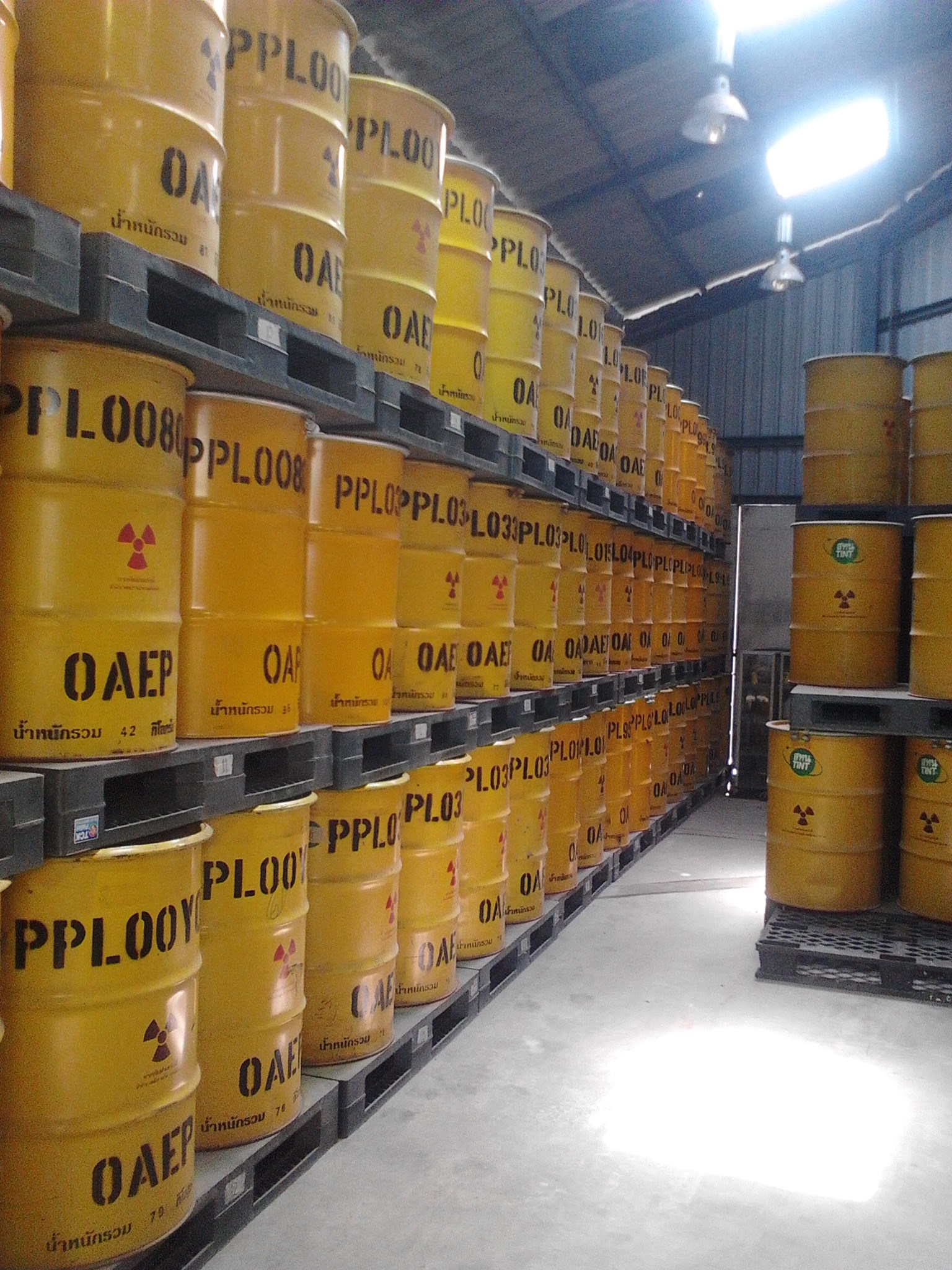
This seems wrong in both places. There are probably enough gold rings manufactured per year to fill a swimming pool. In pictures: Fort Knox itself seems to have at least a swimming pool of gold [1] and Thailand a swimming pool of waste.[2]
[1] https://external-preview.redd.it/rgD0FO1pELgkuXZzWC2NQk0vJZU... [2] https://upload.wikimedia.org/wikipedia/commons/9/93/TINT_Rad...
Those piles of bars are shallow, and those barrels are probably mostly non-spent-fuel by volume.
In the 1930s they put about 13,000 tonnes of gold in Fort Knox. (It now has about 4,500 tonnes). Density of gold is about 20g/cm^3, or 20 tonnes per cubic metre. So Fort Knox held up to 650m^3 of gold.
A normal swimming pool is about 25m x 12.5m x 2m which is 625m^3.
https://en.wikipedia.org/wiki/United_States_Bullion_Deposito...
This page indicates Sellafield has 2000m^3 of high level nuclear waste.
> Reported volume: This is the volume actually taken up by wastes that exist at the Inventory stock date. It is the volume taken up by wastes inside the tanks, vaults, silos and drums in which they are contained.
> burying it deep and forgetting about it for the next 100.000 years is the way to go I think.
Is there a problem with burying it in a subducting plate boundary, so it is eventually pulled back into the earth's mantle? There's already fission going on down there.
>The earth travels at 30 km / s (70K MPH) around the sun, so you need to decelerate about that much the other way.
Surely you’d just need enough to end up in a decaying orbit? Then it’ll eventually reach the sun
Low-earth orbits decay because of friction between the spacecraft and the Earth's upper atmosphere. What do you imagine would guarantee the decay of a solar orbit before a perturbation (by, e.g., the gravity of the Earth's moon or a comet) sends the orbiting object into a collision course with Earth?
All you need to do is hit the Lagrange point.

1. Build a large superconducting flywheel energy storage system like they have in Japan, right under the launch centrifuge.
2. Use it continually to arbitrage energy prices. Buy low sell high.
3. At launch time divert the rotational energy to the centrifuge. (I'd like to see that clutch.)
4. Profit
5. Forget about the rockets, just buy and sell energy
Couldn't you simply do it with a battery?
Not a scientist, but in theory flywheels or any kind of mechanical energy storage have less energy loss than chemical energy storage like batteries. Then there's wear and tear, switching, etc.
Yes but then how would you raise all the investor funds to funnel to your offshore accounts?
Put this on the moon and we are talking. I'm not sure I see this being too useful otherwise, considering how much extra fairing mass those gforces are going to require
Yes, SpinLaunch on Moon launching ore concentrates. No housing needed, g-forces irrelevant; gravity well is smaller.
Obligatory link, "Moon is a Harsh Mistress", by Heinlein: https://archive.org/details/TheMoonIsAHarshMistress_201701
I came here to say exactly the same thing. Perfect for my favorite project to save the Earth - launching refined moon dust at Lagrange points.
I swear I either read a book or watched a movie in which they did exactly this.
I loved Heinlein as a kid...
I wonder how many geeks today realize he's the origin of the term 'grok' ?
A lot? It's not that big a secret, if the question ever occurs to you. I've known for a while and haven't even read the book.
I don't think its a secret, but I do think it was before a lot geeks time...hell, it was actually published almost a decade before my time :-P
P.S. It also appears 'grok' has fallen out of favor over the years. It's too bad, I always liked how subtle it was - the distinction between knowing WHAT something does and WHY it does it(eg fully understanding it)
A smooth bore gun (like the one in tanks) with a very long barrel will work for moon projectiles as well.
How does this prevent the satellite from being damaged when it transitions from 5000mph in vacuum centrifuge to less-than-5000mph-in-troposphere 1 meter later just out of the door?
That's gotta be one hell of a fairing.
Oh wow, I was wondering why bother building housing around it. That seems incredibly expensive to build and maintain.
Your comment is very on point. If they slowly even out the atmosphere, they loose the speed. So they'll need to coordinate the door opening at exactly the right moment. And if it doesn't the whole instillation goes boom.
I feel like it would be better just to use the money to buy more rocket fuel at this point. This is so much alike to "game changing ideas" like the hyperloop, solar roadways, and other "disruptive" tech that make a cool headline, but break down the second you think about the real world logistics and cost.
I hope they prove me wrong if they can get it to work though, cheaper space flights could help the world in so many ways.
Here's a video of the CEO at some ground breaking they did: https://www.youtube.com/watch?v=lmO0k7Nv30g&feature=emb_titl...
Maybe it's a minor thing, but it's a big tell to me. He says: "My team and I", in the possessive, and to me that always betrays something in founders that I don't like.
The best founders I know usually focus more on the team than on themselves. It's subtle, but I think it's meaningful.
> And if it doesn't the whole instillation goes boom.
The projectile is going to go boom when it hits the thick lower atmosphere going many times the speed of sound when it exits the vacuum chamber regardless.
Reaching max q at T+0.0001 seconds while 1 inch away from the launch site's massive expensive centrifuge. It's a bold strategy, Cotton.
I hear you :) but IIRC the US "rail guns" are generating muzzle velocities in this speed range (?)
I've seen very spectacular footage of these rounds tearing a hole in the atmosphere ... so maybe our shared intuition isn't reliable...
or maybe once you get a cross section bigger than a playing card, things become.... interesting at these speeds at sea level;)
No they're definitely going to fail. The founders don't seem to understand how difficult this is. If you're going to build an accelerator you want it to accelerate over a very long distance and have it exit the vacuum well into the stratosphere if you can.
Pack it up, boys. Mlindner on hacker news says said you’re going to fail.
I mean, the general consensus seems to be that this is the juicero of space launch systems...not 'impossible' just not realistic or useful
I have heard them say repeatedly that the physics work. Physics are 'easier' than manufacturing/building something...lab scale/bench scale are exponentially easier than full scale...full scale is exponentially easier than building something consistently. Ask Tesla.
I have yet to hear them talk about how they are manufacturing parts for the full size centrifuge. When I hear them mention forging or the heavy press program or similar I'll take them slightly more seriously. I'm trying to conceptualize what the arm would look like and the force it would have to withstand and honestly can't.
Right now, they have been stuck for years on 'trust us this doesn't violate the laws of physics' which is not comforting when I only ever hear that from cooks.
I think they're going to make it pointy.
Perhaps relevant https://www.businessinsider.com/fastest-object-robert-brownl...
They're going to need an ablative heat shield or make it out of pure titanium.
How does it deal with the sudden inrush of air and the object at supersonic speeds when the hatch is opened?
Although, I guess for something about to go 5000 mph through the atmosphere, a little extra air probably isn't a big deal.
Maybe the hatch cares though.
> 5000 mph > a little extra air
I think this is actually a big deal.
I think it’s possible with some tricks.
The Mach angle is going to be extremely tight, so the profile of a normal spacecraft design would look like a flat plate at that speed. Normally, the craft is designed with a body shape roughly matching the Mach angle, but that would make it look like a long needle and you’d never be able to spin that up.
So instead, you can use a hypersonic projectile to open up the pressure envelope in front of the payload. This would be a big chunk of tungsten in a tear-drop shape. In this case, the shape is not for laminar aerodynamics; it’s for keeping mass in front for positive ballistic coefficient, and maintaining the same shape as it erodes. This is required because it has to stay ahead of the payload. Of course you can also make a train of these increasing in width and spaced to match the pressure cone.
The calculation for how much energy this takes is the sum of: 1. Mass to orbit. 2. The atmospheric pressure times the atmospheric height times the area of the Mach cone. 3. Heat losses. We can compute minimum values for the first two to get an idea of how much energy is required. I’m not sure about heat losses, but I think it’s roughly half the energy budget.
Overall I’d naively expect this to end up being more efficient than carrying fuel to orbit.
I couldn't help wondering what happens to the counterweight. 100kg travelling at 5000mph works out as about 500MJ. For comparison, 1 tonne of TNT is about 4.2GJ, so the energy of the counterweight is about the same as 120kg of TNT. Looks like stopping the counterweight will produce a pretty big explosion, but probably not their biggest problem.
This has always been my question. In college, we built a spinning pumpkin launching appartus...the first time we had it release a 5lb pumpkin it the whole frame (about 400lbs) jumped about 2 feet in the air a split second later.
Unless they are releasing liquid, releasing two projectiles a half cycle apart (which still isn't optimal) or something similar, I can't see how the counterweight doesn't just turn the structure into dust instantly. If it isn't perfectly the vibrations will just eat the thing.
If you could guide the counterweight, maybe you could use the thing for either forging [0] or bonding of metals [1]
From the article
"a counterbalance spinning opposite the rocket gets released at the same time, preventing the tether from becoming unbalanced and vibrating into oblivion"
Yes, but where is it released? Because if it's at the same time and the rocket goes up, the counterbalance goes down. And that means a big explosion right under your infrastructure.
Exactly - the energy of the released counterweight will inevitably produce an explosion as it's stopped pretty quickly by something. My question was how big an explosion. The answer is pretty big, but this probably isn't their biggest problem.
Liquid back stop? Ballistic jello?
500MJ is enough energy to flash-boil 200Kg of water, so that might work. Would be a sizeable steam explosion, as the 330 or so cubic meters of instantaneously created steam tries to go somewhere, and an interesting pressure wave in the water tank.
"interesting" -- the concussive overpressure would be brutal in water and travel further I guess, maybe you could add a bubble stream to the water like in dives to diffuse the shockwave some.
Can it regenerate energy when slowing down?
I have a hard time believing this is efficient in terms of energy.
Air resistance is a function of the velocity squared and the air density. Air density is a non-linear function as well- it gets very thick near the ground.
To put all your energy into maximizing your speed while you're at ground level (the spin launcher) you're wasting huge amounts of energy just pushing air out of the way. At hypersonic speeds, you'
Rockets, by contrast, go their slowest at ground level and continually accelerate as they get higher. In SpaceX launches, they actually have a period where they throttle back as they go through "Max-Q", the highest aerodynamic pressure point, as it's more efficient to be slower until you're past this point.
I guess using electrical energy, which is a much cheaper source than chemicals like rocket fuel, makes the payoff worthwhile? I dunno, I'm skeptical.
Oh also you can only launch this somewhere that no one around will mind an insane sonic boom at ground level.
You seen to have forgotten to finish your third paragraph.
I'm not really convinced nor reassured by their supposed tests to prove the physics will work. The test involving the iPhone? That's like saying "well, a marshmallow can withstand 1g of forces without being crushed therefore I can build a 3 story apartment building out of them".
10000g peak forces are a bit of a mess for space travel.
Perhaps instead of directly spinning the object up to speed and "letting go", you could build up all of the energy into a heavy rotating mass which then imparts it into the spacecraft over a slightly longer timeframe via some simple mechanical clutch and cable arrangement. You would still have very strong g-forces, but you could control the impulse curve over time to spread out the forces better.
Steel cables, flywheels and other members aren't going to care about such forces as much as the delicate electronics on board a spacecraft. Let these parts do the heavy lifting and then transmit the energy into the spacecraft in a methodical manner. You need to decouple the extreme nature of this sort of energy storage system from the spacecraft until it is go time.
You very quickly get to multi-kilometer ropes, and the need to accelerate a far higher mass than the launch mass...
Reminds me of Seveneves by Neal Stephenson. In a future setting, they use long whip like objects to fling objects around in space, with a flywheel to drive them.
“The reason it's hard to get to orbit isn't that space is high up. It's hard to get to orbit because you have to go so fast.”
Sounds like this solves the easy part (getting to high altitude), but makes the hard part (getting to orbital velocity) even harder.
I think you're imagining that the rocket is fired directly vertically and peaks at some altitude, when the rocket ignite to "make it go fast". Instead, imagine the flings the rocket at a 45 degree angle so when it peaks in altitude it's already going quite fast. As other commentators in this thread point out, it's really an alternative for the primary stage rocket booster part, which doesn't just shoot a rocket straight up vertically.
Except they're completely inverting the rocket. The rocket goes slow in the lower atmosphere where the forces are lower. This allows them to lose much less energy in the lower atmosphere from drag.
If they could just launch at 45 degrees to get to orbit the rockets would do that too, but no they don't. They go straight up at first because the drag is such a huge penalty to the performance.
If they actually build this thing, the most efficient way to launch is to launch it almost straight up at 90 degrees so they lose the least energy. However the hardest part is going to be immediately after exiting this thing where they hit the atmosphere going mach 6-7 and instantly turn into a glowing ball of plasma, which is what happens if you try to move that fast at sea level.
Drag forces increase with the square of the velocity and linearly with fluid density. The instant it leaves the cannon it will feel like it's hitting a brick wall.
That would just cause even more problems with air resistance. We've flown at 5,000 miles per hour before, but nowhere near ground level.
This thing is going to tear itself apart as soon as it leaves the centrifuge.
The image on the site says 35 degree angle.
I'm still scratching my head thinking of how much force will be crushing the rocket and satellite for an hour. I know space stuff needs to be super durable, but surely the G's it'll experience over an hour will be more grueling than a traditional rocket, no?
> "At this point the spacecraft will be subjected to a peak force 10,000 times greater than Earth's gravity, something opponents believe will seriously affect its structural integrity and the safety of its complex electronics."
Centrifugal projectile weapons scale up poorly and have issues even at BB gun scale. Envisioning what happens with a 200lb projectile; leave aside the laughable velocities they're talking, and I want to be well distanced from these people when they power shit up.
I think this is a device for separating investors from money.
I just assumed they fully expect to pivot into the defense industry.
This isn't very appealing to defense either, due to the slow spin up.
This isn't my area of expertise, but judging from some of the extreme physics they're dealing with I'm assuming they're solving problems with potentially lucrative military applications.
They aren't solving anything, and no, there's no potentially lucrative military applications. This is just an investor scam. Dunno if the founders are true believers it or not, but this thing has 0% chance of producing anything interesting.
Hypersonic anti-ship missiles are a hot topic these days, maybe this is related.
To get a rough idea of the numbers if this was a rail gun and accelerating linearly: 1G is 32 feet/second 32 feet /second is ~22 mph They're accelerating to 5000mph so they need to crush things at 1G for ~230 second or just under 4 minutes.
If I understand correctly, this would hold for angular acceleration too, since they'd just release at some point. Can someone correct me if I'm wrong?
You're probably correct, but there is more.
Take a 200 pound payload, add some rocket to it, let's say 10x the weight to be generous, then spin it in a circle 200 feet in diameter. You're looking at 18 thousand tons of force spinning it at 5000mph. So you're spinning 4 navy destroyers worth of force in a circle, which means you need a latch mechanism that can not only hold that much force, but release it at the exact moment to exit the biggest vacuum chamber ever created through a door that just opened at the right time, generating a mach 6+ shock wave at about 0 meters distance from the door and somehow not destroying it in the process. I don't know that it is impossible, but it is highly improbable. They'd probably have a burst disk rather than a door, because that would let you use the capsule as a bullet to penetrate the exit.
In the article they mention the payload experiencing 10000g, so they must be planning on a circle greater than 200 feet in diameter. I can't find numbers on existing satellites, but I remember reading that rockets typically top out at 6g acceleration and figure on a 10x momentary acceleration due to vibration. To tolerate 10000g the payload being launched will need to be built like a tank, rather than the relatively light current designs. To ease that requirement you could submerge the payload in liquid, but that would decrease your usable payload accordingly.
It would be impressive if they could actually pull it off. I think it would be useful for limited applications. I have watched science fiction shows where mass accelerators could basically nuke planets without radioactive fallout. Maybe this would be something similar.
Having read "The Moon is a Harsh Mistress" a looong time ago, I have sometimes wondered why no one has ever tried to use rail guns as launch mechanisms. I vaguely remember from not so long ago that one of the criticisms was that the acceleration forces would crush any fragile parts like electronics, but is it still true that electronics can't be hardened to survive the acceleration forces? Are there other problems that make the idea of rail gun launchers simply impossible?
A rail gun would work from the moon, where there's no atmosphere. On earth, the projectile would attain its highest velocity (right as it leaves the rail gun) in the thickest part of the atmosphere (at ground level).
And just for a sense of scale, escape velocity from earth's surface--assuming no atmosphere at all--is 25,000 miles per hour. The projectile is going to tear itself apart in atmosphere at those speeds.
Main problem is to avoid being assassinated by Mossad.
10,000g sounds pretty rough. Are there any existing electronics that we would expect to survive this?
Yes. Guided munitions. Some artillery shells incorporate guidance electronics that survive these sort of conditions.
Yes but guided munitions are compact lumps of steel, not squishy rocket tanks full of liquid. The forces are also all in one direction, first in the positive direction from launch, and then in the negative direction from atmospheric deceleration.
This will have lateral forces, then sudden relaxation of those forces (shock unloading) and then sudden vertical forces when it hits dense atmosphere.
Nokia 3310
From the title, I was hoping this would be about a slingatron. That's still one of my favorite space launch proposals (the launch loop is another), but I wasn't able to quickly find a good reference. :(
Does the rocket somehow counter the spin of the tether? If it's rigidly attached to the tether, I don't understand how it would stop spinning after being released. The rocket itself would spin very quickly, and due to conservation of angular momentum it would keep spinning upon release. Am I missing something?
Or do they somehow counter the spinning of the tether, so that the rocket's orientation remains static? If there's another bearing at the attachment point, I don't see how just the outer bearing would withstand the friction at 10000g.
The Lofstrom Launch Loop[0] is less fanciful than a 5000 mph centrifuge slinging payloads into LEO.
How is this less fanciful?
Because the physics actually works.
Really? What will they use to build the legs to support it?
Those aren't legs, they're guy wires.
https://en.wikipedia.org/wiki/Launch_loop
I said the physics works. The engineering is a totally different question.
"I said the physics works. The engineering is a totally different question."
So if the engineering is questionable or unrealistic, how is it less fanciful?
In 50 years or 100 years, there might be a launch loop. There will never be a launch centrifuge, not in 50 or 100 or 1000. Fluid dynamics simply don't allow objects to move that fast at ground level.
0.000000000001 > 0
I hope they actually try, it's going to be a hell of a show.
I'll RSVP no to the in person watch party and happily watch a stream with a room full of engineering students so we can debrief the explosion afterwards.
It seems to require a vacuum to spin. And then it needs to launch at Hypersonic speeds and then meets atmosphere. Instant encounter with a solid barrier == blow-up. I am thoroughly skeptical about the technology both on the incredible G forces, and then hitting atmosphere at huge rates of speed.
I wonder what the cost/benefit of using a centrifuge is versus a light gas gun?
I'm skeptical but I hope they can at least get a test launch or two out. I've always found things like this or using a slingshot to launch something to be interesting ideas and would love to see them tried out.
Is it necessary to survive 10000g to get to orbit? Wrong question. It requires 17600mph to stay in orbit. However you do that. The g's to do that depend entirely on how long the acceleration is applied.
I think it would be more practical to build a helium filled temporary plastic tunnel around a rail gun over a few miles with a gradual curve up at the end so humans could use it.
This lesson describes the fictitious ‘force’ used in this technology:
Ambitious. Not sure how it deals with the structural impact due to extreme forces.
So Wired is now Popular Mechanics and Omni.
It amazes me how many people fall for such ridiculous physics-defying nonsense. I guess this works to deprive fools of their money.
Ultimate trebuchet!
I’d rather see them launch junk toward the sun with it.