Movie Industry: VPNs and Tor Pose a Threat to Legitimate Streaming Platforms
torrentfreak.comWell hey, that's what happens when you turn streaming into cable.
I had Netflix, Amazon, and Hulu subscriptions last year.
Today, I have none of those, except for one or two video purchases I made on Amazon.
Now I'm supposed to have Disney+, CBS All Access, HBO Max, Peacock, etc., and that list will probably grow. And we're at a low point in what we consider entertainment. It's bread and circuses up the wazoo. And now I'm apparently supposed to pay more(I heard the Netflix subscription increased again).
"A la carte" was proposed for a long time as "here's what's wrong with cable" and overall it's definitely better now. I pay less for a few services, and can switch them in and out, than I did for cable.
But people got unrealistic expectations of total price from the first few years of Netflix and Hulu prices + library. That stuff was always gonna get more expensive as the market moved to streaming.
Thank you! I've been saying this for years.
I will admit that the request for a la carte assumed channel theming along the lines of cable, which isn't materializing in streaming. If I want just high quality sci-fi, which streaming service do I subscribe to? If I want feel good family movies? Etc.
But it was always going to be a dozen streaming services. Anybody who thought otherwise was either delusional or didn't understand how money worked.
It's mind boggling to hear people compare cable and satellite TV to media via the internet.
We once had to sign contracts, and have people come into your house and install things, and then pay rental for their cable boxes or whatnot and had to watch shows based on the schedule they were broadcast.
Now, we can click a few buttons and stream exactly what we want, when we want, and unless you are watching too much media, it is surely cheaper than cable/satellite in years past. And you can purchase a subscription and cancel a subscription within seconds, as opposed to calling the cable company and waiting on hold and dealing with retention departments.
Comparing it cable is unfair. At least cable worked properly with my television unlike the HDCP infested upgrade nightmare that streaming turned into.
I started just pirating the content I was subscribed to because it was easier. Then they made it harder with all the fragmentation so I stopped paying for it full stop.
Movie industry has to do the leg work to get my attention and that is very fragile. They choose not to so no cash from me.
I find a lot of pirate services don't really serve the 4k market that well. The vast majority of it is 1080p. Do you just use 1080p or 4k in your piracy adventures? Is the new thing not bittorrent?
1080p and bittorrent. That's it. I honestly don't have the eyesight or a large enough screen that 4k makes a difference for me.
> Now I'm supposed to have Disney+, CBS All Access, HBO Max, Peacock, etc., and that list will probably grow
I honestly don't see why anyone needs more than maybe two streaming services. Do you really need to see everything? Even during the pandemic, two seems to be plenty for most families.
Imagine arguing that movies are too expensive now because you have to see a movie every day. The obvious solution is to prioritize what you view and watch fewer movies.
For most people the current approach is better: spending $20 or $30 a month instead of $80 -- and with much better choices available, and often without any ads.
If you want to be frugal, it also makes a lot of sense to stop and start your subscriptions depending on what show(s) you're actively watching that season. During Game of Thrones I needed only HBO. During The Handmaid's Tale I needed only Hulu. During Stranger Things only Netflix.
The next headline would be: "Stopping and Starting Subscriptions Pose a Threat to Legitimate Streaming Platforms"
Well, more like "Dear subscriber, for your convenience and security, you can now activate your subscription in 3-month packages. Don't thanks us, at EvilCast, we're always thinking of you".
This one is easier for them to fix with loyalty-based pricing and/or activation fees.
At least we can rest for now, knowing they won't do that until one of them is convinced it won the subscription streaming war.
> Do you really need to see everything?
It's not about seeing everything, it's about seeing what's good, and how that's scattered across a dozen or more services where it's buried under mostly mediocre/bad content.
Sure, sometimes there's an option to just rent/buy digitally, but often that ends up being way more expensive than just buying a physical blu-ray version.
Case in point: If I wanted to stream Battlestar Galactica (2004) in Germany then the first option for that would be Amazon Prime Video. Even tho I pay for a prime membership, buying all 4 seasons digitally in HD quality, would cost me 92€, there is no option to just rent them.
While ordering the blu-ray set for the whole show, on Amazon with delivery tomorrow, would cost me 48€, nearly half as much and I get a physical version I can use as often and wherever I want, even if the unthinkable happens and Amazon goes out of business.
Why does the clearly inferior version of a product cost that much more?
The virtual version doesn't take up space. Physical items occupy space so after a while they want to discount them to since that's costing them money to store. Digital items won't go away even if they put them on sale, and hard drive space is cheap.
I agree it sucks, but isn't this pretty much what "everyone" was asking for? A few years ago it felt like every week there was some refrain of
> Look, I don't want to pay $120 for 900 channels I never watch. Just let me pay for them a la carte.
This reminds me of those plots where the devil grants wishes in sneaky terrible ways that are not at all what the asker intended.
Only, we're not paying $60 for 15 channels we want now. We're paying $60 for 1-2 shows each from 200 channels (most of which we don't want). Channels had themes, and what people meant by a la carte was being able to get the themes they wanted.
Personally, I'd prefer to see every service have access to (pretty much) all content and then compete on quality/price/etc... kind of like how music tends to work nowadays.
Well at the same time due to the way the industry works in the first place. Netflix was fundamentally going to die. Mainly due to how licensing fees work. Doing this alleviates that pressure in a way that cable never could.
I just couldn't resist: https://i.imgflip.com/4kyf7g.jpg
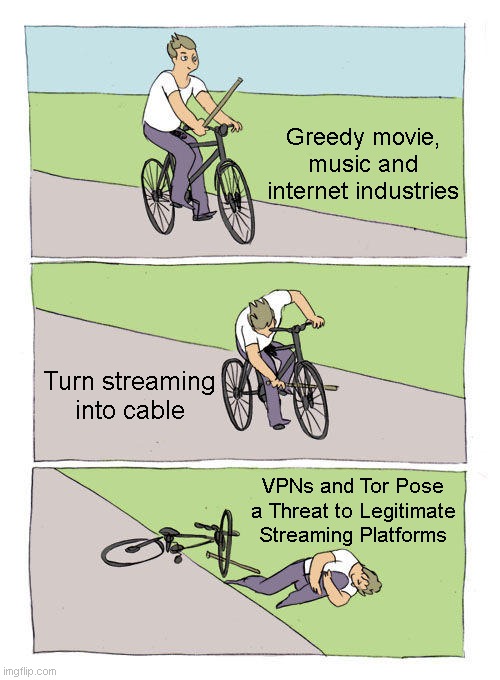
Movie industry: we're not going to give a bunch of people any way to pay us for our content.
Also movie industry: why are so many people watching our content without paying us for it?
I live in the nordics, and I can't show my kid Netflix kids' content in my native central european language because only nordic languages are licenced here.
If you don't want me to get smart on using VPN's, maybe it's time to evaluate your licensing system first..
Hum... It's about VPN and TOR, not piracy, so no it's:
Movie Industry: Those criminals are breaking the Law and paying us to watch our content in ways that we really do not want them to!
I don't really understand people who do that. If I pirate, the movie industry disapproves. If I pay but use a VPN, the movie industry still disapproves, I have to use its DRM-infested client and an operating system it approves of, and have less money.
This is because foreign distribution for movies is usually sold to a 3rd party prior to release by studios. They get an upfront payment.
That's why US box office has always been the only metric that "Hollywood" cares about.
Much like the music industry, the need for the Hollywood-machine, which is effectively a bank that gives loans to make movies - just as record labels would give musicians a loan against future earnings to make an album.
The barrier to enter the world of video content creation has led to more independent films and the platform to restrict revenue from studio-funded productions are evaporating because they were so late and backwards in how they approached streaming.
Time for the Movie industry to move to the Patreon model. They have more than enough fans to support them. Why can't i watch a movie in the app of my convenience (e.g. Popcorn Time) and still be able to pay for it? Why is there no such "virtual ticket" option. I know they want to package their products in specific ways, but they demand that the entire internet infrastructure bends to match their favourite way and that's just insanely egocentric. Hollywood is not the center of the universe anymore.
because almost no one pays in a patreon model.
i m not sure if someone has worked out the economics. Billions can pirate a movie, yet many millions pay netflix etc. How much does a movie play cost on netflix.
Billions pirate a movie, yet they still recoup the production costs somehow because they aren't anywhere near going bankrupt.
Honest question, why does region locking exist?
Usually it's all about money, but what is such a strong incentive that makes it sensible to decline getting money from customers?
Laziness? Local laws? Some complicated scheme where it costs more money than it makes?
Basically because of the division between publishers and distributors.
Publishers make deals with different distributors in different countries, and some (many) of these distribution deals are exclusive. For example, Universal signs a deal with a UK channel that includes the exclusive right to distribute in the UK. These exclusivity deals are mutually beneficial - Universal has less deal-signing overhead in dealing with fewer distributors overall, besides the additional exclusivity royalties paid to Universal, and the distributor benefits because exclusivity makes their platform more attractive to end-consumers, who are now forced to deal with that distributor in order to watch that film.
Meanwhile, a streaming distributor (i.e. Hulu) comes to Universal and shows interest in distributing the film as well. Universal tells Hulu, that it'll sign a distribution deal, but this deal must not violate any of the other dozens or hundreds of distribution deals that Universal already signed, so that Universal won't violate its preexisting agreements. Streaming distributors need to figure out exactly which films can be distributed exactly where; for many films from many distributors with non-standard agreements in many regions, this is a non-trivial problem to solve.
Many distributors - like Hulu - make the business decision not to solve it at all. Hence, region locking.
I think it's because of price discrimination. Same reason why there are "international" versions of text books.
https://en.wikipedia.org/wiki/Price_discrimination
If you have a good whose marginal costs is very small, then once it has been created, the optimal method to sell it is to sell it to each person for the maximum amount they are able and willing to pay. Obviously, people in poorer countries aren't able to pay as much as people in richer countries, so by creating different versions for them, the seller can maximize revenue, but only if the people in richer countries aren't able to obtain it at the cheaper price.
In a way, this is good for poorer countries as they can obtain the goods at a cheaper price since the alternative might be that the seller simply abandons the market.
The original exclusivity deals between publishers and legacy distributors, of course, are not for standard prices. Different distributors in different regions are able to pay different amounts - largely, the distributors in richer regions are able to charge more and pay the publisher more than distributors in poorer regions.
Regardless, streaming distributors still need to work within the framework of the pre-existing deals that the publisher has already committed to.
> the optimal method to sell it is to sell it to each person for the maximum amount they are able and willing to pay.
The optimal method for minimizing the consumer surplus.
Because some countries don't allow certain types of media to be accesses/broadcasted/consumed. If a streaming/broadcasting business wants to operate in that country they will have to follow the local laws.
VPNs and Tor: Movie Industry Pose a Threat to Legitimate Streaming Platforms
e: I do love that ThePirateBay is still sailing around the internet. The middle finger that could.
Play stupid games, win stupid prizes. They had a good thing going for a while, and it looked like Netflix and Amazon were headed in the direction of the music-streaming landscape -- basically all the providers have pretty much all the content -- but then greed took over and the current "exclusives"-situation is veering back to the cable-tv structure.
This is the problem with modern copyright. Content creators needs to be paid, but they should not be in control of what the public can do with their shows. We need a standard price to pay for a standard license.
Heck let them set their own price, but any special deal should be considered a breach of the monopoly they have been granted - no more favoring one streaming service over another. No more region or geolock.
Since they are so happy about tell us that we have brought a CD, not its contents I should be allowed to get that content however I want and pay a standard fee in a standard way.
We should let their obsolete business models fail instead of writing new laws in defiance of the reality of digital communication.
They're like any other industry, struggling in an increasingly digital, on-demand world and competing with 'free' YouTube entertainment. There is no quick fix here. Its a supertanker that takes ages to correct course. People need to vote with their eyeballs and ears. Folks need to take some personal hits and avoid popular big-studio content. Its hard, if not impossible to make an amicable deal when only one side has to compromise.
Unfortunately abstaining from consuming their products (as I generally do these days) doesn't render me immune to the legislative fallout of their dying thrashes.
It's not just the movie industry. It's also the sports tv industry.
I'm ok coughing up the money required for the NHL subscription for the season, but I still can't watch my hometown team live without a blackout.
And you wonder why people VPN.
Has anyone actually ever succeeded in streaming anything over tor? It’s usually so slow that ordinary html pages take several seconds. I can’t imagine streaming would work...
Just tested a 720p youtube video, works fine. You're likely experiencing high latency rather than low bandwidth.
Still seems silly it's mentioned though, it's trivial to block Tor exits.
https://webtorrent.io is pretty good if you have a decent internet connection
But the question was about Tor, how would torrents solve the low bandwidth problem?
Part of me wishes that the film industry's initial resistance to home video and streaming platforms had succeeded so that COVID-19 would have buried the entire business.
That would be hilarious.
You guys could accept, or I can go back to torrent. Your choise.
They pose a threat to the efficacy of region blocking
REgion block sucks. I live and Brazil. I have a few hundred DVDs. I can't watch them, because my main way of watching was my videogame. My ps3 died, and I was planing on using my Xbox one for that. But my Xbox one is an Us made model, so to watch my dvds, I have to rip them using Handbreak.
Alternatively: Legitimate streaming platforms pose a threat to security and privacy.
>However, they can use tools such as VPNs to access them in locations where the platforms and content are not licensed.
>For example, if Netflix is not available in country X, people could use a VPN to make it appear they come from country Y, where the service is legally available. This is a problem, MPA notes, particularly in the United Arab Emirates (UAE).
Hmmmmm....well maybe the idea of region locking and licensing content to specific regions in a world where everywhere is instantly connected to everywhere else is for lack of a better word...completely fucking idiotic.
Their tears of unfathomable sadness are delicious.
So “geolocation pirates” are customers who pay for a subscription and then have to pay for a VPN to access full library.
Industries that rely on TV are a cancer refusing to die. People here are forced by law to pay more than 200 EUR per year to the national TV broadcaster even when they don't own a TV. The reason? They still receive the signal, thus they could watch TV if they wanted. BS. /rant
Generally, I've heard very wonderful things about the Public Broadcasting Station here in the United States and would be happy if $200 per year of my taxes went to them.
In Germany the problem is that it's a fee that is flat per household, so a young single with barely any income has to pay just as much as a family with 2 incomes or a shared apartment with a bunch of people, each household has to pay the same 210€ per year regardless of number of users or actual consumption.
A lot of the programming is really dated and mostly appealing to somewhat older folks, with tons of regional broadcasters having several versions of folks music festival shows.
There's some interesting online-content aimed at younger audiences like ZDFNeo, Tagesschau does some decent reporting but kills any comment section hours after release, if they open them at all. I enjoy content co-produced with ARTE like documentaries, but all of that has zero retention.
German public broadcasting laws do prohibit them from storing their content for an indefinite time, which the private media industry lobbied for as they feared public broadcasters would build massive libraries "distorting the market". This even applies to publicly funded news portals like Tagesschau [0] where articles will often be deleted after a year or ARTE documentaries that are only streamable for like 3 months, to then vanish in distribution/publisher limbo for sometimes years before they can be bought.
[0] https://www.tagesschau.de/inland/rundfunkaenderungsstaatsver...
I understand your frustration, but the public library, museums, schools, or roads, for that matter, follow the same funding scheme.
In a pure capitalist world, you pay as you go, but in reality, people want common public goods funded by the public regardless of use.
Well if you want to stop vpn services stop doing region locked content. In this day and age region locking isn't really feasible. Vpns are a solution to your crapy business practice not a problem.
I just read that and other articles on Torrentfreak, did that site slowly become an industry mouthpiece lol?