'Cancel Culture' Comes to Science?
wsj.comWhat appears to have happened here was that a climate denialist group that deliberately use "NAS" to confuse people into thinking they are receiving an invitation to speak at a conference by the National Academy of Sciences, was called out by an open science advocate who himself felt mislead. Then the Wall Street Journal was snookered into publishing an editorial because they'll publish pretty much anything that claims to be about "cancel culture". And now we're here debating how some tweets mean science has been ruined by cancel culture warriors or whatever. The irony is that the person being "canceled" is exactly the person being accused of it.
Wow, I hadn't realized. How insidiously dangerous. Funded by the Charles Koch Foundation.
Kerry Emanuel, a climate scientist at MIT and former member of NAS, says he was initially drawn to the organization because he was worried about what he saw as a growing relativism in the academy, evident in the work of deconstructionist philosophers like Jacques Derrida. NAS seemed to be taking a stand against those intellectual currents, Emanuel said — though he adds that he eventually became concerned about the organization’s stances on climate change, especially during a much-publicized incident in which hackers stole thousands of emails from a group of climate scientists and accused them of misusing data.
In a 2010 article published on the NAS website, Emanuel described the event as “a scandal” — but he didn’t see it as a challenge to the scientific consensus on climate change. The National Association of Scholars, on the other hand, sought to extrapolate the Climategate incident “into a universal condemnation of the field,” Emanuel told me. “It was just patently disingenuous.”
He left the organization soon afterward.
“It sort of revealed them not to be what they claimed to be — people who stood for scientific truth and scientific integrity. It was just another organization that used that as a front,” Emanuel said. “They’re basically a political organization posing as an organization dedicated to free inquiry,” he added.
https://undark.org/2018/04/18/national-association-of-schola...
> " By Peter W. Wood"
> " Mr. Wood is president of the National Association of Scholars. "
Of course the person being "cancelled" would write an opinion piece on "cancel culture".
One person criticised his event on twitter and he wrote an opinion piece on WSJ about how he's being persecuted. This seems incredibly childish to me. Especially considering the original tweet* got under 100 retweets and about 130 likes.
Honestly, I feel like this is more likely to be advertising for the conference than an actual complaint about "cancel culture". Nothing here is noteworthy in any way.
Opinion piece author, an anthropology PhD holder, has been pushing climate change denialism and attacking individual scientists via his NAS organization since 2009. He did the same thing to another scientist in 2011[1]. The publications he lists on the Federalist Society make his other agendas very clear. And yes, this is plain as day advertising and deception.
[1]:https://www.desmogblog.com/sites/beta.desmogblog.com/files/b...
His articles on the Federalist for anyone who's interested https://thefederalist.com/author/peterwood/
The paper, along with some really basic googling, raises a big red flag over NAS's impartiality. Namely that:
* NAS was founded by a conservative
* Its president is conservative
* Its funders are conservative
* Its board is full of conservatives
* It frequently uses conservative (arguably far-right) catchphrases like "defending western civilization"
* Often pushes conservative viewpoints such as climate scepticism
* Other conservative organisations call NAS conservative
Yet despite all that NAS, or at least Peter W Wood, consistently claim they are not a conservative organisation.
This is completely absurd. Definitely an advert and no sane person should trust anything that Wood is saying here.
Are you insinuating that conservative voices should not be listened to?
This does seem to be a perfect example of "cancel culture" though, someone is mad that regular people get to talk about them on the internet and them being "cancelled" has meant they get more attention, more press and their career is unaffected.
And most of the people complaining about it don't care about the specifics but want a chance to vent about the fact that their preferred version of phrenology isn't taken seriously anymore.
Some relevant context here contesting this view: https://twitter.com/lteytelman/status/1216770668475252738
This guy's Twitter thread doesn't seem like a great defense, because he doesn't make any specific scientific claims. It's all just ad-hominem that this org are "climate deniers."
More troubling is his claim that they are "weaponizing" reproducibility against climate change. Doesn't that raise a red flag? If you're worried that reproducibility poses a problem for something, doesn't that mean you might just a little bit probably have beliefs not based on reproducible science, but on faith? And that the irreproducible science has a chance of being wrong?
I'm not trying to deny climate science, I think it's real. But it seems like there's a real problem with this person's stance and how they're trying to argue and obstruct.
I'm kind of a believer that people can think for themselves. Let anybody attend anything - if it's a science convention that isn't promoting science it seems like it's not going to get very far, no protesting required.
Who are these people who feel that simply listening to someone speak is equivalent to endorsing them?
> This guy's Twitter thread doesn't seem like a great defense, because he doesn't make any specific scientific claims.
No one is hiding scientific claims about climate change. It wouldn't be difficult to list scientific claims, but that's not his point. He is complaining that this organization is misrepresenting itself and the nature of its event in order to trick people into attending or appearing to support something they do not actually support.
He doesn't claim that climate deniers' arguments are incorrect because of something about their character or motives (that would be an ad hominem attack). He just doesn't want people to be deceived regarding this organization and its conference.
> More troubling is his claim that they are "weaponizing" reproducibility against climate change. Doesn't that raise a red flag?
No. Why should it raise a red flag? People can invoke the name of true and important criticisms in the defense of beliefs that are incorrect or harmful.
> I'm kind of a believer that people can think for themselves. Let anybody attend anything - if it's a science convention that isn't promoting science it seems like it's not going to get very far, no protesting required.
It seems like this person would agree with you: and that's why he has made an effort to inform people that (in his view) this conference is not promoting science. Moreover, how is this so-called "cancel culture" incompatible with people thinking for themselves? This person can write criticisms about an organization in a Twitter thread. Someone from that organization can write a WSJ article in response. People can and do choose what to believe. This Twitter poster (presumably) does not have the ability to unilaterally cancel anything, nor is there some cultural rule that if his tweets get a certain number of likes then the target of his criticism automatically gets cancelled.
Are there recordings or slides of the presentations at this conference? I think that would provide a better way to judge to what degree they're scientific or non-scientific, rather than all this theoretical back-and-forth debating on Twitter and HN. (I think you both have valid points, though.)
Why are they calling themselves NAS? No reason suggests itself except deception. Name another?
Because they are part of the National Association of Scholars. It was founded in 1987.
The "real" NAS (National Academy of Sciences) was founded in 1863. Their choice of name is certainly suspicious.
It's not right to say that only one is real. That's biased thinking, and shows that you're trying to push politics rather than find the truth.
Furthermore, the organization you're talking about isn't even NAS -- it's NASEM: the "National Academies of Science, Engineering, and Medicine". [1,2]
[1] https://nationalacademies.org/
[2] https://twitter.com/TheNASEM
This was all described in the article.
Furthermore, there are a bunch of other groups with the acronym NAS:
These are all very real.Nationaal Arbeids-Secretariaat", a trade union federation in the Netherlands from 1893 to 1940 National Academy of Songwriters, a music industry association for songwriters National Apprenticeship Service, the official UK government body responsible for apprenticeship coordination National Archives of Scotland, in Edinburgh, Scotland National Association of Scholars, an educational organization based in the United States National Association of Schoolmasters, a former trade union representing teachers in the UK National Association of Seadogs, a Nigerian confraternity National Audubon Society, an American environmental organization dedicated to conservancy National Autistic Society, an autism-related charity in the United Kingdom National Salvation Front (South Sudan), a South Sudanese militant group Nautical Archaeology Society, a British archaeology charity Nord Anglia International School Dubai
"More troubling is his claim that they are "weaponizing" reproducibility against climate change. Doesn't that raise a red flag? If you're worried that reproducibility poses a problem for something, doesn't that mean you might just a little bit probably have beliefs not based on reproducible science, but on faith? And that the irreproducible science has a chance of being wrong?"
If I encounter an organisation with a name that tries to make me sound reputable primarily funded by Marlboro If I take not of the fact that they make the claim that cigarettes are not unhealthy. If they support this claim by picking and choosing data and misconstruing and twisting the words of reputable sources and scientists to make them fit their claim. (See their mention of a Claudia Tebaldi statement in the report this mess is about and other fud they've written in the past of course completely disregarding anything else she'd say that conflicts with their views) If disregarded and bashed for this I then see them rethink strategy and simply start saying there are too many studies showing the negative effects on health are not reproducible (not defining what is too many which can be anything from hundreds to a single one) and drawing a link to "anti cigarette dogma"
Can I then not say they are weaponising reproducibility without being accused of just "being afraid I'm wrong"?
For reference, here's the spreadsheet with the screenshotted link [0], I've copy-pasted the climate change deniers and corresponding sources below.
Anastasios Tsonis https://www.businessinsider.com/scientists-who-deny-climate-...
Elliot D. Bloom https://www.independent.org/aboutus/person_detail.asp?id=403...
Patrick J. Michaels https://climateinvestigations.org/patrick-michaels-climate-d...
S. Stanley Young https://errorstatistics.com/2014/12/13/s-stanley-young-are-t...
David Randall https://undark.org/2018/04/18/national-association-of-schola...
David Theroux https://blog.independent.org/2012/10/27/its-official-no-glob...
Peter Wood https://undark.org/2018/04/18/national-association-of-schola...
Overall, I'm mostly underwhelmed by the evidence he presents. Anastasios probably falls into the climate change denier camp, though I know him from my time in UWM's math department and I believe he's a genuine skeptic acting in good faith. On the other hand, I turned up an awful lot of unscientific nonsense peddled by Elliot Bloom in my short time looking into him [1].
I haven't looked into the rest other than by following links above, which again are off-putting but not completely damning. I will add that the National Association of Scholars does appear to publish a lot of articles on climate change by clear climate change deniers and authors with significant links to the oil and gas industry [2], including:
- Leo Goldstein, whose website makes such claims as "CO2 in a greenhouse does NOT warm it. 'Greenhouse gas' is a misnomer.", "Higher CO2 concentrations in atmosphere do warm the surface, but only insignificantly.", and "Of all potential global dangers conceivably related to human activity, nothing has been studied better and found more harmless than anthropogenic CO2 release." [3]
- Edward Reid, who has at least 26 years of experience in the natural gas industry [4] and "fifty years of experience in the energy industry".
- David Legates, who according to Wikipedia "is a senior scientist of the Marshall Institute, a research fellow with the Independent Institute, and an adjunct scholar of the Competitive Enterprise Institute, all of which have received funding from ExxonMobil." [5]
[0] https://docs.google.com/spreadsheets/d/136FNLtJzACc6_JbbOxjy...
[1] For example, the graphic at 1:17:08 of https://youtu.be/1zrejG-WI3U?t=4628 is based on the same data as the graphic in http://archive.is/qlqA8, which is debunked here https://blog.hotwhopper.com/2014/02/roy-spencers-latest-dece... and in the follow-up linked at the top of that page
[2] http://web.archive.org/web/20180921133012/https://www.nas.or...
[3] https://defyccc.com/summary-of-science/
> Who are these people who feel that simply listening to someone speak is equivalent to endorsing them?
There are certain topics that are so settled, that to engage with anyone with a contrary view is tantamount to giving them credibility and a platform to reach the uninformed. Some topics simply don't have "both sides" in any meaningful sense. Flat eartherism, Holocaust denial, and antivaxxerism are ones that immediately come to mind. Anyone who denies the mainstream consensus on those subjects is either a moron, a dishonest person with selfish or malicious motives, or both.
Denial of human-caused climate change is close to being in that bucket by this point (the next 2 decades will determine the truth of it). From the perspective of those advocating for action against climate change, deniers have blocked any sort of meaningful action for nearly 30 years. Their actions have led to unprecedented, potential economic, humanitarian, and ecological crises.
Yeah but climate science is complicated by the fact that it is overwhelmingly political.
You could say the same thing about geocentrism, germs [1], fat vs sugars, etc. - which all turned out to be false, given time and scrutiny.
Scientists have to learn the science to understand it, and that means encountering it from all perspectives. As new generations of people learn, they all have to go through it all again.
To not do so is to promote faith, not science.
Plus if denialism is wrong, then there should be nothing to worry about anyway. Assuming scientists are scientific, they will consider it, consider other evidence, and come to the correct conclusion.
[1] https://www.mentalfloss.com/article/532074/how-promoting-han...
> You could say the same thing about geocentrism, germs [1], fat vs sugars, etc. - which all turned out to be false, given time and scrutiny.
Those things were not proven false by simply exposing the supposed political influence in the practice of science! The validity of a scientific theory does not depend on the political influence of the institutions that researched or proposed the theory. They were proven false and replaced by better scientific theories.
> Plus if denialism is wrong, then there should be nothing to worry about anyway.
I don't follow the logic of that. If denialism is wrong, but it's influencing society and policy, how is that not something to worry about?
It feels vaguely like Pascal's wager.
The payoff for anthropogenic climate change existing and us doing something is much higher than the price of it not existing and us doing something.
Even if climate change wasn't happening (it is), it seems plain to me we'd all benefit from less sulfer in the air. Not even coal miners like smog (though if they live far away from the smog they may be apathetic towards it.) The universal appreciation for fresh air should be more than enough motivation for anybody.
If your side is failing to convince people, the solution shouldn’t be “shut up the other side”, no matter how right you may be. It’s intellectually dishonest.
By engaging in cancel culture, it gives the silenced side way more credibility, because they can say “why are they afraid to let us speak?” It’s not just that cancel culture is morally bad, its also ineffective.
When the "other side" is arguing in bad faith, you're damned if you let them speak and damned if you don't. Someone like that isn't going to play by the rules of logical, rational discourse - such as sticking to the facts - so there isn't much to be gained by letting them speak versus not giving them a platform. I point you to Holocaust denialism, which has a long, rich tradition of ignoring, obfuscating, or concocting elaborate alternative explanations for any truths that run counter to their dogma. Or for something more benign, the flat earth movement or the Apollo landing conspiracy theorists.
It's easy for a bullshitter to make up more bullshit, and people love to believe "contrarian" bullshit so they can appear smarter than the next guy. Refuting bullshit takes time, energy, and effort that could be spent on more productive activities.
It's absolutely a worry that legitimate contrarian speech (I get that that's an oxymoron to some people) might be suppressed. But that's not what's currently happening.
An analogous historic example can be found in lead toxicity denial and denial of the harmful effects of tobacco. It took generations to chase away the bad-faith actors in the scientific and medical communities.
Geocentrism wasn't really a scientific theory, because we didn't really have scientific theories yet. This was just a thing people believed.
Fats vs sugars I don't know what you're referring to, but it hasn't really ever been a scientific theory.
The germs article about a discovery in the 1800's. And if that is a allegory about climate change, the doctor's who denied germ theory are the climate deniers.
> Plus if denialism is wrong, then there should be nothing to worry about anyway. Assuming scientists are scientific, they will consider it, consider other evidence, and come to the correct conclusion.
Scientists have already considered it and come to the correct conclusion. And if climate change denialism is wrong (which pretty much every scientist who has studied the subject believes) and we choose not to act that could cause billions to trillions of dollars in harm and many lost lives.
Also climate change science is pretty simple. If you take a green house and fill it with carbon dioxide it will get hotter. Do the same thing to a planet and it will get hotter. Not to mention the global temperature record has told a very consistent sorry over the last decades of warming.
"...climate science is complicated by the fact that it is overwhelmingly political."
We shouldn't use science to inform policy?
Holocaust denial is offensive and frequently a precursor to Nazi ideology. Antivax leads to children not getting medicated.
Flat Earth though seems pretty valuable to me. It's an intellectual exercise to argue a challenging position, and to do so you must learn the evidence you're arguing against. Until flat Earth advocates start getting into NASA or something I can't see how they're doing any harm.
In general, I tend to think that even if some ideas are toxic and should be kept from children or the mentally disturbed, there's nothing wrong with discussing ideas of any kind between people speaking peacefully and consensually.
Key quotes:
>The @NASorg [National Association of Scholars] sounds like the National Academy of Science, but it's not.
>The conference they are organizing has 21 speakers. Of them, 7 are hard core climate change deniers and 0 are climate experts.
Sounds like a pretty shady group to me.
What does a "hard core climate change denier" look like according him though?
I took an environmental law seminar at Northwestern, and one of the invited guests was read the riot act by faculty who accused him for being a climate change denier. But he didn't actually deny climate change, he just had a model that predicted 50% as much increase in temperate at IPCC average models. And, for that, many called him a denier.
So just because Teytelman makes this claim, doesn't mean its true. Teytelman might also be 100% correct.
Even after reading his tweets I have a distaste for what he is doing. He doesn't want this conference going forward because they are of different political leaning or are saying things he doesn't agree with. What business is that of his? If these people want to meet, they can meet without his stamp of approval.
> He doesn't want this conference going forward
That is NOT what his Tweets say. He is warning that the conference is not what it says it is but nowhere does he argue for canceling the conference.
It IS his business, literally, to warn people of this. And finally, we agree, if these people want to meet, they CAN meet without his stamp of approval.I've been warning people not to attend it.
Wanted to post exactly this. WSJ doing some terrific propaganda here.
It's been sad to watch such a storied institution reduced to another Murdoch mouthpiece over the last 10 years. The WSJ never had much of an ideological bent other than "capitalism" until News Corp took over.
Murdoch could’ve spiked the Theranos story that led to its collapse and cost him millions, but he didn’t.
Spiking that story would have delayed Theranos's collapse a bit (it isn't like if one news organization doesn't report a story no one else will ever find it), but had Murdoch spiked the story and unloaded his stock while it was still worth a lot, he could have been in legal trouble for trading on inside information, something only sources within the company knew.
This kind of spiking backfires badly when discovered (NBC blocking Ronan Farrow because they had their own related problems, he wound up taking the story elsewhere).
Trading based on inside information? This is verging on “not even wrong”. Are you aware that Theranos was not a public company?
That still feels like a "wheels of capitalism" thing -- the writing was on the wall and someone else would have run the Theranos article if the WSJ hadn't. But the overall editorial tone went from centrist to hard-right in the course of a decade, to the point it's not taken seriously as a financial publication anymore.
Since twitter is horrible on mobile, here's a summary:
# Nasorg sounds like NAS and could be mistaken for it.
# Nasorg is conservative and have published material with conservative slant.
# 7 out of 21 speakers are climate denialists.
# Therefore it is righteous to deplatform them.
The wsj article is actually fairly accurate, since it has basically listed all the same arguments.
The question is the last point: assuming everything else here is true, is this sufficient grounds for deplatforming? Do you want to live in a world where it is?
Edit: apparently the HN answer is: yes, we totes do.
Please don't add flamebait to HN comments, regardless of how frustrated you feel by other users. It only makes things worse.
Yes, denial of man-made climate change is sufficient grounds for deplatforming in my book. Not that that's happening here. A scientific conference calling for freedom of speech is upset that a scientist is using their freedom of speech in a way the conference doesn't approve of.
Do you want your children to live in a world with +4 degrees because some purely financially motivated people stopped progress on the environmental protection front?
Come on you guys, please keep predictable rhetoric off this site. It's tedious and we're here for curiosity.
I want my children to live in a world where they are free to think and to read and to listen to a wide variety of opinions, and not just parrot those that come from the loudest voices.
Come on you guys, please keep predictable rhetoric off this site. It's tedious and we're here for curiosity.
Is the chance of this higher or lower in a world where scientists with opposing views are allowed to deplatform one another instead of applying the scientific method?
The scientific method deplatforms. It is skeptical. It is observational. It is experimental. It refines and eliminates failed hypotheses. It is not fair to all viewpoints.
For example, the scientific method deplatformed geocentrism.
># Therefore it is righteous to deplatform them.
It's not "deplatforming" when your objection to someone speaking is about what they're saying. An organization pushing climate change denial should not be treated as credible because climate denial is not science.
Anyone who has even the faintest experience with physicists -- anyone who has sat in a room full of them -- knows that there are thousands upon thousands of physicists in the world, any of whom are perfectly capable of interpreting the detailed technical reports from climatologists. If the theory of global warming was carious, there are a lot of people who would know. Physicists are known to complain about theories they don't like, and they do -- usually about string theory or fusion power, never about climatology.
And that's just it. Anyone who understands enough physics to read a paper knows that the "climate change debate" is a media ploy to trick people into voting for something stupid.
The people running the ploy have made their beliefs known as well -- they realize that climate change is going to happen, but they think that the world, or at least the West, will be OK. Ronald Bailey delivers the exegesis of this viewpoint, and his readers are largely the educated right, who go on to encourage this nonsense among the gullible.
Lubos Motls is a theoretical physicist and is probably classified as a denier. Though, I think this definition is applied too liberally. In his latest blog post he claims there is 1-2 deg of warming per century and this from contributions by mankind (he doesn’t break down the proportion). He doesn’t think the warming will be an issue for 200 years.
https://motls.blogspot.com/2019/12/rss-amsu-acceleration-of-...
This blog post is unhinged nonsense. Is that your defense?
https://en.wikipedia.org/wiki/Luboš_Motl
> Since 2006, Motl's has focused less on fundamental physics research and instead on controversial questions in other, related fields. In these related fields, Motl is regarded as something of a crackpot.
> It's not "deplatforming" when your objection to someone speaking is about what they're saying.
The speakers aren't talking about climate denial. They are talking reproducibility in science.
> never about climatology
Bullshit. They look down their nose at climatology just like any other science without any experimental validation of theoretical models (a.k.a soft science).
It seems disingenuous that Mr. Teytelman calls this article an attack. He himself is reaching out to speakers at this event to get them to cancel.
Agree or disagree with the event's motivations, trying to get it shut down is an outright attack. Defending against that publicly, like this article seems so do, is warranted and not an attack on Mr. Teytelman.
A point I've heard Neil deGrasse Tyson make a few times is that despite the fact that Edwin Hubble was a heinous racist, that should have no bearing on the validity of his scientific contributions.
I have a feeling that with sufficient rabble rousing a twitter mob could figure out how to get the name of the space telescope and constant changed.
One of my guilty pleasures is finding someone on the web saying something foolish and engaging them in debate. Rather than cancel these guys, wouldn't it be better to have a few well-prepared opponents attend and do the same? (Isn't that how science is supposed to work?)
Debates can make for great entertainment, but are a poor forum for establishing truth and fact. Case in point, the 'cancel culture' argument is designed to shift the debate away from the science and instead focuses the debate on the 'character' of the scientists. So instead of arguing about the facts of climate change (which at this point are hard to refute), we are arguing about whether its okay for scientists to try and boycott right wing conferences. That debate is a little more complicated and nuanced, enough so that the right leaning audience can walk away feeling like they have some ground to stand on. The point isn't to prove that climate change doesn't exist. It is to merely sow enough doubt in the minds of enough people to keep climate change action out of reach for the politicians.
It's not the kind of evidence I prefer, but people who concentrate on ad hominem attacks do effectively provide evidence in favor of their targets' position.
The term cancel culture like political correctness is a PR term and an effective one. For global warming 1st year college physics is enough to tell that global warming is in fact real and pretty much all the cranks are on the well funded fossil fuel side. And then there's the likelihood that man created global warming will put an end to the human race.
Like the tabacco industry, maybe dissing these folks and giving them a hard time is in fact a good idea and also like tobacco pushback comes from older folks and the industry. In the former case it's a conservative form of ignorance. I've been smoking my whole life and it hasn't killed me yet or in this case I've been driving my whole life and it never caused any harm. In the latter case, it's psychopathic opportunism.
Meanwhile Australia and California (in season) are burning.
I'm Lenny Teytelman, the target of this article. I'm the CEO and cofounder of protocols.io, an open access platform to improve reproducibility of published research. Accelerating science has been my mission for the past eight years.
The claims in this piece of "cancel culture" and fear of disagreement on my part are utter nonsense.
This National Association of Scholars is a group using the legitimate reproducibility discussion to undermine the EPA and climate research.
I've warned people not to attend this conference because 7/21 total speakers are climate change deniers and 0 are climate experts. My full response is here: https://twitter.com/lteytelman/status/1216770668475252738.
Lenny Teytelman, Ph.D. CEO, protocols.io
Interesting complain by the author. I checked out the Twitter account of National Association of Scholars (the organization the author belongs to) and it is just straight up propaganda with a false veneer of science. No wonder people are warning others
There is a fairly good piece from the youtuber Contra, it's about 2 hours and goes fairly well into the details of Cancel Culture and how the author was herself cancelled after showing a <10 second clip of a specific person in a +1 hour video. I can certainly recommend it.
Herbert Marcuse's essay "Repressive Tolerance" is required reading when discussing these issues, it's where it all started:
https://www.marcuse.org/herbert/publications/1960s/1965-repr...
While this explicit cancel culture has been slow to arrive, this is exactly the kind of traditionally left leaning activism which has gradually come to infest almost all of academia (and to a lesser but growing extent, industry). The result is an extremely strong, emergent cultural pressure against certain results and certain questions, which has been holding back a wide range of fields and ensuring pursuit of severely one sided science for decades. Our understandings of intelligence, social dynamics, genetic influences on behavior, sexually dimorphic psychology and performance, climate change, et al. are mired by unspoken taboos, not because certain lines of inquiry are logically unsound, but because they may uncover results which run contrary to socially acceptable, but ultimately poorly or un- justified assumptions about reality and human nature. More importantly, a subset of results may justify certain traditionally right leaning beliefs, and so certain necessary research topics are effectively forbidden. Please understand, I'm not suggesting choosing between left and right, only pointing out that the bias is pervasive and undeniable.
The results are less effective social and economic policy, and poorer research in general, as incentives are no longer aligned with classical goals of objective knowledge discovery.
> Our understandings of intelligence, social dynamics, genetic influences on behavior, sexually dimorphic psychology and performance, climate change, et al. are mired by unspoken taboos
Perhaps, but all the spoken taboos—that is, the concrete examples of things which are cited as being supposedly taboo to address in research—are, it turns out, actually quite well covered in the literature (sometimes, they are things one side would like to be true that are consistently refuted by empirical research, sometimes, as is the case with race/IQ correlation, they are facts both opposing sides acknowledge but each side prefers a different explanation for, and where one side, rather than acknowledging the dispute over the explanation, prefers to pretend the other side denies the phenomenon, and sometimes there is some other dynamic at work, but its pretty much never that the research either isn't done or is suppressed.)
Well covered relative to what?
The problem is you don't know how much research into taboo topics would exist in an academic environment where freedom of speech was actually respected. It could be double, triple or 10x what we see today. Or it could be equal.
However, it would be strange to assume it's equal given the very public mob mentality and academic "executions" for conservative thought, the many testimonies from academics saying they're afraid to even voice conservative ideas in academia let alone apply for grant funding for them, and the work of people like Jonathan Haight who showed fields like psychology are dominated by one political ideology.
To me it's obvious there are areas that are under-researched by academia. To name just two:
1. Climate change skepticism. All the research I've seen here is done by academic outsiders. They find real problems, publish papers and get real retractions or changes made in the field, but none of it is done by academia itself. When you read the various emails showing how academics try to block people who disagree with them from getting published, it's obvious what's going on.
2. Men's rights. Academia churns out vast amounts of "research" into various feminist and intersectionalist topics. I've seen very few papers on anything approximating the male opposite. The small amount that does exist tends to come out of psychological research into education in the context of why boys are falling behind at school (they find some worrying things about teacher bias). But it's an occasional dot compared to the torrent of government-funded feminist thought.
The problem with areas of inquiry like these is that leftists attack them as not only illegitimate to study at all, but to even talk about. This is despite the fact that they're both completely mainstream sets of views.
> To me it's obvious there are areas that are under-researched by academia. ... Climate change skepticism.
Why would anyone research "climate change skepticism" and not just "climate"? The very idea of a discipline with "skepticism" in it's name suggests that there is an existing answer that someone is looking for, whereas the whole point of science is to keep an open mind. Nobody researches "physics skepticism", they research physics.
If you presuppose an outcome, you're not really doing science.
That's sort of the trouble - mainstream climate change research seems to be lacking skepticism when it comes to claims that we're all doomed. For example, there was a paper in Nature which claimed the oceans were soaking up 60% more heat than previously thought, which implied CO2 caused much more warming than previously estimated. This made it onto most of the world's news and HN: https://news.ycombinator.com/item?id=18352506 It should've caused skepticism, since it used a weird indirect method to estimate something that was measured directly and contradicted both the direct measurements and the models. It didn't. It took some of those academic outsiders to spot that they'd screwed up the error bounds and, in fact, this weird method wasn't able to measure ocean heating accurately enough to contradict the existing measurements. The researchers did at least admit some of their errors, which is not something that can be relied on in any field.
The HN comments are quite amazing in retrospect too. Lots of comments proclaiming our doom, with tthe topmost one starting "yet more bad news on the climate change front", one not-particularly-insightful downvoted comment at the bottom suggesting that a 60% change in an important measurement shouldn't inspire confidence in climate science's accuracy.
> mainstream climate change research seems to be lacking skepticism when it comes to claims that we're all doomed.
That isn't enough. Mainstream physics research lacks skepticism about the laws of thermodynamics. Mainstream biology lacks skepticism about cell division.
When evidence for a proposition is strong, skepticism is weak.
If you want to argue for climate change skepticism, you have to provide evidence for to raise that skepticism. Yet every time someone does so, it gets shot down.
Yes, I agree. That was poorly phrased by me.
What I mean is that academia finds it structurally impossible to do research that ends with the conclusion that maybe there's enough research done into something for now, that perhaps there's no problem that requires this sort of academic attention, or perhaps we lack the tools to make useful predictions in a field at the moment. There are no feedback loops.
Imagine you go into a very small, very closed field like climatology or economics, do some research, and your conclusion is this: "climate is too complex for us to model with any certainty, our data sets are corrupted and low quality, we really have no idea what's going on and can't fix this any time soon". Or even "the climate is changing but not in any actually problematic way, there's nothing to do here".
This may well be a legitimate or correct conclusion (for any field of science), but it's also a career-terminating one. Research into the question of how effective research can be just doesn't get done by academia because there's no ground truth end goal - research isn't a means to an end, as in the private sector. In academia research is itself the end.
This is what I'm trying to get at. To leave climatology for a moment, look at how long it took for replication studies in psychology to start at any scale, and how much science - for decades - has been found to be completely bogus. It's a staggering amount. Every time I read something about the replication crisis I'm stunned by the enormous scale, and how much more there seems to be to uncover. Academia has simply not been funding "psychology skepticism" and to a large extent still isn't. The production of large amounts of nonsensical research is guaranteed by the incentive structure of academia, in which research is entirely self-justifying and in which it doesn't pay to shoot down colleagues in your own field.
You’re presenting as argument a non-issue and distracting from the real issue. They are researching climate. What GP seems to be referencing is that they’re coming to a different conclusion and are being assaulted for it.
> Academia churns out vast amounts of "research" into various feminist and intersectionalist topics. I've seen very few papers on anything approximating the male opposite.
Have you looked? Because there's at least two competing fields devoted directly to the topic (“men’s studies” and “male studies”.)
> leftists attack them as not only illegitimate to study at all, but to even talk about.
Conservatives love raising freedom of speech issues, if it aligns with their viewpoint. Where were the conservatives when extreme leftists were getting jailed for burning the american flag? Where were they when in the middle of the century when a bunch of music was considered being banned?
Conservatives don't care about free speech, they care about their own speech.
s/conservatives/leftists/ and you get the same thing. It’s another non-argument.
The point GP seems to be making is that it is only conservative thought that is assailed as illegitimate to study or even discuss. As a conservative-turned-libertarian, I was frightened to even speak my conservative thoughts in college 15 years ago lest my grade be impacted. I can’t imagine what modern conservatives must endure in college.
Many reasonable people don’t want any particular side to have the upper hand. That applies to all of my conservative and libertarian friends. My leftist friends seem to have a self-righteousness about them that I can only conclude they gain from their empowerment on a campus lacking intellectual diversity.
> My leftist friends seem to have a self-righteousness about them that I can only conclude they gain from their empowerment on a campus lacking intellectual diversity.
Conservatives are plenty self-righteous, you only hear ad-hominems like "anti-American", "hates freedom", and "naive" from the right.
It sounds like you are sending the all clear even as science is being polluted by toxic politics and some chilling effects spread.
>I'm not suggesting choosing between left and right, only pointing out that the bias is pervasive and undeniable.
Can you point to specific examples of this where the science is actually robust and well documented but has somehow been blocked from being published or otherwise stopped due to this pervasive bias?
You’re asking people to prove a negative, and also assuming that there’s no chilling effect as people learn that certain topics are not a good idea if you want a career.
The premier example of robust, well documented science with vociferous opposition has to be intelligence. Besides scholars with a fiercer attachment to their politics than the truth like Gould you also have introductory psychology textbooks that go out of their way to muddy the waters by giving space to alternative theories of intelligence to g with fuck all empirical backing like Gardner’s or Sternberg’s. If they had similar standards in other areas of psychology everything would be as bad as social.
For suppression there was an article in Third World Quarterly withdrawn due to credible threats of violence because a mob didn’t like the topic. Note it wasn’t retracted and it passed peer review. David Graeber recently led a campaign to have Noah Carl’s offer of a postdoc withdrawn at Cambridge, successfully. And there was a campaign at Hypatia, a feminist philosophy journal to have an article withdrawn for discussing trans racialism in the context of transsexuality.
That Noah Carl one is interesting, hadn't heard about that. The Cambridge college actually conducted a formal investigation with a panel led by a Professor, and published a statement [0] explaining their decision to retract the fellowship. The reasons cited were lack of research ethics and integrity in Carl's work, poor scholarship, and the risk of the college being used as a platform to promote racist views.
Frankly, this seems like a measured response to a fairly standard complaint. Perhaps the only part of it that grates me is the public and "outraged" nature of the complaint. Without knowing much more about Carl's actual work, I suppose the outstanding question is, if the reasons above are true then how did he get the offer in the first place?
[0] https://www.st-edmunds.cam.ac.uk/sites/www.st-edmunds.cam.ac...
Yeah, if you get to pick the committee you can get them to report whatever you want, whether you explicitly instruct them as to what to find or not. Read his work for yourself and come to your own conclusions.
His research gate profile.
https://www.researchgate.net/profile/Noah_Carl
His website.
> Since I was fired, over 600 academics have signed a petition supporting me , and several leading newspapers have published articles criticising the college’s decision. The support I’ve received so far has been incredible! But petitions and newspaper articles aren’t enough. If we want to safeguard academic freedom, and freedom of speech more generally, we need to start imposing real, material costs on the institutions that buckle under activists’ pressure.
> Since I was fired, over 600 academics have signed a petition supporting me
He initially got fired because (almost) 600 academics signed an open letter casting doubt on his work, on top of 800 students [0].
Also, I don't really think that "read his work for yourself" is a valid argument. For one, you're talking hours, if not days or weeks of research, which isn't reasonable. And secondly, unless the person you're responding to knows sociology well, they're probably not going to be a good judge of his work.
[0] https://medium.com/@racescienceopenletter/open-letter-no-to-...
> if you get to pick the committee you can get them to report whatever you want
That's sometimes true, but I'd need more than that to suspect it in this case. The committee was chaired by a senior, tenured life fellow, and perhaps I'm biased as it's my alma mater, but Cambridge tends to be pretty insulated from cultural whims.
As the other reply pointed out it's not really reasonable to expect someone to become proficient in a body of scientific work in order to make an opinion, moreoever the great majority of his research gate articles require the text to be requested.
Unless something further comes to light I'm not yet persuaded that this is a miscarriage of justice or scientific suppression.
An introductory psychology book that didn't give alternatives to g wouldn't be a very good textbook. g is easy to replicate but it doesn't really explain anything. It literally just proves that there's a correlation between cognitive tasks. That answers a what but not a why.
I would agree if the alternatives were held to the same standards. As is teaching Sternberg or Gardner’s theories alongside g is like teaching Lamarck alongside Darwin.
Hell, look at the insane, wholly unscientific public crucification of James Watson for commenting, totally reasonably, on this very subject. Stripped of a Nobel prize for suggesting that two and two may equal four. Find me one credible media outlet which even questioned such treatment!
Edit: sorry, I misread a headline about him losing the prize, it read stripped of "honors". Point still stands.
'Dr. Francis Collins, the director of the National Institutes of Health, said that most experts on intelligence “consider any black-white differences in I.Q. testing to arise primarily from environmental, not genetic, differences.”
Dr. Collins said he was unaware of any credible research on which Dr. Watson’s “profoundly unfortunate" statement would be based.' [0]
I think this video [1], does a good job of attacking a lot of race science and intelligence, though at 2.5 hours long it may be a bit too thorough.
[0] https://www.nytimes.com/2019/01/01/science/watson-dna-geneti...
[1] https://www.youtube.com/watch?v=UBc7qBS1Ujo
edited for formatting
Dr. Francis is either unfamiliar with, or being profoundly misleading of, expert opinion, as surveys show:
"In the current study, EQCA experts wereasked what percentage of the US Black-White differences in IQ is, in their view, due to environment or genes. In general, EQCA experts gave a 50–50 (50% genes, 50% environment) response with a slight tilt to the environmental position (51% vs. 49%; Table 3). When EQCA experts were classified into discrete categories (genetic, environmental, or 50–50), 40% favored an environmental position, 43% a genetic position, and 17% assumed 50–50." - https://doi.org/10.1016/j.intell.2019.101406
> I think this video [1], does a good job of attacking a lot of race science and intelligence
'Attacking' is a good description, as the author of that video went to great lengths to mislead. For example, he says the author of The Bell Curve doesn't understand what 'hereditary' means. But the definition the video author gives for 'hereditary', and the definition given in the book he's reviewing, match almost perfectly. So how did he come to that conclusion? He went out of his way to find a live interview where the book author fumbled his answer, instead of giving the definition from the book he's reviewing, or as you more accurately put it, attacking.
While the quote you pulled from that survey seems to contradict what Dr. Collins said in his statement, the two sentences before that one seem more problematic for the idea that there's even a difference in IQ that can be attributed to race:
"There was little to no support for separate subgroup norms for different racial, ethnic, or social groups or for people with different nationalities (natives vs. immigrants), with the percentage of experts favoring separate norms below 25%.
There was no clear position among experts regarding environmental and genetic factors in the US Black-White difference in intelligence."
Maybe Dr. Collins rubs shoulders with experts other than those surveyed here, who knows.
Looking at the SD in the survey responses suggests that the position of the researchers polled in this survey wasn't accurately represented by the quote you posted.
The example you use to critique the video I posted is also not very generous, and is a pretty lame rebuttal to what was a very extensive attack on the ideas presented in "The Bell Curve". Do you have any critiques on the more relevant points that the video actually makes? E.g. what is intelligence anyway and how can it be measured, if at all? Or, presuming that IQ is an accurate measure of intelligence, then how to square the supposition the Bell Curve makes about an idiocracy-style drop in IQ points with the Flynn effect?
Another relevant question is what exactly is the scientific support for "race" as anything other than a meaningless label[0]? For example, in the interview of Charles Murray conducted by Sam Harris for his podcast, Murray used Barack Obama as an example of a typical black man, saying that, and I'm paraphrasing, even supposing that there is a difference in IQ between the races, it wouldn't justify denying a job to someone like Barack Obama if he came in applying for one. But, like, why is Obama black and not white? Have you seen a picture of Obama's mom? She's the whitest white lady from Kansas. I was recently working on some cancer project and I had a spreadsheet of the subjects' self-reported race, as well as genetic ancestry results showing the percentage of African ancestry and European ancestry. Some of the respondents who self-reported as African American had 97% European ancestry.
[0] https://www.nationalgeographic.com/magazine/2018/04/race-gen...
> Looking at the SD in the survey responses suggests that the position of the researchers polled in this survey wasn't accurately represented by the quote you posted.
There's one or two charts in the article, showing how many experts believe the IQ gap is 0% genetic, how many believe it's 10%, and so on, up to 100%. There's a large spike at 0%, then a noisy, mostly equal distribution up to 100%, where it drops back down to near zero - i.e. almost no hereditarian believes environment plays no role. So yes, there's no consensus, but the view that IQ is hereditary is well represented among experts - moreso than the opposite.
The Flynn effect disproves nothing, much like the increasing average height doesn't imply height isn't heritable. As I don't believe IQ is 100% determined by genes, there's any number of explanations that are consistent with heritable intelligence - changes in culture, environment, upbringing, nutrition, air quality, levels of athleticism, etc. For example:
"Similarly, researchers have shown that differences in the ways boys and girls spend their time (e.g., playing with Legos) (Bornstein et al., 1999), toy selection (Goldstein, 1994), and computer videogame experience (Quaiser-Pohl et al., 2006) are responsible for differences in their spatial abilities, also loaded on g."
> The example you use to critique the video I posted is also not very generous
The example was to show the video author was being deliberately misleading, going out of his way to hide data that opposes his conclusion. Meaning everything else in the video is probably similarly cherry-picked.
> what is intelligence anyway and how can it be measured, if at all?
I don't see how minor fuzzyness in the definition of intelligence casts any doubt on clearly defined IQ scores, especially when IQ has been shown to be such a useful and important measure - IQ is very predictive for success at other tasks also considered to require intelligence, such as academic achievement - this is referred to as being g-loaded. Moreover, the more g-loaded a test is, the more heritable performance on it is [2].
> Another relevant question is what exactly is the scientific support for "race" as anything other than a meaningless label[0]?
Race is simply how closely related people are, at a very coarse level, where clusters correspond to races. See this post: https://news.ycombinator.com/item?id=22052174
[1] https://www.cato-unbound.org/2007/11/13/stephen-j-ceci/signi...
I'm confused about how you got to your first point. You cited figures from the survey paper that show a spike at 0% genetic (meaning that a bunch of the people surveyed think there's a very low genetic influence on intelligence), but then you say "the view that IQ is hereditary is well represented among experts - moreso than the opposite." Doesn't the figure you cite contradict your conclusion?
The HN post you referred to supporting the idea of "race" included a link to a paper [0] where these are the final 2 lines of the abstract: "Respondents educated in Western Europe, physical anthropologists, and middle-aged persons reject race more frequently than respondents educated in Eastern Europe, people in other branches of science, and those from both younger and older generations. The survey shows that the views of anthropologists on race are sociopolitically (ideologically) influenced and highly dependent on education."
I wouldn't call that scientific support for the notion of race as a meaningful category.
Ever since the idea of "white" people was invented, groups which have at one time or another been considered non-white include the Germans, Greeks, white Hispanics, Arabs, Iranians, Afghans, Irish, Italians, Jews, Slavs and Spaniards. [1][2]
I agree with you about the video I linked to cherry picking that quote from Murray about heritability. That section was taken from a critique [3] of The Bell Curve, and the paragraph it was pulled from ends with this: "The Bell Curve itself does not make these embarrassing mistakes. Herrnstein, the late co-author, was a professional on these topics. But the upshot of part of this essay is that the book's main argument depends for some of its persuasive force on a more subtle conflation of heritability and genetic determination. And Murray's confusion serves to underscore just how difficult these concepts can be, even for someone so numerate as Murray."
It doesn't seem like we will be convincing each other of anything here. For me, it's just about impossible to be schooled on the history of America and the incredible multifaceted assault on people that aren't white, which is still very much ongoing, and then argue that there's any way to say that there isn't an overwhelming environmental cause for disparities in socioeconomic status/IQ/incarcaration rates/etc between blacks and whites. Just falling back on ockham's razor, which seems more likely:
A - After humans migrated out of Africa and spread out over the globe, there was selection for genes that generated differing amounts of melanin in reaction to different amounts of sunlight at different latitudes. For some reason, genes linked with intelligence shifted as well so that there is now a strong correlation between skin pigmentation levels and intelligence despite a lack of any obvious reason for these things to be linked.
or
B - Africans, being better adept at surviving the malarial load of the new world due to a genetic predisposition [4] were recruited en masse for the trans-atlantic slave trade. The people running this slave trade, having at least a modicum of morality and most likely Christian, invented a theory of race that placed Africans below Europeans so that it became less morally repugnant to maintain the chattel slavery system. This theory of race pitted all of the poor people against each other, allowing people in power to maintain their positions. This theory of race also allowed for a prolonged (and ongoing) withholding of resources from an entire population of people (defined by having dark skin), and this deprivation is having a direct effect on the success of dark-skinned people in many different measurements.
For me, it's B all the way.
[0] https://researchers.mq.edu.au/en/publications/current-views-...
[1] https://en.wikipedia.org/wiki/White_people#United_States
[2] https://digitalcommons.law.yale.edu/ylj/vol109/iss4/4/
[3] https://www.nyu.edu/gsas/dept/philo/faculty/block/papers/Her...
[4] https://www.nps.gov/ethnography/aah/aaheritage/lowCountry_fu...
> I'm confused about how you got to your first point. You cited figures from the survey paper that show a spike at 0% genetic (meaning that a bunch of the people surveyed think there's a very low genetic influence on intelligence),
No no no - the spike is not at "very low", but at zero. While the people that believe there's some genetic influence, are about evenly distributed between thinking that influence is anywhere from 10% to 90%. In total, more believe there's some influence than zero influence.
> I wouldn't call that scientific support for the notion of race as a meaningful category.
Neither is it a consensus debunking it. And what the idea used to be is irrelevant to the current understanding.
> argue that there's any way to say that there isn't an overwhelming environmental cause for disparities in socioeconomic status/IQ/incarcaration rates/etc between blacks and whites.
But I never argued that. A and B aren't mutually exclusive.
As for Occam's razor, well, claiming that of all the genetic distance caused by geographical separation for tens of millenia, none of it affects intelligence or personality - that just doesn't seem very likely to me. It's not the case for dogs [1], why should it be for humans?
[1] https://www.psychologytoday.com/us/blog/canine-corner/201304...
> Hell, look at the insane, wholly unscientific public crucification of James Watson for commenting, totally reasonably, on this very subject.
Watson wasn't crucified, or anything remotely analogous to it, his comments weren't particularly reasonable, and even his own near immediate apology explicitly noted that there was no scientific basis for them. (Though he has since returned to repeating them; the whole thing is weird since at the time he first made them, there was a very recent piece of work which could have been cited as support for the geography/IQ link he suggested, but in between then and the time he went back to issuing them that work had been torn apart for gross methodological errors, including deliberately excluding data to fit the intended conclusion.)
> Stripped of a Nobel prize for suggesting that two and two may equal four.
He wasn't stripped of a Nobel prize, and he absolutely wasn't suggesting two plus two may equal four; he made an at best thinly supported claim about geography and IQ combined with a completely unsubstantiated claim about the premises of development policy toward Africa, and drew a dire conclusion from that combination.
You can’t be stripped of a Nobel prize.
Looks like he sold his medal [0] to ameliorate his loss of earnings; perhaps that's to what GP was referring.
[0] - https://www.telegraph.co.uk/news/science/11261872/James-Wats...
He never actually sold it [0]; a billionaire just paid him some cash instead and Watson got to keep his prize.
[0] https://www.theguardian.com/science/2014/dec/09/russian-bill...
Rather than public crucifixion, it looks like James Watson actually did quite well for himself?
"Two and two may equal four" being a bunch of nonsensical racist slandering based on no evidence. Every result ever has pointed that all races and genders are equally "intelligent" and well-suited to the same tasks. And trust me, there's been no lack of racist scientists. It's just that bullshit doesn't stick.
> Every result ever has pointed that all races and genders are equally "intelligent" and well-suited to the same tasks.
This isn’t true. Ashkenazi Jews and East Asians have higher IQ scores than whites. Male and female scores on IQ tests are identical by construction. They have different scores on the component sub tests.
http://www1.udel.edu/educ/gottfredson/reprints/1997mainstrea...
Mainstream Science on Intelligence: An Editorial With 52 Signatories, History, and Bibliography
Since the publication of “The Bell Curve,” many commentators have offered opinions about human intelligence that misstate cur- rent scientific evidence. Some conclusions dismissed in the media as discredited are ac- tually firmly supported. This statement outlines conclusions re- garded as mainstream among researchers on intelligence, in particular, on the nature, ori- gins, and practical consequences of individu- al and group differences in intelligence. Its aim is to promote more reasoned discussion of the vexing phenomenon that the research has revealed in recent decades. The follow- ing conclusions are fully described in the major textbooks, professional journals and encyclopedias in intelligence.
I suggest going back to school on your basic terms. Skin color taxonomies such as "white" and "black" are weak proxies for genetic diversity. Races are not taught this way anymore. This article in Scientific American puts it well in summarizing that "the mainstream belief among scientists is that race is a social construct without biological meaning."^1 "Ashkenazi Jews ... have higher IQ scores than whites" is a nonsensical statement from that perspective. You are mixing categories of ancestry and skin color. The authors of Bell Curve made the same basic mistake and were rightly skewered for it.
1. https://www-scientificamerican-com/article/race-is-a-social-...
Apply principal component analysis to human DNA, and not only does race pop out, it even coincides with the 'socially constructed' categories [1,2,3]. A 2009 survey of physical anthropologists in Europe by Katarzyna Kaszycka found that 51% (N=123) recognize biological race - 33% in Western Europe, and 70% in Eastern Europe [4]. In a review of China's only biological anthropological journal Acta Anthropologica Sinica, 324 article from the 1982-2001 period that dealt with human variation. The researchers found that "all of the articles used the race concept and none of them questioned its value" [5].
[1] https://commons.wikimedia.org/wiki/Category:Principal_compon...
[2] https://commons.wikimedia.org/wiki/File:Individual-level_hum...
[3] https://commons.wikimedia.org/wiki/File:3D_PCA_plot_of_Xavan...
[4] http://sci-hub.tw/10.1111/j.1548-1433.2009.01076.x
[5] https://lesacreduprintemps19.files.wordpress.com/2011/07/on-...
Do you have studies that use better taxonomies of "race"? Or do you mean any statement about race is so confounded by social factors it becomes nonsensical.
Also, The original claim was:
> Every result ever has pointed that all races and genders are..
If you muddy the water wrt race, it invalidates the above claim also.
Those bell curves don't control for environmental and other non-genetic factors, making your statements - insofar as they are based on the document you linked - irrelevant to the conversation.
He wasn't commenting on which factors cause difference in test scores. He was simply saying that the test scores are different.
But it's become an unfortunate pattern that when people bring up the difference in scores, other people (like you) presume that mentioning the correlation data itself is akin to arguing that they are caused by genetic factors, and then attack them for not mentioning the environmental factors.
This is disingenuous. Did you miss where he mentioned "whites" without any context of location/upbringing/...
There you go again, attacking him for not mentioning the environmental factors.
You are too predictable. You just did exactly the behavior I criticized, in response to my critique!
> Every result ever has pointed that all races and genders are equally "intelligent" and well-suited to the same tasks.
Really? The strongest rebuttals I ever saw boiled down to "it has not yet been conclusively proven impossible that all races are equally intelligent". Large meta-analyses certainly always find correlation, this one goes a long way towards showing there is causation as well: https://doi.org/10.1111%2Fj.1467-9280.2006.01803.x
> Large meta-analyses certainly always find correlation
No legitimate study has actually shown that such correlations are caused by genetic factors. However, numerous studies have shown that social factors (i.e. not having access to good schools, not having access to decent healthcare, etc, which statistically and historically correspond with racial divisions) play a major role.
So showing a correlation between environment and intelligence is clear proof that environment plays a role, but the same kind of correlation with ancestry tells us nothing? Even when economic [1] and environmental factors [2] are corrected for (to the best of our ability), and the differences persist?
No matter what the data is, you can always construct some convoluted theory by which ancestry doesn't play a role, just like you can keep adding spheres to make a geocentric solar system work.
[1] http://www.jbhe.com/latest/news/1-22-09/satracialgapfigure.g...
[2] https://en.wikipedia.org/wiki/Minnesota_Transracial_Adoption...
Ok, someone's a racist. So what? At the end of the day, it's a belief system. As long as that person treats people with respect, I have no problem with it.
For example, if you are, say, a Christian and some other guy is a Muslim and your offended by that belief, well, that's on you. It shouldn't discredit a scientific theory. Evidence is supposed to do that.
The fact that your comment is gray means to me there are a lot of racists on HN. Sigh...
And worse, they're thinking they're not racist because they think they have scientific backing for their beliefs..
It was just the other day where I someone on here unironically mention social darwinsism in a positive light on here. Honestly I probably need to quit HN because despite the number of informative articles and comments I read, it's more of less just becoming a collection of shit show comment sections (albeit that may be a product of me clicking on threads that encourage this). Perhaps I'm wrong, but it seems a number of these arctlces wouldn't have ever been allowed on the site a few years ago, but I wasnt as active back then as I am now.
> When disagreeing, please reply to the argument instead of calling names.
If you disagree, show your reasoning, or your credentials.
Oh here comes the racist brigade to yell down moral proclamation upon the unwashed masses.
You know what, who cares if Watson was a flaming racist? He has done more than almost any other person to save the lives of millions of Africans but he makes one opinion about intelligence and hes slagged off and completely discredited?
Cancel culture has been in science a lot longer than people know.
Should someone be excused from dubious behaviors because he did one thing in his youth? The DNA model would have been elucidated by someone eventually. I also doubt it helped 'millions' of Africans.
For "Africans"? Really?
Everyone is aware of Watson's contributions (though there is of course ample evidence that he stole a lot of the work from Rosalind Franklin and gave her no credit for it, then said things like "of course Franklin couldn't envision the structure of DNA because jewish women can't see in 3D - he said this in front of a preeminent female jewish structural biologist too). The discredit isn't against his scientific achievements, it's against his racist-ass opinions. That's why people don't invite him to talks much anymore, because he just goes and says made up racist shit.
He said that about Jews, not just about Jewish women
> He has done more than almost any other person to save the lives of millions of Africans
How?
Yes, intelligence is 100% environmental and cultural factor, that’s why genetic affliction such as the Down syndrome has absolutely no effect whatsoever on the subject intelligence... It’s incredible how far some people will bury their head from evidences because of their ideological beliefs.
On the contrary, when some facts put a positive light on certain groups (for instance the better maximal physical performance) there is magically no taboo about it at all, and no pressure groups asking for "affirmation action".
Strawman aside, down syndrome is just as common in black people as it is in white people, so you know, nobody was denying genetics play a role, they're just pointing out there isn't a proven correlation between "the white gene" and IQ like so many racism apologists want to believe.
If this were about "white racists", why would they rank themselves firmly below east asians and ashkenazi jews?
IDK, just sounds like more racism to me.
You think it is racist to be curious about IQ variance across races? Why?
I am curious, it just turns out the world is more fluid and diverse (billions of people, millions of non-isolated genetic populations), and more interesting, than over simplified and debunked ideas like "5 races with known IQ stats".
He didn't say anything about curiosity - where did you get that from, exactly?
You would have think that him winning a Nobel prize would have made him aware that IQ tests are a scam, apparently he didn’t.
You're claiming that Watson's views of IQ, genetics, and race are scientific?
You're asking for examples where science is robust and well-documented but has been _blocked_ from being published? You understand that this is effectively an unanswerable question, right? How would anyone here come to know about such findings if they existed, and further know that they well-documented _despite their not being published_?
It's fundamentally unknowable how much science is being denied the imprimatur of good science for ideological reasons while "actually" being good science. The best you can hope for is examples that meet a lower, more reasonable bar that point to problems in the culture of academia, from which you can extrapolate chilling effects.
There are examples of things like this, as in Case & Deaton's description[1] of the reaction to their study on declining mortality amongst US whites:
> Deaton: Anne presented the first paper once and was told, in no uncertain terms: How dare you work on whites. Case: I was really beaten up. Deaton: And these were really senior people. Case: Very senior people.
This example is just off the top of my head, and it's a blatant example of a study that _isn't even saying anything that taboo_, except among those whose brains have been thoroughly liquefied by politics. If examples as dramatic as this exist, at well-known, highly-regarded institutions, for a paper _published by a Nobel Laureate_, it's not unreasonable to conclude that there's some degree of unobservable cases that were actually successfully blocked, along with chilling effects changing the direction of research in the first place.
[1] https://www.washingtonpost.com/news/wonk/wp/2017/04/06/how-d...
Many academics are more than happy to raise a stink about suppression of other topics outside of traditional channels. Ex: https://www.politico.com/story/2019/06/23/agriculture-depart... So, it’s reasonable to expect examples of actual suppression.
If nothing else I expect someone to be making that argument on at least one paper somewhere. Though how much merit that’s worth depends on the paper.
This isn't inconsistent at all with the premise we're discussing. Academics are happy to make a stink about _external_ influence on their research, influence that runs contrary to beliefs dominant in academia[1]. Bitching about the Trump administration isn't going to lose you any friends in academia, but bitching about forces internal to academia, whose sympathy much of academia lies with, is a whole different ballgame.
(Note that I'm referring to the opinions of "academia" fairly carelessly here for conciseness, when I mean things like "the dominant opinion among the individuals making up the departments that affect an academic's career")
[1] Note that I'm not making any statement about academia being left or right specifically. Ie, I think the OP comment of the thread may be right about these forces being sometimes lefty
To write papers academics need to get grant funding. That's where the bottlenecks are going to primarily be.
That said I've read a whole bunch of essays by scientists whose research couldn't be published for explicitly stated ideological reasons over time, like this one:
https://quillette.com/2018/09/07/academic-activists-send-a-p...
One example is unconscious bias training. Modern meta-analyses strongly suggest that it doesn't work at all, that whatever the IAT is measuring is unrelated to patterns of discriminatory behavior. This is well-documented in the literature, and by a subset of news sites including some left leaning ones. But it would be completely impossible for a big company's HR department to say "we are cancelling our unconscious bias training because it doesn't do anything".
How about a correlation between IQ and race. It seems that no one will touch the subject out of fear the it would end their career.
Not even race, but just suggesting that evolutionary psychology is a valid scientific field can get you crucified in some circles. Somehow the human brain avoided all sexual selection forces, environmental pressures, and even difference between the sexes; but everything else in our bodies was at the complete mercy of these factors.
But evo psych isn't a valid scientific field; there's no way to go back and conduct experiments to validate hypotheses. It's a bunch of nonsense just-so stories that appeal to people's existing biases. It's horoscopes-and-crystals-woo dressed up in the language of science.
The point is that brain is an organ like any others, and thus also affected by the evolutionary pressure. Nothing is truly equal at birth between humans (or animals) except for twins so it’s really specious to consider that intelligence, which is based on a physical organ, is somehow magically exactly the same for everyone. And once the fact that there is indeed individual variations is accepted, it’s not too far stretched to understand why there could be a different average intelligence between population.
The second thing is most people interpret mean (average) wrongly. It does not mean that every individual of group X is less intelligent than group Y. If all those activists had a better mathematical education they could probably deal better with the facts instead of harassing people who state them.
No-one denies that there are differences in average intelligence between different populations. The claim that there is variation in intelligence between populations is practically equivalent to the claim that there is variation between individuals in intelligence, since given individual variation, it must be the case that some groups of individuals will have higher means than others. This could only fail to be the case if nothing was correlated with intelligence.
The controversial (and incorrect) claims are (a) that there is a scientific notion of 'race' and (b) that genetic differences between these 'races' are responsible for certain observed differences between certain populations.
>there's no way to go back and conduct experiments
Well then, you should probably throw out psychology, sociology, climate science, economics, and geology, among other fields, if you want to be consistent.
Perhaps you've stumbled upon the distinction between hard and soft science.
People run rigorous psychology experiments all the time; it's one of the more-sound experimental fields. The only real constraint is that because it deals with human subjects, there are limitations on what types of experiments can be conducted.
Sociology is harder to run experiments, because it deals with interactions among groups of people, rather than individuals. Nonetheless it benefits from natural experiments taking place all around us all the time. This opens it to a different set of confounds, because you cannot precisely design experiments to control them, but you can still do science. You cannot falsify arbitrary theories, but you can falsify many theories.
Ditto climate science; we can formulate numerical models, and refute them by comparing to the ongoing ground truth around us. We can use those numerical models to examine what would happen with perturbed environmental conditions. This a sound computational science for small perturbations. For larger perturbations or very long timescales, you will not have the necessary stability guarantees, but that doesn't mean that you can't do science.
Much of economics is secretly math. You have theorems and proofs rather than experiments. You're correct that this isn't science, but it's not trying to be, and that's OK. The remaining body of economics includes behavioral economics, which--much like psychology--is absolutely science, and can be done extremely rigorously, and macroeconomics, which is largely in the same boat as sociology; they have to take advantage of retrospective studies, but in a sufficiently diverse set of regional economies, you can do some science--you just can't always control for every confound via experimental design.
As someone who studied cognitive science in college, I can tell you that reproductibility is a big concern among researchers not only in cognitive psychology, but also in the social, clinical and developmental subfields. Reproductibility is also a concern for serious sociologists, and I'm sure it's the same thing in most of the other disciplines you've listed.
By contrast, most of evolutionary psychology is hardly testable since it tries to extrapolate what constitutes human essence at this point primarily from observable human behaviors, which is might be more a function of our current environment rather than genetics. It can also be used politically to justify anything, from neo-Nazism to anarcho-communism.
It's just as valid as evolutionary biology in general. You can say there are a lot of bad evo psych studies out there but that doesn't mean it's impossible to make scientific inferences about evo psych. You can run experiments with animal models and intervene on sexual selective pressures and see the outcomes.
It doesn't have the answer to everything and it's exactly the reason to research it.
> there's no way to go back and conduct experiments to validate hypotheses.
That's not required to do science. The notion one must be able to go back in time to prove evolution is absurd. Evolution happens, that's a fact. No system in the body, including the brain, is untouched by its processes and consequences.
But we can test people who exist today who evolved independently over millenniums? Why is it nonsense to think that maybe humans who mostly existed in hunter gatherer societies for thousands of years would face different evolutionary pressures than agricultural societies?
Is it really insane to believe the Sentinelese have a difference in genetic ability to engage in abstract thinking compared ashkenazi jews?
" can get you crucified in some circles."
That's....not exactly the same as being globally suppressed. Stephen Pinker seems to have not only survived but done quite well.
A racial label doesn't tell you much of anything about their underlying ancestry or genetics. Here in the US you can easily find people who identify as white or black who have a mix of European, African and Native American ancestry.
There are people looking for genes influencing intelligence, which is a more practical thing to look for.
It's been tried using 23andMe genetic data for over a million people.[1] No one gene seems to have a large effect, “Yet when we analyze the combined effects of many genetic variants, taken together they can predict the length of a person’s formal education as well as demographic factors.”
[1] https://blog.23andme.com/23andme-research/massive-study-on-t...
Well yeah - at that point you could trivially start mapping relations in those groups which to families who are advantaged materially or culturally in the sense that nine year olds usually only have access to genetics textbooks and latest papers lying around their home if their parents are genetics professors.
I am pretty sure the British royal family has distinctive combinations of genes which are of course strongly correlated with a college education!
Or, it might be evidence of systematic racism. Would it surprise you that the genetic bouquet associated with people of color would also correlate with a long history of racism, which includes poverty and denial of education?
https://www.ias.ac.in/public/Volumes/jgen/089/04/0417-0423.p...
Comparing genetic ancestry and self-reported race/ethnicity in a multiethnic population in New York City
Self-reported race/ethnicity is frequently used in epidemiological studies to assess an individual’s background origin. How- ever, in admixed populations such as Hispanic, self-reported race/ethnicity may not accurately represent them genetically because they are admixed with European, African and Native American ancestry. We estimated the proportions of genetic admixture in an ethnically diverse population of 396 mothers and 188 of their children with 35 ancestry informative mark- ers (AIMs) using the STRUCTURE version 2.2 program. The majority of the markers showed significant deviation from Hardy–Weinberg equilibrium in our study population. In mothers self-identified as Black and White, the imputed ancestry proportions were 77.6% African and 75.1% European respectively, while the racial composition among self-identified His- panics was 29.2% European, 26.0% African, and 44.8% Native American. We also investigated the utility of AIMs by showing the improved fitness of models in paraoxanase-1 genotype–phenotype associations after incorporating AIMs; however, the im- provement was moderate at best. In summary, a minimal set of 35 AIMs is sufficient to detect population stratification and estimate the proportion of individual genetic admixture; however, the utility of these markers remains questionable.
> A racial label doesn't tell you much of anything about their underlying ancestry or genetics.
It absolutely does, which is why medical practitioners ask for race. Different races have different susceptibility to various medical conditions, for genetic reasons (even if we don’t understand the causal mechanisms yet).
Please review your basic understanding of race as per my comments above. If you still think there are five races or whatever, you are living way in the past century.
Your argument is that people do not teach Race in the same way anymore. I think that your implication is that the previous way of teaching Race was wrong -- however, this very article is making the point that political activism is changing the way that people teach, and politics has certainly affected how we teach Race -- the most politically-charged topic of them all!
So when you say "you are living in the past century", that could be a compliment -- it could say that the author is not being censored or brainwashed by a political orthodoxy.
If you actually want to improve his understanding of Race, I'd suggest providing him with some data that contradicts his statements, rather than just dismissing him as old-fashioned. Because on the other side of that, it implies that you could just be getting lost in a fashion.
> How about a correlation between IQ and race. It seems that no one will touch the subject out of fear the it would end their career.
Uh, this has been and continues to be extensively studied (along with other correlates of each, causal mechanisms, etc.), so the “no one will touch it” claim is rather firmly empirically refuted.
What's the use about a study on _correlation_ between these two things? You could also have a study on correlation between IQ and poverty, IQ and access to education...
Not to mention, what's the point of IQ anyway?
Maybe no one is picking up the subject because it would be a waste of time?
Well IQ is an attempt to measure the mythical G (general intelligence, if there is such a thing), and more studies in that direction would allow you to better control for various factors relating to G, and figure out what interventions are best for increasing G.
I'd personally consider those other studies to be more important than race and IQ, and certainly more palatable. I think it's possible that the race/IQ factor has made that whole field untenable though.
I very much doubt it's because it's a waste of time, figuring out what interventions allow people to be smarter, to flourish, is pretty important. I'm pretty glad we got rid of lead paint, and leaded gasoline. That's a very visible and important intervention of the type that IQ research would help with.
A lot of related research goes on, but it seems like it very rarely touches directly on the subject of IQ. That being said it's understandable when any IQ researcher's research would be immediately weaponized by racists, no matter how useful it could be. Most of the examples you cite (race, education, economic background) would not be useful in-and-of them-self (at least in a just world) but would be useful to help control for those factors in other research.
General intelligence is as dubious as general AI in that performance in one domain can predict performance in other domains, and the degree to which that’s possible is attributed to general intelligence.
General intelligence was a statistical artifact discovered from testing. It basically a theory that if you do well on a history test you'll probably do well on a math test.
If we’re not going to find research because it’s useless that’s the humanities gone. All of the topics you mentioned have been done and are being done.
The point of IQ research is that it effects real life outcomes that we care about, like health, education, social status, criminal behavior, STI status, having children outside marriage, many others.
If two groups are assumed to be identical but they have different outcomes one possible reason is discrimination. If they are not actually identical the difference can be real and not due to discrimination. East Africans are crushingly dominant in marathon running. This is not due to discrimination against non East Africans. If similar differences exist between different ancestry groups in intelligence you’ll see dramatic differences in outcomes. If they’re due to discrimination we can fix that. If not pretending they’re due to discrimination will just lead to a great deal of wasted effort.
Funny how environment is continually dropped from the conversation of race in favor of heritability. You note that there is now East African dominance in marathon running. That has not always been the case however. As East Africans were provided opportunity to compete on a level playing field their talents whether inherited, conditioned by demand, and/or environmental were demonstrated. Now there is intense competition and selection pressure for the fastest East African runners. West Africans and East African are of the same race, but differ in the case of marathon outcomes. Why can’t this be true for intellect?
Discrimination is not some leftist fantasy. Black Americans have been systematically deprived of quality environments for over 400 years. I am talking about truly horrific intellectual deprivation from making it illegal to read during slavery to living in highly polluted sections of segregated cities today.
When we talk about intellectual disparities history needs to be part of the conversation.
> West Africans and East African are of the same race
They have similar skin color, but that doesn't mean they're particularly closely related.
Black Africans have the by far biggest genetic diversity of any population. This is because our species evolved there, and has had the longest to develop variations. By contrast, the rest of humanity comes from relatively small populations of Africa emigrants.
As it happens the best long distance runners come from an region in East Africa, while the best sprinters come from a region in West Africa. This includes US sprinters.
https://www.theatlantic.com/international/archive/2012/04/wh...
> West Africans and East African are of the same race, but differ in the case of marathon outcomes. Why can’t this be true for intellect?
It can be. Among Africans Igbo show much higher levels of educational attainment than others. I’m sure there are other groups this is true of.
> Discrimination is not some leftist fantasy. Black Americans have been systematically deprived of quality environments for over 400 years. I am talking about truly horrific intellectual deprivation from making it illegal to read during slavery to living in highly polluted sections of segregated cities today. When we talk about intellectual disparities history needs to be part of the conversation.
I agree. For example Irish IQ scores were historically lower than English and this is no longer true.
I don't believe the person you're replying to said that discrimination is a fantasy, but it's not always the answer either. It's important to study the situations so that we can identify when each is the culprit or how much of a factor they are.
"East Africans are crushingly dominant in marathon running." To be more precise, East Africans from East Africa. The effect of biology dissipates in East African communities living abroad.
Yes, if people have other better opportunities then they’re likely to pursue those. I highly doubt they dissipate entirely, if only because biomechanics don’t change. Being tall and skinny with long legs compared to most people will place those of East African ancestry at an advantage for long distance running regardless of culture. As the East African diaspora increases you’ll see more nationalities represented among successful long distance runners but I doubt there’ll be much dispersion in the ancestry of successful long distance runners. The West African diaspora are dominant in sprinting worldwide to a ridiculous extent. I think there are two men ever who don’t fit that profile among those who have run 100m in under ten seconds.
> Yes, if people have other better opportunities then they’re likely to pursue those.
Right, so all those olympic athletes from the rest of the world are merely under-achievers in their own societies?
No, but the better the outside options are the less likely people who are athletically gifted are to pursue an athletic career. Think on the margin. There are a lot of people working as quants on Wall Street who would be mathematicians and physicists if there were jobs for them. Likewise as Kenya develops economically a lot of people who could be long distance runners will pursue other opportunities.
How much of East African marathon dominance is for similar reasons to the cricket dominance of former British colonies?
Not much though I’m sure there’s some cultural contribution. Cricket is really only played seriously in former British colonies whereas you can run a marathon with over a 1,000 competitors at least once a year in almost every city in OECD countries. For middle income countries the Mexico City Marathon was founded in 1983 and there appears to be at least 10 marathons annually in South Africa. I’ve run in the Shanghai Marathon and there must have been 10,000 competitors.
Long distance running is a good candidate for second least culture bound sport, after sprinting.
East African also overstates the relevant population group. Among East Africans the Kalenjin, an ethnolinguistic group are themselves dominant.
https://pdfs.semanticscholar.org/9b58/9a401e65cb8bbd1f3cacb6...
The dominance of Kenyans in distance running
Kenyan runners, and especially those originating from the Kalenjin tribe, have dominated international middle- and long-distance running for over 40 years, prompting significant interest in the factors contributing to their success. Proposed explanations have included environmental factors, psychological advantage and favourable physiological characteristics, which may be genetically conferred or environmentally determined. Running is inherent within local Kenyan tradition and culture, and the Kenyan way of life, which involves many outdoor activities and pastimes in addition to mostly unfavourable living conditions, is conducive to enhanced distance running performance. Despite economic deprivation, Kenya has produced world and international running cham- pions repeatedly over the past few decades; these champions have become role models for the younger gener- ations, who take up running in the hope of a better future for themselves. Favourable environmental conditions such as altitude, diet and anthropometry, in addition to the motivational and socio-economic factors mentioned above, have all been proposed as possible reasons for the unsurpassed achievements of Kenyan dis- tance runners. However, the fact that the majority of internationally successful runners originate from a small tribe that accounts for approximately 3% of the total Kenyan population also points to a possible genetic component. Whether this is subject to influence from other co-factors, such as altitude or training effects acquired during childhood, remains as yet unresolved.
> What's the use about a study on _correlation_ between these two things?
Understanding correlation is the first step to understanding causation, and a statistically significant correlation, by definition, implies that it is unlikely that there is not a causal relationship, though the cause may not be directly between the two studied variables.
> You could also have a study on correlation between IQ and poverty, IQ and access to education...
You could and you do. Or (to pick a real example that came up near the top, by recency, of a Google Scholar search for race and IQ) of the correlations between IQ, sex, and maternal obesity, controlling for (among other factors), race differences in IQ, which requires first having studied the correlation between race and IQ.
> Maybe no one is picking up the subject because it would be a waste of time?
Maybe the story that no one is picking up the subject is just a lie easily refuted by searching Google Scholar.
> What's the use about [a study]
It's academics. Whether or not there is a use isn't really an important factor. It is enough to be agglomerating facts.
> It's academics. Whether or not there is a use isn't really an important factor.
It certainly is to many funding sources, and academic research isn't free.
Because using a flawed test to make racist generalisations about Africans, who are the most genetically diverse racial group is not a good idea?
I wouldn’t say robust beyond dispute, but Brown disavowed their own professor’s research because it disagreed with the orthodoxy:
https://thefederalist.com/2018/08/31/explosive-ivy-league-st...
There was quite a lot wrong with this paper, and it wasn't about the "orthodoxy." The study makes claims about children, but the study was actually a survey of how parents felt about their children's transition. There was significant bias in how parents were selected to participate in this survey; it was predominantly advertised on anti-trans websites. The survey itself was biased. By all accounts, the statistical analysis of this data is not in dispute. The methodology, however, leaves much to be desired.
I read both the Federalist and the Huffington Post, because it's interesting to contrast how issues are being presented in mass media (and I get a certain pleasure in exercising my bullshit detector). But I certainly don't link to them in pursuit of a reasoned argument, because they're both quite biased.
https://www.marketwatch.com/story/how-biased-is-your-news-so...
There are so many papers that make claims that are in no way proven by the actual research done, whose authors don't get disavowed, that it's almost certain it was because of the topic.
The egregious and apparently deliberate sampling bias, and begging the question, are factors that cannot be ignored in this case. They tip the scales from this being a mistake made in good faith, to this being a politically motivated bad-faith effort. Science makes room for mistakes, retractions and replication efforts. But the paper in question was unscientific to the core. Authors who engage in fraud are regularly discredited.
But it is extremely rare that a university publicly disavows its staff.
I mean: let's talk sample bias. So many psychological studies are run with just psychology students as subjects, certainly in cognitive science. There are also quite a few studies using questionable sources like Amazon Turk. Did anybody ever get reprimanded over this from higher up? I've only saw them receiving praise for yet another article published.
> But it is extremely rare that a university publicly disavows its staff.
And they didn't even do that in this case. They retracted the study because it was flawed. The researcher has had an opportunity to revise the study, which happened; updates in [1]. The retraction spells all this out; here's an excerpt, my emphasis added. You'll note that the researcher didn't lose her job, she just had to do a little more work to address concerns raised. Universities have to do this once and a while, when they publicize faulty research -- retract it, and if the researcher is willing to patch issues, post a revision.
> The University feels it is important to make the following three points about this incident:
> 1. This is not about academic freedom, as some news outlets have made it out to be. This faculty member — and, indeed, all Brown faculty members — have the right to conduct research on topics they choose. This is the case even for research that leads them into politically controversial territory. Brown gives its full support to this faculty member to conduct her research and publish her work.
> 2. This is about academic standards. Brown can publicize only a small subset of the great research conducted by our faculty. As a research institution, we feel we must ensure that work that is featured on the University website conforms to the highest academic standards. Given the concerns raised about research design and methods, the most responsible course of action was to stop publicizing the work published in this particular instance. We would have done this regardless of the topic of the article.
> 3. Academic freedom and inclusion are not mutually exclusive. This paper has attracted wide attention due to its politicized nature. Brown is steadfast in conveying to people who object to the content of the research that we stand by academic freedom, and will not do anything to thwart this (or any) faculty member’s research.
This is the problem with publications like The Federalist and Huffington Post: they mix editorializing and fact without making a clear distinction between the two. They've got agendas, and their primary focus is on reader enragement.
How many times has Brown taken these actions in response to other work by their staff? Surely quite a few Brown papers must have had shoddy methodology.
> How many times has Brown taken these actions in response to other work by their staff? Surely quite a few Brown papers must have had shoddy methodology.
I'm not sure it's appropriate to limit such a question to Brown. It would be great to know how often shoddy studies are published, the types of errors / malpractice, in which fields, in which journals, how often they're caught, and how that's handled by journals, authors and the institutions that employ them. Perhaps you could do a meta-study and report back.
A list of victims of cancel culture would be handy. I'll start it:
You just reframed the debate into terms that suit you. Very clever and great for arguing on the internet but ultimately you won't convince anyone with these methods.
I can point to specific examples of requiring candidates to be politically vetted before hiring: https://www.insidehighered.com/news/2019/11/19/mathematician...
You don't have to block science, if you can block the scientist.
Also take into account this is an official, open requirement. For something like that to manifest, it has to be preceded by a lot of bias.
The only thing coming to my mind for a possibility to this question is any type of research that would be for pro-assisted-suicide. Research promoting positives of assisted suicide for people with illnesses or disabilities. That type of thing likely was held back by certain ideologies rooted in culture. I'm not sure if it can be proven and makes me think the question is very difficult to prove.
Dual Inheritance Theory
people would be banned for a truthful answer for flamebaiting
There are two possible dangers that you can fall into with science. One is to assume a conclusion with such force that it causes you to avoid certain questions or to suppress certain research. The other danger is to be so fascinated with doubt or so averse to a particular outcome that you ignore consensus, and place less weight than you should on the obvious conclusion that research is pointing to (and yes, I think the author is guilty of this).
I have been hearing for a long time about how scientists are scared to question climate change, or gender differences between men and women. From what I've seen, the reality is that there are pretty clear conclusions that we can draw in those areas: that climate change is human-caused and dangerous, and that purely biological, mental differences between men and women are usually overstated.
Frankly, I don't think that there's a particularly strong culture in science that is scared to ask those questions, and while cancel culture is a real thing, I don't think it's a real problem here. I do think there's a culture at the edge of science that doesn't like the answers researchers have found, and that is aggressively underestating the degree of confidence in those answers in the hopes that certain debates can be prolonged forever rather than used to influence policy changes right now.
In other words, pervasive doubt can be just as dangerous and just as politically motivated as pervasive certainty. There are certain topics (such as climate change) where we effectively know the right answer. Of course we never reach 100% certainty, of course there are areas where we want to learn more, but we're a heck of a lot closer to 100% certainty than we are to 50% certainty.
Because of that, some of the taboos you notice on the far-edges of the scientific community are actually justifiable defensive measures -- because running the clock down while introducing impossible standards of certainty is an effective strategy to circumvent scientific and social progress. We saw this happen with the sugar industry, we saw it happen with the tobacco industry, we saw it happen with race science, and we're seeing it happen today with gender studies, climate science, and anti-vaxers.
If you were to look at the subjects I just listed to pick out a common theme or lesson, I would say that it is, 'beware isolated demands for scientific rigor, particularly when those demands are selectively applied in ways that benefit a political or socioeconomic status quo.'
Scientific and social progress should continue with the near certainties we already have -- I think we are in agreement here. So long as we don't cancel contrarian scientists. We need to accept their long-shot research and be grateful for it, because we cannot predict ahead of time which one of them will turn out to be correct, as long as they couch their statements when they present them publicly. As a defender of free speech, I think that if some people want to believe in the long shots, they are making that ill-advised decision for themselves. When it comes to anti-vaxxers, they shouldn't have that choice as the effect is upon all of us. If a voting majority choose to believe the ill-advised long shot research then something is definitely broken, but it's not the existence of long-shot research. I won't pretend to know what that 'something' is.
From what I've seen, the reality is that there are pretty clear conclusions that we can draw in those areas
The problem is this is circular: you reached your conclusions based on the output of the academic system (presumably).
I used to think like this, that if most scientists agreed on something it was very likely to be true, that mistakes by whole fields were exceptionally rare and remarkable events, and that groupthink wasn't very powerful.
Over the years I've been faced with evidence that I was wrong about those things, over and over again. Now I think if most scientists agree on a topic where you can't run extremely rigorous experiments then it's quite likely to be wrong, that mistakes by whole fields are very common and groupthink is extremely powerful.
I do think there's a culture at the edge of science ...
Science is almost entirely funded by governments. In some fields there's more diversity than others, but it's notable that the fields that seem to have the biggest problems and most controversies attached are the ones where there's little private sector involvement. If groupthink sets in, and due to the lack of any feedback loops from outside the academic system that is clearly a problem in academia, then almost by definition anything that's taboo will be at the "edge of science" even if it's right.
Maybe background plays a role here.
My perspective is that I used to think like you growing up as a Creationist, and I can't see a major difference between the arguments OP is making and the arguments that were made to me by members of my church. I used to be highly dismissive of group consensus, I used to say that if you couldn't explain your point in a way that convinced me in specific, that I didn't care how many people agreed with you.
I now think that consensus is an important metric that should be at least considered, particularly in areas where I am not an expert.
Of course, we've seen areas where the broader scientific community was wrong. Before race science became a fringe argument used by fringe segregationists, it was a generally accepted conclusion. But again, underconfidence is just as dangerous as overconfidence. You can't pick one, you have to reject both.
> you reached your conclusions based on the output of the academic system (presumably).
At the end of the day I have to base my conclusions on something, and I think basing them on scientific output is a better place to start than basing them on ideology. Even from the much more subjective metric of "do I trust the communities who argue for this", climate-science doubters and gender-science doubters don't come out looking well.
During the early rise of neural networks, where consensus was that this was extremely promising for AGI, I could find neutral, intelligent people that I respected who disagreed with that conclusion. That made me feel much more confident rejecting the general consensus myself. On the subject of gender-science, I can't find the same number of quality defectors. To me, the people saying that race/gender are heavily tied to IQ look a lot like Creationists, and I ain't getting pulled into that trap again.
Yes, I suspect it's different backgrounds. I was never exposed to creationism as a child.
I'm curious what led you away from creationism. Was it purely a matter of observing most people aren't creationists and deciding to go with the crowd? Or did people argue with you about it (perhaps implicitly via things you read or watched) and you came to realise the arguments didn't hold water?
Given no competing evidence against it, I'm happy to go with the apparent consensus on a topic, especially if it doesn't matter to me. Where there's disagreement combined with a question that matters though, argument-by-apparent-consensus doesn't do it for me anymore.
Partly this is because of what I saw in the Bitcoin community. That whole community lost its mind after a small minority of people hijacked the communication channels, started deleting any posts they disagreed with and loudly insisted that their (crazy, unsupported) views were actually the scientific consensus, that anyone who disagreed was either uninformed or - when they couldn't quite get away with that argument - simply in a tiny minority and should be ignored. None of that was true but because concepts like "consensus", "intellectual minority", "edge of science" etc are totally subjective they were able to effectively create in people's minds that belief despite that it was false.
I see a lot of that sort of behaviour in academia now. There are people who say, wait a minute, does that claim stack up? And in response what they get is "Shut up, you aren't qualified to have an opinion, 97% of scientists all agree so they can't be wrong". Such claims of consensus usually fall apart when examined, but you can't get the word out because those same people are doing everything they can to silence disagreement.
That's why I don't think we can really trust much academic output. The signs of groupthink are all there. Note: I distinguish between science and academia. Lots of great science is done by corporations, e.g. in the field of AI. It's the institution of academia that has the problems, not science as a concept.
To me, the people saying that race/gender are heavily tied to IQ look a lot like Creationists, and I ain't getting pulled into that trap again.
Look in what way? The people I've seen say that are all scientists or people quoting them. I don't like these conclusions either, because I'd like to believe my own intelligence or IQ is related to hard work and not DNA. As would everyone! But I can't just blow the people off who have research showing these things because of how they look. Surely that'd make me the whatever-ist?
I think the answer to this is not to start having general feelings of doubt about generally accepted conclusions in science. Rather, we need to be much more specific about where we think that groupthink is playing a role, looking at things on a case-by-case basis, rather than casting doubt on everything without justification. We also need to be extra careful with accusations about groupthink in fields where there is a political or economic motivation for making such accusations.
No, this particular example is a group of partisan trolls looking to discredit science through quasi intellectual seeming “conferences” which bait this particular response
I don't care what context I'm in. allovernow's comment made sense at face value and I couldn't agree with it more.
'The long march through the institutions (German: der lange Marsch durch die Institutionen) is a slogan coined by student activist Rudi Dutschke to describe his strategy for establishing the conditions for revolution: subverting society by infiltrating institutions such as the professions.'
https://en.wikipedia.org/wiki/The_long_march_through_the_ins...
So the diabolical strategy of living their life, doing good work to their conscious, and the qualified replacing those who die of natural causes? History's greatest monster right there!
That is a downright sinister use of moving the goal posts that effectively calls not actively ensuring suppression of all inevitable all succession related mutations an evil. Since how else do they hope to maintain a status quo post-mortrem? Merely leaving the replacements to decide would.
I wonder if there is a word for that "not-even remotely a crime" cast as something sinister vilification effort. Given an inverse Halo effect I wonder if most users are even aware that they are doing it.
Please don't take HN threads even further into ideological flamewar. That's the wrong way down a one-way street.
[flagged]
Please don't take HN threads even further into ideological flamewar. That's the wrong way down a one-way street.
Ok.
This is complete nonsense. First of all, there has been and still is plenty of research on gender differences and even differnces within the LGBT spectrum from biochemistry to psychology. Genetics is the same with all kinds of insights coming up about alleles related with personality changes, autism, OCD etc. We even know about genetic factors that contribute to different drug efficacies between people of different racial backgrounds. (edit:) And that's just the stuff I know about. There's so much more out there.
What this article and other "dark web" people are doing is trying to play the victim and contriving a boogeyman. Just because science isn't shouting "omg women are inherently submissive" and "oh black people are better suited to manual labor", "dark webbies" make it sound like someone is suppressing research into any such area. Finally, climate change is real and people should get over it. If you look within the scientific community there's a huge range of diversity on opinions on every issue, including climate change. It's just not of the type "dark web" enthusiasts would like it to be because it's constrained by actual facts and not fantasies.
By the way, scientists tend to be left-leaning in general. It's not like there's some force out there "pushing them" to act like lefties. And no, the general leftward tendency of scientists doens't negatively impact research, because science isn't political. Climate change isn't a political issue, and neither are any of these other so-called "points". Science is about learning how nature works. The scientific establishment certainly has some flaws, most notable being the publish-or-perish regime that dominates many fields. But this dark web stuff is total nonsense that's only there to justify shitty beliefs or make people feel special and part of some "cool", "rebel" outsider group without having to put any work in.
Edit: oooh looks like i made some dark webbers salty. Downvote as many comments as you want, everyone is onto this charade. If you care about objectivity, fairness or justice then stop looking for boogeymen and easy narratives and focus on trying to make a difference for people who need help.
Science is a global effort these days, with a lot of cultures involved, and a lot of immigrants working as researchers. The biases aren't consistent, and vary greatly.
A bunch of liberals at American universities isn't enough to completely throw off something like climate change or genetic influences on behavior. A lot of eyes have looked at a lot of data.
I thought conservatives were often sympathetic to taboos, extolling would be reformers to first explain why a taboo (or gate) is there before seeking to remove it.
So why do taboos against topics like race and gender biology exist?
Tell me why the gate is there.
it makes me sad this sort of unnuanced, oh-so-rational take unengaged by any sort of philosophy is still getting upvotes in HN. posting here feels like a lost cause.
I've been brewing in my own rage for this for a while, thank you for spelling it out.
> Our understandings of intelligence, social dynamics, genetic influences on behavior, sexually dimorphic psychology and performance, climate change, et al.
So... the correct results that are being suppressed all skew to the political right and in favor of established social order? Really? You're sure that's not itself an observer bias?
On the other hand, this suggests there are low-hanging fruit in those areas.
The trick is to find one that will produce money for you as a researcher/investor even if it's an unpopular opinion (i.e. not reliant on investment / cooperation from mainstream players).
Suggestions?
Related, what's the best way to short cancel-culture-heavy endeavors? Seems like it predicts a much higher chance of failure in the long term.
> this is exactly the kind of traditionally left leaning activism
> ensuring pursuit of severely one sided science for decades
More like a government level effort, not some random left leaning activism infesting science. So this is the social and economic policy they want.
You argument might be okay when you only used social "sciences".
Once you start trying to attack climate change, you lose all your credibility. This is something that has MOUNTAINS of evidence that is quite clear and gets even clearer with the passage of time.
Parent comment:
> extremely strong, emergent cultural pressure against certain results and certain questions, which has been holding back a wide range of fields and ensuring pursuit of severely one sided science for decades.
Your comment:
> Once you start trying to attack climate change, you lose all your credibility
I am a firm believer in climate science, but this reaction suggests that the post you're replying to is correct.
> I am a firm believer in climate science, but this reaction suggests that the post you're replying to is correct.
Sorry, there are things in this world called facts. There are things in this world that are empirically correct. As far as science can determine, climate change is factual and real. If that isn't your position, you really don't believe in climate science. And I'm calling you out on it--this isn't a "truthiness" zone.
The climate politics, aka what should be done about it, is a very different problem and falls under social and economic "science".
Right. I agree with all of that. My position is that I defer to the majority of scientists on the topic. The argument I'm making is a bit different, though:
No amount of supporting evidence renders a topic exempt from scrutiny.
Climate science is solid, to my knowledge. And while I think most of the people who want to see it pulled down from the pedestal are wackos, intellectual humility demands that they be allowed to continue to try. Not with the same tired tactics – they shouldn't be able to DDoS debate with the same old crap. But to the extent that people can come up with novel, testable angles.. the question shouldn't be forbidden.
There's subjectivity here. IMO there are good faith and bad faith attempts to challenge eg climate science. The overwhelming majority are in bad faith. But the good faith versions of the question should not only go unpunished, but be encouraged.
It doesn't seem to go that way in practice. Certain lines of inquiry are de-facto forbidden in science, at least informally.
Climate change is empirical fact, the extent of climate change is not. Within the scientific community, there are wildly differing theories about impact and causes.
As for climate modeling, there are WILD differences in projections.
This is why there are constant "X years until point of no return!" articles in tabloid media, which are all different and usually incorrect.
Immediately shooting people down for being anti-science for suggesting the impact is on the lower end of the prediction spectrum is not scientific.
Making this sort of "the models are uncertain" claims without any mention of the uncertainty being mainly regarding the political choices made in the future is a classic of the last 30 years of climate change denialism.
Further strengthening your denialist status is the fact that you in a separate post (https://news.ycombinator.com/item?id=22050842) try to pass off state censorship of criticism to its (suggested) policies as suppression of research disproving climate change.
Also, insisting the wildfires are caused more by arson than exceptional drought and heat is also unambigiously mainstream denialism.
If you are serious about going into the climate change discussion, you obviously have some reading to do about the status of the research, and more importantly the over 30 years of organised and well funded attempts to discredit and suppress climate research.
Not really, this is a tired trope, climate change mostly boils down to well-established physics relating to energy transference which is pretty consistent to my understanding, here's Nasa also saying as much: https://climate.nasa.gov/news/2943/study-confirms-climate-mo...
What's a tired trope?
Back in 2014, Nature did an entire series of articles that attempted to explain the "global warming pause".[1]
And now, recent articles claim there never was a pause.[2]
So it's apparent there is disagreement even among those scientists who are firm believers in global warming.
[1]https://www.nature.com/collections/sthnxgntvp [2]https://insideclimatenews.org/news/18122018/global-warming-h...
Did you actually read the second article you linked?
Well, it's actually much worse than that. We expect disagreement in science on the interpretation of data. What we don't expect is disagreement about actual measurements, especially not for something as basic as temperature. It's not like the disagreement here is about the output of a particle accelerator, it's literally about "what was the temperature in the recent past" which should be well beyond any controversy or disagreement.
The problem with our societies approach to climatology is anyone who scratches the surface of this field sees problematic practices, but the moment they try and talk about it legions of what can only be described as true believers attack them and do everything they can to shut them down and destroy them completely. Our societies discussion about climate has become totally unhinged. You now see important people who seem to literally believe the world will end in just a few years or decades. There's absolutely no reason to believe this, yet any attempt to bring the discussion back down to earth via actual scientific discussion is attacked as "denialism".
Facts are things like CO2 levels are rising, ocean temperatures are rising, etc.
What will happen as a result of those changes and how it will impact us are models. The application of those models fed by assumptions for the trends/changes in the parameters are forecasts. Forecasts and models aren't facts.
So are you defending the facts? Or are you calling your favorite models/forecasts facts and saying no one can question them?
Seems to me that science education is as much an issue as the taboos...
If someone came up with novel and valid research that disputes some specific claims of climate change I'd wager the research would have a difficult time being published and the author would be considered to be a denier.
Absolutely not. This actually happens all the time, and it just get incorporated into the literature. Thats what science is. Climate research is actually very competitive between the modeling groups, everyone trying to show off that their model is better then the other guys. Everytime someone comes up with a new method that disproves a previous assumption, its just folded into the models to make them better. See this recent publication from one of my colleges: https://arstechnica.com/science/2020/01/the-latest-generatio...
Let say someone made a meta study on what different studies suggest we should do to combat climate change, and we compare how many suggest we should invest in more renewable energy productions and how many suggest we should invest in more nuclear. With renewable being favored by the left, and nuclear by the right, is it that unlikely that we would see a pattern emerge from the data that has less to do with science and more about political affiliation?
I don't doubt you when you say that researchers are open when it comes to the models for which they are competing with. People who conduct research is usually doing it for a genuine interest to find out answers, and in the domain of those models I am not worried. The concern is when they intersect with politics, such as the above example.
You are right. That's because muddying the waters, obfuscation, saying "the science isn't settled" has been used in bad faith in the past. It's tainted an entire branch of scientific thought.
There are certainly individual claims of climate change that are probably not entirely correct. That's how science works - hypotheses are made, experiments run, some are disproved and others continue to stand. Anyone who works to disprove those claims runs the risk of being tagged a denier due to the actions and motives of those who came before them. I don't have much sympathy.
EDIT: Apparently this isn't even true. Individual claims are rebutted all the time and the theory is adjusted according to https://news.ycombinator.com/item?id=22050728. I'll leave my original comment up for posterity.
Read the reply just above yours. I'm not a climate scientist but I am a scientist, and contradicting, competitive studies are the norm. If they didn't exist no progress would ever be made. If you're gonna make up demons you should know how the thing you're trying to vilify operates at any level.
We have plenty of evidence already showing the concentration of CO2 in Earth's atmosphere going back many thousands of years (from core samples). There really isn't any room left for debate, because the facts are clear, the only question is "just how bad will it be with all this extra carbon in the atmosphere?".
Debates on climate change is not just about the concentration of CO2 in Earth's atmosphere. One very active part of the on going debate is the role of methane, and if increase methane leaks from natural gas is acceptable trade for decreased CO2 emissions from coal. To name other common debates, we see people argue over the effectiveness of carbon emissions trading, nuclear vs renewable, cows vs cars, boats vs airplanes, and the effectiveness if planting trees. A common theme here is that what get disputed is usually the strategy to combat climate change rather than the fact of climate change.
>We have plenty of evidence already showing the concentration of CO2 in Earth's atmosphere going back many thousands of years
Excellent example! I'm no climate scientist, but I am a former geoscientist, and as it happens, all of our estimates for historic atmospheric conditions are based on various proxies which in turn are rooted in assumptions. Let's take a look at ice cores, for example. The theory is that bubbles of gas are trapped during solidification and a very strong assumption is that gas ratios do not change through processes like diffusion while the ice changes state through gradual burial over thousands of years. Now I could not find any literature after a cursory search questioning or even exploring such assumptions. But it is a fact that at least one other indicator contradicts estimates from ice cores. Plant stomata overreport historic CO2 concentrations relative to ice cores.
Now, a hypothetical thought experiment: suppose a scientist is able to obtain funding for and completes research which suggests that ice cores actually underestimate peak CO2 concentrations, indicating that modern levels are actually not as unprecedented as commonly believed. Which scenario do you think is more plausible:
1. The paper is published and the field of climate scientists, quite entrenched in a particular dominant viewpoint, become much more sceptical.
2. The scientist is shunned, if they even find an outlet willing to publish, for being a denier, and their career is jeapordized.
Remember, scientists need to eat too.
I do not wish to turn this into a debate about climate science. But there are other perfectly valid indicators, hard to find in "prestigious" journals, which are in desperate need of scrutiny but are not explored because people who spend their best years pursuing a PhD are unlikely to risk destroying their careers and losing their jobs when they have safer questions to ask. That's a large component of this emergent pressure to research in a particular safe direction.
Honestly, given the massive uncertainty that we deal with in geoscience, with strong economic pressures to be precise (oil wells are expensive) it is extremely difficult for me to see the same wildly uncertain proxies, models, and technologies being used to justify unquestionability of facts in climate science, particularly considering the risks of overestimating warming are far lower than drilling a $200MM dry hole. Climate is a massive, complex, chaotic system which we have only recently begun studying, and requires enormous infrastructure for data collection, processing, and modeling, the latter of which cannot be empirically verified. To believe that the science is settled and beyond questioning is naive. CO2 levels are rising, but how far this deviates from the norm and how bad it may ultimately be for humans and animals is still an open question.
> a very strong assumption is that gas ratios do not change through processes like diffusion
It seems to me this should be an easy matter to analyze in detail. Diffusion would blur two distinct bands into each other, right? A sharp change in gas composition would appear more gradual with time, as diffusion blurred the boundary. So, are there sharp changes in the old ice? Lack of sharp changes might not prove anything, but the presence of sharp changes in very old ice should be informative. I'm no statistician but it seems to me a statistician should be able to look at the data and give you an upper bound on diffusion.
> Remember, scientists need to eat too.
The oil industry is literally the wealthiest industry in the history of the world. Oil companies and petrostates are perfectly capable of funding and feeding any and all contrarian scientists. I find it really hard to believe that the stigma of being labeled a 'denier' is what is holding back researchers. More likely is that plenty of research is being or has been done, but nothing truly compelling has yet to be found.
That is a counterfactual because it hasn't happened. If it did happen, scientists would look at the evidence and adjust their theories because that is what scientists do.
This has happened repeatedly, though. [1]
[1] https://en.wikipedia.org/wiki/CSIRO#Climate_change_censorshi...
> The debate was called for by opposition parties after evidence came to light that a paper critical of carbon emissions trading was being suppressed
This is disappointing but it's not climate change censorship, it's ETS (as a solution to carbon emissions) censorship.
Edit - And he was probably wrong anyway, look at the results of the ETS in action: https://www.climatecouncil.org.au/resources/climate-cuts-cov...
Given he was bullied and harassed, do you think someone could oppose climate change at CSIRO and not be bullied and harassed?
ETS and climate change are inextricably linked and related.
If the establishment cannot even handle dissent on solutions, how could they handle dissent on the actual problem?
It's a single incident, have you got any evidence of a trend?
Considering the next conservative government cut funding to the CSIRO, particularly in climate science areas is there any evidence that it's about the report itself or is it just about not pissing off the current government?
Considering how heavy handed the climate deniers have been (https://www.miamiherald.com/news/state/florida/article129837...) you're going to need more examples.
Just curious, would you trust a scientific organization that would compromise scientific ethics including censorship and bullying at the whim of the current government in order to preserve their funding?
I'm not sure if you're defending or supporting CSIRO here. Bending to the whims of the government is reprehensible for an "independent" organization.
Also, consider the words of the scientist who was censored: "Managers said it was a political hot potato — too political to publish". [1]
So CSIRO is acting politically, using bullying and harassment to force censorship.
I don't see why I should have to prove a trend, I've already shown the chilling effect they intended. [2] Speak against the political grain, and get severely punished personally and have your career ruined. This means politics is driving climate science through intimidation.
Honest question: do you think anyone would put their livelihood, career and reputation on the line to question the political status quo after someone was publicly executed for doing so?
[1] https://www.abc.net.au/news/science/2017-05-02/csiro-missing... [2] https://en.wikipedia.org/wiki/Chilling_effect
> If someone came up with novel and valid research that disputes some specific claims of climate change I'd wager the research would have a difficult time being published and the author would be considered to be a denier.
Not if backed up by data. I believe that we had this recently with the fact that one of the temperature measurements was off and stuck out. Eventually they traced it back to calibration on sensor platform.
There is a VAST difference between the science of climate change (does it exist and what caused it) and the politics of climate change (what should be done about it). The deniers always want to conflate the two because the science is basically unassailable.


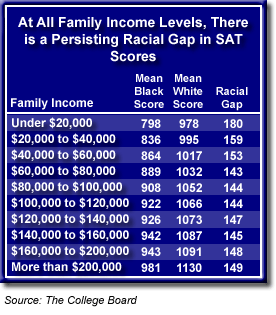
One problem is that tenure and standing for established scientists no longer afford any of the expected protections. James Watson was not discredited but promptly fired and "disgraced" for stating a well-supported scientific finding in abrupt layman's terms for an interview. The minds of cancel culture would probably say they gave this dinosaur enough chances to fade away, but he wouldn't. If they do want scientists to be free to investigate the genetic and other bases of IQ further in order to find better answers, then it seems like they want scientists to first find a way to talk about it publicly without specifying the categories or where members of a category tend to fall on the scale.
There is a chilling effect on various lines of inquiry. For now, you can claim the information is out there, but any further writings could become more esoteric or limited. In the case of IQ, I don't think certain people want scientific answers as to why. They would rather assume IQ is highly malleable while they run social and economic experiments to find ways to equalize it and other factors that predict success.
We detached this subthread from https://news.ycombinator.com/item?id=22051823.
The race IQ war is never going to go anyplace good for this site, and it attracts hard-core ideologues who proceed to do hard-core ideological battle, which is off topic here.
Of course, the parent comment to mine broached the subject. I guess that person's statement should stand, and there will be no way to address it.
We moderate not so much by comment as by subthread. That wasn't the only thing the parent was talking about, and there was at least one other subthread in reply that wasn't as bad. This one, however, definitely went way into classic flamewar hell. Nothing about this is going to get resolved on HN, only talking points thrown back and forth by the already-dedicated, while everyone else tunes out.
James Watson - who was as close to royalty as you can get in science - worked very long and hard to get himself fired. It wasn’t just ”an interview”, but a lifetime of racism and sexism. Lior Pachter has a handy collection of quotes with links to sources: https://liorpachter.wordpress.com/2018/05/18/james-watson-in...
I read the quotes in the links. None of that to me constitutes as 'racism' and 'sexism' as commonly defined. They are just plain observations which incidentally resonates with my own observations. Of course your average person out there will construe all his statements as being racist and sexist.
You could argue that some of his statements are bad jokes, but that is subjective.
To quote the guy 'rob' who made the comment on June 4, 2018 at 5:22 am :
------------------------------------------
Is he an old man? Yes. Does he not know when to keep his mouth shut? Yes. Are some of his views outdated? Yes. Get over it. 90% of the planet is as bad as him, if not worse. And 90% of your views will be outdated too in 20 years.
This never-ending desire of "the left" (which includes most of academia) to feel offended is far more damaging than the ramblings of an old man.
------------------------------------------
You mean to tell me an old man who grew up in even more racist and sexist societies, making racist and sexist "jokes", is not racist because he is old and this used to be normal?
We all know plenty of old racist men like this. Hell, some of the more civilized (your definition of "left") people may have acted like this as children or young adults.
Some of us also know better men than this. Better ones who find most of that page pretty despicable in any context. Are you stating what it seems you are -- that the better ones are wrong because they do not observe the these things that resonate with you?
I think you should seriously re-evaluate your observations if half of those quotes are things you hold true, let alone all of them.
Also, why don't you spend some time to expand on rob's comment. What _about_ his views is so outdated? What _about_ him being old makes him hold those views and "open his mouth" to express them? See, many on the planet are over him and his kind. We thank him for his contribution, but it's time he got off the stage. There's hardly room for 90% of the planet on it.
Perhaps the people who worship the egos of "outdated" and "bad" "old" people lacking in self control should recognize the fact that they worship the weakness of, in your commenters words, the bottom 10th percentile of people.
I don't really trust the selective quoting of that blog, e.g:
quote: “Some anti-Semitism is justified”
full quote: “Should you be allowed to make an anti-Semitic remark? Yes, because some anti-Semitism is justified. Just like some anti-Irish feeling is justified. If you can’t be criticized, that’s very dangerous. You lose the concept of a free society.”
They pounced on the unfortunate and/or unusual use of the word "justified", where the full context makes it clear he's talking about what you should be allowed to say, not what is correct. He means its existence in public discourse is "justified".
Wow, I never realized the extent of it!
But you're just assuming that he is wrong based on your own presumptions without any actual knowledge about the subject.
The question is who is most likely to be right, a nobel prize winning Ph.D. specialized in molecular biology, genetics and zoology, who worked 20 years at Harvard etc, etc....or you.
This is exactly the problem of cancel culture.
Just because he points out something you don't like you're suddenly an expert and somehow think he is now wrong.
What about double helix? Is he wrong about that too? Based on what? Why don't you have an opinion about that? Because you don't care? Even though your ability to judge the correctness of this research is the same as the race-related studies.
> The question is who is most likely to be right, a nobel prize winning Ph.D. specialized in molecular biology, genetics and zoology, who worked 20 years at Harvard etc, etc....or you.
Or we could, instead of argument to authority, look at the actual research in the field, which doesn't support Watson's conclusions. (Neither does it strongly support their negation.)
And Watson's expertise is in the low-level mechanics of heredity; it's less relevant to broad population psychometry and the analysis of heredity of traits measured through such psychometry than is, say, a bachelor's degree in any of the social sciences.
> What about double helix? Is he wrong about that too?
By “he” do you mean Rosalind Franklin? But, no, of course that's not wrong, it's been extensively confirmed.
> By “he” do you mean Rosalind Franklin?
"he" obviously refers to the person you've been talking about: Watson.
What is interesting here is that you disregard authority for results you disagree with and quotes authority for results you agree on. It sounds like your emotions are deciding which results you find 'correct'. This is the exact problem we're discussing.
> What is interesting here is that you disregard authority for results you disagree with and quotes authority for results you agree on.
What is interesting here is that you have an obviously pre-conceived argument and simply invent false facts (such as the appeal to authority I did not make anywhere) to fit it when reality doesn't supply them for you.
You're showing a curious case of projection. I'm not presenting any arguments in favor of Mr Watson's research, I'm pointing out that you are not basing your opinion on all available facts since you're arguing for censorship of research you disagree with for emotional reasons. And in turn, you accuse me of inventing facts that you're not willing to examine yourself. How curious.
> The question is who is most likely to be right, a nobel prize winning Ph.D. specialized in molecular biology, genetics and zoology, who worked 20 years at Harvard etc, etc....or you.
It doesn't really matter either way when you're pushing your opinions and anecdotal opinions as fact.
> What about double helix? Is he wrong about that too? Based on what? Why don't you have an opinion about that? Because you don't care? Even though your ability to judge the correctness of this research is the same as the race-related studies.
How exactly is this relevant?
The question is who is most likely to be right, a nobel prize winning Ph.D. specialized in molecular biology, genetics and zoology, who worked 20 years at Harvard etc, etc....or you.
Lior Pachter (who that link was from) is a Professor of Computational Biology at CalTech. His other post about Watson is good too: https://liorpachter.wordpress.com/2014/12/02/the-perfect-hum...
But you don't need to steal a Nobel prize to recognise racism. And yes, "scientific" racism is wrong as in incorrect, as any honest search will show.
>And yes, "scientific" racism is wrong as in incorrect, as any honest search will show.
Not at all, proof of absence is famously difficult.
No, his other post is hot garbage. He's using his knowledge, wit and ability to obfuscate, ridicule and discredit the information critical to our well-being as a species – all the while committing character-assassination. It's honestly despicable. Let's look at it closer.
> One of Watson’s obsessions has been to “improve” the “imperfect human” via human germline engineering. This is disturbing on many many levels. First, there is the fact that for years Watson presided over Cold Spring Harbor Laboratory which actually has a history as a center for eugenics. Then there are the numerous disparaging remarks by Watson about everyone who is not exactly like him, leaving little doubt about who he imagines the “perfect human” to be. But leaving aside creepy feelings… could he be right? Is the “perfect human” an American from Chicago of mixed Scottish/Irish ancestry? Should we look forward to a world filled with Watsons?
Then he brings up the topic of "good" and "bad" SNPs and seques into an inane argument about ethnicity of perfect human: «since many disease SNPs are population specific», "admixed" Puerto Ricans are superior. But that's working backwards from the conclusion, not a knockdown argument against Watson's dream. To wit: Watson is racist and racists are obviously wrong, therefore we should renounce research into human germline engineering. Most damningly, Pachter poisons the well of engineering by tying it to eugenics with nothing but guilt by association.
Now, any non-indoctrinated human can understand that the issue of "perfect" phenotype is not about modern groups at all; indeed, every human on the planet has a decidedly wretched genome. A word to Maynard Olson, one of the founders of the Human Genome Project:
> So, what have our first glimpses of variation in the genomes of generally healthy people taught us?... What is on the top tier? Increasingly, the answer appears to be mutations that are “deleterious” by biochemical or standard evolutionary criteria. These mutations, as has long been appreciated, overwhelmingly make up the most abundant form of nonneutral variation in all genomes. A model for human genetic individuality is emerging in which there actually is a “wild-type” human genome—one in which most genes exist in an evolutionarily optimized form. There just are no “wild-type” humans: We each fall short of this Platonic ideal in our own distinctive ways.[1]
It seems that Watson was correct again.
The degree to which we fall short, to which we are damaged by deleterious mutations, is hard to appreciate, but near-certainly astronomical. By helping to suppress this line of research with his non sequitur and vitriol, Pachter subjects future generations to an avoidable misery of historically known human condition. Gwern makes a compelling case for intelligence: «since existing differences in intelligence are driven so much by the effects of thousands of variants, the CLT/standard deviation of a binomial/gamma distribution implies that those differences represent a net difference of only a few extra variants, as almost everyone has, say, 4990 or 5001 or 4970 or 5020 good variants and no one has extremes like 9000 or 3000 variants—even a von Neumann only had slightly better genes than everyone else, probably no more than a few hundred. Hence, anyone who does get thousands of extra good variants will be many SDs beyond what we currently see. »[2]
But since so much is heavily hereditary, the same logic is true for longevity, willpower, general health, mental health, hedonic tone, beauty of course... Our descendants could be as Gods, way above ugly squabbles for ethnicity rankings that we have and Pachter is obsessed with – but only if some Professors of Computational Biology don't succeed at completely brainwashing people on fairly uncontroversial topic.
Article Pachter links to is also just opinionated blather and guilt by association:
> Watson then sought to pre-empt any scientific self-doubt: “We should be proud of what we’re doing and not worry about destroying the genetic patrimony of the world, which is awfully cruel to too many people,” he said. “We get a lot of pleasure from helping other people. That’s what we’re trying to do.” ... Making “better human beings” differs from making human beings better by curing their diseases. Making better human beings is more closely aligned with the old eugenics vision. The previous century’s eugenicists sought to breed better humans by promoting specific types.
Besides the heavy–handed implicit demand to clutch pearls at Watson's suggestion, I don't see how he is wrong or bad, and how the author is making an argument at all.
A community of hackers should be able to easily understand the eldritch horror or a long, highly redundant, 90% dysfunctional code that evolved by random alterations and no fitness function sans "can actually survive" running their entire biochemistry; as well as the potential for improvement here. But no, listening to politically motivated demagogues is more fun I guess.
It's a shame really.
1: https://science.sciencemag.org/content/331/6019/872.3 2: https://www.gwern.net/Embryo-selection#limits-to-iterated-se...
I don't think Watson is after some narrow, technical relationship between a particular gene and a particular ability. Instead, he make wide, unconstrained and unscientific generalisations which can only be defended by shrinking what he says.
To quote Watson: “I think now we’re in a terrible sitution where we should pay the rich people to have children.. if we don’t encourage procreation of wealthier citizens, IQ levels will most definitely fall.”
Now, any non-indoctrinated human can understand that the issue of "perfect" phenotype is not about modern groups at all;
TO be clear - it is Watson who is making racial arguments about Irish, Black and Jewish "races".
The whole point is what you are saying - the "perfect" human isn't about racial selection. It's Watson's clear racism (and he admits he is racist!) that makes it so dangerous.
This isn't some indoctrination thing - it's anyone who has read the Nazi or Communist "scientific" justifications of their theories that should hear alarms.
> James Watson was not discredited but promptly fired and "disgraced" for stating a well-supported scientific finding in abrupt layman's terms for an interview.
Even Watson admitted, before being fired, that the last straw that did that wasn't a well-supported scientific finding.
> In the case of IQ, I don't think certain people want scientific answers as to why
The people that don't want the answers as to why are the people that are busy trumpeting any reported finding of correlation that fits their political narrative, no matter how thinly supported, and insisting that it must be an inherent racial difference. The rest of the world is very much interested in both testing the correlations and seeking causal explanations.
> If they do want scientists to be free to investigate the genetic and other bases of IQ further in order to find better answers
It's quite obvious they don't want that, so they can continue to stretch the remaining gaps in knowledge enough to fit the entire blank slate hypothesis inside.
Not saying for a moment that this conference is authoritative at all. Let's get that out of the way first.
Is it possible for both sides of this matter to be right and wrong?
Absolutely, and that is mostly the case.
This, because of how f'd-up this climate change thing has become. It's a mess of indescribable proportions.
Why are deniers right?
Well, they are not. There's no denying this. Where they are right is in the outcome they are helping create: Taking action to "save the planet" is going nowhere.
How are deniers wrong?
Well, their belief system is completely skewed and devoid of scientific support. They believe in a fantasy they have woven over time.
OK, then.
Why are proponents right?
Well, because climate change is real. We have irrefutable data going back 800,000 years to show how things used to be on earth and how we influenced things in the last, say, 200 years. One look at atmospheric CO2 concentration and it is impossible to argue against it. And that's just the start.
How are proponents wrong then?
Well, because they have turned this thing into an ugly combination of politics and religion. It's as irrational as can be and EVERYONE is lying through their teeth.
The greatest lie is that we can actually "save the planet". It's an absolute pile of manure.
Politicians are the worst. They are using climate change as a battering ram to drive votes. And 100% of what they say are lies. And 100% of what they want to do is pointless and maybe even dangerous.
OK, you might say: That's crazy! What proof do you have to support this?
Easy: Exactly the same proof we have to show climate change is real. That is 800,000 years of atmospheric CO2 data resulting from ice core sampling.
This is the point where people don't bother to do the work and either dismiss or attack the messenger (rather than to think, follow the argument and actually apply a bit of critical thinking).
Step 1: Check out the graph for the last 800,000 years of CO2 fluctuation. Here it is:
https://cdiac.ess-dive.lbl.gov/images/air_bubbles_historical...

Here's the source:
https://cdiac.ess-dive.lbl.gov/trends/co2/ice_core_co2.html
Step 2: Print that graph or open it in Photoshop and fit lines to the up and down cycles.
Step 3: Measure the slopes for up and down cycles of approximately 100 ppm of CO2 change
Step 4: Average the ups and average the downs.
What I get, in rough strokes, is (roughly):
25,000 years for a 100 ppm increase
50,000 years for a 100 ppm decrease
Step 5: Stop and think about this:
That, what you just calculated, is the NATURAL RATE OF CHANGE OF ATMOSPHERIC CO2 WITHOUT HUMANITY AND OUR TECHNOLOGY ON THE PLANET.
That is crucial, absolutely crucial, in understanding just how ridiculous this has become.
It means the following: IF WE LEAVE THE PLANET IT WILL TAKE 50,000 YEAS FOR ATMOSPHERIC CO2 TO DECREASE BY 100ppm
What does that mean?
It means you are not going to fix it by:
    - Switching to renewable energy sources everywhere on the planet
    - Eliminating all fossil fuel-based transportation
    - Switching the entire planet to electric cars
    - Carbon tax credits
    - Eliminating all plastic
    - Taking humanity --all 7 billion of us-- back to medieval times
    - Destroying the economies of every developed and developing nations
Why?
BECAUSE, EVEN IF YOU DO ALL OF THE ABOVE AND MORE, IT DOES NOT EQUAL ALL OF HUMANITY LEAVING THE PLANET.
Please think about this for more than a moment so you can start pushing for real conversations based on the truth rather than the ridiculous fantasies being pushed by both sides. This is beyond silly now. It's tragic.
We know that the natural down-slope rate of change is in the order of 50,000 years for 100 ppm without humanity, factories, cars, planes, etc.
What politicians and zealots are talking about is achieving somewhere in the order of 1000x better performance while all 7 billion people, our cities, factories, technology, etc. remains on the planet. I mean, you don't need to do any math to understand how silly this is.
All you have to do is look at these graphs, look at the rate of change and ask: How are we going to do 1,000 times better? How are we going to do that without using unimaginable amounts of energy and resources to the point that we are far more likely to kill everything on the planet than fix it.
These are planetary scale problems that require beyond planetary scale energy and resources to "fix". The sooner we start talking about the realities of climate change --that we can't fix it or "save the planet"-- and stop being hysterical about it, the sooner we can start talking about how to live with it and improve things to the extent possible. Which also means both sides will meet somewhere in the middle.
BTW, this does not mean we should not clean-up our act at all. We should. All we have to do is stop lying about the reasons for it. There are plenty of legitimate reasons to live in cleaner cities with renewable power sources, climate change and saving the planet just happen to not be among them, not if we want to talk about reality vs. fantasy.
BTW, don't take my word for it. Read this for an insight into how futile some of these crazy ideas actually are. This is from Google Research:
https://storage.googleapis.com/pub-tools-public-publication-...
Prediction: Nobody is going to take the time to consider the above, much less do the work and understand. And by that I mean not one person from either side of the argument. Nobody seems to care about the truth, particularly not scientists who depend on bullshit grants and don't dare bring up the fact that we are wasting valuable time and resources focusing on nonsense. There's big money and great power to be had by riding the gravy train of lies on both sides. Sad. Truly sad.
Warning: I am not a climate scientist.
However, I have to disagree that humanity has to leave the planet, or that it's impossible to fix. I will agree that it's very unlikely to be fixed or mitigated to a decent amount before disaster happens, but that's because of politics and human stupidity, not because it's not possible.
More CO2 in the atmosphere doesn't have to equal higher average global temperatures. CO2 holds in energy from the Sun. So the answer is simple: decrease the amount of sunlight. There's already ideas of how to do this, such as "solar shades". Basically, put a bunch of things in orbit that block some of the Sun's light, so less of it strikes the atmosphere. Now, even with the higher levels of CO2, less energy is entering the system that will be retained by the greenhouse effect. Of course, planetary engineering ideas like this are megaprojects and would require huge amounts of money to do, and probably international coordination, which seems unlikely given the terrible state of world politics at the moment.
You misunderstood. I didn't say we have to leave the planet. What I am exposing in the data is that we know how atmospheric CO2 would decrease if we did (and took all of our toys with us).
The answer is simple: We cannot fix this. Because any attempt would require energy and resources beyond planetary scale. Which means we are far more likely to kill everything on this planet than to fix it.
I am not a climate scientist either. I am, however, an engineer, and I have a pretty solid handle on Physics. Conservation of Energy alone says we cannot fix this.
BTW, by "fix this" I mean, any faster than the natural rate of about 50,000 years for a reduction of 100ppm.
If you take the time to read the Google paper I linked you'll find the statement that sent me on a path to truly try to understand this many years ago. They said, paraphrasing:
"Even if we convert all energy generation on the entire planet to the most optimal forms of renewable energy, not only will we not see atmospheric CO2 levels decline or level-off, they will continue to rise exponentially".
This was a conclusion exactly opposite what the researchers went into this "knowing". I appreciate they were honest enough to publish this and actually expose just how confused we've become about this concept of saving the planet. It simply isn't going to happen. Not in a generation, not in a hundred, not even in a thousand.
You see, it's that pesky bit of data: 50,000 years for a reduction of 100 ppm. Without humanity.
This means that if humans stay on the planet, even if population growth stopped, and we magically --because it would require magic-- became carbon neutral, it would still take at least 50,000 years to drop 100 ppm, or, more than likely, 100,000 or 200,000, pick a number.
This is equivalent to trying to remove smoke from your kitchen with a small fan while you continue to burn the food you are cooking on the frying pan. You just can't do it. You have to stop cooking and then wait for the small fan do do the job over a couple of hours. If you want it done faster you have to stop cooking and use a much larger fan (more energy). If you, on the other hand, continue to burn your food and install a bigger fan, you may or may not clear the smoke. If you do, it will likely take just as long or longer.
This isn't difficult stuff to understand. It's actually the most common sense science I've seen in a long time. The graphs tell a story. All we have to do is see it, read it and understand it.
The entire problem with your logic is that you're assuming that humans will not and cannot do anything at all to change carbon levels, aside from relying on natural processes. That's completely ridiculous. Any attempt to fix the problem has to involve artificial actions: carbon sequestration, solar shades, etc.
Your entire mentality is "it took X years for nature to do this, so it'll take X years to undo it by natural processes, and oh yeah, we have to actually undo it so everything goes back exactly the way it was, instead of just making the end result satisfactory". This isn't helpful at all. As I pointed out before, we can reduce the amount of sunlight using solar shades; we don't actually need CO2 levels to go back to pre-industrial levels. We just need to prevent the temperature from rising so much, while we figure out how to deal with the CO2.
>This is equivalent to trying to remove smoke from your kitchen with a small fan while you continue to burn the food you are cooking on the frying pan. You just can't do it.
Yes, you really can. With a fan powerful enough, and a vent hood, you absolutely can. It really doesn't take that much, and it depends on how much smoke you're producing, but you seem to think you need a turbojet engine to clear the air in a small kitchen from a small cooking fire, and you really don't.
>If you want it done faster you have to stop cooking and use a much larger fan (more energy).
Here's the part you're not getting. The amount of energy you need to run a vent fan isn't anywhere near the amount of energy unleashed by your cooking fire. Even better, if you constrain the air supply, the fire burns itself out quickly, or at least is prevented from producing as much smoke.
>It's actually the most common sense science I've seen in a long time.
I've noticed that people who throw around the term "common sense" a lot do so because they really don't understand things very well, and think their intuitive understanding suffices, when in fact it doesn't.
Thanks for the personal attack at the end. Class act.
Don't take the kitchen analogy literally, that's not what an analogy is for. I won't discuss it, because it is purely a tool not a precise model of planetary-scale dynamics.
You also misunderstood my point entirely. And, BTW, don't tell people things like "that's completely ridiculous" unless you are in a position to irrefutably prove what you are saying. Also, it's rude.
Anyhow, my point is very, very simple:
If it takes in the range of 50,000 years for atmospheric CO2 to come down by 100 ppm without humanity around, any solution that claims to be able to do this a thousand times faster has a massive burden or proof equivalent to magic and divine intervention, combined.
Politicians toss around all kinds of proposals and plans that are equivalent of the famous "and then a miracle occurs" cartoon. They want to destroy entire economies just because they say so. And all of it is nonsense.
Now, let's think about what it means that it took 50,000 years for a 100 ppm drop (which is about what we need).
Well, it involved massive amounts of rain, hurricanes, cyclones as well as massive amounts of trees and vegetation growth. Please stop and think about the energy it took for, year after, year, for 50,000 years to drop so much water and grow so many trees and vegetation to capture the CO2 and drop it by 100 ppm. The scale is almost inconceivable.
Can we find a more efficient way to do it? OK, let's assume we can (which I think is a fair assumption). A thousand times more efficient? I don't have to do the math to know that even if we were 1,000x more efficient it would still require an astronomical amount of energy and resources. I would not be surprised if an improvement in efficient CO2 capture in the order of a million times better than the natural process still required so much in terms of resources and energy that it would be just about impossible.
And yet we are missing the forest for the trees. What I am talking about mostly is what the zealots and politicians are parading around. With the reality I presented, which is irrefutable --unless someone wants to challenge ice core data-- it is easy to prove how ridiculous their proposals actually are:
Switch to renewable energy sources: Nope, CO2 levels will still continue to rise exponentially. This has already been studied.
Stop coal plants: Nope, even if we left the planet it would take 50,000 years.
Outlaw all forms of petroleum-powered transportation: Nope, even if we left the planet it would take 50,000 years.
On, and on, and on.
What you are saying about blocking the sun is another one of those ideas. First of all, anyone who has spent a reasonable amount of time in aerospace and gotten into the physics of the matter understands the unbelievable amount of energy it would require to launch millions of solar shades and put them into orbit. I mean, it takes energy to create the fuel and oxidant to put into a rocket. And these processes are not clean. On top of that, that many rocket launches would only add to the problem. And then we are talking about meddling with a planetary scale ecological system that is the result of billions of years of adaptation under existing solar conditions. There is no way whatsoever to predict what could happen. Again, we could succeed at killing absolutely everything on this planet. The only people who believe simulations are those who wrote the code, for the most part we have no clue what <doing x> will produce 10 years from now, much less 50 or 100.
It's hubris to think we can actually do this when everything we touch is far more likely to cause more pollution and require hyper-planetary scales of energy and materials.
I know lots of people --politicians!-- have a lot of sunk costs and interest in not challenging --even a little-- the status quo. And so I fear we are going to do a whole bunch of really stupid things. And I can't do a thing about it. Nobody can, because that train is already on the tracks in more ways than one. In that sense and more this conversation is a complete waste of everyone's time.
In the article mentioned by parent comment, they suggest extracting CO2 from atmosphere and storing it somewhere safe. There is (at time of article's writing) no technology capable of doing so. I guess it is would be "safer" than creating a "solar shade"? I am not a climate scientist either..
The questions nobody answers when it comes to all of these so-called solutions are:
Conservation of Energy is an ass. It does not care one bit. Which means we can't solve a problem with less energy than what went into creating it in the first place.How much energy will this require? How will we generate it? Will generating that energy produce CO2 or other problems? What resources are we going to need (chemicals, etc.)? How are we going to extract or produce them? How much energy is that going to require? How are we going to produce that energy? Will generating that energy produce CO2 or other problems?A common misconception is that humanity added a bunch of CO2 in a couple of hundred years. That's not true. It took millions, if not billions of years. Sure, in therms of use using petroleum, yeah, we did it in a couple of centuries. However, the reality of this fuel is that it took billions of years to create. THAT is what we burned; billions of years of stored energy.
That was the other revelation I had during my research. We are looking at this with the wrong time scale. In a couple of hundred years we burned millions or billions of years worth of stored energy. And to clean-up that mess you need far more energy than what it took to produce the mess in the first place.
Imagine how many trees, plants, animals and solar energy went into creating the petroleum we burned. That's the start of the scale of the problem we are trying to fix. In other words, we can't fix it. Not without making a much larger mess.
In a couple of hundred years we burned millions or billions of years worth of stored energy. And to clean-up that mess you need far more energy than what it took to produce the mess in the first place.
That would be true if the only way to remove CO2 from the atmosphere were to run "combustion in reverse" to turn carbon dioxide back into hydrocarbons.
That is not the only way, though. Enhanced silicate weathering is attractive because it turns atmospheric CO2 into chemically stable condensed phase compounds, without the huge thermodynamic cost of reversing combustion. The energy cost of enhanced silicate weathering (though still large in absolute terms) is greatly reduced compared to combustion-reversal because it's just accelerating the kinetics of a thermodynamically favorable natural process.
MgSiO3 + CO2 => MgCO3 + SiO2
This is a sketch of the geological carbon cycle [1], the same thing that eventually (100,000 years from now) would remove the excess CO2 from the atmosphere. The idea is to accelerate the drawdown by pulverizing silicates so the above surface-area-limited reaction goes faster.
See e.g. "Enhanced weathering strategies for stabilizingclimate and averting ocean acidification"
https://csas.earth.columbia.edu/sites/default/files/content/...
[1] "The Global Carbon Cycle: Geological Processes" Section 3.6
In my research of the domain I did come across this. It is one of the scariest proposals out there. These people risk causing irreversible damage to the oceans and all life within them. It's hubris to think we can do something like that and actually control it at a planetary scale. Also, refer back to my questions about the energy and resources required to do this, to do anything.
While you are right in that the process is not combustion in reverse, the reality of the matter is that it much worse than that. Massively worse.
We haven't even gone to the other elephant in the room: Australia. I hope someone eventually publishes an honest accounting of the CO2 that was released into the atmosphere through these fires. My guess is it easily negates decades of clean energy and other mitigation technologies.
I didn't get into it in my original comments. There are two questions everyone should ask when looking at the 800,000 year CO2 concentration chart:
1) How/why did CO2 levels rise?
2) How/why did CO2 levels drop?
These are fundamental questions anyone with a science background should ask almost immediately. The answers, at a basic level, are simple:
1) Massive continental scale fires burning for thousands of years. Remember, no fire dropping helicopters.
2) Storms, rain, water, hurricanes and, yes, trees and vegetation growing over thousands of years.
So, stuff burned for approximately 25,000 years for a 100 ppm increase and stuff grew and rain fell for about 50,000 years to capture the CO2 that was created.
The bottom line is that anyone claiming that we can do 1000x better than if humanity left the planet they are going to have to explain, in great detail, how it is that they know Zeus so intimately that he will grant them magical powers. And I don't think this is an understatement at all.
BTW, the only intelligent proposal I've seen is to plan trees like our lives depend on it. Seriously. Simple tech. We know how it works. We know what it does. And, if we have the water, we know how to grow them. This won't solve the problem any faster but it is likely to make things better. All we have to do is figure out how to prevent our massive new forests from burning, because, in that cases, once again, we will have made the problem een worse. Here's an article on that one:
https://www.livescience.com/65880-planting-trees-fights-clim...
Originally you said "Conservation of Energy is an ass. It does not care one bit. Which means we can't solve a problem with less energy than what went into creating it in the first place."
Enhanced silicate weathering is a way to draw down atmospheric CO2 with less energy than went into creating the problem. Still, perhaps it will never be deployed on a large scale if people find the proposal too scary.
That's one of the most depressing things about curbing climate change. There are a number of changes that we could have implemented to prevent the problem from getting as bad as it is now. But all of them scared enough people that they didn't go forward on a scale that was large enough, fast enough. That could be fear of physical safety (opposition to nuclear power), fear of unemployment (coal miners against cleaner power sources), fear of lost profits (businesses against carbon taxes)...
Since the scale of the problem is vast, the scope and scale of any actual solutions will be vast as well.
My point is that you can't just look at chemical reactions. How much will it take in energy and resources to make it happen? That's where Conservation of Energy becomes an ass.
In other words, it's easy to talk about a solution, any solution, in isolation of what it would really take to deploy it at a scale massive enough to affect planetary level changes. Think about all of the equipment, transportation, processing, people, energy, etc. We literally can't think about things at these scales.
To go back to my super-simple argument about how the planet behaved without us polluting it further. It typically took absolutely massive storms for tens of thousands of years to reduce CO2 by 100 ppm. I use 50,000 years as an average of sorts, but the reality is that the range extends all the way out to 100,000 years for 100 ppm.
Now imagine taking all of that and proposing that we are going to do the same in 50 or 100 years, without leaving the planet, without shutting down every form of transportation, without killing every industry on the planet and without reducing population to medieval levels. That is a tall order. It's one thing to run a little microscopic test (when compared to planetary scale everything is microscopic), quite another to have the audacity to claim we know what will happen if we take it global. We could create quite an ecological mess.
The things you mention we could have done. I don't think they would have made any difference. I mean, not in terms of atmospheric CO2 concentration. Human life, definitely. One of the things I learned --and I can't remember it accurately-- is that CO2 in the atmosphere "sticks" and is hard to mitigate. The idea is that anything we do at ground level will have zero impact past a certain altitude. We can certainly burn stuff and have the CO2 go up and circle the globe but we can't easily pull it down from 10, 20 or 30 km of altitude.
That's what a lot of these simplistic conversations miss. When I say it will take an astronomical amount of energy and resources I am thinking about a process that has to reach out and grab CO2 going up tens of kilometers into the atmosphere all around the globe. We just can't do this by installing solar panels, sprinkling the beaches with chemicals, banning coal and gasoline powered vehicles and devolving into the middle ages. This is a very tough problem and one that likely has no human-scale solution, both in terms of time and resources.
That said, I don't think this is reason for depression. Imagine for a moment if we agreed on this idea that we just can't fix it. What would our conversations turn to then? Improving human life? Developing technologies to help us live with the coming changes? Cleaning-up our act to improve life locally? That and more.
I would imagine the narrative would change radically. For one thing, we would stop hearing from ignorant politicians, celebrities, deniers and zealots. Researchers would be able to work on real research rather than having to get on the bandwagon for fear of never having access to research grants and opportunities. There is no telling what advances we might make if we just stopped the insanity this has become and allowed facts, reason and real unencumbered science and engineering to float to the top. Utopia, I know.
One of the things I learned --and I can't remember it accurately-- is that CO2 in the atmosphere "sticks" and is hard to mitigate. The idea is that anything we do at ground level will have zero impact past a certain altitude. We can certainly burn stuff and have the CO2 go up and circle the globe but we can't easily pull it down from 10, 20 or 30 km of altitude.
I'm not sure what you are trying to recall, but this is incorrect as written. The atmosphere stays well-mixed up to about 100 kilometers:
https://en.wikipedia.org/wiki/Homosphere
Any silicate weathering process that binds CO2 at the Earth's surface will also remove atmospheric CO2 that exists at 30 km from the surface.
The atmospheric CO2 excess was created by generations of humans all over the world. Barring breakthroughs like self-replicating machinery, fixing it will also require global scale efforts over multiple generations. I am not optimistic about people even starting serious efforts toward that end in my lifetime. My pessimism is more because of the misaligned incentives than the huge numbers involved.
If you told an engineer 150 years ago that the world would burn over 4 billion tons of coal in 2013, and asked them to plan how that would happen, it would seem impossible too. Nobody could really plan an endeavor of such scale. And in fact it didn't come from one globally coordinated plan, just a set of incentives that diffused globally. Sadly for the climate, the incentives to stop burning fossils do not spread as easily as the incentives to start.
Well, destruction (burning stuff) is always easier and cheaper than cleaning it up. So what we did over 150 years, while not of a scale imaginable back then, isn't a surprise.
It's getting late. I'll check out your link later. I probably didn't word my statement correctly.
BTW, I appreciate the conversation. It is very --very-- rare that someone would engage in a mutual exploration of ideas with any degree of intelligence and critical thinking on this topic. More often than not people attack each other from opposite extremes, down-vote anyone they don't agree with into oblivion and nobody learns a thing.
BTW #2, I actually want someone to show me that I am wrong. I don't like my conclusion. I just can't find any real holes in it. And down-votes do exactly nothing towards solving that problem.
Aren't a lot of topics already taboo in science/academia? I'd say cancel culture has been in science for a while now. Afterall it is part of academia.
Didn't a female brown university professor's study on transgenders get "canceled" because it offended some people not too long ago?
Didn't Bret Weinstein, a biology professor, at some college in oregon get "canceled" not too long ago?
Didn't Jordan Peterson get "canceled" not too long ago?
Academia and journalists have been canceling people for a while now. Was WSJ asleep for the past decade?
Not sure about the first example, but Bret Weinstein was fired because his behaviour didn't reflect his employer's values, not because of the science he was doing. I also don't think Peterson is having particular difficulty doing scientific work, nor is the actual research he does "taboo".
> Not sure about the first example
If you are that well versed in the lives of weinstein and peterson, you most definitely are aware the first. But being as woke as you are, you probably can't admit it to yourself.
> but Bret Weinstein was fired because his behaviour didn't reflect his employer's values, not because of the science he was doing
Weinstein wasn't fired, he resigned after getting a settlement from his university since the university couldn't provide for his safety from racist mobs.
> I also don't think Peterson is having particular difficulty doing scientific work, nor is the actual research he does "taboo".
You don't think? I suspect Peterson would disagree. You sure his research into political correctness, authoritarianism, identity politics, evils of postmodernism, etc aren't "taboo"? If it wasn't taboo, jordan peterson wouldn't be so well known. He'd be just another no-name professor somewhere in canada.
Instead of saying racism, hate and cancel culture is bad, you are defending racism, hate and cancel culture. Which may get support and upvotes in echo chambers online, but is laughed at in the real world. Reality will ultimately trump fantasy.
(That's a pretty condescending and presumptuous post.)
I wouldn't say I'm "well-versed" in this but I have read around the case of Weinstein and have looked into what Peterson has to say about things here and there.
The question, it seems to me, is whether particular avenues of science are being stifled, or whether scientists are being stifled because of the nature of their scientific research.
Weinstein was pressured out because of his opinions on a matter separate to his scientific research. This sort of thing has happened before and it will happen again. I'm not defending it, I'm just saying it's not a case of science itself being stifled.
Jordan Peterson's diatribes on things like political correctness and postmodernism might be informed by his knowledge of psychology but unless I'm mistaken they don't in themselves constitute scientific research.
He has an extensive record of published papers that you can find on google scholar. As far as I can tell he doesn't have major issues getting funding, publishing papers or obtaining academic positions in pursuit of his actual scientific research, but I'm happy to be shown wrong here.
Where has this been since 2015?
Cancelled, I suppose.
'Culture War' Comes to HN?
The line between genius and madness is famously thin and there is no way to distinguish a room full of cranks from a room full of enlightened scholars without listening carefully and weighing up what gets said. And of course one side straight up lying is a fairly useful indicator.
So I suppose as long as these people are trying to tell the truth as they see it good luck to them. But articles like this are fundamentally a cross between advertising and propaganda so aren't much use to the general public. There is a dire need for some political balance in academia as it is a sheltered institution that by and large doesn't have to deal with the cost of things in the same way as broader society does; so it is good to see someone pushing the right wing as long as they are playing by the rules of honesty and citation which is what academics is about.
It's funny that this is posted on HN since places on which you cannot speak any controversial opinions are the main way in which CC spreads. HN being one of those places by design.
> Our list of speakers includes no women. (All declined our invitations.)
The fact that every woman they invited declined to give a talk is a huge red flag.
Could be a red flag but it's not possible to know unless you can find out the number of women who were invited, the number of men who were invited, and the ratio of men/women in the field. Maybe they invited a reasonable number of women but they all had scheduling conflicts. Depends on the numbers.