The Gravity of a Photon
jwkennington.comWhat I've always found wild about gravity and photons is that gravity produces the same proportionate effect, i.e., acceleration, on them as it does normal matter and the only reason the sun and planets don't render light nearly unusable for sensing by utterly distorting the light's path is that it travels so quickly it doesn't spend any significant amount of time in a gravity well.
I don't think I'll ever fully wrap my head around the kind of numbers that implies, that when light is at approximately sea level it is accelerating at 9.8m/s^2 toward the core of the earth and the only reason it doesn't all get dragged out of the air and to the ground is that it moves too fast to notice.
That's the fundamental idea behind a black hole. The concept of escape velocity is based on the curvature of spacetime and is represented by √2GM/R where M is mass and R is radius. Light travels along the curvature of spacetime. At the event horizon of a black hole, escape velocity equals c, so from that point down to the singularity, spacetime is curved so much that light simply isn't traveling fast enough to escape.
That is an interesting thought that never occured to me. It would render the headlights of your car pretty much useless if the light just fell to the ground a few meters in front of the car. I wonder if one has or could measure the effect in the lab - it's about 0.5 μm over a distance of 100 km, so it seems not totally out of reach.
Your comment reminded me of Gamow's Mr. Tompkins in Wonderland. I don't know if he mentioned that in particular, but he discussed what relativistic effects would look like if the speed of light was 10 MPH.
There is also a free game, A Slower Speed of Light. [1]
It's a bit tricky because it isn't light taking a curved path through your lab; it's light taking a straight path through the curved spacetime in your lab.
The elevator thought experiment suggests that the light will indeed also take a curved path through my lab, but I am way out of the territory where I have any good intuition. And I have no intuition at all what would happen to the matter the elevator is made of if one accelerated it hard enough to make the effect noticable, nor do I have any idea what Earth's gravity does to matter in my lab. Can I have a trully straight ruler out of some common material? Or at least not as bend as the light beam? And now I am not even sure anymore what straight would mean.
If you had a 100km long rod that was perfectly, impossibly straight and infinitely strong, placing it in a gravity well equal to that at the earth's surface would still make it look bent by half a micrometer to an outside observer, in the same way you can draw a triangle on a sphere using nothing but three right angles and three straight lines.
If that's not interesting enough, do some reading on the relative nature of spontaneity. Two things that happen at exactly the same time in one reference frame don't happen at the same time in another. Crazy.
I guess this is an autocorrect issue, but you certainly mean simultaneity. Anyway, I have been through several university courses on special and general relativity with all the math and have at least some basic understanding of the thing. However, as said before, I have no real intuition for it.
So the only thing I can work from right now is the elevator thought experiment and it seems to me that I can have a perfectly straight rod in a 100 km wide elevator accelerating at 9.81 m/s² while a light ray would bend downwards by 0.5 µm. So ignoring the fact that Earth's gravitational field is not uniform, this seems to suggest that even a rod made out of some common material would not be bend or appear bend or whatever in Earth's gravitational field. Maybe this analogy just leaves the realm of validity of the thought experiment, but I honestly don't know.
I am also not convinced by your analogy with the triangle on a sphere, gravity is curvature of spacetime but the analogy involves only curvature of space. If you tell me that you are a physicist specialized in general relativity, I will take your word for it, otherwise I will keep some doubt about getting my nice rod bend in the same way the light path gets bend, after all they are two quite different things, an extended object versus a path through spacetime.
This ties in well with the revelation many high school physics students have that a bullet fired from a gun parallel to the ground also falls to the earth at the same rate as any other object.
A handy rule of... thumb I like to keep in mind is that it takes about 1 ns for light to travel from your hand to your eye...
(... and then 10,000,000 ns for your brain to process it...)
If you haven't seen the brief lecture from Admiral Grace Hopper regarding nanoseconds it's well worth a watch. https://youtu.be/JEpsKnWZrJ8
The important thing to remember is it's called the stress-energy tensor for a reason, it's not just mass distribution that causes curvature.
Thought experiment: which will curve spacetime more, a 1kg box of gas at 1K or the same box after the gas inside is raised to 293K?
The warm box will of course »heavier« because it contains additional energy. Fundamentally there is no mass, it is just a convenient way to talk about the energy hidden in the structure of matter.
The internal structure of leptons being? :)
Note that I wrote structure and not internal structure and I did so intentionally. As far as we know elementary fermions - quarks and laptons - have no internal structure but - and I am totally not a physicist - there are the Higgs mechanism, the seesaw mechanism, selfinteraction due to vacuum polarization, and other things I have never heard of. As far as I know, this is still an area of active research with unresolved questions, but I think it is also generally believed among physicists that all mass has a dynamical origin.
This isn't quite the same thing as what adds mass to say hadrons like who you're replying to is, but at least according to the Standard Model, leptons as well as quarks start out massless and acquire an inertial mass due to interaction with the Higgs field. You wouldn't say it is "internal structure" but it arises due to interactions rather than being an a-priori property.
Bingo
I find gravity interesting, because everything that exists interacts with everything via the gravitational field. This is not the case with any other sort of interaction; gravity is truly different. See this diagram showing the ways that different particles can interact in the Standard Model: https://upload.wikimedia.org/wikipedia/commons/thumb/4/4c/El...
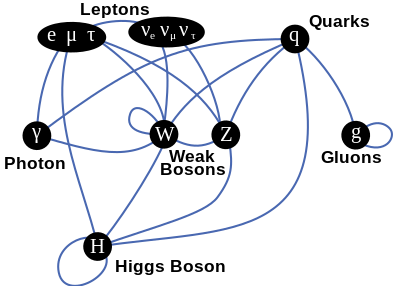
Photons, for instance, cannot interact directly with each other via the electromagnetic field. Gluons do self-interact via the strong interaction. But both photons and gluons interact with all types of particles via gravity (although sometimes this interaction is so small that we would never be able to measure it).
Photons do interact electromagnetically [1], just not in the same direct way as gluons.
Yeah, I was more so speaking of direct coupling but didn’t want to get too technical. That interaction is due to virtual fermion-antifermion pairs.
Is it ok to mentally replace the word/concept “gravitational field” with “energy density field”?
If so it resolves the mysterious central relationship this field has for all the others.
How does one particle know that is here know that there's another one over there?
How does spacetime know to curve?
> because photons have rest energy that can be viewed as mass in special relativity
What?
Hence I said my friend was being a bit “interpretive”. He really meant that though photons have zero rest mass, they nonzero inertial mass (E=mc^2)
That still does not make any sense. I'm sorry to be so direct, but I'm really worried laypeople here are going to think that this is correct.
Photons have momentum. momentum is analogous to mass in special relativity (specifically, mass is the 0 component of the four-momentum)
That's not how it's written in the post though. If you just swap out the "inertial mass" at the end and the "rest energy" somewhere in the middle it makes more sense:
> because photons have rest energy (=> kinetic energy) that can be viewed as mass in special relativity > [...] > impact the gravitational field despite having no inertial mass (=> rest mass)!
Speaking of "mass" in context of relativity is always a bit tricky. The term "inertial mass" for example is really saying something about how an object behaves under the influence of a force (F = ma), not how it behaves relativistically (that would be "relativistic mass", E = mc2).
I've cleaned up the last paragraph, and replaced my friend's reasoning with the term "momentum" to avoid confusion. thanks for feedback
Maybe you could write “because photons have energy that can be viewed as (relativistic) mass” then. Or maybe he did really refer to the “rest energy” of photons? That seems weird even for an experimentalist ;-)
It was weird - I've reparaphrased that to be "momentum" now for improved clarity. thanks for feedback
The low contrast on that web page is terrible.
If you think electrons and positrons have a gravitational influence, then it seems to me you should also think photons do. Otherwise, if an electron and positron annihilate, producing photons, there will be a discontinuous drop in the gravitational field, which doesn't seem right somehow. Furthermore, if you put all this in a black box, the gravitational influence of the box will change because of what's happening within it, which also doesn't seem right.
Can anyone with with real knowledge of gravity comment on whether these two intuitions are correct?
I don't have real knowledge of gravity, but I can speculate a bit. First, I don't think the blackbox argument necessarily makes sense. If the black box contains a massive point particle, and this particle moves from the left side of the box to the right, then the gravitational properties certainly change. For example, if there is a particle on top of the box, it will initially be pulled to the left, and subsequently be pulled to the right.
Having said that, your intuition that photons should have gravitational influence makes sense, since according to special relativity, mass and energy are equivalent. Since total energy (mass + energy) is conserved, the gravitational influence of the photon should equal that of the electron-positron pair (assuming they are all located at the same position). I think the article is agreeing with this point of view.
If the black box is freely floating (which is what I was thinking of), then a particle within it can move to one side only if something else in it moves the other direction.
But on further thought, I wouldn't be surprised if some changes in the internals of the box could produce gravitational waves, so maybe my intuition for this is wrong. Although if I further clarify that the box isn't supposed to be emitting energy (which will obviously reduce its gravitational influence as it loses energy), then maybe the intuition is correct after all...
“Electromagnetic waves” are the manifestation of relative motion between an electric charge and an observer’s reference frame. A detector inside a cryogenic ion trap would detect much lower energy EM radiation from the contained cloud of ions vs a sensor speeding towards the trap at 10% c. If this second detector slowed towards the inertial reference frame of the ions, the apparent EM radiation emanating from them would decay towards zero from the second detectors point of view as it became stationary relative to the charges.
Are gravity waves similarly observer-reference-frame-dependent? I.e. the gravitation of a given object is not intrinsic but rather dependent on the energy difference between the object and a given observer’s frame?
I think the charges need to be accelerating, not just moving, to emit radiation. Whether or not something is emitting radiation ought to be invariant to the motion of the observer.
Wow I didn't expect that! For the layperson that's really interesting.
"the conventional electromagnetic fields, and the photons that constitute them, impact the gravitational field despite having no inertial mass!"
Does that mean the build up of the photon sphere around a black hole would have a significant impact on space time?
The photon sphere is not a place where photons collect because the orbits along the sphere are unstable fixed points. Small perturbations from these orbits either fall into the black hole or escape to infinity.
Is there a line between where light neither escape or get swallowed. Simply just stands still in perfect balance between being pulled and escaping?
That is what the parent comments were talking about - on the photon sphere - in case of a non-rotating black hole - photons could theoretically orbit the black hole but as pointed out by your parent comment this orbit is not stable and any tiny perturbation will either send the photons into the black hole or make them escape. And the photons would of course not stand still - they are massless particles and therefore can only move at the speed of light, neither slower nor faster - but orbit the black hole at the speed of light.
If you were further in the black hole’s gravity well than the photons in the photon sphere, you would see them redshift and eventually freeze, right? I.e. from inside the photons don’t appear to escape
There are no frames of reference where photons reverse direction. If everything is spherically symmetric, a photon emitted from any point in spacetime is either (1) already heading outward and escapes or (2) already heading inward and is consumed. Within the event horizon, only trajectories of type (2) exist. The picture of a photon struggling outward to escape and then reversing direction under gravity is incorrect.
Ok, thanks for bringing precision to my comment. It makes sense that any photons reaching an observer who is inside a BH event horizon must also already be trapped inside the EH.
I think what I find confusing is that I thought outside observers would never see the infalling observer reach or cross the EH due to time dilation.
I’ve read that an observer falling into a black hole would notice extreme time compression in the external universe (observing millions or billions of years pass in the external reference frame), and conversely external observers would notice extreme time dilation of people and redshifting of photons falling into the black hole. Infalling particles from their external perspective appear frozen and smeared into a blur outside the EH, fading away but never optically appearing to “enter” into the BH, even though physically these particles indeed have/will.
So I think I had it backwards, the external observers would see infalling objects redshift, and those falling in would see the universe blueshift (I guess getting fried by high energy photons before being torn up by tidal forces).
> I think what I find confusing is that I thought outside observers would never see the infalling observer reach or cross the EH due to time dilation.
It depends what you mean by "see". An outside observer will certainly not see this this in the literal sense of seeing photons that image the horizon-crossing event. However, there are sets of space and time coordinates on the manifold where the infalling observer crosses the horizon at the same "time" as external events occur.
> frozen and smeared into a blur outside the EH, fading away but never optically appearing to “enter” into the BH
Yes, but note that the brightness of the image gets exponentially suppressed as the infalling object approaches the horizon, so it really just looks more like it's vanishing than freezing (although it's doing both). Importantly, a finite amount of electromagnetic energy is emitted/reflected by the infalling object before it crosses the horizon so, for any given minimum-energy threshold of your detection equipment on the outside, you will see no more than a certain finite number of photons no matter how long you wait.
> and those falling in would see the universe blueshift (I guess getting fried by high energy photons before being torn up by tidal forces).
No, I don't think much blueshifting happens. If you hover above the event horizon of a black hole, the outside world will look blueshifted, to a stronger and stronger degree as you get closer to the horizon. However, the amount of force necessary to maintain a stationary position above the horizon goes to infinity as you get close, so you can't get arbitrarily close and experience arbitrarily large blueshift; indeed, the blueshift is in general quite modest without extraordianry materials or fuels. And once your support fails, so that you start falling into the black hole, the blueshifting goes away.
I don t understand. The title is gravity of photon. Then you start talking about electromagnetic field. I sure something is missing here. What would be the source of gravitation and who is subject to that field?
Photons are excitations of the electromagnetic field. The source of gravity is the energy in the EM field, as described by general relativity.
This is really interesting. Perhaps there is also a chance that electromagnetic fields are indeed entirely responsible for gravity, in some complicated yet unknown manner.
No, energy curves the gravitational field and there are other forms of energy than the energy of the electromagnetic field. For example, if you start walking, you gain kinetic energy and this will affect the gravitational field, not much but it will.
What would that mean? As far as we know there is gravity in the absence of EM fields and EM energy produce gravitational effects just like other forms of energy (and in the realm of direct human experience the contribution of EM is negligible).
"there is gravity in the absence of EM fields" That just cannot be true. EM fields are just about everywhere. They permeate space almost as universally as gravity, but in form of photons (to name higher energy EM fields here) or other low energy waves. Gravity accumulates with great masses, mass is also energy (in rest).
The article explores the idea that pure kinetic energy in form of photons indeed might have at least gravity-like properties.
My presumption is that atoms are somehow made of really high energy EM fields so that they appear to be massive. Consequently, atoms having mass or photons having inertia are responsible for gravitation, and that could mean that EM fields are the cause of gravity entirely. The problem with that presumption is that perhaps there is no way to check.
Easy way to check, just wave a long piece of iron through the air. If there is truly a massive EM field, it should induce a decent voltage into said iron rod as it moves through the magnetic field lines produced by the "gravity EMism"
Considering noone died from waving iron rods through the air by way of electrocution (other than lightning) I'd say that means gravity is not an EM field.
There is also a different test: EM fields are either positive or negative in charge. If you have three objects, in an EM field they cannot all three attract eachother, one object must be pushed away from one of the other two.
Considering we don't see that behaviour in our solar system, gravity cannot be an EM field.
I like your elegant thought experiment!
Quarks have -1/3 or +2/3 charge in the standard model and presumably(?) at high enough energies they separate out into a quark-gluon plasma thus exposing the universe to their unholy fractional charges. Above 2 trillion Kelvin according to wikipedia.
Even with fraction, either you have repulsion or attraction, depending on the sign. -1/3 charge will be repulsed by +1 or +2/3 charge, just at different strengths.
> The article explores the idea that pure kinetic energy in form of photons indeed might have at least gravity-like properties.
Saying “explore”, “idea”, “might” makes it sound as if this was not a well-established 100-years-old theory.
> My presumption is that atoms are somehow made of really high energy EM fields so that they appear to be massive.
Somehow... The easiest way to proceed in that program of research may be to rename the standard model as ElectroMagnetism and try to get a unified theory of the strong, weak and the-force-previously-known-as-em forces. Then you unify that with GR and you’re done :-)
> The easiest way to proceed in that program of research may be to rename the standard model as ElectroMagnetism and try to get a unified theory of the strong, weak and the-force-previously-known-as-em forces.
Certainly the unification of electromagnetism + the weak force is understood, and there is a theory (or several theories) about electroweak + strong unification: https://en.wikipedia.org/wiki/Grand_Unified_Theory .
That links says: “Unsolved problem in physics: Are the three forces of the Standard Model unified at high energies?”
But we may be close, for some values of close :-)
> That links says: “Unsolved problem in physics: Are the three forces of the Standard Model unified at high energies?”
Indeed, that's why I said only that there were theories about it.
Sure, but the solutions to the solved problems in physics are also called "theories". I'm sure you knew the GUT is not yet done, it was just a clarification.
I always appreciate non-shouty clarifications of misunderstandings, combined with charitable interpretations of others' motives and knowledge. Thank you!
EM fields are just about everywhere.
Fields are mathematical tools, they are not - without wanting to go down the philosophical rabbit hole - real things out there in the universe.
And the thing about everything just being electromagnetic fields is nonsense, physicists understand physics way better than you do. Sorry to sound condescending, but the internet already has enough obviously wrong ideas by random people without a clue what they are talking but.
Well by saying that fields are not "real things" you have just started going down the "philosophical rabbit hole". What is a real thing, is the gravitational force that we feel not a real thing, is the energy we feel in an EM wave (e.g. The sun on our skin) not a real thing?
What, you don’t think the Hylaean Theoric World is realer that reality?
Dude, fields are a tool physicists use to describe phenomena. It's okay to say EM fields exist because they interact with everything everywhere and we can actually observe that.
The universe appears to have expanded or be expanding faster than the speed of light: the diameter of the observable universe is ~42 billion light-years but best estimates of age of universe is ~14 billion years.
So these fields can’t interact with everything everywhere, only the portion of the universe In the field’s lightcone. if the universe keeps this up there’s a chance some day Everything will be so stretched out that the fields will be basically redshifted to null, so not interacting with anything anywhere. That’d be lame.
[...] the diameter of the observable universe is ~42 billion light-years [...]
That's the radius.
Honest question: aren't radio waves "physical objects" that represent oscillations of an electro-magnetic field, to the best of our current understanding?
There is an agreement in physics that low energy EM fields are called waves, such as radio waves, and high energy EM fields are called photons or even particles. In any case they are actually both. If they are physical objects I don't know. I think, I wouldn't go that far.
Sure, they are both, but my point was - if they have wave-like characteristics, they must be a wave of/in something; if we can have experimental evidence that the wave exists, I would consider that experimental evidence that the field the wave is a wave of must also exist, to the same extent.
Let’s talk virtual particles...
They are also just in the models and heads of physicists.
Radio waves are streams of photons, the fields are just a mathematical tool we use to describe this. And there are several of them, the classical electromagnetic field but also an entire set of fields involved in the quantum version.
My understanding was that some kind of wave-particle dualism was well accepted. It's exact physical meaning may not be understood, but isn't there experimental evidence that photons, even individual ones, behave as waves in some circumstances (as does as any other 'particle', in fact)?
I've seen this dualism claimed pretty recently by Leonard Susskind.
Other people may say that photons are just mathematical tools that we use to describe fields. :-)
The fact that gauge fields have redundant degrees of freedom should at least be a strong hint that the fields are not the fundamental description. ;)
I don't think you are correct: you can view the extra degrees of freedom as just a symmetry
It is usually called a gauge symmetry but it is kind of a misnomer and should better be called a gauge redundancy. It is artifical and only due to the mathematical formalism we are using. As an analogy, probably not a really good one, is that you could decide to describe temperatures with a complex number and just say temperature is invariant under translation along the imaginary axis. Sure, the symmetry is in your mathematics but it doesn't really tell you anything new or interesting. Besides of course that the imaginary part is actually redundant and you better described temperature with a real number instead.
That would not work in the same way as a typical gauge theory though - typically the symmetry of a gauge is for shifts of the entire system along the gauge - changes along the gauge locally do have physical meaning. For example, in an electrical diagram you can arbitrarily shift every voltage in the system by a billion Volts (ground rail is 1b Volts, 5V rail is 1b+5V, etc) and the system will behave identically. The gauge quantity is real and not redundant, it’s just that it doesn’t have a known meaningful absolute reference point.
Gauge symmetries are local symmetries. In case of the complex temperature field you can change the imaginary part of the temperature at each point independently without any physical effect. Global symmetries on the other hand are meaningful, for example spatial translation and rotations and time translations in Newtonian spacetime are associated with the isotropy and homogenity of space and time and also the related conservation of momentum, angular momentum, and energy. And of course your example of changinging the reference potential is also a global symmetry, not a gauge symmetry.
Oh yes, quantum electromagnetic quantum field. Just add "quantum" and the discussion is over.
> EM fields are just about everywhere. They permeate space almost as universally as gravity
Isn't dark matter most likely some kind of material that has mass, but no EM interaction?
We also know that there are interactions inside atoms (the strong and weak forces) that have no known relation to electro-magnetism, so I'm not sure what you are getting at.
As far as I understand, dark matter is an educated guess (which was made upon the discovery that galaxies rotate differently than expected). Something out there must be causing gravity, but we cannot see it, which means that there is no observable EM interaction.
The next guess here is that dark energy has a much much higher rest energy so that no photon in this universe is able to interact with it via EM fields. The search for dark matter was unsuccessful so far, and the LHC is still trying to achieve higher energies to be able to detect dark matter. So, dark matter is just a guess.
The interactions inside atoms seem to have no known relations to EM, because, and this is my guess, there are much higher energies at work than we know. So, if dark matter is hiding behind high energies so that EM interaction seems impossible, why should it be different for EM interactions inside atoms. There still is a slim chance that it might be EM, just at much higher energies.
The interactions inside atoms seem to have no known relations to EM [...]
The electromagnetic and the weak interaction are known to be different aspects of the unified electroweak interaction. There are several grand unified theories and a few hints that at even higher energies the electroweak and strong interaction also unifiy into the electronuclear interaction. Due to the high energies involved, only indirect experimental evidence seems accessable for the forseeable future but there are various groups looking for hints. I am not aware of any uncontroversial results but there are a few non-reproducable experiments, for example observations of magnetic monopoles, which might be due to experimental error but also due to the rarity of magnetic monopoles.
there's a whole field of science who believes gravity is just electromagnetic effect... it's just particle physicists who struggle with such notions...
Well in the beginning there was just the one electro-strong-weak-gravity field... until inflation cooled everything down enough for the four “fundamental” forces to freeze out.
Edit: ok so really there is only theoretical evidence of an electroweak field at the beginning (electromagnetic field and weak field are not independent at high energy) and everyone is currently hard at work trying to 1) figure out the “Grand Unified Theory” that will putatively integrate the strong force with the electroweak force, and 2) figure out how to rethink either gravity/spacetime in a quantum context to integrate it with the quantum GUT, or unquantize the GUT (not likely) so it can be combined with spacetime...