European MPs vote to end summer time clock changes
bbc.comI'm glad we are getting rid of daylight savings time. It's a biannual disruption of sleep cycles that costs lives (in increased accident rates) for at best marginal benefits: for most of europe sunrise and sunset times change too fast for an additional hour to really matter.
Still, I think given the choice most people would have prefered to stay in summer time instead of winter time (or equivalently: to abolish DST and move the timezone by one hour).
The actual proposal is only 8 pages long and also worth a read [1]
1: http://www.europarl.europa.eu/RegData/etudes/BRIE/2018/63030...
I'm only aware of Russia switching to permanent summer time in recent memory and they switched back to permanent winter time two years later because the long dark winter mornings were unbearable. Also, your circadian rhythm doesn't care for where the hand on the clock is and doesn't like being pushed too far outside of where you naturally would have it.
It would be best to keep the clock as close to astronomical time as the timezone system allows and adjust certain business times if required to be off the standard 9-to-5. Which already happens.
>Under the new legislation, governments opting to make summer time permanent would adjust their clocks for the last time on the last Sunday in March 2021.
For those choosing permanent standard time - also called winter time - the final clock change would be on the last Sunday of October 2021.
It's down to the member states to decide but I think most would prefer summer; save for maybe the Nordics, where the vast difference in the amount of daylight hours makes quite a significant difference.
Edit: Removed Iceland, since they froze their EU application.
I think countries on a blatantly wrong timezone such as Spain should take this opportunity to fix it. For instance, Spain could stay in UTC+1 all year round and go back in the same timezone as Portugal (which is going to certainly pick its summer time as its whole-year round timezone), thus eliminating the artificial shift everything has there (people eat lunch at 14 and dinner at 22, but these times match roughly with 13 and 21 in solar time).
What exactly makes it "wrong"? I live in Spain and am perfectly happy with our current timezone and daylight saving. Staying on Winter time just means we get an hour of useless light long before anybody has woken up and take it away from the evening where it is far more appreciated.
The spanish public have already been shown to be massively in favor of staying on UTC+2 year-round, though this would mean that the sun wouldn't rise till 0930 in the depths of Winter.
I think once the government actually stops and takes a look at the repercussions of all options we will end up carrying on with the status quo.
I would argue Portugal is the one in the "wrong" timezone here.
If you want the sun to be at its high point at noon, Spain is obviously in the wrong time zone. But you see plenty of countries around the world choosing a slightly different timezone to facilitate trade and communication with some other country (or within itself, in the case of larger countries). With most other barriers to trade gone within the eurozone having to convert timezones is a significant inconvinience that (in the mind of many) outweighs having the sun in slightly the wrong place.
Why would you want the sun to be at it's high point at noon?
Perhaps that has value in an agricultural society, but in today's world I'd much rather have more daylight in my leisure hours (evening) than my working hours.
> Why would you want the sun to be at it's high point at noon?
* https://en.wikipedia.org/wiki/Circadian_rhythm
Nothing wrong with wanting sunlight during after-work activities, but are there biological consequences to all of this clock fiddling? (Not arguing for/against, just spit-balling a hypothesis.)
Biologically, the optimum would probably be more time fiddling, adjusting the clocks daily so that sunrise is at the same time every day. That would sync the clocks to one of the most important environmental factors that sets circadian rhythms.
Offhand, I can't think of any biological significance to noon. Noon's charms for timekeeping are technological.
1. It is easy for everyone in a given area to agree on noon. It happens with the Sun high in the sky, as opposed to sunrise which is obscured for many be trees, hills, and buildings.
2. The interval from noon to the next noon is constant [1]. The sunrise to sunrise interval varies considerably. Make a good mechanical clock and sync it to noon, and it can run a long time without getting too far out of sync. With time based on sunrise, you'd need to adjust the clock everyday, or make the clock more complicated to have it know about the variation.
[1] well...maybe not to people with very precise clocks, but it is constant as far as the needs of most people most of the time goes.
Because that's the literal definition of local noon.
That has value in any society that values precise measurements of physical observations.
A purposefully inaccurate time zone is the equivalent of changing the length of the meter to make your daily commute less distance in the winter and more distance in the summer, or to make the meterstick longer all year just so you don't have to drive as many meters every day. It's ridiculous for distance, so why do we do it with time?
Business hours are almost entirely arbitrary anyway. Change them instead.
Solar noon and local noon are different things, unfortunately.
Changing an offset isn't quite the same thing as changing the measure of a unit. Seconds, minutes and hours are not being adjusted as part of this. It would be more like starting to count from 1 metre instead of 0 metres to adjust the length of your commute.
> Business hours are almost entirely arbitrary anyway. Change them instead.
As it happens, a sibling comment has already pointed out that people have effectively done this. The time of day you eat lunch is arbitrary. So the lunch hour in Spain is 14:00 instead of 13:00, effectively resolving the 'wrong hour' issue.
> because that's the literal definition of local noon.
Fair enough. I was (of course?) using the term to mean 12:00pm which I think is what most people think of when thinking of 'noon'.
Most people have approximately zero reasons to care about when the sun is at it's peak in the sky. Valuing precise measurements of physical observations doesn't make any difference to that in any way I'm aware of.
The sunrise and sunset times have much larger implications on our activities, so why not optimise for those times? I get that any solution won't be optimal for everyone, but it's reasonable to try to optimise for the majority of people where you can.
Spain was in GMT/UTC+0 until march 1940, when Franco's desire to align the country with Axis powers led him to change the clocks to CET. France was in GMT (as it is obvious given that its right below the UK) until the same year, when it was moved into German time following the Nazi invasion.
Didn't know that. TIL. Thank you!
I feel that way here in Hungary. If the Eastern Europe time zone was called something else maybe we'd be in it. In the summer it doesn't matter but I'd kill for sunset an hour later in the winter.
Doesn't switching permanently to summer time fix that exact issue? (we suffer from the same problem in Poland)
Even in the Nordics, eternal summer time would be preferrable for most people I think. It gives you more sunlight in the afternoon (if I'm not mistaken), when you actually have some free time to utilize that fact.
Who cares if it's light or dark in the morning, nobody is outside enjoying the weather at that time anyway, we're just trying to get everyone to school/work.
When I had to bike 6km to school in the Netherlands I was always very happy with the DST switch to wintertime because it meant biking in daylight a bit longer. In summertime sunrise would be at 9:48 am - I really think that is quite late.
In my county (Östergötland), the sun starts rising at 3am around this time of year; so, the concept of it being light or dark in the morning (or afternoon/night) isn't really a concern (overall).
In places like Kiruna, the sun will never set for about two weeks[0], during the summertime.
It's the amount of actual daytime during the winter that would principally matter - in the overall scheme of things.
[0] - https://www.kirunalapland.se/en/see-do/midnight-sun-2/
FWIW I live a bit further north, at 63 degrees. In winter, at least december and january, we're in the state of "dark when you go to work, dark when you go home". However for the approx. two months between autumn equinox and end of november, and similar two months from end of january to spring equinox, having one more hour of daylight in the afternoon would be really really nice.
I leave every morning at 5.30am. I literally see many others (but clearly a minority of peoples) doing the same.
It's much nicer doing that in daylight than in darkness, although it was also nice watching the sun rise during my morning swim a couple of months ago.
Some people have tonwork outsides? Sun light also helps to wake up. So it's a trade off either way.
Here in the UK permenant summer time would mean sunrise would be 9am during the depths of winter. That sounds like a great way to make more accidents (as everyone is now driving to work in the dark at 8am) and also make the seasonal depression worse.
Southern Britain gets just over 8 hours of sunlight in the middle of winter.
Meaning you can choose between people driving to work with the sun up, or driving home from work with the sun up, but you can't have both. So I guess we'll just have to decide whether people would rather get hit by cars just after breakfast or just before dinner.
How does going to/from school work for children in Britain?
In the US, school generally school starts in the morning around the same time as or earlier than adult work time, so kids going to school are traveling at the same time as the work commute traffic.
The school day, though, is shorter than the work day so the kids come home while the adults are still at work, before the evening heavy traffic starts.
That introduces an asymmetry between the morning and evening work drives. The morning drive has a bunch of kids walking along the road. The evening drive does not.
This suggests that if you can only have one of those in daylight, it will probably be safer in the US to make that the morning one.
Permenant winter time means that school hours in Winter are entirely contained within sunlight hours. Permenant summer time means that kids are walking to school in the dark. I'd rather not have them hit by drivers also driving in the dark.
>kids are walking to school in the dark.
As they already do in many other places. Why should this be particularly dangerous for the UK compared to elsewhere?
Alternatively, permanent winter time would mean that school hours are entirely during daylight if we shift the school hours to match.
Alternatively, some time zones are so wide that there's no argument that assumes a constant school or work start time and can also work with a standard time system. For example, not far east of where I live, it's possible to switch your clock from 8AM to 7AM just by driving to the next town over.
All of this by way of saying, presenting these sorts of observations as if they were compelling is specious. With the sole exception of the rate at which the planet is spinning, literally every variable is easy to vary.
The potential effects on mood and freetime activities of having all sunlight hours fall into school hours sound more serious than walking to school in the dark (most places where you walk are already illuminated quite well)
I'd much rather school kids had time to play in the light after school.
Where as at the moment we drive home in the dark.
Iceland is already on permanent summer time. Reykjavik is at longitude 22 degrees west, so they're "naturally" in GMT-1 (and close to the line with GMT-2) but they use GMT year-round. (The country as a whole is between 13 degrees west and 25 degrees west.)
Iceland is not in the EU. And also has no land borders with member states. So it doesn't really matter what they choose to do from a Europe-wide perspective.
Fixed. I didn't realise they had frozen their application.
> There were 4.6 million replies [to the online] consultation, 70% of which were from Germans.
Germans make up around 15% of the EU population. So by this metric they've got an out-sized democratic participation in the EU by a factor of almost 5x.
As seen on a solar map [1][2] Germany isn't even particularly badly impacted by this issue compared to say France or Spain. There's some truth to the saying that Germany basically runs the EU, but as results like this show mostly because they seem to be making an effort to give a crap about it and its policies.
1. http://blog.poormansmath.net/images/SolarTimeVsStandardTimeV... (source: http://blog.poormansmath.net/how-much-is-time-wrong-around-t...)
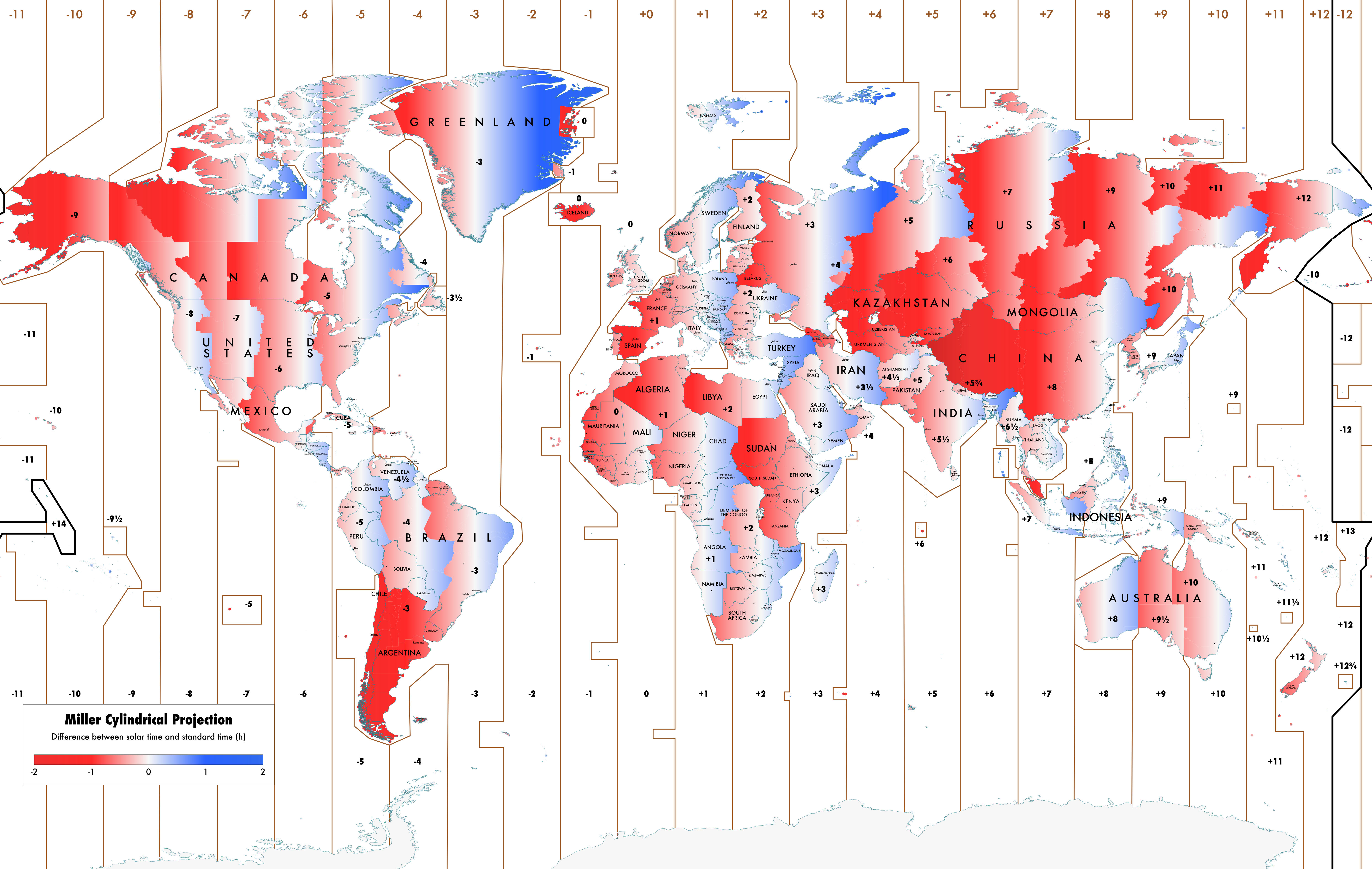
If you don't vote, don't complain. I live in the UK and I also voted to end the twice-yearly wrecking of our body-clocks with the attendant accidents, injuries and deaths.
Moreover from an IT perspective it would be convenient if we don't pick permanent Daylight Saving Time in that the UK would effectively always be using UTC.
I don't know, BST (more sunlight in the evenings) would be better, and UTC happening to line up with GMT could result in a whole load of programmers getting quite far in their career before realising timezones are something you even need to account for...
But BST would mean waking up an hour early all the time and that's its own kind of hell. Your body doesn't care for where the hand on the clock is and the standard 9am work start time is meant to allow you to get up at some normal time around 7 or 8am. I would rather have a normal sleep schedule than an hour of sunlight in the evening. Just wake up early and use the morning light if you need it.
There were other consultations though.
In the French poll, 2 million answers were given and 84% were also in favor of ending time savings, 60% wanted to keep summer time rather than winter time. For some reason, people often take France and Spain as examples of countries that would be badly impacted by a decision "taken by the Germans", but France and Spain are very much in favor of staying on summer time.
I don't know if the BBC is trying to push the idea that the decision is somehow undemocratic, but most countries in the EU have had consultations and as far as I know the results were in favor of giving up time savings everywhere.
What survey are you referring to? I mean the one the EU did: http://europa.eu/rapid/press-release_IP-18-5302_en.htm
Either you're mis-recalling that "2 million" number for France, or very coincidentally there was some poll specific to France whose result in France was exactly the same (84%) as the one the Commission conducted across the EU.
In any case, whether citizens in specific EU countries participate in polls held locally or held by member states isn't relevant if we're discussing how much citizens in various countries directly engage with EU institutions.
This is the French survey: http://www2.assemblee-nationale.fr/15/autres-commissions/com...
The results are here: https://www.vie-publique.fr/actualite/alaune/changement-heur... and 2 103 999 persons answered it, with 83.71% being in favor of dropping daylight savings time.
That served as a basis for the French government's contribution to the draft that was voted on at the EU parliament. The draft didn't drop from the sky, it was written by the European commission, which is made up of representatives from all EU countries.
So the ~84% is a coincidence. Neat!
I'm not making some claim that the French don't have representation in the EU, but that in this case (for whatever reason) Germans have an outsized direct participation in the EU's own survey, and that might be a more general indicator for how they're more likely to directly deal with EU institutions in other matters, instead of leaving it to their national government.
The news is not correct. Member states cannot chose to keep the daylight savings, but they will have to choose between keeping the summer time or winter time. This is to ensure uniform time keeping in the union to reduce trade costs.
quote:
"Consequently, the Commission proposes to discontinue the seasonal time changes in the Union, while ensuring that Member States retain the competence to decide on their standard time, in particular whether they will move to the standard time corresponding to their summer-time on a permanent basis or whether they will apply their current standard time permanently. "
https://eur-lex.europa.eu/legal-content/EN/TXT/PDF/?uri=CELE...
I recognize that this is probably an unpopular opinion but I live for the days when the sun sets at 9pm.
DST really factors in quite well for night owls like myself. I'm aware there is a strong degree of detraction in terms of complicating time keeping and body clock adjustments.
It makes the daylight stretch into what we conventionally consider the night. In the winter, I'm always somewhat a little sad that the sun sets before I even leave the office (~4-4:30pm), but I'm always in a much better mood in the summer when I leave the office at 5pm and still have hours of daylight left in the day.
The late evening sunset in the summer is a godsend for anyone who has a day job and has projects they need to work on outdoors. It's like having every weekday followed by a Saturday afternoon for productivity purposes.
I'm not particularly a night owls but sunset at 9 PM or 10 PM in June is much better than wasting sunlight when people are sleeping at 5 or 6 AM (which is my country is pretty much all of us.) I'll vote for permanent summer time if we'll have to make a choice by holding a referendum.
People often say they would rather have permanent summer time, but from observation it seems everyone sets their rhythm around solar noon regardless, so why not make noon = noon. During the summer months Spain's solar noon is between 2 and 2:30pm. Guess what time Spaniards sit down to eat lunch? In the summer the UKs solar noon is around 1pm, guess what time all the office workers pour out on the streets to eat lunch.
THis is actually false.
School start at the same time in Spain and UK, people wake up early in Spain.
One of the main reason of eating late is that it gets too hot in the beginning of the afternoon so people take a break then. Work hours can be 8-14 and then 18-21 for instance.
Making solar noon 12:00 would not help anything at all.
In addition, it would require rewriting all the laws regarding night work, all the work agreements etc. (because your contract says from 18:00 you are paid x% more, but suddenly with your change 18:00 is way too late).
This would be a disaster and with no real benefit apart from saying that you synchronized an artificial time construction with a solar phenomenon.
Why even bother with a 24-hour clock, then? If we went to a 25-hour day, everyone could get another hour of sleep.
We synchronize clocks to the sun because there is actual merit in matching the civil day to the solar day. The sun-earth relative positioning is the same for everyone on the planet. It sets a time standard without everyone having to agree on it. If someone chooses to go off the common standard, they may be trying to push some time-dependent externality off onto those who remain on it. That's something we should actively punish, rather than everyone joining in to do exactly the same thing.
Making mean solar noon at the nearest meridian divisible by 15 degrees equal to 12:00 clock time would have the benefit of making the clocks uniformly honest. If the laws are the problem, it is the laws that should be changed, not the goddamned clock settings.
That is basically how the time zones were set. They were modified because it didn't work. We're still working on which modification is best.
With the invention of cheap, ubiquitous, artificial lighting, it makes sense to set the clock at 13h for solar noon. Most people, if having to choose, would rather get up with artificial light and then do outdoor leisure activities with natural light.
Nothing "makes sense" about an arbitrary number. That's why it's arbitrary. It makes an equal amount of sense to say that mean local solar noon is 183615.
The system we have doesn't work because the problem is how to coordinate billions of humans. No solution will ever work, because you can't perfectly coordinate any number of humans greater than about 500. The mess we have now is just built upon centuries of kludges, each trying to improve on how civil time was defined beforehand.
Why are there 24 principal time zones? Because the clock has 24 hours. Why does the clock have 24 hours, with 60 minutes each? Because Sumerians counted on their fingerbones, and Babylonians liked base-60.
Machines, on the other hand, can coordinate perfectly fine on the number of milliseconds since 1Jan1970, at the center of the main telescope of the original Greenwich Observatory. The zone file is the only thing holding the stupid mess together. We could specify civil time to be any rule-based system whatsoever, and the computer clock would still allow us to coordinate with the rest of the world.
With the invention of cheap ubiquitous computing and piezocrystal-mediated clocks, it makes sense to throw out every unit other than the SI second, and stop trying to coordinate things that don't need to be coordinated. Schoolkids don't need to be in their homeroom seats at the same time the NYSE opens. The fast food chain stores don't all need to stop serving breakfast at exactly the same time. And companies don't need to have the same business hours as the local bank branch.
Most owls, as opposed to most larks, would rather get up after sunrise, rather than before it. Tired (literally) of larks setting the schedule for everyone just because they wake up first.
Summertime sounds better than wintertime because of the association with summer. Give people the choice between UTC+1 or UTC+2 and you will get wildly different answers.
Because in the northern latitudes there is no such thing as 'noon'.
There is indeed a highest point the sun reaches during the day. It's known as "solar noon."
I don't understand? Are you talking about days in winter where the sun doesn't rise at all?
No, I'm talking about the fact that "noon" has no cultural or practical significance if the solar day changes wildly during the year.
There's something like a million people in the entire world subject to that edge case. 0.014% of the world doesn't have a solar noon for at least one day a year. I'd say that's not enough to avoid fixing timezones for the other 99.99%.
>The proposal would give each member state a choice from 2021: either to keep the current summer time system or scrap the twice-yearly clock changes
So if you travelled vertically within a timezone, you could end up going back and forth by an hour repeatedly, depending on the state’s decision made here?
Truly, a design made by committee.
Arizona doesn't observe DST, but it contains the Navajo Nation which does[0], and in turn contains the Hopi Reservation which doesn't.
So you can go back and forth by an hour within a single US state.
[0]The Navajo Nation extends into Utah and New Mexico, which observe DST, so this lets the Navajo Nation maintain a single time throughout.
There is actually a Navajo exclave inside the Hopi reservation, and a Hopi exclave inside the Navajo reservation, so if you travel into Arizona via route 264 in the summer, you have to change your clock seven times.
I like this, in a crazy way, despite having argued elsewhere for consistency... Makes me wonder, if Italy and Austria ended up choosing different time zones, would the ethnic Austrians living in Süd-Tirol get their own time zone too?
Note that the article is incorrect. I just went thought the proposal and what member states can choose is between keeping summer ot winter time!
quote:
"Consequently, the Commission proposes to discontinue the seasonal time changes in the Union, while ensuring that Member States retain the competence to decide on their standard time, in particular whether they will move to the standard time corresponding to their summer-time on a permanent basis or whether they will apply their current standard time permanently. "
https://eur-lex.europa.eu/legal-content/EN/TXT/PDF/?uri=CELE...
Edited: clarified "This is actually incorrect" to "Note that the article is incorrect."
The comment you replied to is correct based on what you said - if you start in a state in permanent summer time, travel south to a state in permanent winter time, keep travelling south to a state in permanent summer time, and so on, you will be going back and forth by an hour repeatedly.
Hypothetically, if you start just north of Sittard and east of the German/Netherlands border (in Germany), and travel in a straight line, almost due south to Geneva in Switzerland, you could, depending on what time member states choose to permanently adopt, potentially go from German summertime, to Dutch wintertime, to Belgian summertime, to Luxembourgish wintertime, to French summertime, to Swiss wintertime, all in under 350 miles and with not much deviation in longitude.
Ah! you are correct. I thought the author was referring to the possibility of a country south of another being 1h ahead/behind depending if they do the yearly switch or not.
But in this case we go to the general problem of choosing of timezones. You have plenty of cases of south borders with different timezones (ie. without moving in longitude you still switch zones).
It's a matter of country size, not to mention that it is a matter of economic interest to keep the same timezone as neighbouring countries. I would assume the scenario you mentioned to be quite unlikely.
If Belgium and the Netherlands don't agree on a timezone, you could probably do that in the space of half a mile at https://en.wikipedia.org/wiki/Baarle-Nassau
That's already what happens if you go from France to the UK or Spain to Portugal, so it's not really something new.
UK/France isn't such an issue, there's a big stretch of water in between that takes a minimum of an hour to get across by any mode of transport (once you factor in waiting/boarding time).
Not sure how many people make daily border crossings between Spain/Portugal like those I described in my other comment, but even then it is something new if the time difference between states varies with the time of year.
In short, if your country opts out of summer time but your close neighbours don't, all those living in densely populated border areas are still affected by the summer time changes, only with the added complexity that your neighbours in the next suburb don't always keep the same time that you do...
That's so very common.
In North America, for example, there are (admittedly not very populous) mountain time regions that are north of areas that observe both Alaska time, which is 2 hours behind, and Eastern time, which is 2 hours ahead.
If you want to complain about bouncing back-and-forth across a single time zone boundary by going north and south, as someone who's lived almost their entire life in various places along the Central/Eastern time border, all I can really offer is ¯\_(ツ)_/¯. Committee or not, it's gonna happen. Because there are so many reasons beyond simple longitude to pick a time zone.
I once found a latitude with 4 different time zones. I think it goes through Pakistan. Time zones are always going to be weird.
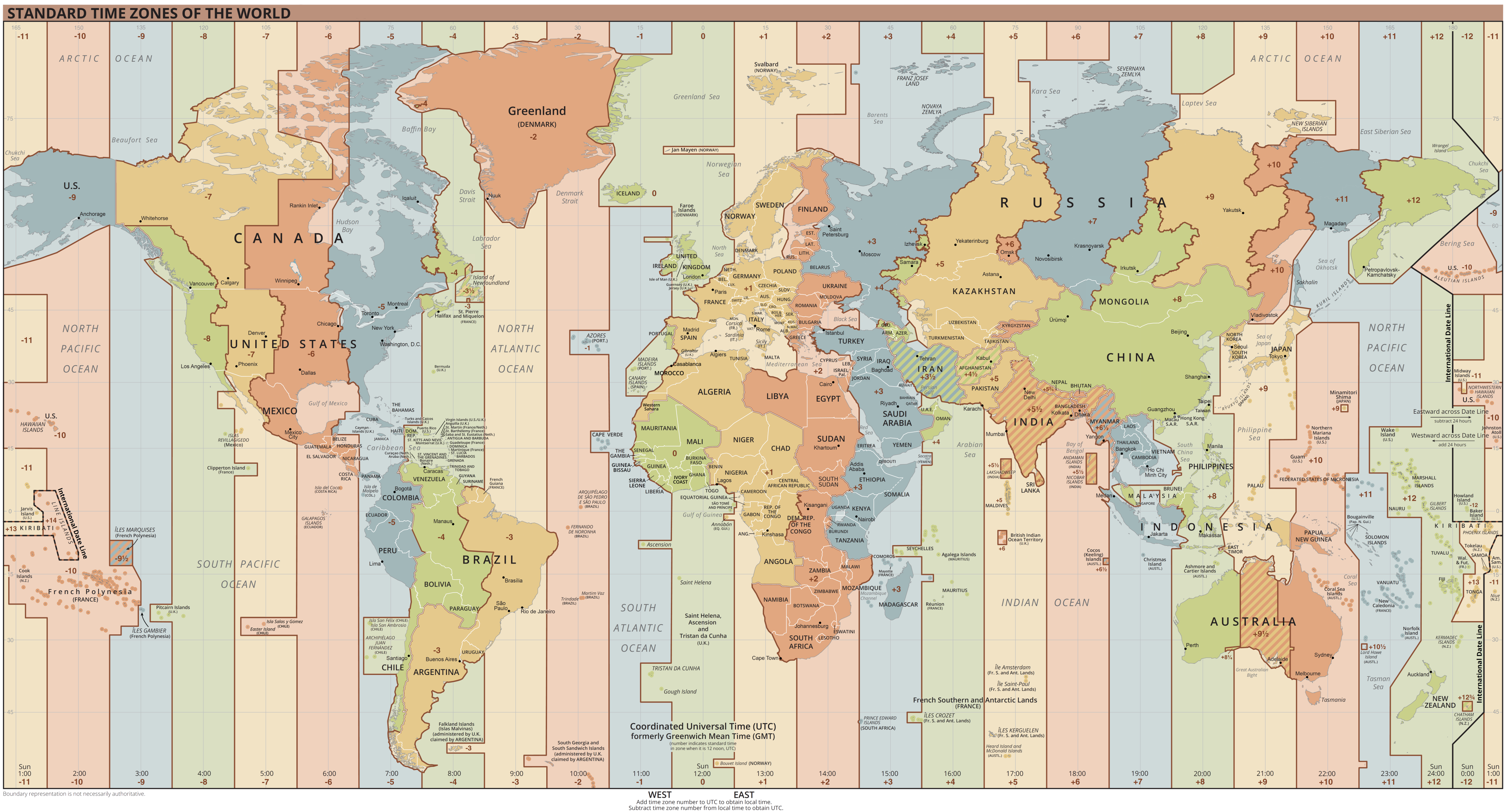
If the Wikipedia map (https://upload.wikimedia.org/wikipedia/commons/8/88/World_Ti...) is accurate: - at the longitude of Kabul you have Afghanistan (+4.5), Pakistan (+5), India (+5.5), and Kazakhstan (+6). - at the longitude of Rangoon you have India (+5.5), Burma (+6.5), Indonesia (+7), China (+8) (and the open ocean at this longitude is theoretically +6)
There is actually also +3 at that latitude. In russia, the moscow timezone reaches far enough in the North.
That means you get 6 timezones for that latitude if you include the ocean.
That's what I get for figuring this out by eye.
I believe India and Pakistan shared a time zone until partition (there were Bombay and Calcutta Times), and Pakistan adopted some standards asymptotically closer to Bombay Time (see the Wikipedia article for Karachi time)
Outside the EU that's already true, even between countries that all observe DST (since start and end times of DST vary). But having most of the EU in the same time zone with the same DST rules was very convinient.
That's the case currently in the US year-round as the timezone borders aren't nice, straight lines and no one seems to have a problem with it. For example, traveling North through Western Indiana.
There is already no single timezone, with the possible exception of a timezone in the deep pacific, that would allow you to go from south to north without adjusting your clock once.
See eg. https://www.timeanddate.com/time/map/
There are a few more longitudes for which it works but not that much...
>So if you travelled vertically within a timezone, you could end up going back and forth by an hour repeatedly, depending on the state’s decision made here?
See: Arizona
You already have that in EU -- Spain is observing CET (and its summer equivalent CEST) even though it is pretty much completely in the same time zone as Great Britain.
And Portugal is on GMT, so you have a bit of Spain (GMT+1) that's due north of Portugal (GMT) and borders it by land.
(and most of Portugal is west of 7.5 degrees west so "should" be GMT-1... but really in any sane time zone scheme Portugal and Spain would have the same time.)
PS: GMT is defined by UTC, and not the other way around.
Arizona is a hack. This is where the EU is starting from.
This is already the case. Travelling across Europe, you would go back and forth between the current date and VG Day 1945.
Getting date and time correct is already a challenge in some cases, adding multi-dimension time zones does not make it easier.
This is why people don't trust politicians - they don't understand the effects of their decisions (it _might_ be slightly more complicated than that.. but it's still).
It's really a simple question. How should you approximate this curve?
   ....................*****.....
   .................***.....**...
   ................*..........**.
   *.............**.............*
   .**..........*................
   ...**.....***.................
   .....*****....................
   ..............................
   ..............................
   ..............................
   ******************************
   ..............................
   ..............................
   ..............................
   ..............................
   ..............................
   ******************************
   ..............................
   ..............................
   ..............................
   ..............................
   ..............................
   ..............................
   ****..........****************
   ..............................
   ....*********.................
   ..............................
..............................There are two curves to account - sunrise and sunset. Daylight savings attempts to flatten one of those and not the other!
Yes, because DST correctly attempt to adjusts Sunrise towards our usual wake-up time (obviously it can't do miracles).
People vote for "summer time" because they, d'oh, prefer summer. But summer time in winter is atrocious. And there are many people getting up early, they're (mostly) called "the poor", those generally brown people who clean up your office hours before you come in, prepare food early so that you can eat at noon, collect trash, etc. I know, they don't vote and don't really count, who cares if they can't see the daylight all winter long?
Yeah, that's a cynical take on the class orientation of HN... (I don't get up at 5 and never ever reach the office before 10:30 myself).
I don't think you're right that it's mostly poor people who get up early, but even if it is, they would benefit even more from permanent summer time. There would still be sunlight after they get off work, and if they started their shift at 5am, then they get a whole lot of sunlight after work, an hour more than they would otherwise.
I hated DST, but now that I have kids I really like it - it means in the summer I have one more hour of sunlight to play with them outside after I come back from work.
The consultations might have had a different result if there had been a practical multiple-choice test with questions that link the idea of DST to actual consequences. Like:
Would you like to go to work in the light or in the dark during winter time?
Would you like to have some daylight while having barbecue at 9pm in the summer.
...
(My concern is that people had no idea of the practical consequences beside sucks-to-have-to-get-up-one-hour-earlier and will be in for a rude awakening)
Whether you go to work in the light or in the dark is determined by your work schedule relative to the local solar day/night cycle. Not DST. If you want to drive to work in daylight, negotiate for your working hours to start after sunrise. If you'd prefer some sunlight after work ends, negotiate for your working hours to end before sunset. Keep in mind that you won't get both year-round at most latitudes simply because a typical work day is longer than the length of visible daylight in winter. (What would probably make the most sense would be 10-12 hour work days in the summer and 4-6 hour work days in the winter, centered around solar noon, but that's likely to face strong opposition from both sides.)
The only _practical_ consequences of DST vs non-DST lie in whether we try to force everyone to shift their schedules all at once twice a year or leave it to individuals and businesses to set their schedules as they see fit.
There are no practical consequences for permanent-standard-time vs. permanent-summer-time. Either way, people will adjust their schedules to suit local conditions just as they do now, but without the complication of abrupt time changes in the spring and fall. My preference would be to place local noon as close as possible to solar noon (+/- 45 minutes, to permit one-hour time zone offsets without splitting up dense urban areas) so that morning and afternoon are approximately the same length, but I wouldn't call that a _practical_ difference, as long as the offset from solar noon is consistent. It's more a matter of aesthetics, in particular a distaste for needless complexity.
What stores or businesses allow to choose their opening time or beginning of shifts like that?
That might work for an office worker but beside these?
All of them? It's not like private stores or businesses are legally required to be open at specific times. They decide for themselves when to open and how to lay out their shifts. It's normal to have some variation in operating hours between different businesses.
Individual employees don't necessarily have the option of setting their own personal hours, especially for shift work, but if there's a clear preference among the group then they have a decent chance of getting the business to adapt its hours to suit the majority.
This is ignoring certain jurisdictions which have made the short-sighted mistake of hard-coding specific hours into local employment laws. Such laws would need to be updated, of course, to reflect this or any other time zone change.
Exactly. Basing the policy of the whole Union on the internet votes is... just wrong.
I have been wondering for a while: will this decision trigger any significant work to make software compatible?
Or is it "just" a timezone library to update and voila?
it's just a tz library to update, assuming you're using a tz library. Any poorly localized software is going to have issues.
The challenge is actually getting that update pushed out to everything that needs it. Every embedded and IoT device needs to get a new tz database, and any applications that might use a different tz database to the system one need to be updated. It's not significant programming work necessarily, but it's still probably going to cause a significant number of bugs in reality.
Made this little visualization of the night/dawn/sunrise/day/sunset/dusk/night times throughout the year.
Mind that this is just a step in the legislative process not the final thing. Next step is the EU Council where relevant ministers of the individual member states have to find an agreement. Some governments aren't that enthusiastic ..
Do all of them actually have to agree or just some majority?
This is always so complicated and I do not know. Sometimes they need a simple majority representing so and so many citizens and so and so many different countries (i.e. so that big countries [De+Fr+UK] can't overrule small ones and the small ones can't overrule big ones) some hings have to be unanimous, sometimes a simple majority is enough ...
Turkey removed DST in 2017 after 47 years, and it did not cause much trouble.
I don't have a strong opinion on whether we're better off with or without the seasonal time change. But I don't like the idea of individual member states opting in or out, which is what this ruling allows.
I've lived the past few years in a border town where many people will live in Germany and commute to Austria, or live in Austria but do their regular shopping in Germany, or regularly go on weekend mountain hikes that may cross the border multiple times. Hopefully the authorities are smart enough to avoid the kind of situation where the two regions would end up in different time zones for half the year and all the ensuing confusion over bus and train times, opening hours and so on.
> two regions would end up in different time zones for half the year
AIUI, every pair of countries will (like now) either always be in the same time zone or always be in different ones. Daylight Savings Time is being abolished; the choice is whether the permanent time zone will be the current summer one or the current winter one. Germany and Austria, being closely connected and at simular longitudes will probably choose the same one.
Currently Germany shares a timezone with all of it's neighbours. Most Germans seem to think they would prefer UTC+2; there would probably be no reason in that case for Germany's eastern neighbours (including Austria) to go to UTC+1. It's Germany's western neighbours that might end up on a different timezone. Certainly permanent UTC+2 seems crazy for Spain (which is geographically in the UTC zone); France and the Benelux countries are more of a toss-up.
How is this any different than various people bordering Germany thinking they can just pop in for some shopping, only to discover it's Sunday and pretty much everything's closed?
Maybe the result of countries being able to fiddle with DST is going to be silly, but it's a big stretch to think that it's something the EU must centrally enforce as an economic union.
Think about what time change does to hospitals and other critical services. Many systems, but not all are based on UTC and at some point the information needs to be interfaced to a human with the expectation of clocks being a certain way.
I think you misunderstood that bit, see this comment: https://news.ycombinator.com/item?id=19491551
Well yes, I believed the BBC reporter's description of the proposal instead of bothering to read the source document. That's thankfully a bit less ludicrous than what the article suggested.
Not bad, they now at least understand the basics of PR! Always combine an unpopular decision (uploadfilter) with a popular one (summer time).
Conveniently this is going to steal a lot of press from the copyright reform
> The European Parliament has backed a proposal to stop the obligatory one-hour clock change which extends daylight hours in summer EU-wide.
> which extends daylight hours
No, it doesn't. The number of daylight hours is exactly the same no matter what your clocks do.
All DST does is force everyone to change their schedules so that they wake up earlier, go to work earlier, come home earlier, and go to bed earlier. It effectively forces businesses to open an hour earlier and close an hour earlier because of society's expectations.
When you describe it this way, the entire process sounds like something that takes place in a totalitarian state run by a crazy person. Yet here we are as a group claiming it somehow helps farmers (it doesn't, it makes things more challenging for them). The only people who truly benefit from DST are golfers (and golf course owners) who can leave work an hour early and get in a few more rounds.
> When you describe it this way
Which is by far one of the most accurate description in this community.
> the entire process sounds like something that takes place in a totalitarian state run by a crazy person
It's due to the way the Universe works, it only requires a review of your early school notes about science / geography / astronomy.
DST is a way to compensate that "strange" behavior for the current definition of a "time-zone".
Is DST good ? it depends because we over-generalize the definition of a "time-zone" by taking in consideration only the longitude, but not the latitude. (and above/below certain latitudes, nothing can be done)
Is DST good for EU (or North America) ? Mostly yes if you take a closer look at the year-round daylight charts for key geographic coordinates.
Extra notes while here:
1) "EU propose to get rid of DST", its our best interest to keep it; don't let some incompetent rule such a thing because he/she doesn't really know how it works but only how it's perceived.
2) "If I have to choose, I prefer more daylight in the evening": fine, but that is out of scope from DST; it's about changing schedules. Clock should (I'd say "must") stay on their natural "time-zone" for the sake of coordination and travel.