What I learned at work this year
gatesnotes.com> [...] we are also going to be focusing more on improving the quality of life. I think this will be the thrust of many big breakthroughs of the future. For example, software will be able to notice when you’re feeling down, connect you with your friends, give you personalized tips for sleeping and eating better, and help you use your time more efficiently.
Seems like a retrofitted use case that is more of an answer to the question "What could technology do next?" rather than the question "How to improve quality of life?"
If one started with the latter question---which is what is worth answering---a significant component of the answer would be to strengthen relationships and make them more authentic. Since the medium undeniably biases the message, it is important to prevent the disintermediation of relationships by corporations looking to insert themselves (or their technology) into positions from where they can better extract rent.
Technology can of course be useful in numerous ways, but the right solutions would put human emotions and relationships front and center, and sparingly sprinkle technical solutions only when needed -- and in many ways force people to interact more directly, even if it were temporarily (somewhat) inconvenient.
I preface my statement below with a disclaimer that I live in a "developed" or "1st-world" country but have previously lived and experienced other less developed economies.
Anyway, it feels to me Gates is fixing a real problem but with very 1st world solutions?
> For example, software will be able to notice when you’re feeling down, connect you with your friends, give you personalized tips for sleeping and eating better, and help you use your time more efficiently.
Maybe it is just the skeptic in me but it is a lil captain obvious that more of those activities will give you a better quality of life. In fact, I will say that most people are very aware that they should sleep or eat better or even use their time efficiently and probably wouldn't need any form of software to tell them that. I will even wager that the overwhelming number of people that are feeling down, need more sleep or need to eat better can't do so easily and is possibly due to their personal circumstances such as having to work insanely hours due to (almost uncontrollable) working conditions and/or have a low to middle wage job that won't allow them to have any spare income to eat healthy/organic food.
This feels like a stereotypical 1st world solution to me that will only apply to certain type of people and I say this as someone in the privilege position to do so.
I know I sound dystopian but could someone refute my view? Am I missing something?
It feels odd that on an entire post talking about the challenges of treating diseases like Polio, Alzheimer and Malaria, and the reinvention of the toilet too, people are focusing on a single statement that he just posed as a possibility for the future.
Maybe it is just the HN mentality of nitpicking to every mention of the word "software".
I'm sure there will be comments on other aspects also. But discussion on this part is important too.
I am sad to agree with you. We in tech love to believe - with our inflated egos due to recent successes improving the world - that every problem is solved through more tech. I think we need to watch tech fail to solve some problems and experience that failure first hand to really believe that some problems are rooted in culture and social norms, not in a lack of guidance or convenience from some app.
I feel like we've lost connection and patience for each other from lack of practicing empathy. More technology is not the answer to that. I hope we find an equilibrium where we move past such an infatuation with tech that we let it be the right amount of a participant in our lives and place more of an emphasis on the human experience and condition and value our humanity first.
I guess what I'm saying is: if we need an app to remind us to call family, maybe there's a larger problem at hand.
Book 4 of the Pendragon series (The Reality Bug) comes to mind. That was a formative book in my young adulthood.
People are lonely because corporate culture - including, but not limited to, work culture - is outrageously demanding and often insane, not because they need an app to remind them to phone grandma.
Everyone - who isn't financially independent - could benefit from shorter hours and more creative freedom and financial security. Apps that try to parent us are not a solution.
"We in tech love to believe ... that every problem is solved through more tech."
As a recovering technophile [1], I remind you that Arabic numerals, alphabets, double entry accounting, and a zillion other things are also technologies.
Technology is more than modern hardware and software and algorithms.
Sometimes it's just a new take on old problems.
Sometimes it's starting with a new set of assumptions.
Sometimes it's revisiting problems after the economics have changed, identifying new opportunities.
[1] Postman's Technopoly, Wright's Nonzero.
An exception I could see to this is if somehow technology could be employed to affect those cultural/social norms? Maybe the problem is where we're aiming the technology, and not technology itself.
Though, I could be wrong about that. I agree that there are some problems not solved through more technology and the "there should be an app for that" mentality can be a problem.
> For example, software will be able to notice when you’re feeling down, connect you with your friends, give you personalized tips for sleeping and eating better, and help you use your time more efficiently.
I'm sorry, I can't let you do that Dave.
> software will be able to notice when you’re feeling down
This feels dystopian to me too, not least because in order for software to diagnose this problem you'll need to spend sufficient time generating relevant usage data... usage that will (if existing social media are anything to go by) be a net contributor to problems with self-esteem, fitness, sleep, etc.
I'm not going to pretend to know exactly what he means, or how it'll pan out, but the cynic in me is expecting a greater net benefit from just deleting your FB/Twitter/Insta account.
This reminds me of the movie _Elysium_. In it, Matt Damon's character is talking to a robot, and when he shows frustration the robot responds, "You seem to be experiencing elevated levels of anger. Would you like an antidepressant?"
Has Bill ever been good at predictions? No mention of smartphones or social media in The Road Ahead. Blindsided by how quickly the Internet developed, underestimated "bazaar" economies that enabled millions of people building both software and content. All the smart home stuff he was in love with has gone hardly anywhere.
I think he's very smart and great at setting huge goals then hitting them, but I'm not sure he's a great prognosticator.
> No mention of smartphones or social media in The Road Ahead
The road ahead is from 1995 and is about the Internet ("Information Superhighway") which Microsoft almost missed, but got right just in time.
The Smartphone he saw coming earlier than almost anyone else, and Microsoft desperately tried to conquer that market. They initially failed because existing mobile phone companies (Nokia, Motorola, Ericsson) feared Microsoft too much and refused to partner. Then Microsoft had to enter the market with third tier player HTC, which had no distribution at all. Then they executed very poorly, trying to miniaturize Windows using a pen interface and killing the much better specialized numerical ui they had. Then they got surprised by the iPhone and touch screens, and took way too long to come up with a good implementation of that, with Windows Phone 7. And then finally with Windows 8, they redid everything again for no good reason, loosing any loyalty from customers they had left.
They missed smartphones, but not because Bill Gates did not foresee them.
Microsoft was in the smart phone market with Windows Mobile (based on Windows CE) way before the iPhone was a thing and HTC was far from a third tier player. At one point, before the iPhone, HTC was one of the most successful smart phone makers in the world, manufacturing not only its own brand but also third party white label brands and was manufacturing 80% of all Windows Mobile/Pocket PC/Windows CE devices - including those sold and labeled by other vendors.
Which edition of "The Road Ahead" did you mean? From the Wikipedia article:
After the book was written, but before it hit bookstores, Gates recognized that the Internet was gaining critical mass, and on December 7, 1995 — just weeks after the release of the book — he redirected Microsoft to become an Internet-focused company; in retrospect he had "vastly underestimated how important and how quickly the internet would come to prominence".[3] Then he and coauthor Rinearson spent several months revising the book, making it 20,000 words longer and focused on the Internet.[citation needed] The revised edition was published in October 1996 as a trade paperback,[6] with the subtitle "Completely revised and up-to-date.".[3]
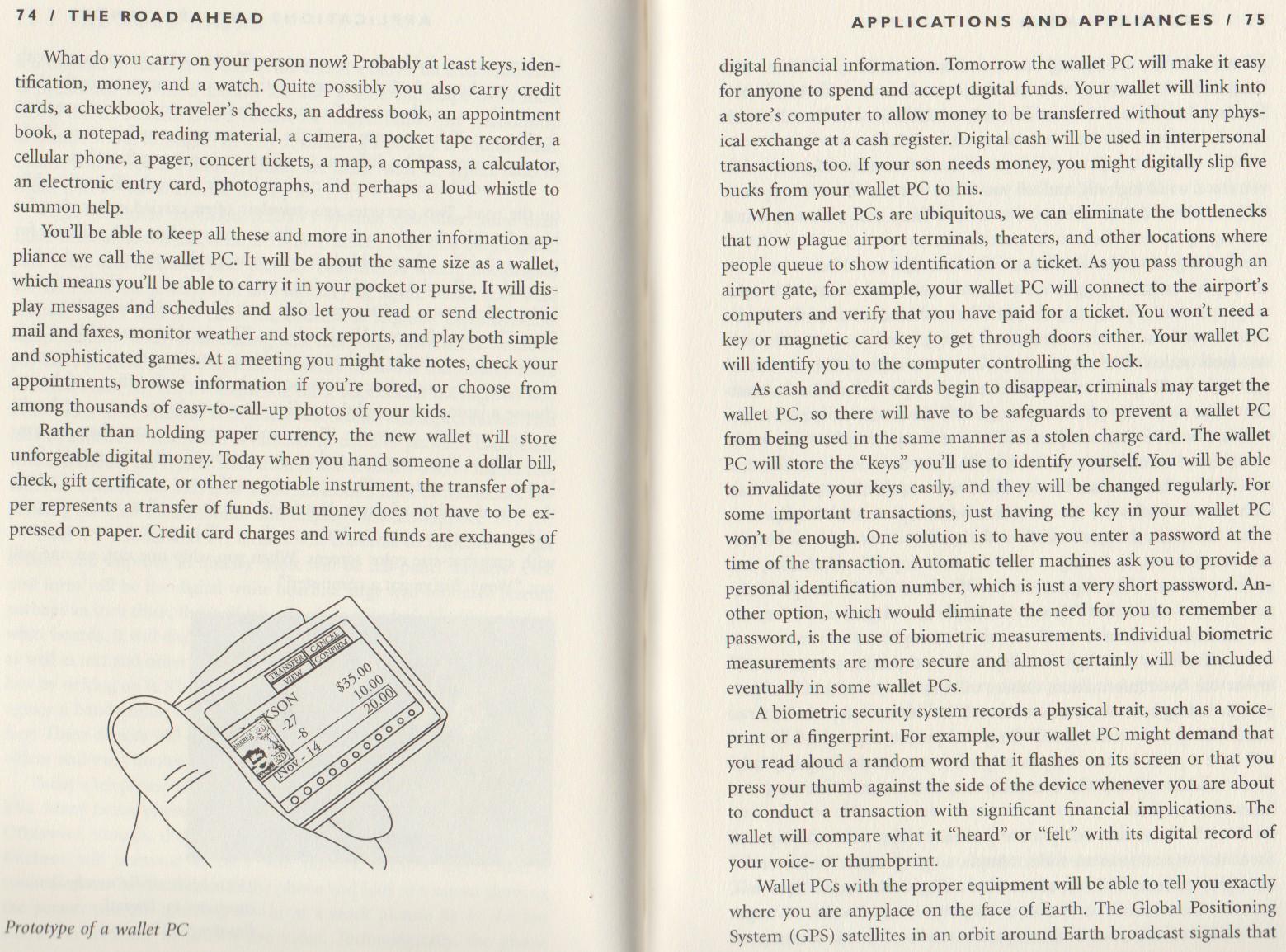
I think his vision of smartphones has held up well. From page 74 of my hardcover copy of The Road Ahead:
What do you carry on your person now? Probably at least keys, identification, money, and a watch. Quite possibly you also carry credit cards, a checkbook, traveler's checks, an address book, an appointment book, a notepad, reading material, a camera, a pocket tape recorder, a cellular phone, a pager, concert tickets, a map, a compass, a calculator, an electronic entry card, photographs, and perhaps a loud whistle to summon help.
You'll be able to keep all these and more in another information appliance we call the wallet PC.
Great comment and I guess he really did see more of it coming than I was aware of. It seems like the main thing he miscalculated, ironically, was how people would use these devices -- it turns out that all that functional stuff is totally dwarfed by being a Facebook zombie, in terms of total eyeball hours.
It's like we all had this innate drive (or susceptibility?) to zombification that we weren't aware of until the smartphone actually appeared
His most famous prediction was one he helped make true.
Microsoft's original mission statement was "A computer on every desk and in every home"
The ending seems to have been missed off most quotes, it appears to have been "A computer on every desk and in every home running Microsoft software".
In all fairness, it would be a terrible mission statement if it ended any other way.
Only if you consider first world countries and even then it’s a stretch. The smart phone market made “computers” far more accessible than Windows ever did.
Yes, there literally isn't a computer in every home. Less than 9 out of 10 households in the US currently have a computer[0]. Yes the smartphone made computers much more accessible, especially in third world countries. The iPhone was also released 23 years after the founding of Microsoft, an eternity in the tech industry. Between the founding of Microsoft and the release of Windows XP computers changed from something in a single digit percentage of households to more than half of all households in the US. That's a major accomplishment, and Microsoft played a large role in it.
[0] https://www.statista.com/statistics/214641/household-adoptio...
There is this panel discussion with Jobs and Gates, circa mid 2000s, where Gates describes the future of computing in now-obvious iPad form, and Jobs is obviously taking mental notes
History is that the iPhone project started in early 2005 and before that Apple was already prototyping touch screen tablets but decided on releasing a phone first.
They released the iPod touch before the iPhone, and it was arguably a touch screen tablet. That's how I used it.
No, they didn’t. iPhone was released in June 2007, iPod touch in September 2007. Perhaps you are thinking of outside of the US? (First iPhone was sold in the US only)
They released the iPhone in June of 2007. They released the iPod Touch around September of 2007. They announced the iPhone in January of 2007.
Gates and Jobs were both familiar with the DynaBook concept from Parc, I don't see how this would be a case where Jobs is taking Gates' ideas.
I think reducing the number of hours in the work-week would do more for this than any technological solution.
> Technology can of course be useful in numerous ways, but the right solutions would put human emotions and relationships front and center
You're looking for a technological solution to a social problem - such things don't generally exist. It's not that technology is bad per se, it simply can't do what you're expecting it to do.
Agreed.
I can imagine a huge host of compensating bad behaviors that would result from something like that. Then should it go away are you just doomed and emotionally catatonic?
> Nuclear is ideal for dealing with climate change, because it is the only carbon-free, scalable energy source that’s available 24 hours a day. The problems with today’s reactors, such as the risk of accidents, can be solved through innovation.
So refreshing to see someone with his reach pushing for nuclear.
Though still missing the mark. Nuclear’s biggest issue is cost.
If it was cheap enough companies would have built more and scaled them up and down to meet demand, instead France only got mostly Nuclear by exporting its excess and nobody else really got very close to full nuclear.
The problem today is wind costs less. But, when you add a lot of wind during times of high wind your nuclear becomes useless. This ends up driving up the effective cost of nuclear even higher.
Storage makes this worse as you would then just want ever more wind due to cost.
The cost is a political problem. It's easier for the opponents of nuclear to find support for stricter and stricter safety laws for new reactors. Driving up the cost, making them economically nonviable. Meanwhile the older and far more dangerous reactors are rotting away and cannot be replaced (or are replaced with fossil fuels).
It's been pointed out again, again and again. Coal plants pump out more radioactive waste than is ever released by all the accidents to date, catching a plane will irradiate you more than living next to one, etc. etc.
If that where true China would happily jump on the nuclear bandwagon. Instead, they use minimal Nuclear because the basic cost of running a nuclear power plant reasonably safely can’t become really cheap.
Nuclear in China is 40.6 GW vs 290GW or so total power production. They are adding 14 GW but these things take time so the ratio will stay about the same. Meanwhile they are ramping up wind and solar extremely quickly with a stated goal of 1,300 GW of peak solar capacity by 2050 which they are on pace to reach. https://en.m.wikipedia.org/wiki/Solar_power_in_China
Your comparisons between power production of nuclear and solar is somewhat misleading since you are forgetting the low capacity factor of solar.
In terms of power production of solar in China:
>...The contribution to the total electric energy production remains modest[8] as the average capacity factor of solar power plants is relatively low at 17% on average. Of the 6,412 TWh electricity produced in China in 2017,[9] 118.2 TWh was generated by solar power, equivalent to 1.84% of total electricity production.
https://en.wikipedia.org/wiki/Solar_power_in_China
In comparison:
>...Nuclear power contributed 3% of the total electricity production in 2015, with 170 TWh,[1] and was the fastest-growing electricity source, with 29% growth over 2014.[4
As far as long range plans in China:
>...By mid-century fast neutron reactors are seen as the main technology, with a planned 1400 GW capacity by 2100
https://en.wikipedia.org/wiki/Nuclear_power_in_China
In short, it looks like China is doing what any smart country is trying to do: develop all non-carbon based energy sources that they can.
First, however you want to slice it Nuclear is a low percentage of China’s production. Even nuclear + wind + solar is not that huge, still the trends are very promising.
But, I want to say that growth figure is misleading as it’s comparing as specific year when a power plant came online. In terms of total TWh and rate of increase wind beats nuclear. In terms of relative percentage increase Solar is insane.
Looking at 2018 Solar’s insane year over year growth is starting to have a huge impact and does not seem to be slowing down. In some ways even 2017 numbers are misleading.Solar 2013 9 TWh Solar 2017 118.2 TWh Nuclear 2013 124 TWh Nuclear 2017 246 TWh Wind 2013 134.9 TWh Wind 2017 305.7 TWhSolar, *capacity* added per year. 2014 10,560 2015 15,130 2016 34,540 2017 52,830
I disagree; politics are a small factor, but up-front capital costs are by far the bigger issue. The most salient example is South Carolina, where it was up-front construction costs that axed the project. They poured billions into the plant multiple times and it never was completed.
I'm all for advanced nuclear but it's never going to happen with such high start-up costs, especially outside of an authoritarian economy like China, which is basically the only country making major expansions to nuclear today. Maybe traveling wave or molten salt or modular reactors could be cheaper and better on fundamentals, but if the cost to start-up is still very high, the LCOE isn't going to beat renewables/storage in the medium/long term.
On top of this, look at energy widely. Demand is flat, old coal is shutting down, new renewables/storage and new-ish gas turbines are going to be online for a couple decades. Where is the payback potential for an expensive nuclear plant in a flat-demand environment? Renewables kill the wholesale cost to boot, so nuclear would be running a deficit in windy or sunny times. It's just hard to make the numbers work.
I always wondered how they came up with that north of 30% interest rate for the financing for the rest of the project that caused them to abandon it. Probably the banks just saying FYAD politely.
The big problem with nuclear is that it's only economical to run the reactors at full blast 24/7. However demand goes up through the day and down over night.
You need to pair it with some sort of grid energy storage. That's not quite a solved problem.
Personally I'm a fan of offshore compressed air... https://www.greentechmedia.com/articles/read/toronto-hydro-p...
This is like punching someone in the face, and then accusing them of having a nose-bleeding problem.
Nuclear is expensive because the rampant fear-mongering generates massive amounts of litigation, construction delays, and outdated/unreasonable regulations.
If you look at the cost of reactors in China, Russia, Saudi Arabia, etc, they are one-tenth the US cost for the exact same reactor design.
None of the counties you mentioned use a higher percentage of nuclear power than the US. Russia plans to eventually hit 35% but unlike most of the rest of the world they can’t rely on cheap solar.
We already use nuclear power around the world, but to displace fossil fuels it needs to become cheaper without subsides.
Large parts of the U.S., Japan and Canada all have good nuclear. Gates' has always been about pushing research in the area to get better nuclear, which he outlines clearly in this note.
It’s also subsidized in those areas. As I said in another post, counties like China don’t use a lot of Nuclear power even with minimal political issues because of core economic issues.
Saudi Arabia for example is aiming for 15% nuclear by 2040. They have plenty of money etc, it’s just not a great solution to scale. Further, any advances you make today take a long time to put into production meaning we can’t wait for ‘better tech’.
Nationalize any nuclear plant that has an "accident". Investors would have a financial justification to spend on safety.
It’s not a US or western problem. China, Saudi Arabia, Russia etc also use minimal nuclear power because of basic economic issues. It’s fine under 10%, but as you scale up the problems get worse.
PS: Rosenergoatom which runs Russia’s nuclear power plants has seemingly made progress in lowering operating costs, but it’s not clear how much of that progress is real. Though Russia is planning to ramp up to ~35% nuclear and is pushing a lot of R&D which is promising. Then again they have issues with solar.
Bill Gates thinks he can run nuclear power-plants at a profit, and safely. Nationalizing plants that aren't safe would let investors try. Governments could reduce up-front regulations by punishing reckless investors.
Considering the ~US$187 billion dollar cleanup effort after the most recent failure, just let them try can be an extremely expensive proposition. Operate for 50 years then say, sorry cleanup is your problem now suckers is similarly an issue. https://en.m.wikipedia.org/wiki/Fukushima_disaster_cleanup
That’s the catch 22, you need to not just be extremely safe but able to convince others outside your organization that it’s going to work. Having been burned twice by failure modes outside the original context it becomes even more difficult to innovate. Novel designs have novel problems and unknown unkowns can be a huge deal.
Can you get away with fewer guards? Well probably, but the minimum is not clear. How about thinner walls, again probably but can you convince others it’s a good tradeoff? Now extend that to everything.
They'd have a much larger financial incentive to reduce safety protection at older facilities.
"[Warren Buffett] says his measure of success is, “Do the people you care about love you back?” I think that is about as good a metric as you will find."
I love this.
So then why does he bother being an investor? He could probably find that level of success working at Walmart and concentrating on his home life.
Given that he’s successful at investing, he must have some other standards.
Maybe a good number of the people he cares about work at or invest in the company he built?
It's one of the few things you can't buy. Good goal for an ambitious billionaire.
This reminds me of the song 'what Sarah said' by death cab for cutie.
"That love is watching someone die
So who's gonna watch you die"
That doesn't help much if you and your loved ones are just barely not-starving. :/
Gates' resolution to learn and think more about the intersection between privacy and innovation is absolutely spot on. I've been thinking about better ways that we can approach chronic illnesses through health tracking, but absolutely terrified of the implication of that data falling into the wrong hands - and not even for nefarious purposes.
For example, I would not trust my health insurance company with information that may indicate I am predisposed to an illness or disease lest they brand me as a high risk, pre-existing condition patient, and deny or price me out of coverage forever. I'd rather do my own experimentation outside of the 'official' medical community than to risk my own data being used as a weapon against me.
Somewhat unrelated, I feel that the next underexplored area of medical science is that of the gut & intestines. Having a toilet that could do continual personalized analyses of your urine and stool is going to revolutionize medicine. However, as much as I believe that this is an opportunity to change the world for the better, I would never purchase such a device under the current privacy and security climate. I hope we can start to resolve these issues in 2019 and beyond so we can unlock these sorts of innovations to help people on a daily basis with chronic conditions.
> Did I devote enough time to my family? Did I learn enough new things? Did I develop new friendships and deepen old ones? These would have been laughable to me when I was 25
I'm almost 30 and those are my priorities, maybe that's why I am not as "successful" as Bill Gates?
I was thinking something similar. I'm 28 and 2018 was a difficult year because I had to end many, many friendships because it became harder and harder for me to relate to them on a level I desire for my personal growth but I digress. The fact that Gates mentions that he thinks about these things now as opposed to his 20s makes me wonder if I am making the right decisions here. Still, I have made great progress. Sober and cigarette free for over a year, in a committed relationship for the first time since 7 years ago and a stable income and some savings in there somewhere. So maybe there is benefit to be had from being old young.
>>I had to end many, many friendships because it became harder and harder for me to relate to them
>>I desire for my personal growth but I digress.
>>The fact that Gates mentions that he thinks about these things now as opposed to his 20s makes me wonder if I am making the right decisions here.
A few days back some one on HN mentioned that most people on earth, are not going to terrible failures or spectacular successes.
Once you come to this realization. You will take your health, mental health, friendships, relationships and hobbies far more seriously.
After a while all you want is a peaceful, normal life with happy relationships and healthy body. After a while you can earn enough. And you are going to be eating the same burgers, as a billionaire eats to fill stomach. The beef ain't exactly going to come from heaven for trading extra efforts for sure failure.
>> Still, I have made great progress.
That which is in locomotion must arrive at the half-way stage before it arrives at the goal.
— as recounted by Aristotle, Physics VI:9, 239b10
https://en.wikipedia.org/wiki/Zeno%27s_paradoxes#Achilles_an...
For a lot of things in life, there are indeed infinite sub tasks you need to complete. Most of us aren't going to make it. Bail out while you have time.
I think it's ok to end or lessen friendships that do not align with where you are going, as long as you commit and build new relationships that do align with your goals, which seems to be what you are doing :)
I haven't had to end friendships as I grew, as those that diverge tend to naturally fade away. But I always make sure to nourish new ones that are more in line with where I'm going, and it feels amazing to have that kind of control in your life.
"We still need a lot of innovation to solve problems like malaria or obesity, but we are also going to be focusing more on improving the quality of life."
To solve obesity we need the opposite of innovation. Nature has delivered the perfect array of nutrition for the human animal to thrive. We have innovated ourself into obesity and the reversion to the simple truth of natural nutrition is the cure.
"The simple truth of natural nutrition" is scarcity and starvation. Obesity is a result of the ready availability of the kinds of foods (carbs and fat) that are "naturally" hard to get, so our body hoards them when it has access. We innovated ourselves into effectively unlimited food. All diets are unhealthy if access isn't limited.
I like not going hungry on a regular basis. Most people do.
Most healthy people I know aren’t chronically hungry. You’ll be chronically hungry if your diet consists of simple carbs (white bread, soda, chips).
I mean hunger from a lack of available food, not from eating food that overstimulates your systems (the simple carbs). The solution to this is primarily education (so people make healthy choices), and availability of healthier alternatives.
That said, all of civilization is built on the ready availability of refined carbs brought about by agriculture. This isn't a modern phenomenon. The only modern thing is that suddenly our food production is outstripping population growth for the first time in ever.
A reversion that very few will undertake. Unless there is some kind of innovation that can affect that (social engineering? who knows)
So in light of the harsh reality that obesity is essentially a given, what CAN be done?
I don't see why anything should be done. Obesity is your body telling you that you are doing food consumption wrong. If the human that is wearing a large body in life doesn't find the awareness to recognize that they must change their behavior, I don't believe society should try to innovate them a thinner body. Their currently large body is a gift from nature intended to signal that a course correction is needed. This enlarged body (which will usually come back to shape and health through corrected nutrition) is a manifestation of a more fundamental internal issue (mental or emotional). Innovating thin bodies while not addressing the internal issues will only cause more problems for this human and society at large.
> is a manifestation of a more fundamental internal issue (mental or emotional)
This is false.
Food deserts and lack of financial/nutritional education are a major cause of obesity. Many Americans don't have quick access to grocery stores and can only purchase fast food / junk food. They literally don't have time or the ability to change what they eat. Some Americans have grocery stores but literally do not know that healthy food CAN be cheaper. They see Whole Foods and rich people eating healthy and intuitively it makes sense that it seems more expensive. These are problems outside of individuals that exist on a national and global scale.
> Distance to store and prices were positively associated with obesity (p<0.05). When distance to store and food prices were jointly modeled, only prices remained significant (p<0.01), with higher prices predicting a lower likelihood of obesity. Although low- and high-price stores did not differ in availability, they significantly differed in their display and marketing of junk foods relative to healthy foods.
https://www.sciencedirect.com/science/article/pii/S074937971...
I've tried losing weight and eating healthier and I can always stick to doing it for a while, but always gradually start eating worse and worse again. So I am aware, and have tried, and yet it feels like there's something bigger always pulling me back to eating poorly.
Is it addiction? Is it some biological process (the body wanting to retain its new equilibrium)? Is it the fact that my taste buds tend to prefer the flavors of unhealthy food a majority of the time?
Clearly the problem is bigger than obese people being aware of their obesity and trying (and failing) to change it. There are other forces at play, and I think, difficult ones to overcome.
Separately, why not still try to innovate or do something to reduce the burden obesity places on the healthcare system (regardless of how you feel about the individuals)?
> Obesity is your body telling you that you are doing food consumption wrong.
On the contrary, obesity likely exists because evolution optimized for the ability to survive long famines, which isn't a big problem in most developed nations nowadays.
If this is Bill Gates blog, I do wonder the following:
On first visit, it pops up a modal subscribe email dialog.
On a second visit, a distracting large survey thing slid in from the bottom.
Why would Bill Gates need spammy patterns that detract from reading the text on his personal blog?
you should consider using uBlock Origin , I am using it and not getting any messages
He's still a brand that needs to be marketed
Wouldn't his brand look better without these spammy things? It's a person writing insightful stuff, not an entity shoving clickbait in your face.
This assertion is presented without any arguments to support it.
Put a super pretty looking button in the sidebar to subscribe to the newsletter, and on subsequent visits have a "take the survey" button show up.
As a bonus, that doesn't get blocked by adblockers, and doesn't annoy those who aren't interested. I might be bored and see what the questions of a survey are, and maybe take it if they're interesting, but not if it's a pop-up.
> software will be able to notice when you’re feeling down
Facebook-controlled depression, what a dream
I keep spamming this link, but it's important to be repeated: Facebook already intentionally manipulated emotions of a "small number of users" (700k), proved it was possible, and released a paper on it almost half a decade ago.
https://slate.com/technology/2014/06/facebook-unethical-expe...
Link to paper: https://www.pnas.org/content/111/24/8788. (It does say 'massive-scale' though)
It's an article about the future, so we don't need to bring up Facebook.
Depressed people are likely to shop to alleviate their depression symptoms temporarily, too.
> If you’ve never been exposed to the flu, it’s possible to make a vaccine that teaches your immune system to look for those structures and attack them. But once you’ve had the flu, your body obsesses over the strain that got you sick. That makes it really hard to get your immune system to look for the common structures.
Very interesting, I did not know that.
Ah, so the body is basically overfitting the training data.
Probably better than the other way around.
> The only problem where I don’t yet see a clear path forward yet is how to develop more efficient ways to recruit patients for clinical trials. Without a simple and reliable diagnostic for Alzheimer’s, it’s hard to find eligible people early enough in the disease’s progression who can participate in trials.
There’s an interesting use case for Facebook’s Machine Learning algorithms
Oh please NO. Let's try to not insert facebook also in our supersensitive medical data, considering how shady they are even with non-sensitive data it's clear it won't end well at all.
Medical data has strong governance around it
Which is why Facebook should not be allowed to touch it with a ten-foot pole.
Are there other great and insightful blogs from important personalities like this one? Maybe warren buffet's blog?
Warren Buffet writes very insightful letters to shareholders of Berkshire Hathaway which you can find online
Here's a link: http://www.berkshirehathaway.com/letters/letters.html
> Unfortunately, America is no longer the global leader on nuclear energy that it was 50 years ago. To regain this position, it will need to commit new funding, update regulations, and show investors that it’s serious.
> We had hoped to build a pilot project in China, but recent policy changes here in the U.S. have made that unlikely.
Maybe running pilot projects in U.S. instead of China can solve the first issue he mentions?
Mere sentences later he says that they would like to do a pilot in the US but regulatory constraints make it impossible.
The whole section is kind of strange. First he says that he believes only technology breakthroughs can solve the climate crisis, despite the expert consensus that the technology is mostly there if the political will can be found to disruptively deploy it.
So, presumably, he thinks that mustering the political will is intractable. Then, a few paragraphs later, he admits that his preferred fix of nuclear energy is also blocked by... political constraints. Why he thinks he'll make more progress touting nuclear energy, which is wildly unpopular, instead of "green jobs", which polls well, he doesn't say.
This note was quite short, so Bill Gates didn't go into much details.
The details are:
* Bill believes in a new nuclear fission technology that addresses the concern of nuclear waste, traveling wave reactor [1].
* He financed a startup called TerraPower [2] to demonstrate and then to put in use this technology
* Being aware of the strong anti-nuclear sentiment in the US and of the more friendly attitude in China, he signed an agreement with China National Nuclear Corporation to build a 600MW reactor in China
* With the new US administration more hawkish approach towards China, some new restrictions on nuclear deals were announced by the Department of Energy in October [3]
* Gates' TerraPower venture found itself in the crosshairs of these restrictions, so the deal with the CNNC became for all practical purposes void [4]
[1] https://en.wikipedia.org/wiki/Traveling_wave_reactor
[2] https://en.wikipedia.org/wiki/TerraPower
[3] https://www.energy.gov/articles/doe-announces-measures-preve...
[4] https://www.rt.com/business/447910-bill-gates-nuclear-china/
Hmm. No working examples, "maintenance free" (in reality this translates to "maintenance impossible"), and uses liquid sodium as a coolant.
I think it is a bit of both. We have the technology, but it isn't good enough to work without political changes. What really would help is new technology that is so good that it don't need any political changes to work. So it isn't good enough to be as good, but more expensive, than current technology, it have to be better without costing more.
Political changes to put the cost of pollution on the consumer would help but is only part of the solution
> the expert consensus that the technology is mostly there if the political will can be found to disruptively deploy it.
Citation needed. This may be the case for a few rich Western countries but if we expect China, India, and Africa to gain a modern quality of life (which seems likely), global energy consumption will continue to increase. My understanding was we didn't even have enough raw materials to scale solar that far with current technology.
I believe that a Chinese company had already inked a deal to provide cash and regulatory help.
We’re asking the guy who thought the internet had no potential to predict the future?
IMHO, what he thought at 25 is more useful than what he thinks now.
Say that again when he has eradicated polio or malaria.
Many would like to eradicate polio or malaria. The methods are known. Problem is to get resources to do that. Those resources were created by the work of 25yo Bill Gates.
This comment is so useless and belittling.
"We still need a lot of innovation to solve problems like malaria or obesity ..."
There's really no innovation needed for the latter. Just educate people and when that fails implement better controls, i.e. sugar taxes on sodas and food. Fundamentally the goal should be get rid of refined sugars in foods, especially high fructose corn syrup.
People become obese because of emotional issues.
You can't over-eat spinach.
Popeye's relatively obese forearms would beg to differ.
I don't think that's true. Ultimately the reason is eating unhealthy food that throws the nature's built-in weight control system off balance and allows the accumulation of fat (which is actually not a problem per se, it's symptom of the underlying cause which is far more troublesome, i.e. metabolic syndrome).
People however like to blame other things and external factors. I'm X because of Y. It's time to take the pity cock out of the mouth and take responsbility for oneself.
That being said it's hard to rely on education for the average non-educated lazy person (i.e. the general masses) but instead we need to regulate the supply, i.e. what is already done with other poisons such as tobacco, drugs, alcohol. Sugar needs to be added to that list.
I or others shouldn't have to pay more for sugar because of others inability to limit themselves. There's already several other "taxes" we have to pay. No one wants to add another thing on that list.
If you're not overconsuming it, then it will cost you only a tiny amount overall?
You’re already paying less for sugar than you “should” because of government subsidies on corn.
But as a tax payer you will pay for the enormous cost on the (public) health care system created by this epidemic of high sugar consumption. Personally I'm not sure why I should have to pay for the type II diabetes bills for the people who ruined their health with bad choices.
Your society taught them to how to make choices. Most people work at a job which ultimately derives income from sales and marketing folks who go out of their way to encourage people to make poor decisions. The vast majority of advertising shows a savy, intellegent, attractive, funny buyer committing to continually poor decisions.
There is very little in the world encouraging people to make good decisions.
You have no idea about obesity...
I saw an article [0] posted on here, which made me reconsider my feelings on obesity. It's worth a read even if you don't agree with the conclusion (I still don't), it was very thought provoking
0 - https://www.vox.com/science-and-health/2017/12/7/16587316/ba...
Either bring more to the discussion or abstain from commenting. What exactly are you trying to say?
It’s not about education or price. It’s a pure emotional thing. You can ban sugar and all fast food, but the people will find something to abuse. There is a need for some nation wide happiness improvement program.
Perhaps it could be more than one factor?
I agree that there will always be something to abuse.
In the same way that windows is not bug-free, nuclear plants are not safe, at all. And they will never be.
Without considering accidents, for only 50 years of comfort, we have shamefully produced deadly waste, that future generations will have to keep confined at all costs for thousands and thousands and thousands of years.
Unlike CO2, uranium pollutes in the very long term, destroying all bacteria in the environment. It is high time to get up-to-date with renewable sources of energy.
The very basic point you're using here might be incorrect [1]. The difference is that all the nuclear radioactive waste is concentrated while the things coming out of coal plants are significantly diluted and mixed with local air. Therefore I think nuclear is better than coal plants even in the short term.
[1] https://www.scientificamerican.com/article/coal-ash-is-more-...
You say "without considering accidents", but I'd argue that accidents are usually negligible to begin with. Yes there were the "big" incidents early in the history of nuclear power, but besides being huge public relation disasters, these disasters are not so "big" compared to other energy production accidents (e.g. offshore drilling, mining, etc).
Yes 100% solar/wind would be virtually accident free, but if you argue this point too hard you let the perfect become the enemy of the good.
I always like to point out to people (it often surprises them) that the province of Ontario gets more than half of its energy from nuclear plants [1]. How often do you hear about horrible accidents in Ontario? Not so often - there hasn't been a major clean up required since the mid 90s. And these are facilities built in the 60s! Anecdotal, but this is the sort of "quiet evidence" of nuclear safety that is easy to ignore.
[1] https://www.ontario.ca/document/2017-long-term-energy-plan-d...
Also, climate change promises a lot of trouble, I'm not sure we want so many nuclear power plants lying around.