Nearly Half of Americans Are Lonely
advisory.comHonestly, I've never had problems talking to random strangers. Some of my best friends were random strangers at first.
IMO, the problem has nothing to do with the internet. Instead, the problem has more to do with poorly controlling marketing and homelessness. Political correctness also takes a toll.
When I lived in the Bay Area, most of the time I was randomly approached, "on the street," it was from a homeless person. Thus, I was less likely to be friendly to someone when I was in areas with high amounts of homeless people. If the Bay Area took care of the homeless situation better, there would be less people approaching me, and then it would be easier to interact with strangers.
But then, what about being in stores, malls, ect? I then need to put up defenses against aggressive marketing. That also makes it hard to be friendly. If we considered unsolicited marketing as insulting, we wouldn't need to keep our defenses up in places of commerce.
Even political correctness takes a toll. If I start talking with someone who has a different opinion than me, or is a difference race than me, faux pas get blown out of proportion. No one wants to make friends with someone who's going to scream at them for being a bigot because they lean a little right, or be labeled a libtard because they lean a little left.
> But then, what about being in stores, malls, ect? I then need to put up defenses against aggressive marketing.
There's aggressive marketing in the street too. Most often when someone approaches me on the street, they're trying to get money out of me. Either they're panhandlers, or they're selling me something, or seeking donations of some sort - which are all really the same thing.
The only exception is if they want to influence me in some way, i.e. they want my vote.
So ultimately, strangers approaching us in public areas are looking to get something out of us. They're not looking for a reciprocal social relationship. They're looking to get something: money, votes, support for their cause.
I do agree that it's a big part of the reason why Americans don't make social connections in public areas. I'm not sure about the solution though. The biggest problem in most places I lived was the panhandlers, and that's a big problem that causes a lot of issues in general, and doesn't seem to have a good solution.
> So ultimately, strangers approaching us in public areas are looking to get something out of us
This matches my experience as well (I suspect it might not in less urban areas, though). It's quite frustrating.
I also resent the fact that the people who are accosting me like this usually have the expectation that I owe them my attention. I'm pretty good at brushing them off/ignoring them, and I've seen quite a few get genuinely offended that I'm evading their pitch. Which is offensive to me in turn: they're trying to take advantage of my natural inclination to be social/respond to another human, and they're mad because I didn't fall for it? It's a parasitic situation. Sadly, I also agree with you that there's not really any way to fix it. The well is just poisoned...
> This matches my experience as well (I suspect it might not in less urban areas, though).
Indeed, I lived in less urban areas, and people are more open to socialize there.
As for the rest, I agree and encountered the same as well. What they are doing is parasitic, but they are naturally offended if you ignore them. For marketers especially, consider that every time someone ignores them, it means they failed at their job. It's a bad situation for them, and for us.
I don't think agreddibe marketers or panhandlers has anything to do with not being social in public. No one just walks up to you to strike up a friendship. That would always be weird.
When you socialize in public it would be while waiting in line together, or asking the person next to you at restaurant what they are having, or asking the person at the grocery store whether they think that product is better.
If you walk directly up to someone and it isn't a natural connection, everyone will always assume your trying to sell them something or bother them in some way.
> If you walk directly up to someone and it isn't a natural connection, everyone will always assume your trying to sell them something or bother them in some way.
The point of my comment is why this is happening. The reason "everyone" (in the US) assume that is because that is typically the reason. Because the typical people who approach us in the street are panhandlers and marketers.
It's like the early year of SPAM. When email just started, messages would usually receive attention, since they were usually from genuine people looking to connect. Then SPAM started, and many people started ignoring email completely, to the point it became effectively dysfunctional as a communication medium. It required an extensive, aggressive campaign to fight off SPAM, until email because a functional medium again.
In the same way, if somehow panhandlers and marketers stopped approaching us, we would be more open to socialize in public spaces, because we wouldn't assume (quite appropriately, as of now) that any stranger who tries to talk to us is just looking to get something from us.
>any stranger who tries to talk to us
But again, that isn't the case. If you talk to someone in line at the bakery, most will be very friendly. If you look at someone and make a b-line towards them while they are walking down the street, you will weird them out, no matter the country, culture, whatever.
>Even political correctness takes a toll. If I start talking with someone who has a different opinion than me, or is a difference race than me, faux pas get blown out of proportion
You call it a 'faux pas,' others would call it casual racism or casual sexism, etc. Funny enough, when you point this out to a lot of people, they wind up being the ones to blow up about it.
If you think a difference of opinion is casual racism or sexism, you're inventing terms so you don't have to deal with opinions other than your own. It's your way of hiding from people who are different than you.
That's why they're called opinions. Everyone has them, and accepting someone else's opinion is an important part of living in a diverse world.
I'm an introvert, I didn't date much in college, and I can't begin to count the number of faux pas extrovts made towards me. I'd never accuse someone of being a casual racist, sexist, ect, because they're different than me. The world runs smoother when I accept that most people aren't perfect.
Probably because sexism and racism are very charged words.
It's kind like calling someone who hugs girls in greeting a casual molester.
they totally are
I think your personal experience might be more specific to your location. For example, I live in a town where neither one of those things (marketing or homelessness) is a problem and, yet, it's still hard to meet people.
> Honestly, I've never had problems talking to random strangers.
Did you grow up in a culture that prized that ability? I've noticed that in the U.S. south, being able to make conversation was a point of pride. ("friendliness")
But not so much on the east coast. East coasters tend to be more clammed up and introverted.
I'd guess this is mostly an urban/rural divide, though maybe there's a Northern/Southern divide as well. People who live in large cities have to put up with a bunch of bullshit on a daily basis. Panhandlers, crazy people, perverts, etc. Plus you tend not to get to know your neighbors too well.
I grew up in the Northeast.
Seems specific to where you are. Like another poster I run into neither of those but people are still guarded and unwilling to chat to strangers, especially millennials, and this situation likely isn’t the same in other places facing a similar issue.
For a long time I've been wanting a "Tinder For Platonic Adults" app. I'm not looking for romance or sex, but I want to find nearby matches with similar interests; do you drink, play board games, are you married, how many kids and what age?
There are likely tens of matches for me within a 5 minute drive, I just don't know how to find them.
I'm a friendly guy and would love to have that friend that feels comfortable stopping by unannounced or that I can share my latest batch of cheesecake with. I'd love to have regular friendly gatherings nearly every weekend. Literally the only thing stopping me is the first step of connecting. Once I'm there I can easily deal with step 2: "dating" the field to find a decent practical match with mutual interest in the relationship.
> There are likely tens of matches for me within a 5 minute drive, I just don't know how to find them.
I have found meetup.com to be exactly this. Not everybody at a meetup will click personally, but they're much more likely to share interests. One meetup group has completely changed my life, and I have met people I consider some of the best people I have ever encountered anywhere. And they all live right near me.
I think a lot of this is economics, culture and the city-scape of the US. In other places (my home country included) there's no meetup.com, but there's just more community and family. Having lived in the US I've noticed the following:
1. Colleges get expensive and matter a lot, so people leave home for college if they want to achieve. Time to make new friends.
2. After college, a lot of people go where the job is-- this might be far from your family and since you went to college with a lot of people from a lot of different places, probably far from them too. Goodbye friends.
3. It's not unlikely your job brings you to a city, and US cities are notorious for having the tall downtown where most city life exists and the quiet, expansive suburbs. You're young so you move downtown. Time to make new friends.
4. Downtown will be expensive, apartments will be for rent not sale, so you'll be moving about constantly. You never form meaningful connections with neighbors.
This point is interesting in that is, I feel, why people seem more glued to their phones today, interact with people around them less, and overall annoy each-other more. Their real friends are not necessarily the people around them: they live on your phone. You don't make an effort to meet people around you cause you might never see them again. Not even your neighbors: your lease is for just one year.
5. You eventually settle down and move to the suburbs. Time to make new friends. Everyone wants the lawn, but this also means houses are far between. How many people can your really interact with? Moreover, American suburbs are just that: houses. No one walks on the streets of suburbs, so meeting, bumping into and interacting with neighbors takes effort. All the time you spend shopping, working, having fun-- it's probably going to be around strangers downtown, not your neighbors.
6. You have kids, and your kids leave for college. They're not going to move back home, or to your neighborhood. They're going to go down the same path-- you better remind them to call.
7. You get very old, and then get put in a elderly home. Again, instability, and you probably have to find and make new friends.
A lot about this progression seems relatively normal but are unusual where I'm from.
I think a lot of it is denial and wanting not to admit it to yourself, or to put up the appearance everything is ok. We can get pretty good at even lying to ourselves.
I agree 100%
I think almost every lonely person considers this, but when you are lonely you might also be depressed and that makes it hard t go meet other ppl because of one or some combo of the following: 1. you feel like nobody would want to associate with your miserable ass 2. you are low on energy from feeling sad and 3. you actually are not interested in anything.
Thats what I went through and probably would be going through right now if it weren't for weddings/ bps I 'had' to go to and moving back home. We don't spend enough time together anymore b/c of the retarded 9-5 system we have and it just being easier to sit around and binge on content
Thing about meetup.com which messes up touches on your point.
Even though you may feel down... you get those small 'silces' of energy... even if they are brief.... You need to hit that 30 minute window of feeling pumped to go out and socialize.
Feeling pumped? Yeah ! lets do this! goes on meetup.com.... F* the next cool thing is Sept 2. 89 hours away..... 30 minute window of feeling pumped to go socialize fades away...
A better solution would be a queueing system like a video game a-la league of legends.... Want to socialize NOW.?!?! Did you just read an awesome book by Brandon Sanderson, or want to talk about FIFA ? Browse the dream app / Meetup 3.0 to see queue up spots nearby (hopefully situated at starbucks , mcdonalds, libraries or any other form of public space (that is shrinking in cities)).
I'd do it myself but the legalities of a startup just seem like a truck-ton of work here in Canada (harder to setup the equivalent of a LLC).
You're overthinking this.
Pick one, put it in your diary, and go to it. No excuses.
In those 30 minutes of action, commit yourself to that future action. Make it easy, in those 30 minutes plan your outfit, how to get there, look up the venue on a map, plan how much cash you'll take or what cards or whatever. Whatever excuses you come up with usually, plan against them. The group will usually say how to find them in the bar or cafe or wherever, write it down.
Worst that can happen is you hate it and somehow make a fool of yourself. In front of people you will never ever see again, so who cares.
Reality is you'll be welcomed, and at least one person, if not many, will go out of their way to make sure you are included.
And even if your worst fear happened and it's a mini drama, you'll still get a win from going. You still get to feel great about trying.
And if it doesn't click or you don't like anyone, don't go to that one again. You can just never turn up again, without any consequence. You aren't obliged.
This is good advice but ignores moderate to severe social anxiety, depression, and many things in between. You're totally right that the worst case here is that you lose a few hours and maybe meet people you don't click with, but there's something in the mind of a lot of people that paralyzes them, or rationalizes staying in.
It's not so much 30 minutes of feeling motivated or energized, it's 30 minutes of something else entirely, that you can't really psych yourself back into in much the same way that you can't "snap out of" a depressed state.
This is 100% correct. The problem is that this mental state is just completely fucked in this regard: you know that this advice is good. You know it'll help. You know you'll feel better if you do it; you'll have fun, and it'll even be easier next time!
But the little monster still talks you out of it at the last minute, with your hand on the doorknob to leave the house.
It can be beaten, and like I said, your advice is absolutely correct. But -- in my experience, at least -- reasoning about the situation is only part of the solution. Seeing the path does not automatically mean you will follow the path.
moral support buddies to go to the meeting could be an option, say you meet close to the meetup and then go in together
Why do a start up? that sounds like it could be done in less than 30 lines of <insert favorite language> in CGI.
I met my wife at a meetup, as well as some of my closest friends. Definitely recommend it if you're feeling lonely.
Same here, I've made my new best friend here. You just need to know what you are looking for, I pick mostly techmeetups and volunteer work as the common interest and to build mutual learning / bonding experience. I don't really get much out of pure generic "social" meetups though... people seem to care more about what you do VS. who you are in my opinion. Sports is another mutual bonding area too
Meetup seems to be the go to recommendation for people to get out and meet others, but I've had the problem, at least in my area, of Meetup groups consisting of people much older than who I find it hard to connect with.
I founded a company that did this. Despite our best efforts and aggressive marketing campaigns, it turned into a dating site. For example, messaging almost entirely stopped when we only matched same sexes. We found that even if the app is used for making friends, people look for someone they're attracted to first, since it's just more fun.
During our market research, nearly everyone wanted to meet new friends and liked the idea. However, in practice noone thinks of using an app/website to make friends, and there's no driving motivator like with dating or employment.
We all know it's exciting to meet people serendipitously in person. However, being exposed to lots of profiles online that look similar and tell you everything up front takes the magic away.
And that's the difference between "listening to your customer" and "listening to your customer". Also we get to see where "the customer is always right" actually falls.
Customers said "we want a friend app". You listened to them, you made them what they wanted because they were right.
But once you listen to what your customers are actually doing, you realize where you should be focusing your energy. Because the customer can't use the app "wrong", they'll use it how they use it.
I've heard of people using Linkedin like a dating site and even achieving moderate success. I guess you can't win going against love.
If you have hobbies, look for a meetup around them.
If you have pretty generic interests (wine, board games, and cheesecake), perhaps the best thing you can do is join a unitarian universalist church near you. It's all of the social benefits of church without the need to (pretend to) believe in anything specific.
Failing that, you can probably find another reasonable-ish religious community. There's a huge spectrum, and plenty of people do it casually just for the social aspect.
I mostly agree. Although, it is often the "unreasonable, specific beliefs" that bind a social group together despite their differences. If that core belief or two is strong enough, you will force yourself to interact with people you wouldn't ordinarily hang out with. I have found this aspect of social clubs to be the most beneficial to me (and others). It also seems that belonging a religious community with moderately strict beliefs is the most efficient way to get this.
...and if you don't have a hobby, get one! no one really wants to know about your job, they have one of their own.
If you want people to be interested in you, be interesting!
I know a number of atheists that go to church purely for the community. Also, adopt a social hobby (Magic the Gathering, Warhammer, etc.). It is much easier to make friends when there is common ground. I have made a lot of friends over the last year since moving. Sharing hobbies is rad.
I wanted this app as well so I decided to just build it myself. Feel free to sign up for the beta, I would love your feedback after launch: https://peapods.com
Building a social network around local events seems obvious and honestly I am very surprised no one has executed it correctly yet. We have a plan for solving the chicken-and-egg problem by bootstrapping off of the existing event platforms.
I tried to sign up but couldn't get past the street sign captcha. I tried three times... Google is making it hard these days.
I'm sorry about that, I will investigate why this is happening. Feel free to email support@peapods.com, and we can add you manually to the list.
Had the same problem on another site. Are you using firefox on linux? In Chromium it works.
I use dating apps regularly when traveling for exactly that. You'd be surprised how willing people are to meetup without the pressure of dating/sex being involved. Fly into a city for work, meetup for fun, and make a new friend for next time.
Don't most people on dating apps actually look for dates, instead of just for some chat?
I think you'll find most people are sick of dating, and are completely open to something platonic. Maybe I'm just really, really, ridiculously good looking though.
Yeah I agree that a lot of people are probably sick of it. It's kind of strange trying to keep friend and dating spheres so separate. Would be better if there was easier ways to just meet people with shared values where finding dates was a potential bonus and not the end game.
Most dating sites let you specify your intentions, and many of them offer a "Looking for friends" option.
Yeah, but I think that option is mostly used as a way for women to keep men from messaging them so they can message the ones they choose without being constantly harassed by throngs of men they aren't interested in. Not that it works, a lot of men message anyway because they never read the profile in the first place. A better strategy is to identify as homosexual and explain in your initial message that you do that to keep creepers from messaging you. Of course, then you have to let down some actual homosexuals, but I imagine that's a lot smaller pool to filter.
Couchsurfing's mobile app has functionality now where you can post asking to meet up with nearby travelers.
It's quite badly done, IMO.
1. People tend to only join other established groups rather than message individuals.
2. You can only send a hello to someone else and hope they see it or respond back (you can't even look at their profile from the Hangout section). Mostly, they won't respond.
3. Hangouts allows the same person to join as many groups as they want, even though the suggested events are happening at the same time.
4. Just like regular CS events, most people that say they will go often do not show up.
They need to seriously fix all that and develop it into its own app to flesh it out.
Meetup can be good for this.
Can be does not mean it is. I've used Meetup for a couple years now. It's more spammy than Facebook. Big groups have leaders who don't listen, niche groups are led by marketing people.
Try Bumble's BFF feature
IMO it would ideally be separate from any dating app. Not just because of profile overlap, but also because as a married man I really don't want Bumble to be on the home screen of my phone. No matter how innocent my use of it, I wouldn't want anyone to see it on my phone and get a bad impression of me as a result.
Consider that you’re depriving yourself of possible friendships because of other people’s unreasonable judgements about you without having any context.
As long as your partner is aware and okay with it, ignore what others think.
There's a certain irony that you're suggesting I disregard the opinions of strangers in order to go out and make friends with some strangers.
Until the OP mentioned it, I had no idea that Bumble had a friend finding feature. It's a dating app, its advertising shows dating as its function. So I can't say I'd blame anyone that did judge me unreasonably, to be honest. It's not necessarily that fair, but we don't get to make our own rules of social interaction.
The irony is not lost on me. Every stranger is a possible friend. Disregard the ones who prejudge you unnecessarily.
Life is too short to give too many f*ucks when you’re purposely optimizing for happiness while minimizing suffering you cause. Be happy, life is fleeting.
I think the GP's approach actually makes a lot of sense.
Affairs do happen. There's love in not giving your spouse unnecessary reason for worry.
And there's wisdom in not tooling up your phone in a way that makes moments of weakness more likely to result in an affair.
unfortunately what others think about you can materially affect your life.
Bury it in a folder, talk to your spouse about what you're doing with it ahead of time. Don't use it around other people if you're worried about someone you know being a dick about it.
Surely all of those things indicate a recognition that I'm doing something I should be ashamed of and be hiding? I'd say it indicates a market for someone to make an entirely separate app (or for Bumble to do so).
Eh who knows, personally I don't find any shame it... just trying to be helpful if someone feels like they need to avoid it.
If you're avoiding a friend-finding app just because of what other people think, that's really sad. Do you go about everything in your life with that mindset? What does being married matter? If your wife wouldn't approve, then that speaks volumes about the quality of your relationship (i.e., you have no trust between you).
But it isn't a friend-finding app. It's a dating app that happens to have a friend-finding feature (that until now I had no idea existed). People's perceptions follow on from that.
My wife would have no problem with it. But what if one of her friends saw me on the bus with Bumble open on my phone? If she spoke to my wife she'd be able to clear up the confusion. But what if she didn't? What if there ended up being a persistent rumour that neither myself nor my wife could clear up because no-one told us about it?
I'm not saying it's not sad, but it's the actual reality we live in. Social lives are complex in ways we can't really control.
Do you think that’s how the world should work? If not, why are you so willing to acquiesce to that model? These kinds of things are such non-issues in other cultures, and if we actually stand up for our values and live our lives by them, maybe we can rid American culture of some of its ridiculousness.
So you're interested in making some new friends? Fantastic! The first thing you need to do is remake American culture
False dichotomy. You can most certainly choose to live life by your own values and make friends. A lot of people respect that trait in a person enough to put aside gossip.
So what if there's a rumor? Why do you care what people say about you? If people talk badly about you like that, then maybe you shouldn't socialize with them. It sounds like you socialize with some petty, small-minded, nosy people if you're really that worried about this.
I don't know about you, but I don't show random acquaintances all the apps on my phone.
Also, if someone saw you with Bumble BFF in a public place, they'd see you swiping left and right on pictures of men. Are you worried people will think you're gay?
Rumour and gossip happen everywhere, all the time. It's deluded to think otherwise. And friendship groups aren't a series of 1:1 connections, I don't choose who my friend's friends are, nor do I choose my coworkers (who could absolutely make a personal judgement about me based on what they see). This is how socialization works. Anyone is welcome to opt out, but it's not a particularly smart way to try and make friends.
It's kind of funny that in a thread that's ostensibly about making new friends your advice has turned to how to choose which friends to discard.
It doesn't even have to be because it would actually cause conflict. Even the mildest bit of embarrassment - an opportunity for a little joking at one's expense, for example - can be a pretty powerful deterrent.
That said, I think for most of us the potential deterrent is much greater than that. My partner would absolutely mock me a little bit (because mocking each other is how we show love), and then probably sign up as well. My co-workers, on the other hand, would start gossiping. Having that icon seen on my home screen could be a career-limiting move.
Not saying that a dating app shouldn't include such a feature, but the association is going to be a huge headwind toward it becoming a pervasive platform for finding non-romantic friendships.
> My co-workers, on the other hand, would start gossiping. Having that icon seen on my home screen could be a career-limiting move.
Again, I have to ask: why are you showing all the apps on your phone to your co-workers? I don't show my phone to my co-workers, and I certainly don't let them look through all the apps on it. And you don't have to put Bumble on your home screen.
I am of the opinion that the choice between an app that signals "I want/need friends" and "I am interested in hookups" would not be an easy one, even if one's usage is innocent.
Anecdotal evidence suggests not all Bumble BFF seekers actually have platonic intentions, kind of defeating the point of the feature.
I mean, some percentage of people using any service which matches people up for social activities will not have platonic intentions, whether knowingly or not. I think the point of the feature is to minimise the chances of this being the case, right?
Nearly every dating site allows you to officially put you're looking for friends. It's the whole idea that people want to ideally marry their best friend, or that people want to be friends first before dating.
In my experience, nearly everyone hopes that a meeting from a dating site will be more than platonic, even if you go out of your way to set platonic expectations. After all, it's much easier to become friends if you're attracted to each other!
The "plausible deniability" feature.
The solution is a one-on-one Meetup.com-style service. You post an event based on subject matter and see who joins. If more than one person is interested, you can make it a small group activity or you can decide to meet each one individually, to foster the potential friendship.
You can even provide your (free-time) schedule for the other person to mark a suggested time to hang out.
It does sound nice. Once you're an adult, does anyone have these sort of relationships/friendships, or is this a thing that only exists in Seinfeld?
At one time I made a friend at work and we got along so well we became a gestalt entity, always referred to as the pair "AnIdiotOnTheNet and OtherGuy", with quite a few people not sure which was which. It wasn't quite Turk and JD, but it was pretty special. Sadly I kinda fucked it up by having a bad bout of some mental health issues, and then since it was a temp job we parted ways and I never saw him again.
I’ve known a handful of friends for all my life. I believe my relationship with them is of this sort.
Had a similar idea, that automated creating meetings based on interests, availability and proximity.
craigslist
I think a huge factor is the growing theme of social interaction being unacceptable. Back in the day you could walk up to and make friends with almost anyone, it wasn't weird to interact with strangers, thus making new acquaintances.
Modern society stigmatizes that kind of interaction, don't talk to people you don't know if you don't want to be ostracized. You could want to befriend someone in a crowd, but come up with no good ways to go about the situation. See someone wearing a cool jacket and you decide you want to be their friend > Go up and introduce yourself > See almost every single person in the immediate area turn and spectate the interaction, instantly judging you as out of the ordinary. Really stretching the topic, even getting contact information is more difficult these days. 20 years ago you could meet someone, and they'd have no issue giving out their home telephone number. You'd ring them up and you could schedule to see a movie. Nowadays you are considered suspicious if you ask for someones phone number. I know people today that will absolutely not give out their phone number to anyone other than immediate family.If you are their friend and want to contact them, you have to do it over a social app like IG.
That and it can be hard to find people you fit in with well due to the rise of the internet and people staying inside. If you are a hermit and enjoy other hermits, you won't find them by going outside. Which means you are then stuck with trying to meet people online, and introducing yourself online is even harder than it is in person and met with the same hostility. I'm talking about guy > guy and girl > girl here. It's a whole different level of hell trying to befriend someone of the opposite sex these days. Most people assume you either want something sexual or unusual, not just friendship.
I disagree. I'm 40, and had life pre-internet. Cell phones were still expensive when I was in school. A portion of my friends were too poor to regularly have home telephone service. I'm bisexual, and paid for that bit with a middle school not talking to me most of a school year. I lost friends because I dated folks with a different skin color. I didn't really tell folks I was atheist back then, but it didn't really matter because my parents required I go to church every sunday.
I lived in the midwest. The town sizes ranged from 3000 to around 50k. I've never really had more than 2-3 friends at once, and sometimes didn't have that. My ex wound up with schizophrenia, but that's another story altogether.
I started being lonely at 10 or 11. That's only gone away in the last 6-10 years. Regular internet meant I've met folks I can simply be myself with. I moved - across an ocean - to be with one of those folks. I'm rarely lonely anymore, even with the internet. Even with the language barrier. Even with my weirdness.
For the first time in my life, here I feel like I kinda belong, and it is a mix of offline and online stuff. I'm even in a country that is "difficult" for folks to make friends with - or at least they say it is. On the other hand, it actually fits my personality better.
I don't find it hard to talk to folks online. Male or female (I tend to have more male friends than female, and don't care about the distinction. My male spouse is the opposite). sure, some folks are simply there to flirt, but I can shut them down pretty quickly.
Familiar! Some of it, at least.
Asking the "wrong" people out in middle school ('90s) sure was a fast track to being an outcast. Paradoxically, the rising positive presence of LGBTQ+ people in media in the '90s made things worse. People were on the lookout for us!
I don't know if it was worse than the '80s where our presence in the media was almost universally negative.
Later, I found Twitter, and met a friend (also bi) who had lived mere miles away all my life. We probably never would have met without the internet. Having backup when we hang out has actually made me more social because I'm not worried about being alone up against a crowd who decides it's time to make an example of someone.
Hah. I didn't even get to asking the wrong person out. I was caught looking. Oops. :)
I feel almost ashamed for asking this, but are things really that bad for you guys?
You sound like you guys are half joking, but then, not really. So I can't tell.
If it is that bad, I guess people can be bigger arse-holes than I thought.
I literally sat alone for most of 8th grade. I went to that school system two more years after that, and still heard stuff whispered behind my back. I can have half a sense of humor over it now, but it all makes me angry as well. I'd rather laugh than have rage about it all. The next school, I didn't tell anyone. Of course, this also meant that I didn't sleep with a woman until I was out of high school - oddly enough, it was girl I knew from school. I knew of a school official that didn't want gay teachers because he blamed a teacher for "making his son gay". I know this sort of thinking still goes around today. I can only imagine what folks in the 50's, 60's, and 70's went through.
It was weirdly easier being in a mixed "race" relationship back then. I got harassed by cops at times, slurs when out in public, and remember churches stating it was against god. But at least everyone didn't avoid me.
It was pretty normal to be minimally ignored and still find that I'm cautious of who I tell - women sometimes avoid me and men will sometimes make me an object. I truly think gay men have it worse simply because men are more likely to get beaten up by some groups. I think that it sometimes depends on where folks live as well on the severity of it all now.
Edit: I just came back to say thank you so much for asking about it :)
I was out for a walk recently and overheard a group of kids talking, and the f word was present. Not only are things bad, the next generation seems to be the same.
And that's with me being white and having the ability to pass as an ordinary dude most of the time. Trans women (especially of color) die every day, and that's just the ones who get reported on. Just as many get treated as "brawls gone wrong" or "tragic suicides" because their family didn't accept them and give correct information in the obituary.
There are more cisgender and heterosexual people willing to stand up against it, but that mainly helps when it comes to policy. It doesn't help much with the day to day for most.
edit: I do appreciate you asking. Way too many people assume things are fine now because there's gay people on TV, or some other arbitrary metric. There's still a long way to go.
I do think trans women and men definitely have the hardest time. Assault, murder, and freaking rape. And depending on the area, a male being raped might not be eligible for a rape charge if the police will even do anything about it.
I’m curious as to why you think kids using the f word means things are bad? Not trying to imply anything I’m genuinely curious.
When folks are calling others slurs and insults based on sexuality, there is still a lot of taboo around it. If it isn't bad to be part of the LGBT community, it is harder to use any of the words describing folks like me as insults. It is in the same strand as using nationality or skin color references as insults: If it isn't a bad thing, you won't use the insult. Of course, you could be ignorant - especially at a young age, but that also means no one has bothered to explain what it means nor encouraged to be inclusive. They definitely weren't talking about the word "fuck" in any of its forms.
Ah, yeah I was thinking of a different f word.
Possibly referring to a different f word than you might be thinking of. Eg I assumed it wasn't fuck.
I’d disagree, too. Like yourself, half of my life was with any internet or devices. It was still very awkward to just walk up to people and starting talking to them. I believe there are two things at play here: these things get measured nowadays, and, people get more picks who to be with. A lot of people are looking/waiting for the perfect partner and don’t want to put too much energy into keeping a relationship, that’s maybe where devices play a larger role than before.
I think if you want the world to be this way you should just do what you want to do anyway. Life is too short to care what some random group of strangers at a concert thinks, anyway. You're not hurting anyone and I think you're normalizing good behavior. Nobody is going to call the cops on you for complementing their jacket.
I've stopped letting myself be bothered and it's actually done wonders for my social life. And most of them are staring because they wish they could be that open.
I think this hits the nail on the head: who cares?
Who cares what these people (who are judging you for meeting someone in public) think?
They're very unlikely to be anyone meaningful if they're doing that, since being a good conversationalist is a trait that most successful people possess.
Fuck that yeah, do what you want, fuck what people think about who you are or what you're doing. You'll at least give them a good story to tell about that nut who walked up to that guy on the subway and said, "I dig that jacket, wanna get some coffee together?"
I'm a very socially inept person and in recent years I took to practicing striking up conversations with complete strangers on the street and in the park.
Some will get a sour look and resolutely look away, but many will smile and say something back.
I haven't had a bad experience doing that.
I do think people tend to engage with strangers a lot less often than they had "back then," but I cannot agree modern society stigmatizes that kind of interaction at all. You can see people interacting with strangers on college campuses, at music events, and at grocery stores all the time.
Modern society doesn't overtly stigmatize social interaction, it encourages social isolation at a structural level. Car dependent suburban sprawl is designed to minimize the number of necessary interactions you need to have with strangers to get through your day. As a society we've gone to great lengths to avoid other people. The miracle of modern civilization is that you no longer need to be a part of a community and cultivate a series of interdependent relationships to get through life.
Car dependent suburban sprawl maximizes the time that members of the same family spend together, at the expense of interaction with strangers. Both have their place in different phases of life. Many parents gladly give up interactions with strangers on public transit in exchange for the extra hours with their children that fast personal transport enables.
It’s a terrible place to live alone when young and single, but that’s not what it’s for.
Cars don't save any time. Mass transit, cycling and walking in a city optimized for those modes is just as fast. It's also safer, cheaper, better for mental and physical health, better for the environment, upward economic mobility, and aesthetically nicer. The personal automobile is for signalling status and avoiding poor/black people, which is worth more than all those other things.
No amount of bike lane makes you pedal 60mph. That assertion is clearly absurd. Of course there are tradeoffs other than time, but people aren't evil for valuing it.
To replicate the 25 minute commute times that are completely normal across America's car-centric sprawl into a dense and transit-centric area, one has to live in the most central and premium real estate. Great if you can afford it. Most can’t.
When everyone is going 60 mph, going 60 mph gets you nowhere fast. Going that fast takes up a lot of space. To go that fast in cities we had to rip out the places to go to make room for the means of getting to those places at 60 mph, and for room to store your giant protective metal shell when you're not using it.
We stopped building the sorts of places where you can still get somewhere going at a reasonable speed around the end of WW2, and made it illegal, so it's now very expensive to live in a sensible neighbourhood, there aren't many left. It's a simple supply and demand problem, though not so simple once you attempt to unpack the reasons as to why we have this simple supply and demand problem.
There's a banality to true evil. It's a quirk of human social psychology that when everyone is doing the wrong thing, it stops being the wrong thing. This why rape=bad, and destroying the planet=pretty alright if you ask me.
San Francisco's many single-family-home neighborhoods have all you really need to accomodate car storage: garages instead of living space on the ground floor. Houses still come right up the sidewalk and squeeze wall-to-wall against each other.
Typical American suburbia takes density way lower than that. People here seem to value that separation for reasons above and beyond their parking needs. For example, not hearing the neighbors' footsteps through the ceilings or their TVs and family disputes through the walls. Giving each child their own bedroom. Having room for play and gatherings in the backyard. This suggests that, even without cars, we'd still insist on a pretty low densities. (Since it is homeowners in the center who control land use in the center, the frustrations of outer-ring commuters under such an arrangement don't make a difference).
I'm fortunate that I can afford to live in a high-rise district and commute in reasonable time by train and elevator. But even with so many places a short walk from home, it's a big metro area - there are many more I want to go which are not so close. Without a car, I felt isolated and trapped. It's great to have neighborhood businesses, but you get tired of the monotony after a while.
Agreed. While I get the fear of interacting with strangers, I’ve never gotten more than mild annoyance from someone when I actually do it. I have never felt like I was overstepping bounds—people rarely mind being spoken to with respect, even if they don’t respond and engage.
Camaraderie is harder, and making jokes others don’t like can be stigmatizing. I wonder if one’s culture of informality is just less assumably universal than it has been in the recent past. I also wonder if living in a city can desensitize you to how exhausting it can be to invest in a social interaction with no clear payoff.
This still happens but it can be geography-specific.
Chicago is one of the few big cities that is still relatively open to these types of spontaneous interactions.
London on the other hand is not.
As a current Chicago resident of 2+ years, I agree. Although I always thought this was just a Midwestern thing, as I grew up in Ohio and this was pretty common there as well.
But, still, it seems to be a big enough difference that I could see it easily engendering a lot more loneliness.
Even 10 or 15 years ago - at the time I had a job that was 100% travel time, and found I could generally bootstrap a decent social life in a new town by just going to the nearest cafe and striking up conversations with neighbors.
Nowadays, though, most people are engrossed in some piece of electronics or other, and seem more inclined to regard attempts at socialization as an interruption.
Frequently the phone is being used as a shield. Otherwise people feel that they are looking bored/lonely. A good percentage of the time people will put the phone down if you start talking to them though.
(not that I disagree the phone as shield makes the problem worse).
I feel like these interactions go through phases of 1. Being ok and acceptable and even enjoyable at first; 2. People abuse it more and more; 3. Gradually turns into a negative experience in general; 4. The ordinary person will then avoid it and that becomes the norm.
Taking your example of meeting people online. I was on the internet in the late 90s as a teenager and it was incredibly easy and fun to meet people on IRC or ICQ and just chat. Some of those people I even eventually went on to meet in person. There was no motives, no romantic interests, whatever gender people were. Fast forward to now, these things seem unthinkable to do now both for adults and adolescents, safety concerns, predators, etc.
Take real life neighborhoods for example too. Growing up in the 80s and 90s in both Asia and America, when someone rings the door bell, you open the door and see who it is and talk to them. Nowadays this is almost not the norm anymore. In the past 2 years I have been assaulted and robbed as close as a block away from my house. I'm not opening the door to any stranger ringing my door bell, even if 99% of time they are harmless solicitors. There's far too many incidents of people abusing the trust and trying to cause harm when you let them in. I am not risking that.
I don't know what the answers might be to all of this. Is society actually getting more dangerous? Is it just that we're hearing more thanks to more news and internet? Is it overall income inequality in society that causes more crimes to occur? I have no answers to any of these.
Isn’t violent crime (particularly from strangers) at historic lows, at least in the USA? “Stranger Danger” is blown way out of proportion. You’re less likely to be attacked by a rando walking on the street than by Uncle Phil, and far less likely than “back in the day.”
> Nowadays this is almost not the norm anymore.
A couple years back I knocked on the door of a stranger's house. A man answered it with "what the f*ck do you want?" I replied "the car in your driveway has its lights on." He softened up immediately and thanked me.
IRC in particular was great for this, as it was rooms not P2P, and quite often one could find quite local rooms. ICQ and IM in general ruined that, IMO, as it was more invite based.
You forget that IRC has person to person messaging too. It was pretty easy to start a side conversation with people on IRC that wasn't public.
I was sitting on a bench waiting for the bus in Denmark one day, and a very attractive young lady came up and said she'd like to give me a hug.
I'm old, and I was instantly very suspicious this was some sort of scam, or she had a partner that was going to rob me, or whatever. I couldn't believe she was just trying to be nice.
She talked with me for a while, and was not put off by my suspiciousness. Eventually I agreed to the hug, and it was very nice, and then she left. That was it. She didn't want anything from me, she just wanted to give.
It's a unique experience in my life. And a much appreciated one.
I was once walking down the street in the middle of the day. There were 3 young men very cheerful and little bit drunk walking towards me. As I was preparing to pass them, bit worried if I'll have any trouble with them one of them in drunken cordiality looked at me and opened arms for a hug. We briefly hugged smiled and continue going our separate ways. Experience was very weird but pleasent. I think bit of positive human contact with no strings attached is missing from my usual daily life.
Part of that is social interaction being less necessary. My dad made many friends asking random people on the street for directions to a gas station or for a restaurant recommendation. Now we get that all from our phones.
Do you see internet social interaction as being a sufficient replacement for meatspace social interaction?
I don’t think they are a replacement in that they work on a different level.
In a way we deeply lacked the level of discussion we get now online, a lot of opinions couldn’t be discuss effectively with neighbours (for better and for worse). I see them as a lot more genuine than any interactions we had before.
Ideally we need both of them, but I think from now on there will always be a split between very personal online interactions and softer “human” interactions IRL.
Not at all. I’m a much worse person on the Internet than in meatspace.
Oh, I see. I misread "not necessary" in your post as saying "people don't need as much social interaction anymore." Glad to clarify.
I see it as a poor substitute. I'm in many many Discords and 95% of the active users refuse to join voice chat. Text is inefficient for resolving miscommunications and it, at least for me, is aggravating when 30 seconds of fast talk could have sufficed
For some people like you, theres no mental cost associated with speaking on the phone. For the rest of us, the mental barrier is huge. Imagine the amount of mental effort required to, say, pack and move your house - the dread is on the same level. Why? I don't really know. I'm very social in person.
Yeah, agreed. I'm also in plenty of Discords, yet I still recall my most meaningful online social interaction involved spending hours just chilling in a Vent server with my WoW guild.
I think this is an underappreciated feature of "grinding": it gives players a great excuse to put in time and build social bonds.
I think virtual life will never be able to fully replace real life. Even more, I think active virtual life can harm your real life socialization.
It's not a sufficient replacement, it's just a much lower effort replacement.
indeed, Steve Jobs should have called it the iFriend, the only friend you need...
I think we can learn a lot from kids in this area. My six year old is so much more open and tolerant than I. Her thought process: “you look like my age, let’s play and be friends!” And now the parents are arranging playtime next week. Just like that! We adults could learn a lot from that outlook.
Seinfeld did a bit about this:
>Of course when you're a kid, you can be friends with anybody. Remember when you were a little kid what were the qualifications? If someone's in front of my house NOW, That's my friend, they're my friend. That's it. Are you a grown up.? No. Great! Come on in. Jump up and down on my bed. And if you have anything in common at all, You like Cherry Soda? I like Cherry Soda! We'll be best friends!
I've tried going up to women that look my age and asking if they want to play or arrange a playtime, but they keep turning me down :-(
You made the mistake of not being George Clooney.
And then a few years later X don't wanna play with Y because Z don't like them etc etc etc...
Does anyone else get the sense while some people will claim they desire more social interactions, the're also very quick to judge each action, looking for indications of in-authenticity or hints that they're dealing with someone nefarious.
All people have defense mechanisms that cause this. They judge the very things they wish they themselves had the courage to do. It's overwhelmingly natural and very hard to realize in the moment.
What's the point of such defense mechanisms?
You can't get anxiety over missed experiences that you have convinced yourself to despise, I suppose. Too many rejections after trying to make new close friends? I don't need them. Too many rejections trying out for an improv troupe? I don't feel like doing that anymore. Etc, etc the list goes on and on.
I'm learning elixir and ios/android development to try and conquer this problem via friendly geolocation games which include lots of mandatory icebreakers like talking about favourites colors, current books being read and other harmless dumb stuff that helps get that social brain muscle pumping.
I like that. Would be nice with more games like that.
I'll ping you when I have a rough mvp :)
In the past you had to interact with other people more. In today's world you can do nearly everything without needing to talk to a single human being or even leaving your house.
In public people wear headphones while walking, on public transportation, and even in grocery stores.
Just this morning there was a new item in my feed, "Axe attack: Woman guilty of trying to kill strangers". Now, is it likely that I'm going to run into an axe-wielding stranger today? Statistically no. But after being fed daily news stories about the crazy people that are out there... well, better safe than sorry. If you are a stranger you'd better not even make eye contact with me or I'll be bolting in the opposite direction.
> "Modern society stigmatizes that kind of interaction, don't talk to people you don't know if you don't want to be ostracized..."
I agree there's some truth to this. But even more so think it's simply a lost art. Why strike up a cheap quick chat when all you have to do is stare at your device.
I'm old school (read: over 50 y/o white male) and I interact with people all the time. But it a skill to read someone and ideally make them laugh / smile.
I think you also have to have a certain amount of empathy (which I feel most ppl lack). "Hey. Nice shoes." or "I like you jacket" goes a long way. But that's more than clicking an icon. And it means you're taking a __small__ risk to engage someone else instead of waiting to have your own ego stroked.
I think you have to be a regular somewhere (gym, your kid's soccer games, dogpark, neighborhood bar, etc), people generally won't warm up to you until they've seen you a few times. Of course we've made it really easy to stay indoors.
It's because people now see each other mostly as competitors; socializing is a tool for manipulation; the purpose of which is the acquisition of material resources and procreation. Only fools think it serves any other purpose.
I don't think it is any harder to meet random people today than it used to be. But then again I'm under 30 and so don't know what it "really" used to be like.
But I deleted my Facebook (really only social media I had) and I haven't had a hard time meeting new people. Really I'm doing a better job. I think this is more because I'm not using Facebook as a crutch. I used to just say "Oh I'll add you on Facebook" (which ironically is way more invasive than a phone number) and then never message them. We'd both like each other's posts and whatnot but it felt really disingenuous.
But since I haven't had that crutch it actually makes me work and focus on building real relationships. This even includes plutonic relationships with the opposite sex.
I'm not saying go out and delete your Facebook and other social media (at least for this reason), but that a lot of us just rely on it as a crutch and real relationships require work. I just think social media makes it easier to be a hermit and kind of tricks you into thinking you are building relationships when you aren't. I often here "I'd delete my Facebook but there are so many people that's the only way I can keep in contact with them." Liking somebody's status and photos isn't keeping in touch nor is it relationship building. But I think most people think treat those actions as if they were.
And I feel like now because of this people think it is weird to talk to someone they haven't talked to in even a few weeks. Hell, I'm okay if I haven't talked to someone in a few years. Life is busy. Life is strange. It is okay to not have to keep in constant and instant contact with people. And I think we forget this because we have technology that no longer makes this the norm. Because in the past instant and constant contact with someone meant you lived with them or extremely near them.
tldr: Relationships take work
>This even includes plutonic relationships with the opposite sex.
What happens on Pluto stays on Pluto, right?
Everything plutonic is platonic.
(This is my favorite autocorrect mistake of the week. Thanks for catching it)
Movies, news, media all push the message bad things happen if you talk to strangers.
It's weird we are told not to trust anyone online but for some reason started using our real names/address/geotagging our events publically.
I think a huge factor is the growing theme of social interaction being unacceptable
Does this actually exist? Could it be that it's become more acceptable for people to be dicks to each other, so why risk it?
I dont think is less acceptable. I do think that previously people waiting in a line probably had nothing to do and were more likely to talk, where now they're on their phone.
Outside of specific venues, no one I encounter has similar interests. Really disincentivizes me to talk to them.
To counter that, I try to keep up with the local sports, as a base for small talk.
To be fair, social interaction with people whose faces have been buried in their phone all day since they were in kindergarten is unacceptable.
I think you hit the nail on the head.
I would also add that the whole minefield of communicating with someone of the opposite sex, especially if you are a man. It seems that you have a high risk of being called up for harassment if you want to start a friendly conversation with a female as a male for example. This is a direct consequence of the whole metoo thing.
Over the last 15 years, society has been more and more strict into defining what is an acceptable social behavior. You are supposed to stay in your lane and not talk to anyone basically, except in accepted places like a bar, sometimes.
I think in 20 years nobody will talk openly on the streets. All the interactions will take place in well defined "apps" or in defined places like a bar. Everything outside that will be looked down as weird.
This is already half happening with dating. You have a higher risk of creating an incident in real life so everyone is now using well defined dating apps with a well defined flow and a well defined experience.
The world is becoming more and more tasteless. Everything has to take place into well defined boundaries.
Hm. As a woman, I can't say I've ever thought of harassment when men have started friendly conversation with me. Is that not a bit of an exaggeration? If a man catcalled "nice tits" or something, then yeah, that would be harassment. But conversation? Not nearly the risk your describing, I don't think.
I agree with you, but I think people avoid even the possibility//higher risk associated with the awkward start of the conversation.
I work in tech and some of my male coworkers privately tell me that they avoid talking to womens they don't know at networking events or at conferences because of the way it might be interpreted nowadays.
I think there's a difference between initial awkwardness or fear of rejection -- which are totally valid feelings in social interaction, and not just limited to men -- and fear of being accused of harassment for making polite conversation.
I also think that it's easy to get sucked into circle-jerks that promote and exaggerate these fears of being accused of harassment. As long as you're considerate and respectful, no reasonable person would think you're harassing them. There are always unreasonable people, that shouldn't divide us into men vs women, into groups that fear interacting with each other.
Most women would not consider such an ordinary social interaction to be harassment, but suppose a small fraction do - being perceived or accused of harassment is such a negative thing that it can be a strong deterrent even if there's a low chance of it actually happening.
Most men aren't psychopaths, but a small fraction are. Perceiving all men as such even if there's a low chance of it actually happening...
If you're accused of harassment as a guy, that has huge negative social and career effects that are close to impossible to fight. Everybody turns against you and you're ostracized from your community. It's a big deal.
Of course it's a big deal. I never disagreed with that to begin with. Some people understand ostracism. That's why they don't do the things that cause ostracism.
My following reply to ironjunkie is a reply to your comment as well -- I think what you said would be such a shame.
If you find this to be the case, then maybe you’re not being as polite / kind as you think. Because from my experience this simple is not the case. I’ve seen this argument made a few times and it’s pretty rubbish. You are free to talk to anyone of any sex if you treat them kindly, politely and with respect.
How much of that is in your head though? I learned a lot from a friend of mine who is completely and entirely unabashed when it comes to talking to anyone and everyone in public. Most people responded positively. My friend would compliment random people's clothing, ask random questions to people point stuff out randomly. Any time i'm out with this friend we end up talking to random people and 99% of the time it ends positively.
I take public transit a lot and I always see people start random conversations with strangers over little things. People usually don't even respond too badly to the crazy people who talk to everyone. Unless they're being rude or agressive the worst reaction I tend to see is people politely ignoring people like that.
I also have random people come up and talk to me fairly regularly, i've had some great conversations with random people i've met.
My dad gave me a piece of advice he got from a friend of his when he was young about interacting with people in public. It helps to remember most people are just as nervous and afraid of you as you are of them, but at the same time, most people are looking for someone to talk to.
Paying attention to people's body language and reactions helps. If you pay attention you can usually tell the difference between someone who's nervous and someone who just doesn't want to talk.
People really aren't so bad. You gotta remember humans are social animals interacting with eachother is something we naturally do. Today's society may make it difficult, but those drives for human companionship are there.
I've never had a relationship and I think over 30 it's really hard to find one (especially if you never had one so don't have the "how to experience"). Everyone is either already married, or already divorced with kids, or just out of your league. The married part also has another effect: you won't get invited to a lot of events where people socialize, say a kids birthday party where the parents also come together.
Also I think it's a personal thing but I don't even try to make contact with anyone because of the whole climate of our society. Obviously it's divided and that's really bad on its own but I think about things like mansplaining. Basically you are reminded everywhere how bad it is and I agree on that but as an anxious person it makes even more less willing to make contact because I always have that thought of what if you are a doing something wrong, you will be accused of something etc.
Yeah reading back my comment doesnt really make any sense but... I feel that some people, some of us just meant to be forever alone for good or bad
I've never had a relationship until 25. I had all the bad luck when it comes to genetics and upbringing.
At the time of 25, I just learned to drive and had my first beater 15-year-old car. I made lots of great friends when giving rides to Wal-mart to friends who are fellow international graduate students on that shitty car. I just made up bullshit reasons for me to go to Wal-mart every weekend and asked them if they want to tag along. Many were too shy to bother others, and would totally appreciate someone who would offer them a ride. I sort of became the go-to person when people needed a ride (friendship came with a cost, who would have guessed right?). One day, I was asked to give a student a ride from the airport two hours away because she couldn't ask anyone else to help. We became good friends after the ride I gave her and we developed a great relationship two years after.
There is a lot of stuff like that you can do to help others and maybe help yourself. You can volunteer in a place if you don't know where to begin. When you find yourself to be useful and kind to others, oh strangely, people will see that too.
>less willing to make contact because I always have that thought of what if you are a doing something wrong, you will be accused of something etc.
While some people are a pain in the ass, you will find most to be friendly and understanding when you're genuine. Don't be afraid of stories you read online of judgments and lawsuits. I found myself in a strange situation when I just had nothing to lose and I did many things against the advice to protect myself from being vulnerable and potentially receiving the short end of the stick. I have turned my life around doing just that. While I did indeed occasionally receive the short end of the stick, I have gained so many great friends and stories that totally made it worth it.
People have relationships at all ages. Not having had one doesn't make it more difficult to find one. That said, making friendly eye contact is pretty essential to socializing; it's a habit you can improve with practice and analysis. Just because hostile, misanthropic media garners the most attention doesn't mean most people aren't friendly or at least polite in person. Good luck! :)
Incredible how the subtext here is "loneliness requires healthcare" rather than, say, "loneliness requires coordinated social change". Almost as if the goal is "how can we frame loneliness as an illness and reap some sweet insurance money."
I didn't interpret it that way at all.
Considering the health issues caused by loneliness, it makes sense to me that doctors would want to do something about it, and what can they do but provide medical solutions?
I see it as the opposite - medical intervention is a last resort for doctors the way changing the codebase is a last resort for programmers.
I kind of agree with you, but what does positive "coordinated social change" look like? I can only think of negative ones, like those that occurred with radical political changes, or else explicit/thinly-veiled marketing campaigns for consumer goods..
Redesigning neighborhoods to be walkable not driveable. Rezoning so that more businesses can open near residential areas, so people can walk or bike to work, walk to get groceries, etc. More people around leads to more serendipitous interactions, maybe improved safety.
I guess that's not really coordinated social change, but I think tweaks to the context in which we live can have huge, positive social impacts.
There's a nice virtue to this, also. Build walkable and bike-able places and you're building public spaces to be shared. If you only embrace a car-driven model of development, "public" spaces are to be competed for (e.g. you stole my parking spot, you cut me off, you're in front of me driving too slowly, etc.)
Stop focusing on the negative.
"Redesigning neighborhoods to be walkable." Full stop.
In my opinion this includes /planning/ for Parking to have it's own space, preferably /under/ everything. (You don't have to dig down, it's an option build up to begin with!)
Also, relegate /any/ smoking to only designated shelters with negative draw and scrubbed exhausts. It should be a 1 day's pay fine + 4 days of community service for a violation.
If you move to an area like this right now, you’ll find that the “serendipity” is just people asking you for money.
Radical political changes were universally negative? Many of those radical movements had extremely positive effects, such as labor laws and civil rights. These movements were radical partially because of the tremendous material support in keeping the status quo.
That's a great question and I've been trying to figure it out myself for a while. I oscillate between "technology has given us new ways to connect and we just need to leverage them" and "technology broke our existing coordination mechanisms and replaced them with something fundamentally worse for human well-being."
I do think a backlash is already underway against Facebook, at least. This is a step in the right direction, as social media seems to intensity loneliness. The internet can be a tool for community-building -- I see other comments mentioning meetup.com, and I've met many people through Twitter and other online social channels -- but none of the solutions (by my estimation) seem quite there yet in terms of helping people find groups that might suit them and providing a means for keeping people together long-term.
I actually think the most important solutions rest primarily in land use. The "new urbanism" ideas of walkability and mixed-use buildings seem to encourage more casual interactions (which ultimately becomes deeper interaction over time) as people live their lives. On the other hand, I live in Manhattan and I'm still lonely. It's hard to say what will work.
Well, we wash our hands a lot more often now than we did before the germ theory of disease caught on.
Public health crises require coordinated social change.
Indeed, but is loneliness primarily a health concern?
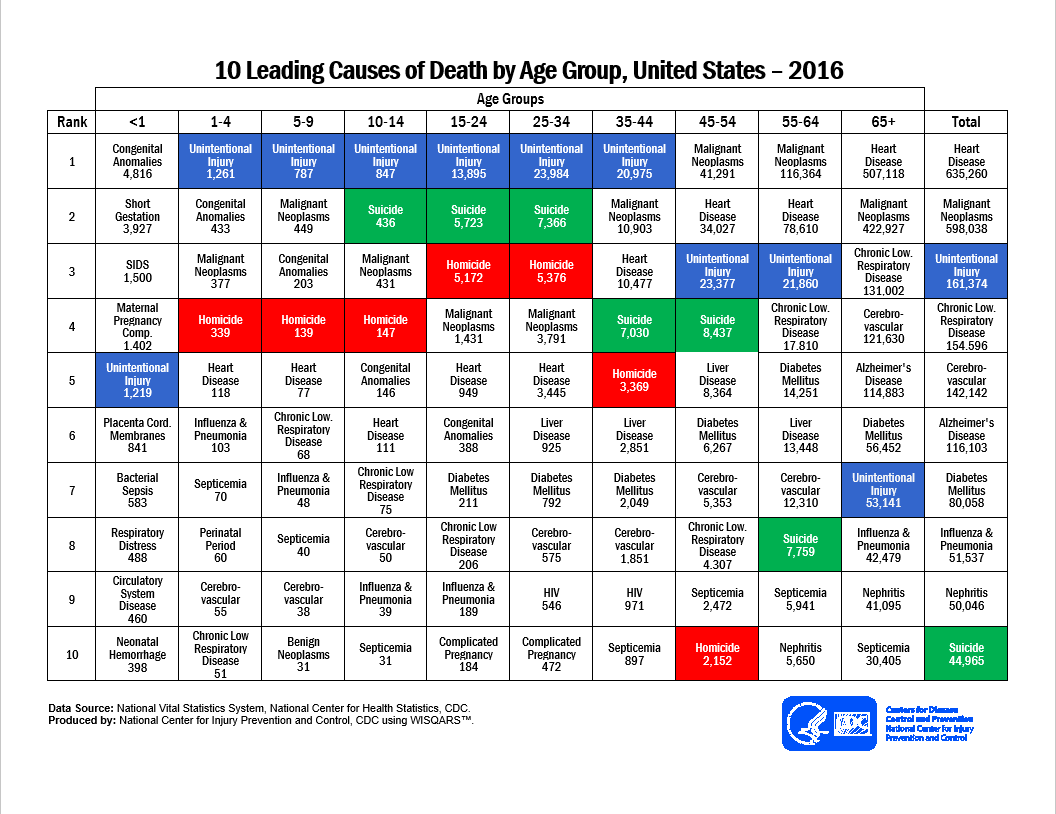
Yeah, suicides are climbing, up 50% since 1999. It's the #2 cause of death of people between 10-34. https://www.cdc.gov/injury/images/lc-charts/leading_causes_o...
To rephrase my question: is preventing suicide the primary reason why we should address loneliness?
I mean, loneliness also sucks? So that's one reason. Also there's evidence that it reduces life expectancy overall https://www.washingtonpost.com/national/health-science/does-... But why do we need to pick a primary reason?
Go watch the movie The Godfather. Find the part where Don Corleone slaps a crying Johnny Fontaine across the face and yells: "You could be a man!"
Watch this as many times as you need to.
In the nineteenth century, teenagers were trekking across the continent with young wives and children in tow. Look at where we have arrived: mewling man-children.
Go join the Marines.
TIL someone could watch The Godfather and come away thinking of Don Corleone as a role model.
I don't understand this comment at all. Maybe tone down the imagery a bit and say what you mean? The suicide rate among veterans is about 75% higher than for the general population in the USA.
coordinate social change - Maybe worker rights and regulation of basic needs items by supply side economics?
Imagine if workers had actual careers, that didn't bounce them from city to city (unless they wanted to relocate).
How about if housing had minimum codes that encouraged actual privacy. (Such as being able to take a shower or do the dishes at 2AM without anyone around you hearing anything; also to doing them at 10PM without waking morning people and at 8AM without waking night people.)
Also if 'rent control' / housing cost control meant that if the market were over a given price more housing would be built in that market to drive the price down properly.
Housing also should not be an investment, that encourages poor behavior in all sorts of ways.
Many reasons for this, and many good ones have already been noted, but I haven't seen anyone mention time yet. Americans work a lot. If you don't make friends at work, or you don't maintain friendships from high school or college, you're working on limited time and energy - as are the people you hope to befriend (though you don't know who they are yet). If you have a family, it's even harder.
I don't have kids, and while I don't have a ton of friends, I'm lucky to have some good, close friends, who I don't (imo) have enough time for and don't get to see enough.
> Many reasons for this, and many good ones have already been noted, but I haven't seen anyone mention time yet. Americans work a lot.
This one is kind of easy. I work A LOT too, but when I’m not, I’m also not: 1. Sitting at the computer, 2. Watching TV/Netflix, 3. Buried in my phone playing Candy Crush
A lot of things I used to say I couldn’t do, I started doing—purely by turning off the screens.
Here [1] is a list of nations by hours worked. The US average is just about squarely average here. The OECD average is 1763 hours per year. Americans work 26 hours longer than that per year, so half an hour per week, less than 5 minutes a day, longer.
[1] - https://en.wikipedia.org/wiki/Working_time#Average_annual_ho...
One think that can lead to loneliness is material abundance namely the abundance of houses. Here in Portugal we have 40% more houses than families. For instance the building that I live has 8 apartments and it was build 60 years ago. I have some neighbors that live here since the beginning. They told me there was a time it had 50 residents. Now there are only ten residents. We are so surrounded by abundance that we are more and more apart from each other. But we cannot stop building houses because that would mean less jobs and the end of economic growth.
I think the solution for your country may be the inverse of the one I recommended for America in a different post in this thread.
The construction workers should become destruction workers driven by supply side regulations aimed at keeping the price of housing 'stable' by encouraging the retirement of the lesser quality housing and the conversion of those areas to more socially productive uses. (Maybe parks, nature, or buildings more suitable to society's needs.)
I'm 21 years old, I grew up online. I started on myspace and chat via gmail, eventually moving to Facebook.
Fast forward through an early highschool graduation, and taking most college classes online: I have no idea how on Earth I am to socialize with people in the real world.
I quit and deactivated Facebook in January, and since I have felt so truly alone. Each day I ride an uber to my dev job, work mostly by myself, then ride back to my apartment. I speak with my coworkers, but all business, and rarely speak with the drivers because it feels so awkward and strange.
To me, it feels like it's going to get worse. I am personally upset that my abilities to connect with other people my age feels so stunted because of the Web. And now, kids in this school district use smartphones in 6th grade.
A lot of this is likely bias, my mental health is really suffering, and I've bounced in and out of therapy for awhile. So take it with a grain of salt.
> rarely speak with the drivers because it feels so awkward and strange
If you decide to not do something just because it feels strange, you will limit your growth in many ways.
Everything you haven't done very often feels strange.
Step out of your so-called comfort zone, make that a habit.
Entirely fair criticism and I am aware that the isolation I am in is self imposed, at least to a degree! Thank you.
I am reasonably good at pushing myself at other things, like my career or learning new things. I just need to take that step with my social anxiety as well.
Is there a form of exercise you enjoy? Even walking is fine. Put on a podcast and go for a stroll (longer the better). Then afterwards, use the momentum and sense of accomplishment to push yourself to try something "strange" or out of your comfort zone. I think with Uber/Lyft drivers, I agree that the conversation in the car is very fleeting, so it's important to invest and try to build new relationships that will be more long-lasting (e.g. like a sports club, board games group, book groups, etc).
You do have to be careful with this, There are plenty of things that feel awkward or strange for good reasons.
I'm sorry to hear this.
I used to have major struggles like this when I was younger. I think people like us are very much in our own heads, maybe too much. Sometimes it's good for us to just jump out there and socialize. Sometimes all it takes is to pretend to be outgoing for 2 hours at a time. Go to a conference for work, or play sports at the gym, whatever. Of course it's a challenge every time, and I'm oversimplifying (I'm definitely no mental health professional). It took me years -- decades really -- to get more comfortable being outgoing. But a life lived with good relationships is truly a more fulfilling life.
Progress in this area often happens by way of other activities, because it's just less initially awkward, and people have things in common. Do you like sports? Join a softball team. Music? Take lessons, and play shows and meet people. Go to the same restaurant regularly and get to know the staff. Volunteer and help others. Join a church or an organization with people that share your beliefs. Have conversations with people you come across -- take interest in the Uber drivers' lives, and you'll quickly become their favorite customer. Once you have good connections with a group of people, before you know it you'll start meeting their friends, and so on, and eventually you'll have your own group of buddies that you'll see around town.
Also, you're connecting with others on Hacker News, which is something. I think you might have more of a knack for this than you realize. I would say to do what you're doing here -- people don't have enough conversations in the real world, so people that do so stand out as being friendly.
It hurts me to hear of other people going through what I went through and still do from time to time. But if I could boil what I've learned down to one piece of advice, I would say, show others that you care about them. They're very likely going through struggles similar to what you are experiencing.
Every person in our lives is a gift, and it's easy for all of us to forget this.
Wishing you the best!
Thank you so much for the kind words! I appreciate the "I've been there, here's what worked" outlook as well.
I'll start working to implement some of these practices in my life. Finding a good organization sounds like a great idea and something I need to just do.
There's a makerspace a few blocks from my work. I think it's time to email them about membership!
You’re welcome! That’s a good first step. Best of luck in all your endeavors!
The post-college life is very hard this way. A very good friend of mine did not grow up on the web, is very gregarious, and still finds that connecting with people is hard, despite whereever she goes.
Some regions are worse - the PNW is notoriously bad regarding this.
My suggestion is to find a hobby - any hobby that doesn't seem gross and is within your means and personality - and take a class, then branch out regarding social groups from there.
oh yes - to you (& any other people reading this) - if you ever stop by Seattle, I'm always open for lunch downtown during the work week - and I love meeting Strangers From The Internet. We often have more in common than randos on the street. :)
Honestly, try meetup.com, find something you enjoy doing and go do it with other people. Worst case you do something you enjoy doing. Best case you meet people who also enjoy that thing.
Have you tried that meetup thing? How did it went?
I use it all the time, but more because I manage a few groups, people who come out and I talk with are always happy to find there are people who share their interests, even if they never come back.
Interesting!
> I quit and deactivated Facebook in January, and since I have felt so truly alone.
I've long suspected that Facebook serves a beneficial function for lonely singles, a way to socialize without having a partner or IRL friends. As a short term fix against loneliness I think that's great. That said, constant Facebooking can also get in the way of getting to know and keeping friends IRL.
Sounds to me you are poised to explore the big and growing world of people who prefer face-to-face relationships, i.e. the kind of relationships that matters most. Hang in there.
My own opinion, and one reason I avoid all such sites and accounts so stringently, is that such "platforms" (walled gardens) are a man in the middle attack on social interaction. This affects society's health and wellbeing overall, including making it more difficult to engage in healthy relationships/interactions with others addicted to any given platform.
Theory: human relationships can be hard, very hard, and any technology that confuses one into thinking he can enjoy his time without the 'burden' of human interactions is pushing this issue deeper.
I think of this theory like how lead poisoning works, where the lead can pass through the blood–brain barrier and substitute in (poorly) for calcium, causing all sorts of toxicity effects. Or how drinking sea water can fool your throat for a second into thinking you've taken care of your thirst.
Online social interactions are plentiful and easy and often don't as quickly or sharply trigger social anxiety. But they are a toxic replacement if you don't get any real interaction with your fellow humans.
The other day I raised my hand to high five a stranger in a dance event and she didn’t notice and passed the other way. I remarked how I haven’t felt something like that in awhile. Imagine if you had to watch everyone left swipe you in tinder or reject your resume personally.
at least lead has no intent, but western culture (and now even more than western) is all about making things easier and easier. That's the only metric. It's turning us into sick vegetables. And we pay for it.
There was a related discussion here a few months ago about the difficulty of making friends after a certain age (40?). Here's my take on it, from someone who immigrated to the US late in his 20s. My point of view is very biased towards the region I live in, which is much more educated and wealthy than most of the US.
Let's start with how kids grow up here since I think it affects their social life later in life. American parents are protective. Most kids, even in middle school, have very structured schedule where time with friends is usually not a priority like academics. Playdates are usually organized by the parents and they are usually short and not spontaneous. Kids who don't live in walkable urban areas with good public transit usually depend on their parents to drive them around to friends. I heard that in rural and poor areas it's even worse. People never go to each other house, instead they only meet at the Church.
Now let's talk about American adults. Americans seem to love communities. They are pretty involved in their communities which is great. However, they usually stay away from forming deep relationships and exposing themselves. Sometimes it feels like they don't want to be a burden on somebody else. Not sure exactly how to explain it. My impression is that many Americans have friends but usually not very close friends (at least based on my definition of close). Maybe the size of the country and the fact the people move often is also a factor.
I'm curious if this is a direct result of the internet and smartphones. The two make us feel more connected, more global, but I think it makes us more isolated. I miss talking to my friends on the phone, and hanging out in the 90s. Everything, especially how humans interact, is so digital today.
I'm one of those few people who don't have a smartphone (by choice) so I observe this behavior a lot because I'm often looking forward instead of down at a phone.
But, check this out...
Everyone misses that. All you have to do is initiate the conversation.
A few days ago I had a 30 minute discussion with a random dude on Swedish death metal bands because he happened to be playing a song from a band I know while I walked past his house. I've been walking for 5 years and this hasn't happened once, so I had stop and say something.
Every time I take the 90min train ride into the city I usually end up talking to someone for most of the way. I'm not a good conversationalist either or some super extroverted person. I'm just bored sitting on the train, and other people are too (even if they are flipping through their twitter feed).
It's prime pickings to start conversations because everyone is so deprived of it.
> The two make us feel more connected, more global, but I think it makes us more isolated.
My wife and I had this discussion the other day. Messaging or posting on FB or whatever is very flat. There's no depth to it at all. It doesn't replace hearing a loved one's voice or looking into their eyes or hugging them or even having a meal with them. When you go and you visit them and you see them, you realize how much you're missing and, yeah, it feels very isolating to realize that. Social media is a facade.
Maybe so, but when I'm done with work, I hang out with my bros and play games on Discord (before that it was Ventrilo/Mumble/TeamSpeak). It may not be face to face interaction, but we're super social and it's great for us. We're always meeting new people and having new voice interactions, which at least for me, is as good (or better) than hanging out IRL. It's still nice to meet up sometimes, but definitely not needed to avoid loneliness.
It's not like I touch my friends much when we're meeting up IRL anyway, and voice is more comfortable to me than being on video (or being visible irl), as I don't have to think about how I carry myself.
Tons of gamers do this and I don't think many of them are in the "lonely" camp. I'm not sure why voice channels haven't seen wider adoption outside of gaming.
Social media interactions don't replace that though. Previously, if I wasn't hearing their voices or seeing their faces, then I wasn't interacting with them at all. Now I can at least see little glimpses into their lives without having to get on a plane.
In my last relationship, almost all our communication when we weren't together was by text. She really had no interest in talking on the phone.
When she finally decided to dump me, she did it by text, and refused to meet in person or even talk on the phone about it.
My hunch is that this isn't the primary reason for such high loneliness though. If smartphone and internet use is contributing so substantially to loneliness, you might expect loneliness to be increasing across the world. I am not sure if that is the case, but I would be surprised if all other countries with equivalent internet and smartphone usage would have similar rates of loneliness.
Was looking for this response as it's the key point.
If you're going to make a hypothesis that A leads to B then you should at other countries that also have A (in this case, lots of smart phones and internet) and see if they also have B (in this case loneliness). That doesn't seem to be the case, certainly not anywhere near the rate in the US.
This basic practice refutes a really large percent of unfounded views, and so is really a good habit to get into when looking to explain things.
Could be a change in reference frame, facebook did make be super depressed because I kept seeing others photographic happiness. I'm not more social these days but being off social networks I spend a lot less time ruminating over it and do other things (even walking out).
Totally agree with this. When was the last time you were in line at a coffee shop? Everybody staring into their phones. Compare that with sometime from like the early 90s where conversations would start up between folks inline. All these people staring at their phones it looks like the eighties equivalent of a Twilight Zone episode
How often did you have a conversation with someone in line at a coffee shop before smartphones?
Edit: not that I'm against it. I've had a very friendly chat with people in a mechanic's waiting room. It's just vanishingly rare.
We’re also now augmenting the problem with bluetooth earbuds becoming more ubiquitous, even if they’re not actively being used.
At least for me I find it a bit more difficult to approach someone if I think they’re listening to something or on a call.
I'd sooner blame later marriage and lower fertility. It's people you (ideally) live with and are 100% committed too. Friendships can be tenuous, but family is putting your money where your mouth is.
There is a certain "herd immunity" to social interaction to the point that nowadays taking down your phone or your book will not make a difference. It's probably not caused by smartphones and media, but they have facilitated the trend.
There used to be a time when constantly looking at a smartphone was the odd one out. Now it's the reverse.
No need to be curious, there has been a ton of articles recently about this. By constantly being barraged by all of the best snippets of everyone's life, kids especially are more depressed, and socially inept.
"Decades of research substantiate the devastating effects of social isolation. Loneliness is equivalent to smoking 15 cigarettes a day and increases the risk of death by 26-45%, which is on par with risk factors such as high blood pressure, obesity, and lack of exercise."
It would be interesting to know if men are more lonely than women as everything I've seen has shown that it's easier for women to join social circles and find dates whereas most men struggle with this. As a result, I wonder if this connects to the much high suicide rate for men.
Women attempt suicide at a rate 40 to 60% higher than men. Men on the other hand die at a greater rate because of the greater use of lethal means like guns etc. It still may be that loneliness is a greater factor in male depression but gender differences in suicide rates are misleading indicators.
I've always wondered just how reliable the suicide stat is because once someone commits suicide, they are no longer able to attempt it.
It's kinda like how one has to be careful measuring people interviewing for jobs, since someone who interviews poorly will spend many interviews before being hired but someone who interviews well will only do a few (on average). So measuring the average ability of the candidate in interviews will be worse than the average ability of people who have been interviewed.
Just from looking at Meetup.com, I see all kinds of social groups just for women in my metro area, but I never see such things for men. There's social groups for everyone, and social groups just for women, and also social groups just for particular little subgroups (LGBT, [religion], etc.). I think there's something to this.
Another thing I've noticed is how many urban women get their exercise from "classes": barre, yoga, pilates, "orange theory", etc. Go into one of these and you probably won't see a single male there.
There are box clubs, amateur soccer clubs, boardgames meetups, tech meetups etc. They are not male only, but mostly males go there. I have also seen craft classes with appeal to men or with 50-50 split among members. A community tends to form around it.
Yoga and pilates attracts mostly women, but they won't kick out males either (as in, I seen guys there, but like 1-2 for full class of women).
There is an episode of Hidden Brain which touches on this subject, though I don't remember if it mentions any sort of measured differences between men and women. Either way, it is a neat discussion on the topic.
https://www.npr.org/2018/03/19/594719471/guys-we-have-a-prob....
I don’t have the study on me but there is evidence for that. The key I remember is that men bond over EXPERIENCES and doing things together, while for female-female (and male-female) interactions, just talking on the phone and catching up works. It changed how I approached some of my relationships (ex. Catch up with a male friend over a sport/activity vs over coffee)
The problem with activity based socialization strategy is that it starts failing when you have less time, get sick, weak or whatever else that prevents you or your friends to regularly do the choosen activity. As in, it is easier, you don't have to think hard about topics nor listen to boring parts, it helps smooth over personal differences at least to me and activity inviation makes things less weird (I even considered it superior). But it failed me in some life situations and left me having really hard time to find socialization.
When I thought about it afterwards, maybe the mistake is to treat your socialization strategy as something inflexible "I do it that way" instead it is set of skills, habits and decisions that can be learned and tested.
Social isolation and loneliness is not the same. When you work with people you don't like much, you are lonely but not isolated.
Also interesting, 18- to 22-year-olds are the loneliest subgroup.
I was listening to a podcast recently where this topic came up with regards to the social pastime of jury duty. A man was being interviewed who lived during a time before smartphones, and he retold that he really enjoyed going to jury duty because it was a chance for him to get to meet people in his city from all different backgrounds. There was a lot of waiting around, so people always talked to each other out of boredom.
Now, whenever you go to jury duty and there's a waiting period of some sort, everyone is of course on their smartphones. The reason for this isn't just for the fact that there might be more interesting things happening on the web than in the quiet courtroom, but instead it's because the smartphone generation can "hang out" with people exactly like them 24/7. To me it seems like a cold optimization of your social graph aided by technology. It does some wonders for loneliness (it's amazing that I can hang out with my friends anywhere in the world at any time and they all have the same interests as me), but it's also causing a lot of deep societal problems. Echo chambers, de-emphasis on local affairs, an ever-widening gap of political viewpoints, and a horrible "grass is always greener" psychological effect.
While loneliness is a real and important problem, there's good reason to be skeptical about it being an "epidemic". The Cigna study is incredibly flawed:
http://andrewgelman.com/2018/05/09/43-loneliest-number-youll...
Journalists (like David Brooks in the New York Times) are getting it very wrong as well:
http://andrewgelman.com/2018/05/16/no-no-epidemic-loneliness...
A bit late now, but part of me wonders whether the advances in communication technology have made it too easy to keep in contact with people we already know, and whether that's caused part of this issue.
Think about it. In the olden days, if you went to college or moved to a new, somewhat distant town or country, that was it for your current social life. You lost contact with your existing friends, and you had to find new friends at the new location in order to not be lonely again.
That lack of communication forced you to meet new people on a regular basis, and likely made college/university a good place for it for so many young people. After all, you couldn't talk to your hometown friends as easily now, and your family was cut off too. You had to meet new people.
Smartphones and social media sites and other such things make it so you can easily keep up with the people you already know, and spend all your free time talking to those you're already in contact with. The need for finding new crowds has basically died.
I know there could be a lot of causes for this but one thing I've noticed, which is specific to my location, is that too much cultural homogeneity can lead to loneliness.
I remember clearly a time in my life when I was very lonely and having a lot of trouble meeting people. Eventually, I crafted a theory that most of the people in my environment secretly did not want to meet anyone. This was either because they already had busy lives or they just didn't need to know yet another person who was just like them.
Shortly thereafter, I went back to university and encountered a lot of exchange students who were perhaps legitimately in need of friends and perhaps also coming from cultures which tended to be much less closed off to casual friendliness. This fixed the loneliness problem for me very quickly. Of course, it must also be acknowledged that the environment in university tends to facilitate social activity.
Has anyone else noticed that clicking on this link causes them to be logged in as "Pam" on the site? That doesn't seem great...
Might be a dark pattern. To nudge you to create an account to make the world right again.
That's what I was supposed to do? I just legally changed my name to Pam.
That would be the weirdest dark pattern ever, although I could see it going down in a design meeting:
You know how people speak up more if you say something wrong, than if you ask for the right answer? Well, what if people were more likely to make accounts, if we made them think they already had an account called "Pam"?
...brilliant!
It persists when you move to other pages, too, although it's not obvious from the site what opportunities, if any, this newfound Pamhood presents.
EDIT: going to "manage your subscriptions" presents you with a login page, so no danger.
It looks like all the pages with personal info or settings are behind a login screen. Rest easy, Pam.
It allows you to logout of Pam. That seems to be it from a quick glance
But it does nothing. You load the link again and you are once again a member of the Pamstalt.
It's like a Sparticus thing. "I am Pam."
URL should probably be changed to: https://www.advisory.com/research/care-transformation-center...
Looks like the original URL came from a daily briefing email.
yeah sloppy, it sets a session token; session-setting URLs should be hard to share, not easy. thank god it asks for a password before you can do anything bad, but the e-mail exposure in the settings flow isn't great. fortunately the x_id param isn't sequential.
Haha, I see it also: xxxxxxx@xxxxxx.com
Luckily it asked for a login when I went to the profile.
In NYC, where I live, I would never strike up a conversation with a random stranger. The first thought that crosses my mind is, "oh they're probably on their way to work", or "they seem busy on their phone", etc.
Our smartphones, tablets, headphones definitely make us less approachable. But our attitudes towards work is also to blame. There is this culture of being busy in NYC all the time, it's almost as if people take pride in it. This probably shows in our body language too.
I feel especially alone on crowded trains. Everybody is staring at their phones or trying really hard to not make eye contact. No wonder a lot of out-of-towners feel NYC is an intimidating place and the people are rude.
When we visited NYC a few years ago, I thought NYC was one of the friendliest places in the USA I'd ever been. And I've been to the midwest, san francisco, the pacific NW, the southwest, and the DC area.
We took the subway and the bus, walked here and there, looked lost every now and then... people offered to help periodically, happily chatted on the subway... it was extremely impressive and we definitely would be up for living there sometime just based on how nice people were. There was a no-bs attitude which was refreshing, but they were also kind to the derpy tourists we were, in ways I'd never expect in Seattle.
The funny thing is when I'm on vacation, I find it much easier to strike up a conversation with strangers! Also, now that I think about it, when I'm walking around NYC with a camera around my neck (i like street photography), people approach me more often. I guess a derpy tourist is less intimidating hahah.
I lived in NYC for ten years, bars are where you can talk to random strangers. I had hundreds of conversations and met many people that way.
I used to live next to a bar. A few times a week, I'd take my laptop down there, grab a beer, maybe order dinner, and code. Over a year or so of doing that, I think maybe two or three people attempted to strike up conversations. Now, that might be a side effect of working on a laptop, or it might be the famously insular Seattle culture, but it still feels like a very low rate of spontaneous personal connection.
Going by old movies at least, it seems like pre-information-age, you'd expect to see far more social interaction in a setting like that.
Liquid courage helps of course.
We've designed ourselves into isolation. We leave our house in a metal box, arrive at work, then return to our metal box. The most prominent feature of newer houses from the street is the garage, not the door or porch. We live in a subdivision where the nearest store is a five minute drive, so nobody ever uses the sidewalks that are mandated to be there. We move across the country for work, so we aren't close to family. There's no real neutral place where people have to interact together for some reason, so you don't have the accidental meetings that is required to meet people and community.
> 46% of Americans report sometimes or always feeling alone
I would choose this answer but wouldn't say I'm lonely. 46% is no surprise. What percentage responded usually/always lonely?
What is significant are the othet equivalent health risks.
Not too long ago I listened to a really great podcast, The Lonely American Man [https://www.npr.org/2018/03/19/594719471/guys-we-have-a-prob...] that I thought really hit the nail on the head for a lot of men I know. Based on societal norms we men tend to lose our ability to make friends as we grow beyond our teens and turn to our female partners to arrange social activity for us.
I'm surprised to learn that more than half of Americans rarely or never feel alone.
Agreed; it is a ridiculous and alarmist leap for this piece to go from 46 percent “sometimes feel alone” to 46 percent are lonely.
One can be alone by choice and actually like it. “Lonely” connotates depression resulting from being alone.
A vast radical social experiment, replacing all human values with that of competitive & monomaniacal accumulation of material wealth, turns out to be a poor fit for actual humans. Well gosh.
The country being so politically polarized isn't helping. It's to the point where most only want to socialize with people in the same "tribe". For better or worse.
It's not great, and I think it shows our society is fracturing and collapsing, but I don't want to socialize much with any Trump voters either. I have enough problems; I don't need someone spouting insane conspiracy theories to me about how 9/11 was "an inside job", Sandy Hook never happened, etc.
> I don't need someone spouting insane conspiracy theories to me
Perhaps, but it may also help that person realize there are normal people in real life who don't share those ideas, despite being told that anyone they disagree with is a horrible person.
This is just like spending a bunch of time with religious zealots trying to convince them their religion is wrong. You're wasting your time, and you're just going to create more conflict. I have one Trump supporter in my social circle and when conversations veer that way with her it's never productive so I completely avoid it.
The bottom line is you cannot use logic to convince people their religious beliefs are wrong. Most rational people already know this about religions and religious people, the problem is they don't realize that right-wing politics (or any extremist politics for that matter) is also a religion.
Now before you try to argue that this only applies to the extremists, the problem in this country is that the entire right wing in this country is extremist. The only non-extremist position in this country is the mainstream Democratic party, which is basically center-right. The Republicans have gone full-on hard-right, so there's just no reasoning with anyone that buys into that stuff.
> The bottom line is you cannot use logic to convince people their religious beliefs are wrong.
You can, but only if they are peripheral rather than fundamental beliefs, and your chain of logic starts with their fundamental beliefs. Well, at least as much as you can use logic to convince anyone of anything.
The problem (well, a problem) is that you can't easily discern, from the outside, a peripheral belief that depends on fundamental beliefs from a fundamental belief which is rationalized in terms of other fundamental beliefs (though circularity of support between beliefs is a pretty good sign that all are fundamental and the support is mere rationalization.)
Perhaps, but that's not my job. I value my sanity too much to try and get them to understand those things are bunk.
I find it interesting that you conflate Trump voters with Alex Jones-style conspiracy theories. They are different subsets, just like your average Hillary voter isn't some mask-wearing rioting antifa.
I don't want to socialize much with any Trump voters either
There were 62,984,828 "deplorables" that voted for Trump in the last election. You're willing to paint with such a broad brush that you shun the 46.1% of the country who voted for Trump?
I think you have the wrong interpretation of Trump voters.
Respectfully, that's such bullshit. I rarely discuss politics with more than a few close friends; there are so many more interesting things to talk about! Separate your identity from The Party.
TL;DR: exit the media circuses and connect on a human level.
/grump
> Few providers have focused on the loneliest population: 18- to 22-year-olds. While typically a low-risk population, young adults experience rates of loneliness and social isolation far higher than any other age group according to Cigna's recent survey.
How is that the case?
18-to-22 seems like the easiest stage of adult life to make and keep friends.
These are the youngest adults. They go out regularly, meet each other in public venues like clubs and bars, they're often actively dating, especially now with the ubiquity of apps like Tinder.
Add to that the fact that they generally either just graduated highschool, or are attending college. College is probably the easiest place to make friends: you spend your entire life there with people your age who are intellectually compatible with you.
I don't know how they did that survey, but in my experience 18-22 year olds tend to have the most friends and active social lives of all adult ages.
Now, compare that to professionals who often have to relocate for work, and find themselves in a new location where they know nobody. There aren't really many social facilities to help these people make new friends.
So I really don't know how they arrived at the conclusion that 18-22s are the loneliest ages. The older people I know, especially in their 30s and 40s, are more prone to social isolation in every respect.
You probably don't know them, but single/divorced retirees are probably the loneliest folks. With no workplace to provide daily social exchange, unless they belong to a church, meeting others in a social setting becomes a huge challenge for seniors today. It's little wonder that the long venerated "joys of being retired" are undergoing a major rethink these days.
Oh, yeah, I absolutely agree. Generally, as I become familiar with older populations, the general rule seems has been that the older people get, the harder it is for them to break out of the shell of loneliness.
When I left college and started meeting young professionals, they seemed far more lonely than college students. Then when I started meeting older people in their 30s, they seemed lonelier still. Now the loneliest people I know are singles in their 40s.
The only exception seems to be that often people in their 30s get married, and then they typically seem less lonely, at least while the marriage is working.
For singles, though, there seems to be simple linear correlation between age and loneliness. So I'm sure when I get to know people in their 50s and 60s, they'll be even lonelier than the 40 year old singles I know now.
Wonder if that age group has become lonier in recent times, since the internet, smartphones, technology, etc. You don't need to go out to be 'entertained' like you used to, and I suspect a lot of young people simply find their entertainment online instead.
Do people still wonder why drug abuse is pandemic in America? Compound loneliness with poverty ... Are people still wondering? Why the birth rates are low and mortality so high? Seriously are people still wondering? Why we are such a divided society, full of hate and fear of one another. People can't be that fucking dumb in America. Maybe they are because they're still wondering. Why we fight wars we can't win? Why we fight so hard to prevent our neighbors from getting healthcare or education or help of any kind. No seriously, are people still wondering why our kids shoot themselves in schools and then when they don't do that shoot themselves up with heroin or worse? Are you telling me people are so fucking dumb here that they're still wondering about such things? Yeah, it appears the obvious escapes most people's common sense. Only the truly stupid wonder about such things. It's not just loneliness, it's lack of any kind of connection that drives people to do insane things. Yet people still wonder why that kid shot up his school. Are people here really that stupid? Yes they are.
Internet is the culprit - as humans we have replaced interacting in physical world with a digital world and thus the physical world is becoming more and more of a barren place when it comes to social interaction. In modern society, unless it is a dedicated club of some sorts or at a party or if it is pre-arranged, social interactions just don't happen.
Agriculture was a mistake.
We should never have crawled out of the ocean!
In the beginning the Universe was created. This has made a lot of people very angry and been widely regarded as a bad move.
Are Americans outliers in loneliness? I know Pinker mentions this in Enlightenment Now, but I feel like it's glossed over a bit since it doesn't really align with his thesis.
I'm very interested in the reasons for this, though. Loss of community structures without replacements? (Wider spread families for work, not going to church...)
Those who have had to move locations probably run into this the most. Usually friends formed in school and college are from a time you were young and naive and tend to have the deepest shared bonds.
And if you have to leave this behind getting the same level of social connection can be tough. Also some people are extremely friendly by nature, they love being around people and can engage easily, others are more reserved. Work colleagues are usually in a weird space, not strangers but not really friends.
Maybe human beings work best in known and close knit communities not urban alienated environments, clearly a lot of our happiness derives from social contexts, and we need that level of connectivity, interaction and support. Sometimes you want to be alone, but the rest of the time you want to be with people who love and care for you. Without it life becomes a bit empty and alienation becomes 'normal'.
Loneliness, in my experience, can be a symptom rather than a problem in and of itself.
I define my past loneliness as: Negative feelings, fed by:
- feeling bad in the first instance
- feeling powerless to improve my state
- feeling that others could improve my state, if only they would show sufficient interest in me
Gaining power to work on why I was feeling bad in the first instance (through health and lifestyle interventions) has had several effects over the years:
- it has improved my state so that I mostly feel good
- it has taught me many valuable things to share with others
The social aspect of my life has radically changed:
- I feel less dependent on others to feel good
- I have many things to share with others and enjoy sharing it
- My attitude and knowledge attracts others
- I am mentally/emotionally stable enough to withstand the ambiguities and stresses that relationships tend to give rise to
I don't claim to have solved loneliness, but I have solved my loneliness and I hope some will be helped by this insight.
How did you achieve it? What were the conditions to change your mental status,opinions?
The conditions were an inescapable sense that something had been going wrong with my life for a long time, and then getting very lucky: an acquaintance of mine is a genius and sort of transitioned several years ago into being a health guru, focused on addressing subclinical health conditions precisely like the kind that had been bugging me. I had a lot of faith in him, worked hard at it, and 8 years or so later am enjoying the benefits. Life is still challenging, but it's great deal better.
The genius is Paul Jaminet. Check out his work if you think you might benefit. I've also benefited from paying attention to the blogs of Chris Kresser, Mark Sisson, and Scott Alexander (his health-related posts of course). Google Scholar and Sci-Hub get huge credit too.
Long term effects of stranger danger writ large.
Being alone is a state, feeling lonely is a symptom that could be triggered by it, but not necessarily. Important distinction here. Warren Buffett spent most of his waking hours reading by himself. He's pushing 90. If you watch his HBO documentary notice how he is very big on shutting his office door and reading for the majority of his workday. If you are not peace when you are alone, there is something else going on that needs attention, listen to it, understand what might trigger that symptom and root cause it. Being with someone else might be a stopgap to your symptom but not a cure.
I don't want to put to fine a point on this...but...good?
Loneliness eventually becomes a motivator to find ways to stop being lonely. Usually that means improving yourself and coming to terms with some of your own faults so that you can stop being lonely. Sometimes it means being nicer to people. Sometimes it means making yourself get up the courage to go talk to that girl over there. Sometimes it means trying to get in better shape.
There are a lot of side effects from it, but you have to decide you are going to fix it and sometimes that means being lonely enough for it to no longer be tolerable.
I see an article about this issue pop up every month or so. But what’s actually being done about it? Seems like the solutions are not catching up with the possible hurdles that get introduced.
Alcoholics Anonymous helps with this for alcoholics. Generally friendships have to be built on some shared interest or experience, so I think it would be hard to create a solution for the general population.
What is the opposite of lonely though? Popular? Not to get all high school angsty, but I bet popular people, of the Instagram famous people variety, are much more popular than they would have been in previous eras given their expanded reach. Perhaps this is the dark side of Internet fame: Increasing real world obscurity for everyone else.
In previous eras, simple proximity counted for something. Now, it doesn't matter and is even a negative with all the drama around workplace dating for example.
Companionship or fellowship would be the primary opposites. Popular people don't necessarily have these, and they can still be lonely.
I was very popular in high school, and I have far, far fewer friends today, but I'm less lonely because of the level of my friendships - to use my self as an example.
My startup is trying to solve this problem for older adults. Seniors often feel disconnected and isolated as their social structures change. Ayuda is an service for finding senior-friendly events. We bring artists, educators, musicians and more to an audience they may not have considered before. Events are curated to be social and accessible for older people, not your typical concert in a loud bar.
Check us out on www.ayudacare.com if you are interested in what we're about.
I think the increased efficiency brought by technology produced an ever faster pace in work, social life, and just about everything else. It takes time to talk and connect with another person which is getting harder to come by. Most of the time, you're getting swept away doing work, looking at a post that just showed up, reading the latest tweet by the president, etc.
I suspect this is a growth trend largely resultant from intentional self-induced social isolation. This problem is similar, in the brain, to addiction in that the inflicted are incapable of perceiving the problem while the implications are immediately clear to them.
noted this elsewhere - but toplevel - if you are ever in downtown Seattle, feel a bit lonely (work trip?) and want to get lunch or coffee with Someone From The Internet, I am usually up for such a thing on a work day. email in profile, etc.
The title:
> Nearly Half of Americans Are Lonely
Vs the actual result of the study:
> 46% of Americans report sometimes or always feeling alone
I would have thought everyone feels lonely sometimes and I'm more suprised it is not higher. The title is clickbate.
I've noticed that most people have headphones on when they are out and about. It's a lot harder to strike up casual conversations with people that have headphones on.
Schizos Are Never Alone
I find the smoking refence in the opening paragraph ironic. I'm what i would call a social smoker. I can smoke and (thus far) not get addicted. But I hardly smoke. It's mainly a "oh...you're going for a smoke...mind if I join you...and bum one..." type of "habit."
It's away to have a brief moment of QT with someone. Taking it a step further, I wonder how much __good__ bacteria used to be exchanged between smokers, that also doesn't happen anymore.
My guess is that America in 2018 is more selfish and cliquey than any other time in memorable history. That simple really
We are an incredibly divided country—whether by religion, culture, ethnicity, sexuality, gender, language, etc etc. it’s a constant issue of us vs them. Unfortunately, Trump takes complete advantage of this to divide the country daily which only exacerbates the situation. I truly think this lack of ‘community life’ is killing Americans and the cause of a lot of other issues like health problems and suicide.
It's a vicious circle. This lack of community life also makes us more divided. That in turn helps destroy community life...
Completely agree. How do we fix this? I notice in other countries there is a much more collectivist mentality, whereas Americans are rooted in a mentality of rugged individualism. It’s hard to get Americans to actually care about each other. For example, the Pacific North West is hostile to California, Virginia looks down on North Carolina who looks down on South Carolina... there’s a lot of divisions across as wide range of demographics in America. It seems to be getting worse. Maybe the pendulum will begin to swing the other way? A really sad symptom is how many people go on social media but essentially broadcast to no one and get no feedback. It seems incredibly lonely to realize how many people online are sort of engaging in form of prayer of sorts (speaking to no one, hoping for a reply) and casting their emotions into a black hole of the Internet.
I think for all it’s merits, we’ve gotta get people offline and engaging with each other in the real world. We’ve gotta get people out of their thought bubbles too, but I have no idea how to accomplish that. Bringing back the Fairness Doctrine would probably help.
I miss Italy from that point of view. It's tough to make friends here in the US.
At least its good to know that you are not alone.
18 to 22 is the worst? Wow. That was unexpected!
Another sad downside to people fetishizing work...and the wealth that apparently results.
Right now people are just alone and grumbling, but give it another ten years and you will see this morph into alcoholism and/or drug abuse. Only a very few will be happy in a society where every interaction is a dick-measuring contest or chance to argue.
It's not too late to move to a hick town, find a spouse, pop out some kids and go to church/temple/mosque (no one gives a shit if you actually believe, it's about being around your neighbors). You will probably end up doing just as well financially as tech workers in SF who are doomed to be lifelong renters. You will definitely be happier.
I don't really get how moving to a more rural locale would make people less lonely. Looks like suicides among young people are way higher there https://jamanetwork.com/journals/jamapediatrics/fullarticle/... and people there are about equally likely to report being "connected" to their communities. https://qz.com/1286591/urban-and-rural-america-people-living...
>give it another ten years and you will see this morph into alcoholism and/or drug abuse
Have you looked at rates of alcohol and opiate abuse recently? It's already happening.
I've gone from "hick town" and going to church to cities (and going to church).
Everything is better except for the light pollution.
these are fucking insane psychos
they should be hunted down and killed
these worthless fucks will piss and shit on anything
We've banned this account. Commenting like this will eventually get your main account banned as well, so please don't.
I know what half I am in.