Last satellite in the Indian Regional Navigation Satellite System launched
newindianexpress.comReason to start working on the system as per the article :
"It is a culmination of 17 years of rigorous work by Indian space scientists. India took a firm decision on IRNSS in 1999 after the US government refused to share GPS data that would provide vital information on Pakistani troops position during Kargil war. As in the previous launches of the IRNSS satellites, PSLV-C41 has also used ‘XL’ version of PSLV equipped with six strap-ons, each carrying 12 tonnes of propellant."
> India took a firm decision on IRNSS in 1999 after the US government refused to share GPS data
Given India's rising position in the world economically (they'll have the fifth largest economy in two years or so) and militarily, they'd have been crazy to not go forward with their own system regardless. That's particularly the case given India has a very complex position among all the powers, from the US to the EU to Russia to China. They're far less blatantly aligned one direction or another than the rest.
Their general geo-political neighborhood presents wild security considerations. To be a fully independent power in the coming decades, they'll want to gradually acquire their own capabilities at most things.
I didn't understand this. How would the GPS system allow the US to know the location of Pakistani soldiers? GPS satellites only transmit and GPS receivers only receive - there is no return path that would disclose the location. What am I missing?
As far as I can tell, all the online reports have been written 15+ years after the fact, and they all just quote one another; I suspect the journalists may be mistaken.
It's worth bearing in mind the Kargil War took place in 1999, and GPS Selective Availability wasn't turned off until May 2000. It might be that India asked for the SA seed key so their own forces/missiles could navigate more accurately, but were denied?
IIRC, with SA on, accuracy was to within 100 meters. And that's enough for troop movements but not accurate enough for missiles and artillery. So using it for land navigation would have been fine. It's sounding like it was a case of "We want it because we want it"
Kargil is one of the highest battlefields on Earth. I don't think I'd compare Himalayan warfare to "land navigation".
https://en.wikipedia.org/wiki/Kargil_War
https://en.wikipedia.org/wiki/Mountain_warfare#Kashmir_confl...
> The most dangerous and volatile of all mountain conflicts involves the ongoing one between India and Pakistan over the Kashmir region.
It's a generic term meaning "How do I get my troops from here to there" either by vehicle or marching, such that they don't get lost and arrive when needed.
This is the classic way with map + compass. GPS just makes it easier. https://www.youtube.com/watch?v=xSNohNPqWlU
There are many scenarios, but here's a simple one. Boots on the ground.
You have men on the ground who can see the enemy position, they need to know exactly where they are to be able to know exactly where the enemy is. Without GPS you are relying on visual points of reference against maps of shaky providence.
Boots on the ground don't need to be accurate to within 1cm. If a normal human is within 10 meters they can nearly always figure things out. In fact if humans are that close it is because you don't actually know where the enemy is and you need the humans to find them - otherwise you would have a plane drop a bomb on them.
Where you need more accuracy is when you want something at a long distance to do something - drop a bomb or something.
https://m.timesofindia.com/home/science/How-Kargil-spurred-I...
This seems to have moderately more information. It seems like maybe they wanted to use GPS capabilities in their guided weapons systems, and the US would not permit it or perhaps threatened to disable the system in that theater? It’s a bit confusing and fuzzy.
Also because swearing-in ceremony of Barack Obama as US President in January 2009 had a disastrous impact on the test-firing of the BrahMos supersonic missile https://www.thehindubusinessline.com/news/national/how-obama...
> But an apprehensive US official turned down the request and told Kalam: “Sorry Dr Kalam, we will give you good lunch and dinner, but no Craig computer.”
> Kalam came back empty-handed, but went on to develop the Pace Plus computer with help from the Indian Institute of Science and others in two years. And, Pace Plus proved to be 20 times faster than Craig!
This type of thing sounds incredibly childish and jingoistic to my American ears. Does it read better to folks who learned to speak English in India, or is it just really awful writing?
Also, as best I can tell, there is no "Craig" super computer. Does the author mean Cray? And if so, why was the scientist asking the USG? You would normally want to get such computers from the manufacturer, not a foreign government, however friendly.
http://www.rediff.com/computer/dec/18super.htm
I agree that it is awful writing. I hope the article above is written better.
> Does the author mean Cray? And if so, why was the scientist asking the USG? You would normally want to get such computers from the manufacturer, not a foreign government, however friendly.
It's not possible to directly purchase from manufacturers if the US Government is going to block the purchase on various grounds. Don't forget that there was a period where sanctions and arms embargo was also imposed on India. It's a different thing that today the US considers India a "strategic partner" but it wasn't always the case.
As far as Cray goes, they even setup an award in the name of the scientist mentioned in the article (who also served as the President of India from 2002 to 2007 [1]): https://www.cray.com/blog/cray-hpc-awards-honor-achievements...
This is helpful historical context, and indeed a much better article. My thanks.
> Also, as best I can tell, there is no "Craig" super computer. Does the author mean Cray? And if so, why was the scientist asking the USG?
Because these things all have export controls. You don't see it if your shipping to a domestic address, but even in Canada I have to certify I won't re-export it when I buy electronic components from US suppliers.
That's the usual state of news reporting. People just love discourse of conspiracy over here.
It's not a conspiracy. The sale of Cray supercomputers was indeed blocked by the US Government. Just because the article is badly written doesn't negate the facts on the ground.
Its not about location of foot soldiers. Although the article highlights about GPS, it is mapping in general. India wanted terrain and altitude data for making strategy.
Only a guess, but at that time wasn't the GPS signal intentionally degraded for non-US-military use, with reduced accuracy? Perhaps they're talking about the more precise signal, which the US didn't let them use.
Yes, "selective availability" was still in use then - but I can't see how its use or not would disclose a GPS user's position.
"I need a missile strike. My position according to GPS is x and the Pakistani you should hit are 920m straight north of me according to my rangefinder."
GPS broadcasts several signals, the higher precision ones are encrypted - until 1999 GPS was encrypted at much lower resolution but the army and armies it shares its tech with still operate at a higher resolution.
The US can lock countries out of higher resolution GPS at will - this (and GLONASS) make sense because of it.
I would speculate that India wanted access to the encrypted military GPS signal, which would have given them 10-1000 times more accurate guidance for precision weapons.
Case of typical uninformed journalism. The basic use would be independent and reliable GPS guided munition.
GPS is the US system. GNSS is the generic term.
The basic use is navigation (the N is GNSS). That capability can be used for both civilian and military purposes. Chances are that even though it will be used by the Indian military it will be used far more often for civilian purposes.
Yes, my bad on the GPS/GNSS.
Yet on the use cases for this, I don't think India would have ponied up the money for this if it wasn't for the military use. With GPS, Galileo, Beidou and Glonass, the civilian navigation problem is pretty much solved. Are you aware of a use case it is solving that the others aren't?
The Indian government is probably also concerned that if the USA ever gets into a shooting war with China or Russia, the GPS constellation could be destroyed by anti-satellite weapons (or at least rendered temporarily inoperable by other means).
If USA, China and Russia go to war with each other, there will be no satellites left.
Not US', nor India's.
Where exactly does it say this the reason to start working on the "system" ? Also what do you mean by "work on the system" ? Reason for who to start working on the system ?
So my phone can use these satellite navigation systems: U.S. GPS, Russian GLONASS, European Galileo, Chinese BeiDou and Japanese QZSS.
I guess one more doesn't hurt, huh?
It's curious how major powers all want to have their own satellite navigation systems.
Edit: QZSS is a regional system, and not due to start until November 2018, yet my phone detected one of those satellites earlier about 2-3 weeks ago. Interesting, especially considering I'm nowhere near Japan. Unless, of course, it was a bug or some weird error case. Or maybe QZSS was doing some early testing?
These are essential national security assets, used for military purposes, and which a hostile (or even neutral) owner could turn off in case of war. The civilian use-case is a handy side benefit.
I've listened to interviews with the creators of GPS and they were very clear that it was always intended as a dual use military / civilian system.
It's always been that way, I mean, the master gps control station is a very highly guarded USAF base in Colorado.
Was a handy side-benefit, then GPS got so cheap and ubiquitous people tag their dogs and hire bikes. Now, location services are an essential civilian service.
A number of devices are theorized to use GPS for cryptographic randomness, such as ATMs. In 2007 the US navy accidentally jammed San Diego's GPS signal, but the effect wasn't too huge.
https://fieldlogix.com/news/navy-accidentally-jammed-gps-sys...
Just because someone tags their dog doesn't make it an essential civilian service.
But that's not the reason why all these countries feel the need to launch their own. If that was what India cared about they'd happily stick to GPS.
If you build your missiles to work using gps (as another poster pointed out), then you also want those to work if the US decides to not let you use the gps system.
> ...my phone detected one of those satellites earlier about 2-3 weeks ago. Interesting, especially considering I'm nowhere near Japan.
Could be an error, but you could just be in Australia or just about anywhere on the Eastern hemisphere. The orbits are geosynchronous and thus very high.
https://en.wikipedia.org/wiki/Quasi-Zenith_Satellite_System#...
Definitely not geosynchronous. It is a Quasi-Zenith Satellite System as per your link.
A lovely animation of three satellites: https://upload.wikimedia.org/wikipedia/commons/b/ba/Qzss-01-...
https://en.wikipedia.org/wiki/Quasi-Zenith_Satellite_System#...
"QZSS uses three satellites, each 120° apart, in highly inclined, slightly elliptical, geosynchronous orbits. Because of this inclination, they are not geostationary; they do not remain in the same place in the sky. Instead, their ground traces are asymmetrical figure-8 patterns (analemmas), designed to ensure that one is almost directly overhead (elevation 60° or more) over Japan at all times."
Ahhhh: geosynchronous versus geostationary. I hope I wasn't the only confused muppet!
That animation clearly shows they are geosynchronous?
How can you tell which nav systems your phone can see?
Android API provides this:
https://developer.android.com/reference/android/location/Gns...
https://developer.android.com/reference/android/location/Gns...
You can also use apps like GPS Test [0], etc. They can tell it as well. QZSS is represented by square icon(s) in that app.
[0]: https://play.google.com/store/apps/details?id=com.chartcross... (not affiliated with them in any way)
QZSS has been in test phase since 2010, and has had a full constellation of 4 satellites since last year.
I don't think IRNSS covers regions outside South Asia.

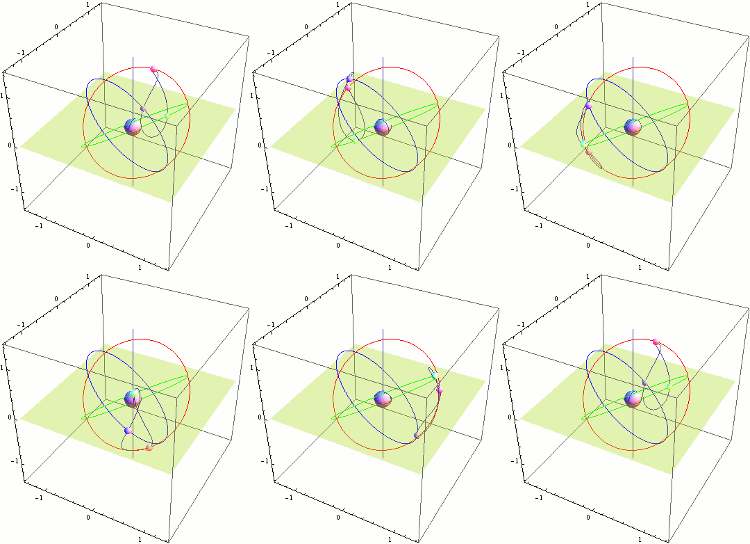
Curious. Do missile systems also lose track of their position midway through a flight like our phones? Are the receivers radically better than the ones in our phones? What happens if a missile loses its coordinates because of a bad signal? Does it just continue and keep track of its position based on the last known position or does it abort? If it cannot lock on to a GPS signal at the start of its flight, does it fail to take off?
Missile have their own very complex on-board guidance systems that don't require GPS at all. Newer missiles might use GPS as an extra layer of calibration, but I doubt they rely on it and most likely discard it if it's way off (otherwise GPS interference could potentially jam a missile).
There's a wiki on the various ways to guide a missile: https://en.wikipedia.org/wiki/Missile_guidance
Ballistic missiles use stars mid-flight and inertial guidance system during the terminal phase. Cruise missiles follow terrain.
Many of those systems were designed before GPS became operational, but even now relying on GPS is not particularly prudent.
The main things that cause loss of GPS 'lock' are the satellite signals being blocked (buildings, terrain, people, etc in the way), and multipath (signals being reflected off buildings, terrain, etc). A munition a few thousand feet above the ground has none of those things.
(There's also 'GPS jamming', which is totally a thing in war, but that's not really 'like our phones', generally.)
As other posts have mentioned, though, GPS is simply one input into weapons systems, not the input into weapons systems.
> Do missile systems also lose track of their position midway through a flight like our phones?
Civilian grade GPS receivers are intentionally crippled to stop working above some altitude/speed limits.
EDIT: It seems that the COCOM limits apply only after "1,900 km/h at an altitude higher than 18,000 m".
However, looking at the ublox receivers as an example, they have to be explicitly configured to operate at aircraft-level speeds, which smartphones likely aren't.
My iphone has picked up gps signals on short flights on several offasions, I have an almost flawless track on a flight from LGA to DCA, and on over the Mediterranean from Frankfurt to Lagos.
The LGA to DCA one had a max speed of 461mph (average 322) and altitude of 23,400 foot, with maximum negative gradient of 67.7%.
Maximum speed I've recorded overall (I've had the app open for 24,190 miles) is 673.3mph, and max altitude of 35,081 ft
Yeah, mine too! I got a perfect signal while flying from Las Vegas to San Francisco.
They not only have better receivers than in our phones, they have an entirely separate signal they can use- P-code (https://en.wikipedia.org/wiki/GPS_signals#Precision_code).
It's encrypted, so it's not for civilian use, and the ability to look at two signals of different frequency at the same time means that they have been able to have much more robust GPS than civilians for awhile.
Airplanes are big metal tubes that can block GPS signals, that's probably the problem you're having.
This is both amazing and sad. Amazing because its the emergence of (yet another) a space power, and amazing because it gives the world more and presumably healthy competition for a globally useful technology.
Sad because "we built, planned, funded and launched this awesome technology because ... war"
Humans. What a species.
Technology tends to be value-neutral. The application of technology could be for evil or for good. To claim that the primary purpose of the Indian Regional Navigation Satellite System (NAVIC) is for belligerent activities is to claim knowledge of the intentions of the Indian government at the time of the system's creation.
Couldn't it be just as likely or more likely that multiple positive and negative rationales were in play at the time?
I think it is amazing that we now have not one (US) but five (US, EU, CN, IN, RU) navigational satellite systems, two of which (US, RU) are globally operational and two more will be (EU, CN) by 2020. What interesting times we live in.- reduced dependency on the US - chance to learn something for oneself - give boost to the Indian aerospace fields - home-grown navigational abilities for war but also for civilian use - pride, wanting to be seen as a global tech leader - any other number of things?> To claim that the primary purpose of the Indian Regional Navigation Satellite System (NAVIC) is for belligerent activities is to claim knowledge of the intentions of the Indian government at the time of the system's creation.
Sounds like you didn't read the article:
> It is a culmination of 17 years of rigorous work by Indian space scientists. India took a firm decision on IRNSS in 1999 after the US government refused to share GPS data that would provide vital information on Pakistani troops position during Kargil war.
I did read the article. I'm not disagreeing that military matters motivated India's decision. I'm merely arguing against the claim that it was their primary motivation. I'm certain it was a large/significant factor, I doubt it was the only factor. There are so many other beneficial reasons to pursue this tech, some of which I enumerated. Consider Galileo.
It is of course hard to determine what is primary motivation for any large decision. But imagine a scenario where the US GPS system was somehow banned from military use. would it have been funded? I don't think so. And the same can be said for India and China and Europe's versions. Somewhere in the decision making is a desire to have this in case the bullets start flying - and that motivation is (IMO) sufficiently large that without it, it's dubious the decades long investments would have occurred.
No we cannot be certain, yes the peaceful benefits are many (cf US GPS) and it is of course right and proper that India takes steps she sees as necessary for her own defence.
But it is still a mixed emotion - optimism and sadness, joy and regret.
It's not an attack on the plans of nations to raise themselves up. It's just sad that humans are so brilliant and so dumb at the same time
Principals of the Indian space program are on record stating the system was developed to assure access to GNSS during conflict. There is no mystery regarding the motivations of the Indian government in deploying this system.
Is that necessarily a bad thing? Protecting one's sovereignty is essential in this day and age.
Why?
Are you serious? Should I remind you of Syria, Iraq, Libya, Yemen and various other countries that have been invaded and destroyed? If the big powers can't keep their thirst for more land and resources in check it's obvious that smaller powers will start taking matters into their own hands. There are incursions happening on a daily basis on the borders of India from both sides of the subcontinent and threatened by military incursions in the peninsula.
I would love it if there was a global world with no borders. But that is too idealistic. No one will give up weapons of mass destruction.
I assume that you are ok with having your country taken over by ( insert random country ) ?
I must say that US gun policy would improve for the better if China was running them.
Civilization is having the gun and choosing not to use it. Not bothering with the gun, singing kumbayah and depending on human goodwill is never going to work.
Human history shows there are competing interests who are willing to kill to get their way. Those lulled into a sense of complacency by fantasy narratives about the how the world works learn the hard way.
See the list of recent victims in the middle east starting from Iraq, Libya and now Syria. Tens to hundreds of thousands killed, families destroyed, infrastructure, education, healthcare destroyed and countries sent back decades if not hundred years in service of human greed.
And 50 years later commentators will dismiss these 'third world' countries as utter failures and insinuate some deficiency without any context of history. You can debate for ever but the man with the biggest gun gets the last word.
Not war, but self-preservation.
Historical fact: India has fought 5 wars since 1947, but was never the aggressor. India, or any country for that matter, doesn't choose its neighbors.
Remember, the internet was a result of DARPA's work.
I think you are missing the point. What I think GP was saying is it's sad that the only way to fund grand projects seems to be making them useful for killing other people.
That would be true if grand projects only came out of military funding. There are plenty of examples of wonderful projects that are the result of civilian enterprises without a primary military motive.
The Internet and GPS are more visible examples, but semiconductors, medicine, algorithms (like machine learning) etc are no less grand and marvelous in terms of taking humanity forward!
CERN participated also.
War is the mother of all inventions.
How does this compare to the Americans GPS? Is it as good or was it designed with different constraints in mind?
As good but works only in the Indian subcontinent and its neighbourhood.
Now I'm just waiting for GPS chip manufacturers to add support. Should increase resolution for those in the subcontinent :)
yet China has Beidou navigation system
IMHO, it's pretty useless compared to the current government and country's scenario. They better electrify the villages and provide better sanitation to the people rather then spending millions on mars, moon missions to prove their superiority! What a waste!
It may stop working in a year or two like any of their indigenous inventions!!
I'm not undermining any Indians, nor the way they work but as they are governed is by far the worst considering the current and past situations.
No quality, no nothing.