NASA to test prototype Kilopower nuclear reactor
world-nuclear-news.orgThis is similar to the "Stirling radioisotope generator" [1] but it is an actual nuclear reactor (albeit a small one). Both systems are a response to the same fundamental problem, the dwindling supply of Plutonium-238 [2]. The Stirling radioisotope generator uses Pu-238 more efficiently than thermoelectric RTGs, and the nuclear reactor from the article dispenses with Pu-238 altogether.
[1] https://en.wikipedia.org/wiki/Stirling_radioisotope_generato...
For anyone else wondering why Pu-238 is dwindling, from the linked wikipedia:
“The United States stopped producing bulk Pu-238 with the closure of the Savannah River Site reactors in 1988.[12][13][14]
Since 1993, all of the Pu-238 used in American spacecraft has been purchased from Russia. In total, 16.5 kilograms (36 lb) has been purchased but Russia is no longer producing Pu-238 and their own supply is reportedly running low.[15][16]”
Interestinly, it looks like Canada (Ontario, Darlington) are starting set up operations to make some in the near future.
Here's an episode of Space Policy from Planetary Radio. They go very in depth on the issue of pu-238, the efforts to restart production and why it is so complicated.
http://www.planetary.org/multimedia/planetary-radio/show/201...
US production has resumed, according to Wikipedia, as Cobalt 60 is coproduced and useful for medical sterilization.
As an aside: There are some people who are very skeptical of both atoms and space exploration. I'm not sure what their motives are but given the amount of steel necessary to produce wind turbines, I'm unconvinced that "renewable" is actually "greener."
"over 20 years, a three-megawatt wind turbine can deliver 80 times more energy than is used in its production and maintenance." [0]
Beyond that, Steel is 100% recyclable^, and that accounts for over 65% of US steel production. Recycled steel can be done in arc furnaces, requiring no coal coke. [1]
Info like this is at the tip of your fingers.
[0] https://www.worldsteel.org/en/dam/jcr:f07b864c-908e-4229-9f9...
[1] https://seekingalpha.com/article/3785906-metallurgical-coal-...
^ This rate is never achieved. Global average is ~90%, as some countries aren't efficient: http://www.steel.org/sustainability/steel-recycling.aspx
Okay!
Downvote me if you like but our fuel mix in this country is still ~40% combustion and the calculations on wind power say that at current power requirements civilization will harvest enough energy from the air currents to change the climate again. Maybe it stops hurricanes, I have no idea.
Also, steel, like atomic fuel, is toxic to produce and reprocess!
I know it is much-despised by but I am curious as to the lifetime energy footprint of a fission reactor facility with onsite fuel-reprocessing and waste transmutation. And then? Tokamak. Won't even need a turbine!!
Parts of that system don't even exist yet but me I believe one day there will be clean atoms, fission or fusion, and they will require even less energy to produce and maintain than the wind and solar grid.
But then, I have lived among the fission reactors my entire life. Perhaps I am "mad from the rads" ;)
> the calculations on wind power say that at current power requirements civilization will harvest enough energy from the air currents to change the climate again
?
Wind doesn't circulate through the atmosphere forever with perfect efficiency, it eventually dumps its energy into the ground via friction.
There's no difference between slowing wind down with a wind turbine and slowing it down with a tree, they both end up as heat eventually.
When I lived in Seattle I was sitting at a cafe one day and a government motorcade came down the street with an 18 wheel truck carrying a dumbell-shaped canister with a giant yellow nuclear symbol on the side. I've never been able to figure out what they were transporting. Does anybody here know what it might have been? It was post 9/11 so I was surprised they were still moving radioactive material on the surface streets of a major city.
An RH-72B[1] cask is a container for shipping trans-uranic nuclear waste, probably to the WIPP site.
[1] http://www.wipp.energy.gov/WIPPCommunityRelations/images/pho...
That's the one! I can finally put that mystery to rest. :)
To some extent we are radioactive material on the surface streets of the major cities, because we have consumed soil!! Even our steel tools can be somewhat radioactive, refinement concentrates point sources.
However, containment vessels like that are usually for refined ores, which end up in reactors, smoke detectors, medical devices, radiotherapy machines, you name it. Too expensive and possibly hazardous to airlift.
As far as I know, production of atomic weapons has stopped in this country and we're not even sure if they still work (half-lives--they rot). Could've been materiel for a stewardship program at the Hanford Site, or waste being evacuated from the Hanford Site.
Generally speaking, the remaining atoms transported and transmuted are for peace. That's why Russia brokers Uranium to the States, and why people in Kazakhstan and elsewhere continue to mine fissile ore.
If you were to shut down the remaining fission plants of Planet Earth, civilization as we know it, would end almost immediately, such is our need for these fuels. It would not be pretty--consider the amount of electric heat, the number of electric stoves with 50+ year duty lifetimes. That's why Japan recycles spent fuel at the French reactor.
Waste from the Hanford Site? Why would it be necessary to transport it through the most populous area of WA state? (I'm asking as somebody who has lived near Hanford as well as in the Seattle metro area)
Eh, it also doesn’t make sense since Hanford is a waste storage site...where else could the waste be going, and even if it’s high grade, why does that involve the Pacific Ocean rather than a trip to Utah or neveda in the other direction? I’ll assume that whatever it was, it was unrelated to Hanford, more likely something to do with nuclear submarines or the training reactor they had at UW.
Waste from Hanford would either stay at Hanford or go through Portland. Seattle is way out of the way. Portland much closer.
Could be related to all the Navy nuclear stuff around town like the shipyard at Bremerton or the Bangor sub base
This was my very first question. Thanks for pulling the basics out. I've been loosely following the proliferation of nuclear power in Ontario for a little while now, it is interesting to learn they'll be starting production nearby.
In light of the current geopolitical climate, it's probably better that NASA's (et al) plutonium should come from Canada vs. Russia.
The problem with Stirling engines is they have moving parts. It's highly unlikely a Stirling cycle generator on the Voyagers would have operated for 40+ years as their RTGs have.
The 40+ years the Voyager probes have stuck around for is impressive... but the actual primary mission duration was about 12 years (for Voyager 2), and that was with two (planned but not guaranteed) extensions for Uranus and Neptune.
The RTGs on both probes have decayed A fair amount at this point and are producing a lot less power.
10 years may seem short, but combined with an electrically powered thruster there is potential for doing types of missions we have not really been able to do before. That 10 years could be spent doing propulsion.
If you want to use it more in the science phase, use chemical rockets to get up to speed and then boot up the reactor in time to say, decelerate into orbit and you are looking at having the majority of that 10 years used at the destination.
My main concern isn't really the duration, but the reliability of the moving parts. But without plutonium, there are not a whole lot of other options for powering missions to Uranus and Neptune.
If you want to use the RTG to power thrusters, then I'd think that doing the "detour" via a stirling engine to create electrical current to turn into thrust might be unnecessary.
There must be some way to directly turn radioactivity (or heat) into thrust with sufficiently high exhaust velocity!?
Let me introduce you to the NERVA rocket. Nuclear thermal propulsion exists, but it's a real pain to make work and they had to search for coatings that could stand the heat and fuel.
Yup, I wonder how they can guarantee the engine will keep turning for 10 years even. Maybe if everything is sealed in a (very long) lived lubricant that stands the harshness of space?
Still hard to imagine
Stirling engines have a pair of seals that are extremely hard to make durable, and to my knowledge only Whisper Systems has cracked this problem to the point where you won't lose working gas (or seals) in a timespan much shorter than those 10 years. It's a stupidly hard engineering issue, without it there likely would have been far more adoption of the Stirling cycle for production machinery.
That's the usual way things are done. If you buy for instance a simple 5:1 gearbox for industrial use, it will quite likely be a sealed casing 'greased for life'.
Not that I'm disagreeing with you really - mechanical devices have high failure rates. 10 years maintenance-free is a bit of a dream. As a mechanical engineer I'm interested to see whether the Stirling engines involved have radically different scaling to optimise for reliability, or NASA just plan to do the engineering really well.
Of course manned maintenance may be possible - they are touting this technology for Mars bases. Plus robotic maintenance is going to become more of a thing over time.
There is a Stirling engine design which only has a piston as the single moving part, called a "lamina flow Stirling engine".
Note that while implementations usually show a crank and rod with a flywheel, it could just as easily use a magnet and coil to generate electricity.
That get's you down to a single part.
Then you have this:
https://en.wikipedia.org/wiki/Thermoacoustic_heat_engine
...that gets you down to something that can generate sound from a heat differential, and you could couple that sound to some kind of transducer to generate electricity. Still a moving part, though.
You probably can't get zero moving parts and yet have it do useful work, but you can get really close I think.
There's some work being done in superfluid discovery which would create the sort of conditions you're looking for but physics discoveries move incredibly slowly and some of the materials are rare or difficult to create. However, that sort of "lubricate, seal, and forget" kinetic system is essential for a lot of surface work in space. Increasingly important on Earth as well.
As a heuristic, the less mechanical parts in any system, the more efficient it is over time.
Ideally, everything that's built is engineered like a spacecraft, because to some extent it is, and is onboard one.
Sounds like there is some redundancy. These are intended for manned missions so occasionally replacing parts might be part of maintenance.
Another very interesting solution to the problem:
https://en.wikipedia.org/wiki/Optoelectric_nuclear_battery
Its major, still undressed downsides are the requirement of expensive beta emitters, and synthetic diamond PV cells (everything else will die to beta particles)
Here is a compromise solution I talked before: https://en.wikipedia.org/wiki/Alkali-metal_thermal_to_electr...
You get around 15 years of useful work and 15% efficiency with current day technology.
It has no moving parts as RTG, has better power to weight than RTG, and has efficiency comparable to simple Stirling
The tape recorders still work.
DTR operations were terminated on Voyager 2 in 2007, and Voyager 1 in 2015, but I don't know if this was related to mechanical problems with the tape recorders or just due to the lack of need given the data collected by the remaining instruments.
Also it is my understanding that /because/ it dispenses with the plutonium out right it's more benign until you turn it on. Which you would presumably do after the potential for RUD in atmosphere has diminished considerably.
> Also it is my understanding that /because/ it dispenses with the plutonium out right it's more benign until you turn it on. Which you would presumably do after the potential for RUD in atmosphere has diminished considerably.
This is a good point. Here's a picture of a Plutonium-238 oxide pellet (referenced from [1]):
https://en.wikipedia.org/wiki/Plutonium-238#/media/File:Plut...
It will always look like that if you have no way to dump the heat -- basically it's a heat source which is always on.
On the other hand a nuclear reactor that's never been activated will have fuel that looks like this (referenced from [2]):
https://en.wikipedia.org/wiki/Uranium-235#/media/File:HEUran...
This is no doubt oversimplifying things, since Pu-238 is a pure alpha emitter, whereas once it's been activated, the fuel in a nuclear reactor will generate all sorts of nasty radioactive isotopes which in turn release alpha radiation, beta radiation, neutrons, and gamma rays. It will be pretty safe while it's still cold though -- in fact if it ends up in the ocean it's really unlikely to hurt anything, since there is already uranium dissolved in sea water.
The other problem with RTGs is they scale very badly.
how ?
They're very low power, make a lot of waste low-grade heat, and use an inefficient electricity generation approach.
> make a lot of waste low-grade heat
That's probably the biggest issue for deep space it's extremely difficult to shed heat in hard vacuum (without ejecting mass and its heat with it) as you can only radiate it away.
And radiative heat transfer scaled with temperature to the fourth power so it would be easy to do if you had materials that could handle really high temperatures for long times.
But then your Carnot efficiency goes way down.


This is a very cool technology, but frankly I have a hard time imagining that it will see much use. NASA sees public protests and scare mongering whenever it tries to fly an RTG, which is based in the radioactive decay of (usually) plutonium, and does not use a nuclear chain reaction. They did fly one on Mars Science Lab, because it was the only way to get enough power for the rover. But it takes a PR hit every time it does so. RTGs are therefore only used when no other technology will work.
It think it's likely that the public relations nightmare NASA would have to go through to fly an actual reactor will be through the roof.
They used to get protests back when Galileo launched, but I don't recall any for Curiosity. There's the soothing effect over time of a known technology not screwing up.
Kilopower is safer, because it would launch inert, and it avoids Pu so any failures would be less toxic.
Downplaying the usefulness of a technology because of imaginary protesters isn't very helpful.
I don't think New Horizons received any protestors either.
It did: https://www.space.com/1929-nasa-pluto-mission-draws-dozen-pr...
(Not many, but more than zero.)
Has anyone studied these protesters? My off-the-cuff sense is they’re mostly older environmentalists.
It's because sometimes a rocket explodes on the launch pad or a few seconds later, and it could spread radiactive material over a very wide area.
The half-life of fuel for these reactors is very long - over 100,000 years. So for all practical biological effects they are basically stable. If it exploded before it was activated (far into space), it would be about the same danger to people and the environment as the rest of the exploding metal the rocket was made of.
The half-life of the currently used fuel (Plutonium 238) is 87 years.
The article is about a reactor that does not use plutonium.
Yeah, but this subthread is about protest reasons :) The reactor in the article (and the half-life of it's fuel) can't be the reason people are protesting.
Pretty much any uncontrolled explosion propels highly toxic material over a large area (rocket fuel is not lickable). I don't see how alpha radiation is inherently worse than hydrazine.
For that case there are launch escape systems typically used for crewed missions.
The alternatives still seem worse.
they should be indoctrinating kids at school that nuclear is safe, rather than other "stuff" they tell them nowadays
Totally. You're probably catching downvotes from people offended by "indoctrination", but a) indoctrination is what schools do, that's their purpose, and b) nuclear is actually pretty safe.
I agree with the sentiment. Anti-science sentiments proliferate partly because science doesn't spend much on public outreach, especially compared to people who want to make a buck off scaring others about new technologies. NASA has been doing more and more PR work over the past few years, and that's great - but IMO in this case, they really need to get someone who looks and sounds confident, and who would go on national TV and say "Yes, we are totally sending a nuclear reactor to space, why wouldn't we?".
I don't think people respond well to this kind of objective reasoning, it just doesn't work very well as an argument. At worse it can sound like you are calling them dumb. We need to explain the benefits, and why they are worth a tiny amount of risk. And accept that sceticism and concern are exactly what an intelligent layman should be exhibiting. Wondering if the thing is going to explode and cause cancer is a perfectly legitimate question to ask. To pursuade people you need to engage with them on an emotional level, not just bash them dismissively.
I agree. I didn't mean bashing people, just addressing some of the more irrational worries confidently as non-issues.
The way I feel it, engaging with irrationality legitimizes it. You don't want to do that too much. If you bend over yourself to explain that people really don't need to worry, it'll only make them feel that there is something to fear.
What I want to suggest is engaging with people on an emotional level, but projecting confidence while doing so.
In your zeal to defend nuclear energy, you're come around full circle, defending something indefensible, with arguments far removed from actual science.
Nuclear energy may be safe, if done under near-perfect condition, with extremely large budgets to understand risks, and plans to mitigate incidents. There is truth to the argument that nuclear power saves lives compared to coal power.
But nuclear power isn't inherently safe. It is, by its very nature, extremely dangerous. Actual nuclear scientists understand that. See, for example, Feynman's work on nuclear safety during the Manhattan project.
Strapping a nuclear reactor to a rocket is almost by definition a dirty bomb. Depending on the height and mode of an eventual launch failure, the result could be anything from Tchernobyl to a less-dramatic yet more deadly dispersal of nuclear material in the upper atmosphere.
The dose-response relationship of radiation exposure is largely linear, meaning the latter event might just increase your risk of brain cancer by 0.005%. Yes, you may consider it negligible. But statistically, it would kill half a million people.
To blithely state that "nuclear is safe, hoho, why shouldn't we strap Plutonium to a rocket, you environmental nincompoops" has nothing to do with science, and gives science a bad name. Maybe NASA could come up with a way to protect a reactor during a missile launch. But it wouldn't be easy, and saying "why wouldn't we?" on TV would not inspire confidence in their abilities, but doubts in their sanity. The right thing to say on TV is "We're sending a reactor into space, and here are the mechanisms we've come up with to make it safe..."
I wasn't aiming for the full pro-nuclear argument in a single comment, because it's a well-trodden road. Nuclear safety issues have been discussed ad nauseam here and elsewhere.
But maybe I should have stated my main assumption explicitly: people at NASA know what they're doing. They're not incompetent morons, they can do the math. They already have absurd amounts of procedures in place to ensure a launch failure doesn't hurt anyone. They're not just trying to strap a bunch of random nuclear isotopes on a rocket and hope for the best.
> Strapping a nuclear reactor to a rocket is almost by definition a dirty bomb.
No, it isn't. A dirty bomb is meant to create a large-scale radioactive contamination that's dangerous to humans, and U-235 is probably the last thing you'd like to put in it. It's an alpha emitter with a half-life so long it doesn't matter, so the only effect you'd get is heavy metal poisoning.
(That's beyond the fact that dirty bombs are speculative devices, and from what I read, they actually turned out not to be a real issue in practice.)
> Depending on the height and mode of an eventual launch failure, the result could be anything from Tchernobyl to a less-dramatic yet more deadly dispersal of nuclear material in the upper atmosphere.
That's the kind of thinking that I suggest we need to fight with a serious public outreach effort. Chernobyl was a total clusterfuck, but the only connection between it and the NASA project is the word "nuclear" in newspaper headlines. Chernobyl was an active reactor, and its explosion contaminated the area with reaction products that had very low half-life and underwent beta and gamma decay, making them really dangerous, unlike plain U-235.
> To blithely state that "nuclear is safe, hoho, why shouldn't we strap Plutonium to a rocket, you environmental nincompoops" has nothing to do with science, and gives science a bad name.
I'm not saying that. I'm saying that there's so much baseless fear around nuclear energy as a whole, that it's high time we stopped treating it as reasonable. And right now, the biggest danger around nuclear energy is the cost in lives of it not being used instead of fossil fuels.
"Depending on the height and mode of an eventual launch failure, the result could be anything from Tchernobyl to a less-dramatic yet more deadly dispersal of nuclear material in the upper atmosphere."
The thing about this reactor is that it doesn't work until you switch it on - so in case of an explosion you are spreading a near-stable isotope that you could handle without any health risks. Chernobyl doesn't compare, because the ashes were spreading isotopes produced as a result of operating the reactor, and are simply not present here until the reactor is actually switched on.
"nuclear is safe/unsafe" is meaningless unless we compare that with other technologies. Nuclear, despite all its nasty problems, is safer than many other technologies that are in wide use.
Consider coal electricity. It kills much more people globally than potential harm from space probes with nuclear engine blowing up in atmosphere periodically. Yet we continue to burn coal.
Or consider bio-engineering. We mess with cells without understand how they work. And since cells are self-replicating, we have a potential of quickly making the whole planet permanently unsuitable for human life. Compared with that the total risk of nuclear is bounded even after accounting for a possibility of a large-scale global nuclear war. Yet protests against, say, GMO are rather weak compared with protests against nuclear energy.
The models we use to guess dose vsm health are linear with no threshold and we chose this to be conservative in lieu of real low dose data. Since then there has been zero conclusive evidence that low dose radiation causes any harm at all. The people who live in very high natural background level areas have never been shown to have higher incidence of anything that could be linked to the radiation. The body has error correcting repair mehcanisms that can handle a lot.
the nuclear reactors you are so afraid of were designed in the 60s and haven't gone through stringent computer simulations, nowadays you have 100s of companies test every single part that will end up in a working reactor, it's come a long way.
Nuclear isn't inherently safe, though. It can be safe if the people do their jobs correctly. Whether you believe it is safe really comes down to whether you believe that regulatory agencies can provide adequate oversight to prevent people from cutting corners, making bad risk/benefit trade-offs, or sweeping problems under the rug to protect their jobs. That's more of a political problem than a technical one, and I don't really blame people for being skeptical that oversight in real-world scenarios is 100% effective.
"RTGs are therefore only used when no other technology will work."
I think this is a good thing. And it seems they can use them if nothing else works.
"Good" as in "extra expense and possibly lesser capabilities", I suppose.
And the bigger chance of failure like Rosetta could not send anymore, because the solar panels were blocked ...
Okay, this is awesome. 10kW is a serious enough amount of energy to do some fun stuff. Things like rovers that move at km/h rather than m/h and all day operation. It also solves the 'base load' problem on deep space missions which would like to use more power for radio communications.
"It also solves the 'base load' problem on deep space missions which would like to use more power for radio communications."
Not really, since "moving parts" ...
One of the primary uses are deep space probes. The stirling engine has exactly two moving parts and uses non contact seals. In theory the lifetime should be limited by the deformation of the piston at elevated temperatures. Still, you’re right. They certainly have to do a lot of reliability testing to be able to show that these stirling engines will last 10+ years before they use them in a mission. They have several stirling engines that have been running for multiple years in simulated conditions for just this purpose at NASA GRC.
But on deep space missions, aren't you aiming for 50+ years, or ideally potentially unlimited if you want to hit alpha centauri?
Voyager 1 is going for 50 years ...
Your point about moving parts is good, it is absolutely the place to look for possible failure. That said, it is also possible to build such things in a durable way. For example, at the science museum in London there was a display with a Stirling engine that over 75 years old and still works fine. I expect the challenge will be to keep the materials within the range of temperatures and pressures that do not cause structural change in the material.
Has that stirling engine had zero maintnence in the last 75 years? If so that is quite impressive and gives much more confidence that NASA can pull this off with the benefit of three quarters of a centruty of technological advancement.
Thermo-acoustic stirling engines have long been a niche product. Seems like a great environment for them to shine, and far better efficiency than RTG's.
Huh, interesting device: https://en.wikipedia.org/wiki/Thermoacoustic_heat_engine
Is this actually a thermo-acoustic engine, or some other kind of sterling engine? Or are they equivalent? The article doesn't seem to mention "acoustic" (or an equivalent).
Another thing to mention is sodium/lithium salt thermochemical generators that run at 15 percent efficiency with liquid salt being the only moving part
What's the advantage over direct thermoelectric conversion?
> What's the advantage over direct thermoelectric conversion?
Stirling engines can approach 50% efficiency [1], whereas thermocouples are usually less than 10% [2].
[1] https://en.wikipedia.org/wiki/Stirling_engine
[2] https://en.wikipedia.org/wiki/Thermoelectric_generator#Effic...
Cool, thanks! It's really surprising to me that inserting a mechanical intermediary has such a large efficiency advantage.
Why does mechanical stuff suck? Because of friction of moving parts. Too much energy is lost to heat. For a thermal engine, if you can arrange to put the moving parts mostly on the hot side, that’s no longer loss.
An RTG uses the Seebeck effect, which gets you microvolts per degree kelvin. A Stirling engine can theoretically extract many times more energy from the same temperature differential, but with a larger complexity.
Actually, when I mentioned thermoelectric conversion I wasn't referring to an RTG (which is just nuclear decay) but rather to the true nuclear reactors that the Soviets put in space:
https://en.wikipedia.org/wiki/Romashka_reactor https://en.wikipedia.org/wiki/TOPAZ_nuclear_reactor
They used thermoelectric conversion rather than a Sterling engine with moving parts (although I guess TOPAZ is technically "thermionc coversion").
I thought one of the advantages of the normal RTG is that it is non-mechanical. I would think a mechanical engine has a lot higher fail rates?
The problem with normal RTGs is they're dependent on Pu 238 which is in short supply.
More details in this german article: https://www.golem.de/news/kilopower-ein-kernreaktor-fuer-rau...
I'll summarize some of the interesting points:
- The nuclear core (75kg of enriched uranium/molybdenum [1]) is designed to not go critical, even if it accidentally falls into the sea and is surrounded by water (which is a good neutron reflector). It only starts when you surround it with a neutron reflector made of beryllium (an even better neutron reflector, mainly due to less absorbtion). Combined with the fact that the reactor only gets nasty when it's been running for a while (and thus is already far away from earth) it is a lot safer than plutonium fueled RTGs.
- It would be very useful to reach far away destinations (like the orbit of Uranus, Neptun or Pluto) using ion drives, as they need to run for years and solar panels aren't effective far away from the sun.
- While there have been other attempts at developing nuclear reactors for space, most of them didn't go far. They could use an existing research reactor (Flattop [2]) for this project which already has all the required permissions to run, so a lot of paperwork could be saved for the Kilopower experiments.
- The Kilopower reactor is the first to use heatpipes instead of pumps for the heat transport and stirling engines for the energy generation. The first experiment was thus to show that the cyclic heat draw of the stirling engine would be safe, because usually nuclear reactors reach an equilibrium between heating up (and thus expanding slighty which slows down the reaction) and cooling down (which accelerates the reaction).
- Instead of the planned eight 125W Stirling engines, they're currently using two 70W ones from the Advanced Stirling Converter Project [3]. The other ones will be simulated using simple heatsinks.
- Theoretically it could run for hundreds of years (after 500 years less than 1% of the uranium will be used), but the Stirling engines will break much sooner than that.
[1] http://www.iaea.org/inis/collection/NCLCollectionStore/_Publ...
[2] https://en.wikipedia.org/wiki/Flattop_(critical_assembly)
[3] https://tec.grc.nasa.gov/rps/stirling-research-lab/advanced-...
My first thought was "deep space mission". But because of moving parts involved, this is probably not the use-case.
So a bit OT, I was wondering if anyone has yet thought about the solution of still using solar panels for them, but to also use a mirror to focus more light in the direction of the probe or a laserbeam?
I mean, theoretical I don't see why not, appart from being more expensive? Andd you could also offset the laser/mirror cost, because you only need them later on ....
(but to be on the safer side, I still would add a RTG)
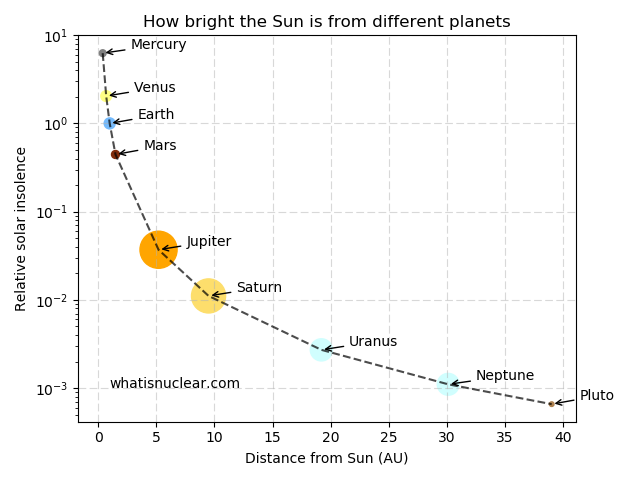
Inverse square law. Every n AU you go out from the earth you will need n2 are of mirror to focus on a solar panel to get the same power. That assumes you can even build a structure that can keep that shape.
Say you have a mission to Uranus, you will need a mirror with 400 times the area of the solar cells to get as much power as they would in earth orbit.
I made a cool plot of this in the solar system the other day.
Does this mean that if you go towards the sun, you would be able to generate more solar electricity with less surface area? I'm not thinking dyson sphere style, but perhaps some sort of electricity space-tanker, that sails toward (or around?) the sun, collecting solar energy, and then returns to earth with batteries packed to the brim with energy?
Dibs on Solar Harvester
Yes, it means exactly that - though soon you'll start hitting into issues with solar panel efficiency and thermal management. It's very hard to keep things cool in space.
The space electricity tanker idea is theoretically possible, but might not make any economical sense. For it to be worth it, it would have to store a lot of energy, so that it could ship back more than the cost of moving it around, while also being competitive with simply building more bigger collectors further away (and closer to the industry). But maybe a highly eccentric orbit, with a very low perihelion, would work.
Not totally sure if the math works out on this, but I could see moving the energy-intensive industry closer to the Sun, and having it use beamed energy to move resources and products to itself and back.
Take a look at the solar panels on the Parker Solar Probe: http://parkersolarprobe.jhuapl.edu/index.php#spacecraft
Hm, ok the mirror is probably out of the question then.
But if you use a laser?
I imagine it will be easier to focus it more precisely?
Lasers are still subject to the diffraction limit, regardless of the quality of focus.
We can examine this limit in the context of delivering energy to a remote object. This analysis will be simple - we assume that the optics are perfectly aligned (dubious - pointing is difficult); we assume nothing about the absorption properties of the object, which will necessarily need to be very high efficiency. The angular size T of a laser beam of wavelength L emitted by an aperture of diameter D_a is roughly L/D_a. Similarly, using the small angle approximation, this angular size T at the object itself will be the width of the beam, W, divided by the distance between the object and the aperture, D_o: T = W/D_o. Ultimately, this gives us the width: W = L*(D_o/D_a).
What does this tell us about the practicality of such a system? Visible light, wavelength roughly 500 nm, is perhaps a solid guess for a real system. Realistically the aperture size is probably limited to about 10 meters, but we can go even further and assume a synthesized aperture of a realistic system being 100 meters. You would want to get all of your beam for power transmission, so lets assume an upper limit for the beam width at the object to be 100 meters as well - probably unrealistic, but maybe solar sail/ultralight absorbers could get there. Throwing these numbers in gives a maximum range of... 2x10^10 meters. This is roughly a tenth of an AU. In comparison, this is about 50 Earth-Moon distances... and only a quarter of the distance between Earth and Mars at their closest approach. Coincidentally, this is also about one light-minute.
Any real power delivery system, using current tech and without assuming convenient fictions, will have a much more limited range. In short, lasers are not really perfect rays, even though they are approximately so over scales we typically encounter; at astronomical scale, diffraction always wins. This is why it is usually way better to bring the power with you - especially as you lose solar irradiance as you get further from the Sun. And for bringing power with you, nothing beats nuclear for energy density.
Thanks!
(also memorys of phsyik lectures are coming up again)
And forgive a nonserious reply:
"And for bringing power with you, nothing beats nuclear for energy density"
I think fusion does ...
can't reply for some reasons ...
anyway, yes sure fusion is nuclear power, I just read in your comment nuclear fission which you did not wrote ... so never mind I am just tired at some airport ...
Nuclear fusion is nuclear power.
Saw a documentary recently and they're doing just this.
From https://ntrs.nasa.gov/archive/nasa/casi.ntrs.nasa.gov/201600...
2-5 W / kg.
Solar cells seem to be about 150 W/kg.
This is relevant for outer system exploration (beyond Jupiter) or maybe for night power on planetary / moon surfaces.
Anyone know the approximate size of that thing? Hard to tell from the picture.
I saw a full scale prototype/model in the Stirling lab. I think a strong person could have lifted it up. It’s just several lbs of uranium with several heat pipes coming out of it connected to Stirling engines. I don’t think they have enough actual Stirling engines because the ASRG project to make them was cancelled so I think they use simulators for the heat load.
Hard to tell what the weight is, of course. Judging from the size of other objects in the picture (the lift point and the connectors) it's very roughly around four cubic feet. Which is actually pretty awesome; the equivalent solar panels would be significantly larger.
According to a NASA pdf the thing weighs 1150 Kg or thereabouts.
https://ntrs.nasa.gov/archive/nasa/casi.ntrs.nasa.gov/201700...
Heat sink for space operation will be quite large though.
I first read 'NASA to test KILLpower nuclear reactor' and thought are they starting to use Space X naming conventions...
the cold of space and the heat of a nuclear reactor would be the perfect combination for a peltier reaction. not very good for a rover though.
Space is cold, but there's not much there, so your flux will be very small. Of the three ways to move heat (radiation, convection, and conduction) you're basically reduced to radiation, which is the least efficient.
cold of space? Unfortunately, no - space is an extremely effective insulator, so it's extremely difficult to get rid of heat. You need large heat sinks (which adds weight) and they have piss-poor efficiency in space. So your cold side would get hot very quickly
are you saying it would be better on a planet with an atmosphere to use as heat conduction medium?
put it in a car
1kW isn't driving you anywhere though(even if we ignore all the dangers of having a nuclear reactor in a car). A typical automotive engine produces 100-300kW.
Highway speed power draw is closer to 25 kW, so a small scale up (they also discuss 10 kW) and you have a self charging battery.
But apparently the 10 kW is modeled to weigh about 1800 kg, so no need to worry about one in a car any time soon.
But it would be perfect for a well isolated home wouldn't it?
Hmmmm a normal boiler for a 4-person family home is about 8-10kW so again, probably not. At least not for heating. But for normal power consumption should be ok, especially if paired with some storage device to account of periods of higher consumption(running a 3kW kettle for couple minutes for example).
Well yeah not the average household obviously but if you really wanted to get rid of your dependency on the grid it would be somewhat possible. As opposed to say drive a at least 70 HP ~ 50 KW car. Not a proposal for everybody of course but for lets say political idealists.
As far as the 3kW kettle is concerned having a battery to provide for these surges is entirely viable.
Like this? https://en.wikipedia.org/wiki/Ford_Nucleon
Also, you need more than a few kilowatts to power a car. 10kW = 13.4 hp. It may work, but you won't break speed records...
Strap it to an EmDrive and head for the stars!