LIGO and Virgo announce the detection of a black hole binary merger
ligo.caltech.edu> Dubbed GW170608, the latest discovery was produced by the merger of two relatively light black holes, 7 and 12 times the mass of the sun, at a distance of about a billion light-years from Earth. The merger left behind a final black hole 18 times the mass of the sun, meaning that energy equivalent to about 1 solar mass was emitted as gravitational waves during the collision.
I wonder if one would experience any macroscopic effects from the gravitational waves if one were close enough to the black holes during the merger. Or would one have to be so close that tidal effects from the black holes' gravity would mask any of those effects?
I ask because one solar mass worth of energy sounds like ... a lot. At least to me as an astronomical layperson.
Apparently from 1 AU you might just be able to hear it! Even that close the stretching and squishing would be on the order of micrometers but the eardrum might be able to pick it up. The frequency would be comfortably in the audible range as well. [1]
[1] https://www.reddit.com/r/askscience/comments/45n0sz/how_clos...
Huh. IIRC, black hole mergers are also a likely source of short gamma ray bursts. So I suspect at 1 AU, one would need a lot of shielding to not get fried by the gamma rays.
EDIT: What I meant to say was: It would probably be quite awesome to experience such an event up close, provided it is possible to do so safely. ;-)
I believe that black hole mergers are dark in the entire electromagnetic (EM) spectrum. This is why the recent binary neutron star merger was so groundbreaking -- it emitted both gravitational waves and a broad spectrum of EM waves.
Indeed, though, it would be awesome to witness the collision and resulting gwaves personally, if such a thing was possible :)
Nah I think there are some effects in the visible range. You probably have some kind of accretion disk that gets shaken up by the merger, there might also be some effects due to Hawking radiation
But they're probably only visible from close range (like the 1AU mentioned above) and are too faint to be seen from 1Bi light years like the event that they captured
That's assuming they are "naked" and not surrounded by rotating disks of gas and dust.
AFAIK, only supermassive black holes at the center of galaxies have disks of material that is falling inward (and emitting significant amounts of light in the process). Even then, they only actively feed in that way for a short period of time -- I think something like 10k years.
All of the LIGO observations have been of more basic stellar mass black holes merging together.
> AFAIK, only supermassive black holes at the center of galaxies have disks of material that is falling inward
Stellar binaries are extremely common, and there is a reasonably large supply of binarys where one star has become a compact object. Their companion stars often drop lots of matter onto them, resulting in a reasonable supply of black holes. Diskoseismologists and others working on Swift have catalogued hundreds of stellar mass black hole accretion disks.
Examples from Swift:
http://adsabs.harvard.edu/abs/2013ApJ...769...16R https://arxiv.org/abs/1112.2249 (preprint version)
Swift also spotted ASASSN-14li which was a star being shredded by an SMBH and forming an early accretion structure. The event has been followed up by other observatories (notably Chandra and the European very long baseline interferometry network). ASASSN-14li is an easy google search term (the trick is knowing the term in the first place :-) ), hopefully you will enjoy some of the hits. :-)
Ah, interesting. That makes a lot of sense. Would it be correct to say that if both objects in a binary pair are SMBHs, they would very likely not have an accretion disk, as the companion would be unable to send over any material?
> if both objects in a binary pair are SMBHs, they would very likely not have an accretion disk, as the companion would be unable to send over any material
BH's don't let what's in the horizon out unless outside is verrrrrrrrrrrry cold (the universe will have to keep expanding for a long tine before it's cold enough for even isolated stellar-mass BHs to lose net mass to evaporation) or the BH is very small.
On the other hand, SMBHs will typically be found in galactic centres, where there is a lot of dust and gas.
So each of the mutually orbiting SMBHs may well have a substantial accretion disk. They may interact, or they might not (the disks might not be in the same plane, for instance).
Given the number of intensely active galactic nuclei we see in the sky, I don't think it's terribly unlikely for a central black hole to have an enormous accretion disk.
However, the Milky Way doesn't have an active galactic nucleus the central parsec is relatively quiet. The dense object in the central parsec is also pretty low-mass compared to that in many galaxies. https://www-xray.ast.cam.ac.uk/xray_introduction/AGN_intro.h...
Hmmm. I wouldn't have guessed that! I suppose it does make sense that SMBHs in galactic centers could have relatively significant accretion disks. Thanks for the informative response.
> I believe that black hole mergers are dark in the entire electromagnetic (EM) spectrum.
Now that I think about it - yes, of course. It's why they are called _black_ holes. ;-) facepalm
That doesn't follow from the fact that black holes are "black". For example, black holes can emit a ton of radiation from accretion disk as matter accelerates and falls inwards, radiating huge amounts of energy [0]. Two naked black holes merging probably wouldn't emit much (if any) EM radiation, but if they had very active accretion disks, then it's certainly possible there would be a ton of EM activity.
Yes. I had not thought of that. But if either of the black holes (or both) had an accretion disk at the time of the collision, they would have been "visible" before.
I am not sure, though, if regular (stellar-mass) black holes with an accretion disk emit enough EM radiation to be visible at such distances, or if it would become lost among the radiation emitted by the rest of the galaxy.
(A merger between two supermassive black holes with active accretion disks must be a spectacular sight even from a safe distance.)
Gamma-ray bursts were believed to be due to mergers of two neutron stars, not black holes. LIGO's observation of a NS-NS merger coincident with a gamma-ray burst has strongly confirmed this picture.
I see. In the back of my mind there was still the possibility that it could have been created by two black holes merging or a neutron star falling into a black hole.
... I wonder, if a neutron star and a black hole merge, does the neutron star get shredded early enough to form an accretion disk, or does it just disappear like a marble falling into a hole?
For some reason my imagination is quite lively today, these questions just keep popping up in my head like banner ads. ;-)
Kinda. In essence you could turn yourself (in a space suit with a thruster pack, for example) into a human Cavendish experiment, with inspiralling stellar black holes as the suspended weights, the red "m"s in this diagram:
https://upload.wikimedia.org/wikipedia/commons/thumb/9/91/Ca...
You'd effectively turn yourself into one of the grey "M"s and record the tugs and jolts you feel as you attempt to keep stationary (with respect to distant stars) above the inspirallers.
If you try to keep a fixed orientation and appparent (to you) distance between your navel and a distant galaxy, you will be pretty busy with your rocket pack if you are fairly close to the rotating system (the period of the tug you feel is driven by the orbital period, which in turn determines the frequency of gravitational waves).
Other observers are generally unlikely to agree with you about your navel-to-galaxy distance and orientation among other things (e.g. close in you may have a unique idea of the orbital period for sufficiently massive black holes), but General Relativity lets one be solipsistic if one wants. :-)
Now continue to imagine the red "m"s as black holes and the point at which the torsion wire connects the bar approximately corresponds to the centre-of-mass of the system. That's not quite right, but you can imagine that there is an invisibly thin bar -- or better still a slowly contracting spring -- connecting the two black holes, and that an imaginary torsion wire or pole could be kept perpendicular to that connection, and that you could float at the point the torsion wire connects to the bar. Your jetpack would not be very busy in that case, at least not until the black holes were almost in contact.
Finally, there's a gotcha here. The linearized gravity formalism that is used to study gravitational waves is only reliable (or even sensible) in the far field, which is no closer than some tens of wavelengths from the rotating system. The gravitational radiation (strictly speaking, the change in the metric under a particular splitting of spacetime into 3+1 space and time) propagates as a massless wave, so goes at the speed of light. So unfortunately near the end of the inspiral, if you are close enough to notice a relatively high frequency periodic tug, you also are also very likely in the near field limit, and have to do some exceptionally tricky solutions of the full field equations with all their glorious hyperbolic-elliptic nonlinearities in order to make robust predictions about your experience.
(Lots of theorists would love you to jot down your observations in great detail, though; we can figure out an approximate solution if you ever return. :-) )
>> meaning that energy equivalent to about 1 solar mass was emitted as gravitational waves during the collision.
Was it all emitted as gravity waves? Given the forces I'd assume that some of it may have been emitted as radiation (acceleration/heating of any surrounding matter etc). And I'm waiting for someone to prove that something might even escape from either of the holes during the final spin. There must be a moment where the two event horizons balance each other out + spinning = potential for very strange things. Maybe, like two bubbles merging, some smaller holes could have pealed off.
I ask because one solar mass worth of energy sounds like ... a lot. At least to me as an astronomical layperson.
It’s a ridiculously large amount of energy. Someone might want to check my numbers, but a standard candle Type 1A supernova releases ~2x10^44 Joules. 1 Solar mass energy is equivalent to roughly ~2x10^47 Joules. So this black hole merger is about 1000x times the energy released by an ordinary supernova. And there’s nothing ordinary about a supernova, pace https://what-if.xkcd.com/73/
You're right: A solar mass is a spectacular quantity of energy.
One would need to be very close to the merger to experience any macroscopic effects from gravitational waves alone, if at all. Spacetime is very stiff.

Six black hole merges observed in ~2 years! That's quite interesting. More observations will make for some useful statistical study.
I wonder if this would give us any insights w.r.t. matter and its distribution across the Universe, and/or help us better understand/estimate dark matter/energy.
Dark matter, quite possibly:
https://astrobites.org/2017/08/31/could-dark-matter-be-black...
http://aasnova.org/2017/09/27/can-ligo-find-the-missing-dark...
http://resonaances.blogspot.com/2016/06/black-hole-dark-matt...
http://4.bp.blogspot.com/-jnY74NBc7ic/V2UcuCswL-I/AAAAAAAAB7...
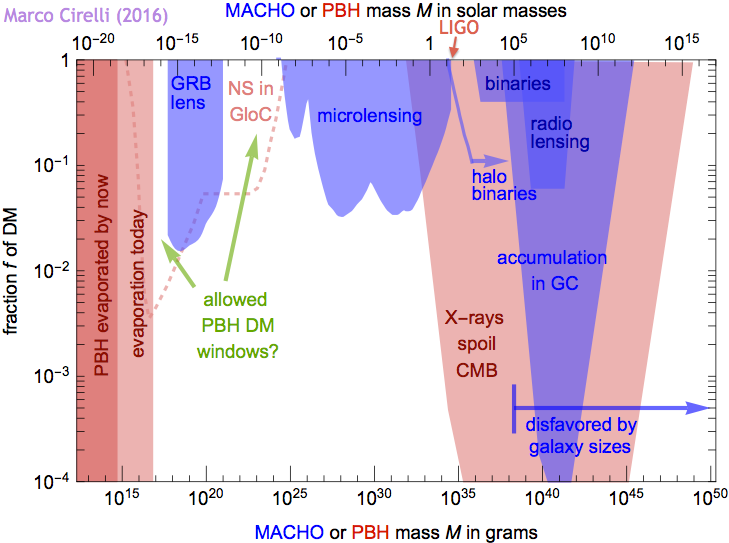
The odds are still very low on MACHO's as a source of most dark matter.
Most interesting is that these have all been medium-sized black holes which weren't known to exist previously and we don't have a theory of how they form.
A 1 kg block of plutonium 12,000km away has ~5 orders of magnitude stronger gravitational field than a solar mass at 1 billion light years.
Presumably a sudden mass-energy conversion of said kilogram would generate a sharp gravitational wave. Assuming someone went back through LIGOs algorithms to fine tune them for such a detection, doesn't it seem plausible that it would be able to do so? And presumably even locate it?
I’ll toss out a guess that the signal is there but it’s so short that there isn’t enough to correlate across locations. So you might not be able to detect a detonation with it, but given a window of seconds from seismograph data you might be able to pinpoint location and corroborate yield.
Only a small percentage of the plutonium's mass gets converted to energy during fission.
Indeed, this site says it's about 46g per megaton: http://www.jick.net/hr/skept/EMC2/node4.html
Still, 1kg has a field strength that's 5 orders of magnitude greater than a solar mass a billion light years away...10mg would be in the neighborhood.
If i didn't screw up the math, that's ridiculous.
> ...meaning that energy equivalent to about 1 solar mass was emitted as gravitational waves during the collision.
Damn. That's something like 179 100 000 000 000 000 000 000 000 000 000 000 000 000 000 000 J
That's an insane amount of energy. It's equivalent to what you would get if you converted the entire mass of the sun into pure energy.
Well, yea - that's what they mean when they say "1 solar mass".
You and I might know that but not everyone has studied physics.
One question I've had about gravitational wave detections that I haven't yet been able to find an answer to is what is the mechanism by which the mass of an orbiting black hole pair converts its mass into a gravitational wave? Presumably the mass of the black holes is comprised of matter (in whatever form that may be) and kinetic energy. Is the gravitational wave energy while the two objects orbit purely a conversion of kinetic energy to gravitational wave energy or is some of the mass lost too? What about when they finally collide? If in this case 1 solar mass of matter was converted into gravitational energy then by what process?
When an apple falls to the earth, by what process is its potential energy converted to kinetic energy? Gravitational processes alone.
Apple-earth collisions primarily radiate apple sauce, black hole mergers primarily radiate in gravitational energy.
Minor nit: In general relativity black holes are not actually comprised of matter---they're entirely warping of spacetime. Whether that remains true in a quantum theory of gravity is unknown.
None of this actually answers the question. The question is by what process does energy in the binary black hole system get converted into gravitational wave energy?
If you accelerate an electric charge, it emits electromagnetic waves. If you accelerate a mass, it emits gravitational waves.
Two masses orbiting their common center of gravity are undergoing centripetal acceleration, so they continuously emit gravitational waves, spiraling closer as they lose energy (that's how the emission of gravitational waves was originally confirmed [1]).
[1] https://www.nobelprize.org/nobel_prizes/physics/laureates/19...
The answer is "by the processes of general relativity". When things fall "down" their potential energy is lowered, so they get faster. When mass-energy accelerates it emits gravitational waves, in much the same way when an electron accelerates it emits electromagnetic waves. If you're satisfied that a radio works by sloshing electrons around, you should be satisfied that a black hole merger emits radiation by sloshing mass around.
Where did the photons "come from"? Well, they weren't stored "inside" the electrons. By what process were the photons generated? Electrons accelerating radiate. That's essentially the answer. You can "math it up" if you want. It's not exactly an axiom, but it's pretty close to the bottom.
Maybe I should be more clear: at least in the generally relativistic conception of gravity, all of the mass of the black hole "comes from" the warping of spacetime already. That's why I keep dancing around the question of whether it's "really" the kinetic energy or the mass or a mix that gets converted---it's hard to distinguish and may not be meaningful to distinguish the pieces from one another, especially if I go to a co-rotating frame.
> all of the mass of the black hole "comes from" the warping of spacetime already
No, it's the other way around. The warping is due to the mass
But the other answer hinted at the source: accelerating mass turns into gravitational waves as an accelerating electron turns into EM waves (remember rotation and things stopping abruptly also means acceleration)
So yeah, it's the potential energy that turns into (less than Newtonian amounts of) kinetic energy because some of it is turning into Gravitational waves
And you can imagine something as big as black holes spinning around each other at a frequency measurable in Hz how much energy they can give in that process then add the sudden merger deceleration.
Certainly normal matter (like the earth) has mass and warps spacetime. But a black hole is a purely gravitational object, there need not be any normal matter involved.
The mass of a black hole is something that's really only defined from a distance away. If a planet of 1 earth-mass orbits it at the same speed & circumference as we do the sun, then we say the black hole has 1 solar mass.
> But a black hole is a purely gravitational object, there need not be any normal matter involved.
There's no "purely gravitational object" it only "looks like that" from behind the event horizon
We know the escape velocity > c and that's pretty much it, for GR it's a singularity (which usually means the theory is incomplete in that circumstance) and we don't know how QM work when squeezed harder than a Neutron star
> The mass of a black hole is something that's really only defined from a distance away.
If you mean "we can sense the gravitational field of something having mass X at a distance D larger than the event horizon" I agree.
But I'd rather say "we don't know what happens there" instead of "singularity" (which is what the current theories say it's inside and from the point of view of Relativity they're not wrong)
> There's no "purely gravitational object" it only "looks like that" from behind the event horizon
It depends on what framework you're working in. If you're working in general relativity, there's a singularity and absolutely nothing else---no matter at all. If you're talking about the "real world" you can ask: Is GR reliable for these situations, especially in light of quantum-gravitational puzzles? I think you agree that we don't know the answer. But we can say what the GR answers are.
> But a black hole is a purely gravitational object
Are you calling compact objects from stellar collapse that have an apparent horizon something other than a "black hole"?
> The mass of a black hole is something that's really only defined from a distance away
The stress-energy in the region of spacetime where one finds a black hole totally determines the Einstein tensor in that region. Solve the Einstein Field Equations for T_munu in \Sigma \subset \M. Extract the metric tensor. Solve the geodesic equations for that region, and you have the orbit for your Earthlike planet. You can make it simpler and consider the surface stress-energy on a shell within the horizon, or even outside in the case of your orbiting Earthlike planet problem, for which we don't care about the region inside the shell.
You are skipping the first steps, treating the metric tensor as a known, or worse, something that you can extract from a single geodesic.
But let's think about that anyway. Do you really know the metric you source? Sure, your stress-energy is localized so you can deploy a large shell to partition the "inside" and "outside" stress-energy. "Outside" it's zero, and nobody will really care about your small deviations from exact spherical symmetry, so your metric is therefore Schwarzschild, right? No, we can't make that inference based on the far field outside the shell; we need an Israel junction condition. [Synge 1960, Relativity: The General Theory (Amsterdam: North-Holland), ch. IV § 6 goes into this in detail, contrasting "realist" vs "agonist" and "creator" positions; yours is the "creator" position in that you are happy with an exact solution of the EFEs, and so you might enjoy reading what Synge wrote as he walks towards the mathematics of junctions :-) .] In a model can ignore that because we get it "for free" by laying down an exact generator of the vacuum Schwarzschild solution and not worrying whether the stress-energy is physical.
My first point about mass was that some are tempted to imagine the mass of the BH as residing in the matter of the neutron star or whatever that formed it. This is misleading, it is better to think of that matter as no longer existing, and just deal with the fact that pure Schwarzschild looks identical to a lump of matter, from a distance.
How you measure the mass, well my orbit example is admittedly crude, ADM mass is I think the right asymptotic concept.
By purely gravitational object I mean this: everything we're discussing here about merging and waves and accretion disks all concerns only the exterior. This is all vacuum Einstein, pure gravity. (Whether we can say anything sensible about the interior is another whole different rabbit-hole.)
Heh I should have kept reading down the thread, could have saved some typing. :-)
I thought your other answer was great!
The apple sauce line is amusing, and I'm sure you know all the following, but even in Newtonian mechanics, potential and kinetic energies are frame dependent; for example the latter is rotationally but not Galilean invariant.
In modern gravitational physics you can treat components of the Einstein or stress-energy tensors as like these energies, e.g. for a family of observers, the apple-breaking kinetic energy is like the pressure components (T^ij, i=j, i!=0 ~ \gamma mv^2) and mostly in T^zz or T^rr or whichever, depending on one's choice of system of coordinates. However, simply by changing frame of reference, at each point where we find the apple/applesauce transition we can shuffle the whole of T^zz into one or more of the other components in G = T (keeping that relation invariant), and it is really stretching things to suggest that a change of coordinates is a process in the sense of the question in your first sentence.
> In general relativity black holes are not actually comprised of matter---they're entirely warping of spacetime
Well, that's not true of stellar collapse black holes; whatever you want to make of the trapping surface / apparent horizon, it encloses matter that existed before that formed. You don't need quantum anything, or even any future infalling, to deal with the fact that there is real matter inside at the time of formation.
The Schwarzschild vacuum solution is matter-free, but then astrophysical black holes of all masses and all origins generally do not truly source the Schwarzschild metric, just a usefully close approximation.
What you can say is that whatever's inside a black hole, eventually it will bald all its "hair" and can be effectively described (by an outside observer) at any point in time in terms of its spatial position (3 components), linear momentum (3 components), angular momentum (3 components), electromagnetic charge (1 component), and mass (1 component), with any other features irrelevant in the Kenneth Wilson sense. That is, eventually it doesn't matter whether it was all neutron degenerate matter or whether there were some other particles inside the horizon when it formed, but there was some matter there: the apparent horizon around V616 Monocerotis didn't just pop up spontaneously far from any matter.
Quantum gravity only matters if you want to make guesses about what state the matter is in within the horizon (assuming you're unhappy about it inevitably being crunched into an infinitesimal point as in classical General Relativity), or about what it looks like when during evaporation the horizon retreats far enough to expose that state. I'll assume you favour keeping unitarity in any solution to the AMPS firewalls problem, and would happily ditch the apparent validity of the EFT outside the horizon. :-)
Yeah, I went straight to the static solutions for simplicity of discussion. From the outside, though, is it even in principle possible to tell whether a BH is a stellar-collapse Bh or if it's an eternal Schwarschild vacuum BH? Now we're outside of my realm of expertise. Do I recall properly from my GR class that once stellar collapse begins the outer shell reaches the singularity in a finite time? In that case, I think it does come down to philosophy (if you're staying within GR) or some theory that resolves the singularity to say whether the BH is "made of matter" or not.
> I'll assume you favour keeping unitarity in any solution to the AMPS firewalls problem, and would happily ditch the apparent validity of the EFT outside the horizon.
You're damn right. Unitarity, unitarity, unitarity:
https://arxiv.org/abs/1602.01473 https://arxiv.org/abs/1603.03055 https://arxiv.org/abs/1606.04948 https://arxiv.org/abs/1606.04951 https://arxiv.org/abs/1709.01932
Oh damn again, I should have looked at your links before typing, and figured out your connection to the papers, and saved on a rant. :-)
> [several MCM papers with interesting bits and pieces that look worth more than a skim]
Wow you guys roll an awful lot of dice.
> From the outside, though, is it even in principle possible to tell whether a BH is a stellar-collapse Bh or if it's an eternal Schwarschild vacuum BH?
There's a hint in "vacuum". There's real stress-energy and it's not where you would put it if building an exact BH solution by hand (I'll return to that in the last paragraph).
How do you tell if a body under a sheet has died peacefully in bed or was violently axe-murdered without lifting the sheet? Look for blood spatter.
If you see the daughter products of a failed core collapse supernova around a black hole, I think it would be strange to think, "hm, that black hole was probably there before the hot dense phase of the universe". The idea of a cosmic supervillain mischievously arranging nebulae around eternal black holes is amusing.
Isolated black holes are trickier, especially as masses go up. How does one distinguish between primordial black holes from early overdensities in the whatever was around at GUT scales or higher vs ones passes through the throats in in a cosmology like the Caroll-Chen model? Unless we catch them evaporating or until we spot them forming, I don't know. Spotting primordial formations is not hopeless, they can't all form with exact spherical symmetry or with the to-be-balded lumps and us on unfavourable alignments, can they? There's bound to be some larger (near-)extremal eating a smaller BH somewhere in our past lightcone. So even if they're very early we should see impressions of the extremal-with-lump gravitational radiation in the relic fields.
> Do I recall properly from my GR class that once stellar collapse begins the outer shell reaches the singularity in a finite time?
Yes, details in MTW section 32. Finite and fast by human wristwatch proper time.
> I think it does come down to philosophy (if you're staying within GR) or some theory that resolves the singularity to say whether the BH is "made of matter" or not
I think BH specialists would love it (and hate it) if someone found something in the matter sector that manifests truly enormous degeneracy pressure. Who knows what the heck is in the inner layers of neutron stars. Cutaway diagrams that show anything other than a ? near the core are wild speculations. One I saw that I enjoyed had six ?????? starting around 10^15 g cm^-3 just for emphasis. Unfortunately this wild hope gets ridiculously wild when considering the most massive known galaxy centre BHs, and eventually your explosion of question marks practically demand some quantum gravity (or asymptotic safety or something).
And anyway there are IR problems in quantum fields on general spacetimes. Even in extremely flat space, G = <T> easily blows up, and who knows what we'll see as we develop devices to point to the source of weak gravity. How small a mass can avoid being in an eigenstate of position for a brief test? [arXiv:1602.07539 is just the start of that story!]
And furthermore actually solving the EFEs is a pain and numerical methods are still barely an aspirin, and anyway readily leads one into even more ways to mislead yourself if you don't cling to a T-first approach instead of a g-first approach ('t Hooft put out a pretty crazy seeming argument based on a brute force diagonalization recently). Sure one could argue that "matter determines curvature" and not the reverse is at least partly a philosophical point, but practically, even if you start with a ridiculously improbable stress-energy distribution you won't be chasing down regions of spacetime in which the eigenvalues of T_ij have the wrong sign. It is perversely common that when one writes down a metric first and then add matter, you end up with a proliferation of negative energy density or find lots of tension around extended objects, or the like.
Tl;dr: I look forward to a successor to GR, but am pretty sure that whatever it is will be even harder to teach.
Anything spinning in an asymmetrical way (e.g. two bodies orbiting each other, but not a single body spinning) loses angular momentum as gravity waves. This is true whether it's two black holes or a tumbling dumbbell.
In addition to that, the ultimate merger of the black holes releases the incredible amount of gravitational potential energy that existed between them when they were separate bodies.
No mass escapes the event horizon. These are black holes after all :)
How much of the 1 solar mass of detectable gravitational energy is released before the moment of collision and how much is released at the moment of collision? Is the mechanism for release of this energy the same in both cases? If 1 solar mass of energy was released in total, and the mass of the combined black hole is less than the two before the merger, how is it possible that none of the mass of the black holes has escaped their respective event horizons?
There isn't exactly one moment of collision like snooker balls, the two spiral and merge and then settle down to look like one bigger black hole. But the time during which most of the energy is radiated is quite short, like 0.1s.
The missing mass is precisely the amount of energy that was radiated away.
We should not think of the mass of the black hole as being the amount of matter stored inside, which may escape... regardless of how it was created, the black hole is just a ball of pure gravity. Its mass is defined by its effect on things far away. You can measure the mass of Jupiter by watching how fast a satellite orbits, and a black hole whose satellites had the same orbits would be said to have the same mass.
> No mass escapes the event horizon. These are black holes after all :)
OK, that makes sense (for whatever that's worth).
But from the article:
> ... the latest discovery was produced by the merger of two relatively light black holes, 7 and 12 times the mass of the sun ... The merger left behind a final black hole 18 times the mass of the sun, meaning that energy equivalent to about 1 solar mass was emitted as gravitational waves during the collision.
And you say:
> the ultimate merger of the black holes releases the incredible amount of gravitational potential energy that existed between them when they were separate bodies.
I think that I get it. It's just that the stated masses of the merging black holes (7 and 12 solar masses) include gravitational potential energy. So the rest masses of the black holes didn't change, just their gravitational potential energy.
Yes?
For black holes these aren't separate concepts. An apple and the earth each have rest mass, and gravity means there is also potential energy in their separation. But a black hole is an object with rest mass which is made purely out of gravity.
With two well-separated black holes it's reasonable to talk about each of their rest masses, and the potential, just like the apple. But as they get close and merge these ideas are hard to pin down, and stop being useful. Their shapes get blended together, and their horizons unite into one sphere, and for a while this wobbles around a lot before settling down. Some of the energy of its wobbling around departs as gravitational waves. Once it's settled down you can meaningfully talk about its rest mass again.
OK, but what about the event horizon issue? So some stuff (GM) can escape the event horizon, but other stuff (matter, light) can't escape. So they must somewhat be separate concepts, because the event horizon affects them differently.
No, not really. Just about everything we say about black holes is talking only about the exterior, the region of spacetime outside the horizon. The simulations through which we model the merging of two black holes only model the exterior of both. The curvature of this exterior is what gets all churned up during the collision, and some of it ends up travelling off as gravitational waves.
The fact that we can get away with studying only the exterior is really the same fact that the horizon is a horizon. The causality only goes one way, for everything not just for normal matter. And thus ignorance of the interior is no barrier to understanding the exterior.
The article says basically: 7M BH + 12M BH -> 18M BH + 1M GW. But I'm getting the impression that this is misleading. Wouldn't it be more accurate to just say that the system had 19M before merger and 18M afterward?
Mass is energy. As I understand it, the waves are created because of the rapid acceleration of large masses, either black holes or neutron stars. These waves do transmit energy and the final resulting body will be less massive at least partially because of that.
I believe all accelerating masses emit gravitational waves, but that most do so on an absurdly small scale. As if the 10^-20 scale of the black hole merger gwaves isn't small enough...
You are correct. In fact, Einstein predicted gravitational waves but considered them un-observable, and the LIGO interferometer is 1km long exactly to magnify the effect.
> what is the mechanism by which the mass of an orbiting black hole pair converts its mass into a gravitational wave?
This is an excellent question, although the formal answer is essentially "mu", or alternatively in some useful approximations of General Relativity we have a research project along the lines of "what is the mechanism that generates the (final) metric of merged black holes?".
I'll try to give you a more useful answer.
The important things are that we go from observables relating to a periodically perturbed near-Schwarzschild spacetime sourced by the inspirallers (this requires us to remove other contributors to the "true" metric, so we're left only with the contributions from the inspirallers) to a much more stable near-Schwarzschild spacetime. The energy-momentum density implied at the origin before merger is higher than that afterwards. So we can ask your question: where did that energy-momentum go?
Ultimately the search for an answer comes down to making a few choices about how to describe a collection of values that appear at various points of interest in a (nonvacuum) spacetime solution of the Einstein Field Equations of General Relativity that survive a degree of calculational simplification.
A more technical response is that by choosing how to split spacetime into space and time, and by choosing to represent spacetime curvature at every point in space (for a slice of spacetime that all has the same time coordinate) as a perturbation of a fixed background metric, one can treat changes in the metric as propagating like massless waves. This is easier when the masses sourcing the metric move slowly compared to the speed of light, and when one is dealing with the increasingly-flat metric far from the source (at least tens of wavelengths from the inspiralling objects), since one can then use linearized gravity. So we're in fairly good shape far from some black holes (or neutron stars) embedded in a galaxy a few million light-years away.
One can then decide that we are not obliged to treat the perturbations as being exclusively sourced by matter, that is, the propagating gravitational waves can induce a squash-strain on matter. With some further choices of gauge and a change to a formalism like linearized gravity, one can treat some components of the two relevant tensors (the Einstein tensor G and the stress-energy tensor T) as representing specific forms of energy, with some (e.g. kinetic energy or angular momentum) being dumped into others (e.g. gravitational potential energy).
General Relativity has at its heart a relationship between matter and spacetime curvature. The former contributes to the stress-energy tensor (T) mentioned above. The components of the tensor relate to the flux of momentum-energy between a point p and its neighbouring points in the four spacetime directions. While the tensor value itself is the same for all observers, the values of the individual components (e.g. the numerical values if you write the tensor out in 4x4 matrix form) depend on choice of coordinates, different observers have almost total freedom when it comes to choosing coordinates. Spacetime curvature is represented by the Einstein tensor G, which is a non-linear function of the metric tensor g. Omitting constant factors and indices (which range from 0 to 3 for each of the four dimension of spacetime), we can write the core of General Relativity as G = T. That is, spacetime curvature is totally determined by matter. For example, G = T = 0 is the case where there is no matter, and thus flat spacetime; that's the spacetime of Special Relativity. When we add any matter at all, we deviate from flat spacetime, however because the contribution of small amounts of matter to the stress-energy tensor is small, it can be very hard to distinguish between true flat spacetime and very very slightly curved spacetime.
While in general it is convenient to think in terms of G = T -- the Einstein Tensor and thus the metric is totally determined by the configuration of matter -- there is a history of vacuum solutions of the Einstein Field equations in which G != 0, T = 0, that is that there is spacetime curvature even without matter being present. An early example was the Schwarzschild vacuum solution ("Schwarzschild spacetime"), which is perfectly spherically symmetric about an eternal gravitational singularity. Some study revealed that for a perfectly spherical uncharged unrotating arrangement of mass gives you Schwarzschild spacetime at a bit of a distance from the mass. For slight deviations from this perfect arrangement of central matter, we still get something very similar to Schwarzschild at a sufficient distance. Indeed, if one goes to enormous distances, Schwarzschild-like spacetime also starts to look like flat spacetime -- it's "asymptotically flat".
We can then ask: at a sufficient distance from a pair of inspiralling objects, is the spacetime very similar to Schwarzschild spacetime? The answer is almost "yes". If you consider these objects as if they were a barbell with an infinitesimally thin handle connecting the two weighted ends, and tumble the barbell around the middle, to a chosen distant observer stationary with respect to the centre of mass of our inspiralling objects, sometimes sometimes one or the other weight will be spatially closer. When the observer is trying to figure out if it is in Schwarzschild spacetime or something else, and using Schwarzschild coordinates, the changing proximity of the barbell ends compared to the centre of mass will become apparent.
If we go back to my fourth paragraph, the observer can make a choice to consider the local measurements of the true metric compared to his or her wristwatch or atomic clock, and a further choice to compare that with the Schwarzschild metric. There will be a periodic change in difference from the Schwarzschild background, relating to the orbital period of the inspiralling objects sourcing the true approximately Schwarzschild metric.
Near the end of the inspiral, the "up and down" of the measurements of the metric they source follows a predictable evolution as the orbital period increases until the objects inevitably collide. The relative deviation from the perfect Schwarzschild metric also increases prior to collision. But after the collision the waves cease (the collided entities settle into a configuration that is much more like the perfect uncharged non-rotating sphere that would source a true Schwarzschild metric, a process called "balding" if the end result is a black hole (with perhaps some debris around it, depending on what the inspiralled objects were). Inevitably, measurements will show a greater Schwarzschild distance from the mass, or equivalently, that the source of the new "truer" Schwarzschild-like metric has less mass-energy at the origin of Schwarzschild coordinates than was in the pre-collision configuration.
We are pretty free to interpret these observations. Generally there is no reason to invoke any local magic rather than suggest that the reduction of energy-momentum is exactly balanced by the increase in the perturbations from Schwarzschild that all possible observers would record, and look for evidence of that.
Finally, how does one measure the deviation from a background like a Schwarzschild metric? Well, one option is to do it in the style of the https://en.wikipedia.org/wiki/Cavendish_experiment . Another is to use interferometry, LIGO and Virgo (and so on) style. Either way, the measurer is looking for a little change in the arrangement of matter "here-and-now" correlated with the big change in the arrangement in matter "there-and-then".
With some deliberate choices one can think of the change "here-and-now" as being various types of energy from "there-and-then" carried to us by gravitational radiation from the source, and calculate robustly on that basis. That picture holds up pretty well under detailed analysis given current experimental results.
Although this invites all sorts of analogies or statements like "spacetime is plastic" or "gravitational waves are real in the sense of being observer-independent", those are big stretches of the theoretical underpinnings (i.e., General Relativity). All we have is a metric that covers the whole of spacetime -- all points at all times -- that we can slice up so that we can think of the value of the metric changing over time. But generally different observers will prefer different slicings, and for a family of observers any inspiraller will shed no gravitational waves at all [consider a diagram BHA ---- x ---- BHB where x is an observer at rest at the centre-of-mass of a pair of black holes in a mutual circular orbit; x will not measure any gravitational radiation under any spacetime slicing]. So they are really a gauging effect. Conveniently, when one turns a gravitational wave into a bunch of particles, one finds that the particles almost certainly have to have the characteristics of a gauge boson.
And now I'm out of space and time. :-) Hopefully this was helpful, or at least somewhat interesting.
Posting this whenever there's a new detection! Dr Roy Williams who's part of the LIGO team has put the notebooks used for analyzing the data online for anyone to check out & run:
https://notebooks.azure.com/roywilliams/libraries/LIGOOpenSc...
Click Clone to get your own copy, then edit/run/etc.
Interesting
This was a couple of days days before Virgo got online AND one of the Ligo detectors was undergoing a noise modelling test (its mirrors were being vibrated at the time)
So no second opinions then, it could just as well be noise?
No, because the noise modeling test in the second LIGO detector (LIGO Hanford) was being wobbled at a very different frequency to that of the gravitational wave they were able to filter out the test motion and were still able to detect the merger.