Some Corporations Pay a Lot More Taxes Than Others
bloomberg.comThis is why corporate taxes are a dumb idea. Firms should not keep one set of books for management accounting and another set that they use for tax purposes.
When money is paid to an individual, tax it as income tax. Very simple. Don't give firms an incentive to act as tax shelters or tax avoiders.
Think about all the legal fees that have been spent by the firms on that list to avoid and reduce corporate taxes. It's outlandish.
Not only do the complicated tax avoidance schemes waste lots of money getting created/maintained, they also drastically reduce transparency and make auditing the company (by regulators, shareholders, etc.) far more subjective and complex.
There is no issue of fairness, since all the firms can conceivably do any of the avoidance schemes any of the others are doing if it offers positive ROI. The issue is that so much time, money, and energy is spent on corporate taxation that should be spent on things that benefit society.
Yes, and what happens when those corporations keep hundreds of billions in profits in the bank for years - see eg Apple?
If shareholders do not demand the money as a dividend and prefer instead to have it kept in the company's control, then so be it.
Shareholders in Apple want Apple to be able to make big investments or acquisitions and are willing to let the money sit there rather than take it as a dividend. This would not be true for most firms.
It sure would be in Jib Inc, the company that will launch about 5 minutes after no corporate taxes and will handle all of my personal finances. :)
I'd pay myself a very basic salary, and if I needed emergency cash I could always borrow against my holdings in Jib Inc until I could adjust my salary appropriately.
That would let me defer paying tax indefinitely on anything that I don't need for day to day living, and I would be able to play the margins on a number of major expenses as well, with very little overhead work, since I dont need to worry about taxes for corporate income anymore.
That's called "piercing the corporate veil" and nobody is going to fall for it.
Ya if you make a one person company to avoid taxes, the second the irs looks at it you're gonna have a bad time. This is already true today, and would be especially more true if they drastically lowered corporate taxes.
"So be it", you say. In other words, average people will need to pay those taxes, instead of very rich people that don't even care about getting dividends. Seems fair to me.
Not sure what you are talking about. What taxes?
The taxes that, according to you, should only be paid by individuals and not by corporations - thus allowing rich individuals to postpone paying taxes as long as they want, and forcing not-so-rich individuals to cover what's missing.
Taxes would still get paid on capital gains when Apple's stock price goes up. As long you raise the capital gains tax to compensate for getting rid of the corporate income tax, that scenario doesn't cause any problems.
They paid income tax on the profits (at least the profits earned in the USA). Apple was the number one tax payer on the list by a wide margin. Are they supposed to be taxed on their bank balances also?
They paid income tax on the profits generated in the USA, but not those generated eg in the EU.
Well, SAP also paid income taxes on USA profits, but not those generated e.g. in the EU. So what?
they're already doing it, so this isn't much of a 'what if'. the problem is that money is kept offshore and never spent, because it's at risk of getting taxed immediately upon repatriation.
my understanding is that is absolutely not true. Apple doesn't have $90B or whatever sitting in a bank vault in Ireland. That money goes to a bank in NY, and Apple has access to it and uses it, though that money can't be used freely as money which Apple has paid US taxes on. It is still part of the economy.
So should the USA tax SAP on worldwide profits as it does Apple?
I think that what you're suggesting (based on a vague understanding of the UK tax system) is abolishing corporate taxes and taxing dividends as income?
I'd be curious to hear someone who knows more accounting's view on this.
I've always thought that the answer was to have wealth taxes, easier to avoid but surely what we should actually aim for.
> I've always thought that the answer was to have wealth taxes
Oh, I totally think this is where we should be going, too! Income seems like such a weird thing to tax; the wealthiest people don't necessarily have income, and high earners aren't necessarily that wealthy. In terms of "tax the rich", I think wealth taxes are more along the lines of what people envision.
It would simplify things so much, too; you don't have to worry about capital gains vs. ordinary income, or gifts, or the so-called "death tax". Businesses don't need to withhold taxes.
It seems like a simple, low, flat wealth tax, over a certain cut-off, would be best. If would counteract the march to aristocracy and dynastic families, unless the children are similarly able to provide value with their assets. Otherwise their wealth will dwindle over time and others will have a shot.
I think the two negatives I can think of are: 1) dealing with liquidity - you might be "worth" millions, but does that mean you can afford your tax bill? and 2) off-shore havens storing the wealth. But neither seem insurmountable.
I'd love to see any discussions of pros-and-cons of this approach to taxation. I know Islam proscribes a wealth tax, Zakat, but I'm not sure how it works in practice.
What if you just spend all your money before you are taxed? This seems to reward non-tangable things, like trips, since they don't count towards your networth unlike say, a house.
A professor I once knew said,"You can only eat so much filet mignon."
You can already stop at your two cons. Those are pretty insurmountable themselves.
Number 1 in particular creates a huge intervention in the details of an economy. Any government would want to fine tune this, and not create a tax aimed mostly on revenue collection. In particular, you do not want to go out of your way to bankrupt people when they make productive investments.
"Otherwise their wealth will dwindle over time and others will have a shot"
Wealth is not a zero sum game, it's the opposite. Wealth creates more wealth for the society around us.
Well the problem is that you just create a loophole.
You can already avoid paying any corporation tax by taking money out of a company as salary.
In the UK you have dividend tax credit so effectively when you take a dividend you get the tax back that has already been paid (as corporation tax).
So both those reasonable ways of extracting money from a company allow you to not pay any additional tax above what income tax would be.
However if there was no corporation tax then the loophole / incentive would be to move money out of the jurisdiction and extract the dividends in a zero tax country.
This is effectively what the big multinationals do via transfer pricing etc but not having any corporation tax would no doubt make it a lot easier for more companies to do that.
This doesn't seem insuperable. The rule could be that any dividend paid to anyone other than a UK taxpayer, or another UK company, is taxed at the top rate of income tax. That would make such a shunt pointless.
You could then extend the existing international double taxation agreements to cover these dividends. So, for example, if a dividend is paid to a Dutch taxpayer, it is not taxed at source, but as income. You might want to retain the current UK arrangement in this situation, though, so as to keep some of that tax revenue in the UK. You wouldn't extend these arrangements to tax havens.
Manoeuvres like the Double Irish or whatever would still get around this, and would still need to be attacked in the way they are (or at least should be) now.
You would need to extend the spirit of this rule to share repurchases, which might be tricky.
> when you take a dividend you get the tax back that has already been paid
Yea, that needs to stop. This idea of being "taxed twice" is ridiculous because companies are not people. If they were then yes they would be taxed twice and it would be "unfair" but then they'd also be taxed at the proper rate.
No, I was explaining that this already happens. Actually at least in the UK the system is just changing over to be more clear so rather than the tax credit you just get a lower rate.
So for instance instead of the 25%ish that you would expect to pay in tax on your income you pay 7.5% on your dividends which is more or less the income tax rate minus the corporation tax already paid.
yeah but your company paid the corp tax, not you. That's isn't fair because your company can offset its losses and individuals cannot. Its not a fair comparison.
>> In the UK you have dividend tax credit
Not any more, that got shelved a few years back AFAICT.
Yes, sorry I did expand in another comment, it's now been replaced with a percentage, but the principle is the same, you pay 7.5% on dividends which is effectively the income tax equivalent minus the 19% corporation tax that has already been paid.
There are several issues that are all relevant, I think:
- Corporate taxes reduce the competitiveness of a jurisdiction and create a market for tax havens like the Caymans which add no value.
- Companies' tax avoidance schemes are massively complex and create an incentive to hide earnings and obscure profits, making this information less transparent to markets.
- A company's share price should reflect company performance only, not the performance of the company's accountants in the realm of tax minimization.
- Offshore tax avoidance schemes reduce government revenues. Google avoids taxes by running such a scheme. Why shouldn't Google pay the same fair share as a tiny startup that lacks the budget to set up such a scheme? Why should governments lose out on the revenues?
- By simply taxing the money when it is income or capital gains, governments can get the proper amount of revenue. Suppose Google evaded $10B in taxes via its offshore scheme. This $10B would instead have been collected from shareholders and employees via capital gains and income taxes.
Why don't we switch to a system of zero corporate tax? The firms like Google that have invested heavily to set up an offshore tax avoidance system are quite happy with the result. They get to be insulated from smaller competitors who do not have the budget to set up their own scheme.
Larger firms like WalMart are cash cow businesses that are not doing enough R&D to offset the profits. Investors in WalMart are OK with this and the shares are priced accordingly. If WalMart paid no corporate tax, the dividends would be higher and the revenue could be captured by capital gains tax and income tax.
Estonia takes an interesting approach - profits are only taxed when they are taken out as dividends. There is thus essentially no corporate tax, as companies can accumulate profit and not have it taxed until it is distributed to shareholders.
Simply taxing revenue is bad for start ups and puts them at a even more of a disadvantage.
Wouldn't that provide an incentive for ultra-wealthy shareholders to move to low-tax jurisdictions like Monaco?
It would be easy enough to pass a law requiring tax payments on dividends paid out to be sent in by the firms, and for such payments to be required regardless of the nationality or location of the investor, in much the same way that firms are required to collect income tax payments on behalf of employees.
I suppose your solution of "murder is a problem, so let's decriminalize it" could work, but I think there may be better ones.
This is because some corporations make a lot more profit than others.
"Amazon's corporate income tax bill is so small, though, because its corporate income (aka profit) is so small. Wal-Mart's pretax income since 2008 has totaled $209 billion, Amazon's less than $11 billion. So while Amazon's rise to fifth-biggest market cap in the world on the strength of such small earnings is a fascinating and perhaps disturbing phenomenon, it doesn't necessarily signal a problem with our system of corporate taxation."
The author is acting like this wasn't an intended phenomenon. I don't understand the mental gymnastics required to NOT see this.
Bezos decided, "we need to grow, and to grow we need equipment and real estate, so I'm going to spend the profits on those assets, since we will get more bang for our buck than just holding onto after-tax cash."
A corporation doesn't just accidentally conduct business that way lol, for better or worse.
I didn't think you could spend revenue directly on assets without booking it as profits and paying tax on it. My understanding was you can discount part of the cost of an asset each year against revenue but not all at once.
Depends on what you're spending on. If you're spending on capital equipment, it's depreciated and spread over many years. But if it's discounting your sales so that you have razor-thin profit margins, then you're just cutting your income which directly cuts your current-year taxes.
> I'm going to spend the profits on those assets
If you make profits you pay tax - Amazon doesn't pay tax because it doesn't make profits. It invests a lot of its operating cashflow true but that is different.
The most surprising thing about Amazon lately is that it suddenly is showing some profits. Normally, Bezos has every single dollar that looks like it might be a profit re-invested in something or other.
Maybe he wants to prop up that share price so he can become the world's richest man again :)
Amazon is expanding really heavily into so many verticals. It is crazy to see. I don't think they will stop the spending, but maybe they felt like showing a small profit for some kind of "investor confidence" strategy :)
You have it backwards- he only became the world's richest man by showing those profits. Something like 7 or 8 quarters in a row with profits is very weird for the company.
Walmart has high taxes(profit) because it has run out of ideas. Amazon has low taxes(profit) because it reinvests almost everything it makes.
> Wal-Mart's pretax income since 2008 has totaled $209 billion, Amazon's less than $11 billion.
Of course many unprofitable companies invest poorly, but Amazon's massive sustained growth indicates they've invested well.
No, Walmart has always been a careful, profitable business by necessity (thanks to extremely low margins). It's not just because they ran out of ideas to fund in the last ten or N years.
For most of their early existence, they didn't have bubbly capital markets to ride as Amazon did during the dotcom bubble and presently. What made Amazon possible turned out to be a very short-term fluke of history that Bezos took great advantage of. He needed to thread the needle and did just that. Amazon nearly collapsed into insolvency specifically because rather than rely on a profitable business they were leaning on funding to subsidize their vast red ink (as eg Uber is currently). That's an approach Walmart never had the option of taking, and in the decades since they've also never had the luxury of routinely being valued at 200x earnings. Amazon isn't a special alien organism, they're one part retailer (boring old retail), one part platform for distribution (eg retail and media), one part software company (cloud etc); they are particularly good at what they do.
Walmart pays high taxes because they generate most of their income in the United States market. Which is the same reason that Delta has a high corporate income tax, and the same reason Whole Foods does. It's the reason Foot Locker paid a 34% corporate income tax rate last year.
Is there any way to determine how much Amazon employees, contractors, and third-parties have paid in taxes? Even if Amazon only pays 1.4 billion itself, doesn't the company still contribute to government taxes paying employees and buying other goods, which are then taxed in turn?
Of course it does. They also collect sales taxes in all (or nearly all?) states now based on customer address, so they contribute to state revenues as well.
It's hard to imagine a tax that would be sensitive to this difference unless it was a tax on market cap, which would be very odd because shareholders are the owners. So it would be a tax on one entity for the value of assets owned by another.
Startup stock options, if you exercise before a liquidity event, are given a cap gains tax based on the de facto market cap.
> Startup stock options, if you exercise before a liquidity event, are given a cap gains tax based on the de facto market cap.
That's not really the same thing. ISOs are taxed (as income) because you're purchasing something for below-market price, so the difference between the market price and the price you pay is income. If you hold onto it for long enough, you may then be able to qualify for capital gains tax when you sell it, but that's different.
And in addition, that's the individual who's being taxed on it (the value of their own income).
If you think of how this works similarly for publicly-traded companies, it's easier to understand.
Right - that's a completely different topic though. That's an individual paying taxes on a gain that they've realized. Not a company paying taxes based on other people's gains.
Amazon decided to "re-invest" all profits back into equipment and etc for the business. Thus there are very few profits to tax.
Wal-Mart decided to what, I guess keep all the cash on hand or something. I didn't look up their 10K or 10Qs, but that's what I assume is happening.
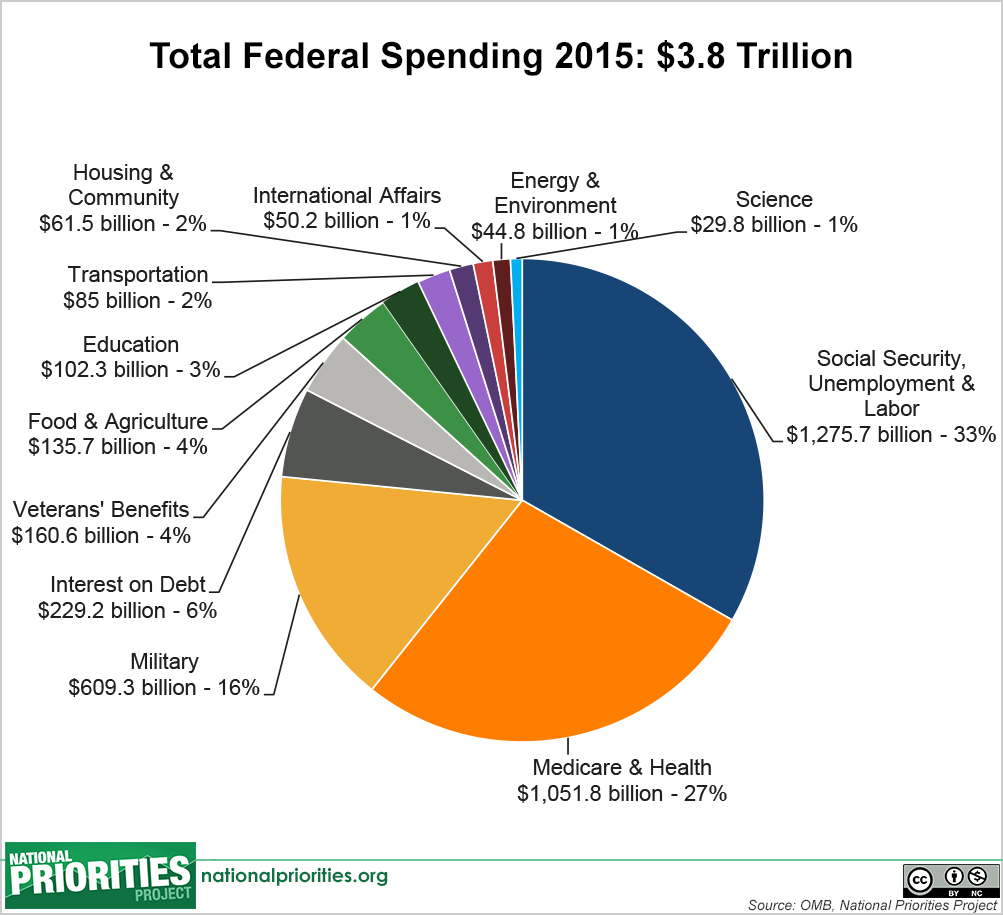
I'm glad Amazon doesn't pay that much in taxes. 609B in tax money per year goes to the US Military, which has been responsible for more death and destruction on this planet than could ever be imagined previously.
So, thank you Amazon for making sure the warmongers don't get too drunk off of your success.
> I'm glad Amazon doesn't pay that much in taxes. 1.2T in tax money per year goes to the US Military, which has been responsible for more death and destruction on this planet than could ever be imagined previously.
That's arrant nonsense. Stalin's Holodomor killed 7-10 million people, more than the U.S. military has ever killed, and it starved millions more almost to death. Mao's Great Leap Forward resulted in the deaths of 15-30 million people, more still.
Moreover, the U.S. military is not currently responsible for wanton death and destruction. It has spent the last decade and a half trying to support civilian government and the rule of law both at home & abroad.
Bombing civilians and giving weapons to terrorist organizations really helps to support civilian governments and the rule of law.
Walmart currently pays $2 a year in dividends to about 3 billion outstanding shares.
So over a few years they have paid tens of billions in dividends (and have done share buybacks in addition to that).
A lot more tax money goes to non-military parts of the government[0], like welfare and education. I'm not happy that Amazon doesn't pay its fair share.
Seems bizarre to only think taxes go into the Military Industrial Complex. I mean, sure they take their cut--but I'd like to think that our taxes go towards maintaining our civil society as well!
Edit: Seems very much cutting off your nose to spite your face, if one is 'happy' a corporation isn't paying taxes
Per my other comment, the military's cut is 16% of 3.8 trillion.
Energy, Environment, and Science take a combined 2%.
Social Security and Medicare take a combined 60% (!), which are funded by entirely separate taxes (payroll taxes). Amazon still pays those.
Trust me, you don't want a corporation paying income taxes.
It just results in dead Iraqis and global surveillance.
What's not fair? They are following the law.
Fairness (distributive) != Lawfulness
Justice != Lawfulness - contested
Justice ≈ Fairness - contested, but developed world's post-war political-economies are based upon this either explicitly or implicitly. A lately weakened norm (post-Thatcher/Reagan) that Amazon and others are breaking further.
https://plato.stanford.edu/entries/justice/
Amazon can't escape paying Medicare and Social Security taxes. So, they are definitely paying into that, along with everyone else who pays payroll taxes.
So, if you exclude those two things from the budget [0], you'll see that military expenses and interest on debt greatly outweigh education and NASA and etc.
Now I personally think Amazon is a great source of good in this world, compared to Lockheed Martin or Halliburton [1]. So if those guys aren't paying anything in taxes, I am biased, they should be paying more, not Amazon.
[0] https://media.nationalpriorities.org/uploads/total_spending_...
[1] they make missiles and weapons that kill people wholesale.