US Lifts Laptop Ban on Etihad, Emirates and Turkish Airlines
techcrunch.com>"The department of Homeland Security initiated the ban in March. It came into effect covering all flights to U.S. destinations from 10 airports in the Middle East, including major travel hubs like Dubai, Abu Dabi and Dohar."
So how would a ban at flights originating at these airports prevent someone from exploiting this on a flight with a layover in this airport i.e while the plane was in route to one of these 10 airports?
>"While administration officials didn’t comment on any new and specific threats, ..."
This is used to justify every questionable action or inaction in the "Endless War on Terror." The claim is always "we can't comment because its an issue of national security." Do people of that "Nation" have no right to be informed about decisions being made on their behalf? Especially where safety is concerned?
Shouldn't this information be shared with the citizens of that nation so they can make up their own minds and make informed decisions? This level of infantilizing is just completely unacceptable. Those in the U.S security apparatus seems to take the view that they are parents and everyone else is a child.
The reason why that information is not disclosed is not because they don't want their citizens to know. They don't want others to know; that's when it would actually compromise the security.
That is a perfectly valid reason in isolation. The problem with that in aggregate is that we don't know when the government or abusing its power.
When is the government telling the truth or not and what policies lead to these decisions. This is compounded by the feeble attempts we have made at performing oversight on this resulting in things that looks like failures such as the whole FISA court system. I don't know if FISA is a failure or not in terms of respecting the interests of Americans, because their trials are secret and that is a failure to protect the interests of Americans.
Yes that's the official "war on terror" party line you are parroting - "we can't tell you for your own good."
Please provide one single example where communication and sharing of information with one's fellow citizens made them less safe.
"Loose Lips Sink Ships"
In other words: this sort of logic is by no means unprecedented in American history, for the simple reason that gathering information from the general public of a nation is a basic and common element of espionage against that nation. Whether or not such espionage is actually useful is a different story, but especially in this day and age of ubiquitous near-instantaneous and effectively-permanent public (or at least less-than-private) communication, there's every reason to believe that there are "enemy spies" among the general population, and therefore that the less information the general population receives, the less information the enemy can gather (at least through that particular avenue).
I feel that this current instance of information-concealment is excessive, but it's not unreasonable to suspect that the likes of ISIS are collecting information from the American public, and thus not unreasonable to want to limit the information going out to the public in order to prevent hostile agents from obtaining that information.
>"In other words: this sort of logic is by no means unprecedented in American history, for the simple reason that gathering information from the general public of a nation is a basic and common element of espionage against that nation"
Please way what the precedent is then if this is not unprecedented in American history.
>"... there's every reason to believe that there are "enemy spies" among the general population, and therefore that the less information the general population receives, the less information the enemy can gather (at least through that particular avenue"
That statement is absurd - "keep all the citizens in the dark just in case one of them is a terrorist!"
"That statement is absurd - 'keep all the citizens in the dark just in case one of them is a terrorist!'"
I don't disagree. That doesn't change the fact that it's been an American tradition since at least WW1/2. This is really nothing new.
If the threat is credible, then limiting the dissemination of information is not unreasonable. I don't believe the threat to be credible, but I'm no national security expert.
>"That doesn't change the fact that it's been an American tradition since at least WW1/2"
Please provide examples of this tradition. What threats were kept from the American public during the first and since the first two world wars?
I mean, there's the instance that I quoted in my very first comment in this conversation: https://en.wikipedia.org/wiki/Loose_lips_sink_ships
Granted, that specific instance was more centered on making sure the American public doesn't inadvertently spread information to America's enemies, but the U.S. Office of War Information (https://en.wikipedia.org/wiki/United_States_Office_of_War_In...) was in fact known to withhold information for "public safety", and the Office of Censorship (https://en.wikipedia.org/wiki/Office_of_Censorship) was literally created for this exact purpose of preventing the public (and therefore - in theory - the enemy) from obtaining information that might in any way benefit the enemy (even weather forecasts!). The Committee on Public Information (https://en.wikipedia.org/wiki/Committee_on_Public_Informatio...) had a similar policy of withholding information that the enemy might find useful.
The situation with the laptop ban is much different from these, of course, which is why - like I said before - I agree with you that withholding information in this case is excessive and unnecessary for public safety.
From the wikipedia link:
"This type of poster was part of a general campaign of American propaganda during World War II to advise servicemen and other citizens to avoid careless talk concerning secure information that might be of use to the enemy"
This is not at all the same as creating a policy and not explain to the citizen you represent why you are doing it.
"From the wikipedia link:"
Which one? There were four.
(That was rhetorical, by the way, my point being that ignoring three presented sources to nitpick one does not a solid argument make)
"This is not at all the same as creating a policy and not explain to the citizen you represent why you are doing it."
Sure, but that wasn't what I took to be your question/request, nor does it really make any difference here when evaluating whether or not the United States has a century-long tradition of wanting to keep military/security information confidential.
The "logic" here is that the mere act of telling the general public why said policy was created would reveal sensitive information about ongoing security activities (information which - allegedly - is indeed of use to the enemy). I disagree with that logic and its application in this case, but that is the logic, and said logic is - as demonstrated previously - precedented in American military history.
Any time that when that information falls into the hands of attackers and enabled them to make more effective plans.
I do not know if this is that case, but there is a class of information that when made public reduces safety. The problem is not with telling any one individual, you or I would probably do little with the information, but once "everyone" knows it potential attackers could use the information.
If it were something like the times or flights we suspected the terrorists would attack and they got that information I hope you can see how that would make things worse.
I think the real solution is valid oversight, not this FISA non-sense we have now. Actually, I don't know if its non-sense because its so secret I can't tell if its doing its job or not, so I must presume its not.
>"Any time that when that information falls into the hands of attackers and enabled them to make more effective plans."
You mean like announcing a laptop ban from flight originating in 10 predominantly Muslim countries? Do you think terrorists don't pay attention to the news?
>"I do not know if this is that case, but there is a class of information that when made public reduces safety."
Please provide an example of this.
This story has several examples! Anything that lets and attacker work around security precautions is that kind of information. Right now the list of airports and countries is a physical security vulnerability because an attacker can just go to a different airport than one on the list.
I wish physical security were like digital security. When securing a server I can publish exactly how I did it and if it is good then the server is secure unless some gets physical access...
With physical access the description of the system is a weakness. Unlike packets against a firewall any real wall can be beaten down with enough force, so letting your enemy know how thick your wall is or how many men guard it is a security vulnerability all on its because then they know what goal they need to reach. Uncertainty is poor computer security tool because most attacks are free, physical attacks have a cost. So attackers won't do them unless they think the odds of success justify the costs. If they don't know if they can beat down the wall they probably won't try unless they are desperate.
Physical security is all about economics or manpower, either way it is about making attacks too expensive to be worthwhile. Just describing the boundaries to be secured makes it easier, and therefor cheaper to plan an attack. This is very unlike computer which is about finding and fixing flaws. A computer system without flaws cannot be attacked over a network, it must be attacked physically (or socially engineered which can be considered a physical attack here). For any physical attack there is some amount of money or manpower that can take the objective.
The government has made pretty clear over the last few months that the reason for the ban was intelligence that jihadist groups had made progress towards developing a laptop bomb. It is pretty reasonable for them to withhold details in order to protect sources and intelligence-gathering techniques.
No they haven' made it pretty clear that "jihadist groups had made progress." Please provide a citation for that. The official TSA website states:
"Evaluated intelligence indicates that terrorist groups continue to target commercial aviation and are aggressively pursuing innovative methods to undertake their attacks"[1]
It says nothing about them making progress. Also that's a pretty nebulous statement. "Evaluated intelligence indicates"? Why not share the details with the public in the form of a redacted report?
Could you imagine the Surgeon General in the US issuing a statement that some food causes cancer and then not releasing any of the details? Of course not.
Withholding details that allow your citizens to make their own informed decisions regarding their safety and welfare is unacceptable.
Also did anyone ever assume that terrorists had stopped being interested in damaging aircraft? We are reminded of that every time we fly in the US and are berated and abused by TSA personal. So this isn't really a new development is it?
[1] https://www.dhs.gov/news/2017/03/21/fact-sheet-aviation-secu...
I don't get the aggressive tone here?
I think the ban is stupid, but they actually have had significant intelligence that (a) they have stolen scanning equipment they are using in the development of explosives so they can avoid detection and (b) they have developed newer laptop bombs that are more dangerous and harder to detect. It took me literally 30 seconds on Google to find an article detailing it with links: http://heavy.com/news/2017/05/isis-laptop-bomb-threat-planes...
I didn't think my tonality was in any way aggressive. It certainly wasn't meant to be.
Yes I read that story on heavy.com back in May. And heavy.com is not part of the DHS, the TSA or any other US government agency.
Also the story on heavy.com is reporting about an unnamed source who reported it to another publication(the Washington Post.)
So in effect you have - someone saying that someone told someone else this. That's hardly counts as a credible intelligence. That's what I would third-hand news. It's like the children's game of "Telephone."
>Also the story on heavy.com is reporting about an unnamed source who reported it to another publication(the Washington Post.) So in effect you have - someone saying that someone told someone else this. That's hardly counts as a credible intelligence. That's what I would third-hand news. It's like the children's game of "Telephone."
This is a rather disingenuous argument. You're making a big fuss about heavy.com linking to WaPo, but why not just disregard the heavy.com article and look at the WaPo article? Further, it's pretty standard for news reports concerning intelligence matters to originate from anonymous sources.
Please read the entire context. I was originally responding to the statement:
>"The government has made pretty clear over the last few months that the reason for the ban was intelligence that jihadist groups had made progress towards developing a laptop bomb."
A Washington Post article citing an anonymous source is not the government making it "pretty clear." I'm not being disingenuous at all. The US Government making it pretty clear would be via a press briefing or some other such official statement.
The whole controversy about Trump telling the Russians too much concerned the intelligence I am referring to. This, and the general existence of intelligence about progress by jihadis towards a laptop bomb attack, has been widely covered by just about every news outlet. It appears that an Israeli intelligence agent or asset was involved in uncovering the threat. The lack of public details is presumably to protect the cover of this agent or asset. I realize that government secrecy isn't popular around here, but the hostility to even this very obviously justified use of it is surprising.
The analogy with food is flawed: the food does not deliberately cause cancer, and the would be announcement by the Surgeon General would not help the food to evade anti cancer treatments.
Having said that, i am glad thst the ban is lifted.
Food was not the point. The point is government agencies withholding information that helps their people:
1) think critically
2 allows them to make informed and rational choices
3) quantify risk
Why do I as a private citizen need to know more detailed information about this? What can I possibly do as a private citizen with intelligence about terrorists planning to use laptop bombs on planes? My government has taken the action it deems appropriate to defend the country and its citizens, while still protecting the cover of the agent or asset that gave us the intelligence.
>"Why do I as a private citizen need to know more detailed information about this?
So you can make an informed opinion. In case you hadn't noticed there a lot of hysteria in the current administration.
>"What can I possibly do as a private citizen with intelligence about terrorists planning to use laptop bombs on planes?"
You can decide for yourself if you feel like it safe for you or your family to fly.
>"My government has taken the action it deems appropriate to defend the country and its citizens, while still protecting the cover of the agent or asset that gave us the intelligence."
Except that they didn't. Donald Trump exposed the source of the intelligence: https://www.nytimes.com/2017/05/16/world/middleeast/israel-t...
He disclosed it to the Russian government, which is not necessarily improper. The US and Russian government share classified info all the time; they tried to warn us about the Boston Marathon bomber after all. Some #resist idiot who thinks he's a hero then leaked it all to various news outlets, doing way more damage. It thankfully seems that these agencies heeded the warnings of the US government that publishing the full details would be highly damaging, but I doubt that news agencies are equipped with SCIF-equivalents that would adequately protect the information from other prying eyes.
Again you stated:
>>""My government has taken the action it deems appropriate to defend the country and its citizens, while still protecting the cover of the agent or asset that gave us the intelligence.""
Well then they didn't do that did they?
Your own interpretation of what is and isn't "proper" in matters of intelligence notwithstanding, they failed to do what you are stating above. "They" being your government.
By the way the "deep state" conspiracy narrative is really tiresome.
>By the way the "deep state" conspiracy narrative is really tiresome.
What are you on about?
>> "...the reason for the ban was intelligence that jihadist groups..."
The reason for the ban has nothing to do with jihadists and everything to do with protecting domestic business.
Emirates and Turkish Airlines were eating US flag carriers' lunch on profitable routes by offering reasonably priced service that doesn't suck. So the domestic airlines called their friends in Washington and asked them to tip the scales.
You'll notice that the laptop banned routes were cash cows for the foreign airlines while being wholly unimportant to Delta, United et al. This tells you everything you need to know about the actual security impact of the laptop ban. It's just regulatory capture of the "security" agencies.
It seems unlikely they'd withhold that intelligence from the other Five Eyes nations and NATO partners, but to my knowledge they haven't implemented the same restrictions.
The UK has: http://www.wired.co.uk/article/uk-laptop-ban-flights-explain...
The US and UK are obviously at higher risk of being targeted than most countries. We also don't know if the intelligence included information about the countries the jihadists intended to target.
Also, other governments may have come to different decisions about how to handle this risk. Some countries let a million people pour across their borders without identity checks, others don't. It may be surprising to some, but who and what you vote for matters.
Yes, lets put those laptop bombs in the hold.
The amount of explosive you can fit into a laptop (and have it not be obvious) isn't a lot. So it works best if you can place the laptop directly against the hull of the aircraft. Putting it in the hold makes that less likely to happen. So while not optimal, putting them in the hold is an improvement.
I know this comment will probably ensure I get on some kind of "list", but you don't need the laptop itself to be the fuel. It could be an accelerant or fuse, packed between fuel in a large bag, and multiple bags sent.
Yes, putting laptops in the hold it is an improvement, assuming your attack vector is intentionally placed small explosives. Randomly placed large explosives, or large explosives placed intentionally by an insider, might be as effective or more so. But I know jack shit about the design of airplanes so I have no idea if this is the case.
Hah, have you seen the "gaming" laptops out there, if you even replaces half of the battery with something like c4 it could easily blow a hole in a plane.
That said I'm not advocating this ban at all, I think it's yet another in a long series of overreactions. But to imply that it couldn't be done is asinine.
> to imply that it couldn't be done is asinine
That isn't called for. Clearly you disagree, which is fine, but there's no need for a personal attack.
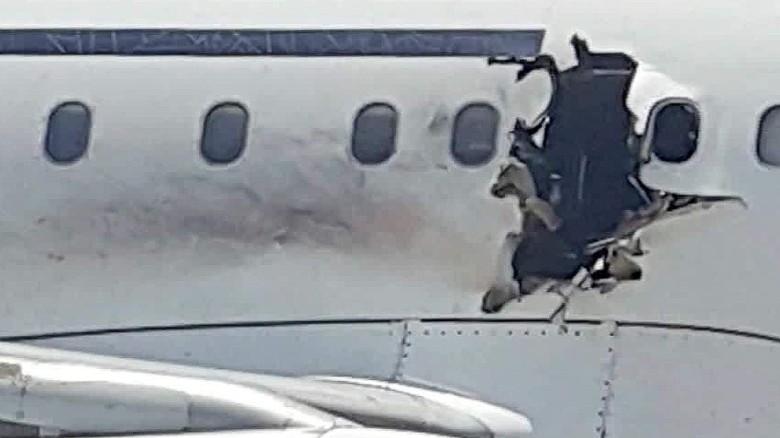
Here's what happened with a laptop bomb that was placed against the hull on a Somali flight: http://i2.cdn.cnn.com/cnnnext/dam/assets/160203180228-plane-... As it happens, it only killed the bomber.
They could allow Ultrabooks in the cabin and ban laptops say heavier than 2.5 lbs. They could publish a list of the heavier models that needed to be checked in.
I believe that US-bound luggage has to go through special screening.
> It is pretty reasonable for them to withhold details in order to protect sources and intelligence-gathering techniques.
Trump already let slip that it was the Israelis who uncovered the plot.
> So how would a ban at flights originating at these airports prevent someone from exploiting this on a flight with a layover in this airport i.e while the plane was in route to one of these 10 airports?
Have you been to a middle east hub? There's a specific security section you have to go through to get to the US bound flights - it's a completely different screening process and would be quite easy easy for them to check for laptops and get them checked as luggage.
Yes, I have flow though Doha many times. The fact that their might be special facilities there doesn't stop someone from damaging a flight en route to that airport with extra security equipment.
They (US) don't care about damage to a flight that is not incoming, no?
For international passengers during layover your personal baggage has to go through security check again before boarding next flight.
Isn't the main reason for the ban the fact that they were worried security checks would be unable to detect bombs in devices like laptops in the first place?
They are worried about security checks in those countries in particular.
I'm not sure if this has hit the US news, but from a few days go in Argentina news, the US is going to require special scanners in the airports in other countries (Spanish article, English translation below):
http://www.iprofesional.com/notas/252113-computadoras-tecnol...
"The United States government will strengthen security measures for people traveling to that country with computers and tablets. Official sources from that country confirmed that you can still travel normally, with personal electronic devices. However, they said that in three weeks the stricter controls will apply.
....airports and airlines flying to the United States from 105 countries of the world, including Argentina, will be asked to install state-of-the-art scanners that detect traces of explosives in electronic equipment....From the moment they request it, passengers traveling to the USA from airports or by companies that do not have them, will not be able to carry either computers or tablets on board. Nor in the cargo hold....
....In this context, the transport authorities, representatives of the airlines and PSA [airport police] officials met urgently this Friday at the headquarters of the Ministry of Transport to discuss the issue. "What we defined is that this Tuesday we are going to communicate to companies a procedural plan: from what types of scanners to how to get them and how we are going to train those who operate them," explained Oscar Rubio, director of The Airport Security Police, Clarín.
In three weeks, passengers of companies or airports that do not have them, will be unable to bring the computers and tablets on board, and perhaps also in the hold because of the current restrictions on equipment containing nickel," added the official...."The truth is that it is not a difficult technology to get, it can be bought, acquired by leasing or through a supplier, it is not impossible, and we are moving with the fastest speed because we want to prevent the restriction from being applied. Therefore, we are not facing a prohibition, but before a new measure. If it is not fulfilled, then the impediment can come."
This is making me worried. When i was a student at mit, we had trips to boeing facilities in seattle. One time, i was again selected randomly for explosive trace sample collection from hands. I dont know what it was, but when they put the tissue in the machine, the machine showed a blinking text saying explosive detected. The tsa agent(iirc) paniced, tried to call out his supervisor while trying to keep an eye on me.
Now usa probably has more experience with false positives, i am curious how i will be treated when i go visit my parent :)
I fly a lot. The only time that has happened to me was when I was on a flight out of Atlanta after taking my crew to a gun range to shoot some auto's. I'm gonna guess the cordite burns on my shirt and residue on my hands probably had something to do with it.
Happened to me about a year ago flying DEN to LGA. I had one of those thermal receipt printers in my carry on. Those set off the bomb swab machines. Luckily Mr. TSA knew that thermal printers could set the machine off so nobody panicked and I was allowed through.
So now all a terrorist needs to do is carry a thermal printer!
Soon: "Serengeti In Uproar As U.S. Travel Ban Extends to Zebras"
Make bombs out of thermal printers, got it.
That sounds like a great way to sell so-called "state-of-the-art scanners".
I don't understand why these bans are only for specific airlines. Maybe if the flights originate from specific airports which may have lax security. However the ban is also for flights to those destination originating from the US.
If there was a way to turn a laptop into a bomb I am sure the terrorist would just jump on a local US aircraft.
Are you sure the ban is in both directions? I'm pretty sure it's only on flights to the US, and what I can find online supports this.
The ban is because authorities believe security at those airports is inadequate to detect a bomb built into a laptop. This implies they believe security at other airports is able to detect such things. If the ban is being lifted for specific airlines, it's because those airlines have security sufficient to detect these laptop bombs (or at least the authorities believe they do).
It is not necessarily the case that every airline at a given airport has the exact same security. It's possible for terminals to be separated and security measures to be enhanced at only one terminal. It's possible for additional security screening to be done at the gate.
I flew a round-trip on Turkish (Atlanta-Istanbul-Vienna, then Budapest-Istanbul-Atlanta) while the ban was in effect. The ban was only in effect on the Istanbul to Atlanta flight. I believe I could have carried a laptop on the Budapest-Istanbul flight and "gate-checked" it at Istanbul; I didn't see anyone do this, but my carry-on bag was searched at the gate so I suppose that's when it would have happened. See http://liveandletsfly.boardingarea.com/2017/04/19/guide-elec... for an example of how this gate checking may have worked.
We've always been at war with eastasia
East Asia? As in Japan, Korea, China, Taiwan, HK?
It's a quote from the book Nineteen Eighty Four
Ah, thanks. I didn't know and there weren't quotes so I was confused by the statement.
I don't think it is so much about it being a "bomb". I'm gonna take a stab and say it may be related to the ability to take over the control system of the plane via a laptop/wifi [1]. It would make sense to some degree if the US knew that an airline had planes that were "unpatched".
[1]: http://observer.com/2016/02/midair-hack-shows-the-dangers-of...
No it's almost certainly due to the recent intel that found that ISIL had developed a way to hide bombs in laptops to evade airport security. http://www.cnn.com/2017/03/31/politics/terrorist-laptop-bomb... http://heavy.com/news/2017/05/isis-laptop-bomb-threat-planes...
Let's see... they developed a way to hide a bomb powerful enough to bring down an airliner inside a laptop, but not a way to buy tickets for flights other than a few specific routes on a few specific airlines? If you believe that, I've got a bridge to sell you.
I admit it's a little odd. Relatedly, the UK also instituted a similar laptop ban as well. If not the laptop bomb threat, then what do you think it is? http://www.wired.co.uk/article/uk-laptop-ban-flights-explain...
I know some (maybe even most) of the affected airlines have significant government ownership. It could therefore be a way of gaining political leverage.
It could also be a leg-up to American carriers competing on those routes. Another commercial option is a tactic to require implementation of security practices that involve American-made equipment.
I'm sure there are many other possibilities that make more sense than the public explanation, which only seems to make sense if we assume the people protecting us are incredibly stupid. I don't think they are, so the public story is probably just a cover.
What if instead of being stupid they were artificially limited in some other way?
Perhaps, they wanted a more comprehensive laptop ban but were stopped by someone.
This just reminds me of this: http://dilbert.com/strip/1997-09-10
On related news, Millimeter wave scanners are being installed in Turkish airports after the lifting of the ban...
Made by an US manufacturer?
Are you kidding?
is this a thank you token for putting pressure on Qatar?
I'm not buying that as part of US strategy. Saudi vs Qatar seems to be part of the standard Saudi vs Iran stuff that the West tries its best to ignore.
Except that the West isn't trying to ignore it, at least not Trump:
https://www.theatlantic.com/international/archive/2017/06/tr...
The President is "paying attention":
https://www.theatlantic.com/international/archive/2017/06/tr...
I upvoted you (it's nice food for thought) but I'm also hesitant to give anyone bad credit for a good thing. The ban needed to be removed eventually, and it was.
Turkey is supporting Qatar.
I know that, and also Qatar Airways also benefits from this. That's beside the point.
The target wasn't commercial but political. The US just chose to put commercial pressure to achieve political goals. Have a look at the demands that were made.
EDIT: Qatar is still on the list... ah well.
Laptop bans are such a horrible idea. Yes, entrust a $2000+ dollar piece of hardware (with important software and files) to someone who is barely paid enough to care what happens to it.
As someone who flew Emirates to the US during the ban I can assure you that laptops were well taken care of. There was special staff in Dubai to take inventory of laptops and other electronics, securely shrink wrap and pack them, and then seal the bag.
Upon arrival in the US there were again special staff that would hand you your laptop box after checking ID and boarding pass, which an airline seal still on it.
At no point did I feel like my laptop was handled by someone who doesn't care about what happens to it.
Not just don't care, also deliberate theft. It's been a big problem with TSA agents in the United States.
That doesn't necessarily mean it would have been a problem with middle-eastern airlines. They knew that the entire profitability of their US routes depended on well-off business travellers continuing to trust them — and unlike the TSA, they operate in a competitive market.
There are plenty of opportunities for things to be stollen from checked in luggage at the arriving airport.
This actually happened to me on a flight into the US, with an expensive set of german kitchen knives in checked-in. In the US my suitcase was taken out of the normal line for extra checking (I guess because the knives showed up in an xray?).
They then later gave me my suitcase, but the entire knife set was missing. No documentation that it was taken. No one even cared. No recourse. And nothing came of it.
If I have something valuable that I couldn't take in my carryon again, I'd rather just DHL than trust the TSA to not steal it.
This makes me happy. I flew from Istanbul, Turkey to San Francisco, CA, USA while the ban was in place. The actual surrendering my laptop didn't bother me much. What did bother me was the humiliation the Turkish Airlines workers had to endure, and how hard I had to work to suppress my desire to complain about the process. Treating a few airlines differently never appealed to me. I "like" "necessary" suffering to be ubiquitous.
The solution to the laptop bans is portable hard drives .Let the $15/hour worker lose your laptop. the software and files are more important
I am looking forward to the day where global entry is applied worldwide :/ breezing through security is pretty nice after being aelected randomly so many times :)