Venezuela’s currency is dying
washingtonpost.comVenezuelan here, the current problems related to our currency losing 70% of its value in only 3-4 days are directly related to media manipulation.
Black market was totally stable in the 1000:1 mark for months, until the actions from the gov to stop the presidential referendum made again the rich unhappy and they decided to attack with all they have and this includes the media.
95% of the imports in Venezuela are made using the official rates and thats a bit complicated to explain, there is 2 rates wich are 1usd:13bsf (a price fully subsided used mostly for food and items that are considered "basic") and 1usd:658 for everything else and then there was the black market dollar wich is now 1usd:1758bsf
The thing is you can sit here and say the dolar is 1:2000 but it doesn't really mean thats the cost, thats where everyone fails, because neither the venezuelans have the money to pay for it or people want our currency, there is an special case of people doing this kind of trades and are the ones that are fleing the country, emigrating to other places and are desperated in need of USD
In the other hand, is somehow totally fake that we are paying this prices, in fact, noone imports anymore since gov barely gives USD at subsided price thus this is why we are now under scarcity problems.... so there you go.. offer and demand sets the prices but theres actually not really demand, I mean there is an insane demand but not demand for the 2000:1 price, thats just a political fight.
Unfortunately, the price of the Bolivar is set in Cucuta, Colombia, the only place where people buy and sell Bolivares. You can change bolivares for pesos and pesos for dollars.
It's a tiny, tiny market, but because the government is set on this stupidity that is called the currency exchange restriction, that tiny market decides how much our worthless currency is worth.
> made again the rich unhappy and they decided to attack with all they have and this includes the media.
From what I understand, the government has pretty much eliminated the independent media.
More generally, are you saying that the government has done a good job of managing the oil industry, and also developing the rest of the economy so it is not so dependent on oil?
> From what I understand, the government has pretty much eliminated the independent media.
There's no shortage of independent media in Venezuela, both press and TV.
What media manipulation are you talking about?
I heard that you can still get the 1USD:13bsf price only if you have connections, and then make insane profits using the black market to exchange the dollars back to bolivars. Rinse, repeat.
And what do you mean no demand for the 2000:1 price? People aren't willing to trade 2000 bolivars for 1 dollar or people aren't willing to trade 1 dollar for 2000 bolivars?
No, it used to work like that when black market was around 10x-15x the value of official rate.
Nowdays, the money got so devaluated that they dont really even need to trade back into BSF.
The way corruption works now is the following:
I as a importer, go to my Chinese friend and ask him a quote for 100 pair of shoes, my chinese provider tells me the 100 pair of shoes are worth 1.000 USD, then I create a company in Panama and Quote myself the shoes for 10.000 USD, I use the new quote to request gov an USD sale of 10.000 using official 1:13 rate. Govs aproves it (by using my connections). I pay the gov 130.000 BsF for the 10.000 USD wich are paid to my panama company (they never give the money directly to the company who is trading the usd but they actually pay to the provider, but remember, the provider is myself in panama) then I use 1.000 to actually buy the shoes and 9.000 as profit.
When the shoes finally arrive to venezuela, marketer does the same, hes supose to sell the shoes at the very same rate he purchased so if you got 100 pair of shoes for 10.000 USD that means each pair of shoe is 100 USD right? that means 1.300 Bsf (using 1:13) thats cool right? beacuse even if they stole 9k, at least the final consumer would pay the 1:13 rate.. but guess what, they also have some child company in here, that would buy all the shoes at 1:13 rate and then chain it over and over to the moment you lose track of the sell/purchase chain and then the shoe is sold at 1:1700 rate to the final consumer.
At the end, the merchant ends up selling 1 single pair of shoes for 170.000 BsF that is even more than he needed to pay for the 10.000 usd at start.
Thats how bad it is.
SO yea, as I said it, they dont need to even get BsF anymore, with just 1 time usd exchange they already profit.
And yes there is no real demand for 1700:1 or 2000:1 or w.e u name because is not sustainable for anyone, ofc unless you really really need it, like if you are cashing out all your stuff because you leave the country or if u are like super sick and cant find medicines etc.
But if you think that people is just normal trading at those prices, that just does not happen.
Even tho there is scarcity and a big one, you can still find subsides things, so either people cant afford to pay for expensive items (at black market) or they just complete ignore the need of USD because how expensive it is.
Thanks for answering!
I was wondering what part you think the mass media had in encouraging this sort of thing. This seems like the result of massive corruption and confused currency controls, not because of media manipulation.
> The thing is you can sit here and say the dolar is 1:2000 but it doesn't really mean thats the cost, thats where everyone fails, because neither the venezuelans have the money to pay for it or people want our currency, there is an special case of people doing this kind of trades and are the ones that are fleing the country, emigrating to other places and are desperated in need of USD
That's what a price is: the point at which twp parties are willing to trade ownership of their goods and both feel that they have come out ahead of the exchange. If there's very little demand for Venezuelan currency, then of course it will be very cheap in terms of dollars (and high-demand currency, e.g. the dollar, will be very expensive in terms of bolivars).
I'm not sure what you're arguing for.
What is happening to your country is a typical result anytime any government tries to control the currency exchange rate and prices of goods.
This also has the bonus effect of increasing corruption because it incentivises paying a bribe to a government official rather than dealing with the regulations.
Venezuela got away with it, somewhat, when you had oil money coming in. Even then your average standard of living was low. Now that oil prices have collapsed, you are where you are and absolutely nobody is surprised.
Your government simply needs to let go and allow your currency and prices of goods float freely according to supply and demand.
Is anyone in your government even considering it?
What can I, as a US citizen commoner, do to help?
well there are ways to help but are somehow complicated and they dont really affect directly to the normal citizen, like for example you could send medicines or food to someone or even money but it does not help at all, the problem persist. Your best bet is to donate to some NGO like https://transparencia.org.ve/ that tries to implement a better transparency system in our country.
Venezuela problem is not socialism or w.e method, we actually had everything. Our all time problem was corruption and we had it during our whole story, is not something that came with chavez or with socialism, we had this very same problems 30,40,50,60 years ago.
Unfortunately, this government is so criminal that they go as far as denying medicine and food donations so that they don't have to admit that we have a crisis.
50% of the medicines donated by Caritas, coming from Chile have now expired in the venezuelan ports because the government does not want to authorize them. [1]
This is a government that would rather let their people starve and die in the hospitals before admitting they have created this humanitarian crisis. I only hope we can see justice in this country some day.
[1]http://www.el-nacional.com/sociedad/Advierten-medicamentos-v...
True we had corruption history from many years ago, but to put it in context and more in financial impact rather than "by the law", its very different what "thousands or millions of dollars corruption" (before chavez) will do to the economy than "billions of dollars corruption" (during chavez and Maduro)... This has been The All-Star, MVP, Nro.1 Corrupt Gov of all time. They literally took it all and they still are taking it all... No mercy for this Masters of Misery!
Yep, there has never been corruption of this magnitude in they history of this country. And it's such sad excuse when the few people left that still support the govt say that this has always been a corrupt country...
Wasn't the Bolivarian Revolution supposed to eradicate everything that was wrong with the previous governments? They've only made every single problem worse.
Well Bolivar himself believed in the concept of a president-for-life so the seeds were sowed early on.
Assume I have access to a largish sailing vessel and can clear customs in Columbia near Riohacha. What are the most essential needs in Venezuela at the moment, and what would be the most efficient way to connect with those in need? Can Venezuelans in need of medical supplies cross into Columbia?
> Venezuela problem is not socialism [...] Our all time problem was corruption ...
The first makes the second a lot worse.
Your problem is socialism. All of what is happening in and to Venezuela was predicted by people who simply observed the 20th century.
Please expand the abbreviation "w.e method" for me.
w.e = whatever
Isn't agriculture well-developed in Venezuela ? Any historical reason for why this is ?
It was well-developed, but when you can't import machinery and fertilizer, your agricultural production is quickly limited. And when the prices of the products that you sell are price-controlled, there's no reason to expand production because you're losing money on any investment you make in agriculture.
Don't forget also the disdain for environmental problems that always bite you hard in return a few years later.
In the Chavez presidency, the Lake Maracaibo protection was neglected, leading to serious pillage and contamination episodes by Hidrolago, Petrol companies, etc... The old ecosystem, plenty of fishes was destroyed and displaced by another ecosystem, one that is very ill. You can't use this water anymore to provide food for the people. Most fishes are gone and duckweeds poison the water regularly.
You can easily create fertilizer processing organic residues, after all is a "subproduct of humans", but the government decided instead to simply trow all to the lake without any processing, that is a criminal movement.
That makes sense; speaks a lot for the criminal mismanagement of a clueless state (largely true of India before the 90s, kind of true even today).
I think cluelessness has a lot to do with it - though it's increasingly hard to believe that people are still unaware that price controls generate shortages. Maybe some policies just have that property of being politically feasible enough to overcome the fact that they're useless.
There was a solid Planet Money story about the collapse two weeks ago.
http://www.npr.org/sections/money/2016/10/21/498867764/episo...
That makes sense, Venezuela's economy, social structure, and political systems are also dying. It would be crazy if currency based on those things were not dying as well. If they were a collapsing star, they'd be rapidly approaching r=2M.
> Now, there's never been a country that should have been so rich been so poor as Venezuela. Indeed, it has the world's largest oil reserves, but has still managed to have the world's worst-performing economy.
Is there any actual evidence that natural resource wealth is strongly correlated with level of development?
There is such a thing as the "resource curse". That is, if a country is rich with exploitable resources, the political economy will tend towards infighting over who controls the resources. This is akin to a zero sum game, instead of creating an inclusive system where innovators can profit from their creating.
"Why Nations Fail" is a great book that goes over this.
It's called dutch disease.
More specifically, it's called a "resource curse".
Is there evidence that Venezuela collapsed due to infighting? Is there evidence that the us (which is resource rich) is going to collapse due to infighting over resources?
I believe that the resource curse mostly applies to economies that are very poorly diversified and have a GDP based largely on exports of relatively raw materials. The U.S. Has an extremely diverse economy with a large base in services and domestic consumption, even though we export lots of commodity materials and agricultural products.
Canada (and in a smaller scale, Alaska and Louisiana) are better examples of developed economies with relatively good governance but an overreliance on resources and under-developed services. Maybe Australia/NZ too?
Venezuela seems to have had major problems with price controls as well as resource production (the federal oil company became staffed with under qualified people due to political patronage and even before the oil crash, production and efficiency dropped dramatically compared to Colombia's which is similar in scale, culture and geology but better run). I don't know the contribution of infighting (in a Gang of Four sense, obviously there were contentious elections) but it's at least not the only factor.
There are plenty of exceptions to the "resource curse": Canada, Norway, Brunei. There is, however, a lot of infighting in Venezuela.
The existence of general infighting and there being a collapse does not mean that infighting (much less, infighting over resources) precipitated the collapse. I think if you examine the history of the collapse, it has almost nothing to do with political infighting.
The "should" here is more normative than descriptive.
That said, the consensus is actually the opposite - if the government controls large stocks of natural resources, they tend to focus on resource extraction rather than developing their economy or civil society. If you can get foreign engineers to run your mines / oil wells / etc (and you definitely can) you don't even need schools for indigenous engineers to keep things running. This is the "resources curse".
OTOH when you have a pre-existing, well-functioning government & society that happens upon a natural resource windfall, like Norway or North Dakota, it's pure gravy.
The US and much of Europe are extremely resource rich. Like, ridiculously so.
The problems only seem to happen when the entire economy is organized around exporting extracted natural resources. And a lot of those problems are as economic as they are political. Local economies dominated by a single sector tend to see smaller versions of the same problems, regardless of the sector.
Europe was resource rich, leading to the industrial revolution, but many of those resources are comparatively depleted now. Partly why steel mills are closing across Europe: they were built to exploit local resources which are no longer there.
No, this is mistaken. The large steel mills are closing across Europe because steel recycling has gotten much better - the old mills closing are generally blast furnaces, which are used for making new steel out of ore - while the mills that are now more common are arc furnances, used for recycling scrap steel, which is a more advanced process than it once was. And blast furnaces tend to be very polluting, which is a major reason why wealthy countries prefer not to have them and simply buy new steel from elsewhere.
"Is there any actual evidence that natural resource wealth is strongly correlated with level of development?"
Money can buy development of many kinds, so of course there is a link.
The question is - can the country organize itself in a manner such that it is able to extract the resource, make a profit, and spend it effectively?
That's the question.
Venezuela has problems:
A) A lot of it's oil is 'tar sands' - Canadians are the only people who can deal with this complexity right now. It's expensive and complex to extract.
B) Total disarray and corruption in governance and private sector.
C) Chavismo Socialism.
So, those things cause all sorts of other things to dysfunction as well, they're all interconnected.
Is there any actual evidence that natural resource wealth is strongly correlated with level of development?
Sure - consider that an abundance of coal, when discovered, kickstarted the Industrial Revolution in the UK, and hence, the entire world. Norway has managed its oil wealth very well. Australia exports minerals but is relatively well-developed.
But of course there are plenty of counterexamples, probably far more actually: Venezuela of course, Argentina ought to be and used to be stunningly wealthy, the oil-rich countries of the Middle East...
But the abundance of coal didn't kickstart the Industrial Revolution. Coal is abundant all over the world - especially in Eastern China, Northeastern India, the Carpathian Mountains, the Urals, and so forth. Industrialization is just what allows you to exploit coal on a large scale, because you can mine and move it in large quantities when you have steam engines, railroads and hydraulics. It wasn't "discovered" in England at that time, it had been known about since the Roman era. Likewise large coal deposits were known about, and used, in many other places in the world. I don't know why this myth of "Britain finds it has coal -> industrial revolution" persists.
> Australia exports minerals but is relatively well-developed.
Have to say that's a significant understatement. Australia now has the world's #1 or #2 richest median household in regards to net wealth. Their economic boom the last 20 years was almost entirely due to commodities + China.
Canada is in the same boat as Australia. Highly developed, well off middle class, high wealth creation the last 20 years. Almost entirely due to the commodity boom over that time.
Uh...minerals and fossil fuels are around about 4.5% of Canada's GDP, and declining as a percentage of the total. To say that the economic growth over the last 20 years has been "almost entirely due to the commodity boom" is completely at odds with reality.
We won't know until we see what happens at the point that the minerals are mined out, or demand for them drops off e.g. an economic downturn in China. They could be more-or-less OK like the UK was when coal became uneconomic to extract, or they could implode like Cuba when the Soviets stopped buying sugar.
It is correlated with having your natural resource wealth extracted by developed nations. Everything else can vary widely.
Nope. Think Russia. The question is about the development stage of the society when the resources are discovered.
For those who want an impartial overview on Venezuela's economic woes, I high recommend the podcast below:
https://www.youtube.com/watch?v=OrfM5UD-Azk
Hint: It did not begin with Chavismo, but it has got worse since.
Venezuela’s political problems also did not begin with Chavismo (indeed, Chavismo was a populist response to entrenched political corruption of the previous ruling elite).
My take is that (a) development of political institutions and functioning civil society is really hard, (b) being a petrostate makes it much harder, and (c) when you’re a weak undiversified petrostate and oil prices collapse, heaven help you.
That didn't sound too impartial to me. Seemed to have a firmly anti-left opinion.
I was actually expecting criticism from the other direction since the presenter unequivocally blames the upper and middle class for their role in the ongoing crisis and see the Chavista government as enablers of continued plundering of Venezuela's national coffers by the same group of people.
As a person on the left, I didn't recognize any anti-left sentiment in the video (which I thought was excellent.)
If you're looking for a neutral analysis that won't blame policies instituted or continued by the group that has been in power for 20 years for its current situation, you're looking for something that is impossible. Saying that they have completely failed to prevent the predictable catastrophe that would be caused by the fall in oil prices is undeniable. Blaming it on the rich who are reaping massive profits by exploiting Venezuela's policies instituted to mitigate the harm to the populace is like blaming the wind. Rich are going to rich, it was up to Chavez to come up with a sustainable defense to that rather than simply pumping more petrodollars in. It was a boat with a big leak, and it's becoming more leak than boat.
It seem to pretty clearly level its accusations at every left-wing government in South America, not just Venezuela.
Would you expect an impartial analysis of other morally and logically flawed philosophies?
It's not the currency that is dying, it's that nobody wants the currency, because the entity that backs it has no integrity.
So, it's more like 'Venezuelan economy and governance is failing -> nobody wants Venezuelan Bolivars -> currency loses value rapidly
> the entity that backs it has no integrity.
Funnily enough, one of the most perplexing thing about Venezuela's disintegration is that they haven't defaulted on any bonds, even though they're paying exorbitant interest rates. See https://www.bloomberg.com/news/articles/2016-07-04/venezuela...
They're going to run out of money to pay bondholders soon, though.
Is that not what people mean when they say a currency is dying? Or is there some other meaning of a dying currency?
A lot of people surprisingly don't make the connection.
Even among politicians and leaders.
They see inflation, then blame outsiders etc. - and then try to fix prices / grab private businesses which only exasperates the problem.
The problem, afaik, is that the Venezuelan oil is nastier than most and thus few refineries will work with it unless it is worth it. And since the Saudis opened the valves and the price tanked, few refineries have found it thus.
There are a lot of problems beyond much of the oil being heavy. Mostly created by the government and it's not very good economic policy.
>The problem was that the Chavista regime bungled the state-owned oil company so badly that it didn't have enough money even when crude prices were high, and really doesn't now that they're low.
Naturally, the problem is but a mere implementation detail.
That sounds like most western economies of the world.. unable to function without running a deficit, and they'll be worried when interest rates go up and wonder where that massive budgetary hole came from.
Well, it's sensible to take some debt (2% interest rate FTW); but the question is how much?
Yes, it's sensible to take on some debt to invest in actual projects, such as infrastructure. Those have a positive ROI.
But: low growth in western countries is here to stay, and it's not sensible to borrow billions every year without reducing structural expenses. You're borrowing from the future, with no money to pay it back. That's just pushing the bill to the next generation, e.g. look at what happened to Greece.
Greece is a bad example because they're not monetarily sovereign.
The harsh fact is: As long as there are leaks in the circulation of money, you either have to plug the leaks or increase the in-flow. If you do neither of these things, the economy shrinks and people suffer.
Western countries have leaks in the form of people saving (in part it's fair to blame the rich, but the whole emphasis on private pension funds is also a huge contributor to the problem reaching all the way into the middle class) and companies accumulating money. You either have to plug the leak (by taxing the rich and/or companies to drain all those savings, and returning to public pension schemes that are pay-as-you-go out of taxes) or increase the in-flow (this is what budget deficits are doing[1]).
Reducing the in-flow is pretty counter-productive: it increases incomes of people without addressing the structural problems that cause the leaks (like pension systems, ridiculously wealthy companies and individuals, etc.).
Also, the whole "pushing the bill to the next generation" rhetoric is pretty non-sensical, because government debt is never an inter-temporal problem, but always an intra-temporal one: If government debts are high, so what? It just means that assets are high elsewhere. You can be worried that assets slushing around are a problem (I am), but myopically focusing on the debt side of the equation without looking at the asset side is pretty dangerous.
[1] This is also what central banks are trying to do by decreasing interest rates etc.; here, the in-flow would come from private debt. The problem is that it's not a very reliable tool.
Adopt US$ as your national currency http://qz.com/260980/meet-the-countries-that-dont-use-their-...
Don't forget that some years ago the gov renamed the currency taking three ceros out and renaming it the Bolivar Fuerte (strong bolivar). So really we are talking about an exchange rate of Bs 2.000.000 = 1 usd at current black market prices...
All comments in which the word 'socialism' appeared, are now [flagged] and [dead], therefore invisible for most users. And you still dare to argue that there is no far left political bias and manipulation on HN?
EDIT: I posted this comment and immediately refreshed the page. I took no more than 2 seconds, and this comment already had 0 points. No real user would be able to reload a discussion page, recognize a comment as a new, read it and downvote, all of this within 2 seconds after the comment was posted. I bet some bots do this, maybe this is even happening on the server side. Thank you for providing the best evidence for my words!
Your comment was (rightly, since it's false, off topic, and unsubstantive) downvoted by a user who happened to see it less than a minute after you posted it. This is hardly unusual on a high-traffic site.
The comments you're referring to were rightly flagged by users as containing nothing more than empty political rhetoric. We don't need posts on HN like "This is what socialism looks like. Bernie fans take note." This would be just as true if you flipped all the ideological bits.
I've given you many detailed explanations in response to these insinuating comments about HN, and already asked you once to stop. Every sinister claim you've made has had a simple factual explanation. If you are open to changing your mind, you now have lots of good information; if not, that's your prerogative; either way, it's high time you stopped posting these harmfully misleading comments here.
Seems like the ideal situation to implement a blockchain-based currency.
Trouble is, there's nothing in your response that lets me differentiate "there is a blockchain solution here and it would work, here's why" from "I'm a bitcoin fan with a blockchain hammer and this kinda looks like a nail".
I'm actually working on an on-demand hardware store that sells only nails and accepts only bitcoin
I'm generally amendable to the idea of cryptocurrency but I don't like the current way Bitcoin is designed. Block size has been discussed ad nauseum whereas nobody seems to be willing to admit that a deflationary currency is doomed to fail.
It's an interesting experiment but I am still waiting for something with proper inflation targeting.
The argument that a deflationary currency is doomed to fail has been made many times too. But it's not a very strong one since Bitcoin isn't forced on anyone like a national currency, so it doesn't behave in all the same ways as everything we've seen before.
Gold is also deflationary, but it's the longest lived currency on Earth. That pretty much proves your claim wrong.
You might be conflating currency with value. Nobody in the world trades in gold. Precious metals did have its hay day for hundreds of years, where coins were the most popular currency, but today nobody will accept gold or silver coins for anything, they want fiat.
Gold remains a tremendous store of value as a deflationary scarce resource. Bitcoin behaves exactly the same - the limited amount of gold, where demand grows as population grows but supply grows slower because it is a fairly limited resource barring occasional literal "gold mines" mimics bitcoin, where assuming network growth the supply curve is not changing to meet increased demand and thus the currency deflates against the dollar.
That isn't a viable or usable currency, though. Societies moved away from gold primarily because just hoarding gold in a vault was too viable a monetary strategy. Forcing transactions in an inflating money means just hoarding the money is losing wealth rather than growing it through deflationary scarcity, and when nations transitioned they saw significant economic growth as all the dead weight precious metals money started moving faster as paper (even under gold standard, every country was devaluating its currency against gold to print more, thus inflating it).
Bitcoin is a great store of value, for the most part. The Blockstream hijacking of bitcoin core, and the lack of any community movement to dealing with it, significantly tarnishes the long term potential. But having a deflationary cryptocurrency is not inherently bad - it just makes it inherently bad for day to day transactions, because the whole point of modern currencies is to inflate to pressure holders into spending it (either on consumption or investment) rather than hoard it to keep it moving in circulation.
I don't believe we actually have a good currency replacement cryptocurrency yet, because that money will take the form of something you don't want to accumulate because its monetary base expands, rather than contracts, over time to cause inflation and thus devalue the currency driving holders to actually spend it (outside volatile adoption demand that controls all the cryptocurrency prices today).
> I don't believe we actually have a good currency replacement cryptocurrency yet
Yeah, cryptocurrencies are not perfect. But they are at least better than fiat/gold. Humanity progresses with baby steps.
> over time to cause inflation and thus devalue the currency driving holders to actually spend it
Here you're bringing up the old belief that a currency needs to have inflation built-in to not incentivize hoarding it, and to foster money circulation. This is a fair requirement, however, it also fosters a consumerism outlook in society. I'm still in two minds of what's better.
Anyway, if you're on the anti-hoarding side, you could like something called Freicoin. It has the good parts of cryptocurrency (vs fiat), and it also has a demurrage fee that disincentivize hoarding.
If we did not abandoned the gold standard then maybe. So far the only ruling regime that made a serious argument for a return to gold standard is ISIS[0]
[0]: http://www.ibtimes.co.in/isis-currency-new-video-shows-islam...
The world has lost confidence in the Venezuelan government, and thus in its currency, and if the government adopted a currency it could not directly manipulate and had publicized inflation rates with trackable velocity and supply confidence would return.
The problem with a catch all blockchain solution is that if Venezuela itself just wrote a bitcoin clone, you would not solve any of the problems. In the same way that bitcoin proper has been hijacked by Blockstream ltd or how the developers of Ethereum decided to rewrite history, if it were the Venezuelan government implementing the cryptocurrency it would also be in their power to modify the protocol however they want, assuming they make their implementation the only officially sanctioned / legal one.
Even without that, many coins - btc, doge, and eth - have all proven how users simply abandon the money than try to fork a broken development process. It would be very unlikely you could mobilize the complacent mining network of a Venzcoin to switch to clients that fight against state manipulation rather than see the network slowly die off to corruption in the same way almost every cryptocurrency so far already has (~500+ historically, only ~10 at any given time actively trading).
It's interesting to me that everyone seems to think all world currencies are not dying.
The problem is the "currency" the worlds been sold into.
Case in point... it takes us all about an average of $2.00 dollars for a gallon of gas. On average right now. Probably more on the coasts.
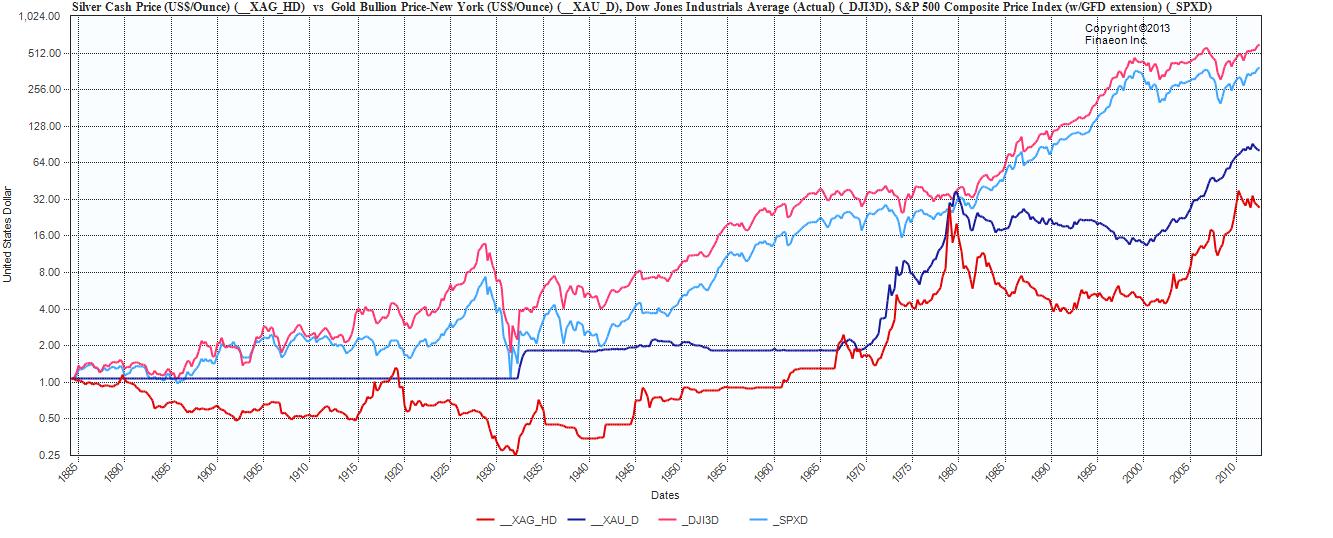
If I take one of my Morgan silver dollars, and melt it for the silver content I can get as of today roughly 8 gallons and a little more for that one silver dollar.
2 paper, fiat, federal reserve notes for 1 gallon OR 1 Morgan silver dollar for 8+ gallons.
The problem is the currency is worthless. And is inflated away each year to lose more and more value.
So IMO the problem is the currency. It's worthless and bankers are able to devalue it at will.
The use of a currency is as a medium of exchange, not necessarily as a store of value long-term. Yeah, you would want it reasonable stable in the short-term, but if holding cash is a bad investment, that doesn't mean that anything is wrong. It just means that hoarding cash is not a useful way to save.
Which isn't a bad thing for the economy. It is better for it if a person of means lends the money to the government or the private sector, or buys equities or other investments.
You can get a large loan denominated in US dollars at a low interest rate. You can exchange the value provided by the loan for things like cars and houses.
Those things contradict It's worthless and bankers are able to devalue it at will.
A decent starting point is any of the threads on /r/badeconomics about the gold standard:
https://www.reddit.com/r/badeconomics/comments/4y6zgn/gold_s...
What am I, the average Joe, going to do with a few ounces of silver though? A few scraps of paper or a handful of metal, both seem pretty equally useless.
Food, medicine, clothes, transportation... Now those are far more inherently useful to a human. Not great mediums for a standard of exchange, however.
It'd make the difference between life and death for many Venezuelans right now.
This is such a wildly unpopular notion, and yet I've never heard a reasonably articulated counterargument.
It's like people who understand supply and demand short-circuit when they think that the same laws don't apply to money too.
I think such people just aren't paying attention.
Everyone who understands American economic policy knows that the currency is being slowly devalued on purpose. This is not a conspiracy theory, it is common knowledge. The inflation target is always greater than 0. This is in part because of the perceived risks of deflation -- better to be on one side of the line than the other -- but also, generally, the point is to encourage people to spend or invest rather than passively save, because spending and investment grow the economy.
To a libertarian this is one of the most oppressive things about the way the government works currently ... it forces everyone to work more than they would ideally have to, in a sense. (But I say "in a sense" because if the economy were at a much less active level as "normal" maybe everyone would have lower quality of life. I don't know.) If you ever wondered why Ron Paul dislikes the Fed so much, well, it's because of reasons like this.
> To a libertarian this is one of the most oppressive things about the way the government works currently ... it forces everyone to work more than they would ideally have to, in a sense.
This part I don't get. It is generally straightforward to invest one's fiat currency in a very secure (and privately run in a nicely capitalist way!) instrument that has positive real interest rate.
The worst thing for me is that inflation is an implicit wealth tax, because governments don't account for inflation when charging capital gains tax. So if inflation is 3%, you have $10000 which increases in value to $10300, then you pay capital gains tax on that $300, reducing the real value of your holdings.
Why are you investing in things with a 0℅ return then?
If you're part of society you're ideally using labor and resources from other specialists such as farmers and miners who need some reason to move dirt around to make your life better. If you have money then you put that to work helping those people be more efficient, and maybe spawn other kinds of specialists like web developers.
If however you'd rather not be a part of this society, then you're free to opt out. But then you don't get the benefits of "being on the team" and now either your standard of living goes down (I.e. homelessness) or you have to work super hard (I.e. living off grid in some remote area).
It doesn't matter what the return is; if the nominal rate of return is 5% and inflation is 3%, and $10000 increases to $10500, I'm still paying capital gains on $500, when in fact $300 of that is just inflation and the real gains are only $200. The key issue is that capital gains tax applies to nominal rather than real returns.
"a 0℅ return"
I've seen ℅ used a couple of times recently where I would have used %. Is there a connotation or other difference in meaning implied by ℅ (care of) instead of % (percent)?
They're fairly close together and easy to mistake for each other when typing fast on an Android keyboard. I certainly meant to write percent (%), and probably others too. In fact I just learned there was even a "care of" symbol.
Ah! Thanks for clarifying!
Another problem we find with it is that it distorts the market. I.e. The example you mentioned about financial instruments. People are "herded" or "coerced" into investing their currency/capital into such things. They simply have no other choice but to try beat the inflation that causes their capital to deflate.
And on every corner, people that accumulate wealth are vilified (see talk of inequality, and progressive taxation). If we can't accumulate wealth and pass it off to better the lives of our own offspring, then we're nothing more than insects that live, work, and eventually disappear into nothingness.
Wouldn't those instruments (I'm assuming stocks/retirement, I'm not an economic smart guy) be implicitly tied to everyone else doing more work then they "have to"? That's exactly economic growth, just reworded.
Everyone is doing more than they "have to" (that is not well-defined) because they want to. Let them do that.
There's limited evidence that demand for currency is really related to the underlying material it is printed on. In fact, that has been a staple of our economy since we adopted fiat currency. It is not perfect to have fiat currency, but currency value is more about aggregate demand for goods and the functional circulation of the existing money. (See velocity theory of money). Remember also that the laws of supply and demand are not necessarily rational, and they effect the value of gold just as much as the value of paper money. (Gold is not inherently valuable)
The demand for money is greater than the supply of precious metals so we don't use precious metals as our only money.
Does this wildly unpopular notion have any predictive power? For example, can you make a prediction about US inflation over the next 50 years?
Usually people don't understand the dangers of private banks owning a fiat paper currency they can print at will.
Until I pull out a silver quarter or silver dollar and prove to them how much the private federal reserve has devalued their money.
Then it's like, "Oh. Wow. You're right."
A Morgan dollar is worth $15 for its material and possibly more for its collectible value, what is the problem here? Every dollar invested in 1900 would still have yielded a better return than $15, i.e. burying silver in the ground.
The real issue with a currency based on precious metal is that the reverse grows at such a rate much slower (<1% annually for gold IIRC) than economic growth. In a deflationary market, rational actors would simply remove money from circulation because it will just increase in value on its own, whilst the economy collapses.
…except people don't keep fiat currency underneath mattresses. They invest it, and better their economy for doing so.
So your old coin isn't competing against some ratty old dollar bill, it's competing against the real value of my index fund shares.
Which, by the way, are winning: http://ritholtz.com/wp-content/uploads/2013/04/fda.jpg
Just wait until he pulls that silver dollar out of his pocket. Then you will see.
People don't understand the risk of commodity investments until I show them a coin collectors red book from 1986, when that same Morgan dollar was worth $3-4.
Gold and silver is high because asians with money in places like China and India don't trust their governments. Period.
Reliance on gold and the resulting starvation of capital caused a lot of economic and social devastation 100-130 years ago.
"It's just like bitcoin in practice, except you have to use fire and steel to break it into smaller increments!"
Interestingly, a good pair of tinsnips is enough. It was a serious problem until Isaac Newton (of all people) came along.
Apologies that I can't find a better source right now: http://www.lsned.com/newton-invented-ridges-coins/
The Morgan dollar isn't unique in this regard.
If gas stations were willing to barter commodities for gas, you could also provide a pound of shelled walnuts or perhaps 8 oz of fine aged Parmesan cheese.
Why was a Morgan dollar worth a dollar? A: Because congress said so. Just as with paper currency, if the market value is higher, people will hoard it (like Eastern Bloc nations did with dollars back in the Cold War) and if it goes lower, people will discount it.
What makes you think slow, steady inflation matters so much?
You can typically keep your savings growing faster than inflation with relatively safe investments.
Can you? I don't see a relatively safe option to invest my money today that pays inflation + taxes associated with inflation.
In which country and what measure of inflation? in the UK an equity income fund can yield >4% and the first $13k capital gains are tax free.
Oh and indexed linked gilts are another option.
Government wouldn't inflate money supply if it didn't matter much.
In countries with strong central banks, the economy is mostly inflating and deflating itself. The central bank attempts to guide it towards a target. The observation that central banks find a low level inflation valuable stems from the fact that the target isn't zero.
One reason the target isn't zero is price stickiness. For instance: people react irrationally to drops in their wages, but, obviously, the price of an hour of labor can't be steady: it moves up and down just like anything else that can be bought or sold.
I think irrationally is a poorly-chosen word there.
More like, people don't behave as you would expect if wages were a purely economic transaction.
Sure! More broadly: humans are extremely loss-averse, and will go through contortions to avoid having things taken from them, and so some of what we do is just to work around that glitch in our thinking.
I don't want to over-sell "rationalism". But loss aversion is extremely powerful.
Oh so the central banks come into being from nothing, their existence and their powers have nothing to do with the government itself.
It's just a group of independent people who decided: We'd like to print some money. And Hyperinflation has nothing to do with government failure.
Only delusional people or people with an agenda would argue against there being any connection between inflation and the government.
Is something that can be manipulated by foreign governments and private interests and fluctuates heavily based on industrial demand really a better alternative? Since you mentioned silver specifically, it's worth noting that the entire world's supply of silver was nearly cornered by the Hunt brothers in the 1970's. Wonder what that would have done to inflation.
There is solid evidence that slow, steady inflation is beneficial to the economy. Besides the emotional appeal of "they're stealing my money!", the onus is on you to prove otherwise.
Quite frankly, I don't care much what random pseudoscientific Keynesians claim is good for "the economy". I care what is very obviously good for me, which is appreciating assets.
Isn't the appreciation of your assets related to the health of the economy?
Certainly, but there are two confounding factors.
First, even if the Keynesians are correct, for which I have low confidence, it is not clear that the small benefit to the economy of not having a government-supported stable or deflationary store of value outweighs the personal benefit to me of choosing to use a deflationary store of value anyway.
Second, even if it's slightly better for everyone to only hold money in inflationary assets, the Nash equilibrium is for everyone to choose to hold deflationary assets anyway, because any one person can defect and improve their own situation by choosing not to hold inflationary assets.
The government will try to maintain the (alleged) Pareto optimum by discouraging/outlawing the use of non-fiat assets for trade, which has the convenient side effect of (among other things) giving them the control necessary to implement negative interest rates and gradually get rid of hard cash, but that's a whole 'nother story.
The US grew from subsistance farming to superpower before the fiat money system, and had zero net inflation.
Is there evidence that this is because there was not a fiat money system? One could argue that the economy would have grown faster with fiat money and a small amount of inflation to further incentivize investment.
What it is is evidence that a fiat money system (and its associated inflation) is not necessary for excellent long term economic growth.
At the cost of very high volitity, which was increasingly more challenging as industry grew larger and more national in scope.
The current system moderated the boom bust cycle.
>The current system moderated the boom bust cycle.
Citation? From what I've read the great depression was a worse bust than anything that occurred during the 19th century, numerically speaking.
But you were on the gold standard then!
Sort of. I suspect much of the banking collapse in the 30's was due to the value of the dollar dropping in half since WW1, yet the exchange rate with gold stayed the same. Like all fixed conversion rates, there's an inevitable huge correction. That manifested itself in the bank runs of the 30s, which only stopped when FDR suspended gold exchange.
Milton Friedman compiled statistics in "Monetary History of the United States" showing that volatility increased under the Fed's management.
At the very least that doesn't seem true for inflation numbers
https://en.m.wikipedia.org/wiki/Economy_of_the_United_States...
And haven't we been experiencing the Great Moderation for 30 years?
Numbers before 1850 involve increasing amounts of guesswork, and are pretty unreliable before 1800. Anyhow, the periods of inflation there correspond to gold strikes.
I don't think the graph supports the notion that inflation was more stable after the 1800-1914 period.
(Inflation during the Revolutionary War and Civil War was high due to the government printing money like mad. It would be fair to not count those periods. In fact, the Constitutional prohibition on printing money came about as a reaction to the Revolutionary War inflation.)
We haven't had a financial panic since the 1930s. Events that would have led to such an event, like the 1987 crash or 2007/8 implosion would have triggered utter destruction pre-Fed.
The Fed was created in 1914. Nothing like the Great Depression happened prior. It's a little hard to argue based on the historical record that the Fed improved stability - as Friedman showed with data, it certainly did not improve stability in the small, and it obviously has not in the large.
Don't know why this is being downvoted - fiat currency is one of the root causes of problems like these.
Really? If you're going to downvote it I at least expect you to point out the flaw in my comment. It's a little hard to argue it's not factually accurate so I'd like to hear why you downvoted it.
This is not a refutation, but the rubric under which your idea would be scrutinized by mainstream economics: https://en.wikipedia.org/wiki/Neutrality_of_money
I'm not going to engage you because I don't even believe in mainstream economics. Shrug.