Microprocessors: 1971 to 1996 (2007)
computerhistory.orgThis diagram is also in poster form: http://tcm.computerhistory.org/Timeline/25YearsMicroprocesso...
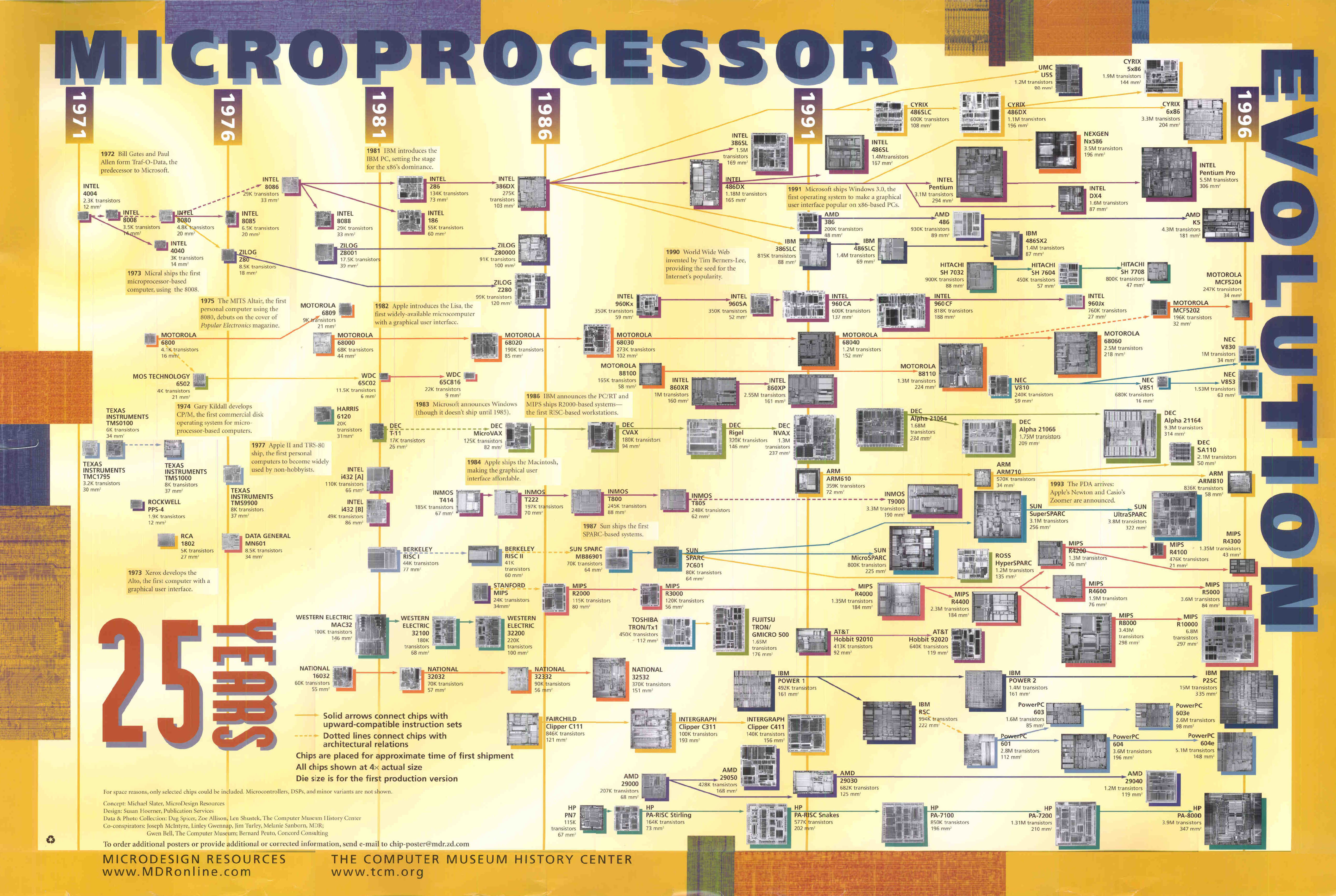
I would quibble about a few things. It shows an architectural relationship between the 4004 and 8008, which isn't the case. It shows the almost-unknown TMC 1795, but doesn't show its architectural relation with the 8008. It shows the TMS 0100 and TMS 1000 microcontrollers but not other microcontrollers. Lots of early microprocessors are omitted, giving the impression that not much was happening back then. The lack of ARM1 is disappointing; it shows ARM starting with ARM6. But overall a very interesting diagram.
Texas instruments had some CPUs on late 80's early 90's that was the core of TIGA graphics cards -> TMS34010
No Acorn ARM? (eg as used in Acorn Archimedes, 1987)
It turned out to be more important than any of these.
edit: ah they have the ARM, but not until 1991 for some reason.
When I visited the Computer History Museum in Mountain View, the complete absence of any mention of ARM in their history of microcontrollers was slightly amusing. Lots of Motorola, Intel, etc silicon (including some really nice exhibits of half-made silicon ingots), but no mention of the architecture which has sold over 50 billion units.
I asked at reception and apparently yes, they do get funding from Intel...
Do go visit, though; it's brilliant. Not quite as good as the National Museum of Computing in the UK, which will let you go and play with a lot of the exhibits, and which has a working decatron computer, but it's still well worth a trip.
It's not quite that bad; there's an ARM1 die photo opposite the silicon ingots at the museum. I think the lack of ARM there is more due to the interesting artifacts being in England than an Intel conspiracy.
You would never guess from this how successful ARM ended up being. Die size is going up and transistor size is going up. They aren't even in that race. It is a great example of a paradigm disruption.
Is “make a pretty generic RISC processor and license it” really “disruption”? ARM didn't do anything especially novel, they did one thing really well. They read the Berkley SPARC papers and made a simple CPU. It's the same thing as MIPS, i960, and Am29k. The difference being ARM's Acorn computer was rather unsuccessful so they licensed the ARM IP instead.
They were very much in a race with MIPS, Intel, and AMD. They won by doing the same thing everyone else did, but by doing it quite well.
Silicon Valley terminology is getting stupider by the day.
I view the ARM as a perfect example of disruption in the Innovator's Dilemma sense. Intel has always been pushing the boundaries of processor design, using as many transistors as possible, and nobody could threaten them with better technology.
The ARM1 on the other hand was built to be simple (because the designers hadn't built a processor before). They didn't care at all about maximizing density (the layout is pretty awful). They cared about low power consumption only to the degree it meant they could use cheaper packaging.
But this low-end ARM processor managed to hit the low-power needs of mobile devices (starting with the Newton). And now the ARM processor is a serious threat to Intel, not because ARM out-raced Intel at the more-transistors game, but because ARM was a simpler, cheaper product that disrupted the market.
I think 99% of the people who use the word "disruption" haven't read The Innovator's Dilemma (and they should), but to me the ARM clearly fits the pattern in the book.
>They won by doing the same thing everyone else did, but by doing it quite well.
I can't but find that pretty admirable.
Weird. I remember in 1988 that we had a Dell 286 that I rather thought was one of the fastest PC's around, and that the 386/486 etc., didn't show up on the street until well into the 90's.
We routed 6 layer PC cards on it ... all night.
"This exhibit sponsored by Intel Corp" ?