The rectangularness of countries
pappubahry.comFor people who like complex borders
https://www.google.be/maps/place/Baarle-Hertog/
This is a Belgian city enclave within the Netherlands with enclaves of the Netherlands within its borders
Wow. I feel like there should be a CGP Grey video about this. He has one about London vs the City of London and the weird US/Canada border.
Someone also tried to tell me Norwood, Ohio is the largest city within a city (an enclave city), but I can't find a source on that anywhere.
Really great video by Tom Scott about Baarle Hertog
The YouTube channel WonderWhy has a video (https://www.youtube.com/watch?v=gtLxZiiuaXs) on complex international borders wrt enclaves and exclaves.
Theres also this place https://en.wikipedia.org/wiki/Hans_Island which is disputed by Canada and Denmark. Apparently the Danes leave a bottle of schnapps for the Canadians and the Canadians leave a bottle of Canadian Club and a note saying welcome to Canada.
Grey did make a brief video about countries within countries in his Bizzare Borders videos [1] which might interest you.
What's weird about US/Canada? I thought it was pretty straightforward. Was this about the "Angle" on Lake of the Woods?
https://www.youtube.com/watch?v=qMkYlIA7mgw
The border is defined as a straight line, but was surveyed as a series of slightly wobbly series of lines. They put up thousands of stone pillars, cut out a strip of trees along the border, and it became official.
IIRC there's also some stuff about a disputed island
There's the exclave Point Roberts, Washington (http://ngm.nationalgeographic.com/ngm/0408/feature7/), which falls ever so slightly south of the 49th parallel.
I once visited Port Roberts just to see the border crossing. I drove in from the Canadian side, parked my car, and walked across the border into the U.S. without being challenged. No one asked for my passport. As far as I could tell, no one even noticed that I had crossed the border. But when I tried to walk back into Canada the Canadians gave me a pretty hard time and almost didn't let me back in. It was an interesting experience.
I've visited there too. Drove in both directions, seemed like not a big deal.
I heard that kids there go to school in Blaine, which means 4 international border crossings every day!
I do not know what is considered weird, but here are some interesting things about the US/Canada border:
https://youtu.be/SxhUsPBFPkU?t=1m46s (Geography Now! Canada - btw awesome channel for people who like geography)
Newark is completely surrounded by Fremont (California) and has over 40,000 residents and is over 13 square miles in area, so if it's not the largest, it's at least near the top.
If we discount natural borders like the Pacific Ocean, Santa Monica borders only Los Angeles and has twice as many residents.
Los Angeles has very strange borders. West Hollywood and Beverly Hills are independent enclaves, and it has an odd tendril stretching down to Long Beach. I remember being delighted when Google Maps started outlining city borders - I had always wondered exactly what LA's looked like.
Another fun one is San Diego, which does indeed touch Mexico, but to get from downtown to the border and stay within city limits you'll have to get on a boat and stay within a narrow band of water stretching down the bay to San Ysidro.
See:
https://www.sandiego.gov/sites/default/files/legacy//plannin...
The City of Los Angeles has a really interesting shape:
https://www.google.com/maps/place/Los+Angeles,+CA/@34.091182...
Not far from Fremont, Piedmont is completely surrounded by Oakland. 1.6 square miles, 10k residents.
I think he did one about enclaves and exclaves.
Until this past year, the India/Bangladesh border was similar - there was even a triple-deep enclave (india inside bangladesh inside india inside bangladesh... I think...). They just recently did a land swap to make the border more sane, and also easier on the inhabitants, who didn't have freedom of movement between the parts.
Yes, that third-order enclave was Dahala Khagrabari (#51): https://en.wikipedia.org/wiki/Dahala_Khagrabari
It really brings to mind "City and the City".
https://www.amazon.com/City-Random-House-Readers-Circle/dp/0...
Indeed, China Mieville has spoken about it as an influence when writing The City and The City.
Really great book! Really one of the most interesting thing to come out in the past few years.
From Wikipedia:
Some houses in the town of Baarle-Hertog/Baarle-Nassau are divided between the two countries. At one time, according to Dutch laws restaurants had to close earlier. For some restaurants on the border this simply meant that the customers had to move to a table on the Belgian side.
The border goes through some houses as well, and the country you're in is deemed as which side of the border your front door is on. Apparently there has been a house or two that moved their front door across the border, in order to benefit from lower taxes or somesuch.
There are many such enclaves between India and Bangladesh.
http://www.economist.com/blogs/banyan/2011/02/enclaves_betwe...
A lot of them are recently sorted out by the governments, by exchanging land.
Our frontiers are sometimes a bit fuzzy to say the last [0] and there is also this place [1] where you can literally be in 3 countries at the same times
[0] http://www.dailymail.co.uk/news/article-3378842/Belgium-Neth...
The second one is not all that interesting, as any country that borders more than 1 other country would have a point like that ;)
Belgium should have 3
Not necessarily - If you have a body of water on the top and the bottom, and two different countries on each side, then there's no spot you can be in 3 countries at once. See: America
Now that's just unnecessary.
I want to go to there.
It's a good metric, but I do feel there's something slightly different being said in human terms when we say a country is "rectangular." Turkey seems to have sharper, closer to 90 degree angles than other countries that may overlap a rectangle more.
I suspect what's really going on, psychologically, is that Turkey looks much more like a rectangle than it does any other basic shape: I would never described Macedonia as rectangular, despite its considerable overlap, because it's "oval." Kenya's a pentagon before it's anything else, and so on.
right. Côte d'Ivoire in particular has a very high score while "looking" nothing like a rectangle
I'm surprised Portugal didn't score higher. One day in the car I randomly asked myself the same question of "which country is the most rectangular", and Portugal was the first one I thought of. Is it because the Azores were included? Would like to see the rank if they had only the mainland.
My exact thought. But I'm Portuguese, so I'm biased.
Campeões!! Campeões!! Nós somos campeões!!
Polandball comics have been on the Portugal-is-a-rectangle trail for a while now:
https://www.reddit.com/r/polandball/comments/300b86/portugal...
Including Azores definitely affected the final result. It's weird that other countries didn't have their islands include though
Others are also affected by islands and territories, see France with French Guyana etc, Norway with Svalbard etc. France is quite a square country if you only consider its mainland so it is an odd choice to include non mainland areas but I guess it is a difficult greyzone on what to include and not.
The French themselves refer to metropolitan France as l'Hexagone so it probably still would not be a square.
Somehow I was thinking about France with French Guyana but must have passed it.
As some have said, I'd like to check the impact of only using mainland in the calculations.
I'd say France is far more a pentagon than a rectangle.
One must not forget Madeira islands either
509 Bandwidth Limit Exceeded
Here's an archived copy: https://archive.is/cRkgb
I was kind of disappointed that this post isn't about artificial borders that look like straight latitudinal or longitudinal lines.
Those kinds of borders are quite common and I've always thought they say a lot about a country and its past.
What do they say?
Long, straight lines for borders usually imply that the territory through which they are drawn was neither well explored nor terribly important to the people drawing them. Sometimes that's because the territory is mostly uninhabited and nobody really has a strong claim to want their particular patch of land to be on one side or the other, but frequently its because the mapmakers either don't know or don't care about the cultural affinities and loyalties of the people who live on or near the proposed border.
This is one of the main reasons why a lot of central Africa is a shit show politically. Most of the modern borders were drawn during the colonial era without much consideration as to which tribes and city-states ended up in which countries, so there's not a strong relationship between "nations" (i.e. culturally similar groups of people) and "countries" (i.e. demarcated stretches of land) like there is in most of the rest of the world.
Exactly. Assuming that countries are united on the basis of some common characteristic (language/culture), the likelihood of this unity following a particular longitude or latitude (both European creations) with such mathematical precision is quite small. Straight borders are not exactly prevalent in Central Africa but the existing borders do not make sense in the slightest, and the dysfunction you see is largely a legacy of European meddling in the region.
Speaking of West Africa, you don't really have to think hard to figure out why Gambia's borders were drawn the way they were.
To add a bit more, if you zoom a bit, there almost always will be some weird straight lines throughout the borders of a country. There are many towns in Turkey, for example, half of which went to Syria. I guess because no one from the people who came up with the borders knew the town was there and/or cared enough. There is even a Turkish movie about this: http://www.imdb.com/title/tt0216986/
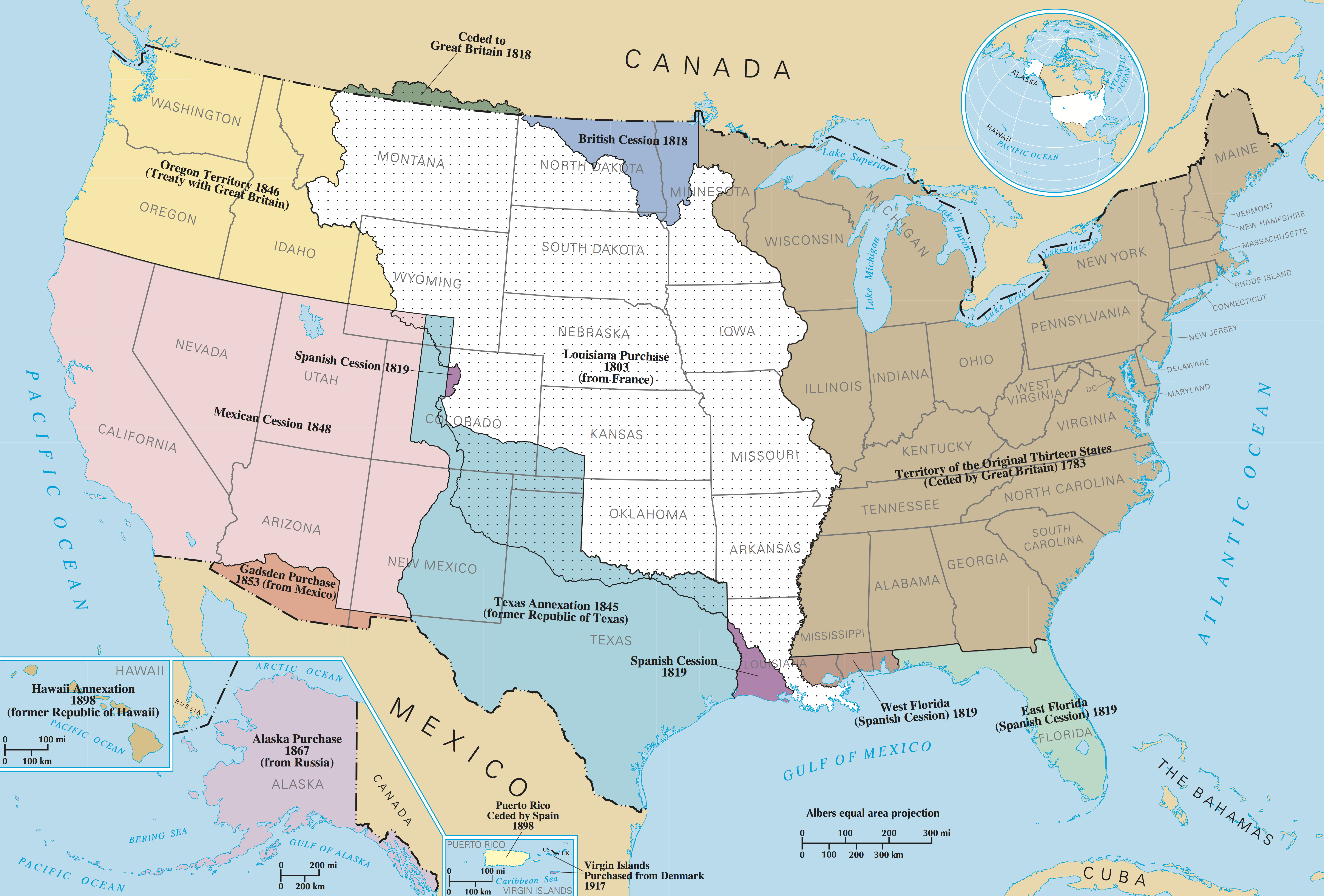
The border between Canada and the US, the longest international land border on Earth, is very rectangular, consisting largely of the lines 49 degrees north latitude and 141 degrees west longitude.
It is very likely that those drawing the border did not care one little bit about the opinions of those who already lived there, and it was definitely unexplored by them.
How does this reasoning apply to the US-Canada border?
It applies perfectly. The 49° N section of the border was set in the Treaty of 1818 [1], at which point all affected regions were still populated by native americans.
You can see on this territorial expansion map [2] of the United States, how the lay of the border differs between the first-settled east and the later-settled west.
[1] https://en.wikipedia.org/wiki/Treaty_of_1818
[2] https://upload.wikimedia.org/wikipedia/commons/2/29/UnitedSt...
Another good one is Bir Tawil, a piece of land that no country wants:
https://www.theguardian.com/world/2016/mar/03/welcome-to-the... https://www.youtube.com/watch?v=J5iJSXaVvao
Natural or artificial borders, rough date of creation of the border (straighter -> more recent).
Someone drew them on a map with a ruler, often from a great distance, I assume.
Mostly that there was a conflict (possibly merely political rather than military) that was settled by people who didn't live near the disputed border.
Not necessarily. For example, these borders exist more often in deserts, for instance (see Sahara and Arizona for instance).
Arizona's not a country, so not quite germane (unless you are talking about its southern border, which is clearly an example of the effect suggested.)
In the case of the borders among countries in the Sahara, my understanding is that lots of those were disputed borders settled by people pretty remote from the areas with the straight borders, so I'm not sure they provide a counterexample. "It's a desert" may increase the likelihood that decisions get made by people living far out of the region (since it reduces the number of people living close by), though.
Looking at this map (http://www.freeworldmaps.net/africa/africa-physical-map.jpg) I see that nearly all the stright-line borders in Africa are in deserts.
Dividing geography with existing populations and long histories into discrete countries is always going to produce tricky ethnic issues. It's just that in Europe those issues were worked out violently over a period of centuries up to and including the second world war. The process is so big, that people don't notice it.
I came across this post on the Berlin Conference years ago and the title has stayed with me:
http://everything2.com/title/Never+Trust+a+Straight+Line+on+...

The site has run out of bandwidth allocation, so I'm only guessing what the metric is from the comments here...
I'd like to see it compared with a "parallelogramness" measure, based on rotating calipers. Rectangularity would be a special case.
Neat!
To me, Egypt doesn't look very rectangular at all. The very deep concave section, and the sharp convex portion at the bottom right completely break rectangularity for me.
I'm also curious as to why Nauru seems to have such sharp, straight borders - it looks more like the Vatican than a Pacific island.
The measure is how much overlap there is with a rectangle of the same area, which means that a narrow but deep deviation is weighted the same as a shallow but long deviation along the border. I'd think that an intuitive notion of "rectangulareness" (rectanglosity? rectangularity?) would better match some sort of RMS measurement, where the penalty for a mismatch is proportional to the square of its distance from the ideal rectangle. It would be really interesting to see what changes with that sort of measurement.
Regarding Nauru, I think that's just poor resolution in the source data. It's only a couple of miles across, and the plot looks like it attempted to approximate the coastline with points roughly 1 mile (maybe 2km?) apart.
There's a couple of different scoring rules that would be interesting, I think.
Another one might be: What's the ratio between the area of the country and the smallest rectangle which bounds the country. This would "punish" countries with protuberances more than ones with "in-cuts", which "feels right" to me.
For some reason, your use of "'punish' countries" made me imagine a world where improving this score gets taken seriously by the peoples of the world, leading to countries gradually becoming more rectangular over time, and many terrible wars along the way.
Alternatively, an era of peace and cultural exchange as countries agree to swap territories to become more rectangular, leading to an influx of new immigrants to both countries and greater understanding that this cultural mixing brings.
But yeah, probably bloodshed and war.
This reminds me of Paradox's strategy games, where players routinely complain about "bordergore" and fight wars to make the map look neater...
That's great, never heard of that before. When I search for that term, the first hit is a Reddit thread where the first commenter expresses his desire to "drop-kick" people who do it. Strong emotions! Maybe we can create this world after all.
I wonder how many actual wars in the past have been started because someone didn't like how the border looked on a map. It has to be non-zero.
> I wonder how many actual wars in the past have been started because someone didn't like how the border looked on a map.
Plenty, though it's less about rectangular shapes per se but borders being drawn by former colonial forces with a ruler, splitting ethnic groups and forcing them to live under a new, foreign government. Under colonial rule every unrest was simply stopped by brute force, after "liberation" and division of countries according to some arbitrary border created by drawing a line along a ruler on the map there was no "moderating" force anymore and ethnicities that had ignored/evaded each other for centuries were forcibly mixed and the former colonial force usually decided who was the new government, based on their interest. A great example is Western Sahara:
Spain left and decided "this part goes to Mauritania, this part goes to Morocco". The Sahawri managed to beat the Mauritanian forces and to claim some land, then Morocco "invaded" (in quotes because Moroccans fought the Spanish in the 50s from as far south as Aoussard). Also, officially the border between Morocco and Algeria is closed because of Algerian support for the Sahawri. But in the north of Morocco, in the Rif area, people feel more connected to the Rif than to Morocco and cultural exchange with the Algerian Rif people is much more vibrant than cultural exchange with the south of Morocco.
Well, even the Paradox players (who can get up to some pretty horrifying things when the game incentivizes them suitably) realize that fighting over bordergore is a little bit silly... :)
That measure (call it boxability) is a bit harsh, though. The US shouldn't have to pay that much for Hawaii.
RMS is a good idea. Maybe you would need an additional penalty for deviations near the corners, to prevent rounded countries from out-scoring those with wavy/angled but straight borders?
It's also good to realize that countries do not lie on a plane, and the edges of the rectangles should be great circle arcs.
Yes, I suspect there may be Euclidean geometry underlying all of this.
Does this depend on the map projection used?
No.. what I'm trying to say is that you shouldn't use a map projection, but rather picture countries painted on the surface of a sphere. Then the border of a country is represented using latitude/longitude coordinates, and straight lines are instead arcs of a great circle. The difference should usually be pretty small, but some countries cough China are big enough that it might matter.
If a measure of rectangularity depends on the map projection used, then it probably also depends on how you orient the coordinate system (e.g. where the North pole is), and is therefore not well defined.
Good catch, seems they're using low-resolution outlines for small countries like San Marino, Nauru, Vatican...
Actual outlines:
Nauru: https://upload.wikimedia.org/wikipedia/commons/7/77/Nauru_ma...
San Marino: https://upload.wikimedia.org/wikipedia/commons/7/7b/San_Mari...
Vatican: https://upload.wikimedia.org/wikipedia/commons/5/58/Vatican_...
Also Sint Maarten is the southern half of a small island
https://en.wikipedia.org/wiki/File:Sint_Maarten-CIA_WFB_Map....
I'm guessing low resolution in whatever dataset was used.


I wonder how many of those are due to pairs or rivers or mountain ranges that tend to lie parallel to each other, or to rivers that tend to be at right angles to a coastline?
this metric is kind of poor. What about something like the area ratio of the biggest inscribed rectangle to the smallest circumscribed rectangle that has edges parallel to the selected inscribed rectangle.
I like this metric better, although I'm wondering if the rectangles should be similar, not just having parallel edges. That should put Turkey and Portugal up at the top, if you remove the islands.
That measures nothing but outliers: consider that changing anything between the two rectangles would leave that metric unchanged.
It seems like it would be an excellent method if you could address the outlier issue though. One approach would be to relax the rectangles, so the outer one only has to circumscribe 95% of the country's area.
A similar approach is used in biology to define animal territories: A kernel density estimate is taken of historical animal positions and thresholded, rather than a minimum convex polygon.
These are not rectangles though. The projection has severly stretched many of the countries. Combined with the tilted angles, that should mean the corners of these "rectangles" aren't really 90°.
Site is currently down, please tell me they used locally fitted projections, not Mercator?
They used an equirectangular projection, because rectangles. But that means that some of these rotated rectangles are more like parallelograms when you look at them in another way.
Mercator actually would have been a good choice because it preserves local angles. Not sure why you'd be so opposed to it in this case. For this purpose, relative sizes don't matter at all.
And I don't think a local projection would clarify anything. Countries can get pretty big and non-local. If you strive for complete geometric accuracy on the scale of, say, Canada, the idea of a "rectangle" breaks down because there are no parallel lines on Earth, and four right angles don't bring you back to the orientation where you started.
I have a theory that newer borders more rectangular, whereas older borders follow natural wiggly features like rivers, similar to newer cities' roads being more rectangular, whereas older roads are more higgly-piggly organic.
The older ones grew; the newer were planned.
You can see it east-to-west in the USA states' borders.
I'm not sure this algorithm is the best fit for our natural intuition of a rectangular country.
I read somewhere that manmade boundaries can be clearly identified. They are mostly straight lines on maps. It makes more sense after reading this article. This is the reason why so many African countries have such sharp boundaries. Colony masters divided them amongst themselves, ignoring natural resource division, people and ethnicity of new countries. This has led to so many conflicts among these countries as well. I might be wrong, but I think this happened to middle-east as well.
Funny to see that France is only 134th while French refer to their country as "The Exagon" (metropolitan France) - 3 ground borders and 3 sea borders. The expression was coined in the 1860s by school reformists and got popular after the Franco-German War in 1870 when Alsace was lost. To my knowledge French are the only ones to define their country with a geometrical form
Portuguese people also generally see our country as a rectangle too. And no, the islands don't count.
You mean xkcd hasn't covered this already?
Wow, what's going on with the Netherlands
The Netherlands have two islands in the Caribbean that is technically no different than any other "county" of the Netherlands.
It looks like a similar thing happened with the USA, except worse because whatever Pacific territories it included got attached to the east side, making it take the long way around.
Aleutian islands wrapping around? Marshal islands?
Ah yes, I believe it is the Aleutians. It's hard to really see it well, but it looks like the blob on the right side is at the same latitude as the end of the chain on the left side. I assume the "edge of the world" for this purpose was the 180th meridian, which would leave some of them on the "wrong side."
Looking again, I see that Russia and Fiji also suffer from this problem, and those are the other two countries divided by that line.
which are these? as far as I understood (I lived in Sint Maarten for a couple of years once) the Netherlands Antilles are colonies only, unlike the French islands (Martinique and Guadeloupe mainly, but St Barts and St Martin too) which are overseas departments of France, and also considered part of EU.
The kingdom of the Netherlands consists of 4 countries: Aruba, Curaçao, St Maarten, and the Netherlands.
In name, they are each other's equal within the kingdom, but there is a 'slight' difference in size.
Also, 3 other islands in the Caribean are part of the Netherlands, the country: Bonaire, St Eustatius and Saba (but, if I have to believe Wikipedia, those 3 are not in the euro zone; the US dollar is legal tender in (part of) the country of the Netherlands)
(https://en.m.wikipedia.org/wiki/Kingdom_of_the_Netherlands)
The French have more overseas areas, and manage to make things complicated, too, with overseas departments, countries, territories, and collectives (https://en.wikipedia.org/wiki/Overseas_departments_and_terri...)
Not to be (too) pedantic about it, but
St Barts and St Martin are not overseas departments of France. They used to be part of the Guadeloupe overseas department, but seceded to be a "collectivite d'outremer" (overseas collectivity), which is different status than overseas department or overseas territory (France also has a few of those). St Barts (really "Saint Barthelemy") and St Martin not collect income tax locally and it goes to their budget (I think they wanted to stop shipping all their monies to the French state and/or Guadeloupe).
I was a little of, there's three: https://en.wikipedia.org/wiki/Caribbean_Netherlands (Bonaire, Sint Eustatius, and Saba)
GPG grey dedicated a __great__ 3"59 video on this subject
Colonies
The site is out of bandwidth, so this might help: http://webcache.googleusercontent.com/search?q=cache:http://...
Something doesn't seem right about this algorithm you used to draw the rectangles. If you used a similar algorithm to define circles, I feel like you would get a artificially high amount of circularness for countries that are not that circular.
Or probably just any kind of polygon from triangle to whatever you choose to find. The common property is probably rather convex shape than rectangularness or anything arbitrary like that. Maybe because convex borders are easier to protect or less threatening to neighbors or something like that?
Would be nice to apply this to gerrymandered congressional districts.
Huh, the US is 169 out of 208. I would've guessed it at a good bit higher but I forgot Hawaii and (especially) Alaska are kinda hanging out there screwing up the ideal rectangle.
The metric used doesn't really knock us for Hawaii though, because it's so small.
Yeah, I'm interested in how just the Continental US would rank.
Correlate with economic development!
There's a fair amount of research in economic history on almost exactly this topic. Two recent papers http://www.nber.org/papers/w12328.pdf and https://drive.google.com/file/d/0B4s_WKe-US99LV9XVTNVNzFxYW8... have looked at how measures of the artificial-ness of borders (how straight they are, how often they cut through the territory of ethnic groups, ratio of a country's area to the area of its convex hull) are correlated with various measures of welfare (e.g. GDP/capita, lack of conflict). The papers are often controversial because they often claim something approaching causality (see recent Twitter war https://twitter.com/bill_easterly/status/753252113510268928).
Who are these people discussing on Twitter? Are they the researchers who publish papers on the topic? (I do not mean these same papers you linked to, just asking if they are serious academics.)
Easterly is an economist at NYU (who published one of the earliest papers on the subject), I'm not sure about the others. However the discussion is a good representation of some of the debate that's gone on regarding interpreting correlations between regular-ness of borders and GDP (i.e. is it that having artificial borders was disruptive, or was it that borders were drawn artificially in areas that had fundamental characteristics which have caused them to have lower GDP today).
I've just checked with Gini and GDP per capita. No correlations :/
I wonder if the overall rectangularness of the African countries is evidence of a bias for retangualarness by the map making colonial powers.
Egypt and Equatorial Guinea are clearly on latitude/longitude lines, but the rest look pretty random. I am actually surprised that it's as nonlinear as it is - go take a look at a map of Africa, not much is actually rectangular! There are a lot of straight lines (which would be another interesting metric to study-the countries most closely bounded by an irregular polygon) in several interior borders on the Sahara, as well as Namibia and its neighbors. But none except Equatorial Guinea are really rectangular.
The state borders, on the other hand, are often quadrilaterals. Perfect scores to Wyoming and Colorado, and near-perfect for many others.
Colorado wins
Fun fact: Colorado isn't a perfect rectangle (besides the lines of longitude converging). It's legally defined as straight lines between certain points that surveyors tried to make straight, but didn't get it exactly right. For example, see this part of the western border: https://goo.gl/maps/BKgwJ4bMfjF2
http://geology.utah.gov/map-pub/survey-notes/glad-you-asked/...
Another kink in the souther border: https://www.google.com/maps/@36.988568,-106.87603,12z
Credit to this blog: http://www.howderfamily.com/blog/colorado-not-rectangle/
Another example is Saskatchewan, Canada. Like Colorado, its borders, on all four sides, are defined by latitudes and longitudes.
Saskatchewan actually has an unusual border on its east with Manitoba, in which a series of north-running meridians are interrupted by west-running jogs. This newspaper piece [1] reflects on the story behind this boundary.
[1] http://www.theglobeandmail.com/opinion/why-the-zigzag-betwee...
But the curvature of the Earth means Colorado is closer to a rectangle :)
My hypothesis is that New York is the best-shaped state because it's not too rectangular, and not to squiggly. Got a good balance of both.
169/208?
Reagan would never have let this happen. #makeamericarectangularagain
I wonder how similar the result would have been with this metric:
Score = area of the symmetric difference between country and the rectangle maximizing the score.
Eq. Guinea at #18 looks wrong...the rectangle seems too large. It is pretty rectangular, about as much as Egypt to my eye...
It's interesting to judge conflicts based on this ranking as well. Check out #55 (Palestine) and #175 (Israel)
What's wrong with New Zealand?
Longitude overflow.
Dead already :\ hn effect in work
The UK map, unlike France or Spain, doesn't include the oversea territories.
What's wrong with New Zealand? Looks even tinier than usual in Safari on iOS.
Love to see a world map tessalated this way!