Nibbler 4 Bit CPU
bigmessowires.comNibbler also lacks any address registers, which means it can’t support any form of indirect addressing, nor a hardware-controlled stack. All memory references must use absolute addresses.
Wow!
The Nibbler is pretty cool. Lacking indirect addressing and a stack isn't that strange. The IBM 1401 mainframe (1959) for instance doesn't have indirect addressing or a stack. [] Self-modifying code was used to get around this. E.g. you store the return address into a jump instruction at the end of the subroutine. However, the big difference with Nibbler is it's not a von Neumann architecture, so you can't modify the code.
[] Indirect addressing was an optional feature on the IBM 1401 for an additional monthly fee.
On the topic of processors made from 74xx TTL, I'll point out the Datapoint 2200 desktop computer. This had a board of TTL chips equivalent to the 8008 microprocessor. The 8008 was actually designed to replace this TTL-based processor. Trivia: the x86 is little-endian because when building a serial computer from TTL it's easier to use little-endian. https://en.wikipedia.org/wiki/Datapoint_2200
The Nibbler is different from the PDP, Datapoint, etc in that the Nibbler has very, very few chips; almost all the logic is done in microcode. This is the same trick used to build a "single-chip" processor from the Four Phase AL1. https://en.wikipedia.org/wiki/Four-Phase_Systems
Yes, it is a very limited design, but the thought, that it was implemented just using (very few!) standard 74xxx TTL logic is really amazing.
And still it runs with 1MHz, the same speed of my first computer ;) with a dedicated integrated CPU.
It's implemented using a few standard 74xxx TTL logic chips and a 256x16 microcode ROM. It's important not to ignore the microcode ROM because that's where all the smarts that turn it from an ALU unit and a bunch of registers and miscellaneous logic into a CPU that can actually execute instructions. All of the instruction decoding and the sequencing of all the operations that make up a CPU cycle is done directly by the microcode ROM.
That is right. That differs of course from early microprocessor designs, but still it is valid, since today's processors also rely heavily on microcode that is simply stored in ROM or similar areas.
I think, you can not give this design a negative, because it is much simpler than early microprocessors.
I forgot about the ROM, and apologize for it.
Two 16 KiB ROMs, actually.
(Meanwhile, current Intel processors have 2 MiB microcode files.)
to be fair, that's 2 MiB code that is the base of the other os you never heard of, the IME, AMT and their backdoor capabilities [1]
1: https://fsf.org/blogs/community/active-management-technology
No, that's just the CPU µcode. IME/AMT are part of the BIOS/EFI images, which is a whopping 16 MiB for my current motherboard.
The current CPU microcode download appears to be 0.81 MB compressed for every single Intel CPU since the Pentium 4.
You know, lights out management is a wonderful thing and there's never been any kind of evidence that these features do anything but offer functionality that Intel's customers asked for.
The ROM is basically acting as an FPGA. After all, an FPGA is just a load of units of small ROM areas, with the inputs and outputs linked to each other. If all you need to implement your circuit is a single unit, then a small ROM chip is quite sufficient instead.
> The ROM is basically acting as an FPGA.
No, it doesn't; neither from a practical, nor from a theoretical point of view. Theoretically, ROMs are equivalent to the class of pure, total, mathematical functions (i.e., each input value maps to exactly one output value), while FPGAs are equivalent to the class of deterministic finite automata, because they contain internal state.
> After all, an FPGA is just a load of units of small ROM areas, with the inputs and outputs linked to each other.
You're forgetting the memory elements – they're crucial to the functionality of FPGAs.
> You're forgetting the memory elements – they're crucial to the functionality of FPGAs.
I'd argue that an even more critical feature of FPGAs is configurable routing. ROMs don't have that either. :)
True. But then again, that's like arguing over which organ is more important – the heart or the lung – when you can't survive without either of them ;-)
You can build memory elements - inefficiently, but it's possible - out of recurrent logic. You can't build routing.
Actually, now I wonder whether it'd be possible to build memory out of ROM by looping outputs back to inputs...
> You can't build routing.
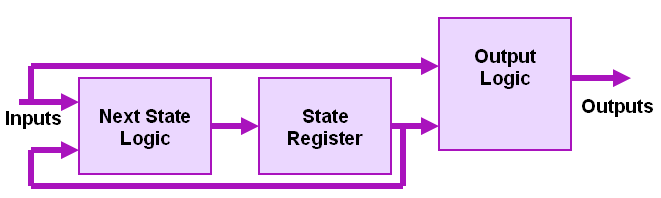
You actually don't need configurable (programmable) routing: We can model every synchronous circuit as a Mealy machine [1], therefore we need two functions and a register. Every function can be constructed from a hierarchy of programmable, fixed-size LUTs which are statically connected (for example, you can build a 5-input LUT from three 4-input LUTs). Now you don't need to build routing, it's implicit in the next-state and output functions.
[1] like this: http://electrosofts.com/verilog/mealy.gif
I have a 12 bit CPU at home that is implemented out of standard 74xxx TTL chips, its called a PDP-8/e :-). Not to take away from the Nibbler design, its great, but using TTL logic to build CPUs was a thing for a pretty long period of time (computer wise), probably 10 years from 1971 - 1981. 1981 was the year IBM introduced the IBM PC and a lot of people realized that bespoke CPU architectures were a luxury they could no longer afford.
Of course the technique itself is not that new, but it is still amazing, because of the real few chips used. Of course the microcode ROM replaces plenty of those, but still it amazes me, how few chips make up for a workable CPU.
I guess, the PDP has at least 10 times more (equivalent) chips inside.
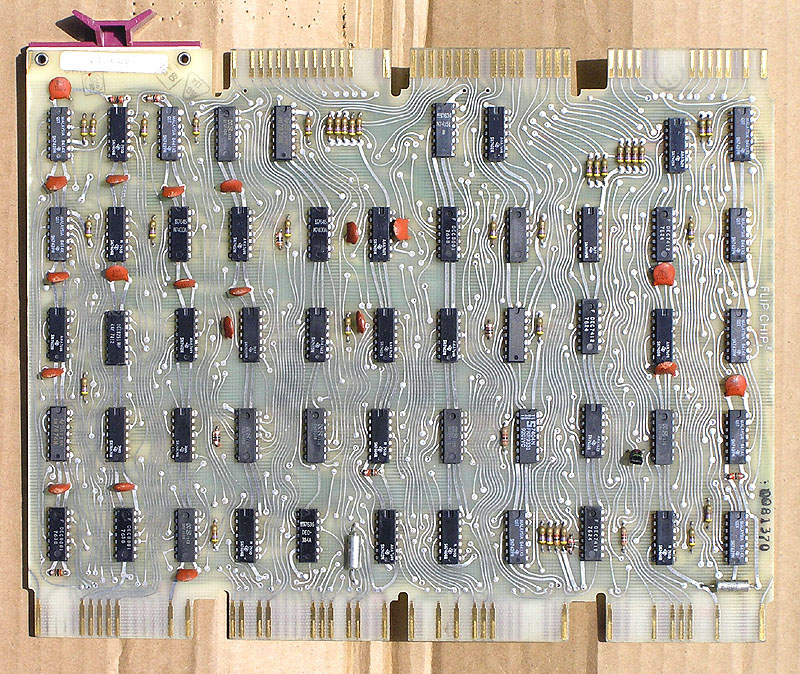
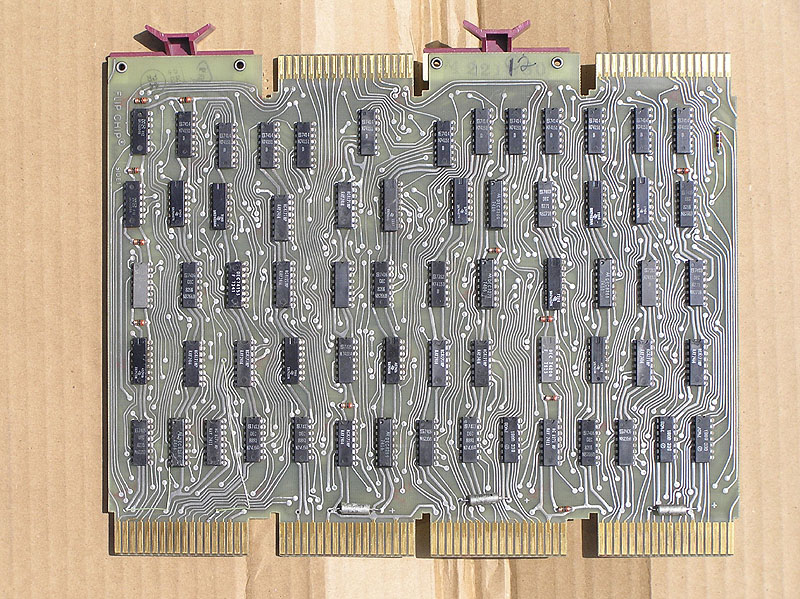
You know, I've never actually counted them although we can estimate them from pictures on the web
M8310 - 53 chips (http://www.classiccmp.org/hp/My%20PDP-8%20Cards/M8310.jpg)
M8300 - 64 chips (http://www.classiccmp.org/hp/My%20PDP-8%20Cards/M8300.jpg)
So 117 chips, so not quite 10X but the nibbler does have an LCD display and if you add the PDP-8/e programmer console to the mix you're probably close to 170 chips. So great estimate!